 by Tom Gurney
Tom Gurney BSc (Hons) is an art history expert with over 20 years experience
Published on August 14, 2026 / Updated on August 14, 2026
Email: tomgurney1@gmail.com / Phone: +44 7429 011000
Introduction
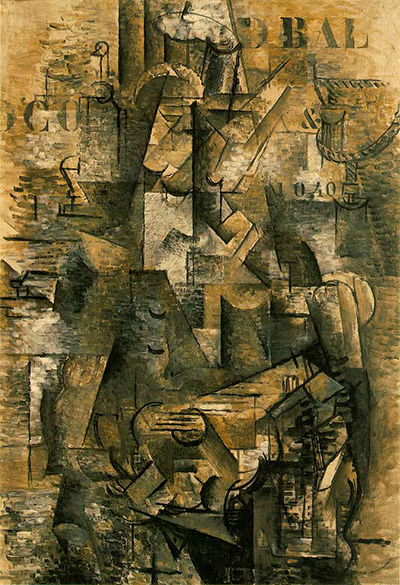
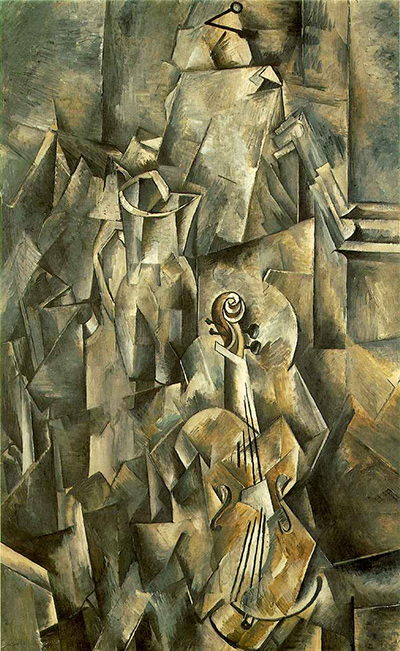
A small painted nail appears at the upper edge of Pitcher and Violin. Its head, shaft and apparent shadow offer a compact illusion of something projecting from the canvas. Beneath it, violin and pitcher emerge by a very different means. Scroll, pegs, strings, lip and handle survive as scattered clues inside a field of shifting planes. The nail seems spatially decisive; the still life keeps changing its relation to depth.
Braque places these two systems of representation on one surface. Traditional trompe l'oeil gives the nail an immediate, familiar presence. Cubist fragmentation requires the other objects to be assembled gradually. Yet the nail is paint too, and its frontal clarity can make the canvas feel more wall-like at the same moment that it seems to project toward the viewer. The painting turns illusion into a double action: depth appears, and awareness of the flat support returns.
At a Glance
- ArtistGeorges Braque[1]
- TitlePitcher and Violin (Broc et violon)[1]
- Date1909/1910[1]
- MediumOil on canvas[1]
- Dimensions116.8 × 73.2 cm[1]
- CollectionKunstmuseum Basel inventory 2285[1]
- SignificanceGuide readers through the Basel work's multiple viewpoints, hanging nail, pitcher and violin
Contents
- Introduction
- The Basel painting and its titles
- Reconstructing the violin from signs
- Finding the pitcher through lip and handle
- Relief made from light, dark and apparent emptiness
- The nail and its painted shadow
- Three ways to represent one world
The Basel painting and its titles
Kunstmuseum Basel catalogues the work as Broc et violon, with the German title Krug und Violine and the English Pitcher and Violin. Braque painted the oil-on-canvas still life in 1909/1910. It measures 116.8 × 73.2 centimetres and carries the inventory number 2285. A “Braque” signature is recorded on the reverse at lower left. Dr h.c. Raoul La Roche gave the canvas to the museum in 1952.[1]
The three titles describe the same pairing. Broc, Krug, pitcher and jug all point toward the vessel whose form has become uncertain; violon and violin name the musical instrument recovered through more numerous clues. Their order matters less to the painting than their differing degrees of legibility. The violin offers several compact signs. The pitcher depends heavily on two surviving features.
Kunstmuseum Basel situates the canvas at a high point in Braque's late-1909 experiments pairing domestic vessels with musical instruments.[1] John Elderfield's 1976 Museum of Modern Art catalogue placed it within a winter-1909/10 group, called it the largest member and proposed that it was probably the latest.[3] These are attributed judgements about development and complexity. The current 1909/1910 date leaves the precise sequence open.
Its scale contributes to the painting's ambition. The vertical canvas provides room for a small illusionistic device above and a broad network of object fragments below. Yet size never produces a conventional interior. The composition remains compressed, its forms gathered close to the painted surface even as local passages suggest relief.
Reconstructing the violin from signs
Seraina Werthemann's Kunstmuseum Basel analysis begins with the violin's most secure details. Its scroll and tuning pegs remain recognisable near the centre. The strings are interrupted and kinked, and the F-holes help establish the instrument even though its body can no longer be reconstructed precisely.[2] Recognition proceeds from concentrated signs toward an unstable whole.
The scroll carries the memory of a distinctive terminal shape. Pegs indicate the practical structure of tuning. Strings establish length and direction, then lose continuity as they meet the surrounding facets. F-holes locate the resonant body in principle, while the body's outer edge dissolves. Each clue identifies a function or part; their combination never settles into one intact silhouette.
This hierarchy gives the eye a sequence. Scroll and pegs can be named quickly. Interrupted strings encourage movement through the field. F-holes bring attention back toward an implied body. The surrounding geometric areas then absorb that body before it becomes fully coherent. The violin persists through recurrence and relation.
Elderfield described these firm details as schematic signs within the wider faceted construction.[3] A sign can condense a feature without reproducing every part of it. In this sense, the scroll or F-hole carries an unusually high amount of identity. Braque preserves the information needed to call the object a violin while redistributing its volume among less definite planes.
The distinction between sign and volume also changes the role of transparency. Elderfield saw the violin as more dislocated and apparently more transparent than the pitcher.[3] Transparency here is a perceptual effect created when the instrument's boundaries fail to close and neighbouring space enters its body. The violin remains nameable, while its solidity becomes difficult to separate from the intervals around it.
Finding the pitcher through lip and handle
The pitcher presents a parallel problem with fewer secure cues. Werthemann places it above the violin and identifies its lip and handle, while the contour of its body remains elusive.[2] Those two features establish the idea of a vessel. The rest has to be inferred from fragments that also belong to the larger geometric structure.
A handle is both a shape and evidence of use. It suggests grasping, an opening beside a vessel body and an orientation in space. A lip indicates the upper boundary from which liquid could be poured, though the painting supplies no secure contents or complete profile. Together they give the pitcher a functional identity without defining its material or full volume.
The uncertain contour keeps changing how those clues relate. At one moment, lip and handle seem to belong to a shallow vessel projecting from the field. At another, their edges join neighbouring facets and return to the surface pattern. The pitcher forms, loosens and forms again.
This repeated adjustment clarifies the museum's account of multiple perspectives. The phrase becomes meaningful through the object. Handle, lip and body suggestions carry aspects that resist assembly into one fixed view. The violin behaves similarly: scroll, strings, F-holes and dissolved body provide information from relations that never resolve as a single, conventionally observed object.[2]
Braque therefore preserves identity through selected features while allowing orientation to fluctuate. Multiple aspects coexist on one canvas. They exceed a countable diagram and a record of one timed path around the objects. Their effect lies in the eye's continual testing of how fragments might belong together.
Relief made from light, dark and apparent emptiness
The current Basel record describes small geometric areas shaped by fine gradations of light and dark. Where lighter and darker passages meet, they produce a mobile, crystalline kind of relief.[1] Tonal change gives individual planes enough projection to feel spatial, while their interlocking pattern keeps them close to the support.
Werthemann describes the resulting perception as an alternation between two-dimensional and spatial effects. Some areas emphasise the canvas surface; others suggest depth. Violin and pitcher remain identifiable while dissolving into forms whose ownership stays uncertain.[2] The painting never chooses one condition permanently.
Elderfield deepened this paradox by locating the strongest sculptural effect in a passage he understood as empty space. In his reading, that interval seems tactile enough to envelop the nearby violin.[3] Relief therefore belongs as much to the space between things as to the things themselves. A painted void can feel substantial, while a named instrument becomes porous.
This reversal weakens the usual boundary between object and setting. Planes pass across both categories, and the same tonal step may describe an edge, a fold or an interval. Elderfield characterised the field as an interpenetrating continuum whose depth keeps oscillating, supported by flickering grey and ochre relations and changes in the direction of facets.[3]
He also gave the enclosing contours a double role. Zigzagging edges can stand upright like boundaries of the composition, while their changes of direction suggest folded planes moving into depth. A neighbouring moulding seems to turn spatially and then return close to the picture surface.[3] The same line can therefore act as a border, a fold and a depth cue. Its function depends on the relation being followed at that moment.
This dual use of contour gives the field coherence without converting it into a diagram. Repeated directions connect separate passages, while each change of direction reopens the question of depth. A boundary may contain the composition and participate in its spatial uncertainty at once. Braque builds order from relations whose roles remain mobile.
Oscillation describes a perceptual change while the physical canvas stays still. A passage can appear to advance, then become part of a flat pattern as attention shifts. The canvas offers local relief without opening a stable room behind its surface. It continually converts depth back into paint.
The nail and its painted shadow
The nail intensifies this conversion because it belongs to another pictorial convention. Basel's collection record describes it as illusionistically painted and accompanied by what appears to be a cast shadow.[1] Werthemann treats it as a highly persuasive spatial illusion above the splintered still life, seeming to project into the viewer's space and to fasten the painting to the wall.[2]
Its effectiveness depends on economy. A small object, rendered through familiar modelling and shadow, can imply projection quickly. The facets below ask the eye to build depth from uncertain relations; the nail supplies an immediately readable cue. It functions almost like a demonstration of the older illusionism that Cubist space has ceased to follow consistently.
The illusion also contains its own reversal. A nail driven into a wall belongs to the wall's surface. When this painted nail seems to hold the composition up, it encourages the viewer to imagine the entire canvas as a coloured plane attached in front of them. Apparent projection becomes a reminder of flatness.
Elderfield made this double action central to his interpretation. He saw the nail and its shadow, together with the schematic signs for the violin, as frontal forms that reassert the picture surface against the shifting depths of the faceted field.[3] The nail's realism gives it no greater physical truth than the Cubist still life. Both are painted conventions, and their friction makes representation itself visible.
The nail consequently belongs to the painting without becoming an ordinary member of the still-life arrangement. It acts on the whole field: apparently securing it, challenging its spatial language and drawing attention to its material support. There is no actual puncture, and no definite sheet needs to hang from it. The painted device gains power from the possibility of attachment.
Three ways to represent one world
Pitcher and Violin holds together three distinct ways of making things present. Interpenetrating planes give objects and intervals a shared, unstable relief. Compact signs—scroll, pegs, strings, F-holes, lip and handle—preserve identity. The illusionistic nail uses modelling and shadow to create rapid projection.
Each mode also works at a different speed. The nail reads almost immediately because its modelling follows familiar illusionistic conventions. The compact signs require several acts of recognition, joining scroll to strings or handle to lip. The faceted continuum unfolds most slowly, as object and interval exchange roles. These differences concern the pace of looking; they supply no depicted chronology. One canvas holds several levels of certainty in simultaneous tension.
None of these systems cancels the others. The faceted field can suggest space; the schematic clues can identify objects; the nail can simulate a tangible thing. Because they occupy the same canvas, each reveals the conventions behind the others. A convincing shadow remains paint. A broken string line can carry the idea of a violin. An apparently empty interval can acquire sculptural weight.
The 1952 La Roche gift brought this complex work into Basel's collection, where its title now names the two objects that looking must continually recover.[1] Their identities survive without complete contours. The nail offers the strongest immediate illusion, then returns attention to the flat surface holding every cue. Braque leaves the viewer with a double demand: assemble pitcher and violin from fragments, and remain conscious of the painted plane on which that assembly occurs.
Related Pages
Frequently Asked Questions
A small painted nail appears at the upper edge of Pitcher and Violin.
Kunstmuseum Basel catalogues the work as Broc et violon, with the German title Krug und Violine and the English Pitcher and Violin.
The 1952 La Roche gift brought this complex work into Basel's collection, where its title now names the two objects that looking must continually recover.
Discussion
A small painted nail appears at the upper edge of Pitcher and Violin.
Reader Insights
A small painted nail appears at the upper edge of Pitcher and Violin.
The current Basel record describes small geometric areas shaped by fine gradations of light and dark.
The 1952 La Roche gift brought this complex work into Basel's collection, where its title now names the two objects that looking must continually recover.
Join the Conversation
Share the visible detail or source that most changed your reading.