 by Tom Gurney
Tom Gurney BSc (Hons) is an art history expert with over 20 years experience
Published on August 14, 2026 / Updated on August 14, 2026
Email: tomgurney1@gmail.com / Phone: +44 7429 011000
Introduction
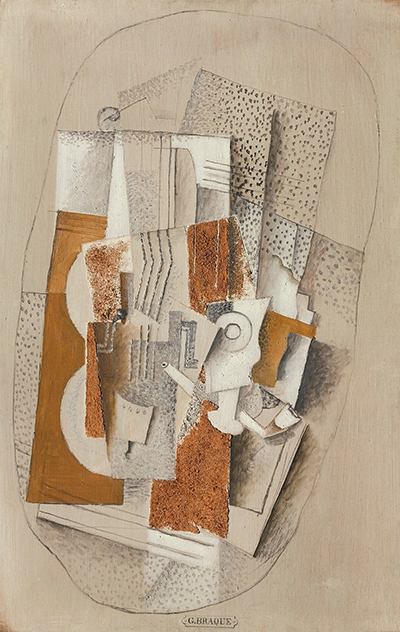
A strip of manufactured pattern, a piece of wood-grain paper and a fragment of newspaper meet drawn lines. From those unlike materials, a violin begins to take shape. The instrument belongs partly to the world of everyday paper and partly to the world invented by Georges Braque's charcoal. Close by, a glass and a table offer the promise of an ordinary still life, yet the promised setting never becomes fully secure.[1]
Made in early 1914, Violin belongs to the most searching phase of Braque's experiments with papier collé, or pasted paper. Real sheets give the work a physical directness: their edges, printed surfaces and overlaps are facts. At the same time, each sheet performs several pictorial jobs. A paper that imitates timber can suggest the wooden substance of an instrument while remaining visibly manufactured paper. Reality enters the picture and immediately becomes ambiguous.
At a Glance
- ArtistGeorges Braque[1]
- TitleViolin (Le Violon)[1]
- DateEarly 1914[1]
- MediumCut-and-pasted newsprint, block-printed or stencilled decorative paper and faux bois, with charcoal and graphite[1]
- Dimensions71.8 × 51.8 cm (28 1/4 × 20 3/8 in.), unframed[1]
- CollectionCleveland Museum of Art[1]
- Accession1968.196[1]
- SignificanceThe Cleveland work's cut papers, drawn instrument and deliberately unsettled material reality
Contents
- Introduction
- The Cleveland sheet
- Three papers, two kinds of line
- Wood that begins as an imitation
- Finding an instrument among the joins
- A table made uncertain
- Newspaper on the face and on the reverse
- From the first pasted papers to 1914
- From Kahnweiler to Paulhan
- Real paper, mobile meaning
The Cleveland sheet
In Centre Pompidou's French catalogue writing the Cleveland work appears as Le Violon; the Cleveland Museum of Art catalogues it simply as Violin.[5] Braque made the sheet in early 1914. It measures 71.8 by 51.8 centimetres unframed and entered Cleveland's collection in 1968 through the Leonard C. Hanna Jr. Fund, with the accession number 1968.196.[1] The date remains deliberately broad: the museum specifies no month, while the accession number belongs to its later acquisition.
Those details distinguish it from several related violin compositions of 1913–14. Cleveland classifies the object among drawings, though its construction also makes it a papier collé. Both identities matter: Braque drew with dry media and built with pieces of paper.
The support is cardboard. That firm ground holds a medium described with unusual precision: cut-and-pasted newsprint, block-printed or stencilled decorative paper and faux bois, combined with charcoal and graphite.[1] The list is almost a miniature account of the work's method. Three kinds of paper arrive with different histories; two drawing materials bring them into a new order.
Three papers, two kinds of line
Newsprint begins as a carrier of mechanically reproduced daily information, and its life before the studio is part of its character. Decorative paper carries another kind of repetition, a pattern designed to recur across a larger surface. Faux bois performs a still stranger task: it is paper printed to resemble wood grain.
Braque preserves those differences. The sheets never become a single anonymous collage material. Their prior functions remain available even as cutting changes their shapes and pasting gives them fresh relationships. The printed fragment can evoke a newspaper, the ornamental strip can retain the memory of interior decoration, and the false grain can summon a wooden surface. Each piece joins the depicted still life while continuing to announce what it was.
Charcoal and graphite supply another register. Cleveland's account specifically describes charcoal lines as part of the violin's definition.[1] Drawing can connect areas whose printed designs pull in different directions, or suggest continuity across a physical join. The marks and the papers therefore share responsibility for recognition. The instrument emerges through their cooperation, with no need for every piece to match a single anatomical part.
Wood that begins as an imitation
The phrase faux bois means imitation wood. Braque knew this decorative language through the trade of the painter-decorator. His father and grandfather worked as housepainters, and his own training included the techniques used to simulate wood, marble and stone. The Metropolitan Museum of Art traces his introduction of painted wood grain and lettering into Cubist works to 1911–12, followed by his use of wallpaper in drawings during autumn 1912.[3]
In the Cleveland work, the faux bois comes ready printed. This creates a compact chain of substitutions. The piece is truly paper; its grain is a printed likeness of timber; Cleveland explains that it helps define a violin, an object conventionally made from wood. One manufactured surface can thus be material, imitation and pictorial sign at once.
The decorative strip adds a different tension. Its pattern suggests a larger sheet continuing beyond the cut edge, while its new outline belongs to Braque's composition. A Lyon and Centre Pompidou exhibition account notes that faux-wood papers in Braque's work could recall café panelling, pedestal tables or the substance of guitars.[4] Here Cleveland assigns the wood-grain piece to the violin. The wider associations still hover around it, allowing instrument, furniture and interior to touch the same material vocabulary.
Finding an instrument among the joins
Cleveland identifies a violin and glass on a table supported by a single wooden leg. Its description explains that charcoal, newspaper, faux-bois paper and decorative pattern all participate in the instrument.[1] This is enough to guide recognition, yet the account leaves the work's discoveries intact. The violin is distributed across materials, escaping enclosure within one continuous silhouette.
That distribution changes the act of looking. A charcoal passage may first read as a free mark, then join a cut paper to suggest the instrument. A printed surface may register as newspaper or pattern before it takes a place within the violin. The shift can also move in reverse: an apparent part of the still life returns to awareness as an ordinary fragment with a cut edge.
The glass has a clarifying role. Its named presence supplies a second familiar object against which the instrument can be tested. The table's single leg offers another cue toward a stable setting. Together they create just enough still-life structure for Braque to disrupt. Recognition arrives by accumulation, through partial agreements among lines, papers and names.
A table made uncertain
Pasting creates a literal relation: one piece lies against or over another on the cardboard. Depicted space asks a different question. Does an edge belong to the violin, the table, a plane behind them or simply the paper itself? Several answers can remain active because the join has physical certainty without possessing one permanent pictorial meaning.
Cleveland describes the subject as occupying a complex field of intersecting planes that challenges conventional representation.[1] The table, glass and violin survive that challenge. What gives way is the expectation that a single viewpoint or continuous room will organise them. A viewer can recover the objects while the intervals between them keep changing character.
The slight relief introduced by pasted sheets intensifies this exchange. The Met observes that the varying weights and types of paper used in Cubist collage produced an actual, if modest, relief.[3] Braque places genuine material depth beside a space that refuses consistent depth. The seam is tangible; the plane it seems to describe can still turn, flatten or attach itself to another object.
Newspaper on the face and on the reverse
Newsprint enters the work twice, on two different scales. On the face, Cleveland records a newspaper fragment among the elements that define the violin.[1] Its printed character brings the tempo of contemporary, mass-produced information into an object traditionally associated with craft and performance. Cutting interrupts the former page, making a remnant of printed paper serve a new construction.
The reverse carries a more surprising fact. Braque glued an entire page from Le Journal to the back of the drawing.[1] The complete sheet occupies a different material role from the smaller fragment on the face. It gives newspaper a broad physical presence while remaining on the other side of the normal frontal encounter.
Cleveland offers no issue date, article or stated reason for that attachment. Its significance lies first in the contrast the museum documents. Fragment and whole, face and reverse, pictorial participation and complete sheet coexist within one object. Newspaper can be read as a sign within the violin and encountered as a large, actual sheet behind it. The work's two-sided construction gives printed matter a reach beyond what its front alone reveals.
From the first pasted papers to 1914
Braque began making papiers collés in 1912, after finding wood-patterned wallpaper and incorporating it into drawn compositions. The invention extended skills associated with decorative painting into a new field. A ready-made imitation could enter fine art as itself, while cutting and drawing redirected its meaning.[3]
During the next two years he widened the experiment. The Lyon dossier describes an active exchange among pasted papers, added texture and effects simulated in paint.[4] Violin stands late enough in that development for several paper languages to operate together. Newsprint, ornament and false grain are chosen for distinct capacities, while charcoal and graphite prevent the collage from settling into an arrangement of mute shapes.
A close comparison appears in the Centre Pompidou's Violon et pipe, dated winter 1913–14. That separate work combines charcoal, graphite, chalk and pasted papers. Isabelle Monod-Fontaine connects its beige-and-grey decorative band and faux-wood moulding effect with the paper used in Cleveland's Violin.[5] The link suggests Braque testing a related manufactured vocabulary across more than one composition, altering the objects and spatial puzzle around it.
The comparison also demonstrates the importance of exact identities. Violon et pipe has its own pipe, paper arrangement and history. Cleveland's sheet builds its argument around a violin, glass and one-legged table. Shared material can become the starting point for quite different acts of recognition.
From Kahnweiler to Paulhan
The work's early ownership is documented with useful caution. Cleveland records it as probably with Galerie Kahnweiler from early 1914 until by 1923. By that year it belonged to Jean Paulhan, who retained it until by 1967.[2] Centre Pompidou's discussion of the related decorative paper also identifies the Cleveland collage as a work once owned by Paulhan.[5]
Albert Loeb & Krugier Gallery handled the sheet in 1967–68 and sold it to the Cleveland Museum of Art. Cleveland completed the acquisition in 1968.[2] The sequence is compact, with its earliest step left properly qualified. It carries the collage from Braque's prewar dealer circle through more than four decades in Paulhan's possession to a public collection.
That history suits an object whose materials have lives before and after their pictorial use. Newsprint and decorative papers entered the studio already marked by manufacture and circulation. Braque cut them free from those first purposes, then made their residual identities essential to a new work. Later ownership added another chain of passage without erasing the physical evidence of their earlier world.
Real paper, mobile meaning
The enduring force of Violin comes from the gap between material certainty and pictorial mobility. Cardboard, printed sheets, charcoal and graphite are concrete facts. Their joins have real edges. Yet the violin they create remains distributed, the table never settles into a dependable container, and the imitation wood grain keeps oscillating between paper, timber and instrument.
Braque's pasted materials therefore deepen representation while making it harder to stabilise. The viewer recognises familiar things through a sequence of changing agreements: a line meets a pattern, a fragment becomes part of an instrument, a seam turns into a spatial boundary and then returns to being a seam. The work never asks paper to disguise its nature. Its most vivid fiction grows from paper being unmistakably present.
Related Pages
Frequently Asked Questions
A strip of manufactured pattern, a piece of wood-grain paper and a fragment of newspaper meet drawn lines.
In Centre Pompidou's French catalogue writing the Cleveland work appears as Le Violon; the Cleveland Museum of Art catalogues it simply as Violin.
Braque's pasted materials therefore deepen representation while making it harder to stabilise.
Discussion
A strip of manufactured pattern, a piece of wood-grain paper and a fragment of newspaper meet drawn lines.
Reader Insights
A strip of manufactured pattern, a piece of wood-grain paper and a fragment of newspaper meet drawn lines.
Pasting creates a literal relation: one piece lies against or over another on the cardboard.
Braque's pasted materials therefore deepen representation while making it harder to stabilise.
Join the Conversation
Share the visible detail or source that most changed your reading.
References
- Cleveland Museum of Art, Violin.
- Cleveland Museum of Art, Violin: printable collection and provenance record.
- Metropolitan Museum of Art, Cubism and the Trompe l'Oeil Tradition.
- Musée des Beaux-Arts de Lyon and Centre Pompidou, Braque/Laurens, un dialogue.
- Centre Pompidou, Isabelle Monod-Fontaine, Violon et pipe.