 by Tom Gurney
Tom Gurney BSc (Hons) is an art history expert with over 20 years experience
Published on August 14, 2026 / Updated on August 14, 2026
Email: tomgurney1@gmail.com / Phone: +44 7429 011000
Introduction
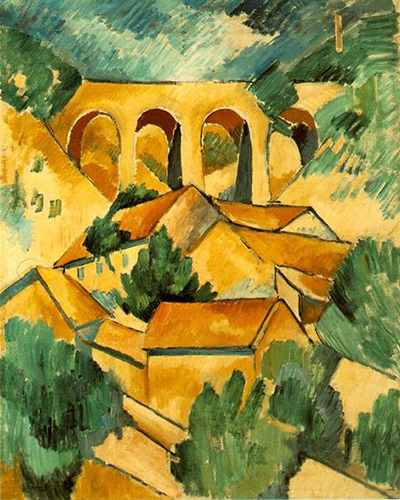
Georges Braque's second Viaduct at L'Estaque began with an absence. The painter was in Paris, while the viaduct, houses and Mediterranean terrain stood far to the south. Working in his studio from memory, he turned that distance into a method. The landscape could be reduced to the relations that continued to matter after immediate sight had fallen away.
Centre Pompidou dates the painting to early 1908 and records Paris as its place of production. An oil on canvas measuring 72.5 by 59 centimetres, it entered the collection by dation in 1984 and carries the inventory number AM 1984-353.[1] Its vertical proportions and compressed construction identify a distinct object within Braque's repeated treatment of the motif.
The museum calls this the second version. The first, painted at L'Estaque in October 1907 and now at the Minneapolis Institute of Art, is a horizontal canvas measuring 65.1 by 80.6 centimetres.[1][3] In Paris a few months later, Braque revisited the same subject through recollection. Across two formats and working situations, the paintings record a landscape being encountered, remembered and rebuilt.
At a Glance
- ArtistGeorges Braque[1]
- TitleViaduct at L'Estaque[1]
- Date1908[1]
- MediumOil on canvas[1]
- Dimensions72.5 × 59 cm[1]
- CollectionCentre Pompidou, Musée national d’art moderne[1]
- AccessionAM 1984-353[1]
- SignificanceThe early 1908 Pompidou viaduct rebuilds a landscape from compressed planes, memory and Cezannian structure
Contents
- Introduction
- What memory changed
- A landscape compressed into architecture
- Foliage as spatial punctuation
- A reduced palette with an active pulse
- Space assembled in stages
- Cézanne's example and Braque's departure
- The exhibition moment of 1908
- A turning point kept in paint
What memory changed
Memory gave Braque a means of selection. A painter facing a site receives abundant, simultaneous information: changing light, irregular vegetation, many small intervals and incidental details compete for attention. In the studio, the motif could be reconsidered through the forms and connections that survived most strongly. The resulting canvas preserves L'Estaque while submitting it to a more concentrated order.
K20 places this method within a broader change in Braque's practice. After the major Cézanne retrospective of 1907, his landscapes increasingly approached basic geometric form, and he completed more of them in the studio as constructions of memory.[2] Distance from the motif allowed pictorial structure to acquire greater authority. The remembered site became material for a new composition.
This process drew on more than one experience. Braque had visited L'Estaque, studied its landscape and already painted the viaduct in the first version. The Paris canvas therefore emerged from accumulated knowledge: place, previous painting and continued reflection. Memory concentrated that knowledge into a second answer.
The distinction matters because recollection can sound vague or dreamlike. Here it produces clarity of relation. Viaduct and houses remain identifiable, and their forms become more explicit as arches, cubes, edges and angles. Memory works as an instrument of construction, preserving the subject through a stricter arrangement of its parts.
A landscape compressed into architecture
Centre Pompidou describes the second version as a radically reduced, compressed landscape recomposed from the architecture of viaduct and houses.[1] Its vertical format contributes directly to that compression. The scene rises through a narrower field than the Minneapolis canvas, gathering successive elements into a close upward sequence.
The central relation is precise. A raised pyramid of pointed roofs advances before the viaduct, while four arches cross high along the horizon.[1] The houses occupy the forward stage and the bridge forms a second, elevated barrier. Their overlap condenses the usual intervals of landscape, bringing foreground construction and distant infrastructure into immediate contact.
The roof pyramid provides direction as well as mass. Sloping edges climb towards an apex, while the viaduct establishes a stronger lateral measure behind them. Diagonal ascent meets repeated horizontal span. These two systems hold the composition in tension: one gathers upward, the other extends across.
Four arches turn the bridge into a sequence. Each opening divides solid structure, setting void against support and recurrence against variation. Placed high in the field, the viaduct limits the passage towards distant space. The bridge still implies travel across terrain, yet its painted role is equally architectural: it closes, measures and binds the upper part of the composition.
Very little sky remains.[1] This narrow allowance matters because sky traditionally offers landscape a sense of expansion beyond built and natural forms. Braque reduces that opening, intensifying the pressure among roofs, bridge and horizon. The scene keeps an outer edge of distance, though most of the canvas belongs to the close interaction of constructed masses.
Compression therefore operates through several linked decisions. The vertical support narrows lateral expansion; pointed roofs press forward and upward; four arches establish a high barrier; the sky contracts. Every relation draws the landscape towards the material field of the painting.
Foliage as spatial punctuation
Architecture dominates, though vegetation still participates. Pompidou identifies a few standardised foliage elements placed to interrupt the severity of the geometric construction and mark the successive stages of space.[1] Braque gives natural form a highly specific compositional task.
The word “standardised” suggests foliage treated as a repeatable sign. Botanical individuality yields to a shared pictorial function. Each element can articulate an interval, signal a change of plane or relieve a hard conjunction of roofs and arches. Nature becomes a flexible unit within the constructed order.
This treatment deepens the role of memory. A remembered landscape need only retain vegetation in the forms required to establish its structure. The foliage remains enough to keep the setting alive and to differentiate spatial layers, while its simplified recurrence connects separate parts of the surface.
The result also complicates any division between natural and built form. Houses and viaduct supply cubes, angles and arches; foliage offers softer interruptions. Both contribute to the same system of staging. Geometry determines the pressure of the composition, and vegetation adjusts its rhythm.
A reduced palette with an active pulse
The second version concentrates colour as decisively as it concentrates architecture. Pompidou identifies ochres of varying warmth and greens, with a few blues used for shadows and sky.[1] This restricted range links roofs, bridge, ground and vegetation without requiring each element to claim a separate descriptive colour.
Ochres provide a broad family capable of small shifts while preserving unity. Greens sustain the presence of landscape within the architectural field. The limited blues have a more selective role, distinguishing shadow and the small remainder of sky. Colour organizes categories and intervals even as its overall variety contracts.
The reduction marks a clear change from the first viaduct. Pompidou characterises the Minneapolis canvas through iridescent colour and a bluish horizon; the Paris version draws colour into a tighter structural range.[1] The difference reflects a change of emphasis, with chromatic breadth giving way to closer integration among planes.
Paint handling keeps that integration alive. The museum describes a continuous, perceptible pulse of brushstrokes moving across the entire surface, animating the canvas and softening the rigour of its conceptual construction.[1] Repeated touch gives geometry a temporal rhythm. Arches, roofs and planes may be tightly ordered, yet the act of painting remains palpable across them.
This balance is central to the work. Geometric reduction creates clarity and pressure; the brush pulse prevents those relations from settling into an inert scheme. The surface carries the trace of repeated action, so construction feels ongoing. Colour and touch become active agents in the landscape's reorganisation.
The painting consequently resists a simple story in which geometry replaces colour. Its palette is narrower, though every remaining hue acquires greater structural responsibility. Its forms are stricter, while continuous touch gives them movement. Braque advances through concentration, preserving pictorial vitality within the reduced means.
Space assembled in stages
K20 describes Braque's landscapes after the Cézanne retrospective as structured frameworks in which central perspective loses its governing role. Forms become layered and faceted, drawing attention to the flatness of the picture.[2] The Pompidou viaduct shows how this change can operate inside a recognisable place.
Conventional perspective coordinates a scene through a stable viewpoint and a continuous recession. Braque's second version builds depth locally. Pointed roofs advance before the arches; foliage marks successive planes; the bridge stands high near the restricted sky. Overlap, height and repetition establish spatial relations one stage at a time.
These stages produce depth and compression together. The roofs sit before the viaduct, and the remaining sky lies beyond it, giving a sequence from front to back. Their close packing also asserts the canvas as a vertical surface. Each element belongs to a spatial order and to a compact arrangement of shapes.
The high arches are especially important. They imply openings through which space might continue, while their repeated structure forms a strong barrier across that continuation. Depth is offered and checked in the same motif. The viaduct turns recession into a negotiation between passage and closure.
Pompidou calls the composition already conceptual.[1] In this setting, the term describes a landscape organised through selected relations—arch and cube, edge and angle, overlap and interval. The painting remains attached to L'Estaque, but its coherence arises from the internal logic Braque gives those parts.
Cézanne's example and Braque's departure
Braque's renewed attention to Cézanne preceded both viaduct versions. K20 emphasises the older painter's approximation of natural forms to geometry and his relief-like handling of space.[2] L'Estaque itself carried that precedent because Cézanne had worked around the village.
The October 1907 canvas still appears closely tied to Cézanne in Pompidou's account.[1] The early-1908 version continues the structural inquiry while changing its conditions. Braque moves the motif to a Paris studio, turns direct encounter into memory and intensifies compression. The pointed roof pyramid, layered architecture and reduced palette make the canvas answer more forcefully to its own organisation.
Cézanne's influence thus remains active as a problem to develop. Geometric mass, interlocking planes and shallow relief supply a starting language. Braque extends that language through a repeated motif and a new distance from the site. The second viaduct records an artist learning through reconstruction.
Its historical position grows clearer through this continuity. The work belongs among the early landmarks in Cubism's emergence, yet its significance lies in observable choices. A remembered landscape is rebuilt through architecture; depth is staged through local relations; colour contracts and touch remains energetic. The movement's larger history begins to take form through these decisions.
The exhibition moment of 1908
Braque returned to L'Estaque in June 1908 for another campaign. Centre Pompidou says that the later paintings, including a third viaduct, were refused by the Salon d'Automne and presented by Daniel-Henry Kahnweiler in November.[1] The active Paris version belongs earlier in the sequence, and Pompidou's detailed analysis says Braque retained it as a witness to this turn in his work.[1]
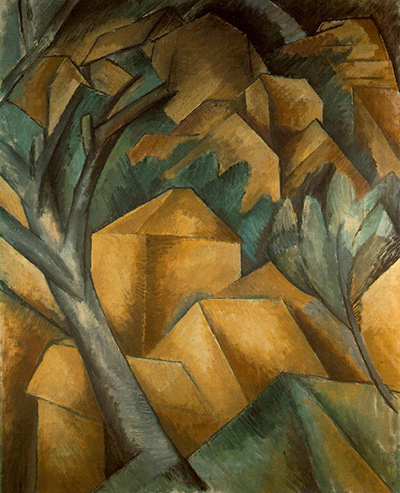
The Metropolitan Museum of Art describes Kahnweiler's November display as the first Cubist exhibition. It identifies the separate Trees at L'Estaque of summer 1908 and The Terrace at the Hôtel Mistral as works from that presentation.[4] The event brought Braque's sustained experiments with landscape before a concentrated gallery audience and gave their new spatial language a public setting.
This context offers a stronger historical account than any search for one founding picture. The first viaduct, the Paris reconstruction, the third southern campaign and the Kahnweiler exhibition form a sequence of revisions and encounters. Cubism emerged through accumulated experiments whose differences mattered.
A turning point kept in paint
The Centre Pompidou's acquisition by dation in 1984 eventually placed the second viaduct in a national collection.[1] Its inventory number secures the identity of a canvas that can easily be confused with another painting of the same motif. The vertical format, early-1908 Paris date and memory-based method distinguish it as sharply as its formal construction.
Braque rebuilt L'Estaque by concentrating its architecture. Pointed roofs advance before four high arches, foliage articulates the compressed planes and a narrow sky completes the ascent. Ochres and greens bind the structures, limited blues preserve shadow and distance, and continuous touch moves through the whole field.
The work's decisive achievement lies in the conjunction of these forces. Memory gives selection its discipline; geometry gives the remembered site a new order; paint keeps that order active. Viaduct at L'Estaque stands at a turning point because it transforms a particular landscape into a tightly governed pictorial construction while preserving the pulse of its making.
Related Pages
Frequently Asked Questions
Georges Braque's second Viaduct at L'Estaque began with an absence.
Memory gave Braque a means of selection.
The work's decisive achievement lies in the conjunction of these forces.
Discussion
Georges Braque's second Viaduct at L'Estaque began with an absence.
Reader Insights
Georges Braque's second Viaduct at L'Estaque began with an absence.
The reduction marks a clear change from the first viaduct.
The work's decisive achievement lies in the conjunction of these forces.
Join the Conversation
Share the visible detail or source that most changed your reading.