 by Tom Gurney
Tom Gurney BSc (Hons) is an art history expert with over 20 years experience
Published on August 14, 2026 / Updated on August 14, 2026
Email: tomgurney1@gmail.com / Phone: +44 7429 011000
Introduction
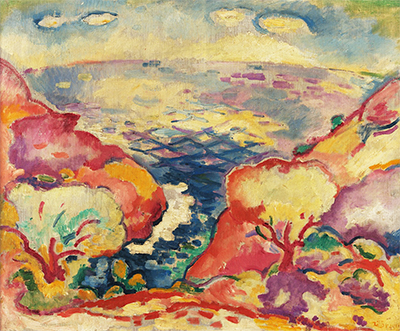
A calanque is a landscape in which land and sea press closely together. Water enters a long rocky enclosure, so the painter faces more than an open coastal view: inlet, cliffs and vegetation must be made to cohere within the same compact field. Georges Braque's Port Miou of 1907 turns that natural compression into a question of colour and pictorial structure.
The painting belongs to the Jucker Collection presented by the Museo del Novecento in Milan. The museum-supplied record dates it to 1907 and identifies it as an oil on canvas measuring 49 by 60 centimetres.[1] Small enough to reward concentrated looking, it comes from a year in which Braque's short Fauvist phase remained vivid even as his landscapes moved toward firmer organisation.
At a Glance
- ArtistGeorges Braque[1]
- TitlePort Miou[1]
- Date1907[1]
- MediumOil on canvas[1]
- Dimensions49 × 60 cm[1]
- CollectionJucker Collection; presented by Museo del Novecento, Milan[1]
- SignificanceA 1907 Mediterranean inlet through colour, rock, water and the move toward firmer construction
Contents
- Introduction
- The calanque as a subject
- An elevated view held by colour
- A Fauve landscape at a structural threshold
- Riccardo Jucker and the painting's Milan history
- Colour contained by place
The calanque as a subject
Port-Miou lies at Cassis on the Mediterranean coast. The Parc national des Calanques describes it as the only calanque in the Cassis district: a roughly 1,400-metre inlet surrounded by steep cliffs and the easternmost of the calanques between Marseille and Cassis.[5] Its present appearance has also been altered by human activity, a useful reminder that a modern place and an early twentieth-century painting preserve different moments.
For Braque, the key pictorial fact was the enclosure. A long inlet draws water into the land, setting a narrow passage against larger rocky masses. The title invokes this geography, while the canvas makes its own selection from it. It can therefore be understood through relationships—opening and enclosure, fluidity and weight, lateral shore and rising terrain—without treating the picture as a topographic survey.
The horizontal dimensions suit that problem. A width of 60 centimetres gives the inlet room to extend, while the modest height keeps its surroundings close. The format encourages movement across the surface, yet the calanque's enclosing character resists a simple sweep toward a distant horizon. Braque had a motif in which depth and compression could operate together.
An elevated view held by colour
An Italian educational account linked to the Museo del Novecento describes Port Miou as an elevated landscape accompanied by maritime pines. It also identifies red, pink and violet as the dominant colour families, with thick brushwork and clearly simplified forms.[3] Those observations give the painting a distinct identity within Braque's southern landscapes.
Elevation changes the logic of a coastal scene. From above, water and land can be grasped as adjoining shapes as well as receding space. The inlet's length remains meaningful, but its shores also become boundaries within the painted field. Maritime pines add a third kind of natural form: branching vegetation set against the heavier continuity of rock and the passage of water.
That position permits two kinds of space to operate at once. The water still penetrates the land, preserving the calanque's physical depth, while its bordering shores can register as edges between shapes on a flat canvas. Simplified forms carry extra weight under these conditions. Each major mass helps establish both the place and the structure of the picture, so reduction becomes a way of concentrating the landscape's defining relationships.
Colour binds these differences. The account names red, pink and violet across the canvas as a whole, creating a family of relations among otherwise unlike substances. Red and pink offer closely related intervals, while violet adds a distinct register within the restricted field. Repetition and variation within this limited family can guide the eye across changes of mass and texture. Rock can feel weighty, water fluid and trees irregular while the colour structure holds them within one pictorial climate. Local description gives way to chromatic coherence.
This freedom belongs to Braque's Fauvist moment. K20 explains that Fauvist colour departed from the observed appearance of things and from the rules of illusionistic perspective. In Braque's landscapes, coloured surfaces and brushstrokes could increasingly organise the picture in their own right.[4] Port Miou uses that freedom with unusual concentration: a narrow coastal setting becomes an arrangement in which hue helps establish unity.
The thick touch matters for the same reason. Paint remains materially conspicuous even while representing water, rock or foliage. A stroke can contribute to recognition while also registering as a tangible part of the surface. Simplification then clarifies the larger relations. Reduced forms allow enclosure, extension and mass to carry more of the composition's force.
A Fauve landscape at a structural threshold
The Metropolitan Museum of Art calls Port-miou a Fauve landscape, a description that preserves the work's colour-led identity.[2] Its simplified forms also belong to a year of rapid change. K20 traces Braque's short and intense Fauvist phase from his encounter with Matisse, Derain and others at the Salon d'Automne of 1905 through his southern campaigns of 1906 and 1907.[4]
During that phase, Braque explored several coastal settings. He worked at L'Estaque after an Antwerp campaign and painted with Othon Friesz at La Ciotat in summer 1907. K20 then places a stronger geometric turn around his encounter with the Cézanne retrospective and a subsequent return to southern France. Natural forms increasingly approached elementary shapes, and landscapes became flatter, more tightly built pictorial structures.[4]
The record dates Port Miou only to 1907, leaving its precise position within those fast-moving events open.[1] Its documented properties make a finer point possible. Red, pink and violet still carry Fauvist intensity; thick brushwork keeps colour physically active; the elevated viewpoint and simplified forms gather the inlet into stronger relations. Expressive colour and constructive pressure coexist.
That coexistence gives the painting its historical interest. “Construction” here means the organisation of a landscape through masses, boundaries, touches and colour areas. The term has yet to require the fragmented planes and multiple viewpoints of Braque's later Cubist work. Port Miou remains anchored in a recognisable Mediterranean place while testing how decisively that place can be remade as a painted structure.
The distinction frees the canvas from a story of inevitable progress. Its Fauvist force is already a complete achievement. Simplification gives that force greater cohesion, allowing the colour to feel structural without losing its expressive charge. The painting occupies a threshold because both tendencies remain alive at once.
Riccardo Jucker and the painting's Milan history
The later collection history is unusually precise at one important point. The Met records that Riccardo Jucker acquired Braque's Port-miou in 1964 through an exchange for paintings by Maurice de Vlaminck, Nicolas de Staël, Jean Dubuffet and Mark Tobey.[2] The transaction reveals a collector actively reshaping his holdings, exchanging works by four modern artists to secure one early Braque landscape.
Jucker built a collection with particular strengths in Cubism, Futurism and Metaphysical painting. From 1974 he explored ways to place it with a public institution, and after his death in 1987 the municipality of Milan eventually took charge of the collection. A significant part is now displayed at the Museo del Novecento.[2] Port Miou consequently carries two linked histories: Braque's intense rethinking of landscape in 1907 and Jucker's later effort to build a concentrated account of modern art in Milan.
Colour contained by place
Port Miou gains its character from a productive tension. The calanque offers enclosure, steep mass and a channel of water; Braque's Fauvist palette releases colour from literal description. The elevated view and simplified forms bring those forces into a compact order, while thick paint keeps the surface energetic.
The result belongs fully to the Fauvist landscape and also shows Braque demanding more cohesion from it. Red, pink and violet do more than intensify the Mediterranean setting: they help hold rock, water and vegetation within one field. In this 1907 canvas, firmer construction emerges through colour itself. The calanque becomes both a particular place and a tightly organised painted world.
Related Pages
Frequently Asked Questions
A calanque is a landscape in which land and sea press closely together.
Port-Miou lies at Cassis on the Mediterranean coast.
The result belongs fully to the Fauvist landscape and also shows Braque demanding more cohesion from it.
Discussion
A calanque is a landscape in which land and sea press closely together.
Reader Insights
A calanque is a landscape in which land and sea press closely together.
The thick touch matters for the same reason.
The result belongs fully to the Fauvist landscape and also shows Braque demanding more cohesion from it.
Join the Conversation
Share the visible detail or source that most changed your reading.