 by Tom Gurney
Tom Gurney BSc (Hons) is an art history expert with over 20 years experience
Published on August 14, 2026 / Updated on August 14, 2026
Email: tomgurney1@gmail.com / Phone: +44 7429 011000
Introduction
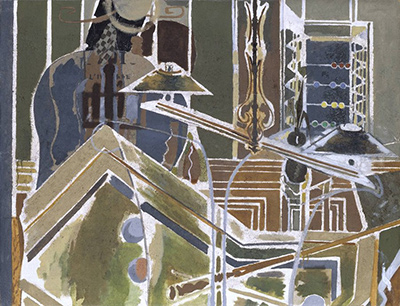
Georges Braque's Le Billard carries the Centre Pompidou catalogue date [1944]. Painted in oil and sand on canvas, it measures 130.5 by 195.5 centimetres and bears the artist's signature at lower left. The French state bought it in 1946, and it entered the national collection as AM 2604 P.[1] Its broad horizontal proportions provide ample room for a familiar piece of furniture to become an encompassing spatial event.
The billiard table dominates that event. Its green expanse supports balls and cues, yet its function reaches beyond holding the equipment of a game. The table bends, advances and draws the surrounding wall into its deformation. A vase, a clipped window and pale traces of an easel make the interior legible through fragments. Each clue belongs to the room while also participating in the design of the painted surface.[1]
This double existence gives Le Billard its force. Braque preserves enough of the game for recognition, then uses its table to challenge the separation between object and setting. Depth emerges through abrupt folds and oblique views. Material texture evokes the cloth on which play occurs. Lines associated with cues also propose paths for moving balls. The picture turns billiards into a way of thinking about how an interior can be constructed in paint.[1]
At a Glance
- ArtistGeorges Braque[1]
- TitleThe Billiard Table (Le Billard)[1]
- Date[1944][1]
- MediumOil and sand on canvas[1]
- Dimensions130.5 × 195.5 cm[1]
- CollectionCentre Pompidou, Musée national d’art moderne[1]
- AccessionAM 2604 P[1]
- SignificanceThe 1944 Pompidou painting as the first billiard-series canvas and as a radical expansion of tabletop space
Contents
- Introduction
- A Table That Takes Possession of the Room
- Autumn 1944 and the First of Seven Canvases
- The Fold as a New Kind of Depth
- Sand, Felt and the Thought of Touch
- Cues, Balls and Virtual Movement
- Fragments of Interior and Signs of the Studio
- Repetition, Difference and Recognition
A Table That Takes Possession of the Room
Still life traditionally grants the table a supporting role. Fruit, bottles, instruments or dishes receive attention while the furniture establishes a stable horizontal base. Braque reverses that hierarchy here. The green rectangle becomes the largest and most insistent element in the encounter, so the support begins to govern everything placed near it. Tabletop space expands until it engages wall, window and studio equipment.
Centre Pompidou's catalogue analysis stresses the variety Braque found in a repeated motif. Across the billiard paintings, the green field could fill nearly the entire canvas, bend, or appear from one side. In AM 2604 P, the first work in that sequence, the table is viewed obliquely and seems broken into two joined parts. Its forward fold gives it an active relation to the viewer.[1]
That movement changes the meaning of scale. The exact dimensions describe a large horizontal canvas, but the experience of breadth comes from the table's internal reach. It crosses the space as a continuous field even where its direction changes. Objects become events within this field, and the architecture responds to it. The room seems generated through the table's pressures, with no neutral container supplied in advance.
The table also performs two visual tasks at once. It remains an identifiable object with a specialised use, and it acts as a plane of colour and matter. The first task encourages imagined depth: a billiard surface recedes, receives balls and offers room for play. The second brings attention toward the canvas, where a large painted zone occupies a broad portion of the support. Braque holds those experiences together.
Once the table assumes this authority, the interior can be understood without an exhaustive inventory. A handful of relations is sufficient. The green field pushes toward the edges, the wall follows its deformation, and partial room cues keep depth in circulation. Furniture has become the engine of an interior whose unity depends upon painting.[1]
Autumn 1944 and the First of Seven Canvases
Centre identifies Le Billard as the first of seven billiard paintings made between 1944 and 1952. Its analysis places the beginning of this canvas in Braque's Paris studio during autumn 1944, following a return from Varengeville.[1] The bracketed catalogue date preserves a degree of uncertainty around the object while the seasonal account gives the start of the sequence a firmer historical setting.
The moment came after years in which Braque had made still life carry a remarkable range of spatial and material experiments. The Phillips Collection describes his work from 1928 to 1945 as a sustained synthesis of Cubist discoveries and an increasingly personal language. It traces a movement from intimate interiors toward larger spaces and emphasises his continuing interest in the physical presence of objects and their surroundings.[3]
War altered the circumstances around that inquiry. Braque worked in Paris during the occupation, and the domestic subjects of the period drew divided interpretations. Some viewers understood modest objects and enclosed settings as a retreat from current events. Others found in those intimate, imaginative spaces a form of creative freedom during tragic years.[3] Such disagreement is useful because it keeps interior painting open to history without reducing every shape to a political cipher.
Autumn 1944 inevitably gives the first billiard canvas historical weight. Paris had recently been liberated, and Braque was beginning a large new sequence within that changed environment. The timing supports a sense of threshold. It supplies no compulsory symbolic dictionary for green cloth, coloured balls, crossed rods or folded furniture. Historical conditions surround the work, while its specific meanings arise through documented relations of space and matter.
The series format extends that threshold beyond one response. Seven canvases made over several years suggest a problem that remained productive. Braque could revisit the table, alter its proportions and reconsider how it met the room. AM 2604 P matters as an opening proposition: a familiar setting for controlled play becomes the starting point for prolonged pictorial investigation.
The Fold as a New Kind of Depth
The table's central deformation provides the clearest entry into Braque's spatial logic. Centre describes it as broken in two and folded toward the viewer. Behind it, a brown wall undergoes a comparable bend.[1] The paired movement makes furniture and architecture answer one another. A change within the table travels outward until the enclosure of the room seems caught in the same event.
Conventional perspective would distinguish a horizontal playing surface from a vertical wall and connect them through a stable recession. Braque keeps those identities visible while loosening their geometry. The table can recede and advance across adjacent passages. The wall can enclose the scene and join a surface pattern. Their junction offers depth, then draws attention toward the physical plane carrying the image.
This is why the fold feels more consequential than a distortion applied to one object. It becomes an organising principle. The eye tries to follow the billiard surface as usable furniture, yet the change in direction resists a single settled viewpoint. The corresponding wall amplifies the uncertainty. Interior space appears through a negotiation among cues whose agreements remain temporary.
The result still permits orientation. Green identifies the field of play, brown establishes the rear enclosure, and the broad format gives the encounter room to unfold. Spatial instability therefore grows from recognisable elements. Braque asks the viewer to maintain object, room and painted plane together, allowing each to revise the others without losing the scene entirely.
Such a construction makes looking active. One passage encourages the mind to imagine a table extending away; another presents a shape pressed close to the canvas. A line may divide two planes or join them. The wall may recede behind the game or appear to share its forward bend. Depth becomes an experience assembled across time, through successive acts of recognition and adjustment.
Sand, Felt and the Thought of Touch
The documented sand in the medium gives this spatial argument a physical counterpart. Mixed with oil paint, granular matter changes the presence of the surface before it resembles anything. Centre's analysis associates the resulting rough-and-soft effect with billiard felt, describing a pictorial equivalence between the paint and the cloth.[1] The connection depends upon a productive material paradox.
Sand possesses qualities far removed from the smooth nap expected of a billiard table. Its particles suggest abrasion, grain and resistance. Felt suggests softness and the controlled passage of a rolling ball. Braque brings those associations into contact through paint. Actual granularity can prompt an imagined softness because both belong to the viewer's understanding of the represented surface.
The device gives the green field more than colour. Its material character helps distinguish the table as an object while making the canvas present as a worked support. Looking moves between represented cloth and sand-bearing paint. The table seems available to imagined touch, yet the granular layer also interrupts illusion and recalls the labour of constructing the image.
This relation belongs to Braque's longer concern with the physicality of objects and surrounding space. The Phillips exhibition follows that concern across his mature still lifes, where texture and pictorial structure repeatedly complicate one another.[3] In Le Billard, the connection becomes unusually exact because the subject itself depends upon a specialised tactile surface.
Material and space consequently reinforce each other. The fold makes the green area difficult to settle as conventional depth, while sand gives it an undeniable surface presence. The table advances through geometry and through matter. Paint can evoke felt while asserting its own substance, allowing the game's field to operate simultaneously as furniture, sensation and canvas.
Cues, Balls and Virtual Movement
A billiard room implies action, although Centre's description identifies no player. Movement enters through the equipment and through the marks that organise it. Two long brown rods cross at the vertical fold. The catalogue reads them as cues and also as virtual trajectories connected with white and red balls.[1] Braque turns the instrument of a shot into a line that imagines its path.
This dual reading makes time available within a static image. A cue is an object that can be held, measured and directed. A trajectory is immaterial, existing as anticipation or memory of movement. When one painted mark sustains both roles, the picture joins thing and event. The game appears through potential relations among rods, balls and field; no narrated match is needed.
The fold intensifies those relations. A straight path imagined across an ordinary table would belong to one consistent plane. Here the playing surface changes direction as it comes toward the viewer. The crossed marks can therefore register the game's calculated motion while participating in the picture's discontinuous geometry. Their virtual energy travels through a space that painting has made deliberately unstable.
The white and red balls provide concentrated points against the larger field. Their importance comes from the network described around them, with no need for a complete tally or reconstructed shot. They give the cues somewhere to lead, and they turn the green area into a site of possible contact. Braque preserves the logic of billiards as relation: alignment, interval, approach and deflection.
These signs also help the room avoid stillness. The table bends forward, trajectories cross, and small spherical forms imply the possibility of travel. No represented body is required to activate them. Human agency remains implicit in equipment designed for use. The scene holds the pause before or after action, leaving play suspended within its painted structure.
Fragments of Interior and Signs of the Studio
The game occupies a room that Braque reveals selectively. Centre identifies a vase placed in the hollow created by the table's deformation and a window cut by the right edge.[1] Each motif widens the setting without stabilising it. The vase belongs close to the field of objects, while the partial window introduces an architectural opening whose continuation lies beyond the canvas.
Their incompleteness is constructive. A clipped window makes the edge participate in the interior, suggesting that the room extends beyond what can be shown. The vase gathers attention within the fold, where the table's changing direction creates a kind of pocket. Braque uses fragments to establish breadth, allowing the larger space to be inferred through interruption.
Pale white contours add another kind of presence. Centre interprets them as the immaterial outline of an easel.[1] The description suits their role: an easel is recognised through lines that seem less substantial than the table, wall or vase. Studio equipment enters as a trace, so the place of play also carries a sign of picture-making.
The easel changes the room's conceptual reach. Billiards already turns on the relation between a flat field, directed lines and moving forms. Painting likewise organises a bounded surface through placement, interval and adjustment. Braque avoids collapsing the two activities into a simple emblem. Their affinity emerges from the way cues, trajectories, fold and easel all participate in the same construction.
Centre's broader account of Braque in the 1940s places Le Billard beside Grand Intérieur à la palette of 1942 and Le Salon of 1944. It describes these works as interiors built around the representation of an entire room and as anticipations of the later Ateliers.[4] The billiard canvas stands at that transition because its subject has expanded from a tabletop arrangement into an encompassing environment.
Repetition, Difference and Recognition
The seven billiard paintings allowed Braque to test this environment across an extended period. The Metropolitan Museum of Art's separate The Billiard Table bears the date 1944–52 and includes charcoal with oil and sand. Its different format and medium establish that the sequence contains materially distinct works, each with its own identity.[2]
The Met characterises the development of its canvas as slow and methodical, connecting Braque's changes with his effort to relate room space to the flat picture surface.[2] That account clarifies why repetition could remain generative. A recurring table offered a constant around which scale, viewpoint, material and surrounding architecture could be revised. The series became a sustained inquiry far beyond a set of replicas.
AM 2604 P supplies the inquiry's first large statement. The state purchase in 1946 gave it an early public history, and Centre connects the painting with Braque's first prize for foreign painting at the twenty-fourth Venice Biennale in 1948.[1] Recognition followed a work whose subject was familiar but whose room resisted immediate spatial resolution.
The painting's achievement lies in that balance. A table remains available for play; cues and balls preserve calculated movement; vase, window and easel establish an interior. At the same time, each element helps reveal the picture's own operations. Folds disturb recession, granular paint turns cloth into material sensation, and virtual trajectories convert equipment into drawing.
Braque thus makes the billiard table a hinge among object, game, room and painted surface. The canvas begins a seven-work sequence because its central problem can keep changing without losing its identity. In this first version, the green field takes possession of the interior, drawing architecture and fragments into its movement. Familiar furniture becomes a complete arena for perception.
Related Pages
Frequently Asked Questions
Georges Braque's Le Billard carries the Centre Pompidou catalogue date .
Still life traditionally grants the table a supporting role.
Braque thus makes the billiard table a hinge among object, game, room and painted surface.
Discussion
Georges Braque's Le Billard carries the Centre Pompidou catalogue date .
Reader Insights
Georges Braque's Le Billard carries the Centre Pompidou catalogue date .
Sand possesses qualities far removed from the smooth nap expected of a billiard table.
Braque thus makes the billiard table a hinge among object, game, room and painted surface.
Join the Conversation
Share the visible detail or source that most changed your reading.
References
- Centre Pompidou, “Georges Braque: Le Billard.” https://www.centrepompidou.fr/fr/ressources/oeuvre/cAzRAE. Accessed 14 August 2026.
- Metropolitan Museum of Art, “Georges Braque: The Billiard Table.” https://www.metmuseum.org/art/collection/search/489968. Accessed 14 August 2026.
- The Phillips Collection, “Georges Braque and the Cubist Still Life, 1928–1945.” https://www.phillipscollection.org/event/2013-06-07-georges-braque-and-cubist-still-life-1928-1945. Accessed 14 August 2026.
- Centre Pompidou, “Braque–Laurens: Un dialogue.” https://www.centrepompidou.fr/fr/programme/agenda/evenement/c7GoEoE. Accessed 14 August 2026.