 by Tom Gurney
Tom Gurney BSc (Hons) is an art history expert with over 20 years experience
Published on August 14, 2026 / Updated on August 14, 2026
Email: tomgurney1@gmail.com / Phone: +44 7429 011000
Introduction
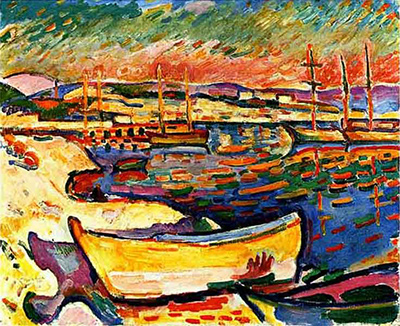
At the near edge of Georges Braque's Boats on the Beach, a yellow boat rests on the shore. The Los Angeles County Museum of Art identifies it as the foreground element in a harbour assembled from vivid, multicoloured strokes: water lies beyond it, masts rise through the scene, and a town extends along the far shore.[1] Those few motifs establish a surprisingly complete spatial order. The boat gives the eye a foothold; the water opens an interval; the masts interrupt that opening; the town closes the distance.
The painting dates from 1906, when Braque was testing the liberties of Fauvism. Its subject remains legible, yet the marks and colours used to establish the harbour retain an energy separate from description. A boat can be both a thing on a beach and a strong chromatic presence. Water can connect foreground and distance while remaining a field of visible strokes. Boats on the Beach makes this double life of the painted image its central event.
At a Glance
- ArtistGeorges Braque[1]
- TitleBoats on the Beach (Yellow Seacoast)[1]
- Date1906[1]
- Mediumoil on canvas[1]
- Dimensions19 1/2 × 27 1/2 in. (49.53 × 69.85 cm)[1]
- CollectionLos Angeles County Museum of Art[1]
- Accession53.55.1[1]
- SignificanceThe verified 1906 LACMA beach scene and explain its yellow ground, boats and Fauvist colour structure
Contents
- Introduction
- The museum title and the L'Estaque association
- The yellow boat as an anchor
- Water, masts and the far shore
- Braque's Fauvist year
- Related harbours, separate objects
- A painting acquired through one early gift
- Colour and recognition together
The museum title and the L'Estaque association
LACMA currently catalogues the work as Boats on the Beach. It is an oil on canvas measuring 49.53 by 69.85 centimetres, held under accession number 53.55.1 and credited as a gift of Anatole Litvak.[1]
A LACMA-associated print listing adds a second piece of title history. It calls the subject L'Estaque (Boats on the Beach), 1906.[2] That wording supports an association with the fishing village near Marseille while leaving the collection record's shorter title intact. It also helps place the painting within Braque's first southern campaign without pretending that every circulating name has equal institutional standing.
The distinction matters because Braque painted several beach and harbour subjects in 1906. Their titles overlap, and reproductions can easily make separate canvases appear to be alternative versions of one entry. For the Los Angeles painting, the secure identifiers are the LACMA title, its dimensions and accession 53.55.1.[1]
The yellow boat as an anchor
LACMA's description puts the yellow boat both on shore and in the foreground.[1] That placement gives it a different pictorial role from the masts and town beyond. It belongs to the nearest zone and provides a relatively concentrated object against a harbour described through more dispersed touches.
The boat therefore does more than announce the maritime theme. It stabilises the first stage of looking. From it, attention can move across the water towards the vertical intervals of the masts and then to the settlement on the far shore. The sequence creates depth through relationships among identifiable motifs rather than through an empty corridor leading to a distant vanishing point.
Yellow also gives the foreground anchor chromatic force. Its effect need not depend upon an exact imitation of a boat's local colour. In Fauvist painting, a hue could earn its place by the relations it created across the surface. Here the identified yellow element concentrates recognition at the front while the multicoloured strokes of the harbour distribute attention more widely.[1][3]
This balance keeps the boat from becoming an isolated emblem. Shore, water, masts and town make a connected system. The foreground object begins that system, but the eye must continue through the other zones to understand the scene.
Water, masts and the far shore
The water occupies the crucial interval between the grounded boat and distant town. LACMA describes it through vivid strokes rather than as an undifferentiated band.[1] Visible marks can suggest continuity and movement while also breaking the middle distance into separate acts of paint. The eye crosses the harbour, yet it remains aware of how that crossing has been made.
Masts add another kind of organisation. As narrow upright motifs, they can measure and interrupt the broader progression from shore to shore. They also preserve the identity of the harbour where colour and touch might otherwise loosen the scene. Their exact number is less important than the function implied by their recurrence: they connect boats, water and open space through a vertical rhythm.
The town along the far shore supplies an outer limit.[1] It maintains the sense that this is an inhabited coastal setting rather than a collection of detached colour patches. At the same time, distance does not require the town to dissolve into a neutral backdrop. The far zone participates in the same multicoloured field as the water and masts. Near and far remain distinguishable, but every part belongs to the painted surface.
Braque's Fauvist year
Braque's commitment to Fauvism followed his encounter with paintings by Henri Matisse, André Derain and others at the 1905 Salon d'Automne. The associated painters formed a loose group without a definitive programme, but they shared a new willingness to use high-keyed colour and undisguised brushwork outside the demands of literal appearance.[3][4]
During summer 1906, Braque worked beside Othon Friesz in Antwerp, experimenting with brighter colour and unusual viewpoints. In October he travelled to L'Estaque, a place already important to Paul Cézanne, and painted harbour as well as inland motifs.[3] The LACMA-associated location label connects Boats on the Beach with that southern setting, although the main collection record gives only the year.[1][2]
K20's account adds an important qualification to the familiar image of Fauvism. Braque's L'Estaque palette contained mixed tones as well as stronger colours.[3] Freedom from literal description did not impose one recipe of pure paint. It allowed each hue, mixture and interval to be judged by what it contributed to the whole.
That principle clarifies LACMA's description. The vivid strokes of water, masts and town can be read as a pictorial structure, not simply as colour laid over a pre-existing harbour drawing. They carry direction, separation and emphasis. The subject tells us what the marks describe; their placement and contrast tell us how the painting holds together.
A painting acquired through one early gift
LACMA traces the painting from Braque to Anatole Litvak. In 1953 Litvak gave it to the Los Angeles Museum of History, Science, and Art, the institution from which it transferred to LACMA in 1961.[1] The 1953 accession number reflects that earlier institutional gift, while the provenance records the later transfer.
The history is concise, but it establishes why the Los Angeles identity should govern. Boats on the Beach is neither the smaller Annenberg painting now at the Met nor the Keithley canvas in Cleveland. Its title, dimensions, accession and foreground description form one consistent record.
Colour and recognition together
The lasting interest of Boats on the Beach lies in the ease with which two kinds of order coexist. The harbour is readable because the boat, shore, water, masts and town retain distinct roles. The surface is active because vivid strokes and the yellow foreground presence refuse to become invisible vehicles for that recognition.
Braque did not have to choose between a coherent place and autonomous colour. The yellow boat makes the nearest point emphatic; the water opens the middle field; the masts give it intervals; the far town holds the scene at a distance. Each motif contributes to depth, yet each also participates in an arrangement of marks and chromatic weights across the canvas.
Seen this way, the painting needs no forecast of Braque's later Cubism to justify its importance. Its achievement belongs to 1906: a familiar harbour becomes structurally clear at the same moment that colour and brushwork claim freedoms of their own.
Related Pages
Frequently Asked Questions
At the near edge of Georges Braque's Boats on the Beach, a yellow boat rests on the shore.
LACMA currently catalogues the work as Boats on the Beach.
Seen this way, the painting needs no forecast of Braque's later Cubism to justify its importance.
Discussion
At the near edge of Georges Braque's Boats on the Beach, a yellow boat rests on the shore.
Reader Insights
At the near edge of Georges Braque's Boats on the Beach, a yellow boat rests on the shore.
Braque's commitment to Fauvism followed his encounter with paintings by Henri Matisse, André Derain and others at the 1905 Salon d'Automne.
Seen this way, the painting needs no forecast of Braque's later Cubism to justify its importance.
Join the Conversation
Share the visible detail or source that most changed your reading.
References
- Los Angeles County Museum of Art, “Boats on the Beach,” current collection record for the title, date, medium, dimensions, accession, credit, provenance and institutional description of the harbour. https://collections.lacma.org/object/15396
- LACMA Custom Prints, “L'Estaque (Boats on the Beach), 1906,” institution-associated listing used only for the qualified L'Estaque title and location association. https://customprints.lacma.org/detail/503419/braque-lestaque-boats-on-the-beach-1906
- Kunstsammlung Nordrhein-Westfalen, “Georges Braque,” current exhibition resource on Braque's 1905 encounter, Antwerp and L'Estaque sequence, mixed tones and the Fauvist picture as coloured surfaces and brushstrokes. https://www.kunstsammlung.de/en/braque/
- Metropolitan Museum of Art, “Fauvism,” on the loose group's 1905 emergence, high-keyed non-naturalistic colour and visible brushwork. https://www.metmuseum.org/essays/fauvism
- Metropolitan Museum of Art, “Boats on the Beach at L'Estaque,” current record for the separate 1906 Annenberg canvas and its first-southern-stay context. https://www.metmuseum.org/art/collection/search/492746
- Cleveland Museum of Art, “The Port of l'Estaque, the Pier,” current record for the separate 1906 Keithley canvas and its account of forceful strokes and complementary contrasts. https://www.clevelandart.org/art/2020.104