 by Tom Gurney
Tom Gurney BSc (Hons) is an art history expert with over 20 years experience
Published on August 14, 2026 / Updated on August 14, 2026
Email: tomgurney1@gmail.com / Phone: +44 7429 011000
Introduction
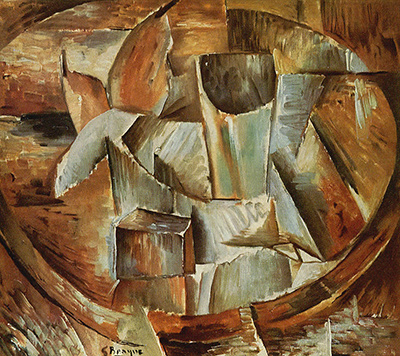
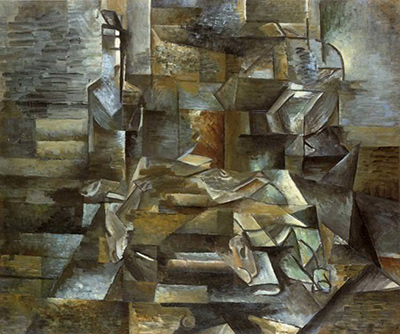
A fish still life usually promises abundance: curved bodies, a plate, a bottle and a table ready for use. Georges Braque gives those things a harder existence. In Bottle and Fishes, they survive first as categories, then emerge by degrees as parts of a domestic arrangement. A drawer can establish furniture before the table gains a stable outline; a plate can gather the idea of fish while its own boundary remains uncertain. Recognition grows from fragments that share their structure with the space around them.
The painting has another kind of instability. Tate dates it c.1910–12, a range that preserves competing documentary clues and an older proposal that Braque returned to the canvas over several years.[1] Its difficult appearance and difficult chronology belong to separate forms of evidence, yet together they discourage a single, effortless account.
At a Glance
- ArtistGeorges Braque[1]
- TitleBottle and Fishes[1]
- Datec.1910–12[1]
- MediumOil paint on canvas[1]
- Dimensions619 × 749 × 20 mm[1]
- CollectionTate T00445[1]
- SignificanceTate's difficult fish still life through object fragments, muted colour and a carefully bounded date
Contents
- Introduction
- Tate T00445
- Finding the domestic arrangement
- A grid of shared boundaries
- Sober colour after Fauvism
- Why the date remains c.1910–12
- Names on the reverse and in catalogues
- A separate basket of fish
- Dealers, sale and museum
- What remains available
Tate T00445
Bottle and Fishes, also recorded under the French title Bouteille et poissons, is an oil painting on canvas by Georges Braque. Tate's current record dates it c.1910–12 and gives the support as 619 by 749 by 20 millimetres. The museum purchased it in 1961, and its accession number is T00445.[1]
That identity establishes several useful limits. The broad date carries a circa qualification. The medium remains oil paint on canvas, preserving a clear material identity across the long date range. The plural “Fishes” belongs to the current English title. Each point matters because older labels, measurements and proposed dates attached to the same canvas vary.
The horizontal support is compact enough to hold the still life in close concentration. Its subject belongs to the familiar world of food, vessels and furniture, while its construction makes that world unusually demanding to retrieve. Braque uses ordinary things as tests of how little continuity an object needs before it can still be known.
Finding the domestic arrangement
Tate identifies a bottle, fishes on a plate and a table with a drawer.[1] These nouns offer a route through the fragmentation. A bottle supplies one object category; the relation between fishes and plate supplies another; the drawer helps turn an isolated shape into part of a table. The cues reinforce one another even when a complete outline stays unavailable.
Ronald Alley's catalogue entry, embedded in Tate's record, offered a more detailed inventory. He described three fishes on the plate and an object resembling an empty fruit bowl, alongside the bottle and table.[1] The qualification around the bowl is important. It records a resemblance without hardening an uncertain form into a fully identified vessel. The count of three belongs to this historic reading, while Tate's current caption keeps the safer plural.
This difference shows how a Cubist still life can remain legible without becoming diagrammatic. The title and museum account guide attention, but they leave the act of recognition active. One fragment may acquire meaning through its relation to another. The plate helps the fishes cohere as a group; the drawer makes furniture thinkable; the bottle adds a separate vessel category to the ensemble. Braque's subject survives through connections among partial signs.
Sober colour after Fauvism
Tate calls the colours sober and interprets both palette and domestic subject as a reaction against the luminous hues and freer expression of Braque's earlier Fauvist paintings.[1] The comparison concerns a change of purpose. Colour has moved away from the high-key independence associated with Fauvism and into the work of holding a fractured structure together.
Restraint gives small differences greater responsibility. When colour ceases to announce itself through brilliance, shifts of tone can support the uncertain passage between object fragment and surrounding plane. A limited chromatic range also allows the bottle, plate and furniture cues to inhabit one field as a connected structure.
“Sober” still describes an active use of colour. The painting's distance from Fauvism comes through control and redistribution. Braque channels expressive force into compression, recurrence and the tension between what can be named and what remains structurally open.
Why the date remains c.1910–12
The current Tate date is wider than a single stylistic label might suggest. Alley's 1981 catalogue entry assembled evidence that points toward several moments. He reported that George Isarlov had placed the painting among Braque's works of 1909, with a note that it was taken up again and finished in 1912. A Prague exhibition in May–June 1913 presented it as Fishes with the date 1911. One Kahnweiler label also reads “Fishes 1911,” while a second carries the alternative title The Kitchen Table.[1]
Alley brought those records together with his assessment of the paint. He considered the canvas exceptionally heavily worked and heterogeneous in style. In his reconstruction, the fractured composition related to still lifes of winter 1909–10, while stippled handling appeared closer to works of 1911–12. He therefore proposed a beginning in late 1909 or early 1910, extensive reworking in 1911 and finishing touches in 1912, either shortly before or shortly after Kahnweiler acquired it.[1]
The sequence is persuasive as a hypothesis and valuable as an explanation for the broad date. Its limits are equally valuable. No available account assigns individual passages securely to separate campaigns, and Alley's argument depends on stylistic comparison combined with labels and exhibition history. Tate's present c.1910–12 retains the useful part of that debate while avoiding false precision.[1]
The evidence has several levels. Exhibition and dealer labels document what the work was called and dated at particular moments. Alley's account of heavy, heterogeneous paint records a judgement about its making. Comparisons with other still lifes then place aspects of that handling within a developing practice. Together they support a history of return and revision, while each remains too limited to establish a complete sequence alone.
The range changes the historical character of the object. Bottle and Fishes can carry traces of Braque's rapidly developing practice without serving as a frozen illustration of one calendar year. Reworking offers a possible reason for heterogeneous handling; the record preserves that possibility while keeping the exact sequence open.
Names on the reverse and in catalogues
Alley recorded the inscription G. Braque on the back of the canvas.[1] Its reverse position makes it documentary, distinct from a signature designed to operate prominently within the painted composition. The changing titles perform a related archival function. Fishes, The Kitchen Table, Les Poissons, Bouteille et poissons and Bottle and Fishes have each directed attention toward some part of the same work.
Those names reveal the challenge of stabilising a fragmented subject. Some foreground the fish; one shifts attention toward furniture; the current title joins fish and bottle. Their variation leaves Tate T00445 intact. It records changing systems of exhibition, sale and cataloguing around an object whose visual cues resist a single exhaustive label.
A separate basket of fish
The Philadelphia Museum of Art's Basket of Fish, dated c.1910, offers a nearby experiment with a firmly separate identity. PMA describes a visible pair of fish crossed at the centre, with textured paint defining parts of a woven basket. It places those motifs among faceted planes and muted earth tones.[2]
Alley saw a relation between the Philadelphia work and Tate's painting. He considered the former possibly a study and judged a variant more likely.[1] That proposal captures a family resemblance without proving a preparatory sequence. The current museum records preserve decisive differences: Philadelphia identifies a crossed pair in a basket, while Tate identifies fishes on a plate with a bottle and table.
The distinction between study and variant affects the history implied by the comparison. A study would place one work in preparation for the other; a variant would treat them as parallel solutions to a related subject. Their broad dates and current records leave that order open. Alley's preference is therefore best retained as a careful judgement, short of a settled genealogy.
The comparison clarifies Braque's repeated interest in fish as a still-life problem. Similar subject matter could be reorganised through different containers and surrounding cues. Each painting must still be read on its own evidence; the basket supplies no missing contour or count for T00445.
Dealers, sale and museum
Galerie Kahnweiler purchased Bottle and Fishes from Braque in 1912. At the Kahnweiler sale held at the Hôtel Drouot on 7–8 May 1923, the painting appeared as lot 130 under Les Poissons. Josef Müller of Solothurn bought it for 500 francs.[1]
The work later passed through E. & A. Silberman Galleries in New York. Tate purchased it through Galerie Beyeler in 1961 with Grant-in-Aid.[1] This compact chain leaves intervals between its named stages, so it works best as a sequence of documented holdings and transactions. The sale title, dealer labels and acquisition history also explain why several names and dates continued to surround one canvas.
What remains available
Braque's still life asks the viewer to keep ordinary things in mind while their boundaries are repeatedly redistributed. Bottle, plate, fish, table and drawer persist because partial cues support one another. Sober colour helps the fragments belong to a common construction, and the planar grid gives their instability an order.
The historical record requires comparable care. Labels and stylistic observations support Alley's multi-stage proposal, while Tate's current c.1910–12 preserves the uncertainty that the evidence deserves. Visual recognition and documentary dating are different problems, yet both reward the same discipline: hold firmly to what can be recovered and leave the unresolved remainder open.
Related Pages
Frequently Asked Questions
A fish still life usually promises abundance: curved bodies, a plate, a bottle and a table ready for use.
Bottle and Fishes, also recorded under the French title Bouteille et poissons, is an oil painting on canvas by Georges Braque.
The historical record requires comparable care.
Discussion
A fish still life usually promises abundance: curved bodies, a plate, a bottle and a table ready for use.
Reader Insights
A fish still life usually promises abundance: curved bodies, a plate, a bottle and a table ready for use.
The current Tate date is wider than a single stylistic label might suggest.
The historical record requires comparable care.
Join the Conversation
Share the visible detail or source that most changed your reading.
References
- Tate. “Georges Braque, Bottle and Fishes, c.1910–12, T00445.” https://www.tate.org.uk/art/artworks/braque-bottle-and-fishes-t00445
- Philadelphia Museum of Art. “Georges Braque, Basket of Fish, c.1910.” https://www.philamuseum.org/objects/63323