 by Tom Gurney
Tom Gurney BSc (Hons) is an art history expert with over 20 years experience
Published on August 14, 2026 / Updated on August 14, 2026
Email: tomgurney1@gmail.com / Phone: +44 7429 011000
Introduction
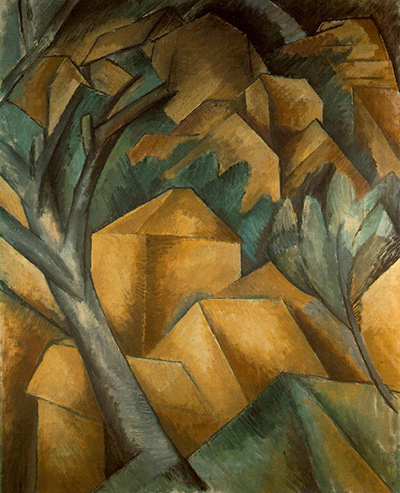
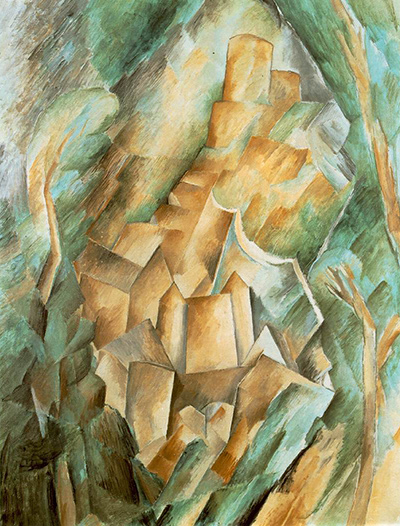
At La Roche-Guyon, a castle rises from a rocky slope. In Georges Braque's 1909 painting, the more revealing question is where the architecture ends. Walls, cliff, tree trunks and sky answer one another so closely that the building seems generated by the same pressures as the landscape around it. The subject remains recognisable, yet the familiar distinction between a structure and its setting has become unstable.
That instability gives The Castle at La Roche-Guyon much of its force. It also creates a practical problem: Braque made several castle paintings during the same campaign, and museums catalogue them under nearly identical titles. The work discussed here is the vertical canvas in the Pushkin State Museum of Fine Arts, museum number Ж-3258. It dates from 1909, is painted in oil on canvas, measures 92 × 73 centimetres and entered the museum in 1948.[1]
At a Glance
- ArtistGeorges Braque[1]
- TitleThe Castle at La Roche-Guyon[1]
- Date1909[1]
- MediumOil on canvas[1]
- Dimensions92 × 73 cm[1]
- CollectionPushkin State Museum of Fine Arts[1]
- InventoryЖ-3258[1]
- SignificanceThe 1909 landscape's interlocking architecture and the difficulty of distinguishing Braque's several La Roche-Guyon versions
Contents
- Introduction
- A summer beside the Seine
- When architecture becomes geology
- A surface that seems worked and cut
- Several views held on one surface
- Colour under structural pressure
- Which Castle at La Roche-Guyon?
- An early Cubist landscape
A summer beside the Seine
Braque spent the summer of 1909 at La Roche-Guyon, a village on the Seine northwest of Paris. The site brought architecture and geology into unusually close contact. A lower castle occupies the slope, while the remains of an older stronghold, including a round tower, stand higher on the rock.[6] Such a place offered more than a picturesque landmark. Buildings, cliff and vegetation formed a vertical sequence in which human construction appeared embedded within the land.
The stay produced a concentrated group of works. Moderna Museet's account records eight paintings of the village, five of them devoted to the medieval castle; the Metropolitan Museum of Art likewise identifies its own canvas as one of five castle views.[3][4] The repetition matters. Braque was returning to a motif and testing how far it could be rebuilt from one canvas to another. “The castle” therefore names a campaign as well as an individual painting.
Serial work gives the motif a different purpose from the one-off souvenir of a place. The castle supplied a set of durable relations—built mass against rock, lower architecture against higher ruin, vertical ascent against the river landscape—whose balance could be reconsidered repeatedly. Each canvas became a fresh solution within that shared problem. The surviving museum records reveal the extent of the campaign even when they leave the exact order of its paintings open.
La Roche-Guyon already carried an important artistic precedent. Cézanne had painted there approximately twenty-four years earlier.[4] For Braque, Cézanne's example made landscape available as a problem of construction: houses, trees and rock could be organised through their underlying relations, with incidental scenery subordinated to them. Braque's 1909 paintings push that inquiry into a more fractured register. The shared location clarifies a lineage, while the Pushkin canvas shows an artist making the inherited problem his own.
When architecture becomes geology
The Ministry of Culture's Artefact account, attached to the Pushkin painting, describes the castle as turning into a crystalline rock. The structure of that rock then affects the rest of the composition, reaching even into the sky.[2] “Crystalline” is useful here because it conveys both unity and division. A crystal is a single body, but its facets face in different directions. In Braque's landscape, the idea helps explain how castle, cliff and atmosphere can belong to one pictorial system while retaining their separate names.
The castle has consequently lost the privilege that architecture usually enjoys in a landscape. It is no longer an intact object placed against a passive background. The rock does more than support it, and the sky does more than fill the remaining space. Similar transitions and pressures carry across these categories, making the eye repeatedly renegotiate their boundaries. Architecture becomes geological; geology acquires something of architecture's constructed order.
This exchange stops short of dissolving the subject. The title still directs attention to a castle, and the painting's organisation depends upon the tension between recognition and reconstruction. Braque keeps enough of the landmark's identity for the transformation to register. If everything became wholly abstract, the central drama—the sense of a building being remade through the forces of its setting—would disappear.
A surface that seems worked and cut
The same institutional account characterises Braque's handling as chisel-like, formed from notched brushstrokes.[2] The language suggests resistance. Paint seems to set edges and planes into place through small acts of pressure. The surface appears worked; smooth recession gives way to cutting, fitting and joining, all achieved with the brush.
Artefact also explains that buildings tend towards cubes and tree trunks towards cylinders.[2] These are tendencies of simplification, with the village remaining legible through them. Their importance lies in what they make comparable. An irregular wall, a mass of stone and the upright growth of a trunk can be translated into forms with stronger internal coherence. Once simplified, they can enter a common rhythm while preserving their differences.
The geometric language also changes the status of detail. A descriptive landscape might invite attention to masonry, foliage or distant incident. Braque concentrates on how masses occupy and press against one another. The painting's subject is still La Roche-Guyon, but its deeper activity lies in the construction of relations: solid form against surrounding space, one volume answering another, one plane turning towards the next.
Several views held on one surface
Artefact links the painting's dynamism to Braque's use of different views and to his effort to give space a material presence.[2] A conventional perspective promises a stable position from which forms diminish and recede. Here that continuity is weakened. Adjacent planes can suggest that a mass has been considered from more than one orientation, so the eye must keep adjusting its sense of how things turn, overlap and meet.
The effect resists reduction to a diagram of fixed viewpoints. Recession and surface presence remain in active competition, while neighbouring forms feel tightly joined. Depth survives, but it shares attention with the physical organisation of the canvas. Space becomes something constructed through intervals and contacts, no longer an empty container waiting behind the objects.
This material quality of space helps unite the painting's two apparent subjects. A castle normally implies enclosure, weight and designed order, while a cliff suggests irregular formation over time. Braque brings both into the same network of planes. Their encounter can then be read in two directions: the architecture seems roughened and embedded by the rock, while the landscape takes on the castle's firmness and articulation. Space participates in the exchange by pressing around and between the masses.
That tension gives the castle an unusual kind of presence. Its solidity comes less from illusionistic volume than from the density of its relationships. The building appears substantial because the surrounding rock, vegetation and sky participate in its construction. Braque creates firmness while denying the castle a simple isolation from its environment.
Colour under structural pressure
The written account of the Pushkin canvas identifies a range of grey, green, yellow and brown.[2] These colours can accommodate different kinds of matter without breaking the composition into brightly separated zones. Their recurrence binds architecture and landscape, allowing a wall, a patch of ground or an area of vegetation to participate in the same restrained chromatic field.
Colour therefore supports the painting's structural argument. It preserves variation, yet it avoids giving every element an independent visual identity. Together, the four named hues create range within a shared field. Their work across the surface matters more than any fixed assignment of one colour to one object. Braque's palette helps keep the subject legible while drawing its parts into a common order.
Which Castle at La Roche-Guyon?
The Pushkin canvas is readily confused with other paintings from the campaign. The safest guide is the combination of collection, dimensions and museum number. Ж-3258 is the 92 × 73-centimetre Pushkin work.[1] The Metropolitan Museum's version, accession 2025.616.11, measures 64.8 × 54.6 centimetres.[3] LaM holds a 73 × 60-centimetre canvas, inventory 979.4.17, which entered through the Masurel donation in 1979.[5] The Van Abbemuseum's painting is inventory 51 and was acquired in 1953; its record publishes a much larger measurement of 116.2 × 96.3 × 4.2 centimetres, explicitly including the frame.[6] Moderna Museet is associated with another castle version from the group.[4]
Each record concerns a separate painting. The distinction reaches beyond administration. Repetition allowed Braque to reconsider the motif, so a vivid observation made about one museum's version belongs to that object. Dimensions and accession numbers protect the individuality of each work while restoring the larger fact of the campaign: five sustained attempts to make the castle and its rocky setting cohere on a painted surface.
An early Cubist landscape
Artefact places the Pushkin painting within Braque's early Cubism, while the Moderna account discusses the 1909 castle works through the idea of faceted Cubism.[2][4] The term “faceted” is especially apt as a mode of connection. Planes meet like worked faces; each retains a direction, and together they build a larger body.
In the Pushkin canvas, that body encompasses human architecture and the natural world. The castle gains its strength through the cliff, the cliff acquires a constructed rhythm, and even the sky enters the crystalline order. Cézanne's precedent remains present in the conviction that landscape can be built, but Braque intensifies the exchange among object, setting and surface. The result occupies the charged interval between a topographical record and a vanished motif. It is a place made newly intelligible through reconstruction.
The achievement of The Castle at La Roche-Guyon lies in that balance. Braque can pull the landmark apart without surrendering it. Recognition persists across notched strokes, simplified volumes, shifting views and a tightly related palette. Castle and cliff become difficult to separate because the painting has discovered a structure capable of holding them together.
Related Pages
Frequently Asked Questions
At La Roche-Guyon, a castle rises from a rocky slope.
Braque spent the summer of 1909 at La Roche-Guyon, a village on the Seine northwest of Paris.
The achievement of The Castle at La Roche-Guyon lies in that balance.
Discussion
At La Roche-Guyon, a castle rises from a rocky slope.
Reader Insights
At La Roche-Guyon, a castle rises from a rocky slope.
The geometric language also changes the status of detail.
The achievement of The Castle at La Roche-Guyon lies in that balance.
Join the Conversation
Share the visible detail or source that most changed your reading.
References
- Pushkin State Museum of Fine Arts, “Картина. Замок Ла Рош Гюйон,” View source.
- Ministry of Culture of the Russian Federation / Artefact, “Castle at La Roche-Guyon,” View source.
- The Metropolitan Museum of Art, “The Castle of La Roche-Guyon,” View source.
- Moderna Museet, “The Castle of la Roche-Guyon,” View source.
- LaM, “La Roche-Guyon,” View source.
- Van Abbemuseum, “La Roche-Guyon,” View source.