 by Tom Gurney
Tom Gurney BSc (Hons) is an art history expert with over 20 years experience
Published on August 14, 2026 / Updated on August 14, 2026
Email: tomgurney1@gmail.com / Phone: +44 7429 011000
Introduction
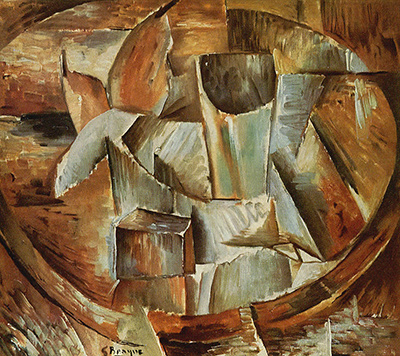
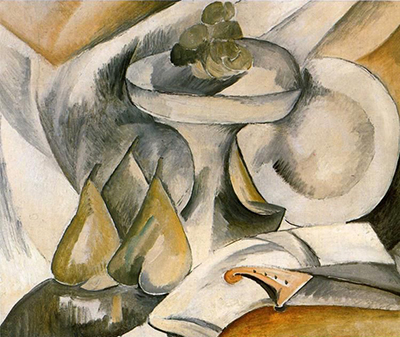
A pink knife handle is a small detail on which to build an account of a painting. In Georges Braque's Plate and Fruit Dish, however, it becomes one part of a compact formal drama. When the critic Karen Wilkin considered the work in 1989, she also drew attention to pears retaining a lively presence and to curves that appear detached yet rhythmic.[4] Between those observations lies the painting's central interest: familiar things remain available to recognition while lines and accents begin to organise relationships across the wider field.
Braque painted the work in 1908. Three catalogue records agree that it is an oil on canvas measuring 46 × 55 centimetres and held in a private collection.[1][2][3] FreeArt gives the more precise date of autumn 1908 and also records the variant title Still-Life with Fruit-dish and Plate.[1] These basic facts place a modest horizontal canvas at an especially concentrated point in Braque's development.
The nine-centimetre difference between height and width makes the format gently horizontal while preserving its compactness. Width allows relations to unfold laterally, yet fifty-five centimetres still keeps every interval close. In a still life built from a small family of objects, that balance gives each separation consequence: the field can expand across the eye without becoming panoramic.
At a Glance
- ArtistGeorges Braque[1]
- TitlePlate and Fruit Dish[1]
- Dateautumn 1908, with 1908 as the wider consensus[1]
- MediumOil on canvas[1]
- Dimensions46 × 55 cm[1]
- CollectionPrivate collection[1]
- SignificanceAn early private-collection still life cautiously and explain its place in Braque's 1908 object experiments
Contents
- Introduction
- Two related vessels
- A still life at the 1908 threshold
- Pears that remain lively
- Curves released into rhythm
- The surprise of a pink handle
- Seen through a comparative exhibition
A still life at the 1908 threshold
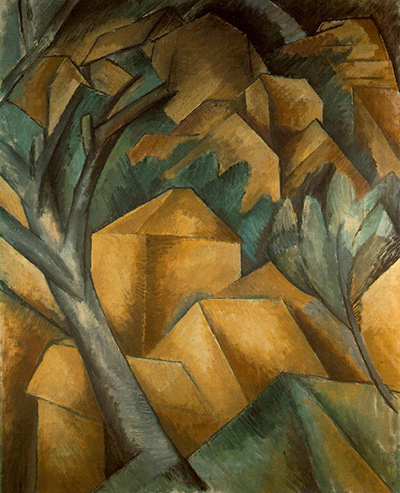
Centre Pompidou places Braque's 1908 still lifes beside his work at L'Estaque. During that year he returned from the south with landscapes in which houses and trees had been translated into geometric volumes, while painting roughly eight still lifes in parallel.[5] The two strands developed alongside one another: architecture and vegetation supplied one field of construction, movable everyday objects another.
The autumn date given to Plate and Fruit Dish locates it within this intense period of exchange between subjects. The objects of a still life offered stable identities—plate, dish, fruit, knife—while their contours and intervals could be reconsidered. The picture concentrates upon a limited set of relations held inside a compact format.
Landscape and still life posed different demands. Houses and trees carried place, scale and architectural weight; vessels, fruit and a utensil brought handling, use and close comparison. Their shared challenge was construction: how could distinct forms retain identity while contributing to a pictorial unity stronger than an inventory of parts?
That historical position is best understood as a threshold. Braque was applying constructive pressure to ordinary things while preserving their legibility. The painting belongs to an early 1908 inquiry in which the parts of a still life could become a tightly organised field. The experiment remains concentrated within oil on canvas and a familiar object vocabulary.
Pears that remain lively
Wilkin's attention to the pears is important because liveliness and construction can pull in different directions.[4] Pears are familiar through their bodily irregularity. They can remain recognisable even when their surrounding relations become more deliberate, allowing organic presence to persist within a disciplined arrangement.
Their animation also prevents geometry from becoming the sole subject. The viewer encounters familiar fruit within the structural experiment. Recognition gives the eye something to hold while other elements—curves, intervals and the knife handle—extend attention beyond each individual thing.
The pears therefore carry a double responsibility. They belong to the named subject, maintaining the everyday character of still life, and they provide responsive forms within a larger rhythm. Their liveliness is less a story about the fruit than a quality of pictorial presence: the objects remain active participants in the construction.
Curves released into rhythm
Wilkin's other observation concerns curves that seem detached and rhythmic.[4] A contour usually serves an object by enclosing it. Once a curve feels partly released from that task, it can be perceived across the painting as an event in its own right. Its relation to another curve may become as significant as the thing it once helped to describe.
Rhythm depends upon recurrence and interval. A curve can call attention to a later response, allowing the eye to connect separate passages without requiring a continuous outline. The still life's unity can then emerge through echoes among lines as well as through the adjacency of objects.
Each curve can consequently hold a double allegiance. It retains some descriptive force through its relation to the object world, and it acquires a rhythmic role through its relation to other lines. This dual function allows construction to grow from the still life's own elements.
Detachment and recognition coexist. Plate, fruit dish, pears and knife remain conceptually secure through title and critical description. What changes is the exclusiveness of their boundaries. A line can help identify a thing while also participating in an order that exceeds it.
This is where the work's early position becomes especially revealing. Braque can make line increasingly autonomous while retaining an ordinary object world. The tension between those conditions gives the painting energy: things are still things, yet their curves belong to the picture as a whole.
The surprise of a pink handle
The pink knife handle singled out by Wilkin provides a different kind of incident.[4] A handle is a fragment with strong identifying power. It calls up a familiar utensil through the part designed to be grasped, bringing touch and practical use into a painting otherwise organised around vessels and fruit.
Its colour makes the cue more pointed. Pink functions here as a local accent, directing attention to one object fragment without defining the canvas's complete palette. The accent can interrupt an established rhythm or create a new response elsewhere, but its first achievement is concentration: a small component becomes memorable.
The handle also differs functionally from the plate and fruit dish. Vessels support or contain; a knife is held and moved. Even without prescribing its exact orientation, the handle introduces the idea of direction into the still life. That latent movement answers the vitality Wilkin found in the pears and the mobility she found in the curves.
Seen through a comparative exhibition
Wilkin wrote about Plate and Fruit Dish while reviewing the Museum of Modern Art's Picasso and Braque: Pioneering Cubism, organised by William Rubin. Her account describes an exhibition of nearly four hundred works spanning the artists' shared experimental years from 1907 to 1914.[4] Within such a dense comparison, the details she selected are telling.
The three details operate at different levels. Pears belong to the recognisable subject; detached curves concern the behaviour of line; the pink handle joins an object fragment to a colour accent. Wilkin's selection therefore moves from thing to structure to concentrated incident. Together they offer a compact account of how the painting remains concrete while reorganising the relations among its parts.
These are modest incidents, yet their animation, rhythm and accent make the work distinctive. Wilkin's response suggests how closely the painting rewards attention: its character becomes legible through the behaviour of ordinary parts.
Plate and Fruit Dish belongs to a moment when Braque was learning how much those parts could do. A plate and fruit dish establish related functions; pears keep bodily recognition alive; detached curves create connections across the field; a pink handle concentrates colour and the possibility of movement. In a canvas only 46 × 55 centimetres, the still life becomes a testing ground for coherence—one in which familiar objects retain their identities while the painting begins to claim a stronger order of its own.
Related Pages
Frequently Asked Questions
A pink knife handle is a small detail on which to build an account of a painting.
The title begins with two objects that are close in function while remaining distinct.
Plate and Fruit Dish belongs to a moment when Braque was learning how much those parts could do.
Discussion
A pink knife handle is a small detail on which to build an account of a painting.
Reader Insights
A pink knife handle is a small detail on which to build an account of a painting.
The pears therefore carry a double responsibility.
Plate and Fruit Dish belongs to a moment when Braque was learning how much those parts could do.
Join the Conversation
Share the visible detail or source that most changed your reading.
References
- FreeArt / Olga's Gallery, “Georges Braque: Biography and Works,” View source.
- WikiArt, “Plate and Fruit Dish,” View source.
- Artchive, “Plate and Fruit Dish (1908; France),” View source.
- Karen Wilkin, The New Criterion, “O pioneers! Picasso & Braque 1907–1914,” View source.
- Centre Pompidou, “Les Instruments de musique,” View source.