 by Tom Gurney
Tom Gurney BSc (Hons) is an art history expert with over 20 years experience
Published on August 14, 2026 / Updated on August 14, 2026
Email: tomgurney1@gmail.com / Phone: +44 7429 011000
Introduction
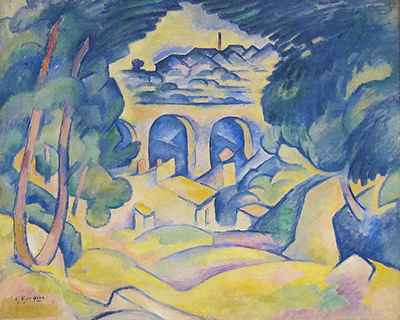
A viaduct is already a system before a painter begins to transform it. Supports carry a passage across broken ground; openings divide a long structure into intervals; repetition joins separate parts. In The Viaduct at L'Estaque, Georges Braque used that built rhythm to rethink the surrounding landscape. Architecture offered a measure, while colour, tilted planes and a retained horizon kept the scene alive as a place.
The Minneapolis Institute of Art dates the painting to 1907. It is an oil on canvas measuring 65.1 by 80.6 centimetres, with accession number 82.22.[1][2] Its horizontal proportions distinguish it immediately from the vertical viaduct now at the Centre Pompidou. The museum records and Pompidou's historical account together identify the Minneapolis canvas as the first version of Braque's treatment of this motif.[2][3]
That identity matters because the two museum versions express different stages of the same investigation. The Minneapolis painting belongs to Braque's work at L'Estaque in October 1907. The Pompidou canvas followed in Paris early in 1908, rebuilt in the studio from memory.[3] The first stage reveals a landscape in which geometric pressure gathers force without extinguishing colour or distance.
At a Glance
- ArtistGeorges Braque[1]
- TitleThe Viaduct at L'Estaque (Minneapolis version)[1]
- Date1907–08[1]
- MediumOil on canvas[1]
- Dimensionsoverall 65.1 × 80.6 cm[1]
- CollectionMinneapolis Institute of Art[1]
- Accession82.22[1]
- SignificanceThe horizontal Minneapolis viaduct as its own 1907 landscape
Contents
- Introduction
- The viaduct as an organising idea
- October 1907 and the example of Cézanne
- A landscape built through local relations
- Iridescence and the blue horizon
- From the site to a memory reconstruction
- The painting's path to Minneapolis
- A structure that preserves the landscape
The viaduct as an organising idea
Landscape painting often finds order through recession: a road, river or chain of hills can carry the eye towards a distant point. A viaduct introduces another kind of coherence. Its structure extends laterally, and its supports and openings establish recurrence. It belongs to the depicted place, yet its intervals also resemble a compositional framework.
Braque could use those architectural properties without turning the canvas into an engineering diagram. The title makes the viaduct the declared motif, while the surrounding site remains the field in which its rhythm operates. Built form and terrain enter a shared problem: how can distinct parts of a landscape hold together when conventional depth ceases to govern every relation?
The horizontal format reinforces that question. Its width gives the subject room to unfold as a sequence, and the viaduct provides a way to articulate that span. Repeated architectural units can guide movement across a surface while linking one area to another. The bridge therefore functions both as an object within L'Estaque and as an instrument for organising the picture.
This double role helps explain the subject's importance in 1907. Braque was asking landscape to become more structurally explicit. A viaduct made interval, continuity and support visible as architectural principles. Those principles could then extend beyond the built motif, bringing the wider scene into a firmer pictorial order.
October 1907 and the example of Cézanne
Braque's return to L'Estaque followed the major Cézanne retrospective at the Salon d'Automne of 1907. K20 describes Cézanne's example as a decisive stimulus: natural forms could approach geometry, while space could become flatter and more relief-like.[4] Centre Pompidou places the first viaduct in October, during the campaign that followed this encounter.[3]
L'Estaque carried special historical weight. Cézanne had painted there before Braque, showing how Mediterranean terrain and buildings could be treated as interdependent masses. The Minneapolis Institute of Art connects Braque's 1907 work directly with that precedent. Its account says that he reduced the site to simple geometric forms, following a principle he found in Cézanne.[2]
Influence here becomes a working method expressed through new relations of mass and plane. Cézanne offered a way to regard landscape as something constructed through such relations. The viaduct gave Braque a subject in which construction existed both literally and pictorially. Its built spans supplied one order; the painter could test how far that order might reshape the site around them.
MIA also identifies the point of departure. Braque's tilting planes follow laws created within the picture itself.[2] The landscape consequently gains a controlled instability. Forms remain parts of a recognisable place, while their angles and connections answer the demands of the canvas. Cézanne's example opens the inquiry; Braque's own arrangement determines its outcome.
A landscape built through local relations
K20 describes the Minneapolis viaduct through basic geometric forms held in a structured pictorial framework. Central perspective loses its traditional authority, and layered, faceted forms direct attention to the flatness of the painted surface.[4] These terms describe a change in how depth is organised.
In central perspective, a unified system draws forms towards a stable vanishing point. Braque instead gives greater force to local encounters: one plane tilts against another; a layer overlaps or presses beside its neighbour; a facet changes direction within a larger mass. Space arises through these connections across the field. The canvas presents a landscape and makes its construction perceptible at the same time.
Flatness in this context remains compatible with distance. A painted plane can suggest recession while also asserting its shape on the surface. Layering can place one form before another while binding both into a compact design. The result holds two kinds of experience together: a specific site extending in space and a material rectangle organised through adjacent areas.
The viaduct is especially effective within that tension. As architecture, it implies passage across depth and uneven terrain. As a repeated configuration, it also establishes a pattern across the surface. Its practical function and its pictorial function reinforce each other. The landscape can still be entered imaginatively, while every interval recalls the ordering presence of the canvas.
Geometric reduction sharpens this effect. Simplifying a site concentrates attention on the relations that make it cohere. Tilt gains emphasis; repeated units become more legible as a rhythm; layered forms carry more structural weight. Recognition survives, yet description yields some of its authority to organisation.
Iridescence and the blue horizon
The first viaduct retains a quality that broad summaries of early Cubism can easily suppress. Centre Pompidou characterises the Minneapolis version through coloured iridescence and a bluish horizon.[3] Its geometry therefore operates within a chromatically active landscape.
Iridescence suggests shifting colour across the field. Variations differentiate forms and energise their junctions, giving the geometric relations a sensory presence. A plane becomes more than an abstract division when colour makes its position, contrast or continuity felt.
The bluish horizon performs a related task at the edge of distance. It preserves a spatial register beyond the layered structures while also contributing a band of colour to the surface. Horizon and flatness consequently remain in productive tension. One carries the thought outward; the other recalls the physical field on which that distance has been made.
Colour also clarifies Braque's historical position. The Minneapolis painting emerged from a period in which Fauvist freedom had released hue from strict local description. Its iridescence keeps that freedom present, even as geometry imposes stronger construction. The canvas records no simple exchange of colour for form. Chromatic variation helps the new structure work.
That coexistence gives the first version a distinctive character. The site is reduced and reorganised, though it retains a colour-bearing horizon and a varied chromatic life. Braque's inquiry develops through the pressure between these qualities. Structure gathers the landscape; colour prevents the structure from becoming inert.
From the site to a memory reconstruction
The Centre Pompidou's vertical Viaduct at L'Estaque reveals how quickly the problem changed. A few months after the Minneapolis version, Braque returned to the motif in his Paris studio and worked from memory. The later canvas measures 72.5 by 59 centimetres, reverses the earlier horizontal orientation and concentrates attention on architectural geometry.[3]
This shift in working conditions carried artistic consequences. Memory could strip a place to its most persistent relations, freeing the painter from the abundance of the immediate site. The vertical format also gathered the motif into a tighter field. Pompidou describes reduced colour and stronger compression in that second treatment.[3]
The comparison protects the individuality of the Minneapolis picture. Its width, iridescence and bluish horizon belong to an earlier balance between observed landscape and pictorial reconstruction. The Paris canvas advances by contraction; Minneapolis remains expansive enough for architecture, colour and horizon to act together. Each version answers a different stage of Braque's question.
The sequence also makes historical change concrete. Cubism emerged through successive decisions as a motif was tested, remembered and rebuilt. Between October 1907 and early 1908, the viaduct became a means of discovering how much a landscape could be reorganised while still retaining the traces of place.
The painting's path to Minneapolis
The painting's ownership history begins with Braque and the dealer Daniel-Henry Kahnweiler. MIA records it with Galerie Kahnweiler from 1908 to before 1914, followed by a possible period with Antonie Albert. It appeared as lot 38 in a Galerie Neupert sale in Zurich on 4 April 1936, then belonged to Countess Angiola Maria Approsio in Sanremo.[2]
By 1979 the work was with Galerie Berggruen in Paris. E. V. Thaw & Co. held it by 1980–82 and sold it to the Minneapolis Institute of Art.[2] The museum acquired it through the John R. Van Derlip Fund, the Fiduciary Fund and gifts from the Butlers and other donors. That path carried a landscape made during Braque's concentrated L'Estaque campaign into a public American collection.
A structure that preserves the landscape
The Viaduct at L'Estaque belongs to a moment when Braque was making a landscape answer increasingly to its own pictorial order. Simple geometric forms, tilting planes, layers and facets loosen the rule of central perspective. The viaduct gives these relations a recurring architectural measure, connecting the practical logic of a bridge with the organising logic of a painting.
Yet the Minneapolis version keeps the experiment open. Iridescent colour moves through the constructed field, and the blue horizon sustains a thought of distance. Cézanne's influence remains visible as a principle of geometric coherence, while Braque's unstable planes establish an independent direction.
The canvas gains its historical force from this active balance. It is a complete landscape of October 1907 and a decisive experiment in how landscape might be rebuilt. Architecture orders the site, colour animates the order, and depth persists through a surface that has begun to declare its own laws.
Related Pages
Frequently Asked Questions
A viaduct is already a system before a painter begins to transform it.
Landscape painting often finds order through recession: a road, river or chain of hills can carry the eye towards a distant point.
The canvas gains its historical force from this active balance.
Discussion
A viaduct is already a system before a painter begins to transform it.
Reader Insights
A viaduct is already a system before a painter begins to transform it.
Geometric reduction sharpens this effect.
The canvas gains its historical force from this active balance.
Join the Conversation
Share the visible detail or source that most changed your reading.