 by Tom Gurney
Tom Gurney BSc (Hons) is an art history expert with over 20 years experience
Published on August 14, 2026 / Updated on August 14, 2026
Email: tomgurney1@gmail.com / Phone: +44 7429 011000
Introduction
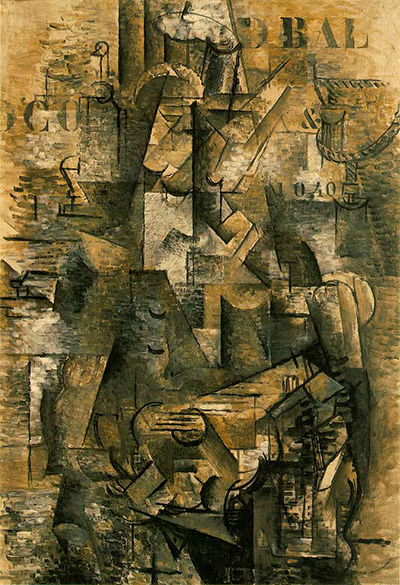
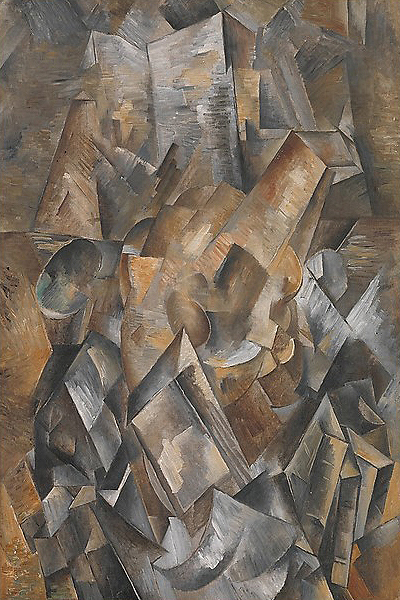
A still life usually gathers things whose movement has ceased. Georges Braque introduced a sharper tension into that familiar genre when he included a metronome, a mechanism designed to divide time through repeated motion. Its casing may be closed, yet its purpose is to set a beat. Its key calls for a hand to wind it. Lines around it can suggest the swing of a pendulum. In Still Life with Metronome (Still Life with Mandola and Metronome), the ordinary equipment of musical practice becomes a way to think about how a motionless painting can imply touch, sequence and duration.
Braque made the picture in Paris in late 1909. It is an oil on canvas measuring 81 × 54.1 centimetres, now in the Metropolitan Museum of Art as accession 2025.616.13. The work entered the Leonard A. Lauder Cubist Collection at the museum through Leonard A. Lauder's gift in 2025.[1] Its tall proportions give the two title objects different kinds of presence: the metronome occupies the upper left, while the larger stringed instrument remains identifiable nearer the centre.[2][3]
Those objects survive inside an increasingly intricate pictorial construction. The Met places the canvas in the early phase commonly called Analytic Cubism, when Braque broke subjects into rudimentary shapes, layered planes and a simplified range of neutral colours.[2] Recognition persists, though it arrives in fragments. The viewer encounters enough of a mandola and a metronome to name them, even as their forms participate in a field whose spatial relations resist a single, settled reading.
At a Glance
- ArtistGeorges Braque[1]
- TitleStill Life with Mandola and Metronome[1]
- DateParis, late 1909[1]
- MediumOil on canvas[1]
- Dimensions81 × 54.1 cm[1]
- CollectionThe Metropolitan Museum of Art, New York[1]
- Accession2025.616.13[1]
- SignificanceThe Met painting to explain how music, measured time and spatial ambiguity converge at the start of Analytic Cubism
Contents
- Introduction
- A painting with several names
- Early Analytic Cubism and the persistence of things
- The off-centre timekeeper
- A key that asks to be turned
- Movement held inside closure
- From spatial ambiguity to duration
- Another metronome, another state
- A musical object for an unfamiliar language
A painting with several names
The history of the title records that difficulty of recognition. Braque's first dealer, Daniel-Henry Kahnweiler, called the work Still Life with Mandolin. The Met now identifies the central instrument as a mandola, the mandolin's larger cousin. In 1938, Christian Zervos used Mandolin and Metronome, explicitly adding the mechanical device. According to Met curator Lauren Rosati, the painting acquired a specific metronome designation about thirty years after it was made.[3]
Each name places emphasis differently. Kahnweiler's version secures the genre and an instrument family. Zervos pairs instrument with timekeeper. The museum's full present title leads with the metronome while retaining Still Life with Mandola and Metronome in parentheses. Across that sequence, the object remained the same while the language used to retrieve its parts became more exact.
This matters because the painting depends upon partial legibility. Its forms have undergone enough disruption to make identification active, yet sufficient cues remain for later viewers and cataloguers to revise what they see. “Mandola” distinguishes the central instrument more precisely. “Metronome” brings a shape at the upper left into the conceptual centre of the work. Naming becomes a record of sustained looking.
The distinction between mandolin and mandola also protects the painting from becoming a generic musical scene. A mandola belongs to a familiar family of plucked stringed instruments, but its identification here is specific. Braque gives the viewer an object whose practical identity can persist amid formal fragmentation. The title consequently works as an aid to recognition while leaving the spatial puzzle intact.
Early Analytic Cubism and the persistence of things
The Met's description of early Analytic Cubism offers a concise vocabulary for the canvas: rudimentary shapes, overlapping planes and neutral colour.[2] These features redistribute attention. A conventional still life might make each object appear self-contained, with one boundary separating it from the next. Braque's construction allows edges and planes to participate in several relationships at once.
Overlap introduces depth, though the result is unlike a stable recession into a room. One plane advances against another; a sign belonging to an instrument may appear, weaken and rejoin the surrounding structure. The painting's shallow space grows through interruptions and correspondences. Its uncertainty comes from the coexistence of spatial cues while objects retain partial identities.
The restricted colour range strengthens this emphasis. Neutral colours allow distinctions of angle, density and overlap to carry much of the organisation. Colour remains part of the painting's structure, yet it yields the leading role to the relations among forms. The mandola can emerge through selected cues while other parts of its body dissolve into neighbouring planes.[2]
At 81 centimetres high and just over 54 centimetres wide, the canvas is markedly vertical. That shape gives Braque room to distribute recognition across levels. The metronome's upper-left position establishes an angular event away from the centre, while the mandola holds the middle of the field. Their separation creates a relation that the eye has to build: mechanism above and to one side, instrument nearer the centre, both caught in the same network of planes.
The objects provide different kinds of stability. The mandola contributes the identity of a musical instrument and the possibility of performance. The metronome contributes a compact geometric casing and a mechanical function. One would make music in a player's hands; the other would regulate musical practice by setting tempo. Their practical difference becomes a resource for pictorial construction.
The off-centre timekeeper
Rosati describes the metronome through its pyramidal or faceted trapezoidal shape.[3] This familiar casing gives Braque a ready-made angular volume. Placed off centre, it can suggest depth while avoiding the symmetry that might make the composition feel fixed. The device acts as both a recognisable thing and a compact spatial instrument.
Its position at the upper left is important because an off-centre object creates directional pressure. The eye meets an identifiable casing away from the central mandola, then has to negotiate the planes between them. The tall canvas accommodates that displacement. Depth arises through the relation between angular form, placement and overlap, even as the surrounding construction keeps that depth unsettled.
The metronome also differs from an ordinary vessel or piece of fruit. Its shape encloses a mechanism. A closed casing implies an interior, and that interior holds the pendulum that gives the device its purpose. The object therefore carries two spatial conditions at once: an outer faceted body and an imagined working space within it.
That concealed mechanism gives the painting an unusually productive object. The casing can serve Braque's experiment with angled planes, while the viewer's knowledge of a metronome supplies latent movement. Recognition reaches beyond shape. Knowing what the object does changes the force of the marks around it.
A key that asks to be turned
The winding key is the smallest component with the largest practical invitation. Rosati describes it as a thick, curved X and reads its form as a call to imagined touch.[3] A key is made for grasping and turning. Even when represented in paint, it can summon the action that would set the mechanism going.
This creates a subtle exchange between surface and depth. The X remains a painted sign on canvas, yet its curved thickness can suggest something projective and usable. The viewer recognises a handle for action, mentally reaches toward it and supplies the turning movement that the still image withholds. Touch becomes imaginable inside a medium addressed to sight.
Rosati connects this device with Braque's later-1909 use of the trompe-l'oeil nail in canvases such as Violin and Palette and Pitcher and Violin.[3] The winding key acts as a precursor: a painted mark acquires the practical presence of something that might be grasped or project from the field. Here, the key retains its place within a machine. Its illusionistic charge serves the metronome's potential movement.
The distinction is essential to the work's effect. The key remains representation, while the response it invites feels bodily. Braque can intensify spatial ambiguity by giving one painted fragment a particularly direct relation to the hand. Among overlapping planes, the curved X offers a brief, concentrated promise of use.
Movement held inside closure
A metronome regulates tempo through recurring intervals. Its winding key sets the mechanism in motion; a weighted pendulum swings; the repeated beat guides musical practice. Braque chose an object whose identity depends upon alternation. Each swing leads to another, and regularity emerges through sequence.
Rosati draws attention to the opposed states contained in the device: interior and projection, movement and rest.[3] The casing in the Met painting appears closed. At the same time, diagonals radiate from its housing as though a pendulum were moving. Closure and activity become simultaneous possibilities.
The radiating lines carry the argument because they make a concealed action available as a visual cue. The pendulum itself stays concealed. Diagonals can activate the space around the casing and suggest successive positions. The viewer receives signs of movement from a machine that appears shut.
This tension changes the meaning of “still life.” The canvas remains physically motionless, and its objects remain held within an arrangement. Yet the metronome's known function and the radiating diagonals introduce an event that seems ready to recur. Stillness becomes charged with potential movement.
The mandola extends that potential in another register. Its practical life also depends upon touch, since a player would set its strings in vibration. The two objects therefore approach time through different actions. The instrument could produce a musical phrase; the metronome could organise its pace. Braque leaves performance and audible beat implied, while the pairing makes both imaginable.
From spatial ambiguity to duration
Rosati carries the interpretation further by proposing that the metronome adds a temporal dimension to the painting. She connects its timekeeping function with the Cubist presentation of several perspectives, reading spatial multiplicity as a way of evoking several moments together.[3] The claim gains its force from this particular object. A mechanism that establishes repeated intervals gives temporal language an exact foothold inside the still life.
Three levels of the argument can be kept distinct. First comes ordinary function: a metronome sets tempo. Second comes pictorial evidence: the casing is closed, while radiating diagonals suggest pendulum movement. Third comes interpretation: multiple spatial aspects may invite thought about multiple moments. The progression moves from object knowledge through visible signs to a larger idea about Cubist experience.
The temporal reading enriches the spatial one. Overlapping planes already prevent the scene from settling into a single view. The metronome turns that instability toward sequence. A viewer may recognise the casing, infer its mechanism, imagine the key turning and anticipate the pendulum's swing. Understanding unfolds through successive acts even though the painted field presents them together.
This is duration as an experience of attention. The canvas offers several cues whose relationship has to be assembled. Recognition arrives, recedes and returns. The mandola emerges from fragmented forms; the metronome becomes clearer through its casing and key; the surrounding diagonals activate what seems closed. Time belongs to the viewer's encounter as well as to the object's function.
Another metronome, another state
Braque treated the subject in a separate canvas now at Statens Museum for Kunst in Copenhagen. The museum currently catalogues The Metronome as a 1909 oil on canvas measuring 41 × 33 centimetres.[4] Its different dimensions and collection identity keep it distinct from the Met's much taller 81 × 54.1-centimetre work.
Rosati uses the Copenhagen picture to sharpen the contrast between possible states. In her account, its closed metronome presents still, undisrupted planes, while the Met canvas makes closure coexist with diagonals suggestive of a moving pendulum.[3] The comparison reveals two ways a similar object can operate. A casing can emphasise planar stillness, or it can become the centre of implied mechanical activity.
Seen this way, the Met picture's innovation lies in simultaneity. The machine retains the appearance of closure while its surrounding signs release movement. Several conditions remain available together, echoing the way the mandola alternates between recognisable instrument and fragmented construction.
A musical object for an unfamiliar language
The subject was closely connected to Braque's own experience. Rosati records that he was a classically trained flutist, also learned the concertina and described himself as surrounded by instruments in his studio.[3] The Met places this canvas among five musical still lifes made between late 1909 and early 1910.[2] The group belongs to a concentrated moment when musical objects gave Braque a varied vocabulary of bodies, handles, strings, cases and practical actions.
Such objects also brought cultural familiarity. Music-making was a popular leisure activity in Europe, and Rosati argues that recognisable instruments helped contemporary audiences approach Cubism's unfamiliar pictorial structure.[3] A viewer could begin with a mandola or metronome, then follow the transformations imposed upon it. Familiar function served as an entry into spatial experiment.
In this painting, familiarity never resolves every uncertainty. It supplies points of return. The mandola remains an instrument even as its body merges with overlapping planes. The metronome remains a timekeeper even as its casing becomes an angular construction. The winding key remains a practical component even as it hovers between depicted sign and imagined object.
That persistence gives the work its precision. Braque could fragment form deeply because recognition still had anchors. Title, instrument, casing and key allow the viewer to move between naming and uncertainty. The painting asks for sustained attention, then rewards it with repeated moments of identification.
Still Life with Metronome (Still Life with Mandola and Metronome) turns musical equipment into a structure for thinking. The mandola holds the possibility of performance; the metronome gives that performance measure; the key invites the hand; the radiating diagonals suggest a pendulum; the overlapping planes keep space in motion. Within one motionless canvas, Braque makes recognition recur like a beat—emerging, weakening and returning as the eye assembles objects, depth and duration.
Related Pages
Frequently Asked Questions
A still life usually gathers things whose movement has ceased.
The history of the title records that difficulty of recognition.
Still Life with Metronome (Still Life with Mandola and Metronome) turns musical equipment into a structure for thinking.
Discussion
A still life usually gathers things whose movement has ceased.
Reader Insights
A still life usually gathers things whose movement has ceased.
Rosati connects this device with Braque's later-1909 use of the trompe-l'oeil nail in canvases such as Violin and Palette and Pitcher and Violin.
Still Life with Metronome (Still Life with Mandola and Metronome) turns musical equipment into a structure for thinking.
Join the Conversation
Share the visible detail or source that most changed your reading.
References
- Metropolitan Museum of Art, Collection API, “Still Life with Metronome (Still Life with Mandola and Metronome),” View source.
- Metropolitan Museum of Art, “Still Life with Metronome (Still Life with Mandola and Metronome),” View source.
- Lauren Rosati, Metropolitan Museum of Art, “Georges Braque's Still Life with Metronome (Still Life with Mandola and Metronome), late 1909,” View source.
- Statens Museum for Kunst, Artwork API, “The Metronome,” View source.