 by Tom Gurney
Tom Gurney BSc (Hons) is an art history expert with over 20 years experience
Published on August 14, 2026 / Updated on August 14, 2026
Email: tomgurney1@gmail.com / Phone: +44 7429 011000
Introduction
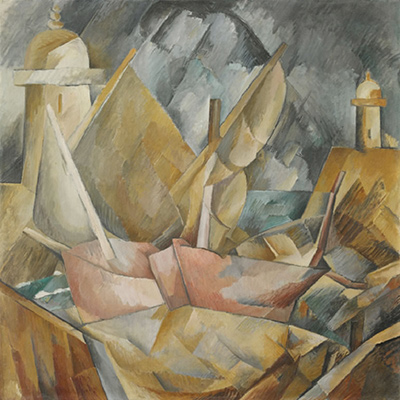
A harbour usually promises recession. Water opens a passage into the distance, coastlines frame its depth, and boats help measure the interval between foreground and horizon. Georges Braque turns that expectation inside out in Little Harbor in Normandy. The Art Institute of Chicago describes compressed space and shifting perspective that seem to propel two sailboats towards the front edges of the canvas.[1] A subject built for passage into depth becomes an encounter with the painted surface.
That reversal makes the work a crucial landscape of spring 1909. The painting is oil on canvas and measures 81.1 × 80.5 centimetres—so close to square that lateral spread and vertical rise remain evenly balanced. It belongs to the Art Institute, where it carries reference number 1970.98 and the credit line Samuel A. Marx Purchase Fund. The museum purchased it through Eugene V. Thaw and Company in 1970.[2] Within this compact field, coast, sea and vessels form a structure whose pressure is directed as much towards the viewer as towards the harbour beyond.
At a Glance
- ArtistGeorges Braque[1]
- TitleLittle Harbor in Normandy[1]
- Datespring 1909[1]
- MediumOil on canvas[1]
- Dimensions81.1 × 80.5 cm[1]
- CollectionArt Institute of Chicago[1]
- Accession1970.98[1]
- SignificanceThe Art Institute painting to show Cubist space spreading beyond L'Estaque into a northern harbour
Contents
- Introduction
- A northern coast after L'Estaque
- The pressure of an almost-square field
- Sea, sky and three kinds of mark
- Pale colour as structure
- Cézanne and the discipline of modelling
- A harbour with many names
- The Salon des Indépendants question
- An early Cubist landscape in full tension
A northern coast after L'Estaque
The Normandy subject carried Braque's changing approach to landscape away from the southern settings in which it had developed. Kunstsammlung Nordrhein-Westfalen traces the decisive turn through his L'Estaque work: from 1908, natural forms became increasingly geometric, central perspective lost its authority, and colour helped link flatter, relief-like spatial planes.[3] Those experiments had often centred on houses, trees, roads or viaducts. On the English Channel coast, the same questions had to accommodate open water, moving vessels and an atmosphere broken by whitecaps and cloud.
This change of location matters because maritime space behaves differently from built terrain. A wall can define an edge and a road can indicate recession; water appears less fixed, while a boat carries its own implied movement. Braque could therefore test geometric construction against a subject that resists stillness. The Art Institute's account identifies the result as the first fully realised example of his early Cubist style.[1] That is the museum's historical assessment, grounded here in the way separate formal devices begin to operate as one system.
AIC places the canvas within the creative dialogue that Braque had begun with Pablo Picasso in early 1908 and that intensified from 1909.[1] The chronology supplies context without turning the harbour into an anonymous product of partnership. Its exact problem belongs to Braque's landscape practice: how to give moving boats, unstable water and an open coast the structural force that buildings and roads had carried in the south. Collaboration forms part of the historical field; the Channel subject gives this painting its individual work to do.
The pressure of an almost-square field
The dimensions establish the first part of that system. With height and width separated by only six millimetres, the canvas gives the harbour little opportunity to unfold as an expansive seascape. Its nearly square shape concentrates relations. Coast, water and boats must negotiate a field that feels contained in both directions.
The absence of a dominant long axis matters. A strongly horizontal format could encourage the eye to travel along the coast, while a tall format could emphasise stacked recession. Here the balanced dimensions make every outward movement encounter a comparable limit. The boats' forward pressure can resonate across the whole field, and the harbour's apparent depth must coexist with a surface whose boundaries remain insistently close.
Braque reinforces that containment with what the Art Institute calls severe geometries.[1] The phrase suggests an image disciplined by strong planar relations, even while its subject remains legible. The coast still belongs to a harbour and the vessels remain sailboats, but their descriptive identities no longer guarantee a seamless illusion of place. Geometry gives each element enough pictorial weight to press against its neighbours.
The two boats are especially important. Boats in a conventional harbour view can serve as stepping stones into depth, one vessel helping the eye judge the position of another. AIC describes the opposite tendency: compressed treatment and shifting perspective make the sailboats seem to advance towards the front edges.[1] They become pressure points within the canvas. Their implied movement keeps them from settling into a stable interval between near and far.
This is a pictorial pressure. The boats remain within the painted field, yet the organisation denies them a comfortably recessed place. Depth is still available through the harbour subject, while the square-like format and changing spatial cues draw attention back to the surface. Braque holds both possibilities in play: movement into the scene and pressure out of it.
Sea, sky and three kinds of mark
The Art Institute's description becomes more precise when it turns from large geometry to smaller marks. Braque added a fringe of whitecaps to the sea and dashes of clouds across the sky, energising both zones.[1] These accents prevent the image's severe construction from becoming inert. Water and atmosphere remain active even as geometry compresses the larger setting.
A third kind of mark works differently. AIC describes repetitive, striated modelling of form and associates it with increased rigid tension.[1] Striation implies recurrence: marks gather into a worked surface that can stiffen or bind a mass. Whitecaps and cloud dashes introduce flicker, while repeated modelling gives forms a denser internal organisation. Motion and resistance coexist.
The three mark families create something like a visual tempo. Whitecaps repeat along the sea, cloud dashes interrupt the sky, and striations accumulate through larger forms. Their intervals differ, so the painting can feel both animated and constrained. Small accents quicken the atmospheric zones; sustained modelling holds the broader construction together. The boats occupy the contested space between these rhythms, possessing an implied course while the canvas keeps bringing their movement forward.
Scale sharpens the contrast. Whitecaps and cloud dashes register as brief incidents within sea and sky, while repetitive modelling extends across the forms it constructs. Braque can therefore organise a larger geometric field and keep its surface alive at a smaller pulse. The marks belong to one canvas, but they refuse a single speed.
The resulting tension is unusually controlled. Braque activates the surface while preserving the coast and vessels. The scene's basic identities remain available even as their cooperation changes. A whitecap belongs to water, a cloud mark belongs to sky, and a striation models form; together they establish a rhythm that crosses those categories while keeping each one legible.
Pale colour as structure
Colour participates in the same discipline. The Art Institute characterises the palette as sober, reduced in both range and intensity, and composed of pale shades.[1] No particular hues are needed to understand the consequence. A narrow chromatic field gives every shift more responsibility: contrast must articulate geometry, atmosphere and movement without relying on a wide display of colour.
The restraint marks a substantial distance from the colour-led landscapes of Braque's Fauvist years. Yet pale colour remains active. It helps severe geometry, whitecaps, cloud dashes and striated modelling coexist within one atmosphere. The painting gains tension through measured differences as chromatic abundance gives way to concentration. Reduced intensity becomes a constructive choice in its own right.
The scene's energy comes from its organisation—from boats pressed forward, marks distributed through sea and sky, and forms tightened by repetition. Geometry and chromatic restraint create unease from within the pictorial system. Weather, hour and dramatic mood remain open. Pale restraint and rigid tension already explain why the harbour feels charged.
Cézanne and the discipline of modelling
The Art Institute connects Braque's repetitive striations to his study of Paul Cézanne.[1] K20 places that relationship within a broader change: Braque increasingly approached natural forms through geometry, weakened central perspective and linked spatial planes through a reduced palette.[3] In Little Harbor in Normandy, those concerns converge around a maritime subject.
Cézanne's relevance lies in a method of construction. Repeated modelling gives form duration and resistance; geometry makes relations more explicit; perspective becomes adjustable, released from a fixed framework that governs every part. Braque uses those resources to address boats and water, where movement and instability are already implicit. The relationship concerns pictorial discipline, while the harbour remains Braque's own specific challenge.
The result has a distinctive tension between analysis and immediacy. Severe geometry asks the eye to consider how the picture is built. Whitecaps, cloud dashes and the forward urge of the boats keep that analysis connected to a scene in motion. Cézanne's example supports the work's discipline, while the Channel harbour gives Braque a problem with its own pace and pressure.
A harbour with many names
The present title was far from the only name attached to the painting. The Art Institute's documentary histories identify it as Paysage in the probable 1909 Salon listing and as Petit Port Normand in a 1912 publication. Later records used Der Hafen, Le Port, Seaport, The Lighthouse, Port in Normandy, Harbour in Normandy and Harbor in Normandy.[2]
These shifts show successive attempts to decide what kind of image it is. Paysage makes the canvas a landscape; the harbour and port titles emphasise place and maritime enclosure; The Lighthouse elevates one possible landmark. None has the authority to turn the whole painting into a single object study. The current title, Little Harbor in Normandy, preserves both the regional setting and the scene's modest scale while leaving room for coast, boats, sea and sky to remain interdependent.
The title history also mirrors the visual instability of the work. Viewers and cataloguers repeatedly selected a different anchor, just as the composition offers several competing kinds of structure. The boats claim attention through forward pressure, the coast through geometry, and the atmosphere through its animated marks. A name can foreground one strand; the painting keeps them in tension.
The Salon des Indépendants question
The earliest title in that trail carries the greatest historical weight. AIC says that documentation suggests the painting was exhibited in Paris in March 1909 at the Salon des Indépendants.[1] Its detailed exhibition history identifies a listing at the twenty-fifth Salon, held at the Quai d'Orsay from 25 March to 2 May: catalogue number 215, under the generic title Paysage.[2]
The museum's caution matters. A catalogue entry called Paysage cannot identify a particular canvas as securely as a unique title, dimensions and present collection record would. The Art Institute nevertheless considers the documentation strong enough to propose the match. The responsible formulation therefore holds two facts together: the Salon listing is exact, while its identification with Little Harbor in Normandy remains probable.
If the match is right, the original audience encountered the work under the broad category “landscape.” Today's title had yet to direct attention towards a small Normandy harbour. That gap between names makes the early showing especially intriguing: the generic listing offered little preparation for a canvas whose boats, water and coast were being reorganised so forcefully.
If that identification is correct, the painting entered public view during the same spring to which AIC dates it. The timing gives the work a role beyond the privacy of studio experiment. A nearly square harbour with compressed depth, pale colour and boats pressed towards the front would have stood before a broad Paris exhibition audience while Braque's early Cubist language was still being formed.
The Art Institute draws a further conclusion: the probable Salon appearance would make this the first major Cubist painting shown in such a prominent venue.[1] The claim is significant precisely because it is attributed and conditional. Its scope is the public history of the emerging style, while the origin of Cubism remains a wider, collective process. Presence itself placed the spatial experiment within public culture; audience response to this particular entry remains undocumented.
An early Cubist landscape in full tension
AIC's phrase “first fully realised” is best understood as an assessment of coherence.[1] The painting brings geometry, format, perspective, mark and colour into a sustained relationship. Each device contributes to the same spatial paradox: a harbour retains enough depth to imply passage, while its boats and forms are repeatedly driven towards the surface.
That coherence remains specific to this experiment. Its value lies in the meeting of a northern coast, two sailboats, whitecaps, cloud dashes and striated modelling. Together they allow the emerging language to engage movement as well as mass. Pale colour holds the competing energies together.
Little Harbor in Normandy thus occupies a decisive threshold between place and construction, private investigation and probable public display. The harbour opens into distance, but Braque keeps returning its parts to the front. What should recede instead gathers force at the canvas edge—and the tension between those directions gives the painting its enduring life.
Related Pages
Frequently Asked Questions
A harbour usually promises recession.
The Normandy subject carried Braque's changing approach to landscape away from the southern settings in which it had developed.
Little Harbor in Normandy thus occupies a decisive threshold between place and construction, private investigation and probable public display.
Discussion
A harbour usually promises recession.
Reader Insights
A harbour usually promises recession.
The restraint marks a substantial distance from the colour-led landscapes of Braque's Fauvist years.
Little Harbor in Normandy thus occupies a decisive threshold between place and construction, private investigation and probable public display.
Join the Conversation
Share the visible detail or source that most changed your reading.
References
- Art Institute of Chicago, “Little Harbor in Normandy,” View source.
- Art Institute of Chicago, “Artwork API Record 109330,” View source.
- Kunstsammlung Nordrhein-Westfalen, “Georges Braque: Inventor of Cubism,” View source.