 by Tom Gurney
Tom Gurney BSc (Hons) is an art history expert with over 20 years experience
Published on August 14, 2026 / Updated on August 14, 2026
Email: tomgurney1@gmail.com / Phone: +44 7429 011000
Introduction
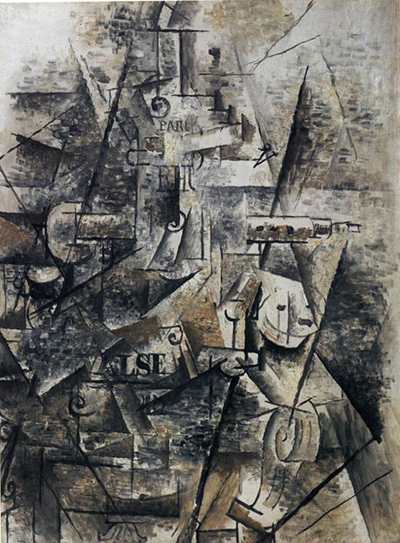
Three clues hold their ground in a field of shifting planes. RHU identifies rum, VALSE introduces music, and a clarinet supplies the instrument that connects them. Tate’s account of Georges Braque’s Clarinet and Bottle of Rum on a Mantelpiece locates each cue within a composition whose spatial relations remain unsettled.[1] Words make parts of the painting readable, yet their success never produces a complete map.
The clues also differ in kind. RHU is a fragment of a label, VALSE is a whole word, and the clarinet is recognised through direction and interrupted form. Their convergence gives the viewer several independent reasons to identify a still life. Around them, diagonal lines and layered shapes continue to change their possible roles. Braque makes local certainty compatible with structural doubt.
At a Glance
- ArtistGeorges Braque[1]
- TitleClarinet and Bottle of Rum on a Mantelpiece[1]
- Date1911[1]
- MediumOil paint on canvas[1]
- Dimensions810 × 600 mm (81 × 60 cm)[1]
- CollectionTate T02318[1]
- SignificanceDecode the Tate painting's clarinet, rum label, waltz lettering and mantelpiece while preserving its spatial uncertainty
Contents
- Introduction
- An Exact Identity in Céret
- The Clarinet and the Interrupted Span
VALSEand the Double Life of Painted Words- Mantelpiece Lines in Several Directions
- A Scroll with Two Identities
- The Painted Nail and the Picture Surface
- Restricted Colour, Varied Touch and Active Intervals
- A Related Céret Structure
- Three Paintings with Overlapping Names
An Exact Identity in Céret
Tate T02318 is an oil painting on canvas from 1911, with a support measuring 81 × 60 centimetres. Its French title is Clarinette et bouteille de rhum sur une cheminée. Tate acquired the work in 1978 with assistance from a special government grant and the Art Fund.[1] These details distinguish a specific material object before interpretation begins.
A historical Tate catalogue records the inscription G. Braque | Ceret on the reverse and treats it as confirmation that the painting was made at Céret in the French Pyrenees.[1] Tate’s later account places Braque there during the summer with Pablo Picasso. The two artists were then developing closely related pictorial problems, although T02318 remains a work by Braque with its own accession, title and history.
The extended title already performs analytical work. It proposes an instrument, a bottle and an architectural support. Tate identifies this canvas as Braque’s first still-life painting organised on a mantelpiece.[1] The claim makes the support part of the work’s historical identity as well as its spatial problem. The title establishes categories to search for; the painted field determines how securely each category can be assigned.
The Clarinet and the Interrupted Span
Tate describes the clarinet as lying horizontally just above the centre and almost dividing the canvas across its width.[1] That long direction gives the instrument a structural role before every part of its body becomes legible. A viewer can follow an extended course through the composition without recovering keys, holes, mouthpiece or bell.
An upright rum bottle stands on the principal mantelpiece reading and obscures the clarinet’s middle.[1] The interruption has two effects. It helps separate bottle from instrument, and it asks the mind to continue the clarinet across a break. Recognition depends on relation: the horizontal form remains coherent because its parts align across the intervening bottle.
The letters RHU sharpen the bottle’s identity. Tate explains them as the opening letters of French rhum.[1] Their evidence is exact but limited. They name the drink category without supplying a brand, a full commercial label or a complete account of the vessel. Braque needs only a fragment of language to stabilise the bottle inside a far less stable arrangement.
Clarinet, bottle and letters therefore form a compact chain. Direction proposes an instrument; overlap distinguishes a second object; text confirms what that object contains. Each clue adds a different kind of information, and each leaves other questions available.
VALSE and the Double Life of Painted Words
Near the lower centre, Tate locates the word VALSE, French for waltz. Fragments resembling treble and bass clefs, along with note-like shapes, reinforce its association with sheet music.[1] No particular score or composer emerges from this evidence. The word establishes a musical category whose exact performance remains open.
VALSE operates simultaneously as language and paint. Its letters can be read in sequence, while their shapes also occupy the same material surface as diagonals, hatching and fragmented planes. Meaning pulls the signs toward represented sheet music; pigment keeps them present as flat marks. The two functions strengthen each other, leaving text and form active at once.
Tate’s account, drawing on Douglas Cooper, describes letters as active pictorial elements that contribute to the reality of the presentation.[1] That reality is selective. RHU and VALSE make bottle and music available with unusual directness, while nearby forms continue to evade firm naming. Painted language increases legibility at chosen points; nearby passages retain their opacity.
Several kinds of authority operate together. The accession record fixes the material canvas, the title supplies object categories, and the painted words confirm selected parts of those categories. Contours and diagonals then propose how the named things occupy space. Keeping these roles distinct prevents a label from settling geometry by itself. It also explains how confidently named objects can coexist with passages that remain unassigned.
The title works in a comparable way. Once “clarinet,” “rum” and “mantelpiece” have been supplied, a horizontal span, three letters and strong diagonals acquire greater descriptive force. Tate argues that this guidance keeps the painting from appearing wholly non-representational.[1] Recognition grows through an exchange between words and visual structure, with resolution remaining incomplete.
Mantelpiece Lines in Several Directions
The main mantelpiece reading begins with two bold black lines. Tate describes them as parallel diagonals running from the lower left toward the upper edge.[1] They give the composition a forceful direction and provide a support for clarinet and bottle, but Tate’s analysis soon multiplies the possibilities.
One possible side edge follows the right-hand diagonal until an elaborate, twisting corbel interrupts it. Lines travelling across the principal direction from upper left toward lower right may offer another view. A brief rectangle, formed by three lines extending from the middle left toward the clarinet, may supply another aspect again.[1] The museum’s proposals amount to as many as four presentations of the mantelpiece, each partial and differently oriented.
These possibilities resist assembly into a single piece of furniture. A line can suggest a projecting edge in one relation and join the wider surface network in another. Parallel directions offer temporary stability; counter-directions disturb it. The mantelpiece remains recognisable as a type of support while its exact projection, depth and alignment continue to move.
This is more demanding than simple distortion. Distortion assumes a stable form against which a change can be measured. Braque distributes the evidence for the support across several alignments, so the viewer keeps revising the relation between one edge and the next. The title secures “mantelpiece” more firmly than the painting secures any single view of it.
A Scroll with Two Identities
The lower-right scrolled form preserves the most explicit alternative in Tate’s current caption. It could represent part of the mantelpiece, or it could resemble the head of a violin.[1] Architecture and musical instrument remain available because the curve carries enough information to evoke both, while the surrounding boundaries fail to grant either reading exclusive possession.
Calling the form a violin head would create a second instrument, but Tate’s conditional language stops short of that conclusion. Calling it architectural with complete confidence would close the same uncertainty from the opposite side. Its value lies in sustaining two possible affiliations within a painting already organised by music and fireplace structure.
The scroll also shows the limit of verbal guidance. The title helps with clarinet, bottle and mantelpiece; it gives no violin. Musical context makes the violin-head resemblance plausible, and architectural context makes the corbel or ornament plausible. A successful reading keeps both contexts active.
The Painted Nail and the Picture Surface
Tate identifies a small painted nail to the right of the bottle, while its historical catalogue also records a represented cast shadow.[1] The nail belongs to the tradition of trompe l’oeil: pigment creates the effect of an object attached to, or projecting from, a surface. Its apparent solidity is produced on the same canvas whose flatness it seems to challenge.
Letters and nail approach reality from complementary directions. RHU and VALSE announce their flat graphic character even as they name objects and music. The nail imitates physical attachment even as its painted character remains central to its meaning. Together they intensify the difference between a thing represented and the material means used to represent it.
The represented shadow adds depth without establishing a complete lighting scheme. Its job is local: it lends the nail an illusion of projection. The broader composition continues to be organised by value, line and layered plane. A tiny familiar object can therefore sharpen the surface-depth problem without resolving the mantelpiece around it.
Restricted Colour, Varied Touch and Active Intervals
Tate gives the palette as black, muted grey, dull yellow and brown.[1] This restricted range connects objects and surrounding planes while preserving differences of value and density. Colour participates in the same overlap as line: one passage can support an object reading and continue into a neighbouring area without a sealed contour.
Brushwork varies with local function. Tate describes short strokes in shadowed passages and longer ones in the thick black mantelpiece lines. Elsewhere Braque applies paint delicately and thinly, increasing the appearance of transparency between layers.[1] Stroke length, weight and opacity become structural resources. Long marks sustain direction, short hatching modulates intervals, and thin passages allow one plane to remain present through another.
Transparency has a double effect. It keeps an earlier or neighbouring plane perceptible, yet it also weakens the sense that one shape occupies a sealed layer in front. Several areas can remain available at once. The viewer receives evidence of overlap without gaining a final stacking order, so material delicacy contributes directly to spatial uncertainty.
Those intervals carry analytical weight. Tate’s essay emphasises Braque’s concern with the spaces between objects and associates short hatched strokes with their construction.[1] The gap interrupting an outline is therefore more than missing information. It can connect adjacent planes, delay an object assignment or make the continuation of a form an act of inference.
Clarinet and bottle demonstrate the principle in concentrated form. The instrument survives an interruption because its direction continues across the bottle. The mantelpiece survives competing diagonals because several edges keep returning to the same support category. Recognition accumulates through relationships among fragments, signs and intervals.
Three Paintings with Overlapping Names
Title words alone cannot identify the Tate canvas. The Metropolitan Museum of Art holds another 1911 oil called Still Life with Clarinet (Bottle and Clarinet), object 2025.616.14. It measures 64.8 × 50.2 centimetres, and the Met now identifies the diagonally placed instrument as a tenora resting on a tilted rectangular tabletop.[3] Its support and instrument differ from Tate T02318 even though date, bottle and historical clarinet wording overlap.
The Met also holds Bottle of Rum, object 2025.616.19, a 46 × 54.9-centimetre oil painted in Paris in spring 1914.[4] Its later date, horizontal dimensions and accession establish another independent work. The shared drink motif creates a family resemblance, never a second identity for the Tate painting.
These distinctions explain why accession, dimensions and institutional record matter. “Clarinet,” “bottle” and “rum” recur across Braque’s still lifes. T02318 is secured by their particular conjunction with a mantelpiece, RHU, VALSE, the reverse Céret inscription and an 81 × 60-centimetre support.
From Kahnweiler to Tate
Tate’s historical catalogue begins the ownership history with Galerie Kahnweiler, which acquired the painting from Braque, and records its appearance as lot 137 in the Kahnweiler sale at Hôtel Drouot on 7–8 May 1923.[1] Current Metropolitan Museum research clarifies the next transfer: Raoul La Roche acquired the lot and presented it to Le Corbusier in May 1923.[2]
The Le Corbusier Foundation sold the painting at Palais Galliera in 1970. Tate’s catalogue then traces it through Galerie Beyeler, a Portuguese private collection, a Sotheby’s sale in London in 1974 and Cofinarte before Tate’s assisted purchase in 1978.[1] This afterlife carried the painting through an architect’s collection, private ownership and commercial circulation while its material identity remained continuous.
That continuity throws the internal instability into relief. Tate T02318 has a fixed accession, support, medium and ownership record. Within its painted field, certainty is distributed more sparingly. RHU secures rum, VALSE secures music, and the clarinet holds a horizontal course through interruption. The mantelpiece keeps changing direction; the scroll keeps two identities; the nail keeps oscillating between represented projection and paint. Braque’s signs tell us where recognition can begin, while the relations among them keep the painting open.
Related Pages
Frequently Asked Questions
Three clues hold their ground in a field of shifting planes.
Tate T02318 is an oil painting on canvas from 1911, with a support measuring 81 × 60 centimetres.
That continuity throws the internal instability into relief.
Discussion
Three clues hold their ground in a field of shifting planes.
Reader Insights
Three clues hold their ground in a field of shifting planes.
The lower-right scrolled form preserves the most explicit alternative in Tate’s current caption.
That continuity throws the internal instability into relief.
Join the Conversation
Share the visible detail or source that most changed your reading.
References
- Tate, “Clarinet and Bottle of Rum on a Mantelpiece”.
- Metropolitan Museum of Art, Leonard A. Lauder Research Center, “Le Corbusier”.
- Metropolitan Museum of Art, “Still Life with Clarinet (Bottle and Clarinet)”.
- Metropolitan Museum of Art, “Bottle of Rum”.
- Centre Pompidou, “Nature morte au violon”.