 by Tom Gurney
Tom Gurney BSc (Hons) is an art history expert with over 20 years experience
Published on August 14, 2026 / Updated on August 14, 2026
Email: tomgurney1@gmail.com / Phone: +44 7429 011000
Introduction
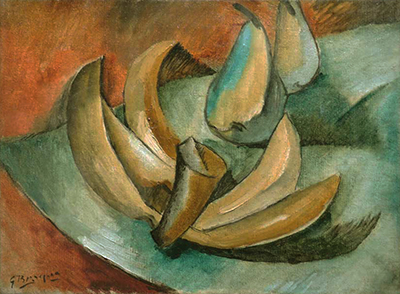
The title of Georges Braque's Five Bananas and Two Pears reads almost like a tally. Seven pieces of fruit should be easy to account for. Yet the painting's deeper fascination lies in the tension between that exact count and a setting whose divisions have begun to loosen. Pears, bananas, cloth and wall retain their names while colour, geometry, light and shadow draw them into a continuous pictorial field.
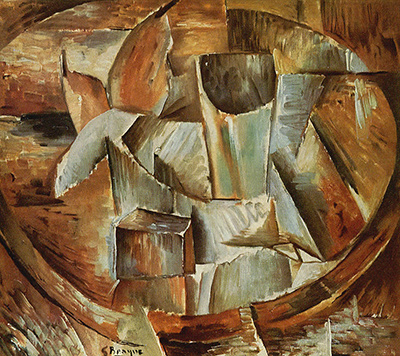
Braque painted this small still life between spring and summer 1908. It is an oil on canvas measuring only 24 × 33 centimetres, signed G Braque at lower left. The Centre Pompidou acquired it by dation in 1992 and catalogues it as AM 1992-145.[1] Its modest scale concentrates a large spatial question: how can familiar objects preserve volume and identity when the space around them stops behaving as a set of independent compartments?
At a Glance
- ArtistGeorges Braque[1]
- TitleFive Bananas and Two Pears[1]
- Datespring–summer 1908[1]
- MediumOil on canvas[1]
- Dimensions24 × 33 cm[1]
- CollectionCentre Pompidou, Musée national d’art moderne[1]
- AccessionAM 1992-145[1]
- SignificanceA compact 1908 still life tests volume, tabletop tilt and a restrained palette
Contents
- Introduction
- Seven familiar objects
- A conscious return to Cézanne
- Green and ochre across the setting
- Geometry, light and volume
- A setting without a fixed divide
- From landscape construction to studio objects
Seven familiar objects
The counted title provides an essential anchor. Five bananas and two pears remain available to recognition, even as their relationship to the setting becomes less stable. Enumeration invites the mind to separate and verify. Braque's construction works in the other direction, encouraging the eye to connect one passage with another.
This creates a productive double reading. The fruits can be understood as individual things, each carrying the ordinary familiarity of still life. At the same time, they participate in a larger organisation that gives colour and spatial rhythm priority over strict isolation. The painting derives its tension from keeping both conditions alive.
The title and the spatial construction therefore perform complementary tasks. The title separates: it assigns kinds and quantities. The construction connects: it draws those named things into relationships that extend beyond each contour. Braque can make object definition less rigid because the enumeration has already secured a strong conceptual image of what is present.
The compact format intensifies the effect. A horizontal canvas only thirty-three centimetres wide offers little room for a procession of independent objects. Every relation carries weight. The count supplies clarity, while the small field presses the seven fruits and their setting into close pictorial company.
A conscious return to Cézanne
Centre Pompidou's educational account describes Braque's fruit-bowl motif as an explicit reference to Paul Cézanne. It characterises that reference as conscious and singular.[2] Braque is therefore working with a familiar artistic problem, one in which ordinary fruit can become a vehicle for thinking about volume, support and the coherence of a painted surface.
The relationship operates through a shared problem of construction, with Braque developing the familiar motif through his own spatial dynamic. According to Pompidou, continuity of space takes priority over the strict definition of the object.[2] The phrase captures the balance at the heart of the painting. Fruit remains identifiable, but its boundary no longer settles every question about how the image is organised.
Still life is especially well suited to this inquiry. Bananas and pears carry meaning through familiarity and physical presence, leaving colour and modelling free to become consequential. The objects stay still while the relations among them grow increasingly active.
Green and ochre across the setting
Pompidou identifies two precise colour correspondences. The green of the pears chimes with the green of the tablecloth, while the ochre of the bananas answers the ochre of the wall.[2] Colour crosses the categories that an inventory would keep apart. One green belongs to fruit and support; one ochre belongs to fruit and surrounding space.
These correspondences weaken the exclusiveness of local colour. A pear is recognisable partly through its object identity, yet its green also directs attention into the cloth. The bananas maintain their counted presence, while ochre carries their chromatic register into the wall. The eye can move through shared colour before it finishes isolating each thing.
The two correspondences also reach across different spatial roles. Pear and cloth join object to support; banana and wall join object to surrounding plane. Together they connect the still life's near and far elements without requiring one uniform colour field. Continuity emerges from paired responses across the setting.
This makes the palette structurally active. Its restraint creates continuity through repetition and response. Green and ochre do more than decorate already separate objects; they help determine how fruit and setting cohere. The painting's spatial unity therefore develops through colour as well as through drawing or perspective.
These two correspondences carry the argument without turning green and ochre into an exhaustive palette. Colour lets the still life remain legible while making its divisions negotiable.
Geometry, light and volume
The museum's account also says that geometrical forms resonate with light and shadows in the space.[2] Geometry gives the fruit a more organised bodily presence, but the forms never need to become perfect solids. Their simplification makes volumes comparable and allows them to participate in the same spatial logic.
Light and shadow keep that geometry alive. They allow a form to register as volume, with extension and weight, while also connecting it to the surrounding field. Modelling belongs to the fruit and to the space through which the fruit is understood. The result is a still life poised between the firmness of objects and the continuity of painting.
Pompidou's formulation places geometry and illumination in reciprocal relation. Geometry organises the bodies; light and shadow vary their presence within space. Each corrects the other's possible rigidity. The fruits acquire enough structure to remain countable, while their modelling continues into the larger pictorial dynamic.
This relation also prevents geometry from becoming a diagram. Bananas and pears retain the irregular familiarity of fruit, even as their forms become more deliberate. Light and shadow introduce variation within that order. Volume survives, but it is no longer sealed away from colour and setting.
A setting without a fixed divide
The tablecloth and wall provide the work's two named spatial elements.[2] In an ordinary arrangement, support and background might behave as clearly separate planes. Here their colours answer the fruit placed before or upon them, so the division loses some of its independence. The setting participates actively in the objects' identity.
The spatial tension is best understood through continuity across the setting. Green travels between pears and cloth; ochre travels between bananas and wall; geometrised form resonates with light and shadow. Together these relationships make the place of each object feel connected to the entire field.
The picture can consequently suggest volume without opening a deep, conventionally ordered interior. Objects occupy space, but the colour of that space keeps returning to them. The fruit-bowl motif becomes a compact laboratory for holding solidity and surface together.
From landscape construction to studio objects
The painting belongs to a concentrated moment in Braque's work. Centre Pompidou records that in 1908 he developed landscapes in geometric volumes while painting roughly eight still lifes in parallel.[3] Construction was moving between outdoor motifs and the familiar objects of the studio. Five Bananas and Two Pears shows how much could be tested with a very small cast.
Its spring–summer date places it early within that expansion. The fruit still life brings the constructive inquiry indoors at intimate scale, before the autumn musical canvas discussed by Pompidou introduced instruments into the still-life field.[3] The relationship is chronological and methodological: geometry travels between subjects, while each subject demands a distinct solution.
Within a year, Braque was expanding the still-life vocabulary. The Metropolitan Museum of Art's separate Mandolin and Fruit Dish dates from early 1909, measures 38.4 × 46 centimetres and introduces a musical instrument beside the fruit dish.[4] The distinction helps locate the Pompidou painting: AM 1992-145 is the smaller, earlier inquiry, centred upon seven fruits and the continuity of their setting.
Its economy is its strength. The title keeps the fruit countable; green and ochre carry vision across object and environment; geometry, light and shadow sustain volume within a connected field. Within its 24 × 33-centimetre field, Braque turns an inventory of familiar things into a question about how a painting holds space together.
Related Pages
Frequently Asked Questions
The title of Georges Braque's Five Bananas and Two Pears reads almost like a tally.
The counted title provides an essential anchor.
Its economy is its strength.
Discussion
The title of Georges Braque's Five Bananas and Two Pears reads almost like a tally.
Reader Insights
The title of Georges Braque's Five Bananas and Two Pears reads almost like a tally.
This makes the palette structurally active.
Its economy is its strength.
Join the Conversation
Share the visible detail or source that most changed your reading.
References
- Centre Pompidou, “Cinq bananes et deux poires,” View source.
- Centre Pompidou, “The Object in 20th-Century Art: Five Bananas and Two Pears,” View source.
- Centre Pompidou, “Les Instruments de musique,” View source.
- The Metropolitan Museum of Art, “Mandolin and Fruit Dish,” View source.