 by Tom Gurney
Tom Gurney BSc (Hons) is an art history expert with over 20 years experience
Published on August 14, 2026 / Updated on August 14, 2026
Email: tomgurney1@gmail.com / Phone: +44 7429 011000
Introduction
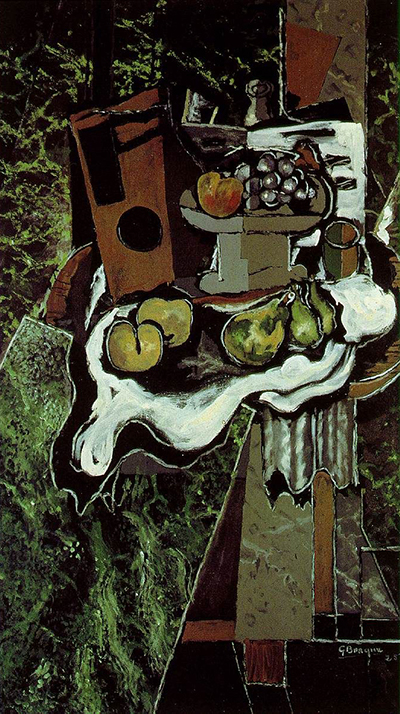
At 130.5 centimetres high and only 75 centimetres wide, Georges Braque's Fruit on a Tablecloth and Fruit Dish gives still life an unusually tall, commanding format. A guitar and musical score share the centre with a fruit dish, apples and pears. Folds of white cloth gather these familiar things into a compact group, while a black ground, pale outlines and painted passages resembling green and grey marble give them the presence of actors under strange illumination. The Centre Pompidou, which holds the canvas as AM 2700 P, describes this emergence as theatrical and the light as unreal.[1]
The work belongs to 1925, when Braque was enlarging the scale and enriching the materials suggested by his still lifes. Its abundant fruit, cloth and instrument can appear calm and classical at first encounter. Yet the setting refuses to settle. A broad speckled plane can rise like a tilted table or divide into the uprights of a fireplace; outlined things detach from one area and lock into another; curves and rectangles repeat across uncertain depths. Braque has made traditional objects newly substantial while allowing their surroundings to remain spatially mobile.
At a Glance
- ArtistGeorges Braque[1]
- TitleFruit on a Tablecloth and Fruit Dish[1]
- Date1925[1]
- MediumOil on canvas[1]
- Dimensions130.5 × 75 cm[1]
- CollectionCentre Pompidou, Musée national d’art moderne[1]
- AccessionAM 2700 P[1]
- SignificanceBraque enlarges and materially enriches the still life in 1925 without abandoning Cubist spatial play
Contents
- Introduction
- One Painting, Several Names
- The White Cloth as a Gathering Force
- Rectangles, Curves, Apples and Pears
- White Edges Against a Black Ground
- Marble Made Entirely with Paint
- A Table That Can Become a Fireplace
- Classicising Objects, Cubist Space
- Rhyme as a Way of Building Space
- From the 1918 Table to the Material Choices of 1926
One Painting, Several Names
The Centre Pompidou records the current French title as Fruits sur une nappe et compotier, meaning fruit on a tablecloth with a fruit dish. The canvas is oil on canvas, dated 1925, inscribed G Braque / 25, and entered the French national collection through purchase in 1947.[1] These details distinguish it from the many tables, bowls and fruit arrangements that recur throughout Braque's career.
Two former titles reveal how readily its emphasis can shift. Nature morte à la table de marbre—still life with a marble table—draws attention to the simulated stone and the question of support. Cithare isolates the stringed instrument. The museum's present analysis calls that instrument a guitar. These names belong to a single canvas, but each names a different path into it: setting, material, or music. Their succession suits a painting whose parts become clear one by one while the whole remains resistant to a single spatial explanation.
The canvas also had an early public life. Braque's new dealer, Paul Rosenberg, exhibited it in Paris in 1926, the year after it was painted.[1] That secure fact places its imposing still-life language before a contemporary audience without requiring a speculative story about sales or critical response.
The White Cloth as a Gathering Force
White cloth performs more than a descriptive role. According to the Centre Pompidou account, its folds take the central motif in a diagonal embrace, isolating it and bringing it forward.[1] The fabric therefore acts almost like a compositional hand. It gathers instrument, score, fruit dish and fruit from the surrounding field, then presents them together.
This movement helps explain why the arrangement feels concentrated despite the canvas's height. Still-life objects often depend on a table to provide a common level. Here, the cloth supplies another kind of unity: its folds connect forms whose positions and orientations remain unsettled. White passages also converse with the pale edging around objects. Cloth and contour cooperate, so that the centre advances while the ground seems to recede into darkness.
The result combines intimacy and display. Tablecloth, fruit and music evoke cultivated domestic life, yet their treatment lifts them away from an ordinary meal or music-making session. The folds frame the group, the black ground heightens it, and the tall support grants it a public scale. Everyday things have entered a setting governed by presentation.
Rectangles, Curves, Apples and Pears
Braque's organisation becomes especially legible through paired differences. The Centre Pompidou draws attention to the rectangular guitar set against the rounded fruit dish, then to round apples beside elongated pears.[1] Shape replaces conventional depth as a principal means of ordering the scene. One form answers another across the surface.
The guitar supplies straight edges and a broad, constructed body; the dish establishes a swelling counter-form. Apples repeat compact circular accents, while pears stretch the rhythm vertically. The score introduces the idea of measured sequence even before any musical content could be read. Across the group, recurrence never means uniformity. Curves return with altered proportions, and angular structures meet rounded ones at changing scales.
This is the painting's visual counterpoint. Each object retains enough identity to be named, while its outline also participates in a larger pattern. Fruit becomes a set of weights and pulses. The instrument becomes an arrangement of long and short directions. Braque can therefore offer the pleasure of recognition and the more abstract pleasure of watching forms echo, interrupt and rebalance one another.
White Edges Against a Black Ground
The objects gain their startling presence through a double boundary. The Centre Pompidou describes them as outlined by both a white border and the black ground.[1] These opposed values sharpen the interval around each thing. Fruit, dish and instrument seem cut free from ordinary atmosphere, even though every element remains painted in oil.
Such edging creates a peculiar light. It gives less information about a real room than about the pressure of one shape against its neighbour. Pale borders flare where forms meet darkness; black areas turn into active separators. The museum's language of theatrical emergence is apt because the objects appear summoned into visibility. Their illumination feels designed for appearance itself.
The stage effect also complicates the painting's classicising calm. A carefully balanced still life might promise repose, but these contours keep every form alert. Boundaries repeat and shift, producing a low visual vibration around the ensemble. The darkness unifies the canvas while the white edges continually divide it.
Marble Made Entirely with Paint
The title's historical reference to a marble table leads to the work's central material paradox. Braque painted a mosaic-like field of faux marbles in green and grey.[1] The stone is simulated in oil on canvas. Varied passages suggest costly, heavy material through colour and handling alone, turning the surface into a display of skilled imitation.
That skill had deep roots in Braque's training. As a young man he learned the painter-decorator's trade, in which wood grain and marble could be reproduced with specialised tools and gestures. The Metropolitan Museum of Art places such craft at the heart of Cubism's exchanges between depicted materials and the physical plane of the painting.[2] In Braque's hands, decorative imitation became a way to test what a painted surface could claim to be.
The faux marble also recalls his experiments of 1913 and 1914, when pasted papers and painted textures doubled, contradicted and reinforced one another. The Centre Pompidou explicitly connects the 1925 marbling with those earlier games of texture.[1] Here, however, the exact medium is oil on canvas. Painted stone summons material memory without adding stone, paper or grit. The eye encounters marble; the object remains paint and fabric support.
This distinction gives the canvas much of its sophistication. Material richness arises through simulation, and simulation becomes part of the subject. Braque is painting fruit and music, but he is also painting the act of making one substance stand for another.
A Table That Can Become a Fireplace
The marbled areas destabilise architecture as well as material. Large speckled planes, lightly edged in white, can suggest the raised surface of a table. They can also be understood as fireplace uprights, a possibility the Centre Pompidou relates to Braque's Cheminées works of 1922–27.[1] The painting keeps both structures available.
A table reading makes sense of fruit resting on a support and aligns the canvas with Braque's long fascination with pedestal tables. A fireplace reading turns the same vertical and oblique divisions into part of an interior framework. Each possibility remains active. The represented support changes function according to which edge the eye follows.
An exhibition dossier produced by the Musée des Beaux-Arts de Lyon and the Centre Pompidou describes dislocated planes, an oblique represented marble plate in the background, and fruit on a pedestal table.[3] Its account emphasises the coexistence of traditional still-life motifs, respect for skilled craft, and memories of Cubism. The table is recognisable as an idea, while its planes evade the consistency expected of a solid piece of furniture.
Classicising Objects, Cubist Space
The museum characterises the painting as a large, classicising still life typical of Braque's admired production during the 1920s.[1] “Classicising” helps describe the renewed weight of fruit, drapery and musical instrument, as well as the deliberate balance among their shapes. The term becomes most useful when paired with the canvas's persistent spatial contradictions.
Scale also changes the genre's register. Fruit and a musical instrument carry long associations with still-life tradition, yet Braque grants their arrangement the stature of a large vertical composition. Centre's adjective therefore concerns more than subject matter: it helps name the poise created by abundant objects, drapery and deliberate correspondences. The canvas holds this dignity in tension with shifting supports. Its classicism emerges through weight, balance and recurrence; its Cubist energy emerges through tipped planes and uncertain spatial connections. Both conditions are experienced at once, which makes the work far richer than a simple revival of older pictorial order.
Braque's Cubist inheritance survives as an operation. Supports tip upward; background and tabletop exchange roles; contours detach things from surrounding atmosphere; material likeness makes the flat surface conspicuous. The Lyon dossier calls the dislocated planes memories of Cubism.[3] They coexist with older still-life traditions while resisting a clean chronological break.
This coexistence explains why the work feels both settled and active. The inventory is accessible, the central group is ceremonially staged, and the fruit has an ample physical presence. Around it, planes continue to slide. Braque can restore clarity to objects while keeping the relations among them open. Tradition supplies the vocabulary; Cubist experiment reshapes its grammar.
Rhyme as a Way of Building Space
In the Centre Pompidou's account, the composition is a visual poem crossed by rhymes and echoes, with space reinvented from Cubist premises.[1] The metaphor captures how the canvas builds coherence without depending on a unified viewpoint. A rounded fruit dish answers round fruit. Long pears extend the directional force of the instrument. White cloth finds a counterpart in white edging; dark intervals recur around separate forms.
These correspondences allow the eye to travel laterally and diagonally, moving from likeness to variation. Space emerges through relationships among shapes and values. It unfolds as a sequence of responses, with no measurable room reconstructed behind them. The technique gives every recognised thing a second life as part of an organising pattern.
Rhyme also accommodates ambiguity. Table and fireplace share visual elements without collapsing into one final answer. Painted marble can evoke weight while declaring the agility of paint. The still life gains unity through repetition, yet each repetition changes the terms. Braque's order remains dynamic because it is relational.
From the 1918 Table to the Material Choices of 1926
The painting belongs to a sustained development following Braque's return to work after the First World War. The Philadelphia Museum of Art identifies its 1918 The Table as the beginning of a decade-long sequence in which still-life elements occupy the tipped surface of a pedestal table. That earlier canvas also revived Braque's decorator-trained simulations of wood and marble.[4] By 1925, the pedestal-table idea could support a taller, more ceremonial arrangement and a denser play of marbled planes.
Braque soon explored another material option. In The Bowl of Grapes of 1926, now in the Peggy Guggenheim Collection, oil is combined with pebbles and sand.[5] The comparison marks two distinct ways of heightening surface: the 1925 canvas creates stone through painted imitation, while the 1926 work incorporates granular matter. Both approaches turn still life into an inquiry about how things and materials become present.
Within this 1925 canvas, that inquiry reaches a poised balance. The objects are familiar, amply scaled and clearly named. Their surroundings remain provisional. Cloth brings the ensemble forward, outlines separate it from darkness, faux marble makes paint masquerade as stone, and shifting planes keep table and fireplace in suspension. Braque enlarges the still life by giving ordinary things ceremonial force, then preserves its vitality by denying their setting a final rest.
Related Pages
Frequently Asked Questions
At 130.5 centimetres high and only 75 centimetres wide, Georges Braque's Fruit on a Tablecloth and Fruit Dish gives still life an unusually tall, commanding format.
The Centre Pompidou records the current French title as Fruits sur une nappe et compotier, meaning fruit on a tablecloth with a fruit dish.
Within this 1925 canvas, that inquiry reaches a poised balance.
Discussion
At 130.5 centimetres high and only 75 centimetres wide, Georges Braque's Fruit on a Tablecloth and Fruit Dish gives still life an unusually tall, commanding format.
Reader Insights
At 130.5 centimetres high and only 75 centimetres wide, Georges Braque's Fruit on a Tablecloth and Fruit Dish gives still life an unusually tall, commanding format.
That skill had deep roots in Braque's training.
Within this 1925 canvas, that inquiry reaches a poised balance.
Join the Conversation
Share the visible detail or source that most changed your reading.
References
- Centre Pompidou, “Fruits sur une nappe et compotier,” collection record and catalogue analysis: https://www.centrepompidou.fr/fr/ressources/oeuvre/cgjzXer
- Metropolitan Museum of Art, “Cubism and the Trompe l'Oeil Tradition — Visiting Guide”: https://www.metmuseum.org/fr/exhibitions/cubism-trompe-loeil/visiting-guide
- Musée des Beaux-Arts de Lyon and Centre Pompidou, Braque/Laurens, un dialogue, exhibition dossier: https://www.mba-lyon.fr/sites/mba/files/medias/images/2019-12/dpresse_expo_Braque_Laurens.pdf
- Philadelphia Museum of Art, “The Table”: https://www.philamuseum.org/objects/51209
- Peggy Guggenheim Collection, “The Bowl of Grapes”: https://www.guggenheim-venice.it/en/art/works/the-bowl-of-grapes/