 by Tom Gurney
Tom Gurney BSc (Hons) is an art history expert with over 20 years experience
Published on August 14, 2026 / Updated on August 14, 2026
Email: tomgurney1@gmail.com / Phone: +44 7429 011000
Introduction
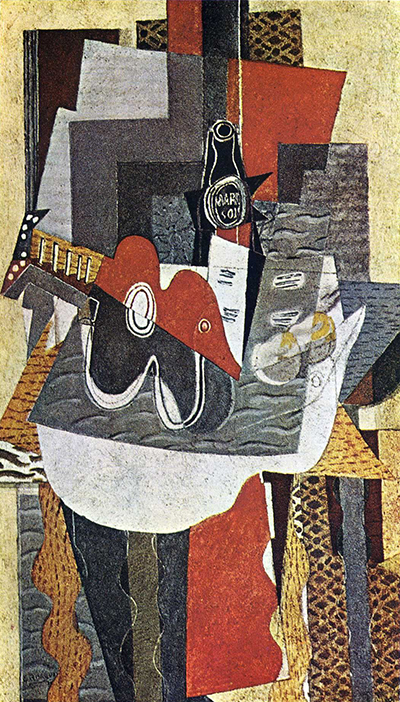
At more than 1.3 metres high, Guitar and Bottle of Marc on a Table gives the modest furniture of a still life an imposing scale. Georges Braque painted it in 1930, using oil and sand on canvas. Its proportions are tall and narrow: the unframed canvas measures 130.5 × 75 centimetres, while the framed work measures 163.8 × 106.7 × 11.4 centimetres. It belongs to the Cleveland Museum of Art, where it carries the accession number 1975.59 and the credit of the Leonard C. Hanna Jr. Fund.[1]
Those catalogue facts already disclose an important tension. The title promises a guitar, a bottle and a table, all ordinary things that can be grasped through use as well as sight. The sand declares the physical substance of the painting itself. Braque brings the recognisable world close, then prevents it from settling into the smooth illusion of a scene viewed through a window.
At a Glance
- ArtistGeorges Braque[1]
- TitleGuitar and Bottle of Marc on a Table[1]
- Date1930[1]
- MediumOil and sand on canvas[1]
- Dimensions130.5 × 75 cm[1]
- CollectionCleveland Museum of Art 1975.59; Leonard C. Hanna Jr. Fund[1]
- SignificanceCleveland's 1930 painting to explain sand, broad silhouette, musical still life and the return to saturated material presence
Contents
- Introduction
- A Still Life at Bodily Scale
- Sand and the Substance of the Surface
- Broad Shapes and a Later Cubist Language
- Music Held in Stillness
- A Productive Interwar Group
- Paul Rosenberg and the Journey to Cleveland
- Material Presence without Spatial Certainty
A Still Life at Bodily Scale
The format changes the terms of encounter. A tabletop subject often suggests a compact field gathered within easy reach. With an unframed height of 130.5 centimetres, this canvas brings the arrangement towards bodily scale. The painting remains a still life, yet its everyday contents occupy a format with physical consequence. Recognition begins with familiar names; scale turns those names into a more encompassing pictorial event.
Cleveland's written account identifies the ensemble precisely. Alongside the title's guitar are a bottle of Marc, a music sheet and a glass fruit bowl holding two apples. A white tablecloth covers a rectangular table.[1] This short inventory is enough to evoke a domestic arrangement, but it offers no anecdote. No musician enters, no meal begins and no particular performance is named. The objects hold the attention through their relationships.
The title gives three elements special weight: instrument, bottle and supporting furniture. Cleveland's fuller inventory then reveals an arrangement built in layers. Fruit sits within a bowl; the objects gather above cloth; the cloth belongs to the table. These nested relationships preserve the logic of containment and support even when the painting's spatial order grows uncertain. Braque can disturb the passage from one plane to another because the identities and ordinary uses of the things continue to provide orientation.
That restraint matters. Braque had long used bottles, instruments, printed matter and table furniture because they were recognisable without requiring a narrative. A viewer could identify a thing from a fragment, a contour or a word while remaining aware that the painted construction obeyed its own order. In the 1930 canvas, the named inventory keeps the work connected to ordinary experience as its large format and altered surface push beyond ordinary seeing.
Sand and the Substance of the Surface
Sand is a literal ingredient here. Cleveland records the medium as oil and sand on canvas.[1] Added granular matter gives the support a physical insistence beyond the varying density of oil paint alone. The picture presents represented things and a materially assertive surface at the same time.
This double condition had deep roots in Braque's practice. During the development of Cubism, pasted papers and other material fragments had made the picture's actual construction part of its meaning. Kunstsammlung Nordrhein-Westfalen describes sand admixtures as one element in that widening material language.[7] By 1930, Braque could work entirely within painting while retaining the lesson that a surface carries its own substance. Sand makes the canvas harder to experience as an invisible carrier for an imagined world.
The Phillips Collection places such experiments within a broader interwar pursuit of physicality. Its account of Braque's still lifes from 1928 to 1945 records richly varied surfaces and the use of granular additions in particular works.[6] Cleveland's painting belongs to that material climate, though its precise distribution of sand remains undocumented in the catalogue text. The significant point lies in the coexistence of matter and depiction. A bowl or guitar can be evoked, while the ground supporting it continues to announce itself.
Material presence therefore produces a productive complication. Actual grains bring the viewer closer to the made surface, yet they offer no simple guarantee of realism. Sand can intensify the distinction between the painted object and the physical canvas. Braque makes substance palpable while preserving ambiguity about the space his things inhabit.
Broad Shapes and a Later Cubist Language
The Arkansas Museum of Fine Arts described the Cleveland painting as a large example of later Synthetic Cubism, characterised by decorative patterning and flat, overlapping shapes.[3] That description is more useful as an orientation than as a final label. The painting dates from 1930, long after Braque and Pablo Picasso's close pre-war collaboration. Its Cubism survives through enlarged forms, surface pattern and unstable relations among things.
“Later” carries much of the significance. Synthetic Cubism had first emerged through larger signs, pasted materials and more openly constructed compositions before the First World War. The Cleveland painting belongs to another historical moment, yet it preserves a related willingness to let broad pieces declare how the picture is made. The label thus points to continuity of method across time. It leaves room for the stronger scale, richer surface and fuller sense of substance that distinguish Braque's mature language.[7]
Early Analytic Cubism had often divided objects into small facets, displaced a fixed viewpoint and made recognition unfold gradually. Braque's later shapes could become broader and more emphatic without restoring a single, continuous space. Flat overlap places one area before another, but it can also keep both areas pressed against the plane of the canvas. Decorative pattern strengthens this frontal order even as familiar objects encourage the mind to imagine depth.
A second 1930 still life helps define the period's wider problem. Karen K. Butler's essay for the Mildred Lane Kemper Art Museum describes Braque's concern with things within reach, the separation of contour from volume, overlapping planes and a materialised experience of space.[4] The museum's label for that separate painting, Nature morte et verre, explains how multiple viewpoints create a conflict between physical presence and the flatness of the canvas.[5] These ideas clarify a shared field of inquiry without turning the two works into twins.
In the Cleveland painting, the broad-shape language gives the inventory weight and immediacy. The guitar, bottle, sheet, bowl, fruit, cloth and table remain available to recognition. Their pictorial life also depends upon contour, overlap and surface. Each thing operates as an object from daily experience and as a component in a constructed plane.
Music Held in Stillness
The guitar and music sheet make this a musical still life, a category with particular resonance for Braque. Cleveland records that he was a classically trained flutist who also played violin and accordion.[1] Kunstsammlung Nordrhein-Westfalen gives the wider context: he listened avidly, counted composers among his friends, played several instruments and repeatedly brought instruments and musical fragments into his art.[7]
Personal familiarity helped make musical things a durable pictorial vocabulary. An instrument offers a body built from curves, apertures, strings and a neck; printed music brings signs that belong to the flat sheet before they evoke sound. These qualities suited an artist concerned with the shifting border between recognisable thing and pictorial construction.
The 1930 painting leaves the musical content open. Its sheet has no identified composition, and the guitar establishes no particular player or performance. Music enters through objects held in suspension. The possibility of sound remains latent while the still-life arrangement concentrates attention upon material, shape and interval. Braque's musicianship enriches that choice without turning the painting into an encoded autobiography.
A Productive Interwar Group
Cleveland situates the painting within a highly productive period between 1928 and 1932. The museum associates it with a group of large still lifes distinguished by rich, textured surfaces and vibrant colour.[1] The description identifies a family resemblance, leaving room for differences among individual canvases. It establishes no fixed numbered series or uniform technical formula.
Across these years, the Phillips Collection supplies a wider arc. Its 1928–45 exhibition traced Braque's movement from intimate late-1920s interiors toward larger-scale spaces in the 1930s, while emphasising his sustained attention to the physicality of objects and their surroundings.[6] This 1930 canvas stands near the beginning of that expansion. Its tall dimensions, granular medium and broad pictorial language make a tabletop arrangement feel increasingly architectural.
This change involved a recalibration of Cubist experience. The small, tightly fractured structures of the pre-war years had demanded close visual reconstruction. The mature still lifes could meet the viewer through larger silhouettes and fuller surface effects, then sustain uncertainty through overlap, pattern and conflicting spatial cues. Presence became more saturated, even as certainty remained elusive.
Paul Rosenberg and the Journey to Cleveland
The surviving ownership record is brief. Cleveland begins it with a sale to the Paris dealer Paul Rosenberg. The next dated entry identifies P. Rosenberg & Co. in New York as the seller to the museum in 1975; Cleveland has owned the painting since that year.[2] The interval between those statements remains open. Its brevity cautions against treating the available sequence as an unbroken history.
Rosenberg was a major figure in Braque's interwar career, and the Phillips Collection discusses his connection with other important paintings of the period.[6] For this canvas, the museum record supports a narrower conclusion: it passed through the Rosenberg orbit and entered Cleveland through the named acquisition fund in 1975.[1][2] Earlier owners, possible movements and the circumstances of the first recorded sale remain unspecified.
The gap has interpretive value because it separates evidence from attractive conjecture. A celebrated dealer's name can suggest networks of patronage, exhibition and transatlantic exchange, but those wider histories require their own documentation. The painting's secure public biography begins with Braque in 1930, contains a partial Rosenberg trail and reaches a firm institutional home four and a half decades later.
Material Presence without Spatial Certainty
Braque's Cleveland still life belongs to a moment when he enlarged and enriched the physical address of the genre. Its familiar objects offer entry: an instrument, drink, printed music, fruit, cloth and furniture. Its substantial dimensions give that ensemble bodily scale. Sand makes the support an active material fact. Broad overlapping shapes and decorative pattern keep represented space from closing around the objects in a conventional way.[1][3]
The resulting presence is powerful because it stays divided. A guitar remains a guitar, yet it also participates in a flat design. A table supports a domestic grouping, yet it also belongs to the picture's architecture. Granular matter heightens the canvas's physical reality, while the depicted things continue to solicit recognition and imagined depth. The eye moves between those conditions without resolving them into a single stable account.[4][5]
Braque's 1930 still life therefore offers more than a softened survival of Cubism. It shows how the language could change scale, admit richer matter and preserve the tension that had made it radical. Familiar things gain saturated material presence, but they never become passive illustrations of themselves. The painting keeps object and surface, music and silence, depth and flatness in active relation.
Related Pages
Frequently Asked Questions
At more than 1.3 metres high, Guitar and Bottle of Marc on a Table gives the modest furniture of a still life an imposing scale.
The format changes the terms of encounter.
Braque's 1930 still life therefore offers more than a softened survival of Cubism.
Discussion
At more than 1.3 metres high, Guitar and Bottle of Marc on a Table gives the modest furniture of a still life an imposing scale.
Reader Insights
At more than 1.3 metres high, Guitar and Bottle of Marc on a Table gives the modest furniture of a still life an imposing scale.
A second 1930 still life helps define the period's wider problem.
Braque's 1930 still life therefore offers more than a softened survival of Cubism.
Join the Conversation
Share the visible detail or source that most changed your reading.
References
- Cleveland Museum of Art, Guitar and Bottle of Marc on a Table
- Cleveland Museum of Art, printable object record and provenance
- Arkansas Museum of Fine Arts, Path to Abstraction: Picasso, Braque, and Cubism's Impact on Modern Art
- Mildred Lane Kemper Art Museum, Karen K. Butler, Nature morte et verre (Still Life with Glass)
- Mildred Lane Kemper Art Museum, Nature morte et verre (Still Life with Glass), WU 3807
- The Phillips Collection, Georges Braque and the Cubist Still Life, 1928–1945
- Kunstsammlung Nordrhein-Westfalen, Georges Braque