 by Tom Gurney
Tom Gurney BSc (Hons) is an art history expert with over 20 years experience
Published on August 14, 2026 / Updated on August 14, 2026
Email: tomgurney1@gmail.com / Phone: +44 7429 011000
Introduction
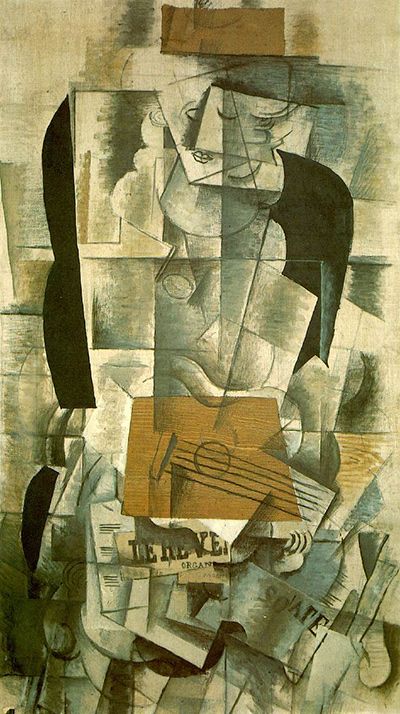
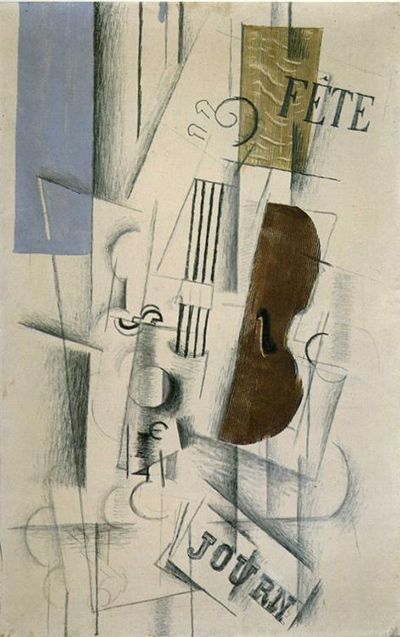
One word in Georges Braque's title seems to promise a fragment of modern life ready-made: newspaper. The Philadelphia Museum of Art, however, identifies Violin and Newspaper as graphite, charcoal, and oil on canvas. Its material description contains no newsprint and no pasted paper. The distinction is fundamental. This is a painting that brings the idea of print into Cubism without turning the printed object itself into an ingredient.[1]
Braque made the work in 1912–13, when the methods associated with Analytic Cubism were meeting the new possibilities of collage and Synthetic Cubism. The canvas belongs to that moment of change while resisting a simple label. Its subject points toward the daily press; its medium remains drawing and paint. The result helps explain how Cubism could transform representation before, during, and alongside its experiments with actual paper.
At a Glance
- ArtistGeorges Braque[1]
- TitleViolin and Newspaper[1]
- Date1912–13[1]
- MediumGraphite, charcoal, and oil on canvas[1]
- Dimensions36 × 23 1/2 in. (91.4 × 59.7 cm)[1]
- CollectionPhiladelphia Museum of Art[1]
- Object number1950-134-26; PMA object 51170[1]
- SignificanceThe Philadelphia composition through newsprint-like signs, faux wood and the tension between pasted and painted effects
Contents
- Introduction
- A title poised against its materials
- Drawing in the register of print
- Why the violin suited Cubist reinvention
- At the Analytic–Synthetic threshold
- When the newspaper became physical
- Simulation remained part of the experiment
- The limits of newspaper evidence
- The Arensbergs and an early American setting
- The force of an absent fragment
A title poised against its materials
The museum's record fixes the work's basic identity. It measures 36 by 23 1/2 inches, or 91.4 by 59.7 centimetres, and carries the accession number 1950-134-26. Its present credit is the Louise and Walter Arensberg Collection, 1950.[1] Those facts distinguish it from several other Braque compositions that combine a violin with printed matter.
The title authorises two points of recognition: a violin and a newspaper. It offers much less than a complete inventory. It identifies no publication, issue, article, language, or date, and leaves every exact letter sequence unverified. Treating the named newspaper as a sheet physically attached to the canvas would go further still, contradicting the museum's medium.
That gap between name and substance gives the painting much of its historical interest. A newspaper can be present as a subject before it is present as a material. Braque could summon printed culture through drawn and painted signs, asking recognition to do work that a pasted fragment would later perform by physical fact.
Drawing in the register of print
Graphite and charcoal matter here because they belong to drawing while carrying different kinds of graphic force. Graphite can produce a dry, controlled line; charcoal can widen, darken, or soften a mark. Oil introduces another register, one associated with painted shapes and fields. The museum leaves individual passages unassigned, making any precise sequence of manufacture speculative. The secure point is their coexistence on canvas.[1]
That coexistence makes representation flexible. A line can define part of a familiar object, act as an independent sign, or help organise a plane. A denser area can carry visual weight without behaving like conventional modelling. Paint can join those drawn structures without restoring the seamless illusion expected of an older still life. None of these operations needs a piece of newspaper to be glued down.
Print therefore enters at the level of reference. The represented newspaper belongs to a world of type, columns, repeated editions, and public circulation, even when no particular story can be recovered. Graphite and charcoal are especially apt for such an encounter because they can make marks feel immediate and diagrammatic. This material-based reading stops short of turning every line into imitated typography.
Why the violin suited Cubist reinvention
The violin was one of Cubism's most persistent still-life subjects. The Philadelphia Museum describes how Braque and Picasso flattened, divided, and recomposed string instruments through changing angles, using abbreviated signs in place of conventional likeness.[2] A violin was useful precisely because it was familiar. Recognition could survive even when its continuous body gave way to selected cues and intersecting structures.
The instrument also moved easily between cultural settings. The Metropolitan Museum notes that the violin could evoke classical and folk music, refinement and sentiment, allowing Cubist art to address both established culture and popular experience.[4] Here those associations simply help explain why the subject remained productive: it already crossed categories before Braque reorganised it.
Placed beside a newspaper in the title, the violin brings two different systems of recognition together. One suggests an object known through contour, parts, handling, and sound; the other suggests information organised through print. Cubism could reduce both to partial signals while relying on the viewer's prior knowledge to complete the identification. The subject is reconstructed mentally even as the painting declines to offer an uninterrupted imitation.
At the Analytic–Synthetic threshold
The date 1912–13 places Violin and Newspaper across a change that art history usually describes through the terms Analytic and Synthetic Cubism. The Philadelphia Museum characterises the earlier phase through the fragmentation and recombination of objects seen from different angles. It describes the later phase as a reassembly of elemental forms, coinciding with collage, brighter colour, and devices such as simulated wood grain.[2]
These labels clarify a broad development. Taken as a material formula, however, they obscure the Philadelphia canvas. Its date belongs to the emergence of Synthetic Cubism, yet its stated components are graphite, charcoal, oil, and canvas. Reassembly remained possible without an attached scrap, while painting continued after pasted paper appeared. Several procedures remained available at once.
The painting can consequently be understood as transitional without being forced halfway between two sealed categories. It carries forward the fragmentation and abbreviated sign of Analytic practice while addressing the new problem raised by everyday printed matter: how little painted or drawn information is needed before a newspaper becomes conceptually present?
When the newspaper became physical
Other Braque works show what changes when paper enters literally. The Cleveland Museum of Art's Violin, made in early 1914, consists of cut-and-pasted newsprint, decorative paper, and faux bois with charcoal and graphite on cardboard. Cleveland also records that Braque glued an entire page of Le Journal to the reverse.[3] Here the newspaper has a prior existence outside the artwork. It arrives with printed language, manufactured surface, and the physical fact of paper.
Centre Pompidou's Violon et pipe provides another exact contrast. Dated to the winter of 1913–14, it combines charcoal, graphite, chalk, and pasted papers on cardboard. One clipping comes from the 28 December 1913 issue of Le Journal, allowing the museum to use the newspaper itself as dating evidence.[5] Such precision is possible because an identifiable fragment survives as material.
These cases clarify the material contrast while keeping their papers, dates, and motifs within separate objects. Literal newsprint carries an independent history into a composition; represented newsprint is produced within the artist's marks. Both can connect the still life with modern public culture, but they do so in different ways.
The difference also unsettles any easy hierarchy of reality and illusion. A pasted sheet is physically real, yet it may represent a table, an object, or a spatial plane within the artwork. A painted sign is materially paint, yet it can identify a newspaper with great conceptual economy. Cubism made the tension between those statuses visible while leaving each one unstable.
Simulation remained part of the experiment
Braque continued to explore painted imitation while working near the invention of papier collé. The Met's Violin and Sheet Music: “Petit Oiseau”, made in early 1913, is oil and charcoal on canvas. Its wood grain was produced with metal combs, while its sheet music is a trompe-l'oeil construction made on the canvas.[4] The work demonstrates how one material could convincingly refer to another as real paper entered Cubist art.
The comparison illuminates a range of possibilities while keeping exact features local. The combed grain and sheet music belong to Petit Oiseau. The Philadelphia record leaves both unconfirmed for Violin and Newspaper. What the two works share securely is a medium based in oil and drawing on canvas and an interest in objects whose identity can be reconstructed through signs.
This coexistence of simulation and attachment is central to Braque's achievement. Papier collé expanded the field while painted illusion remained active. Once a manufactured surface could enter an artwork as itself, a drawn or painted surface could be judged against that new material possibility. An unpasted newspaper became a deliberate representational problem.
The limits of newspaper evidence
A newspaper ordinarily promises specificity: a date, a place of publication, a sequence of reports, perhaps an advertisement or political argument. The title of Braque's painting preserves the category while withholding those particulars. The current object information leaves its issue and article unidentified.[1]
That absence prevents a historical interpretation built around a supposed headline. It also concentrates attention on the newspaper's broader character. Unlike a unique painted object, a newspaper is serial, mechanical, inexpensive, and made to circulate. It belongs to daily time and loses its currency quickly. Invoking it inside a painting brings that temporary public world into contact with the slower, singular object of art.
Any political reading would require specific printed evidence beyond the title. The subject matters without a recoverable hidden message. The title introduces print as a modern category; the medium shows that Braque chose to evoke it through the resources of painting and drawing.
The Arensbergs and an early American setting
The work's later history is unusually tangible. The Philadelphia Museum places it with Louise and Walter Arensberg by about 1918. A photograph by Charles Sheeler of the interior of their New York apartment, taken around that year, supports the dating.[1] It establishes possession while leaving the acquisition date, seller, and place unknown.
The Arensbergs moved their collection from New York to Los Angeles in 1921. Its presence in their home by the end of the First World War places this demanding Cubist canvas within an early American setting for European modern art. The current credit records the final institutional chapter: their collection entered the Philadelphia Museum of Art in 1950.[1]
That concise trail also restores the painting's scale as an object that moved through rooms and cities. Its newspaper may refer to circulation within the represented world, while the canvas itself followed another form of circulation through collecting. The two histories remain distinct, yet their juxtaposition suits a work concerned with how objects acquire new identities in new settings.
The force of an absent fragment
The most important fact about Violin and Newspaper may be what its material record leaves out. Braque named printed matter without attaching it. He used graphite, charcoal, and oil to make a newspaper available to recognition while keeping the painting materially distinct from his papiers collés.
That choice situates the work at a fertile point in Cubism's development. Fragmented representation, abbreviated signs, painted simulation, and literal collage ceased to be successive answers that cancelled one another. They became alternatives that could be tested side by side. The newspaper could enter as commodity, clipping, printed surface, title, or painted reference.
In the Philadelphia canvas it enters through the last two of those modes. The title directs thought toward the modern press; the marks remain the work of drawing and painting. Their tension gives the absent scrap its force. What is materially missing becomes conceptually active, and Cubism's reinvention of representation can be seen in the distance between those two conditions.
Related Pages
Frequently Asked Questions
One word in Georges Braque's title seems to promise a fragment of modern life ready-made: newspaper.
The museum's record fixes the work's basic identity.
In the Philadelphia canvas it enters through the last two of those modes.
Discussion
One word in Georges Braque's title seems to promise a fragment of modern life ready-made: newspaper.
Reader Insights
One word in Georges Braque's title seems to promise a fragment of modern life ready-made: newspaper.
Centre Pompidou's Violon et pipe provides another exact contrast.
In the Philadelphia canvas it enters through the last two of those modes.
Join the Conversation
Share the visible detail or source that most changed your reading.
References
- Philadelphia Museum of Art, Violin and Newspaper.
- Philadelphia Museum of Art, Picasso and the Avant-Garde in Paris.
- Cleveland Museum of Art, Violin.
- Metropolitan Museum of Art, Violin and Sheet Music: “Petit Oiseau”.
- Centre Pompidou, Violon et pipe.