 by Tom Gurney
Tom Gurney BSc (Hons) is an art history expert with over 20 years experience
Published on August 14, 2026 / Updated on August 14, 2026
Email: tomgurney1@gmail.com / Phone: +44 7429 011000
Introduction
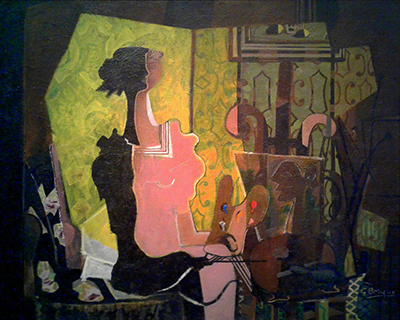
Georges Braque's Woman Seated at an Easel presents artistic work as a relationship among a person, her implements and the room around her. Painted in 1936, the canvas measures 131.4 × 163.2 centimetres and uses oil mixed with sand. Its broad proportions give the studio unusual breadth, allowing the interior to press upon the seated figure from several directions. The painting entered the Metropolitan Museum of Art through Florene M. Schoenborn's 1995 bequest and carries the accession number 1996.403.12.[1]
The Met identifies the scene as Braque's own studio at Varengeville, on the Normandy coast. It also identifies the woman as an artist, with palette and brush in hand.[1] Her personal name remains open, while her occupation is clear. This distinction matters. The canvas offers few grounds for a conventional biography of a sitter, yet it says a great deal about how a painter can inhabit a painting.
Braque makes that presence deliberately unstable. The artist can be recognised through her body and tools, although the surrounding patterns keep pulling her back into the interior. The sand-bearing paint gives real substance to a scene whose depth has been compressed. Easel, palette, brush, nested pictures and folding screen all contribute to a studio that seems engaged in its own act of construction.
The painting's central tension follows from an imbalance between certainty and instability. Its female artist has a clearly recorded occupation, yet her body slips between views and her surroundings claim comparable visual energy. The tools act as anchors. They allow agency to survive even as decoration fragments the unity of the person who holds them.
At a Glance
- ArtistGeorges Braque[1]
- TitleWoman Seated at an Easel[1]
- Date1936[1]
- MediumOil and sand on canvas[1]
- Dimensions131.4 × 163.2 cm[1]
- CollectionThe Metropolitan Museum of Art, New York[1]
- Accession1996.403.12[1]
- SignificanceThe 1936 Varengeville studio scene through model, easel, palette, patterned interior and sand-rich surface
Contents
- Introduction
- Varengeville as a Place of Work
- An Artist Defined Through Her Tools
- Profile and Frontal Presence
- When Decoration Enters the Figure
- Sand and the Material Studio
- One Work Among Creative Figures
- From the Artist in the Studio to the Studio Itself
Varengeville as a Place of Work
Varengeville had become an important setting in Braque's life before this canvas was painted. A booklet published by the museums of Rouen explains that the American architect Paul Nelson bought a country house there in 1928 and showed the village to his friends Marcelle and Georges Braque. The same account dates the building of the Braques' house to 1931.[3] By 1936, the coastal village was firmly established as a place where Braque could live and work.
The location adds specificity without turning the painting into an architectural record. The Met names the room as Braque's Varengeville studio, so the setting carries the intimacy of a known working environment.[1] It is a place formed around artistic labour: pictures occupy the room, an easel stands before the seated painter, and the implements of painting remain close to her body.
Yet familiarity produces no simple or restful interior. The room has been translated into a pictorial structure. Its planes, motifs and boundaries exert their own pressure, making the studio feel both inhabited and constructed. Varengeville anchors the scene in Braque's life, while the painting transforms that setting into a problem of presence, surface and space.
An Artist Defined Through Her Tools
Palette and brush establish the woman's activity with striking economy. The Met's account describes both implements in her hands, and the title brings the easel into the same working ensemble.[1] Together they make her role legible before any personal identity is known. She is represented through the act she is equipped to perform.
This emphasis gives the seated position an unusual force. Seated, she remains equipped for work. The tools link hand, colour and support, placing the woman's body within a chain of decisions. Braque can therefore evoke artistic agency without supplying anecdote, expression or a named life.
Painting also appears inside painting. The Met's acquisitions bulletin describes a work upon the easel and another picture above it.[2] These nested pictures complicate the relation between maker and made object. The woman belongs to Braque's canvas, while the canvas before her belongs to the studio represented within it. Artistic production becomes both the subject of the scene and part of its internal architecture.
The result is a subtle doubling of roles. Braque paints an artist who faces a painting, and the viewer faces both. Each level frames the next. The studio consequently becomes a place where looking, making and being represented converge, even though the exact subjects of the inner pictures remain secondary.
That recursive arrangement changes the usual hierarchy of a studio portrait. Braque remains the maker of the outer canvas, the unnamed woman occupies the role of maker within it, and an inner work carries the process one level further. Painting is represented through a succession of makers, supports and acts of looking. The identity of each nested picture matters less than the structure they create together.
Profile and Frontal Presence
The woman's instability becomes clearest in the Met bulletin's account of her body. It describes one protagonist presented through two aspects: an elongated, partly disjointed dark profile and a more colourful frontal view.[2] These presentations coexist, allowing a single figure to register from more than one direction.
Braque had long challenged the authority of a fixed viewpoint. Kunstsammlung Nordrhein-Westfalen explains how his Cubist work displaced a single spectator position with multiple views and organised fragments across the picture plane.[6] The 1936 canvas carries that inquiry into a fuller, more expansive interior. Its figure remains recognisably human and occupied with painting, while her identity arrives in stages.
The profile offers one kind of legibility: a dark, extended sign that can be read quickly as a body turned sideways. The frontal aspect offers another, bringing colour and face-to-face orientation into the encounter. Their coexistence prevents either view from becoming final. Recognition depends upon movement between them.
This structure gives anonymity a formal counterpart. The museum leaves the woman's personal identity unnamed, and the painting withholds a single, settled presentation of her body. Her artistic role remains the firmest point. The person is dispersed across aspects, while palette, brush and easel continue to hold her occupation together.
When Decoration Enters the Figure
The distinction between person and setting becomes equally unsettled through pattern. The Met's bulletin argues that Braque's handling of decorative motifs nearly overwhelms the female protagonist.[2] Its wording captures an essential tension: the woman remains visible, but the room continually competes with her.
The current Met account adds curvilinear forms to this description.[1] Curves can belong to a body, an object or a decorative rhythm, and Braque allows those functions to approach one another. A contour may help identify the artist at one moment and join the movement of the interior at another. Figure and studio retain their names while sharing a visual language.
The folding screen sharpens that exchange. The bulletin describes a vertical fold behind the artist and an arbitrarily flattened studio space.[2] A screen ordinarily divides a room and creates depth through its hinged sections. Here its fold also belongs to the surface organisation of the canvas. An object associated with spatial division helps make represented space feel compressed.
Braque's early training as a decorative painter gives this pressure a longer context. Both Kunstsammlung Nordrhein-Westfalen and the Phillips Collection connect his mature practice with an enduring sensitivity to crafted surfaces, pattern and tactile effect.[5][6] Decoration in Woman Seated at an Easel carries structural weight. It determines how the artist appears, how the room holds together and how easily one can be separated from the other.
Seen in this light, decoration functions as spatial machinery. Repeated forms can bridge separate areas, while a screen fold can suggest both an object in a room and a division on a flat support. The same device may organise depth and interrupt it. Braque's decorative intelligence gives the interior cohesion, then uses that cohesion to make the figure harder to isolate.
Sand and the Material Studio
Pattern offers the eye a sense of texture; sand gives the painting actual granular matter. The Met records the medium as oil with sand on canvas and describes the pigment as sand-laced.[1] The physical addition changes the terms of the studio. Surface is no longer only represented by painted motifs. It has been materially built into the work.
This practice belongs to a sustained concern in Braque's art. Kunstsammlung Nordrhein-Westfalen describes his use of sand admixtures to give colour tactile qualities, while the Phillips Collection places granular additions within his exploration of physical objects and surrounding space.[5][6] Those broader accounts clarify the purpose of material experiment without assigning a precise recipe to the 1936 canvas.
For this painting, the secure material statement stops with oil and sand. The grain's exact placement and density remain unspecified. Its importance lies in the tension it creates: the room looks compressed into layered forms, yet the canvas asserts physical substance. Depth becomes uncertain at the same moment that matter becomes palpable.
Sand also alters the competition between artist and interior. The body carries the same materially worked field as the space around it. This shared substance encourages figure and setting to approach each other, while the tools preserve a readable account of occupation. Braque makes the painter vulnerable to the room's patterns and binds both to the same resistant surface.
Two kinds of texture consequently meet in the work. Painted motifs create differences that the eye interprets, while sand creates a physical variation within the layer of pigment. Their conjunction brings seeing close to touch while keeping the canvas beyond literal handling. Braque can compress represented space and intensify material presence through the same worked field.
One Work Among Creative Figures
The represented painter belongs to a wider concern in Braque's work of the period. According to the Met, this canvas joins a group of about ten works showing figures engaged in artistic or musical activities.[1] The approximate number suggests a small thematic neighbourhood, centred on people whose identities emerge through making or performance.
The museum's phrase “about ten” keeps the group's boundaries flexible. It indicates recurrence without imposing a formal sequence, shared dimensions or a single commission. What unites the paintings in the Met's account is represented activity. This framing allows the 1936 artist to belong to a wider inquiry while retaining the particular structure of her own studio encounter.
Within that group, this canvas gives visual creation a doubled form. A painter is depicted at her easel, and the room around her contains further pictures. Art appears as implement, activity, object and environment. The woman occupies the centre of that network without becoming a conventional portrait subject.
The musical works mentioned by the Met offer a useful parallel. Music is understood through action unfolding in time, and Kunstsammlung Nordrhein-Westfalen notes that Braque often connected multi-perspectival seeing with a gradual process of perception.[6] The seated artist similarly becomes intelligible through accumulated cues. Profile, frontal aspect, palette, brush and easel contribute successive pieces of recognition.
The group therefore enlarges the painting's central question. Creative identity can be represented through what a figure does, yet activity never isolates that figure from surrounding space. In Braque's hands, making belongs to an environment of objects, surfaces and overlapping views.
From the Artist in the Studio to the Studio Itself
During the later 1930s, the studio became an increasingly fertile subject for Braque. The Phillips Collection traces his movement from intimate late-1920s interiors toward larger and more vibrant spaces during the following decade, while preserving his interest in physicality and varied surfaces.[5] Woman Seated at an Easel brings a human practitioner into that enlarged field.
A separate Met painting, The Studio (Vase before a Window) of 1939, shows the inquiry continuing. The museum connects that work with spatial representation, colour harmony and contrasting textures, then describes it as an anticipation of nine large studio paintings made after the Second World War.[4] The 1936 canvas stands earlier in this development, when the studio's significance is still organised around a represented artist.
That artist never gains complete independence from her surroundings. Her profile and frontal aspect divide presence across more than one view. Decorative motifs approach the body, the folding screen compresses the room, and sand gives shared substance to figure and setting. Palette, brush and easel keep artistic labour legible throughout.
Braque's achievement lies in making the studio active at every level. It is a real place at Varengeville, a room filled with the signs of painting, a flattened arrangement of patterns and a physically worked canvas. The seated woman inhabits all four at once. Her name remains unknown, yet her artistic identity becomes inseparable from the tools, pictures and material space through which she appears.
Related Pages
Frequently Asked Questions
Georges Braque's Woman Seated at an Easel presents artistic work as a relationship among a person, her implements and the room around her.
Varengeville had become an important setting in Braque's life before this canvas was painted.
Braque's achievement lies in making the studio active at every level.
Discussion
Georges Braque's Woman Seated at an Easel presents artistic work as a relationship among a person, her implements and the room around her.
Reader Insights
Georges Braque's Woman Seated at an Easel presents artistic work as a relationship among a person, her implements and the room around her.
The current Met account adds curvilinear forms to this description.
Braque's achievement lies in making the studio active at every level.
Join the Conversation
Share the visible detail or source that most changed your reading.
References
- The Metropolitan Museum of Art, Woman Seated at an Easel.
- The Metropolitan Museum of Art, Recent Acquisitions: A Selection, 1996–1997.
- Musées de la Métropole Rouen Normandie, Braque, Miró, Calder, Nelson: Varengeville, a Cliff-top Studio.
- The Metropolitan Museum of Art, The Studio (Vase before a Window).
- The Phillips Collection, Georges Braque and the Cubist Still Life, 1928–1945.
- Kunstsammlung Nordrhein-Westfalen, Georges Braque.