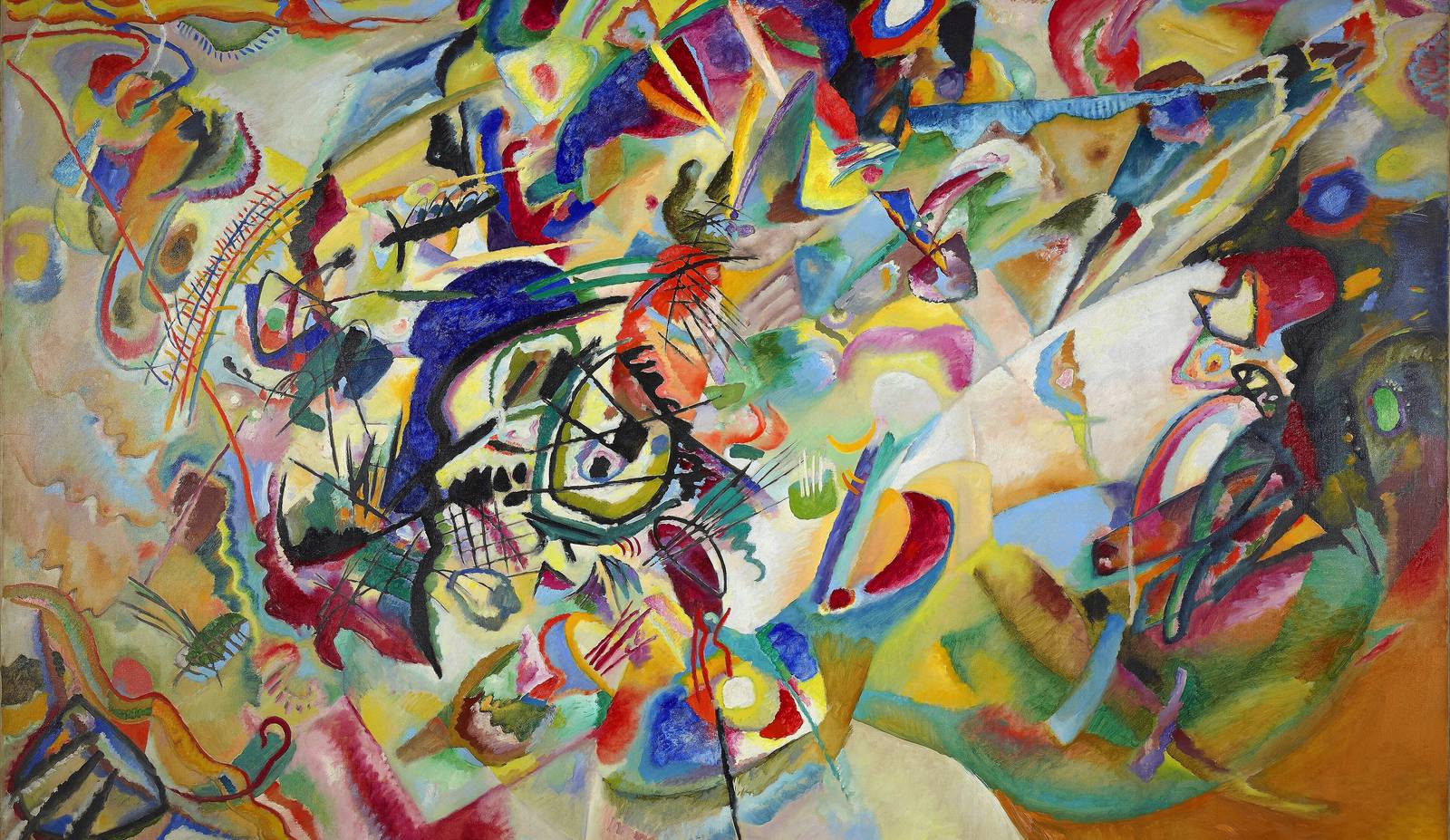
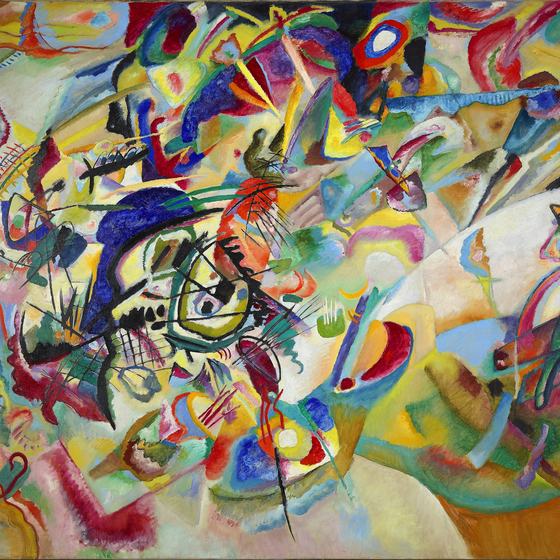
Image reference: Wassily Kandinsky, Composition VII.
At a Glance
- Core period1911–1914, with decisive Murnau and NKVM roots from 1908
- Principal centresMunich · Murnau · Sindelsdorf · Upper Bavarian lakes
- Key projectsfirst editorial-board exhibition · “Black and White” exhibition · Der Blaue Reiter almanac · touring shows
- Known forsaturated colour · expressive landscape · symbolic animals · abstraction · printmaking · image and music
- Central organisersKandinsky · Marc · Münter
- Wider circleMacke · Klee · Jawlensky · Werefkin · Campendonk · Delaunay · Schönberg
- Best understood asan editorial, exhibition and friendship network founded on stylistic diversity
Contents
- Where Der Blaue Reiter fits
- Murnau before the name
- The NKVM rupture
- A name with several meanings
- The almanac as exhibition
- Spirituality and inner necessity
- Music, Schönberg and Kandinsky
- Gabriele Münter and Murnau
- Franz Marc’s animals and colour
- Artists and contributors to know
Where Der Blaue Reiter fits
Wassily Kandinsky
Principal careerFranz Marc
Principal careerGabriele Münter
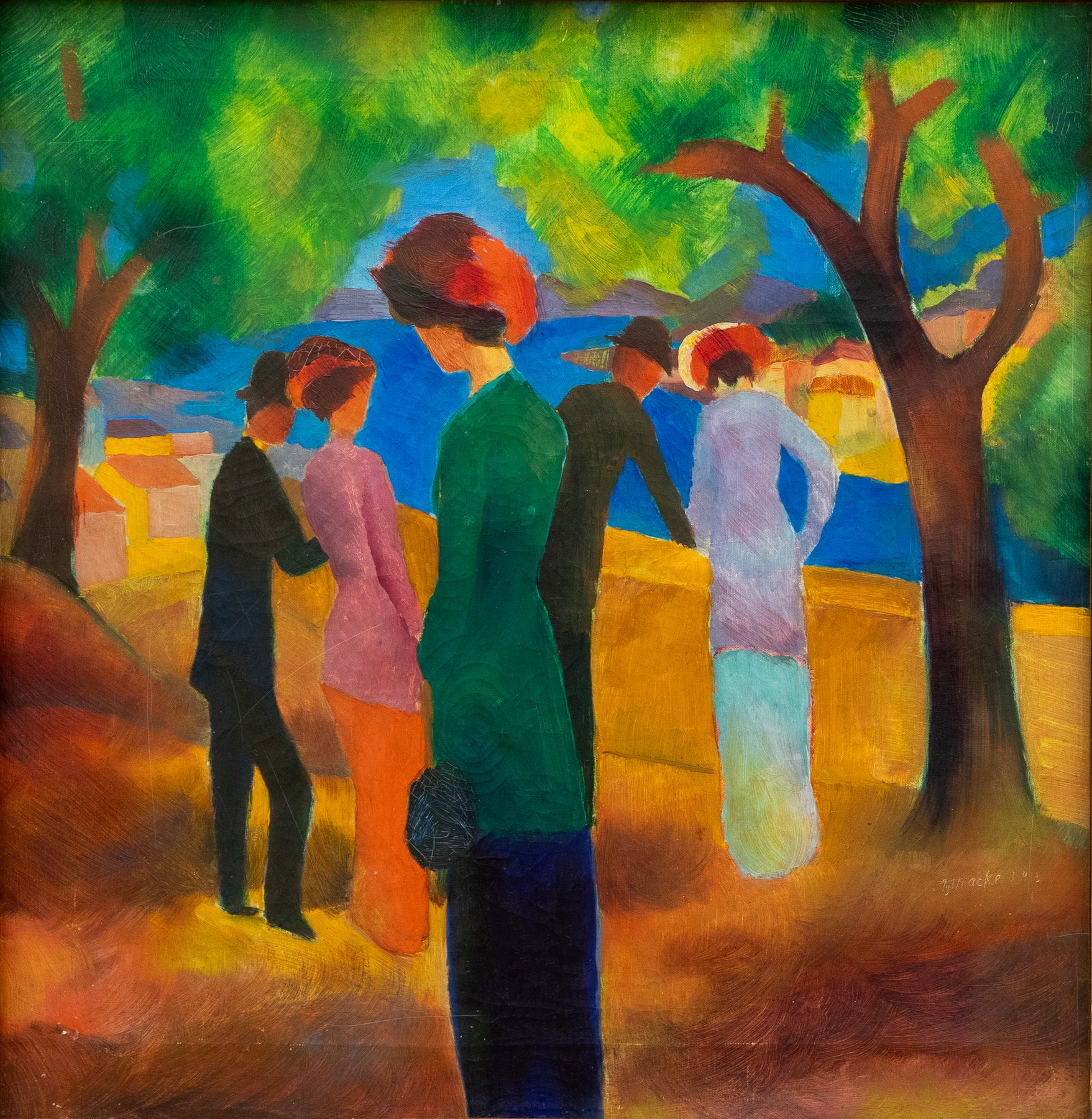
Principal careerAugust Macke
Principal careerPaul Klee
Principal careerMarianne von Werefkin
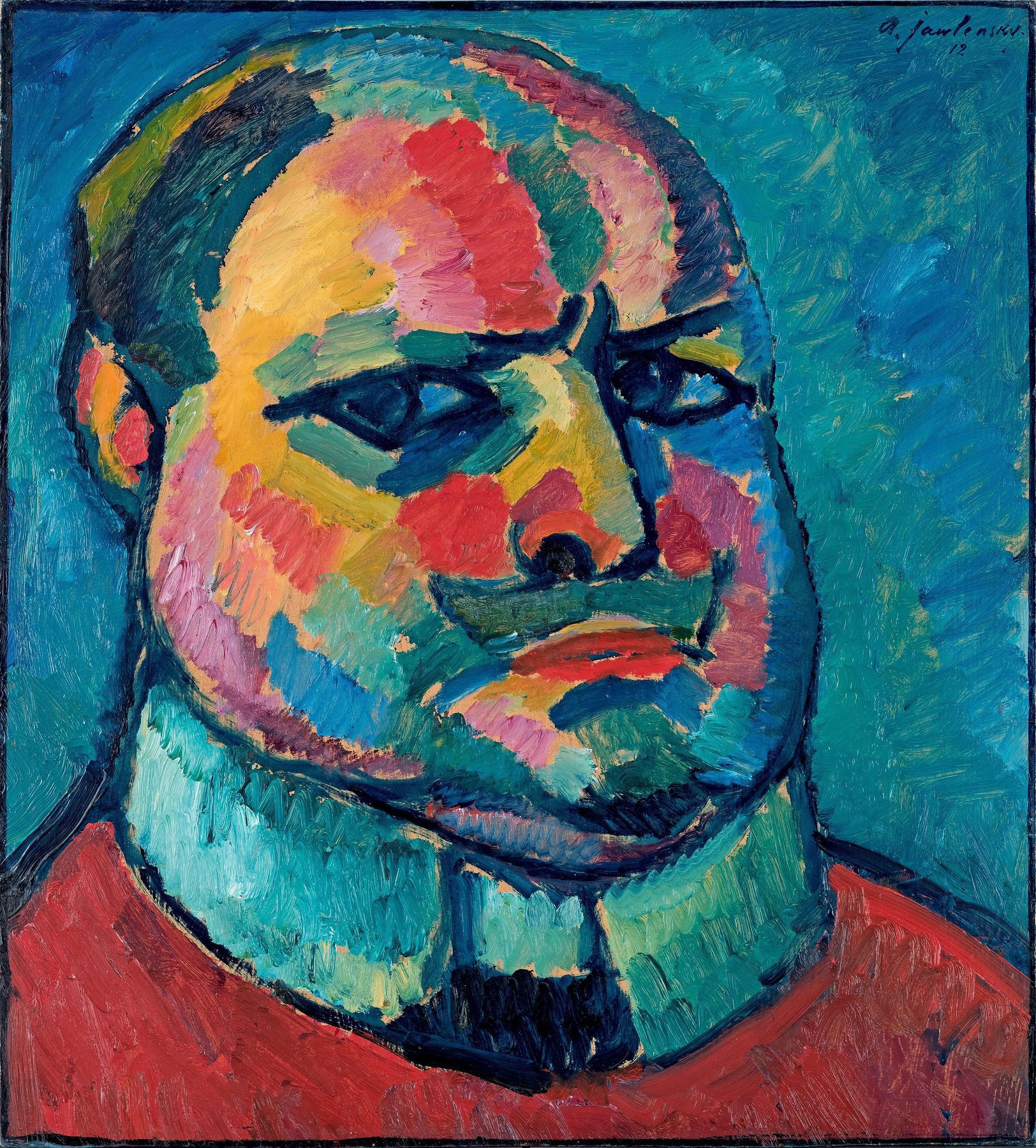
Principal careerAlexej von Jawlensky
Principal careerHeinrich Campendonk
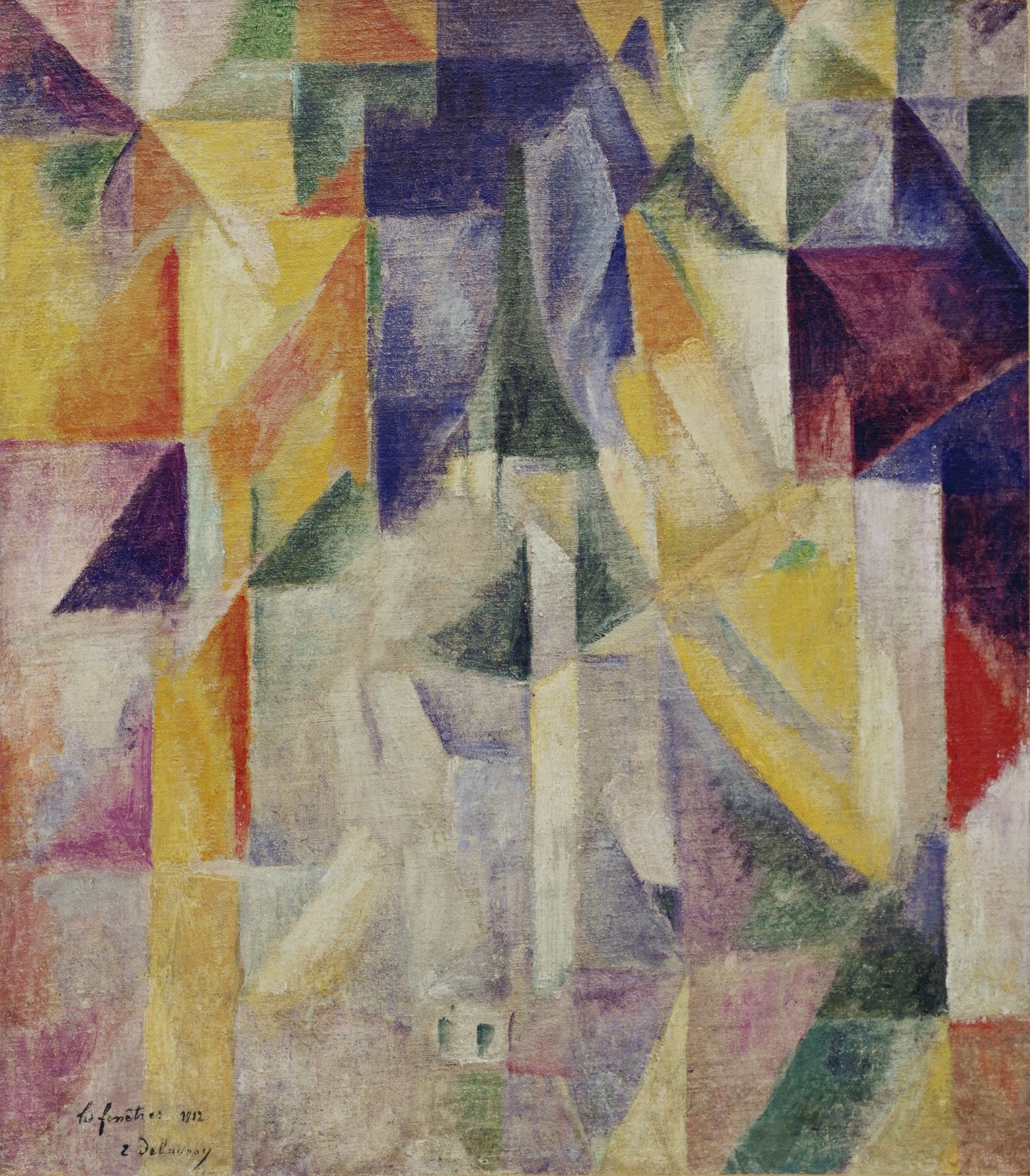
Principal careerRobert Delaunay
Principal careerHenri Rousseau
Principal careerArnold Schönberg
Principal careerDer Blaue Reiter—The Blue Rider—lasted for only a few years, yet it changed what an art movement could be. It had no stable membership roll, headquarters or shared style. Instead, it operated through friendships, arguments, two Munich exhibitions, touring shows and an extraordinary illustrated book. Painting appeared beside music, theatre and theory; modern French and Russian art beside Bavarian reverse glass, medieval sculpture, children's drawings and objects taken from cultures far beyond Europe. The connecting idea was not that all these things looked alike, but that art could give outward form to an “inner necessity”.[1] [3]
The network took public shape in Munich at the end of 1911, led by Wassily Kandinsky and Franz Marc with Gabriele Münter. Its roots lay in the work that Münter, Kandinsky, Alexej von Jawlensky and Marianne von Werefkin had made together in Murnau since 1908. Its field soon widened to August Macke, Paul Klee, Heinrich Campendonk, Alfred Kubin, Elisabeth Epstein, Maria Franck-Marc, Robert Delaunay, Arnold Schönberg and many others—each participating differently and none surrendering an individual language.[2] [4] [33]
Der Blaue Reiter belongs within German Expressionism, but it was never purely German. Russian artists, French paintings, an American exhibitor, Austrian music, Swiss connections and art from across the world entered its projects. Its internationalism was genuinely ambitious. It was also compromised: the almanac's editors used objects available through colonial systems while often ignoring their makers, original purposes and histories. That contradiction—between liberating comparison and possessive looking—is as central to the movement as blue horses or abstract colour.[3] [5]
German Expressionism is a historical umbrella, not one organisation. Die Brücke began in Dresden in 1905 and developed through shared studios, print portfolios and direct encounters with the modern city and the body. Der Blaue Reiter emerged later around Munich, with stronger emphasis on spiritual renewal, international comparison and the possibility that colour and form could operate independently of observed reality. The contrast is useful, but it should not harden into urban anxiety versus mystical nature. Both circles used prints, admired art outside academic traditions and crossed paths through exhibitions.[14] [41]
Der Blaue Reiter was also not another name for abstraction. Kandinsky moved rapidly toward non-objective painting, but Münter continued to make landscapes, portraits, interiors and still lifes; Marc painted animals; Macke studied figures in parks and shops; Werefkin created nocturnal narratives; Jawlensky concentrated on faces. Their organising principle allowed “total abstraction” and a highly simplified “total realism” to coexist when each answered an inner artistic need.[3] [15]
The chronology is equally compact. The Murnau collaborations began in 1908. The Neue Künstlervereinigung München, or NKVM, was founded in 1909. Kandinsky and Marc planned an almanac in 1911, then separated from the NKVM in December and mounted a counter-exhibition within two weeks. A second exhibition and the almanac followed in 1912. Touring shows and the First German Autumn Salon carried the network forward through 1913 and into 1914. War then scattered the participants.[1] [22]
It is tempting to call every friend a member, but the projects had different lists. Klee was important to the second exhibition but not the first. Delaunay and Henri Rousseau supplied crucial French connections without joining a Munich club. Schönberg participated as painter, composer and writer. Jawlensky and Werefkin were essential to the Murnau and NKVM background and appeared in the later touring orbit, though they were not among the first show's listed exhibitors. Historical precision makes the network more, not less, interesting.
Murnau before the name
In summer 1908, Kandinsky and Münter joined Jawlensky and Werefkin in Murnau, a market town south of Munich where the Alpine foothills rise beyond a broad moor. They painted side by side outdoors, looked at one another's work and tested what happened when observed landscape was compressed into intense colour and strong structure. The town's painted façades, surrounding lakes, dark moor and abrupt mountain skyline became shared motifs rather than a common formula.[1] [10]
French modernism helped trigger the change. Kandinsky and Münter had spent time in Paris in 1906–1907; Jawlensky knew recent French painting. Matisse and the Fauves demonstrated that colour need not remain local or descriptive. Van Gogh, Gauguin and Cézanne offered different models of construction and emotional force. Russian popular prints, icons, Art Nouveau design and Bavarian craft supplied other visual memories. The Murnau paintings are not French style transplanted to Germany. They are translations made through a particular landscape and set of relationships.[4] [32]
Münter's View from the Griesbräu Window of 1908 looks down on roofs and streets whose angles lock the town together. Depth remains, but the scene is organised by flat patches and dark boundaries rather than atmospheric modelling. Jawlensky's Murnau landscapes often make colour denser and more confrontational; Kandinsky increasingly loosens buildings and mountains into signs. Werefkin turns village and road into stages for human movement and psychological weather.
The working situation mattered. Women were barred from the Munich Academy, so Münter and Werefkin had built careers through private schools, travel, study and independent networks. Werefkin had trained in Russia, maintained a celebrated Munich salon and placed her own ambitions under pressure while supporting Jawlensky. Münter had studied with Kandinsky at the Phalanx school, but she was not simply a pupil executing his discoveries. Her camera, drawing and painting registered different ways of selecting from the world.[11] [37]
Münter bought a house in Murnau in 1909. It became a home she shared for periods with Kandinsky, a decorated environment filled with painted furniture and collected objects, and a meeting place for artists. In autumn 1911, Kandinsky, Franz and Maria Franck-Marc, August and Elisabeth Macke, Heinrich Campendonk and others worked on the almanac there. Editorial modernism took shape around tables, letters, pictures and domestic hospitality, not solely in a public café or studio.[7] [10]
The house complicates the usual hierarchy. Münter provided place, records and artistic labour. Her photographs preserve the first exhibition's hanging and the circle's work and travel. Decades later, the same house protected hundreds of works from destruction. Its significance begins with her art, not merely with what she saved.
The NKVM rupture and first exhibition
The Murnau collaborators helped found the NKVM in January 1909. It was a formal exhibiting association with rules, a jury and an international constituency. Kandinsky served as its first chairman; Werefkin, Jawlensky, Münter, Alfred Kubin, Adolf Erbslöh, Alexander Kanoldt, Erma Bossi, Moissey Kogan and others were involved. Its first two exhibitions at Galerie Thannhauser attracted hostile criticism but gave artists excluded from conservative institutions a platform.[1] [3]
Franz Marc defended the NKVM's second show in 1910 and soon met Kandinsky. Their friendship accelerated theoretical discussion. In June 1911 Kandinsky proposed an illustrated almanac that would document a new art across national and disciplinary boundaries. Marc brought energy, contacts and editorial labour; the Berlin industrialist Bernhard Koehler, uncle of Macke's wife Elisabeth, supplied crucial financial support.[19] [48]
Tension within the NKVM sharpened. The association's jury rules restricted the size of submitted work, and more moderate members resisted Kandinsky's movement toward abstraction. On 2 December 1911 the jury rejected his large, near-abstract Composition V. Kandinsky, Marc and Münter resigned. Alfred Kubin aligned with the dissidents. The break was real, but the speed of the next exhibition shows that a counter-project had already been considered.[2] [10]
On 18 December, the “First Exhibition of the Editorial Board of Der Blaue Reiter” opened at Galerie Thannhauser. Its title advertised the book project rather than announcing a conventional new society. Around fifty works produced a deliberately unsettled field. Kandinsky, Marc and Münter appeared with Macke, Campendonk, Elisabeth Epstein, Albert Bloch, David and Vladimir Burliuk, Robert Delaunay, Eugen von Kahler, Jean Bloé Niestlé, Henri Rousseau and Arnold Schönberg.[2] [47]
This was not stylistic unity. Rousseau's carefully imagined scenes hung near Kandinsky's dissolving landscapes. Schönberg's intense self-images met Marc's animals and Delaunay's structures. American-born Albert Bloch, Russian-born Burliuks and French artists made “German” Expressionism visibly transnational. The exhibition asked visitors to locate an inward seriousness across incompatible forms.
Gabriele Münter photographed the installation. Her images show pictures in different sizes and frames arranged across the gallery walls, allowing later researchers to reconstruct an event whose surviving works are now dispersed. Documentation was another form of participation.
Essential works
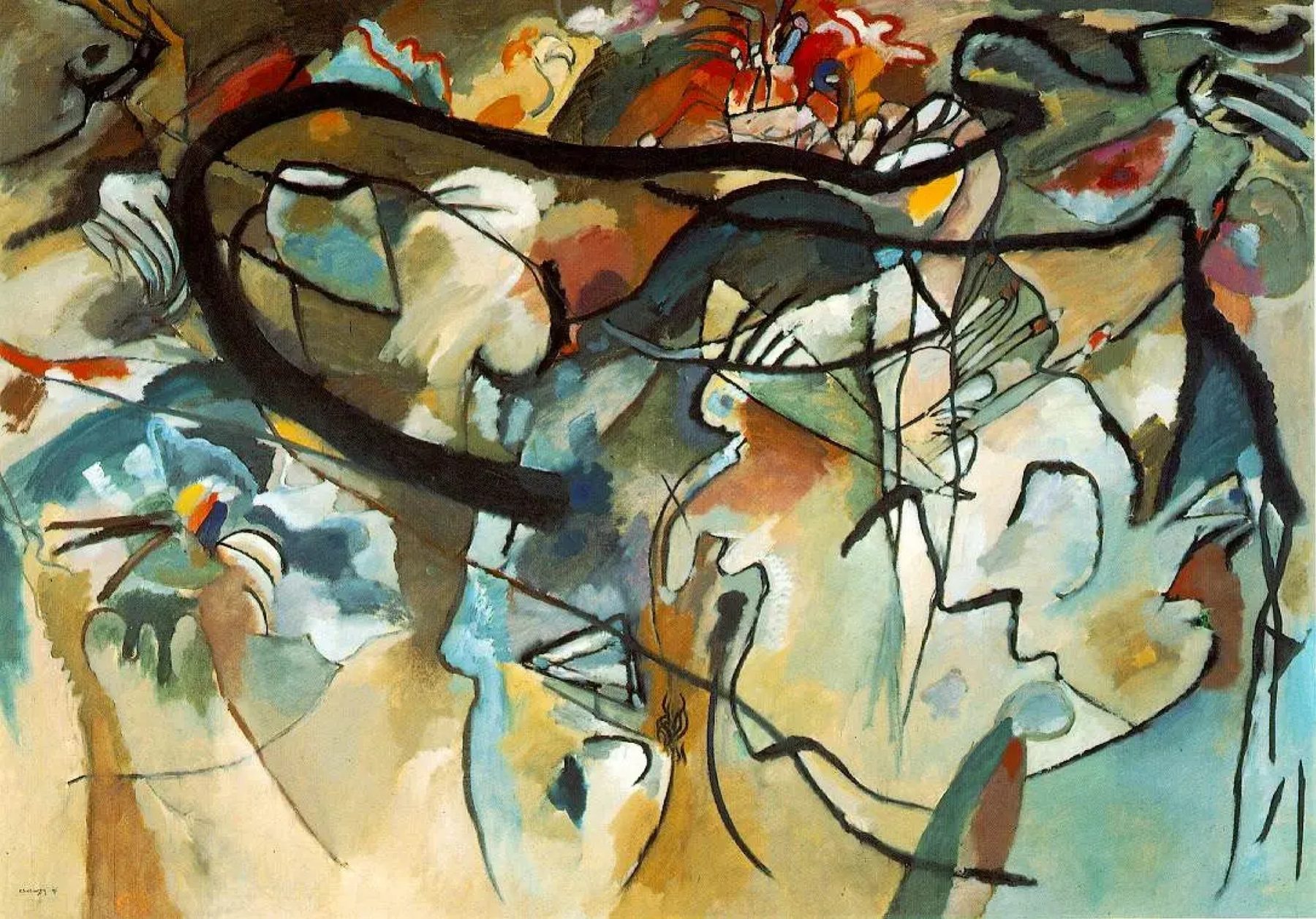
Composition V
Wassily Kandinsky, 1911
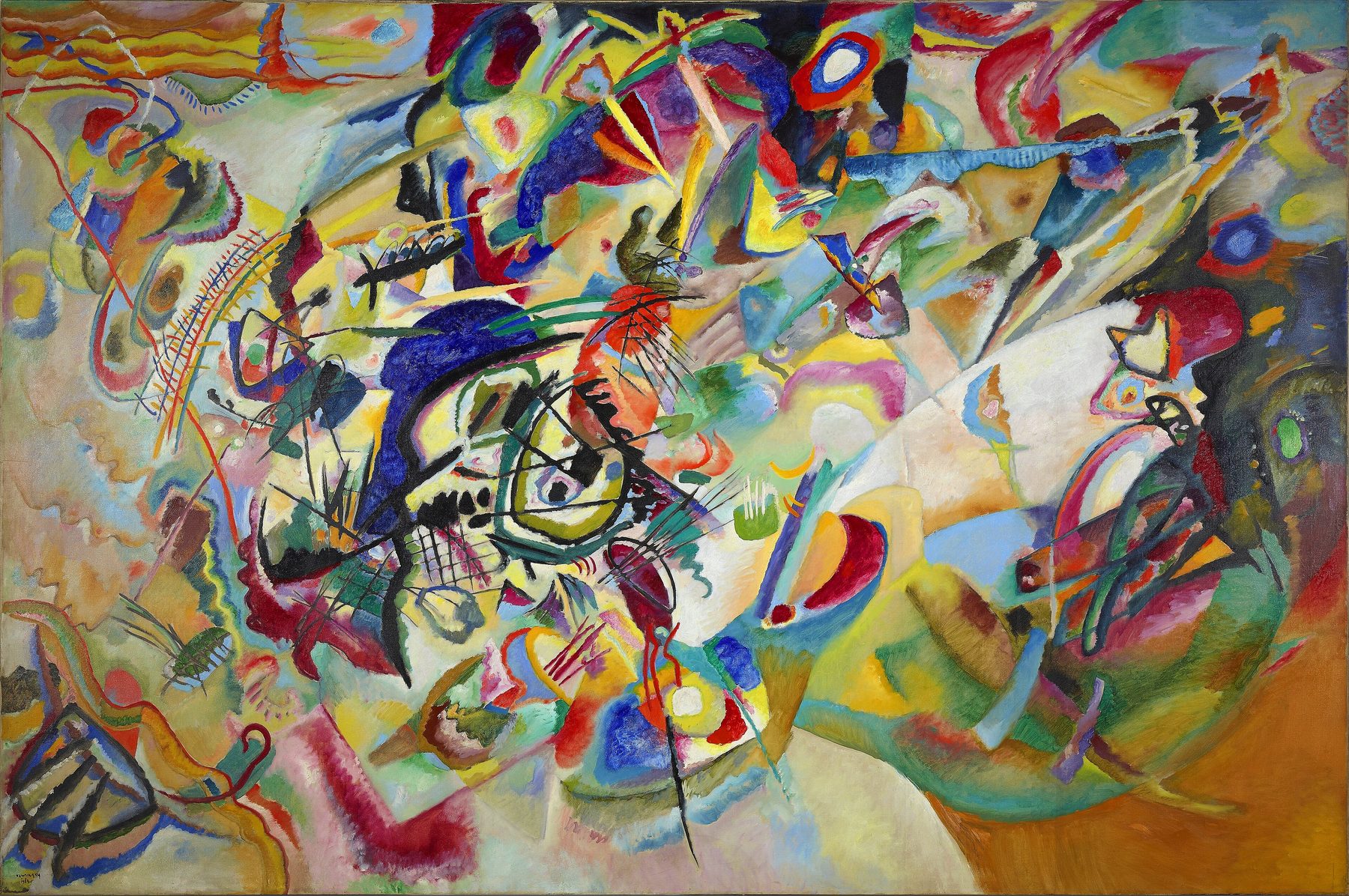
Composition VII
Wassily Kandinsky, 1913
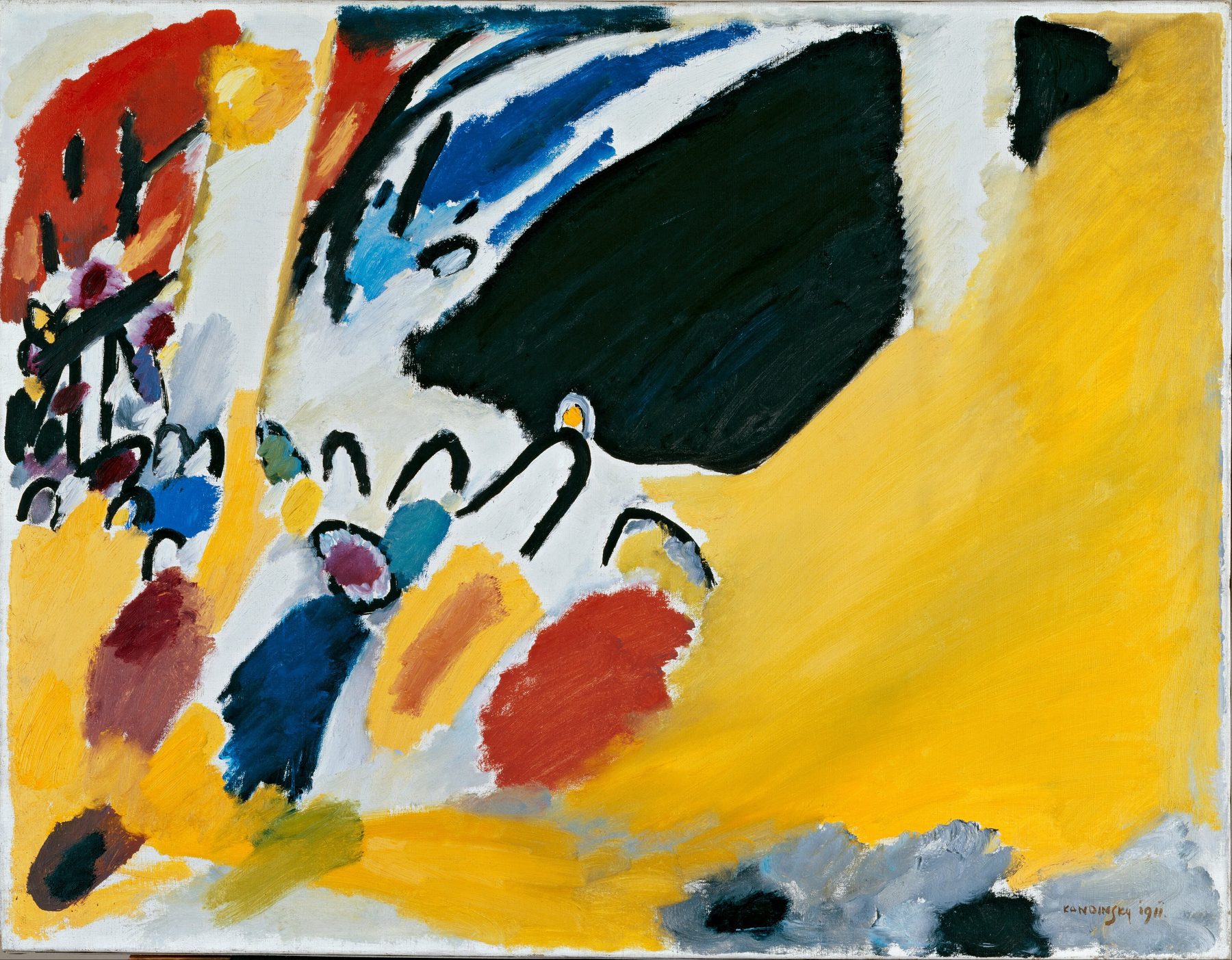
Impression III (Concert)
Wassily Kandinsky, 1911
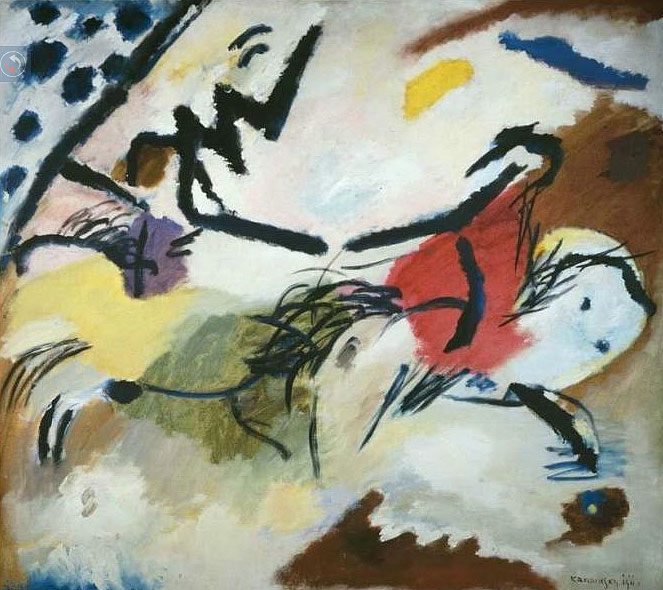
Improvisation No. 20 (Two Horses)
Wassily Kandinsky, 1911
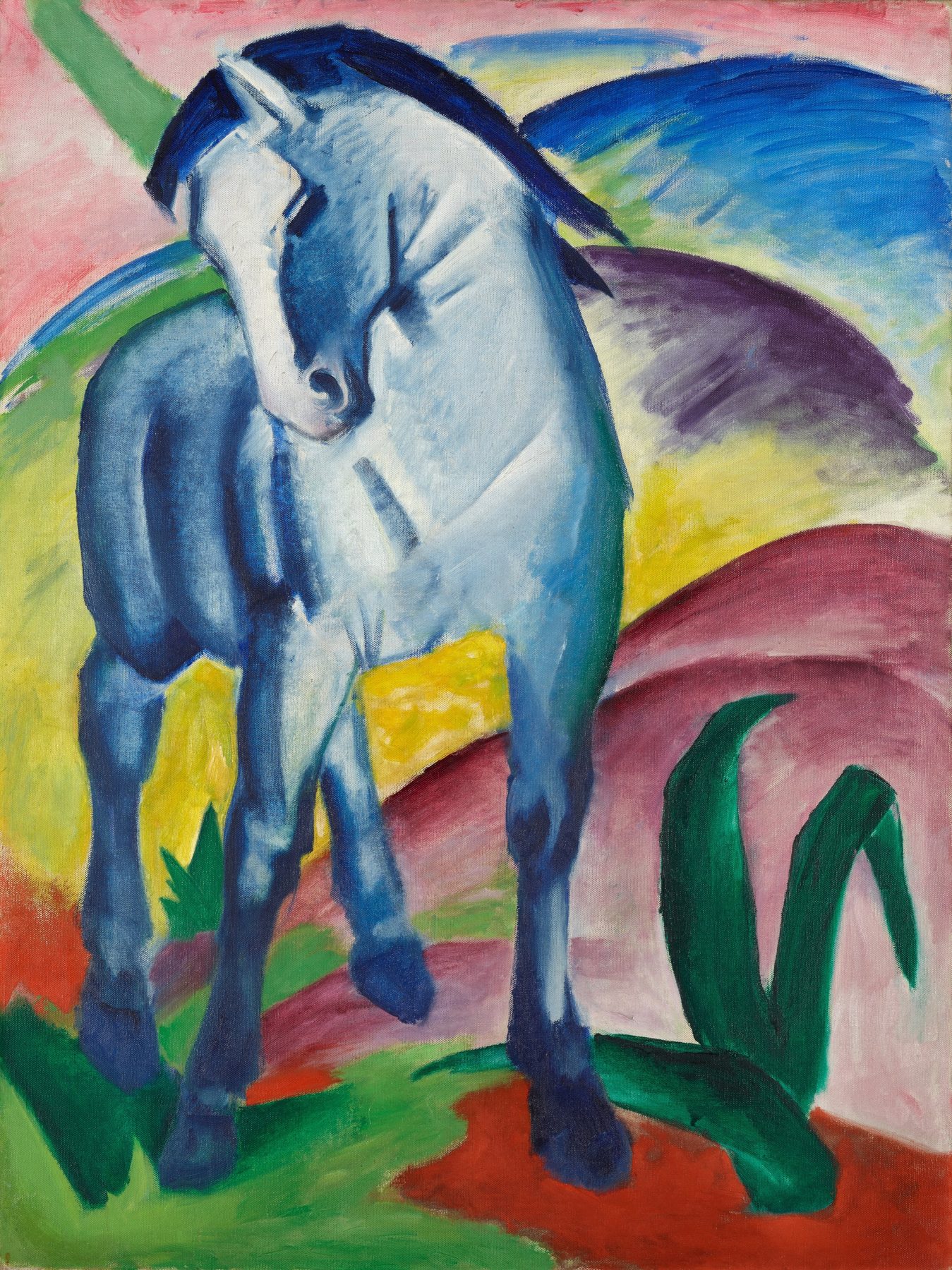
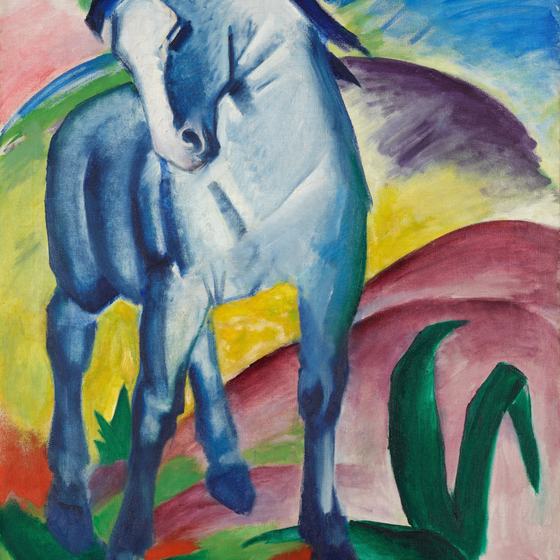
Blue Horse I
Franz Marc, 1911
A name with several meanings
Kandinsky later recalled that he and Marc invented the title over coffee: both loved blue, Marc loved horses and Kandinsky loved riders. The anecdote, written down long after the event, is memorable rather than complete. Marc had already made horses central to his art; Kandinsky's riders connected Russian tales, medieval knights, Saint George and the artist's advance beyond convention.[19] [45]
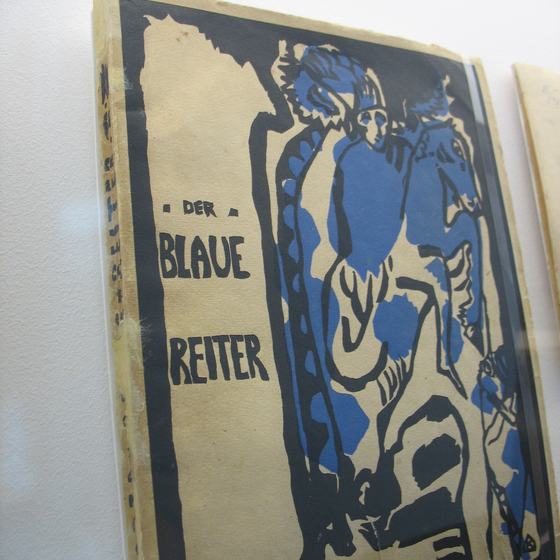
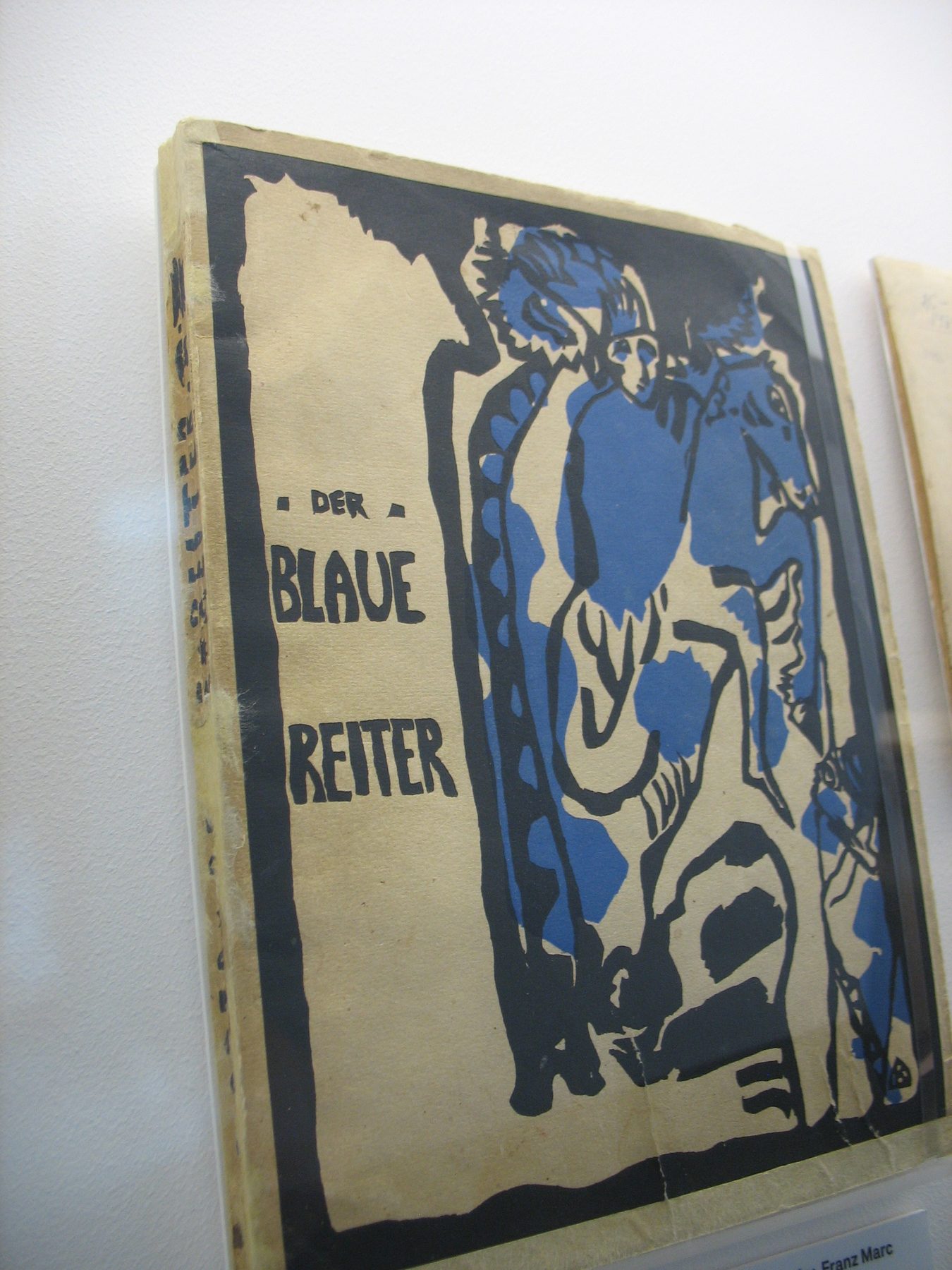
The final almanac cover shows Saint George on a rearing horse defeating a dragon. Its simplified contours and emphatic colour recall the reverse glass paintings collected around Murnau. Spirit triumphs over matter, but the small image also looks handmade, mobile and reproducible. It announces renewal through an old Christian and popular motif rather than through a machine-age symbol.[3] [30]
Blue carried different associations. Kandinsky linked it to depth, inward movement and spirituality. Marc made it part of a personal theory of gendered colour. The title never functioned as a required palette. Münter, Macke, Klee and Werefkin could belong to the conversation without accepting one symbolism.
The second exhibition and travelling network
The second Blue Rider exhibition opened at Hans Goltz's gallery in February 1912 and ran into April. Often known as “Black and White”, it concentrated on works on paper: drawing, watercolour and print. The shift reduced the dominance of large oil painting and made room for a wider technical and stylistic range. Klee exhibited seventeen works; Kubin's graphic imagination was especially at home in this context.[1] [18]
Works on paper could travel and circulate more easily than monumental paintings. The two Blue Rider exhibitions toured in changing selections through German and other European cities until 1914. Marc also linked Munich and Berlin networks, included Die Brücke prints in the second show and helped organise Herwarth Walden's First German Autumn Salon in Berlin in 1913. The story is therefore not two isolated exhibitions followed by silence.[3] [22]
Print mattered aesthetically as well as logistically. Cutting a woodblock encourages silhouettes, reversed design and economical marks. Kandinsky credited woodcut practice with helping him simplify riders, hills and apocalyptic crowds. The apparent roughness associated with an old craft became a modern means of moving between image and sign.[20] [44]
Follow the Der Blaue Reiter through four stages
–1909
Murnau and the NKVM foundations
Shared work around Murnau compresses landscape into saturated colour and strong contour, while the NKVM creates a formal Munich exhibition platform.
Rupture and the first exhibition
The rejection of Composition V precipitates the NKVM break, while a counter-show brings unlike artists together under an editorial-board title.
Works on paper and the almanac
A second exhibition and the almanac expand the project across print, theory, music, theatre, folk traditions and international comparison.
–1914
Touring, exchange and dispersal
Touring shows, Paris connections and the Tunisian journey widen the network before war destroys its practical conditions.
The almanac as an exhibition in book form
Kandinsky and Marc published Der Blaue Reiter with Piper in May 1912. They had imagined a recurring yearbook, but only this principal volume appeared; a revised edition followed in 1914. The book is often called a manifesto, yet it contains no single declaration that every participant signed. It works more like an exhibition whose sequence of pages produces arguments by encounter.[3] [28]
The editors placed essays by themselves, Macke and other artists beside criticism, music and reproductions. Kandinsky's stage composition The Yellow Sound proposes an environment of colour, movement, light and sound. Arnold Schönberg contributed an essay; musical scores by Schönberg, Alban Berg and Anton Webern appeared near the end. Painting was not asked to absorb every art. The volume searched for shared principles across their differences.[19]
Its 141 illustrations make the argument visible. Modern works by Picasso, Delaunay, Rousseau, van Gogh and members of the circle appear with medieval sculpture, German woodcuts, Russian lubki, Bavarian reverse glass paintings, East Asian prints, children's drawings and works drawn from ethnographic collections. The scale and caption style change abruptly. A reader has to compare rather than follow one chronological ladder.[3]
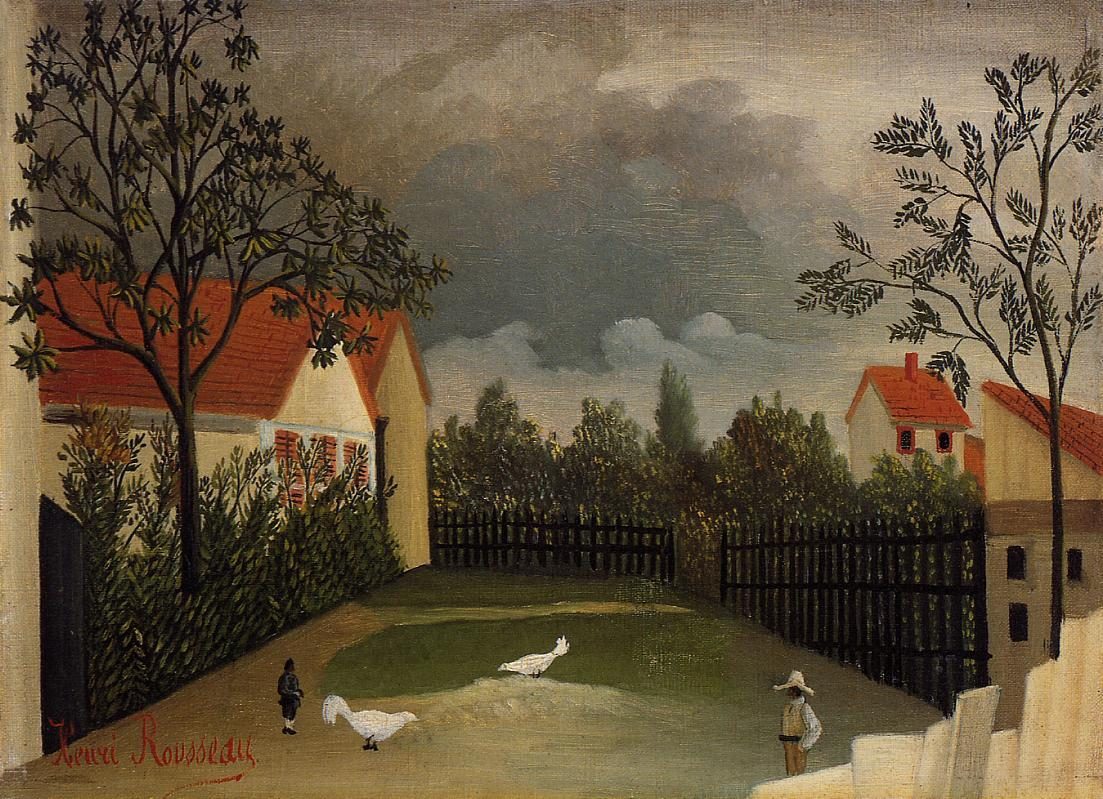
Henri Rousseau occupies an unusually prominent place. Kandinsky had encountered his work in Paris and owned paintings by him; The Poultry Yard appeared in the first exhibition. Seven Rousseau reproductions in the almanac supported Kandinsky's contention that a simplified, intensely personal realism could be as radical as abstraction. Admiration did not make Rousseau a formal group member.[31] [46]
The book's visual discontinuity is deliberate. A child's drawing is not presented as preparatory work by an adult. A glass painting is not arranged as a primitive step toward Kandinsky. At its most generous, montage challenges the academy's hierarchy between professional and untrained maker, fine and applied art, past and present, Europe and the world.
Yet the editorial power remained with Kandinsky and Marc. They selected, cropped, captioned and reassigned images to their own themes. A universal “inner” art could become a way of overlooking differences in makers, beliefs and use. The almanac is both an emancipating design and an archive of asymmetry.
Spirituality and inner necessity
The Blue Rider artists opposed what they saw as materialism, academic routine and art reduced to external likeness. “Spiritual” named a desire for deeper transformation, but it was not one creed. Kandinsky drew on Christian apocalypse, Russian folk and Orthodox imagery, Theosophy and ideas about immaterial vibration. Marc projected innocence and renewal onto animals. Jawlensky later described prayerful preparation for his heads. Werefkin joined psychological drama to ethical and intellectual debate.[24] [35]
Kandinsky's Über das Geistige in der Kunst, published at the end of 1911 with a 1912 title page, is the best-known theoretical statement. It imagines culture as a slowly advancing spiritual triangle and gives colours and forms emotional directions. Yellow seems to press outward; blue withdraws inward; angles and curves carry differing tensions. The artist must choose through “inner necessity”, the relation between a form, a work and its historical moment.[27]
These descriptions are metaphors and working hypotheses, not settled laws of perception. Kandinsky's own paintings alter their effects through scale, neighbour colours, line, texture and remembered imagery. Blue does not mean the same thing in every work. His theory grants form agency while preserving the artist as its sensitive organiser.
He distinguished Impressions, Improvisations and Compositions. An Impression begins with an external stimulus; an Improvisation answers a largely inner event; a Composition develops slowly through studies and revision. The terms encourage musical listening, but they do not separate objective from abstract work cleanly. Improvisation No. 20 of 1911 still contains horses and riders amid loose colour and line.[20] [34]
The large Composition paintings move further from ordinary description while retaining floods, resurrection, boats, mountains, riders and saints. Apocalyptic signs dissolve into energetic structures. To call them simply non-representational misses the drama by which images emerge and disappear. Claims about the single first abstract painting remain disputed; the movement toward abstraction was neither one canvas nor Kandinsky's achievement alone.[23] [36]
Music, Schönberg and Kandinsky
Music offered a powerful analogy because it could organise time, intensity and feeling without copying the visible world. Kandinsky attended a concert of Arnold Schönberg's music in Munich in January 1911. He made sketches that night and painted Impression III (Concert). A large black wedge suggests the piano; a yellow field seems to sound across the picture; smaller marks imply players and audience without describing the room.[21] [25]
Kandinsky wrote to Schönberg and an intense correspondence began. Both men felt they had crossed established boundaries: Schönberg had moved beyond conventional tonality, while Kandinsky was loosening the represented object. Their exchange did not create a code in which a particular note automatically equals a particular colour. It explored how dissonance, structure and inner response might operate in different media.[25]
Schönberg also painted. Four of his works appeared in the first Blue Rider exhibition, where some participants admired their urgency and Macke objected strongly. Kandinsky wrote about the “painting of essence”. The disagreement matters: cross-disciplinary openness did not guarantee shared judgement.[26] [47]
The almanac made this conversation material. Scores must be read or performed; reproductions are seen; The Yellow Sound imagines a stage work not then realised. The reader becomes the site where arts meet. Equality between media does not mean their sensations become interchangeable.
Gabriele Münter and the art of Murnau
Münter's painting is direct without being simple. In her Murnau streets, broad areas of colour meet at dark contours that hold and energise the architecture. Perspective is compressed; roofs climb; roads bend through the picture like coloured bands. She described the artist's relation to nature as translation, including the right to poetic adaptation. The statement captures her independence from both literal copying and pure abstraction.[4]
Her portraits often remove social performance. Portrait of Marianne von Werefkin gives the older artist a startling, mask-like concentration rather than decorative femininity. Interiors can feel psychologically charged through empty space and sharply separated colour. Photography taught Münter to crop and seize structure, but painting did not merely imitate the camera.
In Still Life with Saint George of 1911, flowers, peasant figures, Marian statues and a reverse glass image gather on a dark surface. The objects come from collections that Münter and Kandinsky built around Murnau. Heavy brushwork and saturated colour do not dissolve them into ethnographic evidence or symbols in another artist's system. The still life studies how handmade things produce a social and spiritual presence inside a modern home.[35] [38]
Münter learned reverse glass painting from the local maker Heinrich Rambold and taught the technique to others in the circle. Painting on the back of glass reverses the normal sequence: details applied first are seen through the support, with broad colour added behind. Its luminous surface and clear outlines became a practical lesson, not only an admired look.[3] [12]
Her role extended across the group's activities. She resigned from the NKVM, exhibited in both shows and the almanac, hosted editorial work, corresponded with artists and photographed installations. Calling her Kandinsky's companion is biographically true but editorially inadequate. Their relationship included teaching, love, collaboration, inequality and eventual rupture; her art had a life before, during and long after it.[11] [37]
Franz Marc's animals and colour
Marc sought what he imagined as a less corrupted relation to the world through animals. His horses, deer, cattle, dogs and tigers are not wildlife observation alone. Bodies curve with hills, press against enclosing planes or fragment with the landscape. The aspiration toward harmony sometimes becomes tension: nature can be shelter, cosmic order or a field already breaking apart.[14] [16]
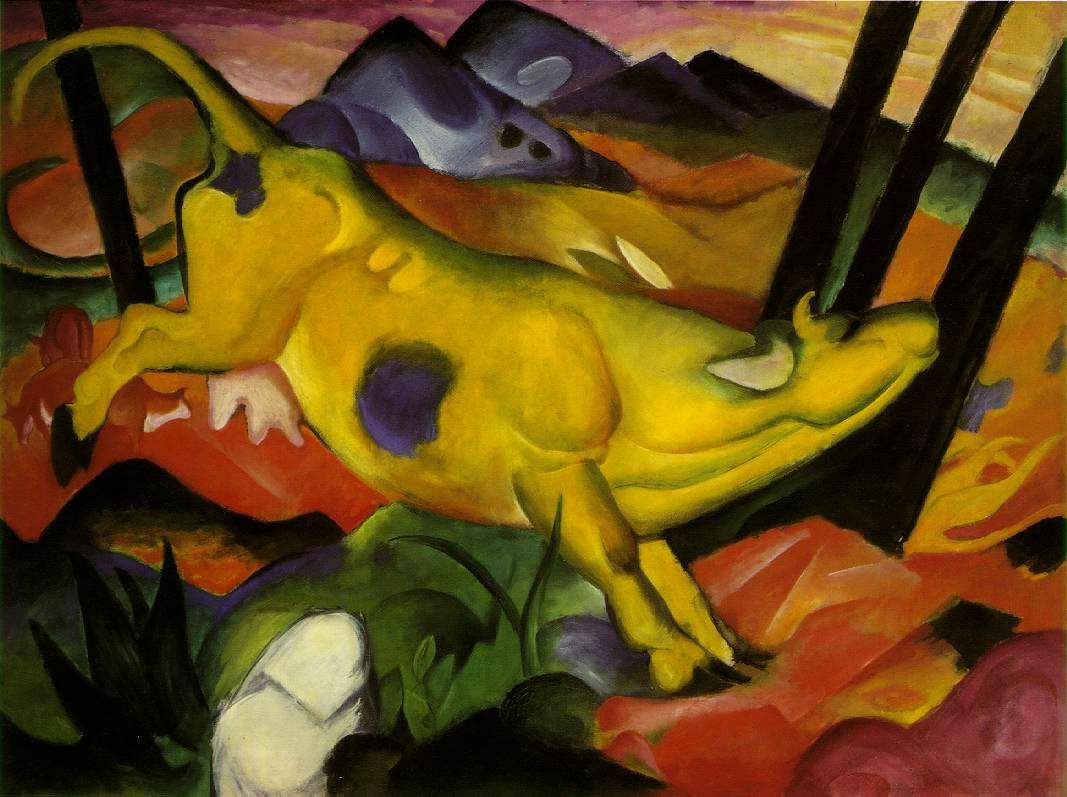
Around 1910–1911 Marc deliberately abandoned local colour. He tested complementary relations with a prism and read modern colour theories, but built his own symbolic system. In a 1911 letter to Macke he described blue as masculine, severe and spiritual; yellow as feminine, gentle and sensual; red as heavy matter. The scheme is historically revealing, not universal truth. It makes spiritual authority masculine and casts the feminine as passive or bodily, even while colour interactions in the paintings exceed those labels.[8] [13]
In Blue Horse I of 1911, the animal bows its head within a vertical canvas. Blue does not decorate a brown horse; it reorganises the creature into cool spiritual mass against rising red, yellow and green forms. The body is rounded and calm, yet its placement has the concentrated frontality of an icon. Colour becomes anatomy and atmosphere at once.
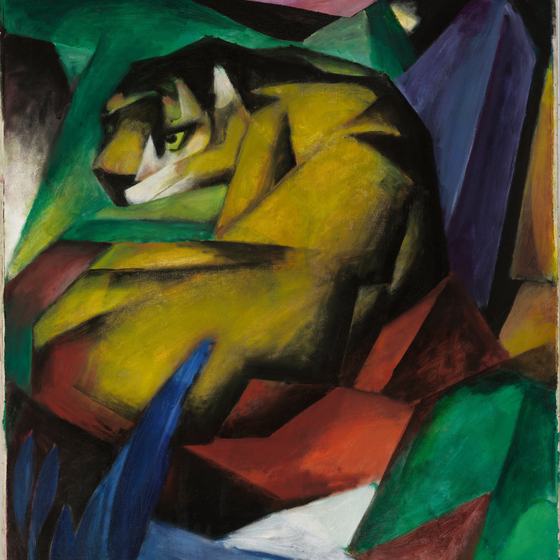
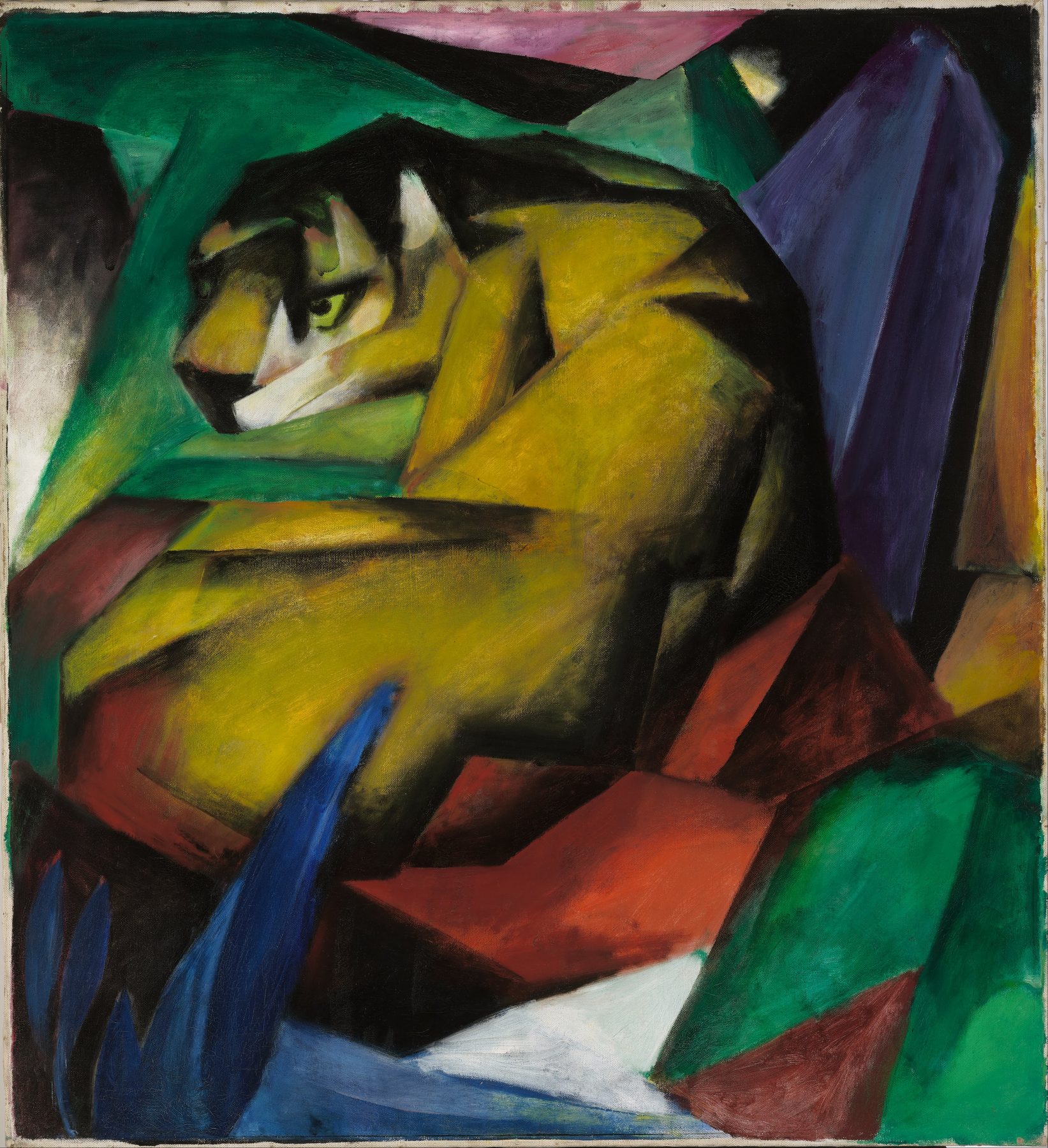
Tiger of 1912 is more compressed. The angular animal turns within fractured green and red planes, its yellow body held like a spring. Cubist structure and contact with Delaunay sharpened Marc's later work; Futurist energy also entered. These developments did not lead neatly from animal image to pure abstraction. The animal remained a vehicle for thinking about perception, violence and unity.[16] [22]
Marc co-edited the almanac, wrote criticism, organised exhibitions and connected artistic circles. The blue horse should not eclipse that editorial work. Nor should his death at Verdun freeze the animals into premonitions of war.
Macke, Klee and French exchange
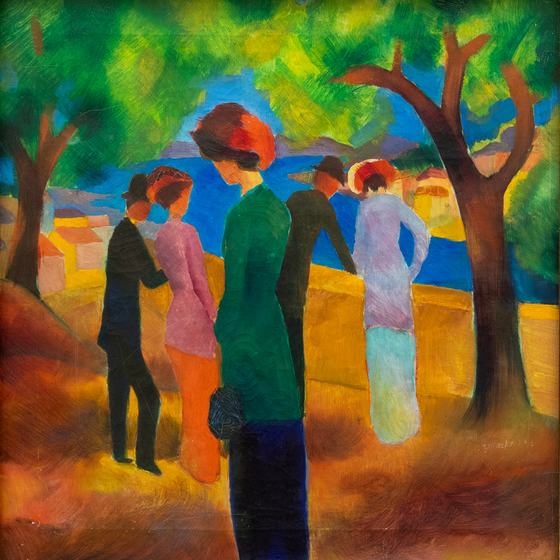
Macke joined the editorial circle and participated in both exhibitions, but his art often feels far from Kandinsky's apocalypse or Marc's spiritual animals. He painted shop windows, promenades, gardens and people absorbed in looking. Figures are simplified and often anonymous, yet they inhabit the pleasures and separations of modern public life.[17] [20]
He helped secure Bernhard Koehler's financial support and contributed the almanac essay “The Masks”, which demanded serious attention for forms excluded from fine-art museums. He also disagreed openly with colleagues, including over Schönberg's painting. Der Blaue Reiter's productivity depended on such differences.
The first exhibition introduced Macke to Delaunay's work. He and Marc visited Delaunay in Paris in 1912; Delaunay and Guillaume Apollinaire visited Macke in Bonn in 1913. Transparent colour planes, window structures and simultaneous contrast entered Macke's scenes without removing their figures. French-German exchange was built through friendship, exhibitions and travel, not an abstract list of influences.[15] [17]
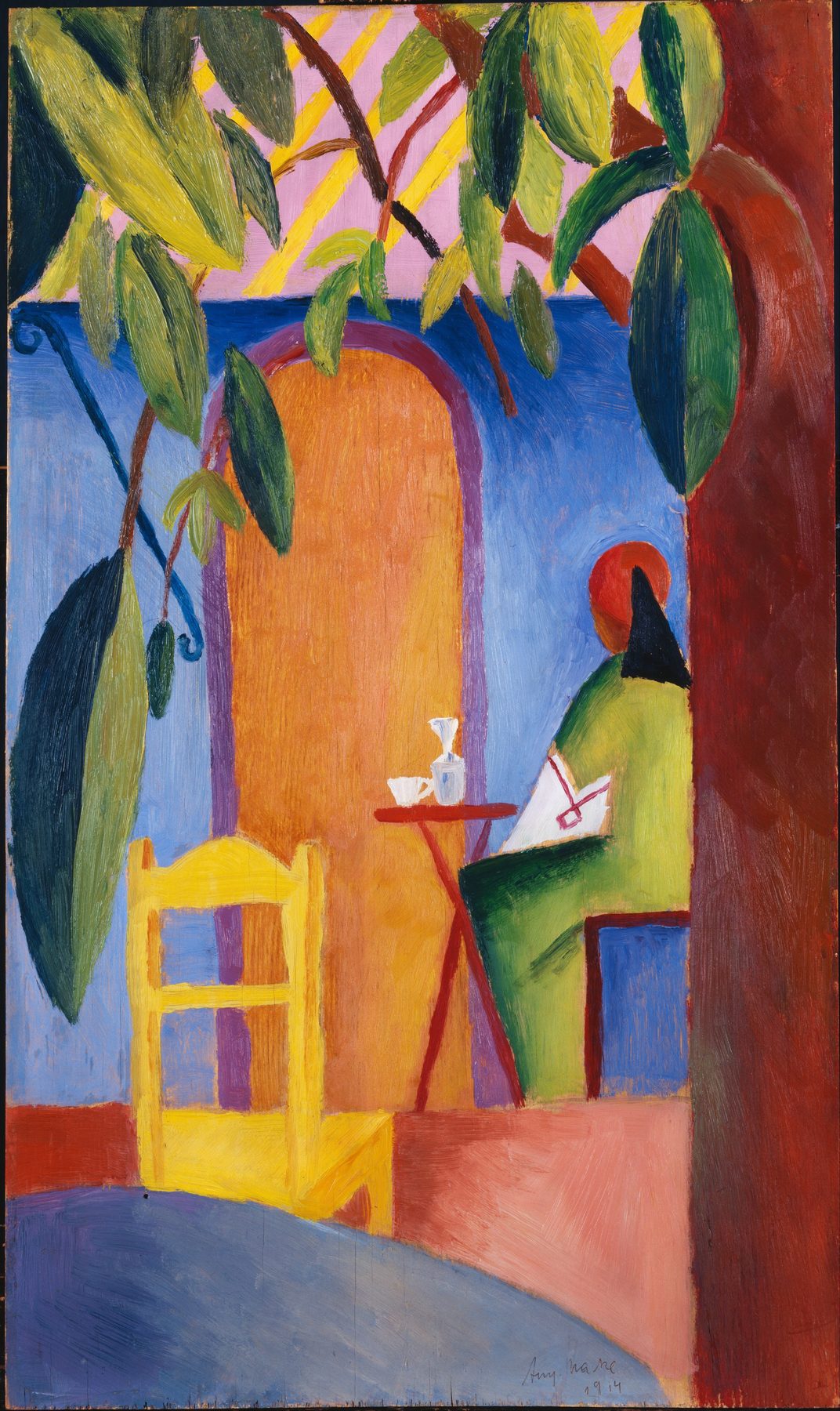
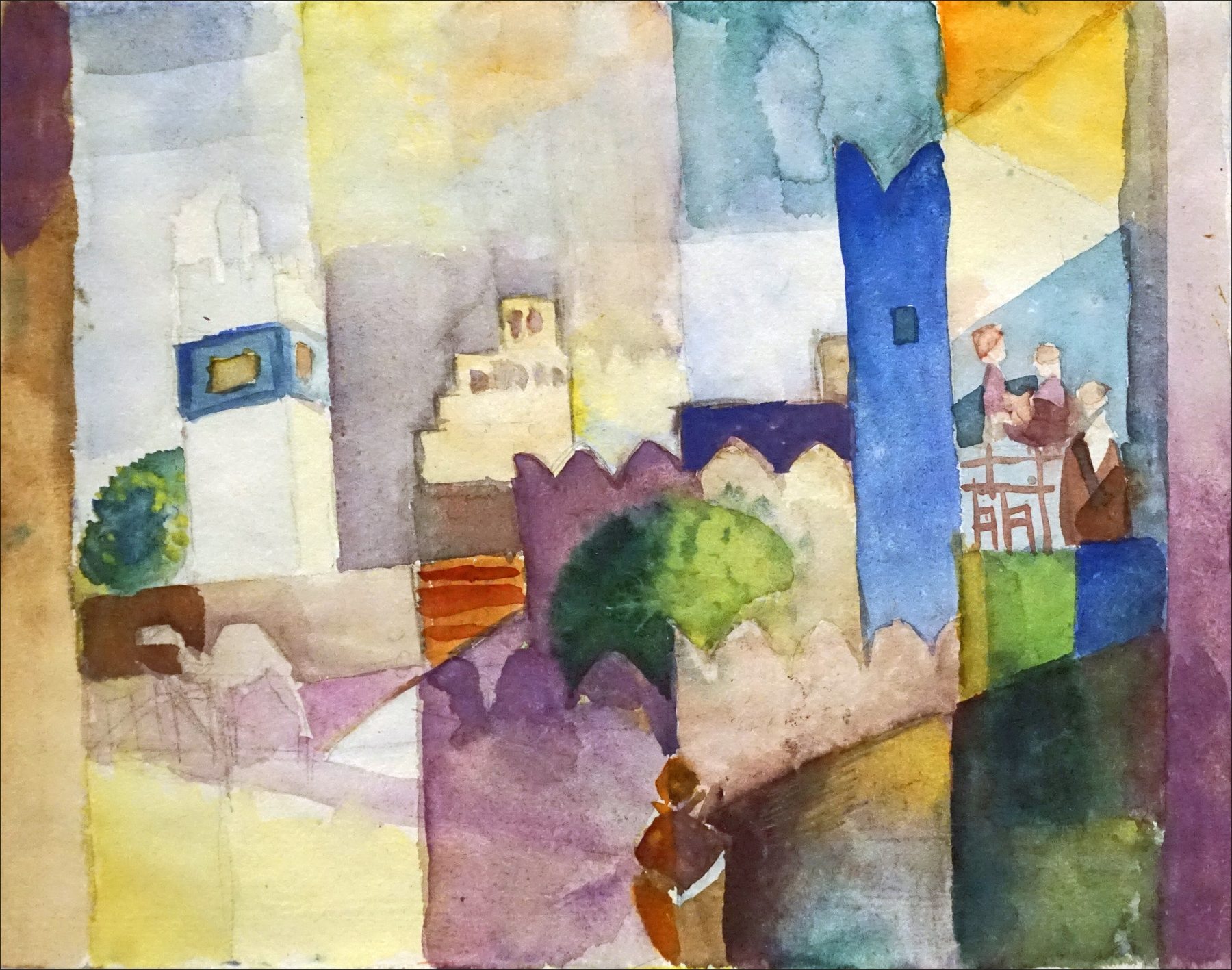
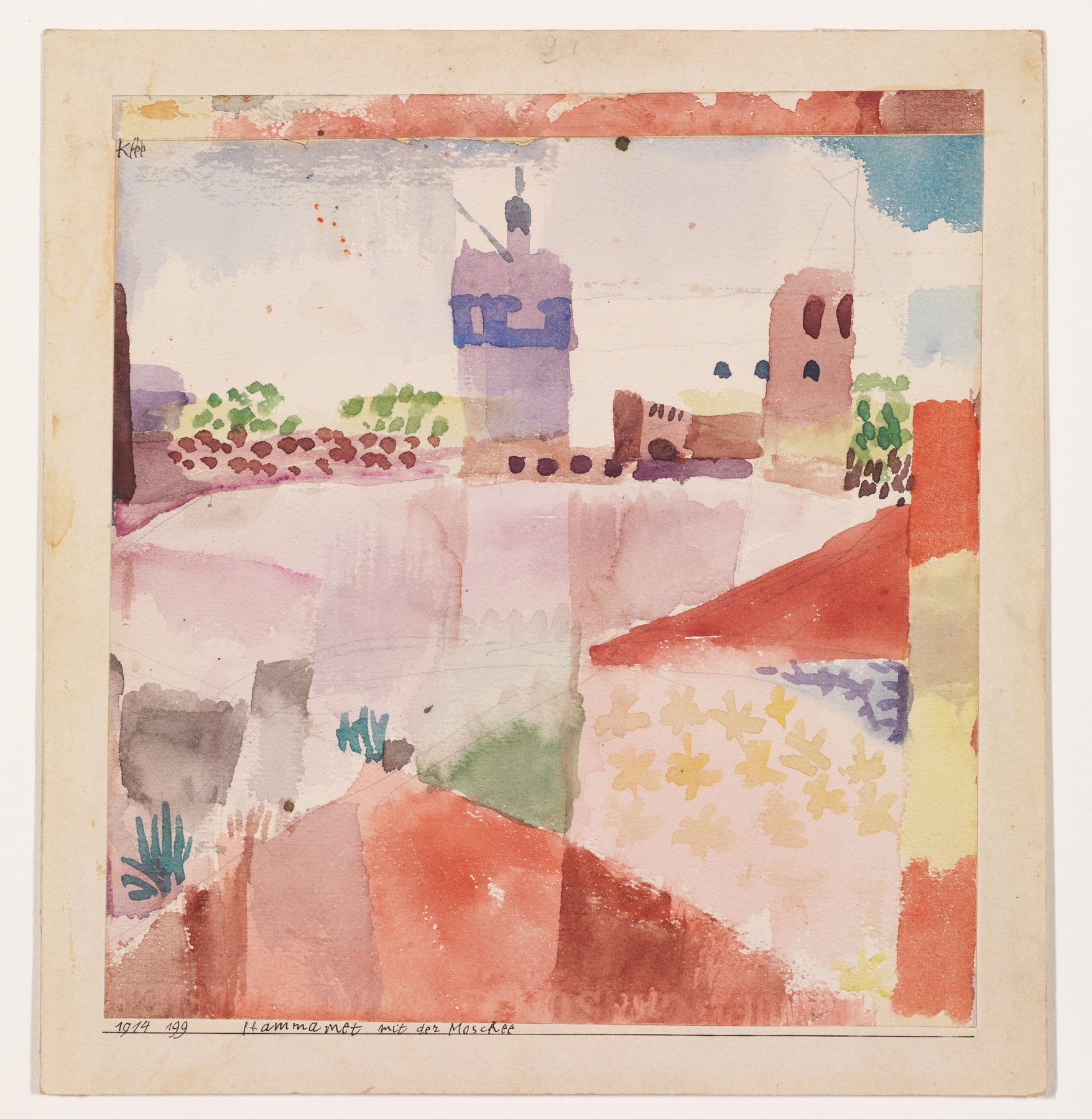
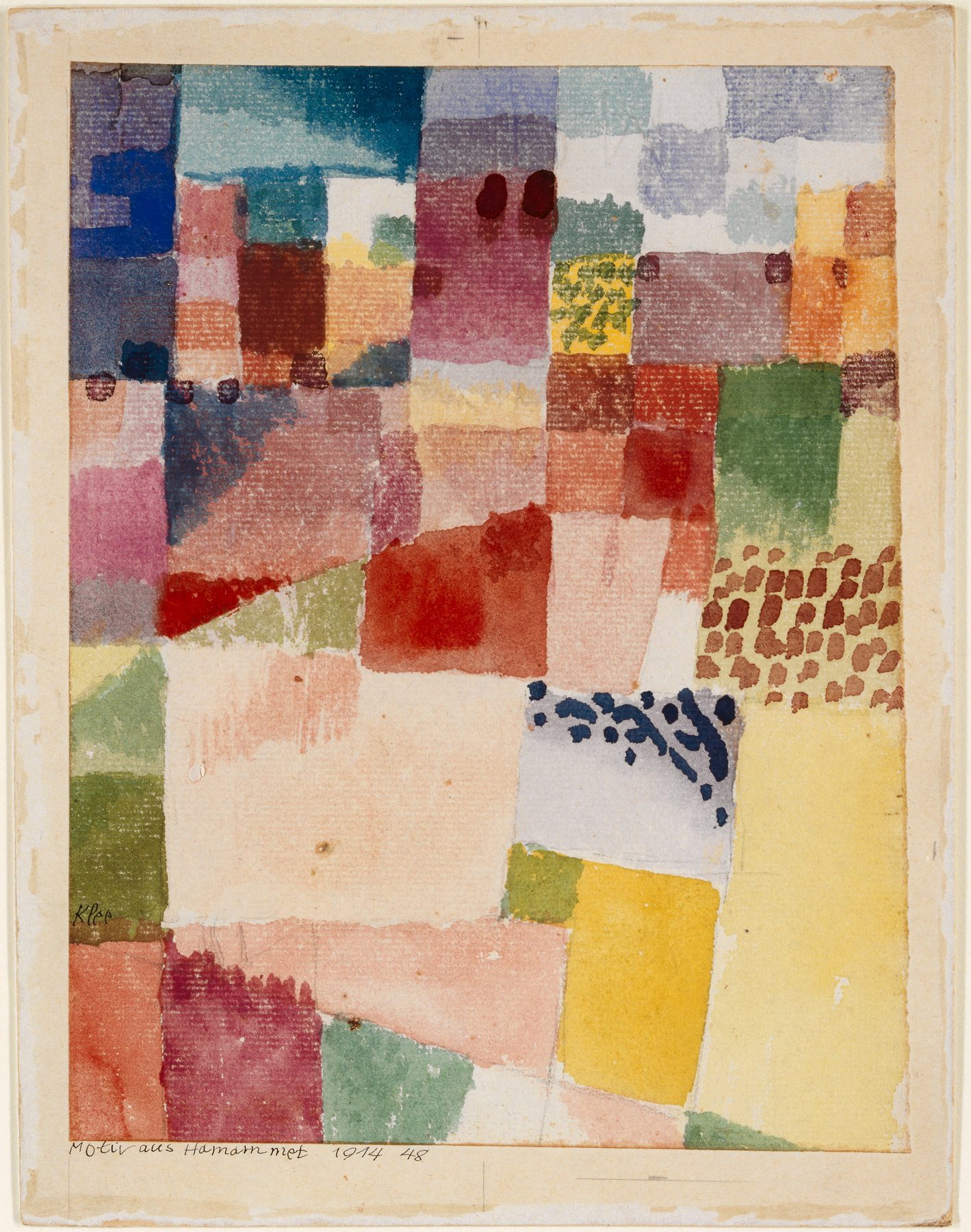
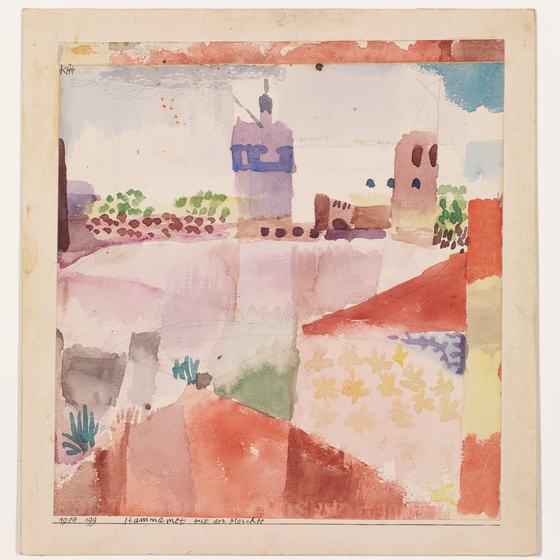
In April 1914 Macke travelled to Tunisia with Klee and Louis Moilliet. Watercolour responded quickly to intense light, streets, gardens and architecture. The trip occurred after the two key Blue Rider exhibitions, so its celebrated works belong to the immediate afterlife rather than a collective style. They also need the caution applied to European travel in colonial North Africa: aesthetic discovery unfolded within French imperial rule.[17] [18]
Klee had met artists of the circle in 1911 and found encouragement after years of comparatively isolated experimentation. His seventeen works in the second exhibition were mostly small works on paper, suited to its graphic focus. One work appeared in the almanac. He was not a founder, and his mature colour developed through Paris, Delaunay and Tunisia as well as Blue Rider exchange.[18] [43]
Werefkin, Jawlensky and the wider circle
Werefkin and Jawlensky are indispensable even though a first-exhibition checklist does not contain them. Their Murnau work and role in founding the NKVM prepared the conditions from which Der Blaue Reiter separated. Werefkin's salon had connected Russian, German and international artists; her writings and paintings pursued the problem of an art adequate to inner life.[1] [37]
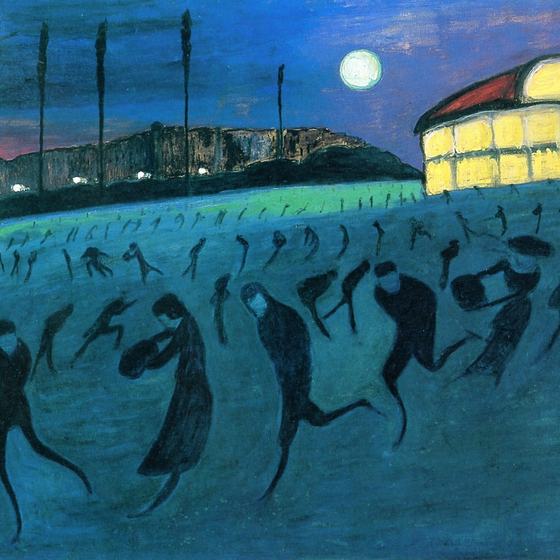
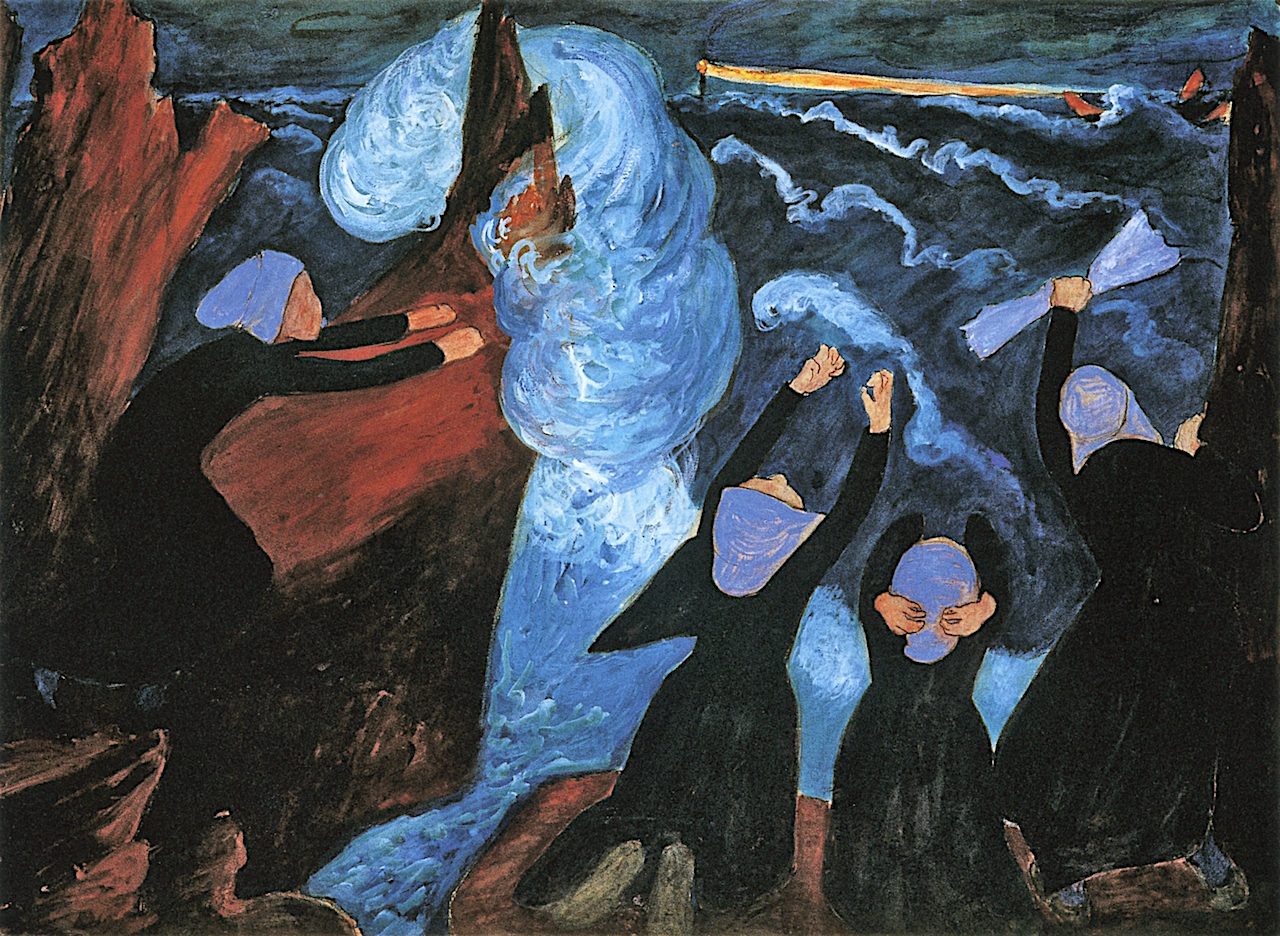
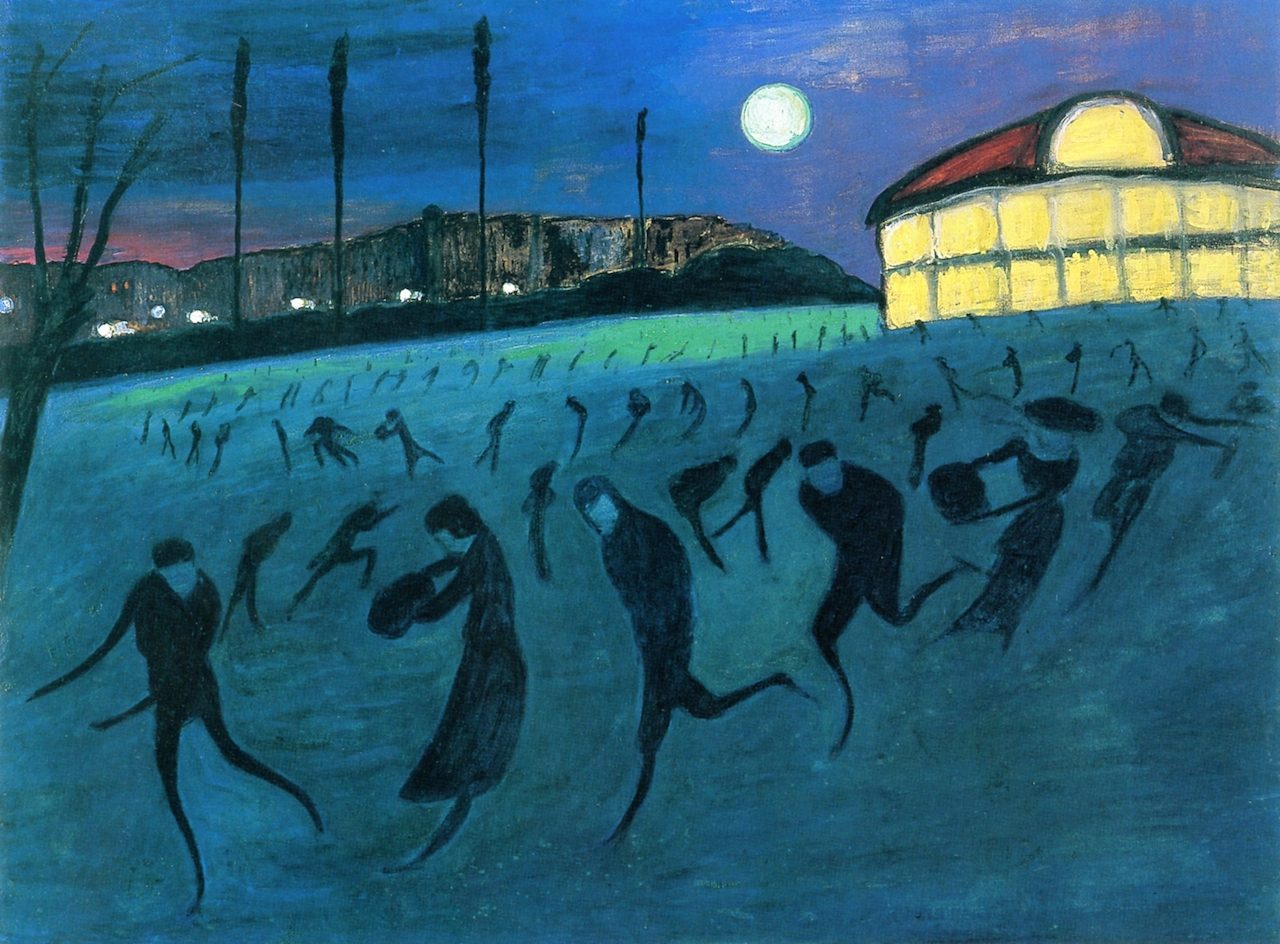
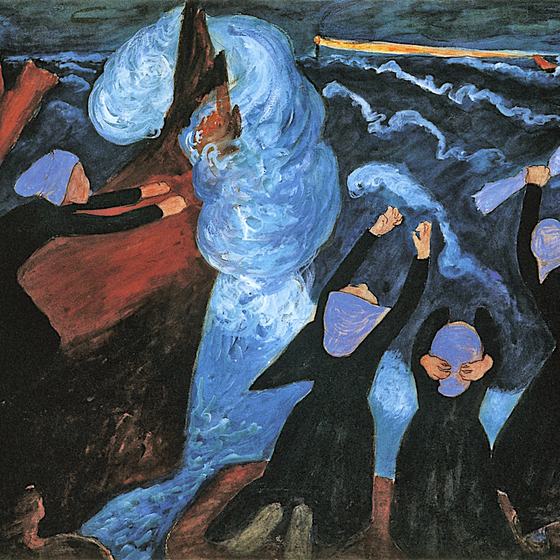
Her scenes often retain narrative pressure. Workers, roads, dark skies and artificial light turn landscape into social theatre. Jawlensky concentrated colour within heads and faces, moving from portrait toward repeated spiritual form. He also collected and traded Japanese prints, sharing knowledge that entered the Murnau circle.[3]
Elisabeth Epstein participated in the first exhibition and acted within French-German networks. Heinrich Campendonk joined human figures, animals and plants in translucent fields. Alfred Kubin's ink drawings supplied an anxious, fantastic graphic pole. Albert Bloch brought an American perspective; Robert Delaunay a French chromatic one. Erma Bossi, Maria Franck-Marc, Eugen von Kahler, Moissey Kogan and others make the circle harder to reduce to a heroic five.[2] [9]
The movement's openness was selective. Kandinsky and Marc chose what entered the book and shows. Some artists appeared once; others were later absorbed into a canon. “Wider circle” is not a lesser rank so much as an admission that participation changed with each project.
Women, partnership and artistic authority
Women were unusually visible in the Blue Rider network, but visibility did not erase structural inequality. Münter, Werefkin, Epstein, Erma Bossi and Maria Franck-Marc exhibited, painted, debated and facilitated. Elisabeth Macke helped maintain social and financial connections. Yet histories long described women as pupils, companions, wives or hosts while presenting men as autonomous creators.[4] [37]
Münter's partnership with Kandinsky shows the imbalance. He had institutional authority as teacher and theorist; she had less access to formal training and carried the domestic consequences of their shared life. At the same time, her paintings, photographs, house and collecting changed the network's work. Agency and inequality existed together.
Werefkin had already suspended much of her own practice while supporting Jawlensky, then returned to painting with extraordinary intensity. Maria Franck-Marc's still lifes and children's worlds are now being recovered alongside her editorial presence. Elisabeth Epstein's self-portraits challenge the assumption that the movement's women merely transmitted male ideas.[5] [9]
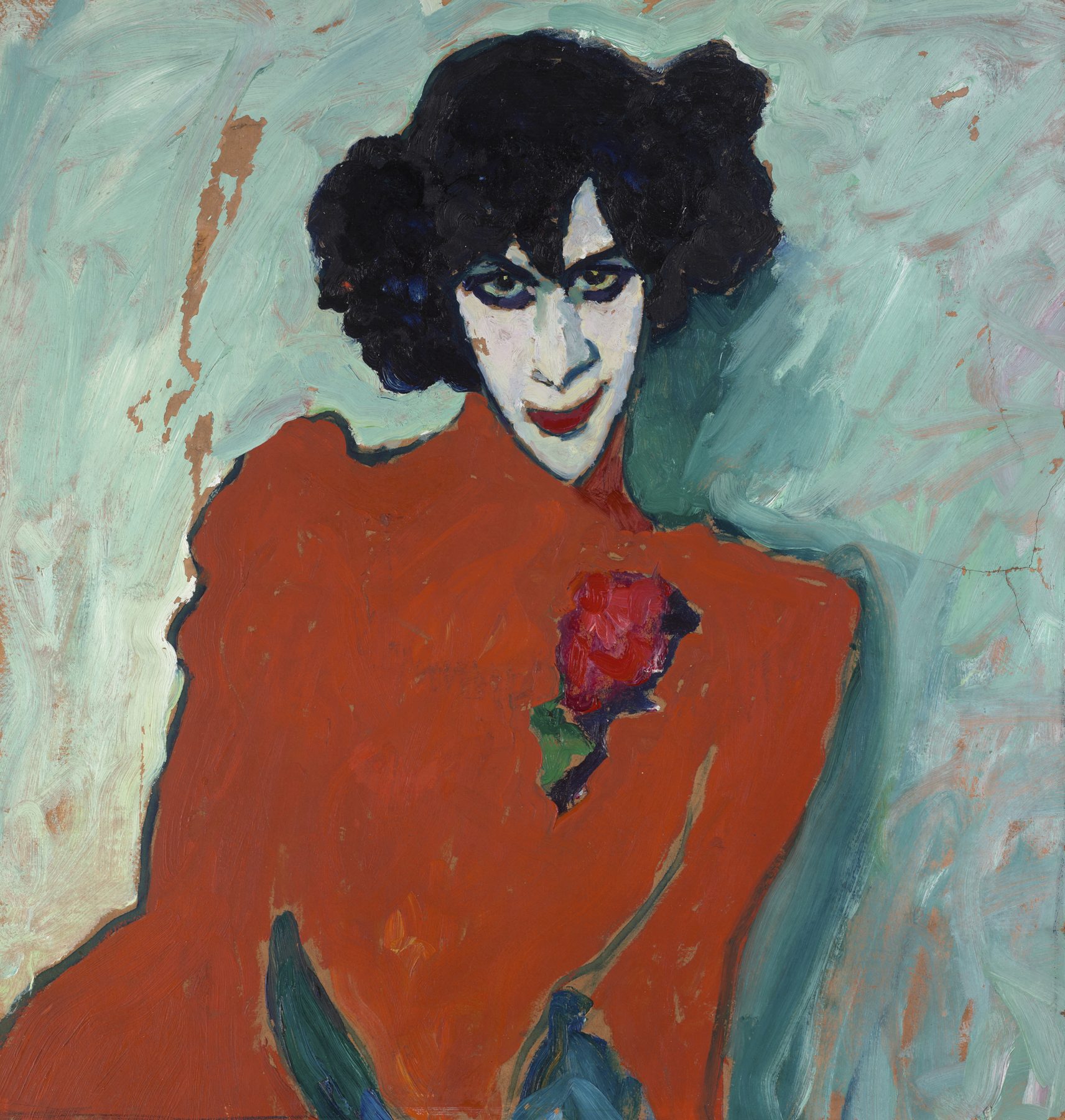
Colour theory itself carried gender hierarchy. Marc aligned spiritual blue with masculinity and sensual yellow with femininity. Current scholarship asks how artists inhabited, revised or resisted such binaries. It also examines figures including the dancer Alexander Sacharoff, whose performance and self-presentation exceeded conventional masculine roles. The avant-garde challenged bourgeois identity without automatically escaping its prejudices.[8] [37]
Folk art, children and print
The circle's interest in folk art was sustained through collection and making. Münter and Kandinsky lived with carved saints, votive objects, Russian popular prints and reverse glass paintings. Marc, Macke and Jawlensky collected Japanese works on paper. These objects offered strong contour, flattened space, direct colour and forms of narrative that academic painting had devalued.[3]
Reverse glass painting was not an anonymous survival outside modern life. Heinrich Rambold made religious images and souvenirs for a tourist economy in Murnau. The brewer Johann Krötz assembled a collection. Münter learned from Rambold and transmitted the technique. Naming those people replaces a vague “discovery of folk art” with exchange involving living makers and markets.[3]
The almanac reproduced twelve Bavarian reverse glass paintings and eight East Asian drawings or prints. Marc's collection included ukiyo-e; Macke owned prints and applied objects, including erotic shunga; Jawlensky collected actor prints and images of beautiful women. The forced opening of Japan to Western trade and a growing export market conditioned European access. Admiration and commerce operated together.[3]
Children's drawings served another argument. Their forms seemed to the editors to arise before academic correction, demonstrating expressive invention independent of professional finish. But children did not edit the almanac. Adults selected their images and made them evidence for an adult theory. The work can be valued without romanticising childhood as pure access to truth.[35]
Woodcut, reverse glass and children's drawing all challenged the polished academic surface. They did so through different techniques and social conditions. Calling them all “primitive” repeats a historical category that erases those differences.
Colonial collections and the limits of universality
Kandinsky and Marc wrote in an unpublished foreword that the whole body of art knew neither borders nor nations, only humanity. The almanac's juxtapositions gave visible force to that belief. Works from Africa, Oceania, Asia, Mexico and other regions could appear on the same page openings as celebrated European modernists and old masters. In 1912, that refusal of a simple Western chronology was remarkable.[2] [3]
The conditions of access were not equal. European empires had conquered territories, removed objects, organised human displays and filled ethnographic museums through purchase, coercion and plunder. Blue Rider artists encountered many works only after colonial systems had displaced them. National Gallery of Art research similarly places German Expressionist encounters with African and Pacific art within museums and colonial exhibitions, not an innocent realm of universal form.[40] [41]
The almanac often supplied inadequate captions. It cropped objects from photographs, at times separating paired figures, and ignored makers, societies, uses and beliefs. An object could become evidence of timeless inner creativity precisely because its own history had been removed. Children's drawings and ceremonial objects were made to occupy the editors' ideological present.[3]
This critique does not require choosing between hypocrisy and heroism. The book disrupted a hierarchy that excluded non-European production from “art”, while continuing a colonial habit of defining other cultures through European needs. Its universal claim opened a door and controlled who could speak through it.
Macke's 1914 Tunisia watercolours carry a related tension. They are brilliant studies of colour and light made during a short journey within a French protectorate. The people and buildings that energised his work belonged to lived histories, not a timeless Orient waiting to renew Europe.
War and dispersal
The First World War ended the network's practical conditions. As a Russian citizen in Germany, Kandinsky had to leave, travelling first to Switzerland and then returning to Moscow. Münter moved through Switzerland and later Scandinavia. Jawlensky and Werefkin settled in Switzerland. Internationalism that had seemed an artistic programme now collided with borders, citizenship and enemy status.[15] [29]
Macke was drafted in August 1914 and killed in France on 26 September, only weeks into the war. Marc volunteered, initially investing the conflict with hopes of purification that became impossible to sustain amid industrial killing. He died near Verdun in 1916. Their deaths should not make every angular form a prophecy. They show how rapidly the social world supporting the art was destroyed.[17] [22]
The group did not formally reconvene after the war. Individual friendships and ideas survived, but Der Blaue Reiter's exhibitions and almanac belonged to a particular pre-war constellation.
Preservation, suppression and afterlife
Kandinsky returned to Germany in 1921 and joined the Bauhaus in 1922; Klee was already teaching there. Their renewed friendship helped connect Blue Rider questions about colour, form and interdisciplinary teaching to a very different school and postwar environment. With Jawlensky and Lyonel Feininger they later formed Die Blaue Vier in 1924, chiefly to promote exhibitions abroad. The Blue Four was an afterlife, not a revival of the 1911 editorial board.[39] [43]
The movement also reached American modernism. Marsden Hartley knew Marc and Kandinsky, read On the Spiritual in Art and the almanac, and adapted expressive pattern and painted frames in his Berlin work. Later histories of non-objective art made Kandinsky a foundational figure, sometimes narrowing the Blue Rider's plural field into a straight road toward abstraction.[42]
Under National Socialism, modern art was attacked as “degenerate”. In 1937 the regime confiscated thousands of works from German public museums and staged a deliberately mocking exhibition in Munich. Fifty-seven works by Kandinsky were removed from museums. Expressionism's earlier claim to spiritual and cultural renewal was recast as racial, political and mental corruption.[39] [40]
Münter protected hundreds of works from the Blue Rider years in her Murnau house. In 1957, for her eightieth birthday, she donated a collection of about 1,200 inventory entries to the Lenbachhaus, including roughly ninety Kandinsky oils, hundreds of his watercolours and drawings, more than twenty-five of her own paintings, works on paper and art by colleagues. A further Koehler family gift in 1965 strengthened the Marc and Macke holdings.[6] [7] [9]
The donation made the Lenbachhaus the central museum for Der Blaue Reiter and preserved an ensemble that could easily have disappeared. It also shaped the canon around what survived in Münter's care. Recent collecting and research have widened the story toward Epstein, Maria Franck-Marc, Moissey Kogan, works on paper, gender and colonial provenance. A collection does not simply reflect a movement; it helps decide how the movement is remembered.[5] [48]
Artists and contributors to know
Wassily Kandinsky
Kandinsky was organiser, theorist, editor, painter and printmaker. His Murnau landscapes, Impressions, Improvisations and Compositions progressively loosened objects into colour and line while retaining riders, floods, saints and apocalyptic drama. His Russian sources and mobile career make him an international modernist rather than a purely German abstractionist.[23] [32]
Franz Marc
Marc co-edited the almanac and connected Munich with wider Expressionist networks. His animals and symbolic colour sought a unity beyond human materialism, then grew more fractured through contact with Cubism, Futurism and Delaunay. His personal colour theory is indispensable evidence and a gendered limitation.[13] [16]
Gabriele Münter
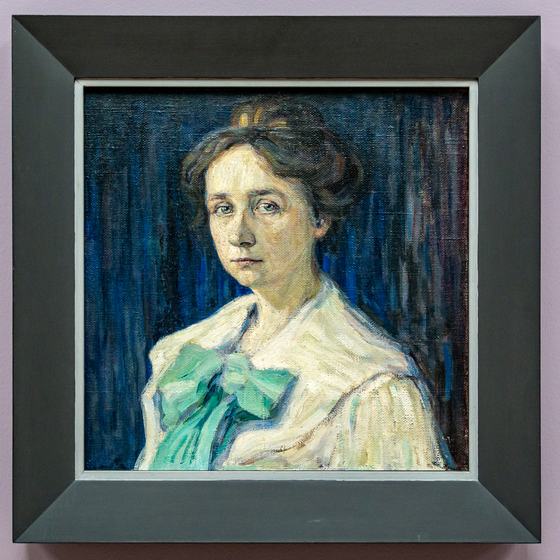
Münter developed an incisive language of contour, saturated colour and spatial compression across landscape, portrait, interior and still life. She organised, photographed, collected and taught reverse glass technique as well as painted. Her later preservation and donation are part of her agency, not substitutes for recognising her art.[7] [11]
August Macke
Macke made modern leisure luminous. Shop windows, gardens and strolling figures become structures of coloured intervals. He contributed to the almanac and exhibitions, built French connections and challenged colleagues. His Tunisia watercolours are a brilliant, colonially situated late chapter before his death in 1914.[17]
Paul Klee
Klee entered through friendship and the second exhibition, where he showed seventeen works. Drawing, satire, fantasy and music already shaped his art; Paris and Tunisia accelerated his colour. His later Bauhaus career made the relationship with Kandinsky enduring, but he should not be retroactively promoted to founder.[18] [43]
Marianne von Werefkin
Werefkin helped create the Murnau and NKVM foundations through painting, theory and her Munich salon. Her night scenes, workers and processions make collective psychology visible. Gendered narratives that place her behind Jawlensky obscure an independent and intellectually forceful career.[37]
Further artists and contributors
Alexej von Jawlensky
Jawlensky brought Russian training, French modernism and Japanese collecting into the circle. Strong contours and saturated colour transformed landscape and portrait; his later serial heads concentrated spiritual attention into repeated facial structures.
Heinrich Campendonk
Campendonk showed in the first exhibition and developed translucent worlds in which animals, plants and human figures interpenetrate. He demonstrates Marc's influence without repeating Marc's exclusion of people.
Elisabeth Epstein and Maria Franck-Marc
Epstein exhibited in the first show and connected Munich with Paris. Her self-portraits and later work complicate a male-centred canon. Maria Franck-Marc participated in editorial gatherings and made her own still lifes and imaginative images. Current scholarship is restoring both from the category of companions.[2] [9]
Robert Delaunay, Henri Rousseau and Arnold Schönberg
These figures reveal the network's reach. Delaunay supplied a chromatic and structural dialogue with France. Rousseau embodied radical realism outside academic expectation. Schönberg contributed paintings, music and theory. None needs to become a fixed “member” for their participation to matter.[25] [31]
Major artists directory
| Name | Nationality | Key Works |
|---|---|---|
| Alexej von Jawlensky | Russian | Portrait of the Dancer Alexander Sacharoff, Self-Portrait |
| Arnold Schönberg | Austrian | |
| August Macke | German | Lady in a Green Jacket, Turkish Café, Kairouan III |
| Elisabeth Epstein | Polish | |
| Franz Marc | German | Blue Horse I, Tiger, The Yellow Cow |
| Gabriele Münter | German | |
| Heinrich Campendonk | German | |
| Henri Rousseau | French | The Poultry Yard |
| Maria Franck-Marc | German | |
| Marianne von Werefkin | Russian | The Storm, The Skaters |
| Paul Klee | Swiss | Hammamet with Its Mosque, Motif from Hammamet |
| Robert Delaunay | French | Windows |
| Wassily Kandinsky | Russian | Composition V, Composition VII, Impression III (Concert), Improvisation No. 20 (Two Horses) |
How to look at Blue Rider art
Start by resisting a style checklist. Identify the artist and project. Was the work in the first exhibition, the graphic second show, the almanac or only the wider circle? Participation changes what the label means.
Look for what colour does rather than what it supposedly symbolises. Does blue cool, deepen, enclose, advance or break apart? Compare it with neighbouring colours before applying Kandinsky's or Marc's writing. Their theories are clues, not dictionaries.
Test the relation between object and structure. A horse, house or face may remain legible while contour and colour detach from description. Watch the moment at which recognition becomes uncertain; many works make that instability productive.
Attend to medium. Reverse glass shines because paint is viewed through its support. Woodcut turns carving and pressure into simplified marks. Watercolour lets light pass through paper and pigment. A reproduced object in the almanac has been cropped, resized and sequenced by editors.
Ask where a source came from. “Folk”, “child” and “non-European” are not styles. Name the maker, technique, region, use and route into a collection whenever they are known. Notice when the historical record withholds them.
Finally, listen for disagreement. Münter's still lifes, Marc's animals, Macke's promenades, Werefkin's night scenes and Kandinsky's abstractions do not resolve into one appearance. The movement resides in the argument among them.
Frequently Asked Questions
It was a loose network organised around an almanac, exhibitions and friendships in Munich and Upper Bavaria from 1911 to 1914. It did not have one fixed membership list or style. Kandinsky and Marc edited its book; Münter was a central founder and organiser; many others participated in particular projects.[1] [2]
Kandinsky later said that Marc loved horses, he loved riders and both loved blue. The title also evokes Saint George, Russian and Bavarian folk imagery, Marc's animals, Kandinsky's recurring riders and blue as spiritual aspiration. The cover turns these meanings into an emblem rather than explaining them with one anecdote.[19] [29] [45]
Die Brücke began in Dresden in 1905 with a more defined membership and shared print and studio culture. Der Blaue Reiter formed in Munich in 1911 around an editorial project, international exhibitions and spiritual or interdisciplinary debate. Both rejected academic convention and sometimes crossed through print exhibitions.[20] [41]
Kandinsky and Marc proposed powerful associations, but they did not share one code. Marc's scheme linked blue with a masculine spiritual principle, yellow with a feminine sensual one and red with matter. Those ideas were personal and historically gendered, not scientific definitions that unlock every painting.[8] [13] [27]
She was a founder, painter, printmaker, photographer, organiser, collector, host and teacher of reverse glass technique. Her Murnau house supported editorial work. During the Nazi era she protected hundreds of works there, and her 1957 donation created the core of the Lenbachhaus collection.[7] [11] [38]
Many non-European objects reproduced in it reached German museums and markets through colonial systems. The editors placed them beside European art as equals in formal power, but often removed them from named makers, functions and histories. The book's universalism was innovative and structurally unequal at the same time.[2] [3]
The First World War dispersed its international participants in 1914. Kandinsky had to leave Germany, Münter went to Scandinavia, and Jawlensky and Werefkin moved to Switzerland. Macke was killed in 1914 and Marc in 1916. Later Bauhaus work and Die Blaue Vier carried relationships forward but did not revive the original network.[15] [17] [39]
Discussion
The almanac asked readers to find artistic kinship across radically different objects. When does comparison open understanding, and when does it erase the maker and history that made each object distinct?
Reader Insights
Compare neighbouring colours before applying Kandinsky’s or Marc’s theories; meaning changes with scale, contour and relation.
Ask whether a work belonged to the first exhibition, the graphic second show, the almanac or only the wider friendship network.
Name the maker, medium, region, use and route into the collection whenever “folk”, children’s or non-European art enters the story.
Join the Conversation
Which work best proves that Der Blaue Reiter was a conversation among different artistic languages rather than one shared style? Share your view below.
References
- Lenbachhaus, “The Story of the Blue Rider”, lenbachhaus.de. View Source
- Lenbachhaus, “The Blue Rider”, lenbachhaus.de. View Source
- Lenbachhaus, Group Dynamics—The Blue Rider, lenbachhaus.de. View Source
- Lenbachhaus, “The Blue Rider: A New Language”, lenbachhaus.de. View Source
- Lenbachhaus, “Beyond the World: The Blue Rider”, lenbachhaus.de. View Source
- Lenbachhaus, “The Blue Rider” collection, lenbachhaus.de. View Source
- Lenbachhaus, “Gabriele Münter and Johannes Eichner Foundation”, lenbachhaus.de. View Source
- Lenbachhaus, “Der Blaue / Gelbe / Grüne Reiter”, lenbachhaus.de. View Source
- Lenbachhaus, Der Blaue Reiter: Eine neue Sprache—Erweiterte Werkschilder, lenbachhaus.de. View Source
- Schloßmuseum Murnau, “Neue Künstlervereinigung München / Der Blaue Reiter”, schlossmuseum-murnau.de. View Source
- Schloßmuseum Murnau, “Gabriele Münter—Grafik und Malerei”, schlossmuseum-murnau.de. View Source
- Schloßmuseum Murnau, “Das Schloßmuseum Murnau”, schlossmuseum-murnau.de. View Source
- Franz Marc Museum, “Franz Marc und seine Farbtheorie”, franz-marc-museum.de. View Source
- Franz Marc Museum, “Collection”, franz-marc-museum.de. View Source
- Städel Museum, “Blauer Reiter”, sammlung.staedelmuseum.de. View Source
- Städel Museum, “Franz Marc”, sammlung.staedelmuseum.de. View Source
- Städel Museum, “August Macke”, sammlung.staedelmuseum.de. View Source
- Zentrum Paul Klee, “Paul Klee—Biografie”, zpk.org. View Source
- Museum of Modern Art, “Der Blaue Reiter (The Blue Rider), 1912”, moma.org. View Source
- Museum of Modern Art, “German Expressionism Styles: Der Blaue Reiter”, moma.org. View Source
- Museum of Modern Art, “German Expressionism Chronology”, moma.org. View Source
- Museum of Modern Art, “Franz Marc”, moma.org. View Source
- Solomon R. Guggenheim Museum, Vasily Kandinsky: Around the Circle, guggenheim.org. View Source
- Solomon R. Guggenheim Museum, “The Spiritual Landscape”, guggenheim.org. View Source
- Arnold Schönberg Center, “Schönberg, Kandinsky, Blue Rider and the Russian Avant-garde”, schoenberg.at. View Source
- Arnold Schönberg Center, “Painted Music: A Visit to Arnold Schönberg's Atelier”, schoenberg.at. View Source
- Wassily Kandinsky, Über das Geistige in der Kunst, Heidelberg University Library, digi.ub.uni-heidelberg.de. View Source
- Wassily Kandinsky and Franz Marc, eds., Der Blaue Reiter, Heidelberg University Library, digi.ub.uni-heidelberg.de. View Source
- Centre Pompidou, “Vassily Kandinsky”, mediation.centrepompidou.fr. View Source
- Centre Pompidou, “Almanach Der blaue Reiter”, centrepompidou.fr. View Source
- Musée d'Orsay, “Le Douanier Rousseau: L'innocence archaïque”, musee-orsay.fr. View Source
- State Russian Museum, “Wassily Kandinsky and Russia”, old-en.rusmuseum.ru. View Source
- Pushkin State Museum of Fine Arts, “Кандинский и «Синий всадник»”, pushkinmuseum.art. View Source
- Pushkin Museum / Artefact, “Импровизация №20”, ar.culture.ru. View Source
- Smarthistory, “Der Blaue Reiter”, smarthistory.org. View Source
- Smarthistory, “Kandinsky, Apocalypse, Abstraction”, smarthistory.org. View Source
- Shulamith Behr, “The Dynamics of Gendered Artistic Identity and Creativity in Der Blaue Reiter”, cambridge.org. View Source
- Deutsches Historisches Museum, “Gabriele Münter”, dhm.de. View Source
- Deutsches Historisches Museum, “Wassily Kandinsky”, dhm.de. View Source
- United States Holocaust Memorial Museum, “Degenerate Art”, encyclopedia.ushmm.org. View Source
- National Gallery of Art, “What Is German Expressionism? Eight Things to Know”, nga.gov. View Source
- National Gallery of Art, “The Aero, c. 1914”, nga.gov. View Source
- Metropolitan Museum of Art, “Paul Klee (1879–1940)”, metmuseum.org. View Source
- Museum of Modern Art, “Two Riders Before Red from Klänge”, moma.org. View Source
- Centre Pompidou, “Etude pour la couverture de l'Almanach Der Blaue Reiter”, centrepompidou.fr. View Source
- Musée d'Orsay, “Rousseau il Doganiere: Il candore arcaico”, musee-orsay.fr. View Source
- Arnold Schönberg Center, “Arnold Schönberg Timeline”, schoenberg.at. View Source
- Lenbachhaus, “The Blue Rider—Collection Presentation 2013–2016”, lenbachhaus.de. View Source
- Image references 49–68: open-access reproductions and institutional collection records.
View 20 image sources
01 · commons.wikimedia.org02 · commons.wikimedia.org03 · commons.wikimedia.org04 · commons.wikimedia.org05 · commons.wikimedia.org06 · commons.wikimedia.org07 · commons.wikimedia.org08 · commons.wikimedia.org09 · commons.wikimedia.org10 · commons.wikimedia.org11 · commons.wikimedia.org12 · commons.wikimedia.org13 · commons.wikimedia.org14 · commons.wikimedia.org15 · commons.wikimedia.org16 · commons.wikimedia.org17 · commons.wikimedia.org18 · commons.wikimedia.org19 · commons.wikimedia.org20 · commons.wikimedia.org