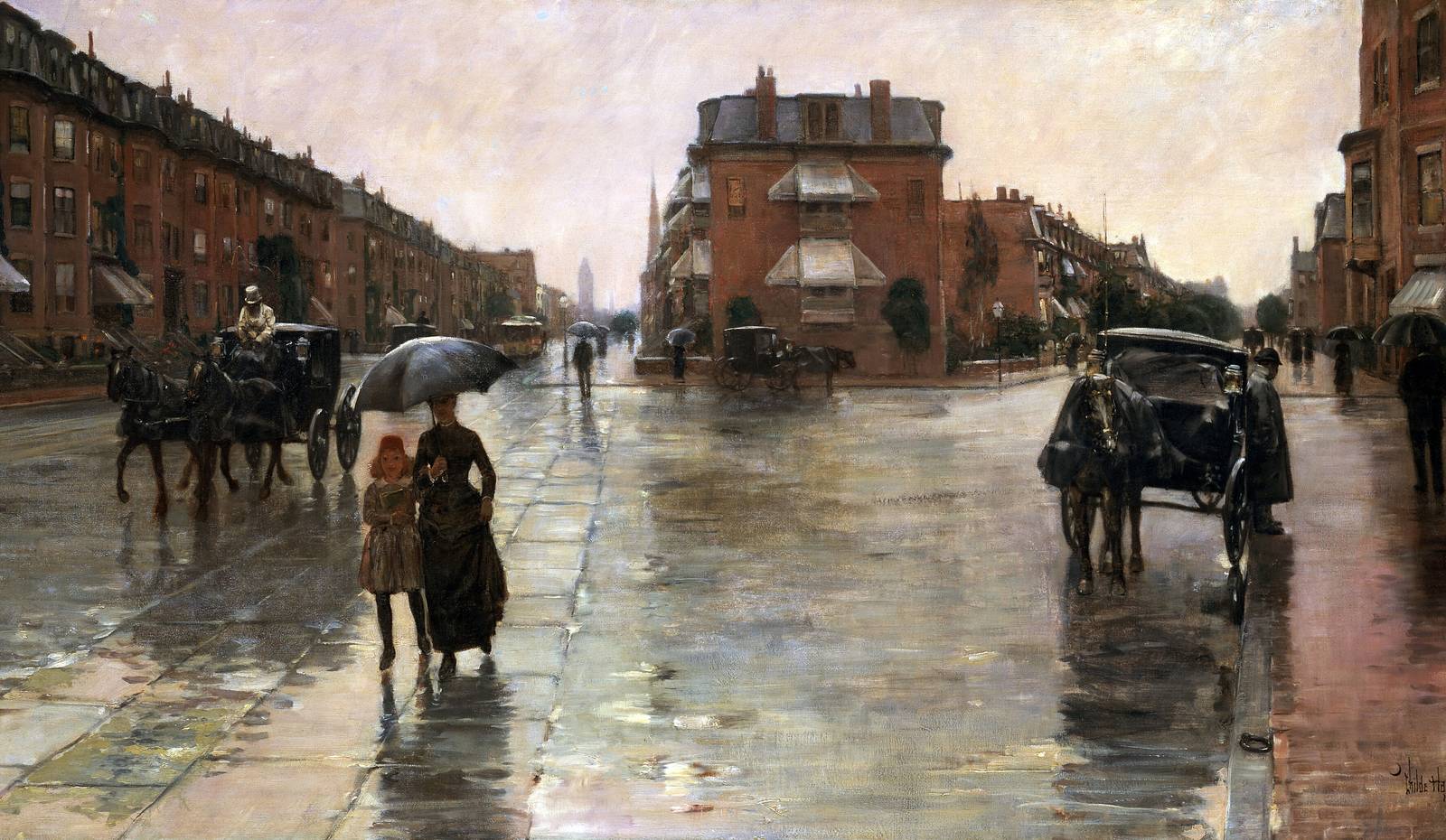
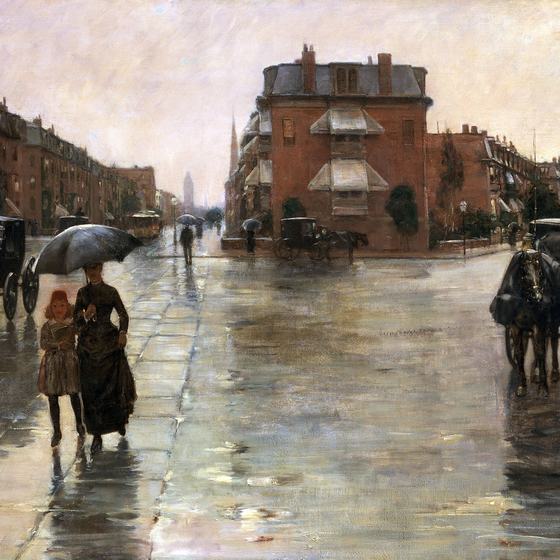
Image reference: Childe Hassam, Rainy Day, Boston.
At a Glance
- Core periodmid-1880s–late 1910s, with later regional continuations
- NationalityAmerican, within a transatlantic field
- Principal centresParis · Giverny · Boston · New York · Connecticut · Pennsylvania · California
- Major networksThe Ten · Giverny · Shinnecock · Cos Cob · Old Lyme · New Hope
- Known forbroken brushwork · changing light · cities · cultivated landscapes · domestic leisure
- Key artistsCassatt · Chase · Hassam · Twachtman · Weir · Robinson · Perry · Metcalf
- Important distinctionThe Ten were one exhibiting group within a much larger field
Contents
- Where American Impressionism fits
- How Impressionism crossed the Atlantic
- Cassatt and Sargent
- Giverny and its networks
- Chase and Shinnecock
- Weir and Twachtman
- Hassam and the modern city
- Art colonies
- New Hope and California
- Artists to know
Where American Impressionism fits
Mary Cassatt
Principal careerJohn Singer Sargent
Principal careerWilliam Merritt Chase
Principal careerChilde Hassam
Principal careerJohn Henry Twachtman
Principal careerJ. Alden Weir
Principal careerTheodore Robinson
Principal careerLilla Cabot Perry
Principal careerWillard Metcalf
Principal careerFrank Weston Benson
Principal careerEdmund Tarbell
Principal careerFrederick Carl Frieseke
Principal careerAmerican Impressionism describes less a single movement than a long, uneven process of translation. From the 1880s onward, painters born or trained in the United States encountered French Impressionism through exhibitions, dealers, travel, study, friendship and collecting. Some adopted high-keyed colour and broken brushwork; others tested outdoor painting against academic drawing, portraiture, tonal landscape or decorative design. What united them was not a manifesto. It was a shared problem: how could an art developed around modern Paris, its suburbs and its independent exhibitions be made useful in Boston, New York, Connecticut, Long Island, Pennsylvania, California and the expatriate communities of Europe? [1] [2]
That question explains why the category has blurred edges. Mary Cassatt exhibited with the French Impressionists themselves. John Singer Sargent used rapid outdoor procedures in certain works but maintained an international portrait practice that cannot be contained by the label. William Merritt Chase moved among Munich-inflected bravura, still life, portraiture, city parks and Long Island landscapes. Childe Hassam made rain, snow, crowds and flags part of an urban Impressionism. John Twachtman turned repeated views of his Connecticut property into quiet structures of snow and water. Regional painters carried related practices well into the twentieth century. “American Impressionism” is most useful, then, as the name for a field of exchange rather than a pledge of stylistic purity. [3] [4] [5]
How Impressionism crossed the Atlantic
American artists had studied in Europe long before Impressionism appeared. The new element in the later nineteenth century was the density of exchange. Students moved through Parisian academies and salons while also seeing work that challenged official finish. Collectors bought French pictures; dealers created exhibitions and markets; artists moved between cities, rural colonies and family homes. Édouard Manet's The Railway, eventually acquired by the American collector Horace Havemeyer and donated to the National Gallery of Art, is one reminder that the history of American Impressionism also belongs to the movement of French paintings into US collections. [50]
The year 1886 is a convenient landmark, although not an absolute beginning. The dealer Paul Durand-Ruel mounted a large exhibition of French Impressionist works in New York. It helped turn a style still associated with controversy into something Americans could see, debate and buy. In the same year Chase painted brilliant views of newly created New York parks, among the first major Impressionist canvases made in the United States. By the early 1890s, the Metropolitan Museum's historical survey notes, Impressionism had become a legitimate option for American painters rather than simply a foreign scandal. [1]
Acceptance did not mean exact replication. The exhibition American Impressionism: A New Vision stressed the range of the response, while the Museo Thyssen-Bornemisza organised the story through Americans abroad, the discovery of Giverny and the later practice of Impressionism in the United States. Its Spanish presentation is revealing because it treats the subject as international from the start, not as a sealed national school. [2] [3] [4] Many American artists retained firm figure construction, arranged composition and carefully calibrated finish. Their pictures could look spontaneous yet be built through drawings, repeated studies or studio revision. The result was often a compromise between the immediacy associated with French Impressionism and expectations formed by academies, juries, patrons and portrait commissions. [5]
The old opposition between Impressionism and Realism also becomes unstable in the American setting. Artists represented contemporary streets, work, leisure and landscape through different combinations of observation and facture. A museum survey covering 1865 to 1925 accordingly placed Impressionist and realist tendencies within the same changing culture, rather than treating them as watertight camps. [16] American Impressionism did not replace every earlier practice. It enlarged the choices available to professional artists.
Cassatt and Sargent: Americans inside European modern art
Mary Cassatt cannot be introduced merely as an American who brought Impressionism home. She was the only American to exhibit with the French Impressionist group, participating in four of its shows between 1879 and 1886. Her friendship with Edgar Degas, her experiments in printmaking and her sustained attention to women in theatres, parlours, gardens and bedrooms placed her inside the movement's arguments about modern life. [9] [35] [39]
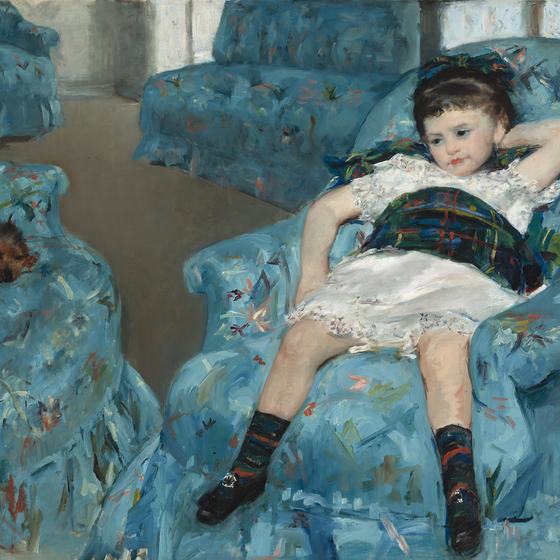
Little Girl in a Blue Armchair makes the difference between subject and structure especially clear. A child slumps across a large chair rather than performing polite decorum. The upholstery repeats in swelling blue forms; a small dog curls in another chair; furniture seems to push forward, turn and crop against the picture's edges. The low viewpoint and oblique recession refuse the centred poise expected of a conventional child portrait. Degas helped alter the background of the canvas, and the work was rejected by the American section of the 1878 Paris Exposition. Its modernity lies not simply in visible brushwork but in its refusal to idealise the child's posture and attention. [36]
In The Child's Bath, Cassatt looks down on an adult and child absorbed in washing. Their linked bodies form a stable oval, but the surrounding carpet, striped dress, patterned jug and basin flatten the room into competing surfaces. The elevated viewpoint and cropped forms recall Japanese woodblock prints, which Cassatt studied closely, yet the picture is not a borrowed design applied to a sentimental theme. The woman's hand steadies the child's foot; touch becomes an action of care and concentration. Pattern and bodily labour coexist. [38]
Cassatt's colour aquatints of the 1890s pushed this translation further. Inspired by an exhibition of Japanese prints, she developed complex plates in which line, drypoint, aquatint and colour required repeated technical decisions. Women bathing, dressing, writing and travelling appear in spaces organised by contour, blankness and unexpected cropping. Their apparent ease rests on exacting work in the print studio. The series also unsettles the idea that Impressionism is necessarily an art of oil paint laid rapidly before the motif. [37] [40]
The repeated presence of mothers and children in Cassatt's later work has sometimes narrowed her reputation. These pictures emerged from a society in which respectable middle-class women had restricted access to many public places and professional roles. Cassatt made that limited world formally demanding. Looking, reading, washing and holding are not empty pauses; they are forms of attention and work. She also used her authority beyond her own studio, advising American collectors and helping French Impressionist art enter US collections. [9] [39]
John Singer Sargent occupies a different border. An American citizen born in Florence and trained in Paris, he was thoroughly international. His friendship with Monet and his outdoor paintings of the later 1880s produced some of the loosest, brightest passages of his career. He painted Monet working at the edge of a wood at Giverny, a picture that makes artistic observation itself the subject. Yet Sargent's society portraits, murals and watercolours pursued other ambitions. Calling him simply an American Impressionist obscures more than it explains. He belongs here as an artist who could activate Impressionist procedures selectively, not as proof that the field had fixed membership. [5] [9]
Giverny: a village, a network and a marketable idea
Claude Monet settled at Giverny in 1883. From 1885 until the First World War, American and other foreign artists came to the village in sufficient numbers to create a durable colony. They did not all study directly with Monet; many saw him rarely. What mattered was the chance to work outdoors near a famous painter, to meet peers and to turn a Norman landscape into a site of artistic identity. French museum scholarship rightly calls Giverny one of the birthplaces of American Impressionism while also describing the Americans' practice as belated and self-conscious—an effort to “perform” an Impressionist role after the original French exhibitions had ended. [7] [8] [10]
The colony had a material infrastructure. From 1887 the Baudy family offered rooms in their grocery and café, later adding studios, tennis courts and food adapted to American guests. Artists painted along the Epte, in fields, gardens and hills, but they also ate, socialised, competed and exchanged information. Giverny was both landscape and service economy. Its appearance as effortless rural freedom depended on lodging, transport, meals and local labour. [7] [8]
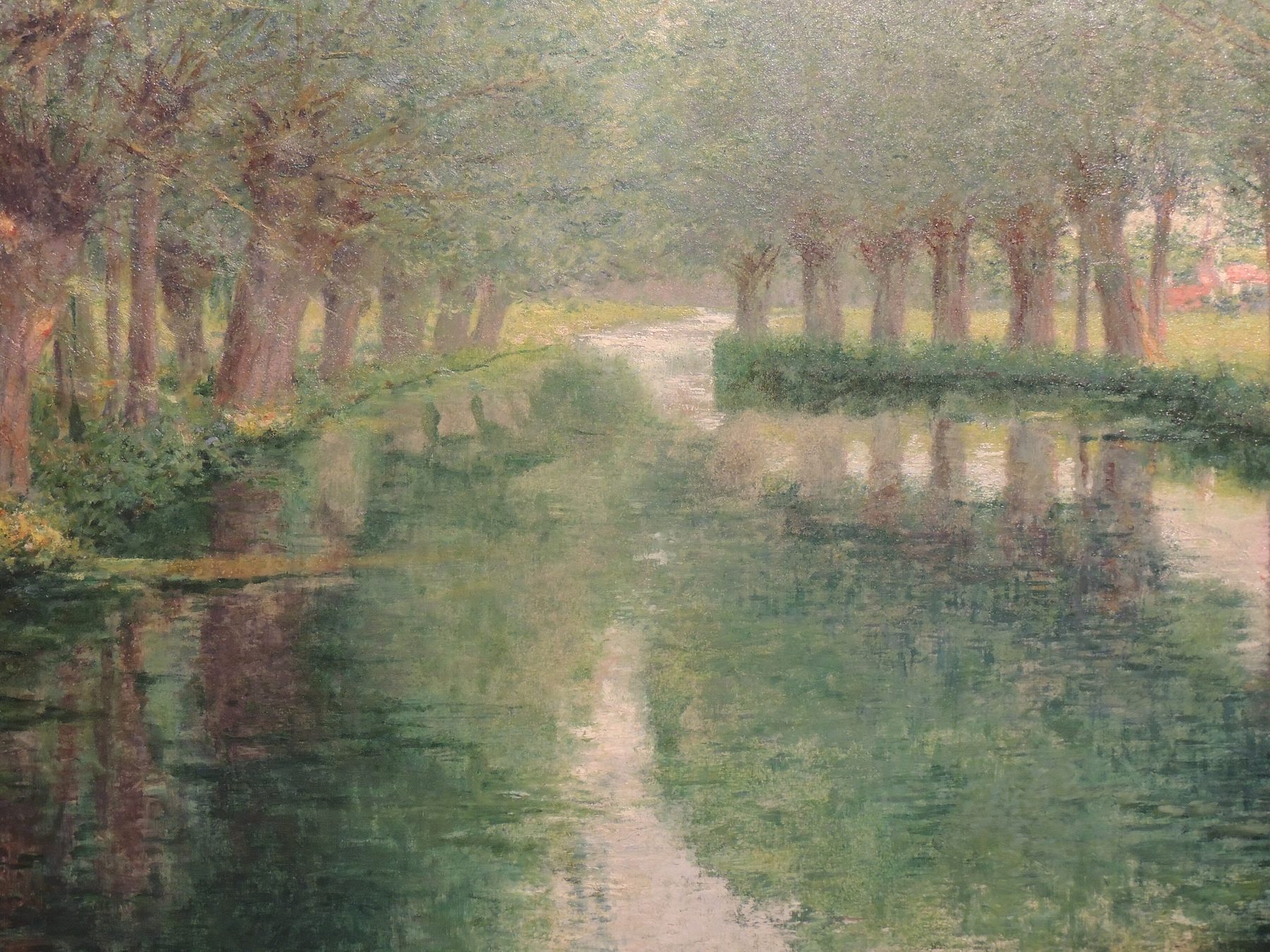
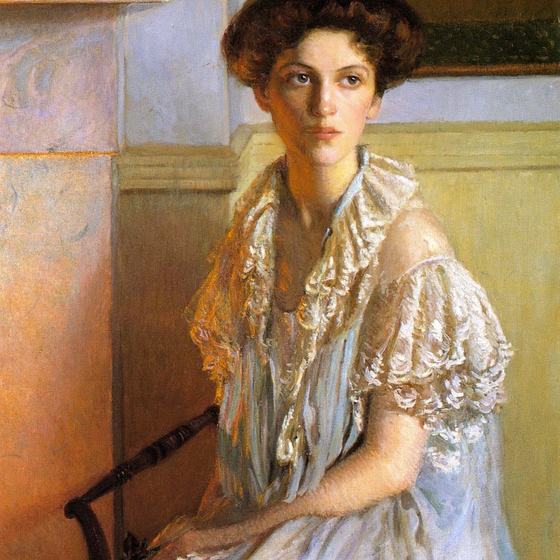
Theodore Robinson and John Leslie Breck were among the early arrivals who knew Monet. Breck's garden paintings used serial observation to register changes of season and hour, adapting Monet's example without becoming copies of his work. Theodore Wendel's Brook, Giverny shows how an ordinary stream could be reorganised through broken strokes and shifting greens rather than monumental scenery. [12] [14] Lilla Cabot Perry and her family rented near Monet repeatedly between 1889 and 1909. Perry became a painter, writer, organiser and interpreter whose career linked Giverny with Boston and, during years in Japan, another visual culture. She was not merely a witness to famous men. [11]
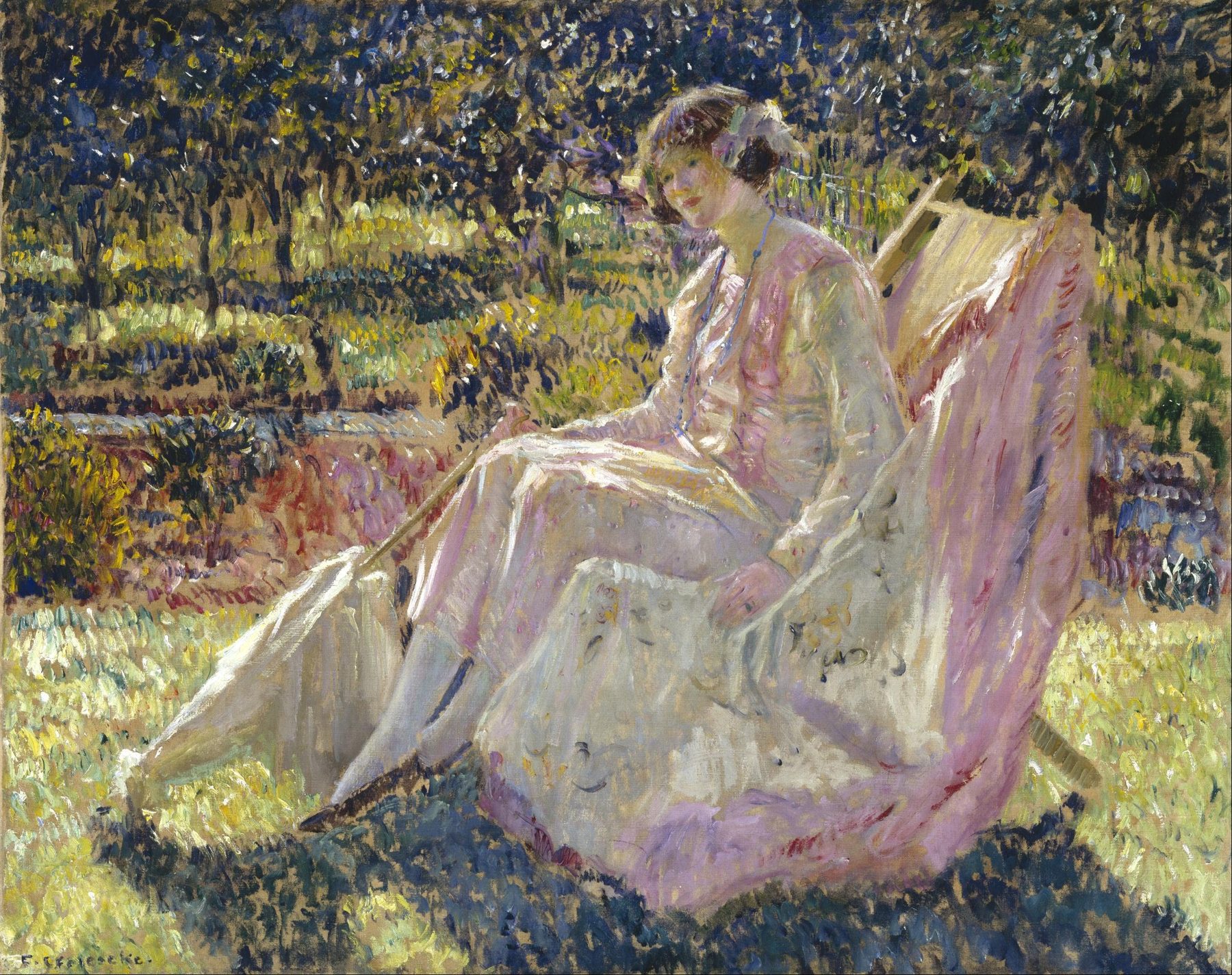
Theodore Earl Butler married Suzanne Hoschedé, Monet's stepdaughter, and settled permanently in the village. That domestic relationship helped sustain the colony's continuity. Other residents included Guy Rose and the married artists Mary Fairchild and Frederick MacMonnies. After 1900, Frederick Carl Frieseke and Richard E. Miller often favoured figures in gardens and family interiors. Their larger decorative surfaces combined Impressionist light with concerns also associated with the Nabis. In 1910 several artists exhibited in New York as the Giverny Group. The First World War disrupted the colony, but by then its participants had carried teaching, pictures and professional contacts back across the Atlantic. [7] [13]
Chase: cosmopolitan performance and disciplined teaching
William Merritt Chase made variety into a professional identity. Trained in Munich, he could deploy dark bravura, old-master references and luxurious studio display. He also painted portraits, fish still lifes, city parks and bright Long Island landscapes. His Tenth Street Studio in New York functioned as workplace, classroom and theatrical self-portrait, crowded with textiles, ceramics and paintings. This cosmopolitanism matters because Chase did not need to discard one identity to adopt another. Impressionism became an addition to his repertoire. [17] [18]
His New York park paintings of 1886 brought sketch-like immediacy to sites shaped by modern urban planning. Parks were not wilderness; they were public works within a growing city. Chase organised strolling figures, paths, trees and water through quick touches while preserving coherent spatial design. The pictures helped demonstrate that an American painter could find modern outdoor subjects at home rather than seeking only European villages. [1] [17]
At Shinnecock on eastern Long Island, Chase founded a summer school that ran from 1891 to 1902. Students worked outdoors in a landscape of low hills, sand, scrub and sea light. His family also populated the pictures and social world of the school. Teaching transmitted habits of observation, equipment, speed and selection, but students did not emerge as copies of their instructor. Shinnecock joined pedagogy, domestic life, tourism and professional ambition. [20]
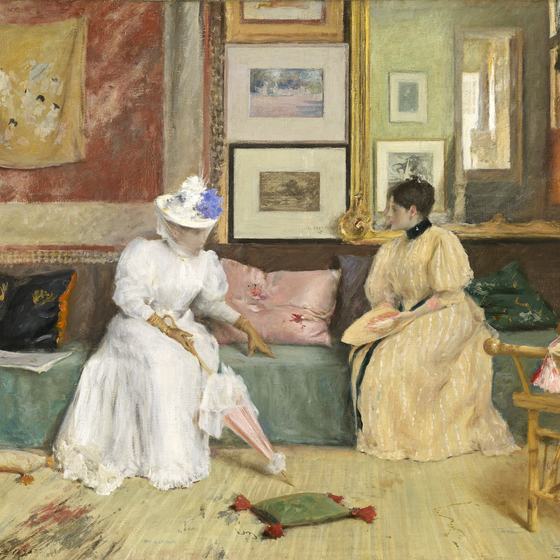
A Friendly Call takes place indoors at Chase's Shinnecock house. Two women occupy a room whose rugs, pictures, furniture and open doorway create an elaborate stage. One sits with her back partly toward us; the other stands near the light. Their visit appears informal, yet the composition balances bodies, reflections, diagonals and carefully displayed possessions. The brushwork is mobile without dissolving form. Like Chase's career, the picture combines social performance and painterly freedom. [19]
Weir and Twachtman: farms, bridges, snow and repetition
J. Alden Weir's conversion story warns against imagining a smooth American embrace of Impressionism. After seeing a French exhibition in 1877, he wrote of his horror at the new painting. His later work nevertheless adopted lighter colour, divided touch and cropped arrangements. The change was neither surrender nor sudden enlightenment. Weir combined French encounters with collecting, friendships and sustained work on his Connecticut property. [22] [23]
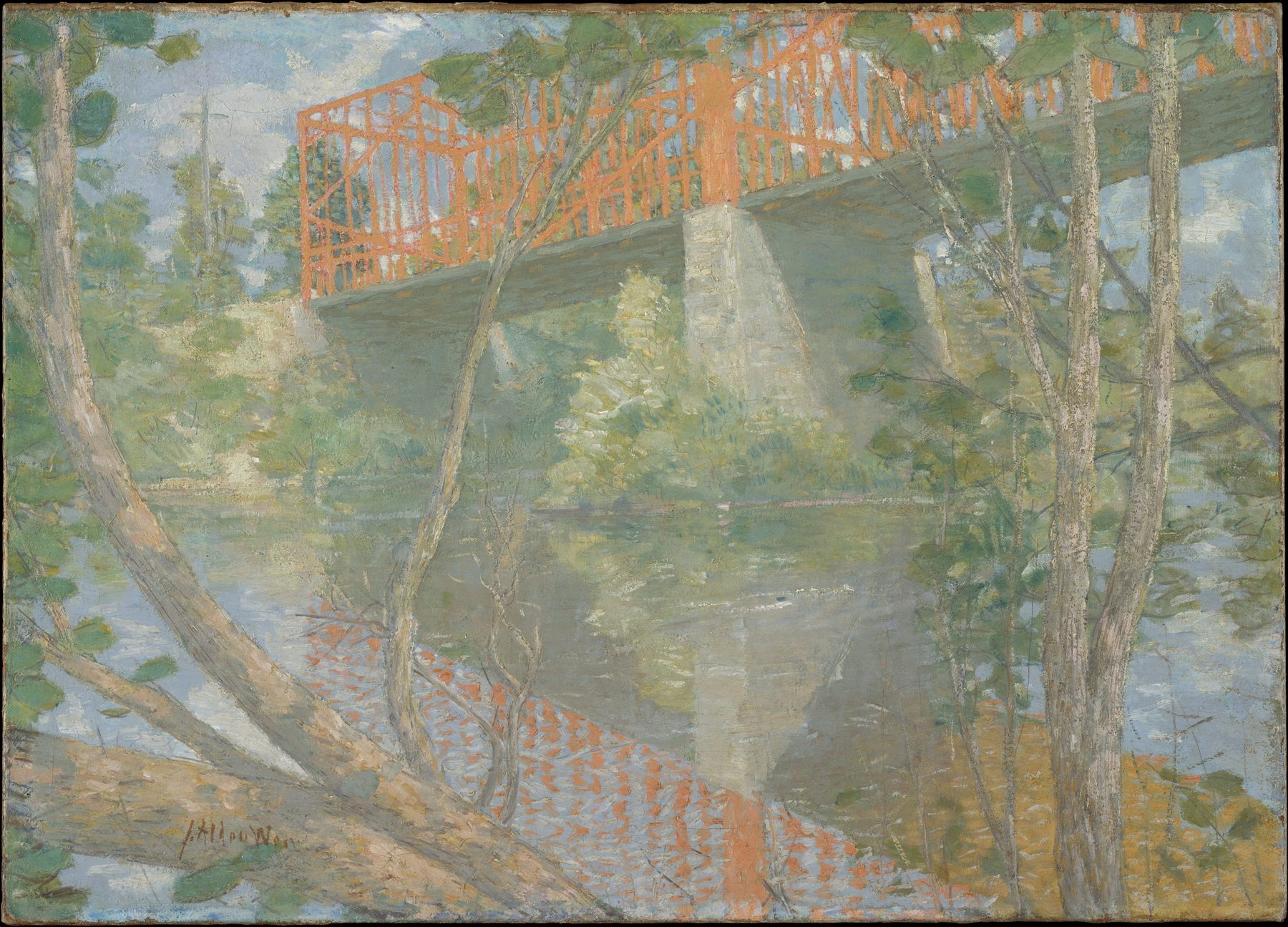
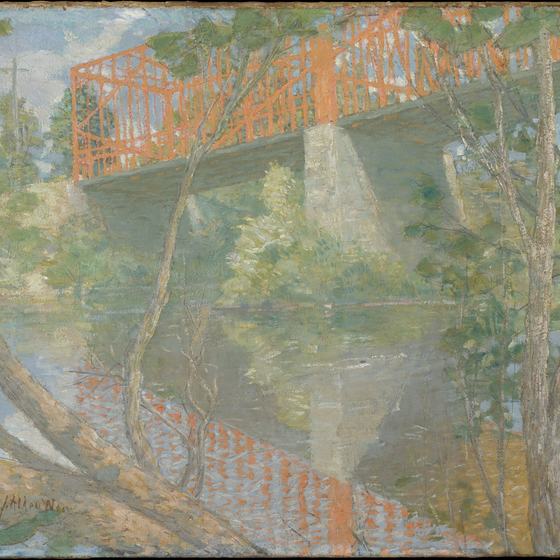
In The Red Bridge, an industrial iron structure crosses the Branchville landscape. Its geometry interrupts water, banks and trees, while the arrangement compresses space into bands and diagonals. Japanese prints offered one possible model for bold cropping and flat pattern. More important, the bridge refuses the fiction that rural Connecticut existed outside modern industry. Nature and infrastructure share the same view. Weir's Impressionism was therefore not simply a retreat from machines; it could make a machine the picture's organising form. [1] [15]
The property now known as Weir Farm was actively made. Fields were cleared and maintained, animals housed, buildings repaired, gardens tended and guests served. National Park Service research into labour restores caretakers, domestic workers and farm employees to a place usually narrated through artists and owners. The barn was not picturesque background but part of a working agricultural system. Once this labour is visible, the cultivated landscape in Weir's art looks less like untouched nature and more like a social environment. [27] [28] [29]
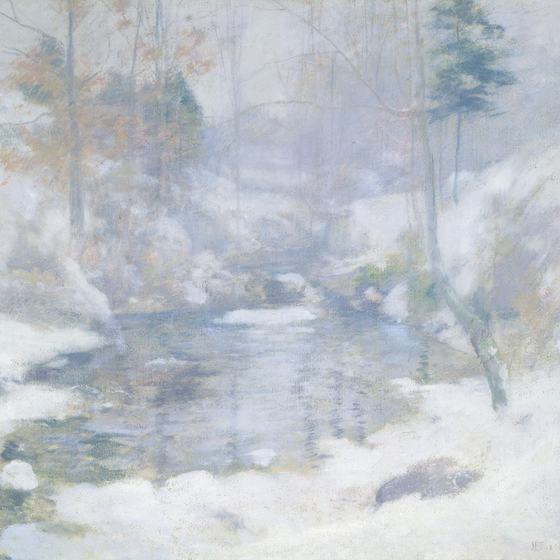
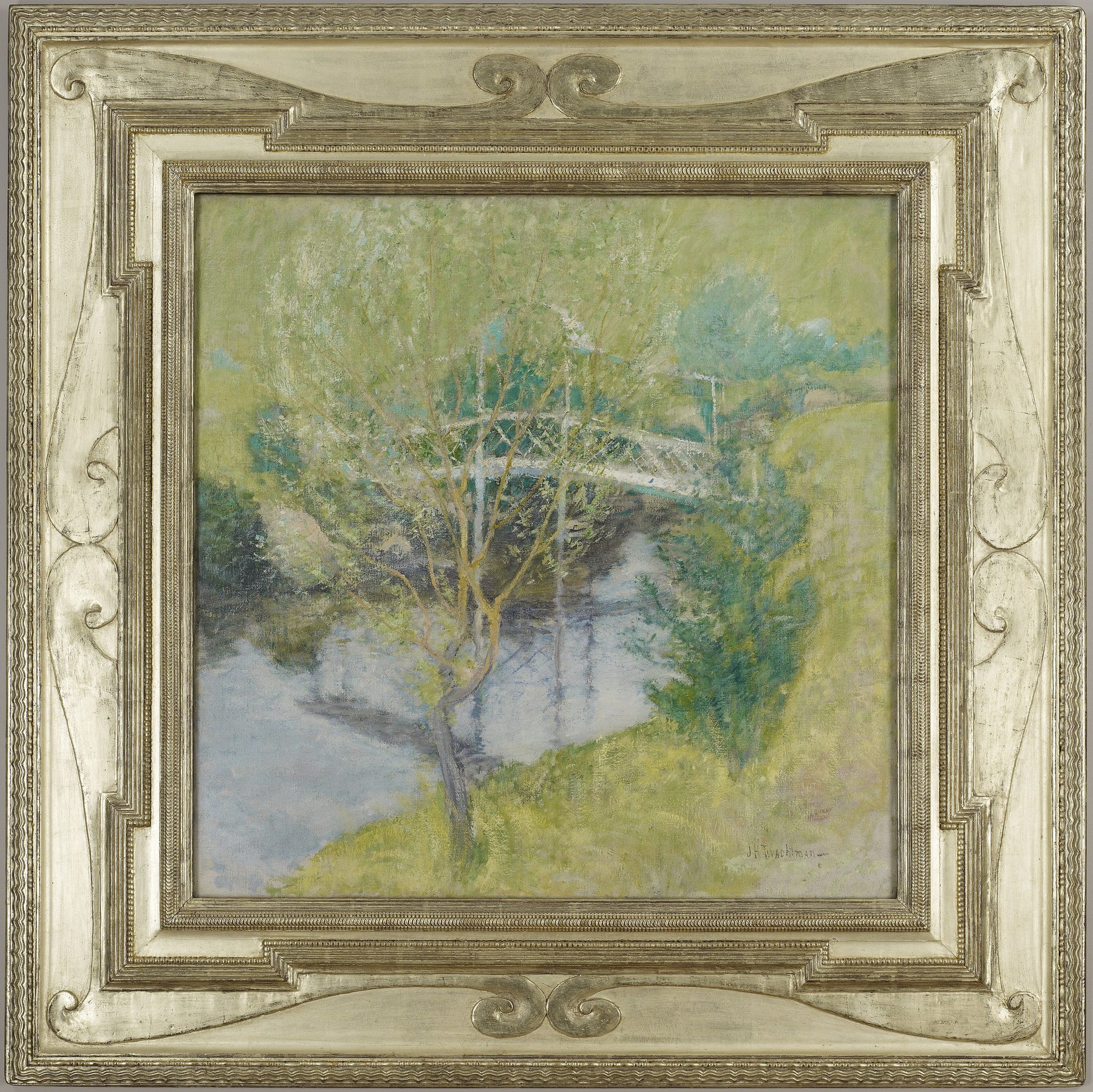
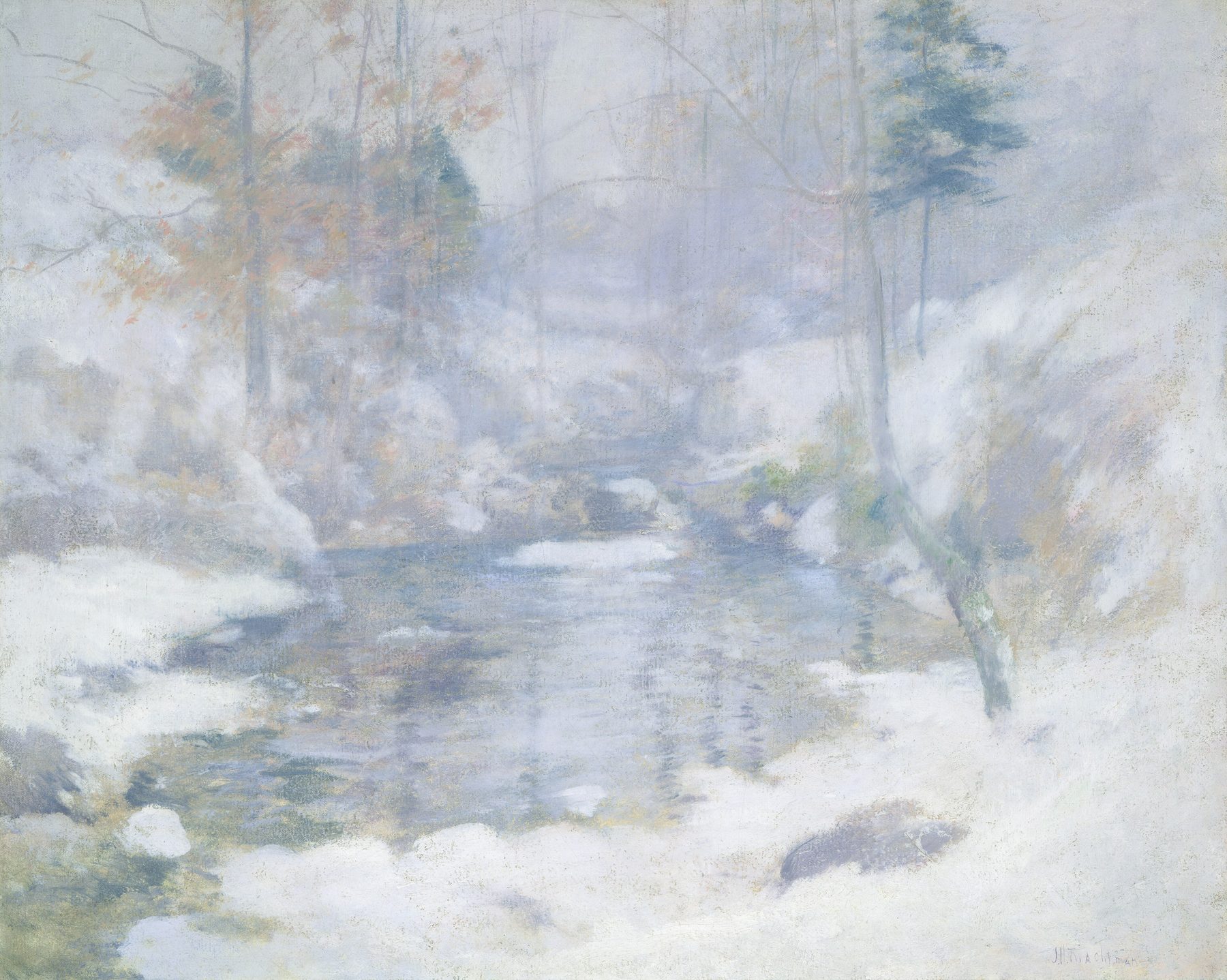
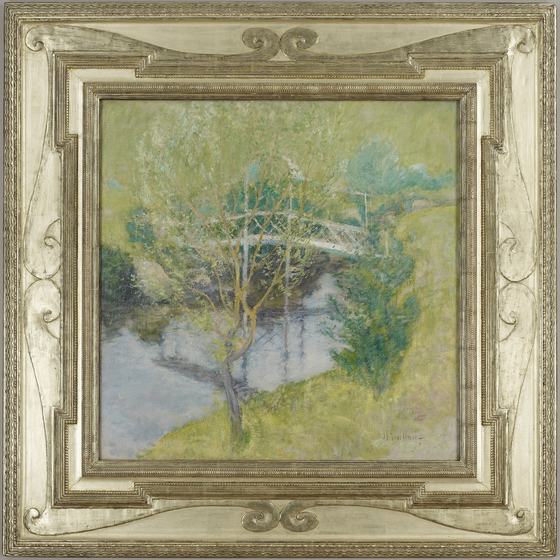
John Henry Twachtman brought another sensibility to Connecticut. His early Munich work could be dark and heavily painted; in Paris he moved toward thinner paint, subdued colour and broad patterned areas. Japanese prints contributed to his compressed spaces, but his mature pictures cannot be reduced to a checklist of influences. At Greenwich he returned to the same pond, waterfall, bridge and house through changing seasons. Snow became not blank emptiness but a field of small temperature shifts—blue, grey, mauve, cream and exposed earth. [15] [24] [25]
Seriality gave these modest places weight. A subject did not need to be grand if repeated attention could expose differences of thaw, reflection, mist and surface. Twachtman's compositions often hover between recognisable place and near abstraction. Paths end, water folds upward, and tonal intervals matter more than topographical inventory. Catalogued works and technical study show deliberation beneath their quiet appearance. [26]
Twachtman taught at the Art Students League and worked around Cos Cob, where artists gathered in another Connecticut colony. His friendship with Weir and Theodore Robinson linked private experiment to professional networks. He was also a founder of The Ten, yet his muted Greenwich paintings differ sharply from Hassam's crowded streets or Benson's sunlit figures. The category succeeds only if it can contain that difference. [1] [24]
Essential works
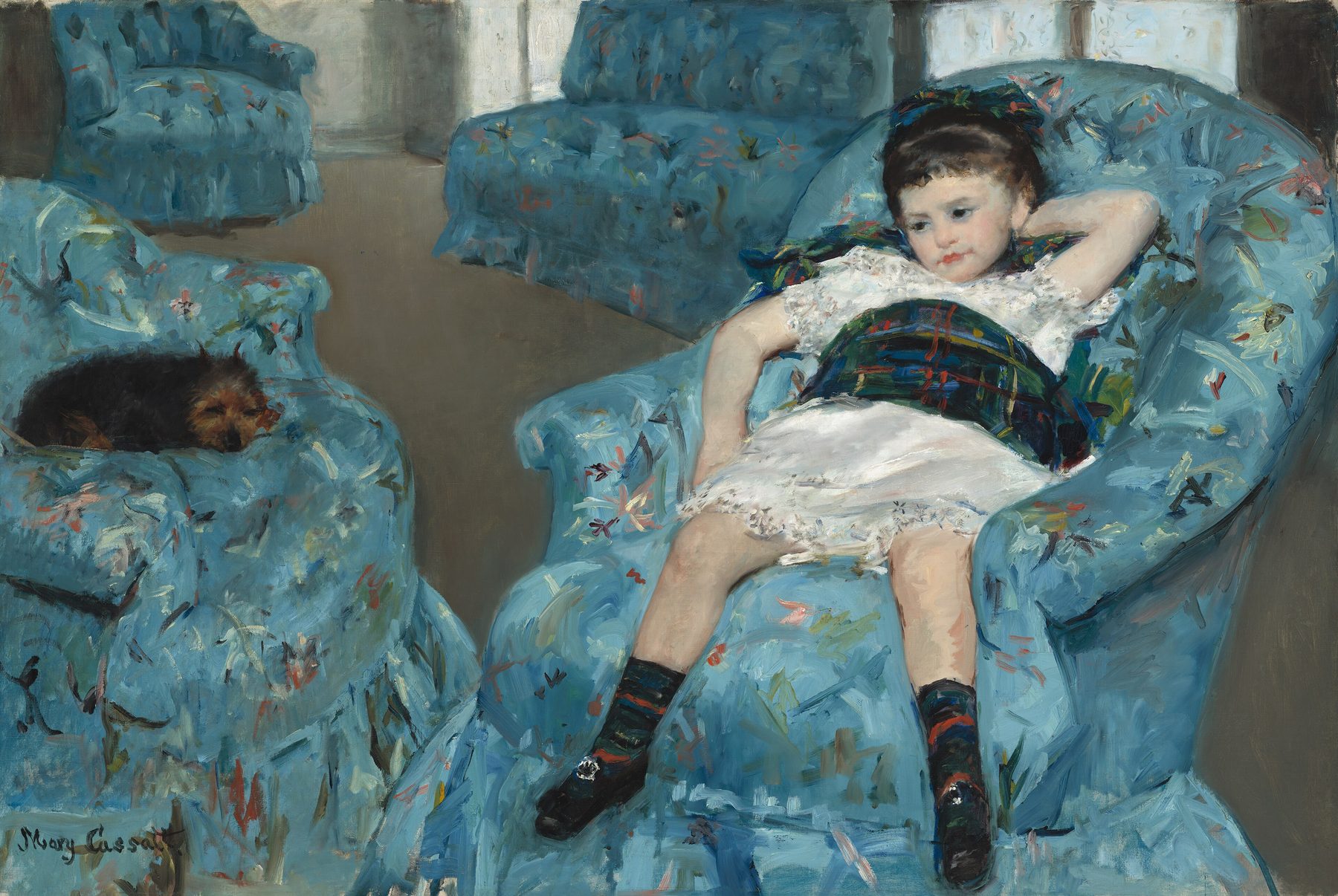
Little Girl in a Blue Armchair
Mary Cassatt, 1878
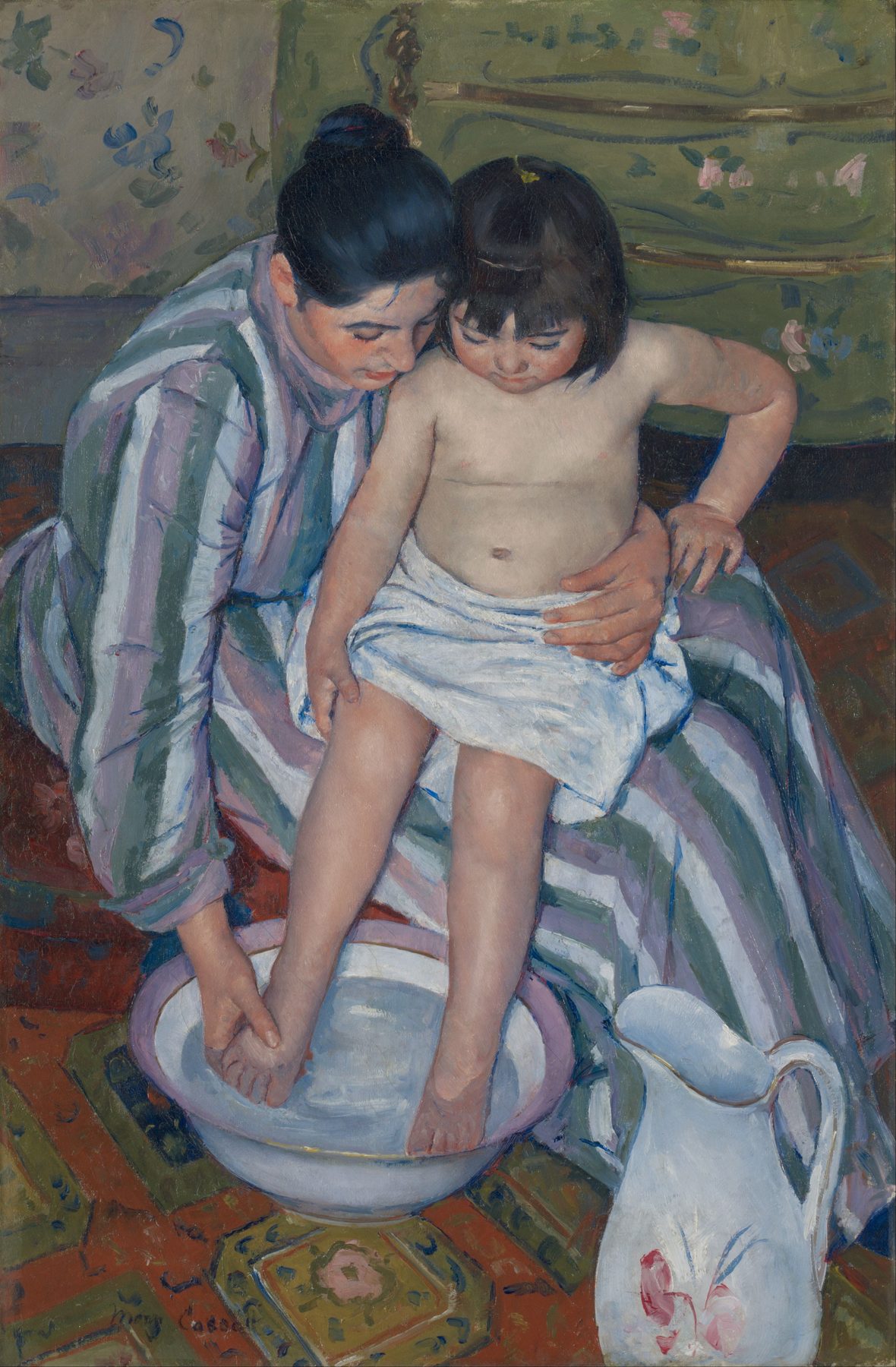
The Child's Bath
Mary Cassatt, 1893
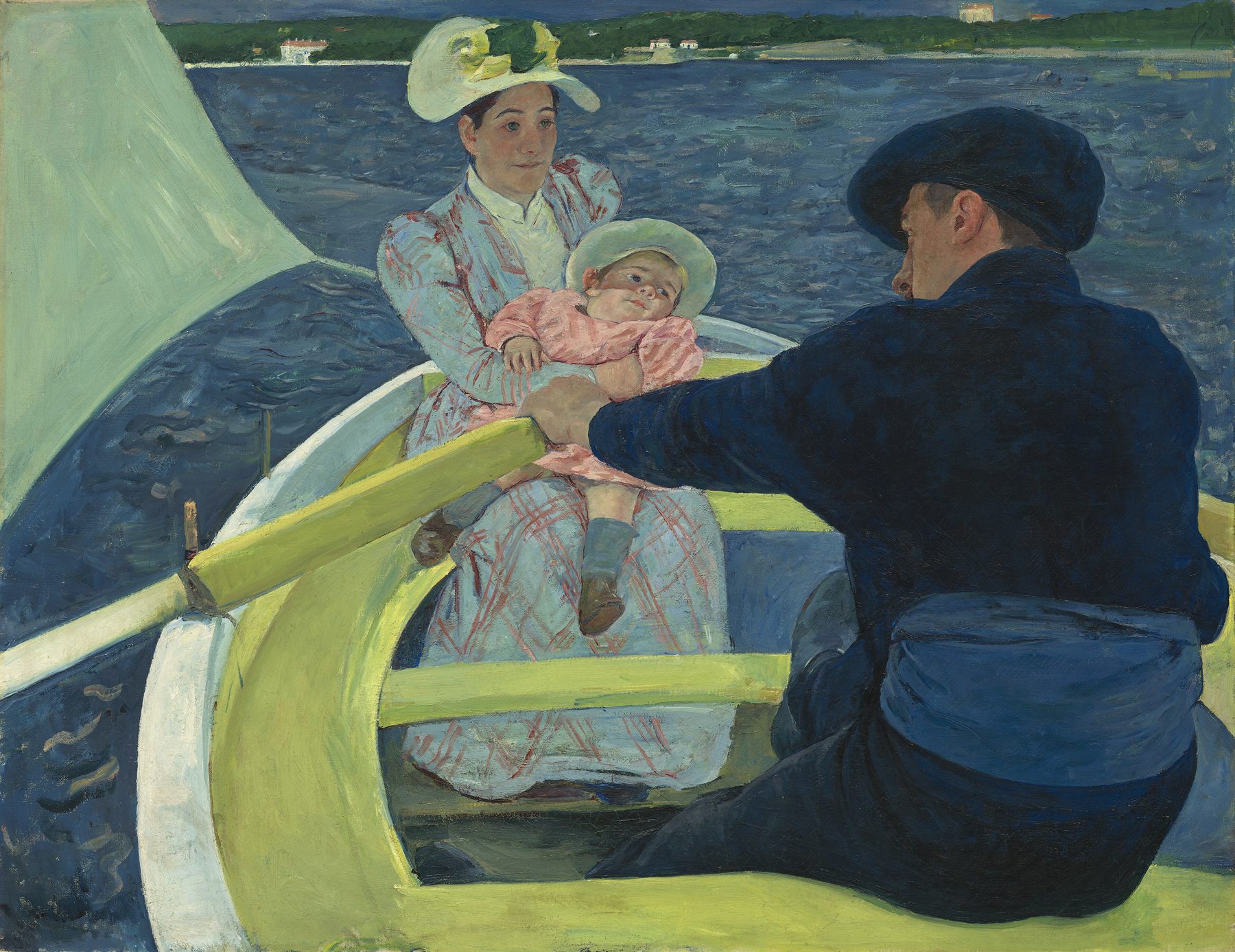
The Boating Party
Mary Cassatt, 1893–94
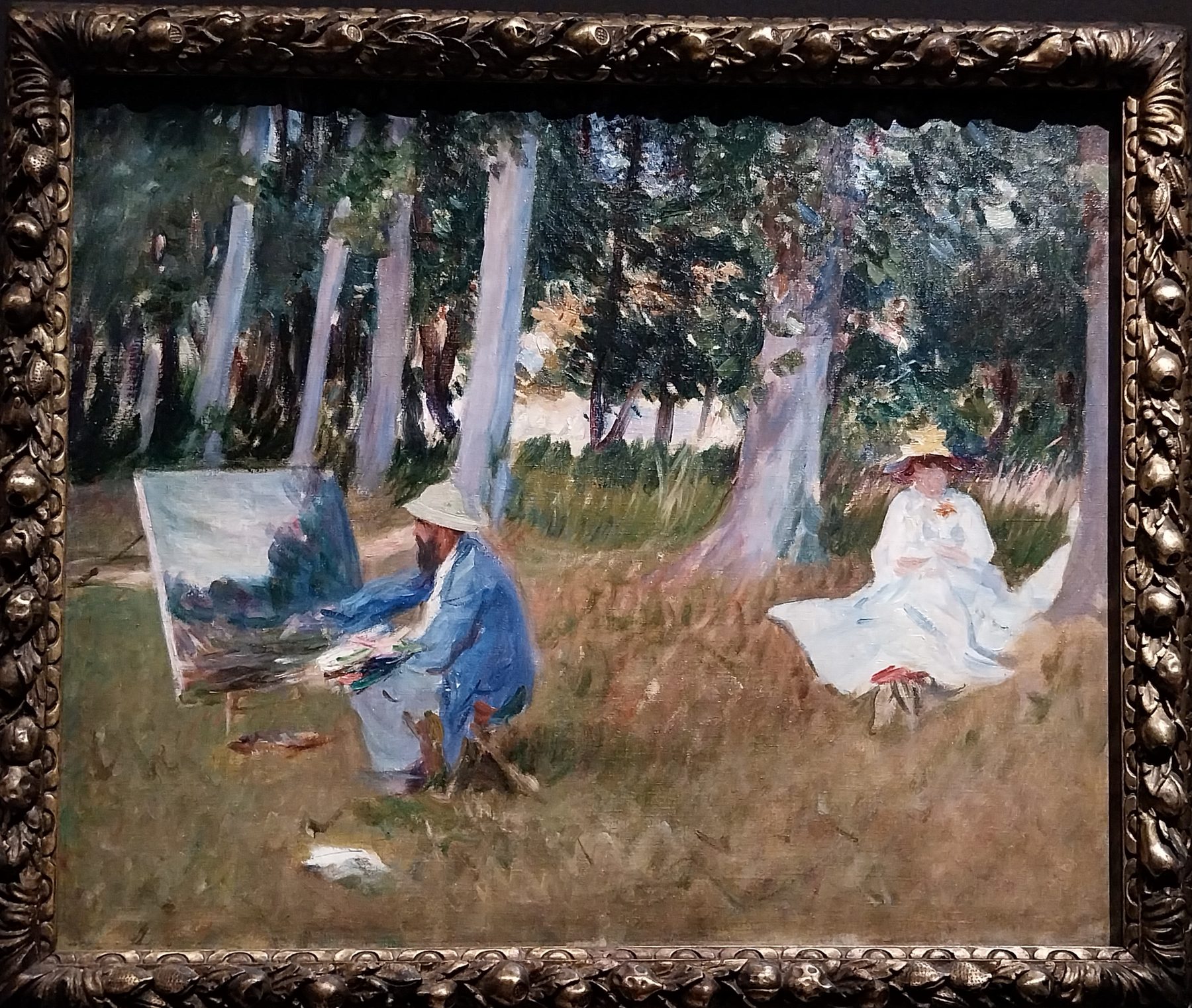
Claude Monet Painting by the Edge of a Wood
John Singer Sargent, 1885
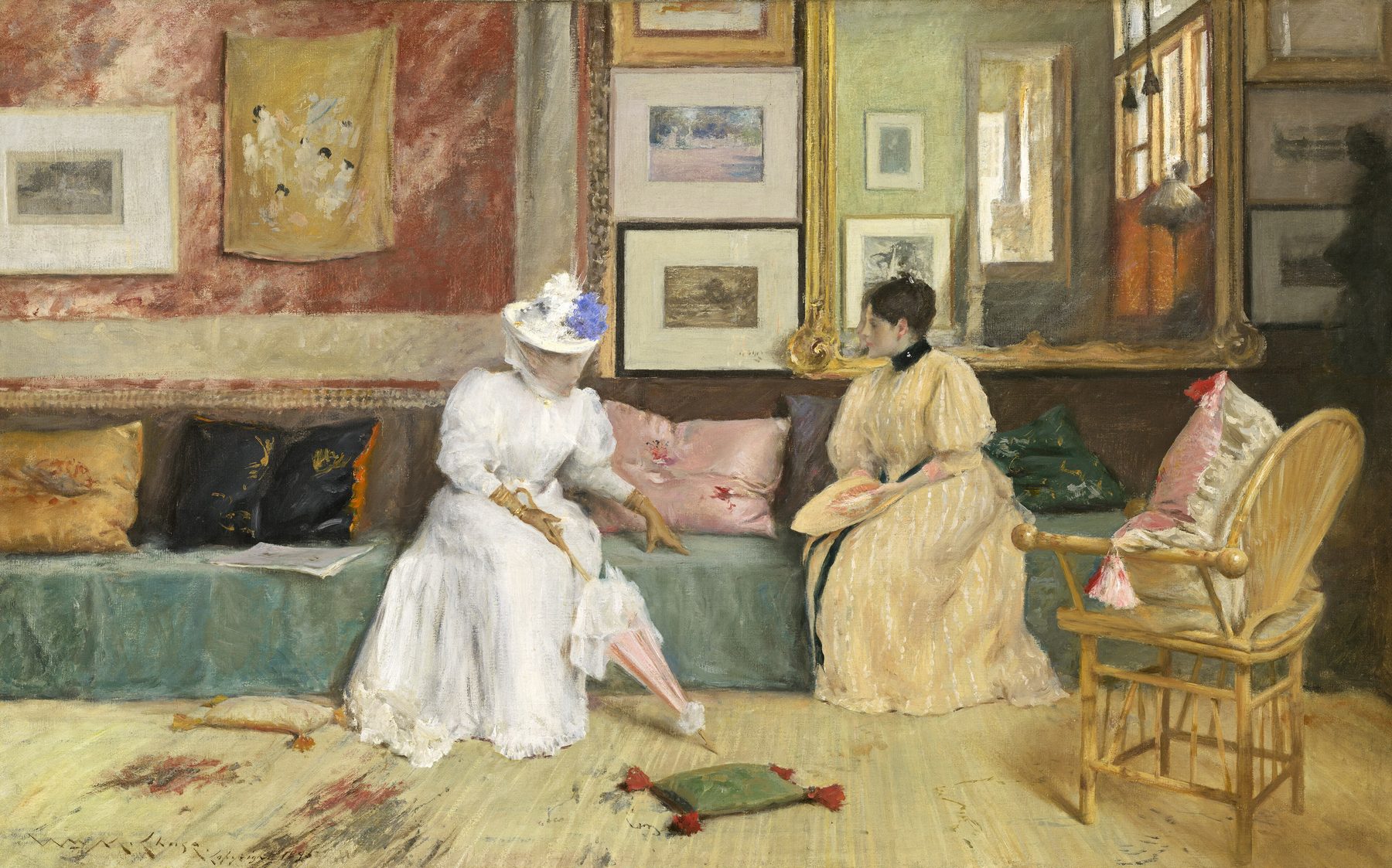
A Friendly Call
William Merritt Chase, 1895
Hassam, the modern city and the theatre of flags
Childe Hassam made the city one of American Impressionism's most sustained subjects. Born in Massachusetts, he painted Boston before studying in Paris, then settled in New York in 1889. Carriages, wet pavements, snowfall, shopfronts, pedestrians and newly built avenues supplied structures of movement. His broken touch could make weather visible, but he also used awnings, signs, poles and façades to pattern the canvas. [30] [31]
These works should not be read as neutral snapshots. Hassam selected elevated viewpoints, compressed traffic and arranged colour accents. A rainy avenue becomes an orchestration of umbrellas and reflections; snow softens the city's edges while revealing dark verticals. His pictures often present urban modernity as visually stimulating rather than socially catastrophic. Crowds appear, but poverty, dangerous labour and racial conflict rarely press to the foreground. Their exclusions are part of their historical meaning.
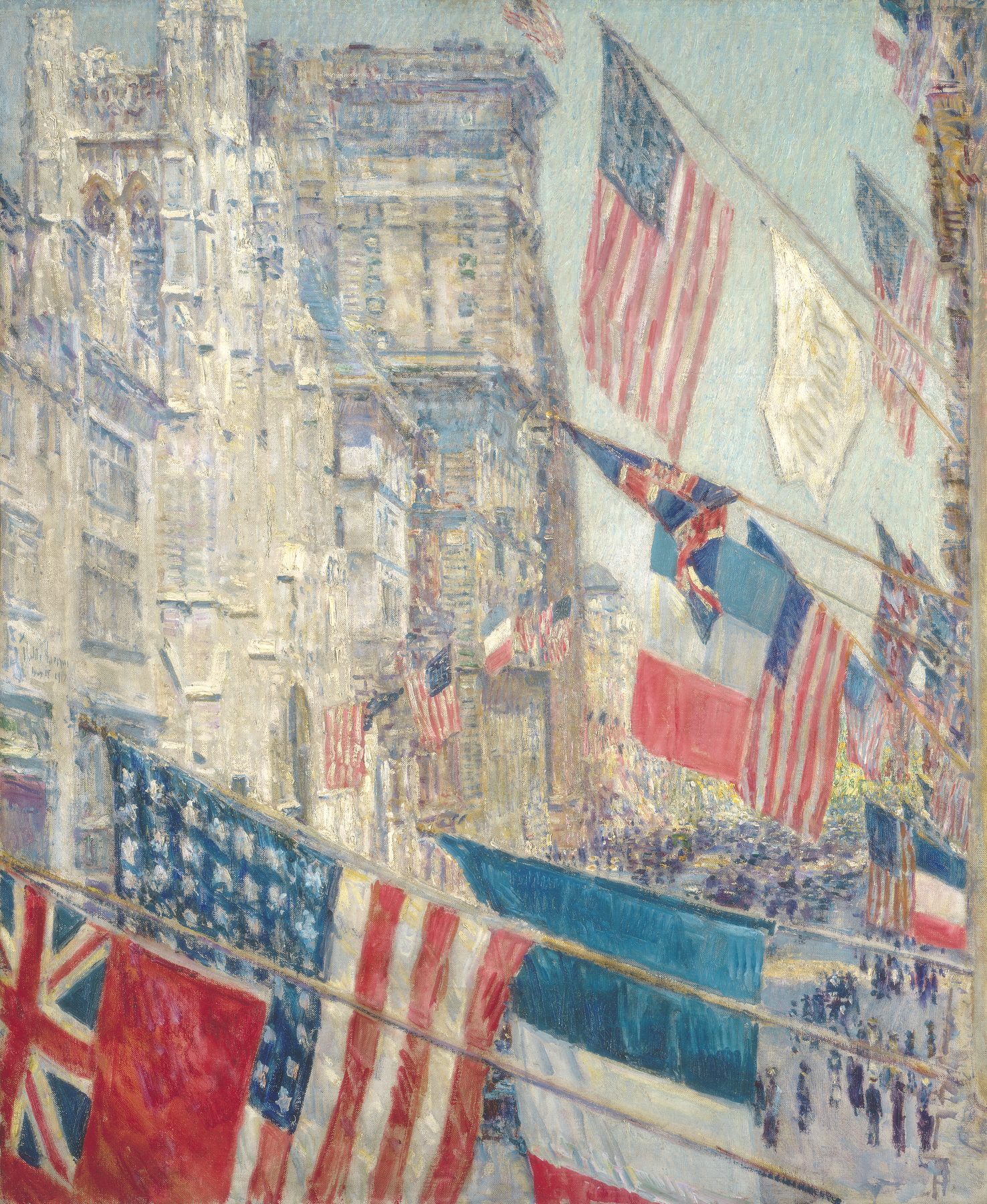
The Flag series, painted during the First World War, intensifies this tension. Allies Day, May 1917 looks down Fifth Avenue as British, French and American flags fill the space above a crowd. Repeated diagonals turn the street into a brilliant canopy. The image records a real patriotic display held after the United States entered the war, while other works in the series relate to preparedness and bond campaigns. [32] [33] Yet the flags' colour and rhythm can make mobilisation look festive. Soldiers' wounds, bereavement and the violence overseas remain outside the frame. The picture's beauty does not cancel its politics; it is the form through which those politics become persuasive.
Hassam returned repeatedly to flag-lined streets, changing national emblems, weather and viewpoint. In Avenue of the Allies: Great Britain, 1918, banners again fragment the urban canyon. Serial treatment links these works to Impressionist interest in variable conditions, but the condition is now ceremonial nationalism as much as light. [34]
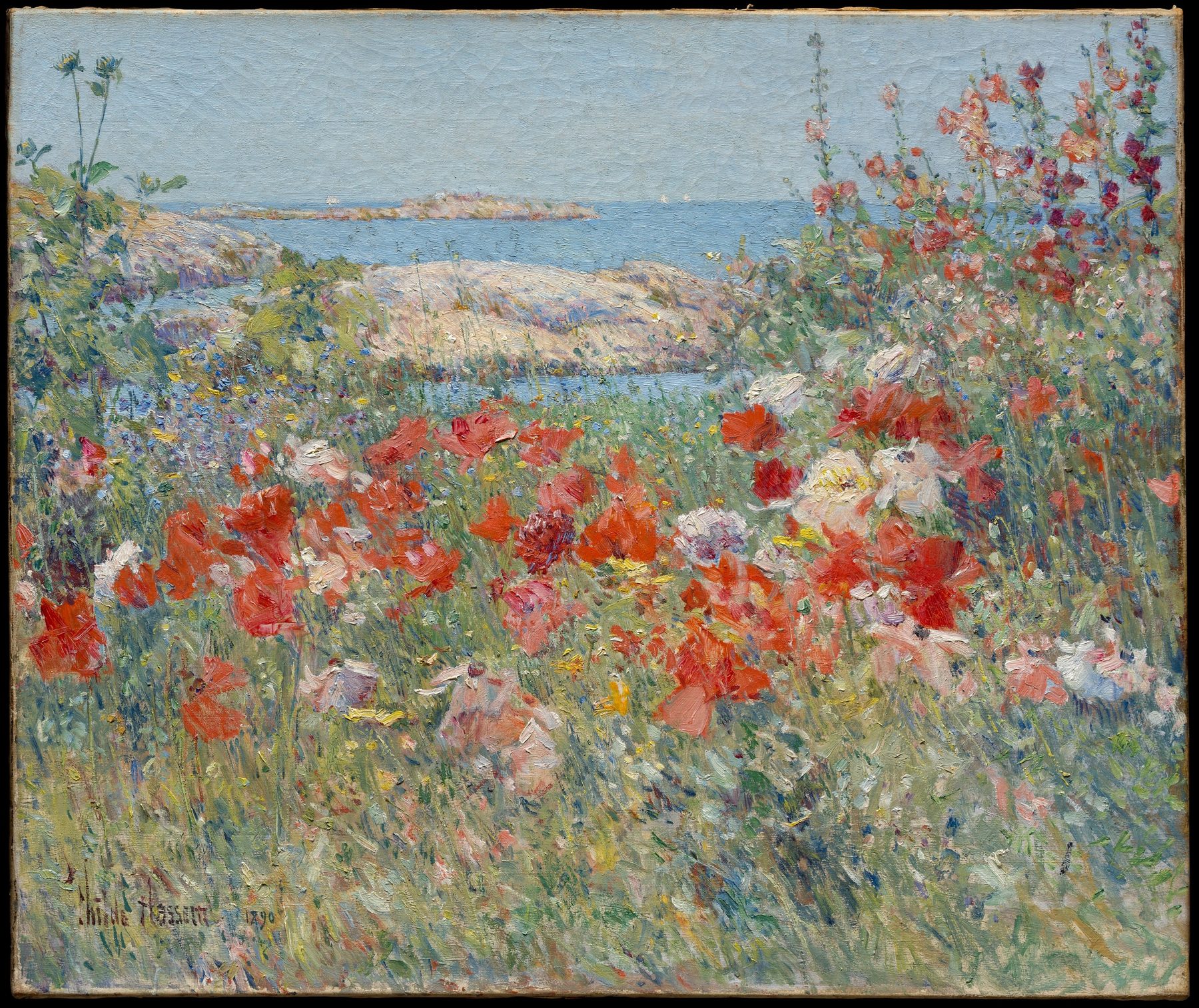
He also painted gardens and coastlines, especially at Celia Thaxter's garden on the Isles of Shoals. Flowers provided dense colour against sea and rock; the cultivated garden offered another collaboration between environment and human design. Hassam's range—from New York traffic to island flowers—shows why American Impressionism cannot be defined by rural landscape alone. [30]
Follow the movement through four stages
–1886
Artists, collectors and pictures cross the Atlantic
Cassatt works within the French Impressionist group while students, dealers and collectors build the networks that make the new painting visible in the United States.
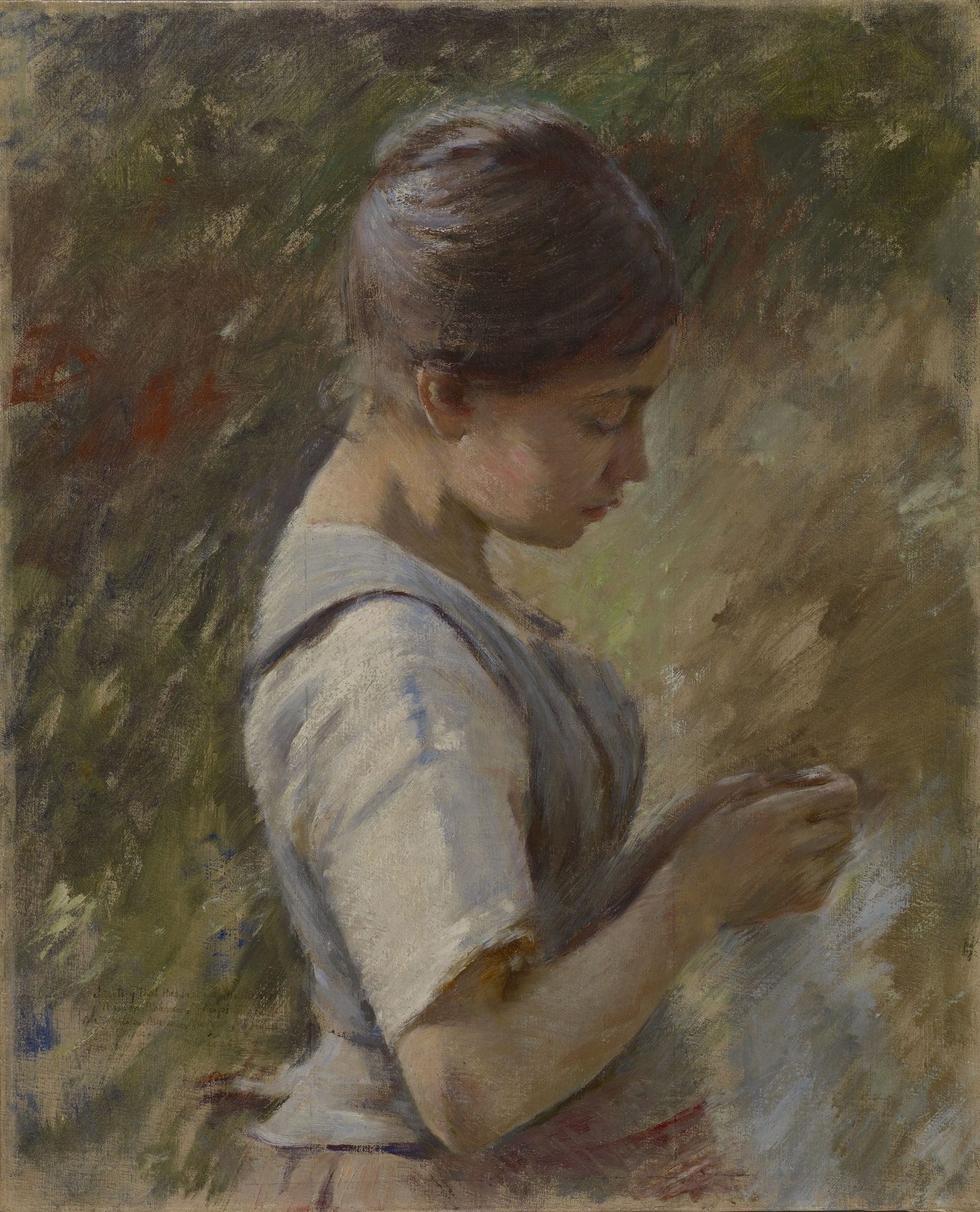
–1897
Giverny, parks and American translation
Durand-Ruel’s New York exhibition, Chase’s park scenes, the Giverny colony and Connecticut experiments turn a French challenge into multiple American practices.
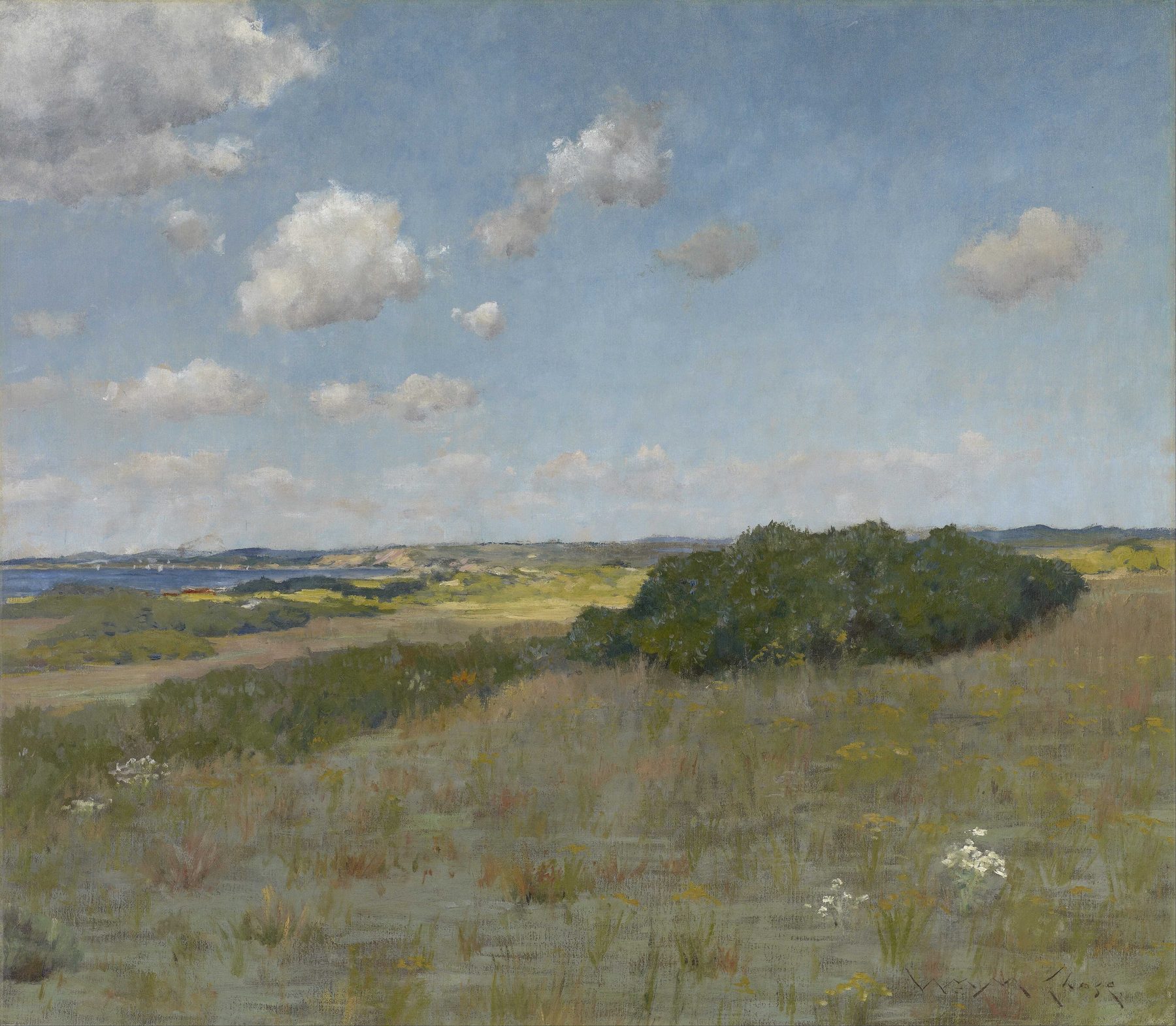
–1913
The Ten, art colonies and regional expansion
Controlled exhibitions, summer schools and colonies carry Impressionist light through Boston interiors, New England fields, Pennsylvania valleys and California landscapes.
–1930s
An established language and regional afterlives
After the Armory Show, Impressionism loses avant-garde prestige but remains active in urban series, New Hope winters, California colour and institutional collecting.
The Ten, Boston interiors and the politics of taste
In 1897, ten painters withdrew from the Society of American Artists and formed a new exhibiting association. Frank Benson, Joseph DeCamp, Thomas Dewing, Childe Hassam, Willard Metcalf, Robert Reid, Edward Simmons, Edmund Tarbell, John Twachtman and J. Alden Weir held their first exhibition at Durand-Ruel's New York gallery in 1898. After Twachtman's death, Chase took his place. The surviving catalogue makes the group's strategic identity tangible: this was a controlled exhibition venture, not a manifesto defining every American Impressionist. [21]
The Ten sought favourable presentation and critical attention at a moment when large mixed exhibitions could bury individual work. Their association signalled professional confidence, but it also exposed the narrowness of institutional access. All ten were men. Cassatt, Perry and many other women who practised or promoted Impressionism were outside the group. Treating The Ten as the movement's official membership would reproduce their exclusion.
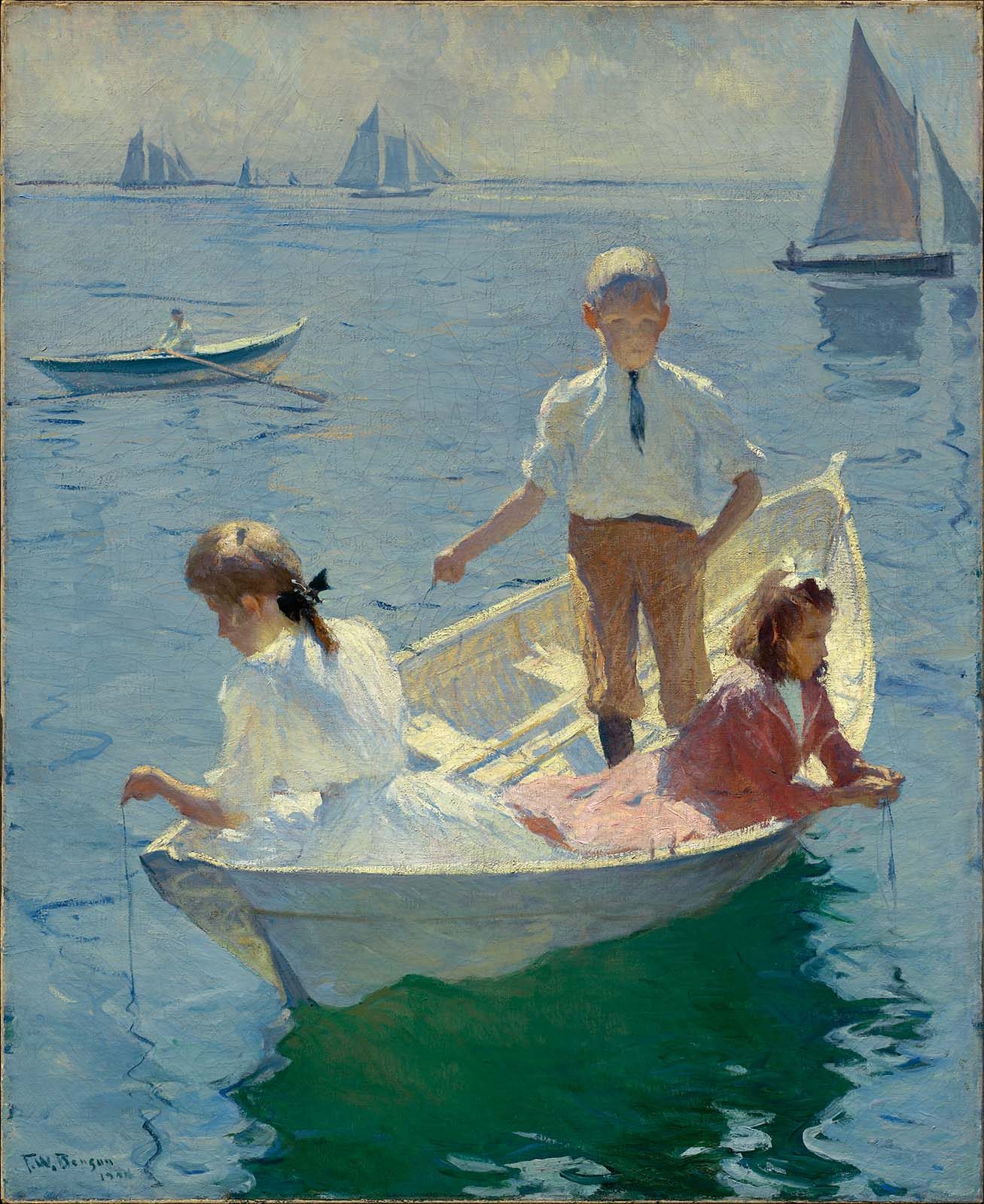
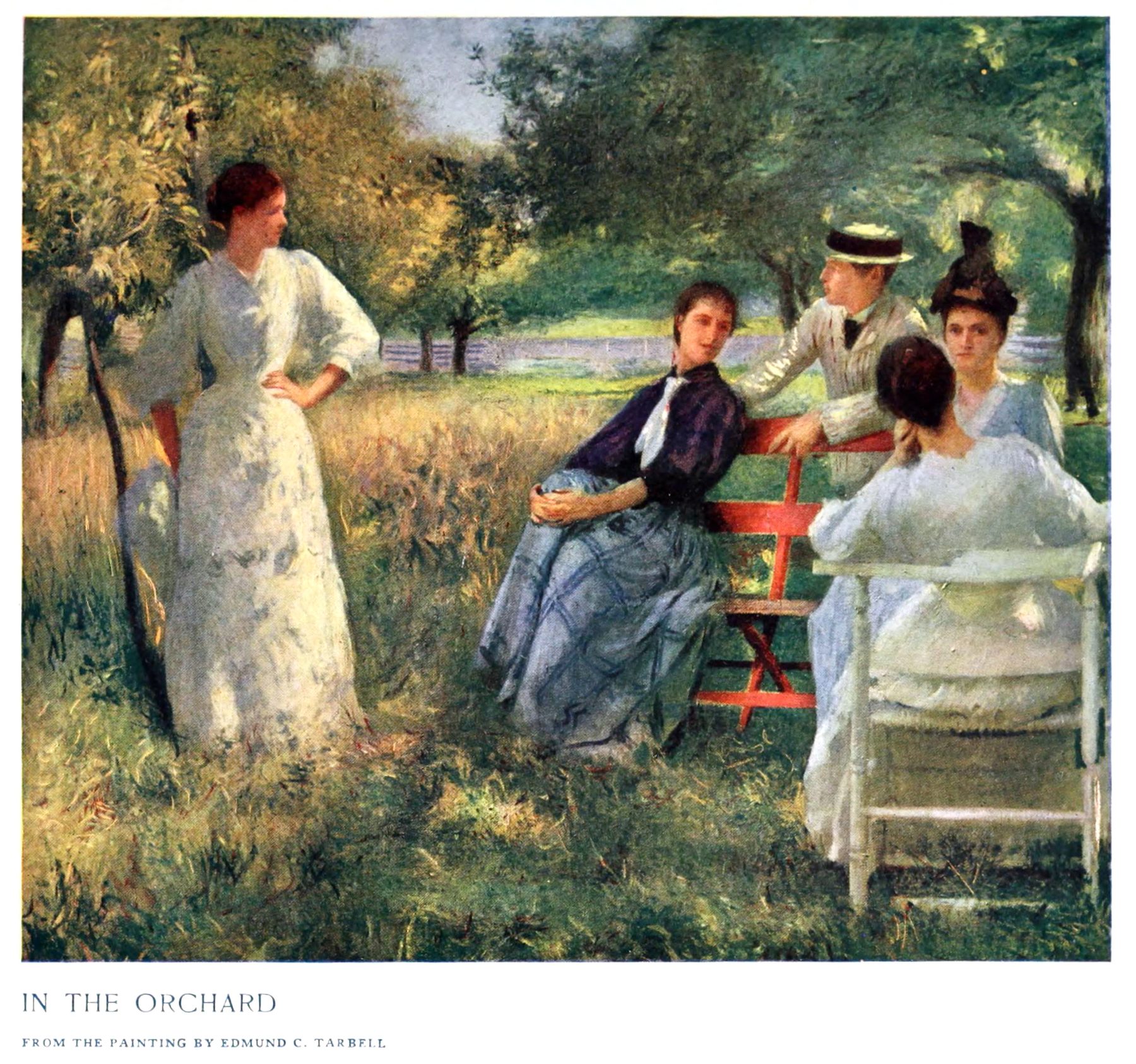
Boston painters Frank Benson and Edmund Tarbell combined academic figure training with bright, broken colour. Their women and children read, sew, take tea or occupy verandas and summer grounds. Sunlight catches a white dress; reflections animate a polished table; an open window connects interior and garden. Such pictures require careful construction beneath their apparent ease. They also helped turn Impressionism from foreign revolt into a language of cultivated American domesticity. [5]
That transformation had a social price. A work such as On the Veranda makes leisure, tasteful clothing, controlled landscape and unhurried looking appear natural. [49] The people represented are often affluent and white; domestic service and the labour supporting the household remain invisible. The “new American ideal” associated with Tarbell and Benson was therefore never universal. It offered patrons a flattering modernity in which painterly freshness confirmed, rather than threatened, social order.
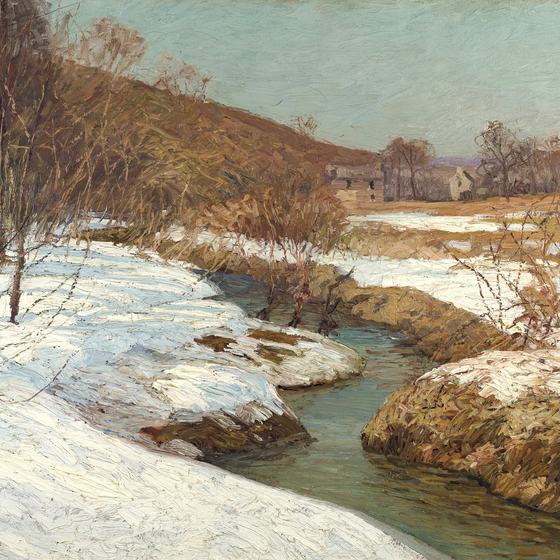
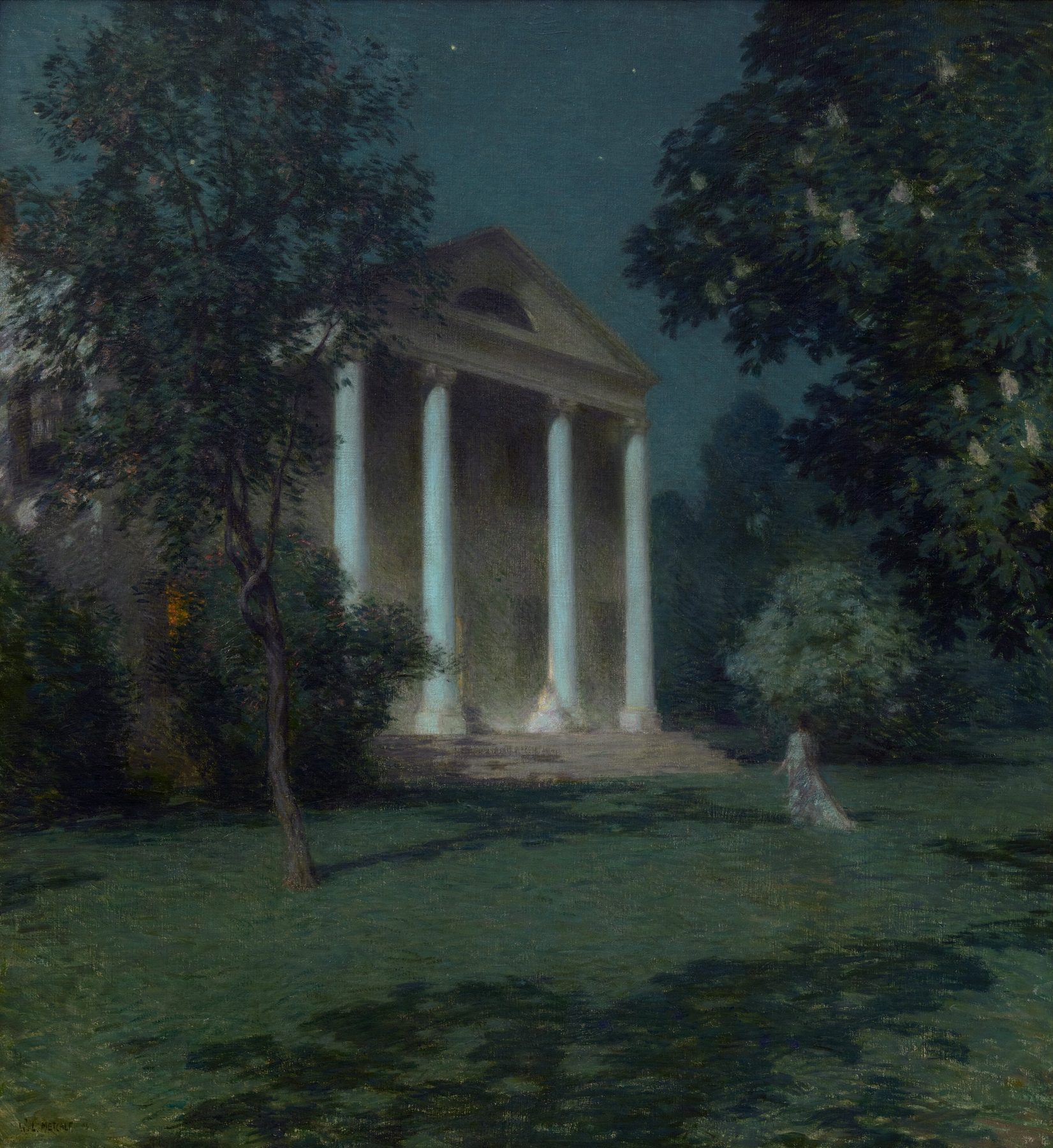
Willard Metcalf complicates the Boston story. He trained at the Museum School and Académie Julian, visited Giverny early, joined The Ten and later worked at Old Lyme. His most distinctive mature pictures often show New England in winter or at the edge of thaw. The broken surface serves slow seasonal observation rather than cosmopolitan spectacle. Metcalf's movements among institutions and colonies demonstrate how the field was carried by people, not simply by formal resemblance. [41] [42]
Art colonies: work disguised as escape
American Impressionism flourished in colonies because colonies solved several problems at once. They placed painters near repeatable outdoor subjects, lowered or shared living costs, enabled conversation and criticism, and connected students with established professionals. They also produced a desirable story. The artist appeared to escape the commercial city for direct communion with landscape, even when a railway, boarding house, school timetable and exhibition market made the escape possible.
Cos Cob grew around the Holley House near Greenwich, where Twachtman taught and Hassam, Weir and others worked. Shinnecock centred on Chase's summer school. Old Lyme developed around Florence Griswold's family home. In each case a building organised the supposedly outdoor story. Meals, bedrooms, studios, verandas and social rituals mattered almost as much as fields and rivers.
Old Lyme makes the economic foundation unusually clear. Florence Griswold inherited a large Connecticut house and its debts. Taking boarders gave an unmarried woman a socially acceptable means of survival. In 1899 Henry Ward Ranger arrived and helped turn the house into the centre of an art colony. Ranger initially encouraged a dark, atmospheric Tonalism; Hassam's arrival in 1903 helped shift the dominant taste toward brighter Impressionist colour. Metcalf, Matilda Browne and William Chadwick were among those who worked there. [43]
The colony's history is not only a sequence of male stylistic leaders. Griswold's hospitality, business judgement and sustained emotional labour held it together. Browne painted animals and landscape in a milieu that often treated women as guests or amateurs. Doors and dining-room panels painted by residents turned the house itself into a collective record. The later museum preserved this unusually intimate setting, but preservation can also romanticise it. A complete history asks who cooked, cleaned, farmed, maintained buildings and enabled artists to devote their days to looking. [44]
Colonies likewise transformed working countryside into aesthetic resource. Fences, orchards, mills, barns and cultivated fields signalled an old New England that appeared stable during rapid industrialisation and immigration. Painters did not necessarily falsify what they saw; rather, their selections could make change less visible. A stone wall might stand for continuity while the workers maintaining land disappeared. The rural ideal was therefore modern in its very longing for escape from modernity.
Teaching amplified the colonies' effects. Students learned to select a motif, judge changing light, block a composition and work quickly enough to retain unity. They also learned how an artist lived: which equipment to carry, how to organise a studio, where to exhibit and how to form professional relationships. Chase at Shinnecock and Twachtman at the Art Students League and Cos Cob made pedagogy part of American Impressionism's dissemination. The movement spread not only through masterpieces but through lessons, summer routines and the ordinary repetition of practice. [20] [24]
Beyond New England: New Hope and California
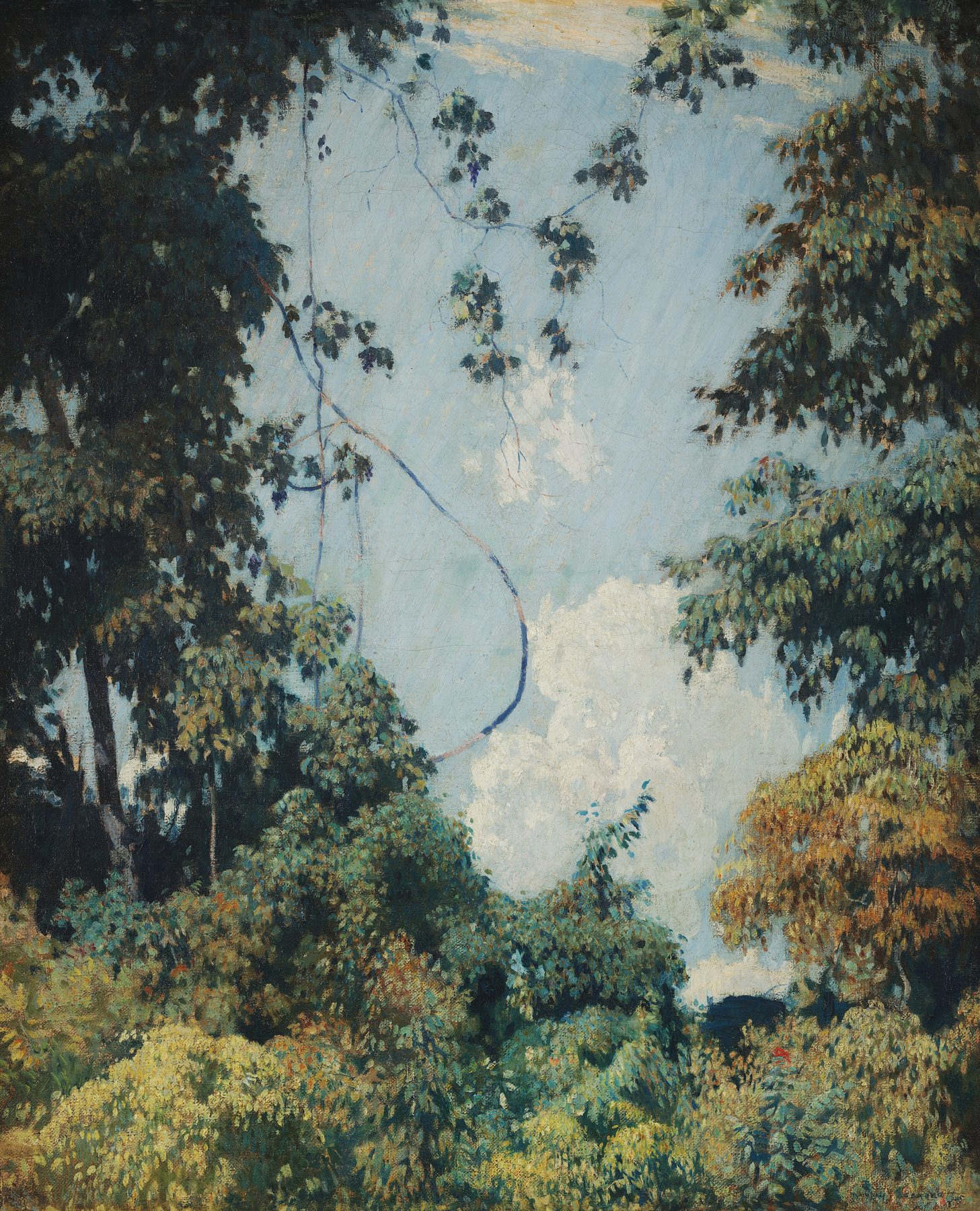
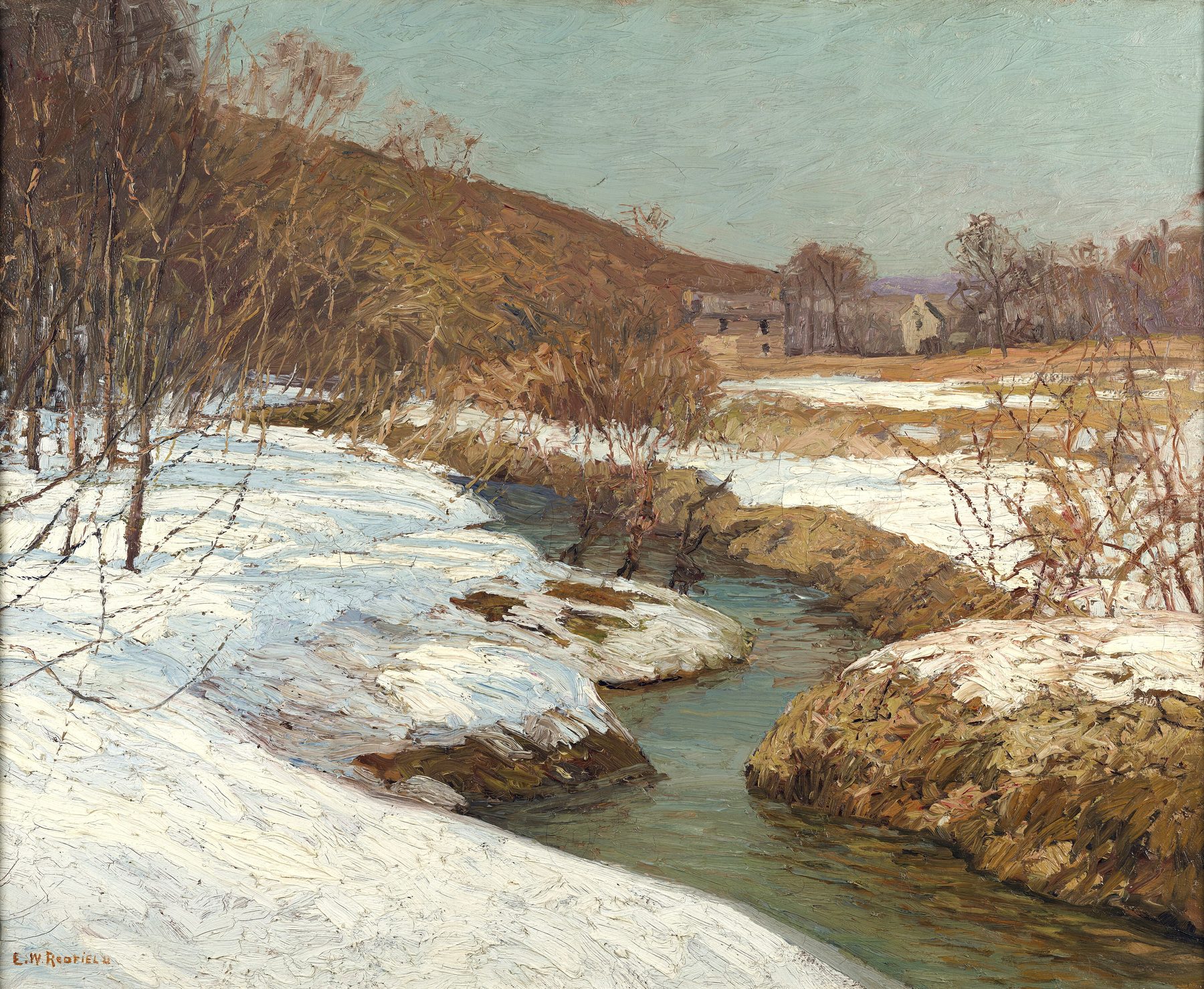
The standard story tends to run from Paris to Boston, New York and Connecticut. That route is essential but incomplete. Around New Hope in Pennsylvania, Edward Redfield, Daniel Garber and related painters worked along the Delaware River and surrounding countryside. Redfield became known for large winter landscapes painted with vigorous strokes; Garber combined luminous fields, houses and river views with decorative order. Their regional Impressionism continued after newer forms of modernism had appeared in metropolitan exhibitions. [48]
These artists did not merely preserve an old style. They adapted it to local weather, topography, patronage and identity. Snow, quarries, canals, farms and villages supplied subjects through which Pennsylvania could be presented as both working landscape and cultural refuge. N. C. Wyeth's engagement with Impressionist colour, explored by the Brandywine Museum, further blurs the boundary between fine-art movement, illustration and regional practice. [48]
California creates an even larger challenge to a single national centre. Artists travelled into, out of and across the state; some had trained in Europe or on the East Coast, while others developed their careers through Southern California clubs and exhibitions. Laguna Art Museum's framing of these travels is useful because it replaces an enclosed “California school” with mobility. Sunlit coasts, eucalyptus groves, mountains and wildflower fields became characteristic subjects, but the painters' careers remained connected to national and international circuits. [45]
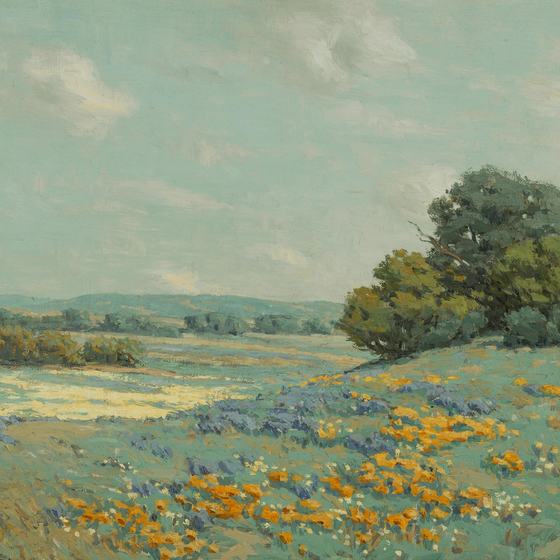
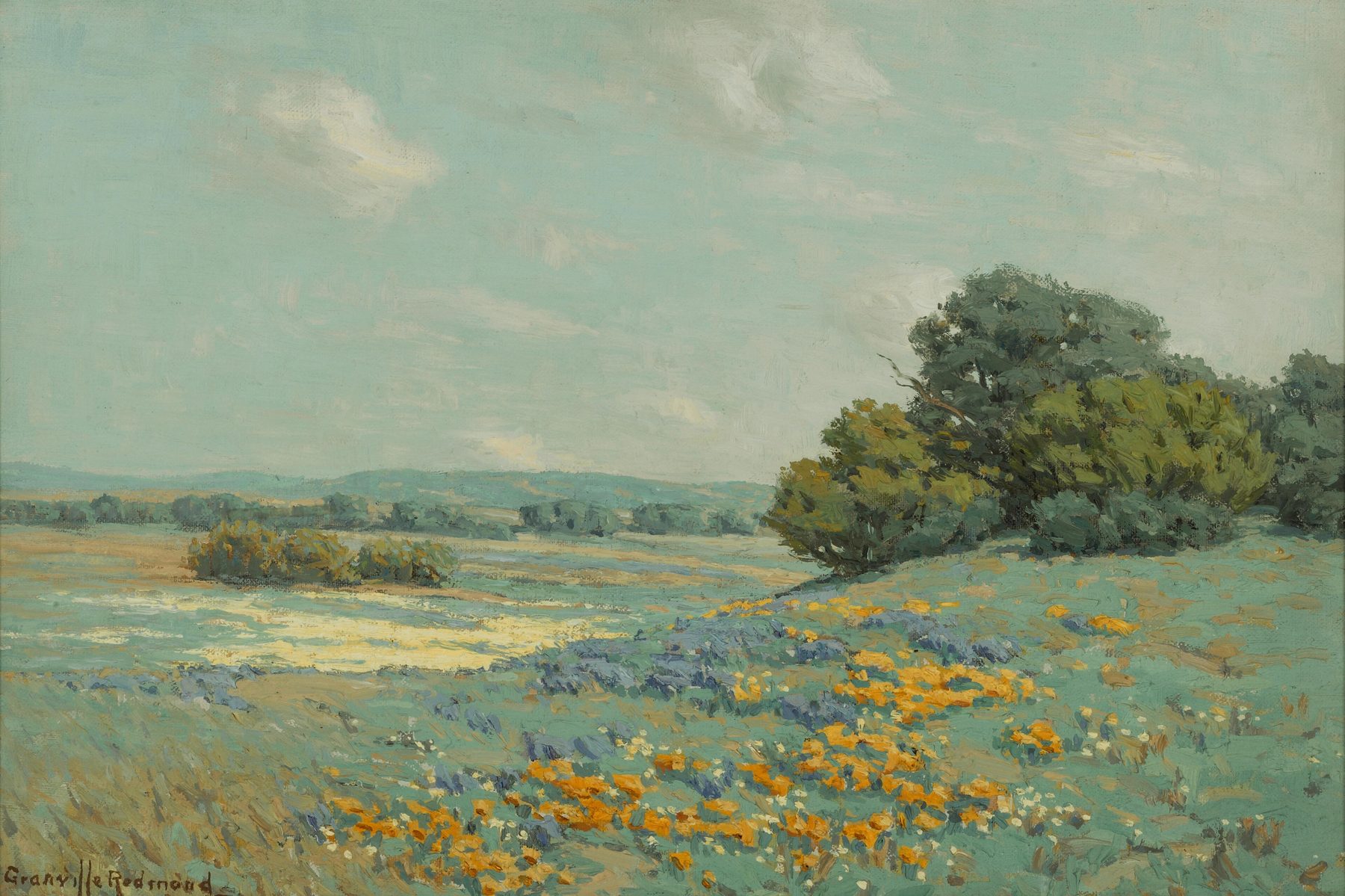
Granville Redmond's poppy fields are among the most recognisable images of California Impressionism. Their saturated colour can become a tourist shorthand for the state. Yet Redmond's identity as a deaf artist, his relation to Deaf communities and his career in silent film complicate any purely optical account. Colour was one part of a life shaped by communication, performance and professional networks. [46]
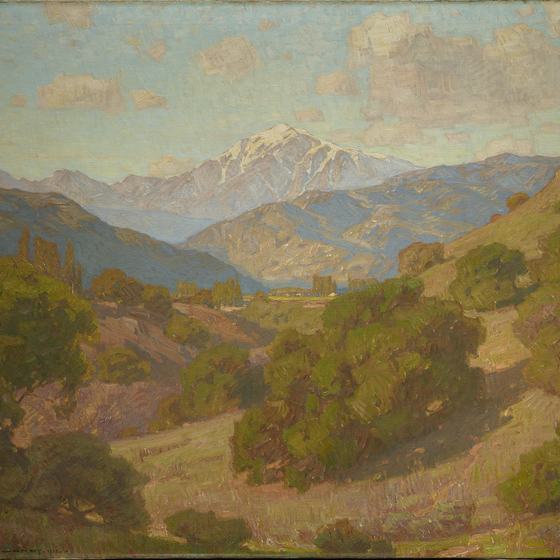
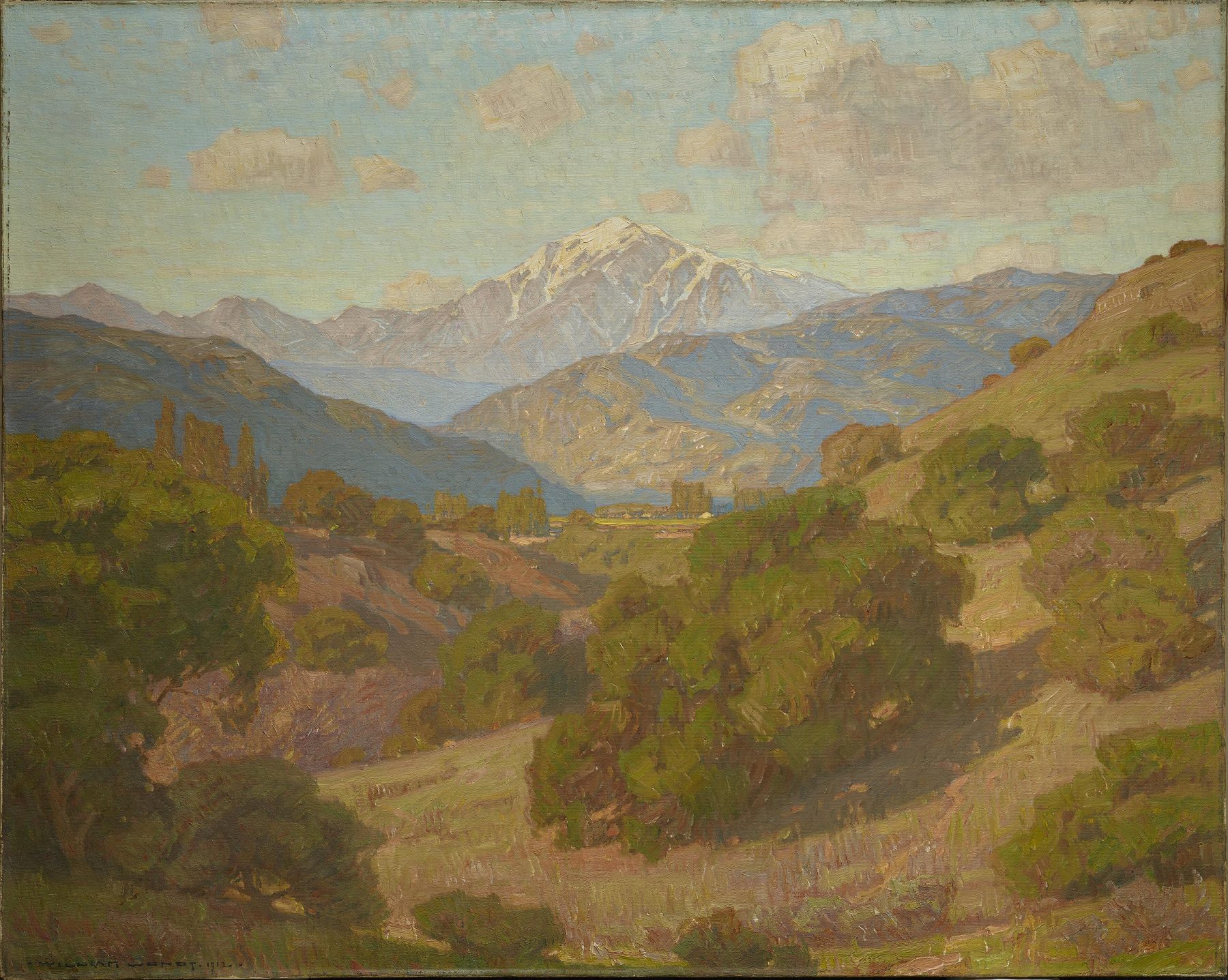
William Wendt turned Southern California landscape into broad, structural arrangements. His pictures and Arts and Crafts commitments could present nature as a temple apart from the city. That ideal deserves both attention and scrutiny. The landscapes are powerful constructions of scale and atmosphere, but the apparent emptiness of the land can suppress Indigenous histories, agriculture, development and displacement. Regional Impressionism helped viewers love particular environments; it could also help them imagine those environments as available and unpeopled. [47]
Women, class, race and the boundaries of the canon
Women were central to American Impressionism as artists, students, teachers, hosts, organisers, writers and collectors. Cassatt's public authority, Perry's transnational mediation, Florence Griswold's colony-making and Matilda Browne's Old Lyme practice are not supplements to an otherwise male story. They show how the field functioned. Mary MacMonnies worked at Giverny; Cecilia Beaux brought a modern handling of paint to portraiture without fitting neatly inside the label; Jane Peterson crossed urban, regional and international settings. The history expands when membership lists cease to control it.
At the same time, representation often reinforced gender convention. Women in white dresses inhabit gardens, verandas and carefully appointed rooms. These figures can anchor daring arrangements of colour and surface, yet their leisure frequently stands for family prosperity. The pictures may honour attention, intimacy or self-possession while also presenting restricted domestic life as harmonious. Formal innovation and social conservatism can occupy the same canvas.
Class is similarly embedded in subject matter. Outdoor painting required time, travel and equipment. Summer colonies depended on property and services. The urban parks painted by Chase were public, but the careers that turned them into art were supported by schools, patrons and dealers. Hassam's shopping streets and flag displays offer spectatorship more often than labour. American Impressionism became commercially successful partly because it could make modernity pleasurable and ownership tasteful.
This success also altered Impressionism's political valence. In France the group exhibitions had challenged official institutions and provoked hostility. In the United States, bright colour and visible brushwork increasingly entered museum collections and affluent homes. The National Gallery's 1973 exhibition history records the later formation of an accepted canon, while broader collection surveys have joined Impressionist and realist works under a national narrative. [6] [16] Institutional recognition is not evidence that the movement was always coherent; it is one of the processes that made it appear coherent afterward.
Race marks a major limit. The familiar roster is overwhelmingly white. Henry Ossawa Tanner studied and worked in France and sometimes used loose, luminous handling, but his religious, realist and expatriate career should not be recruited casually into American Impressionism to repair that imbalance. His different reception helps reveal how categories, academies, dealers and patrons distributed opportunity unevenly. The absence of Black artists from standard accounts is a historical problem to investigate, not a gap solved by changing labels without evidence.
The word “American” therefore needs care. It does not identify a pure national light or temperament. The field was made through European academies, French villages, Japanese prints, transatlantic dealers, immigrant cities, domestic travel and regional institutions. Even the desire for an authentically American landscape arose in dialogue with foreign models. American Impressionism is national because artists and institutions used it to picture the nation, not because it developed in isolation. [2] [3] [45]
Japanese prints and the structure of looking
References to Japanese art can become vague shorthand. In these paintings and prints, the influence is most useful when tied to specific choices: elevated viewpoints, abrupt cropping, broad patterned areas, strong contour, compressed depth and the placement of figures away from the centre. Cassatt's prints engage these devices directly through colour printmaking. Weir and Twachtman used related spatial compression in landscape. Such adaptation was selective and unequal, shaped by Western collecting and the label Japonisme; it was not a transparent exchange between equivalent art worlds.
The influence also demonstrates that Impressionism was never simply the recording of raw sight. A painter chose a position, a scale, a frame and a pictorial vocabulary before the first touch of colour could seem spontaneous. Little Girl in a Blue Armchair feels immediate because its asymmetry is rigorously organised. Twachtman's snow looks natural because small tonal intervals are carefully placed. Hassam's flags seem to flutter because diagonals, overlaps and gaps choreograph the surface.
What changed after 1913?
The Armory Show of 1913 brought a broad range of European modern art before American audiences and changed the prestige attached to artistic experiment. Cubism, Fauvism and other practices made many Impressionist pictures look comparatively safe. Yet the exhibition did not end American Impressionism overnight. Members of The Ten continued to exhibit; New Hope and California painters remained active; collectors still valued luminous landscapes and domestic scenes. The movement's techniques had entered schools, markets and regional identities too deeply to vanish on command.
The better model is a change of position. What had once signalled modernity increasingly became an established language. Some painters repeated successful formulas; others shifted toward decorative colour, realism or modernist simplification. Later museum exhibitions consolidated a canon around Cassatt, Chase, Hassam, Twachtman and their peers. [6] [16] The category grew clearer in hindsight precisely as the original practices became more diverse.
American Impressionism also influenced how the nation pictured itself. Its cultivated gardens, snowy villages, broad coasts and bright city avenues offered a visual inheritance that museums and tourism could preserve. Those images remain compelling. Looking historically does not require refusing their pleasure; it requires noticing what makes that pleasure possible and whose experience it represents.
Paint, preparation and the myth of the instant
The language used around Impressionism—impression, moment, glance, spontaneity—can make a painting sound almost automatic. In practice, American artists managed a difficult balance between responsiveness and control. Portable paint tubes and commercially prepared canvases made outdoor work easier, while railways gave urban painters access to beaches, villages and suburbs. None of these tools removed the need to select, simplify and revise.
Working outdoors imposed decisions. The sun moved; wind disturbed the canvas; reflected colour changed rapidly. A painter might establish the largest divisions first, preserve areas of light ground, and add separate notes without blending them into uniform brown. Some artists completed small works before the subject, while larger canvases passed through a studio. Chase encouraged decisive work, yet the coherent spacing of figures in his park and Shinnecock pictures is not accidental. Cassatt's prints required successive plates and proof states. Hassam's city series depended on chosen windows and recurring routes. “Immediate” is an effect made by technique, not a reliable account of elapsed time.
Scale changes the meaning of the mark. A flick laid into a small panel can describe a leaf, a reflection and the energy of the painter's hand at once. On a larger figure painting, broken strokes must coexist with anatomy, fabric and spatial balance. Benson and Tarbell often kept faces and hands more controlled while letting dresses, gardens or interiors dissolve into light. Their compromise helped academic viewers accept visible facture without losing the recognisable body. [5]
White played a structural role. Rather than serving only as the colour of dresses, boats or snow, it could carry surrounding blue, pink, yellow and green. Twachtman's winter pictures demonstrate that pale landscape is never colourless. Hassam's flags place white between saturated reds and blues, allowing the whole street to flash. In domestic interiors, a white dress becomes a screen for reflected garden light. The palette may look high-keyed, but its relationships remain calculated.
Black did not disappear. The familiar story that Impressionists banned it is too absolute. Dark hats, railings, trunks, furniture and outlines can stabilise a picture. What often changed was the treatment of shadow: painters recognised that shade reflected sky and nearby surfaces, making violet, blue or green available where convention expected neutral darkness. American painters adopted this lesson selectively. Chase could move from luminous grass to a dark still life because he treated style as purposeful choice rather than creed.
Framing mattered too. A high viewpoint can turn a street into a stream of moving colour. Cropping suggests that the visible scene continues beyond the canvas. Repeated verticals—tree trunks, flagpoles, chair backs—can hold a broken surface together. Japanese prints offered compositional resources, but photography, illustration and the experience of fast-moving urban vision also changed how artists organised scenes. No single influence explains the result.
The finished surface therefore records several times at once: the passing weather represented, the bodily rhythm of application, the longer period of revision and the historical moment in which the work entered exhibition or collection. A viewer who moves closer sees touches of paint; stepping back restores figures, streets or water. That physical oscillation is one of the movement's durable pleasures. It also demonstrates why American Impressionism cannot be recognised by colour alone. Technique becomes historical only when linked to training, subject, network and purpose.
Collectors, dealers and the making of success
The movement's growth required buyers as well as painters. Durand-Ruel's exhibitions gave French work a commercial platform in New York, and American collectors helped move important paintings into private homes and, eventually, museums. Cassatt's advice mattered because she combined artistic judgement, social access and direct knowledge of the French group. Collecting was not an afterthought to creation; it changed which artists Americans could study and which version of modern art institutions would preserve. [1] [39] [50]
Dealers also shaped presentation. The Ten chose Durand-Ruel for their first exhibition partly because a smaller, controlled venue could distinguish their work from crowded annual displays. Critical success and tasteful installation made Impressionist surfaces compatible with elite consumption. This history helps explain an apparent paradox: a style once attacked for roughness became a sign of refinement. Its visible brushwork could promise individuality, while familiar subjects reassured buyers.
Museums later stabilised names and hierarchies. A collection built around Cassatt, Chase, Hassam, Weir and Twachtman makes those artists feel like inevitable leaders. Yet the source material shows a wider field of teachers, regional painters and women whose work circulated differently. Canon formation is necessary for public memory but always selective. The task is not to discard the familiar masterpieces; it is to keep their networks and exclusions visible.
How to recognise an American Impressionist painting
Begin with the surface, but do not stop there. Visible strokes may be short, dragged, flickering or broadly laid. Colours often remain distinct enough to animate one another. Shadows may contain blues and violets instead of mixed black. Yet plenty of non-Impressionist paintings share these traits, and many American Impressionists retained smooth passages and firm drawing.
Next examine the composition. Is the viewpoint unexpectedly high or low? Do forms crop at the edge? Does a bridge, awning, window frame or line of flags create a strong pattern? Is depth compressed so that upholstery, water or snow becomes a field of colour? Chase's interior, Cassatt's armchairs, Weir's bridge and Hassam's streets show that composition carries as much modernity as touch. [15] [19] [36]
Then identify the kind of time represented. Impressionist pictures often suggest a passing condition—snowfall, haze, afternoon sun, a child shifting in a chair, flags moving in wind. Serial paintings extend this attention by returning to a site under different conditions. But apparent speed should not be confused with literal one-session execution. Artists revised, repeated and composed.
Finally ask what lies outside the frame. Who maintains the garden, farm or boarding house? Who can afford the leisure shown? What traffic, industry or war does a beautiful surface transform? What earlier use of the land disappears beneath a regional ideal? These questions do not replace visual looking. They complete it.
Artists to know
Mary Cassatt
Cassatt worked inside the French Impressionist circle, turning theatres, parlours, print studios and scenes of care into exacting structures of colour, pattern and attention. [9] [39]
Childe Hassam
Hassam made weather, crowds, flags, avenues and coastal gardens into patterned fields of motion, becoming the movement’s most sustained interpreter of the modern American city. [30] [31]
Lilla Cabot Perry
Perry linked Giverny, Boston and Japan as painter, writer, organiser and interpreter, demonstrating how women carried Impressionist ideas through networks as well as canvases. [11]
A wider transatlantic and regional field
Giverny, The Ten, Old Lyme, New Hope and California connected many more painters than a six-person introduction can show. The directory brings together expatriates, teachers, colony painters and regional continuations while retaining the category’s deliberately porous edges.
Major artists directory
| Name | Nationality | Key Works |
|---|---|---|
| Childe Hassam | American | Allies Day, May 1917, Rainy Day, Boston, Celia Thaxter's Garden, Isles of Shoals, Maine |
| Daniel Garber | American | The Wild Grape Vine |
| Edmund C. Tarbell | American | In the Orchard |
| Edward Simmons | American | July Afternoon, Murals |
| Edward Willis Redfield | American | Meadow Brook |
| Frank Weston Benson | American | Calm Morning, Eleanor Holding a Shell |
| Frederick Carl Frieseke | American | Sunbath |
| Granville Redmond | American | California Poppy Field |
| Guy Rose | American | The Blue Kimono, The Model |
| J. Alden Weir | American | The Red Bridge |
| John Henry Twachtman | American | The White Bridge, Winter Harmony |
| John Leslie Breck | American | L'Epte, Giverny |
| John Singer Sargent | American | Claude Monet Painting by the Edge of a Wood |
| Joseph DeCamp | American | The Blue Cup, Portraits |
| Lilla Cabot Perry | American | Lady with a Bowl of Violets |
| Mary Cassatt | American | Little Girl in a Blue Armchair, The Child's Bath, The Boating Party |
| Matilda Browne | American | Peonies, Old Lyme landscapes |
| Richard E. Miller | American | The Pool, Garden figures |
| Robert Reid | American | The White Parasol, Summer gardens |
| Theodore Earl Butler | American | Garden of the Painter at Giverny, La Grande rue, Giverny |
| Theodore Robinson | American | Variation on La Vachère |
| Theodore Wendel | American | Brook, Giverny, Flowering Fields, Giverny |
| Willard Metcalf | American | May Night |
| William Merritt Chase | American | A Friendly Call, Sunlight and Shadow, Shinnecock Hills |
| William Wendt | American | Mount San Antonio |
Where to see American Impressionist art
These collections combine canonical paintings with historic places, regional breadth and the movement’s transatlantic infrastructure. Displays and loans change, so check current information before travelling.
Metropolitan Museum of Art
New York, United States
Cassatt, Chase, Hassam, Sargent, Weir and Twachtman show the field across paintings, prints, drawings and watercolours.
Broad national and transatlantic coverageOfficial collection informationNational Gallery of Art
Washington, DC, United States
Major Cassatt, Chase, Hassam, Sargent and Twachtman works support close comparisons between portraiture, landscape and city life.
Masterpieces and archival contextOfficial collection informationSmithsonian American Art Museum
Washington, DC, United States
One of the broadest public surveys of American Impressionist painters, colonies and regional continuations.
Breadth of artists and regionsOfficial collection informationArt Institute of Chicago
Chicago, United States
Cassatt’s The Child’s Bath anchors a strong route through American and French Impressionism, prints and modern design.
Cassatt and transatlantic comparisonOfficial collection informationFlorence Griswold Museum
Old Lyme, Connecticut, United States
The boarding house, painted panels and collection preserve the social infrastructure of the Old Lyme art colony.
Old Lyme in placeOfficial collection informationWeir Farm National Historical Park
Wilton and Ridgefield, Connecticut, United States
Studios, buildings and cultivated landscapes connect Weir, Twachtman and American Impressionism to labour and place.
Landscape, studios and labourOfficial collection informationMusée des impressionnismes Giverny
Giverny, France
Exhibitions and research restore the American colony to the international history of Monet’s village.
Giverny and expatriate networksOfficial collection informationLaguna Art Museum
Laguna Beach, California, United States
Regional exhibitions reveal Redmond, Wendt and mobile West Coast networks beyond the East-Coast canon.
California continuationsOfficial collection information
Past and upcoming American Impressionism exhibitions
Six exhibitions that widened the movement through teaching, works on paper, regional mobility, transatlantic exchange and overlooked careers.
William Merritt Chase: Summers at Shinnecock, 1891–1902
National Gallery of Art, Washington
Placed outdoor teaching, family life and the Long Island school at the centre of Chase’s Impressionist practice.
In and Out of California: Travels of American Impressionists
Laguna Art Museum
Challenged the isolation of California art by following painters whose careers moved across regions and national borders.
American Impressions, 1865–1925
Metropolitan Museum of Art, New York
Works on paper placed country, city and domestic subjects beside experiments in etching, pastel and watercolour.
American Impressionism: A New Vision
Giverny, Edinburgh and Madrid
A transatlantic survey used Cassatt, Sargent and Whistler alongside Chase, Hassam, Tarbell and Twachtman to question style and nationality.
Granville Redmond: The Eloquent Palette
Crocker Art Museum and Laguna Art Museum
The largest Redmond survey in more than thirty years joined Tonalist quiet to the colour of his California landscapes.
N.C. Wyeth and American Impressionism
Brandywine Museum of Art
An upcoming focused exhibition will examine the Impressionist and Tonalist influences shaping Wyeth’s early Chadds Ford landscapes.
Frequently Asked Questions
It is a broad historical category for painters and networks that adapted aspects of French Impressionism in American and transatlantic contexts. It includes different styles rather than one official membership.
There is no single start date. Cassatt participated in French Impressionism during the 1870s, but the mid-1880s are a practical beginning for wider American reception, especially the Durand-Ruel exhibition and Chase's New York park paintings in 1886.
Its central period extends through the 1910s. The 1913 Armory Show changed the modern-art context, but regional Impressionist practices continued into the 1920s and later.
Yes, but the label can understate her position. She was an American member of the French Impressionist circle and exhibited with it, rather than merely adopting the style later.
Some of Sargent's outdoor paintings use Impressionist methods, and he knew Monet. His large, varied career is better described as international and selective than wholly Impressionist.
They were an exhibiting group formed in 1897 by ten established male painters dissatisfied with the Society of American Artists. Their first show took place in 1898. They were influential, but they did not constitute the entire movement.
It offered landscape, peer networks and proximity to Monet. Hotels, studios and social life enabled American artists to work together and carry ideas between France and the United States.
Important centres included Shinnecock, Cos Cob and Old Lyme, alongside places such as the Isles of Shoals and New Hope. Colonies combined outdoor work, teaching, lodging and professional exchange.
American artists generally encountered the style later and often combined it with academic drawing, portraiture, tonalism or decorative design. The American field also developed through schools and colonies under different social and institutional conditions.
No. Colour and visible brushwork are only part of the evidence. Date, training, exhibition history, composition, artistic networks and the painter's broader practice all matter.
Domestic and leisure settings were important modern subjects, and respectable women had restricted access to many public spaces. These themes also appealed to patrons. The resulting images can be formally bold while reflecting class and gender conventions.
Because paintings of farms, gardens and colonies often look effortless while depending on caretakers, domestic workers, transport and cultivated land. Recovering that infrastructure changes how the landscapes are understood.
Discussion
Which American Impressionist picture most changes when you look beyond its light and colour—to the city planning, domestic work, teaching, collecting or landscape labour that made it possible?
Reader Insights
Move close enough to see separate strokes, then step back and notice where they rebuild weather, fabric, skin, water or snow.
Ask whether the garden, farm, hotel, school or colony looks natural—and whose labour made that cultivated ease possible.
Follow crops, bridges, windows, flagpoles and high viewpoints to see how composition makes a passing scene feel modern.
Join the Conversation
Which American Impressionist picture changes most when you look beyond light and colour to the networks and labour that made it possible?
References
- “American Impressionism,” Metropolitan Museum of Art, metmuseum.org. View Source
- “American Impressionism: A New Vision,” Terra Foundation for American Art, terraamericanart.org. View Source
- “Impresionismo americano,” Museo Nacional Thyssen-Bornemisza, (in Spanish). View Source
- “American Impressionism,” Museo Nacional Thyssen-Bornemisza, static.museothyssen.org. View Source
- American Impressionism press pack, Terra Foundation for American Art and Museo Thyssen-Bornemisza, terraamericanart.org. View Source
- “American Impressionist Painting,” National Gallery of Art, nga.gov. View Source
- “The American artists' colony at Giverny,” Musée des impressionnismes Giverny, mdig.fr. View Source
- “La colonie d'artistes américains à Giverny,” Musée des impressionnismes Giverny, (in French). View Source
- “L'Impressionnisme et les Américains,” Musée des impressionnismes Giverny, (in French). View Source
- “Faire l'impressionniste: les artistes américains à Giverny (1887–1891),” Musée des impressionnismes Giverny, (in French). View Source
- “Lilla Cabot Perry,” Terra Foundation for American Art, collection.terraamericanart.org. View Source
- “John Leslie Breck: Garden at Giverny,” Terra Foundation for American Art, collection.terraamericanart.org. View Source
- “Theodore Earl Butler,” Terra Foundation for American Art, collection.terraamericanart.org. View Source
- “Brook, Giverny,” Terra Foundation for American Art, conversations.terraamericanart.org. View Source
- American Impressionist and Realist Paintings and Drawings, Metropolitan Museum of Art, resources.metmuseum.org. View Source
- “American Impressions, 1865–1925,” Metropolitan Museum of Art, metmuseum.org. View Source
- “William Merritt Chase (1849–1916),” Metropolitan Museum of Art, metmuseum.org. View Source
- “William Merritt Chase,” Smithsonian American Art Museum, americanart.si.edu. View Source
- “William Merritt Chase: A Friendly Call,” National Gallery of Art, nga.gov. View Source
- “William Merritt Chase: Summers at Shinnecock, 1891–1902,” National Gallery of Art, nga.gov. View Source
- Ten American Painters exhibition catalogue, Smithsonian Institution Archives of American Art, si.edu. View Source
- “J. Alden Weir,” National Park Service, nps.gov. View Source
- “J. Alden Weir,” Smithsonian American Art Museum, americanart.si.edu. View Source
- “John Twachtman,” National Park Service, home.nps.gov. View Source
- “John Henry Twachtman,” Art in Embassies, US Department of State, art.state.gov. View Source
- American Paintings of the Nineteenth Century, Part II, National Gallery of Art, nga.gov. View Source
- “Weir Farm: Home of an American Impressionist,” National Park Service, nps.gov. View Source
- Historic Resource Study: Labor at Weir Farm, National Park Service, nps.gov. View Source
- “The Weir Barn,” National Park Service, nps.gov. View Source
- “Childe Hassam: American Impressionist,” Metropolitan Museum of Art, metmuseum.org. View Source
- “Childe Hassam (1859–1935),” Metropolitan Museum of Art, metmuseum.org. View Source
- “Allies Day, May 1917,” National Gallery of Art, nga.gov. View Source
- “Childe Hassam and the Flag in American Art,” National Gallery of Art, nga.gov. View Source
- “Avenue of the Allies: Great Britain, 1918,” Metropolitan Museum of Art, metmuseum.org. View Source
- “Mary Cassatt: An American in Paris,” National Gallery of Art, nga.gov. View Source
- “Little Girl in a Blue Armchair,” National Gallery of Art, nga.gov. View Source
- “Mary Cassatt: Daring Printmaker,” National Gallery of Art, nga.gov. View Source
- “The Child's Bath,” Art Institute of Chicago, archive.artic.edu. View Source
- “Mary Stevenson Cassatt (1844–1926),” Metropolitan Museum of Art, metmuseum.org. View Source
- “Mary Cassatt at Work,” Philadelphia Museum of Art, philamuseum.org. View Source
- “Willard L. Metcalf,” Smithsonian American Art Museum, americanart.si.edu. View Source
- American Impressionism: Treasures from the Smithsonian American Art Museum, Smithsonian American Art Museum, americanart.si.edu. View Source
- Florence Griswold Museum Overview, Florence Griswold Museum, florencegriswoldmuseum.org. View Source
- A Brief History of the Florence Griswold Museum, Florence Griswold Museum, florencegriswoldmuseum.org. View Source
- “In and Out of California: Travels of American Impressionists,” Laguna Art Museum, lagunaartmuseum.org. View Source
- “Granville Redmond: The Eloquent Palette,” Laguna Art Museum, lagunaartmuseum.org. View Source
- “In Nature's Temple: The Life and Art of William Wendt,” Laguna Art Museum, lagunaartmuseum.org. View Source
- “N. C. Wyeth and American Impressionism,” Brandywine Museum of Art, brandywine.org. View Source
- “On the Veranda,” Terra Foundation for American Art, conversations.terraamericanart.org. View Source
- “The Railway,” National Gallery of Art, nga.gov. View Source
- Image references 51–74: open-access reproductions and institutional collection records.
View 24 image sources
01 · commons.wikimedia.org02 · commons.wikimedia.org03 · commons.wikimedia.org04 · commons.wikimedia.org05 · commons.wikimedia.org06 · commons.wikimedia.org07 · commons.wikimedia.org08 · commons.wikimedia.org09 · commons.wikimedia.org10 · commons.wikimedia.org11 · commons.wikimedia.org12 · commons.wikimedia.org13 · commons.wikimedia.org14 · commons.wikimedia.org15 · commons.wikimedia.org16 · commons.wikimedia.org17 · commons.wikimedia.org18 · commons.wikimedia.org19 · commons.wikimedia.org20 · commons.wikimedia.org21 · commons.wikimedia.org22 · commons.wikimedia.org23 · commons.wikimedia.org24 · commons.wikimedia.org