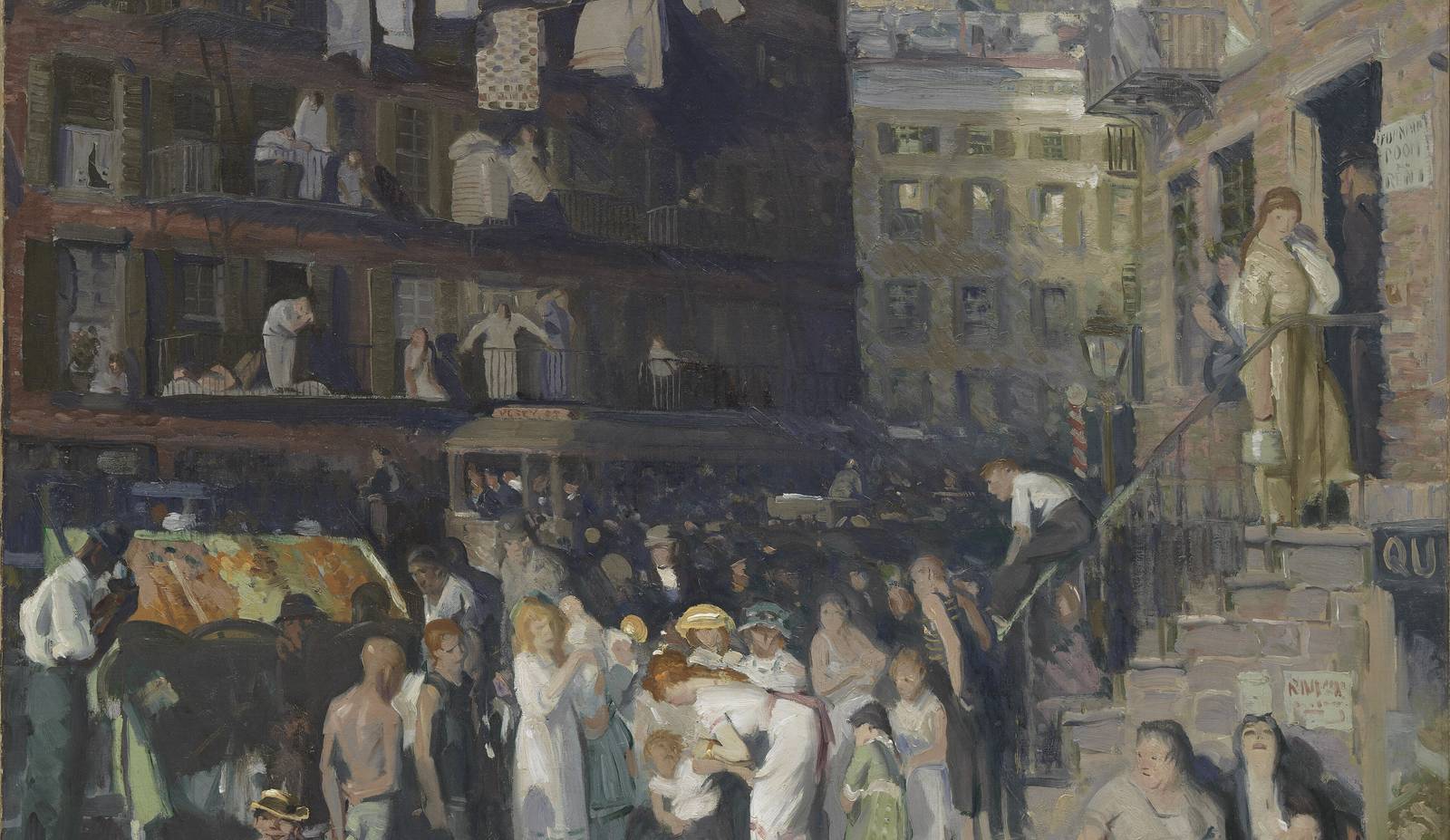
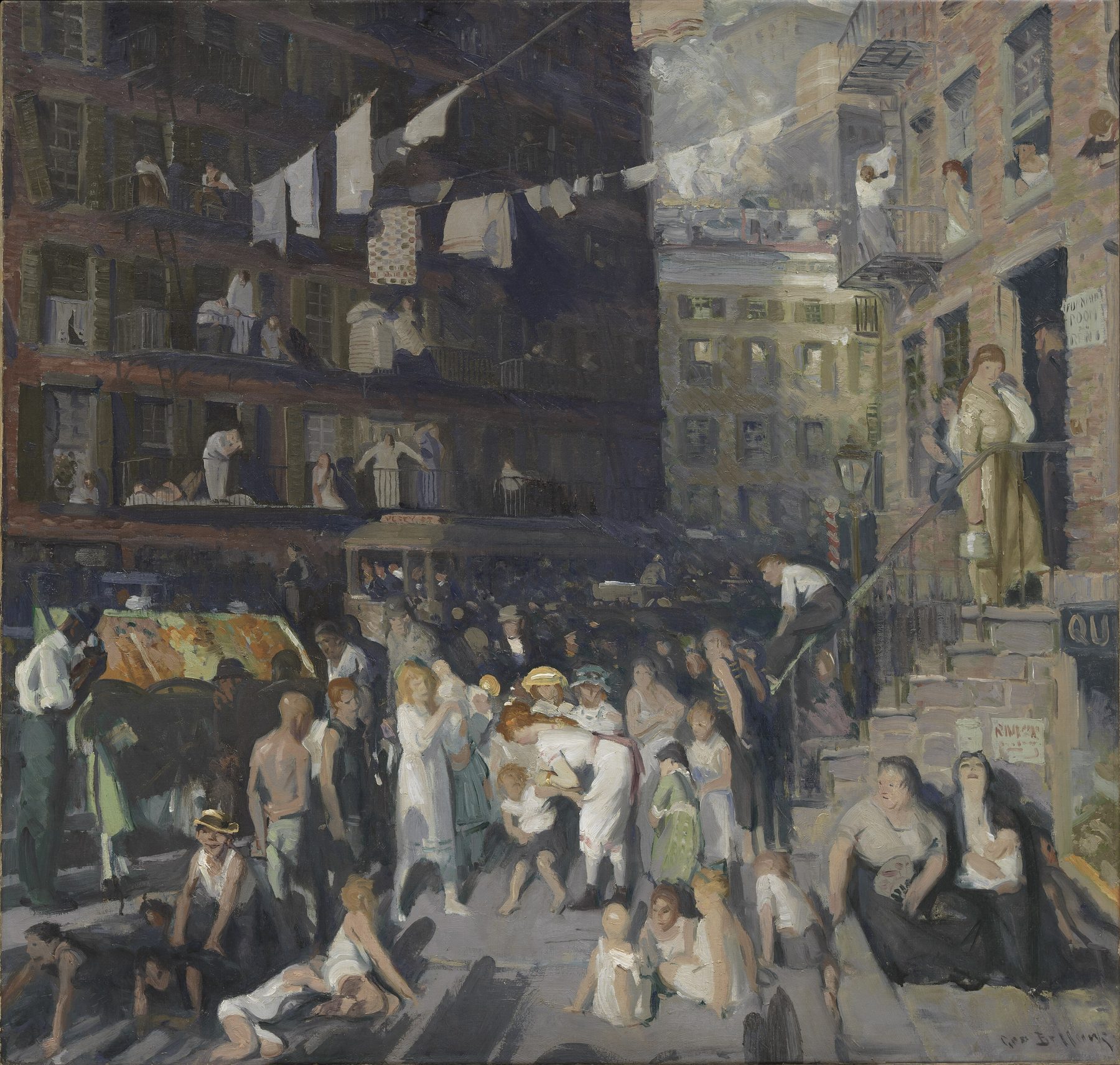
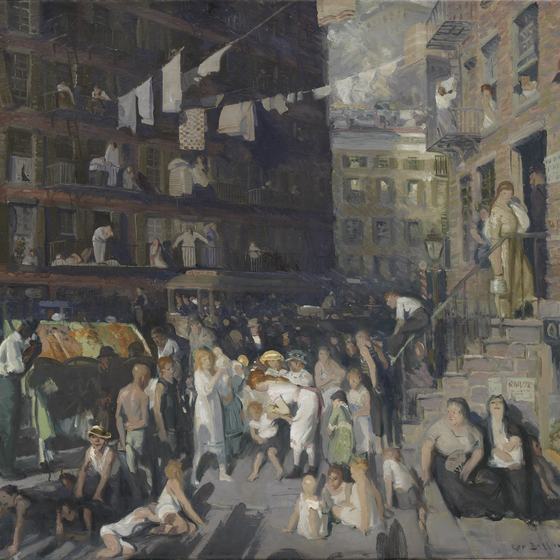
Image reference: George Bellows, Cliff Dwellers.
At a Glance
- Core periodc. 1865–1945, with earlier genre roots and later continuities
- Major centresPhiladelphia · New York · Chicago · regional centres across the United States
- Important strandspostwar realism · trompe-l’œil · Ashcan School · Hopper · Regionalism · Social Realism · documentary photography
- Known forcontemporary life · bodily specificity · city streets · work and leisure · ordinary objects · rural identity · social inequality
- Leading artistsHomer · Eakins · Henri · Sloan · Bellows · Hopper · Bishop · Wood · Motley · Lawrence
- Key contextsCivil War · Reconstruction · industrialisation · immigration · urban growth · Depression · New Deal · segregation · modernism
- Best understood asa changing argument about visibility and lived experience—not a neutral mirror or single style
Contents
- Where American Realism fits
- Civil War and Reconstruction
- Winslow Homer
- Thomas Eakins
- Objects, illusion and the Gilded Age
- The Ashcan circle and The Eight
- Edward Hopper
- Depression and Regionalism
- Black modern life
- Artists and places to know
Where American Realism fits
Winslow Homer
Principal careerThomas Eakins
Principal careerMary Cassatt
Principal careerHenry Ossawa Tanner
Principal careerRobert Henri
Principal careerJohn Sloan
Principal careerGeorge Bellows
Principal careerEdward Hopper
Principal careerIsabel Bishop
Principal careerGrant Wood
Principal careerDorothea Lange
Principal careerJacob Lawrence
Principal careerAmerican Realism was not a single movement with founders, rules or a common style. It is a broad name for artists who made recognisable people, objects and places carry the pressure of contemporary life in the United States. Their pictures range from Civil War camps and Philadelphia operating theatres to New York boxing clubs, Midwestern farms, segregated restaurants and migrant-worker settlements. Some were exacting in detail; others compressed bodies, exaggerated colour or simplified architecture. What made them realist was not a neutral mirror of appearances, but a sustained claim that art should engage the world its viewers inhabited.[1] [2] [3]
A practical central period runs from about 1865 to 1945. The end of the Civil War provides a structural beginning because conflict, emancipation and Reconstruction transformed ideas of national identity. The Second World War provides a useful ending because Abstract Expressionism soon acquired extraordinary critical authority, although representational art continued. Between those dates, several different realisms emerged: Winslow Homer and Thomas Eakins built postwar foundations; trompe-l’oeil painters made ordinary objects into perceptual puzzles; Ashcan artists turned streets and leisure into urban modernism; Edward Hopper reorganised everyday architecture; and artists of the Depression used Regionalism, Social Realism and documentary photography to debate who could represent America.[2] [18] [25]
Realism must not be confused with the absence of invention. Homer revised apparently spontaneous scenes over years. Eakins used anatomy, perspective and photographs to construct bodily knowledge. Ashcan artists selected incidents with the eye of newspaper illustrators. Hopper enlarged, emptied and recombined observed places. Dorothea Lange made photographs of real people, but framing, captioning, editing and government distribution shaped their meaning. Every realist work asks us to believe in its relationship to experience; none escapes mediation.[10] [26] [30] [47]
The history also turns on exclusion. Pictures once presented as universal American life often centred white, male or middle-class viewpoints. Black artists, women, immigrants and working people were not simply missing subjects waiting to enter an unchanged story. Their work altered the forms through which modern life could be known. Henry Ossawa Tanner, Isabel Bishop, Archibald Motley, Jacob Lawrence and Lange therefore belong to the movement’s structure, not an appendix. American Realism is most useful when it names an argument about visibility: who looks, who is looked at, and whose experience is permitted to stand for the nation.[35] [43] [44]
Realism in the United States has deeper roots than this page’s central chronology. Before the Civil War, genre painters such as William Sidney Mount represented courtship, politics, work and community through rural scenes designed for expanding public exhibitions. Their narratives could be comic or moralising, and they often translated national conflict into apparently manageable everyday encounters. Hudson River School painters likewise gave recognisable terrain symbolic force. These histories matter, but American Realism after 1865 developed within a nation changed by mass death, emancipation, industrial capitalism and faster image circulation.[3]
The word “realism” covers subject, method and attitude without guaranteeing agreement among them. A painting may describe surfaces minutely while idealising social order. Another may simplify visible detail but expose a convincing psychological or economic relation. Trompe-l’oeil makes the painted object almost physically present; Social Realism may distort bodies to sharpen political critique. Photography possesses a direct optical relation to what stood before the camera, yet a photograph can be staged, cropped or captioned towards a policy goal. The category is strongest when these differences remain visible.
American artists also worked internationally. Eakins trained in Paris and studied Spanish art; Homer visited France and worked in England and the Caribbean; Tanner made his career in France; John Singer Sargent and Mary Cassatt lived largely in Europe. French Realism, academic training, Impressionism, old master painting, Japanese prints and photography all contributed. “American” therefore identifies an evolving cultural debate, not stylistic isolation from Europe.[4] [50]
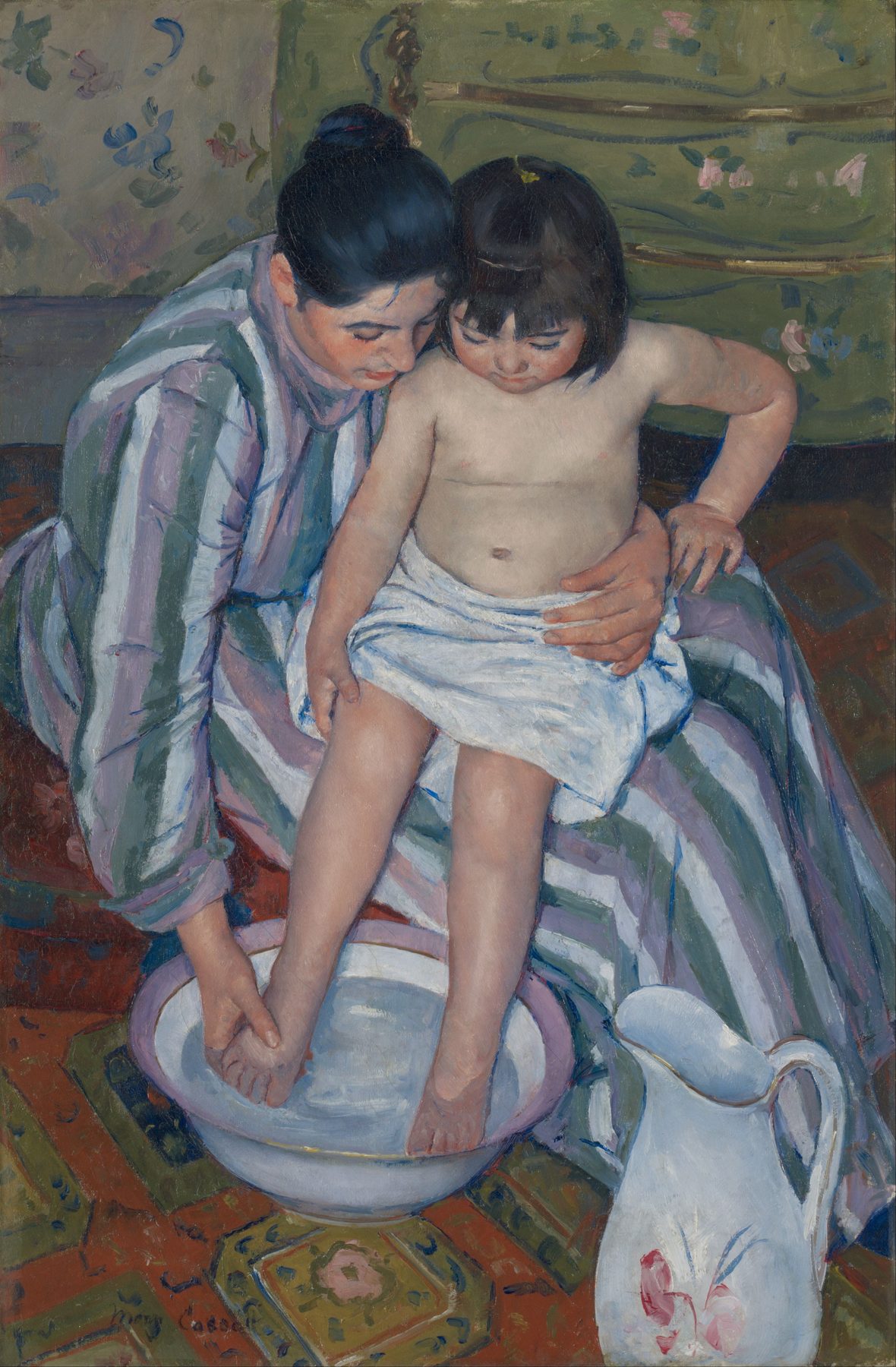
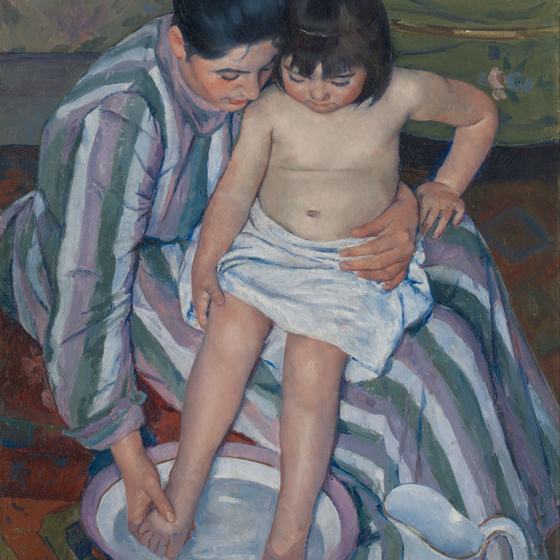
Realism and Impressionism overlapped especially between the 1880s and 1910s. Both made modern leisure, domestic interiors, city streets and countryside retreats newly important. Their artists shared portable media, quick-looking effects and transatlantic study. Cassatt’s intimate subjects are grounded in women’s daily experience but built with audacious colour and print design; Sargent’s portraits can be socially exact while painterly in execution. The boundary depends on the question being asked, not on a bright line between truth and light.[4] [23] [50]
Modernism did not eliminate this tradition. The 1913 Armory Show introduced a vast US audience to Cubism, Fauvism and other European avant-gardes, making Ashcan art appear conservative in formal terms. Yet realist artists exhibited there, adapted what they saw or deliberately maintained figuration. Hopper’s buildings are simultaneously ordinary structures and severe geometric arrangements. Lawrence’s historical sequences use flat colour and repeating shape. Recognisability and formal invention remained partners.[26] [31]
Civil War and Reconstruction
The Civil War created a crisis of representation. Traditional history painting could elevate generals and decisive events, but much of the conflict’s meaning entered art through landscapes, genre scenes, illustration and photography. Artists pictured encampments, damaged terrain, anxious homes and the bodies of the dead. These apparently secondary forms conveyed duration and consequence more readily than a single heroic climax.[13] [18]
Photography brought a new evidentiary force. Timothy O’Sullivan, Alexander Gardner and colleagues recorded bridges, camps, fortifications and corpses. The camera’s mechanical registration seemed to guarantee presence, yet the photographs were products of access, technology and sequence. Long exposures limited battle action; photographers chose vantage points and sometimes moved or rearranged what appeared. Prints reached audiences through albums and exhibitions, while published engravings could translate photographs into another medium. Civil War realism was already a chain of decisions.[13]
Emancipation made the meaning of victory inseparable from Black citizenship, but the visual record remained contested. Artists and publishers repeated stereotypes even as Black soldiers, freed families, voters and workers entered new public narratives. Reconstruction brought constitutional change alongside white violence and political retreat. Paintings could acknowledge new freedom, sentimentalise racial hierarchy or displace conflict into pastoral reconciliation. The apparently ordinary details of dress, gesture and exchange carried political weight.[15] [19]
The era also changed gendered representation. Women’s work, wartime absence and household survival became more visible. Postwar pictures often turned towards childhood and domestic reassurance, offering viewers images of continuity after grief. Rural scenes could appear timeless precisely when urbanisation and industrialisation were accelerating. Realism did not always confront disruption directly; sometimes it managed anxiety by choosing what seemed stable.[3]
This is why 1865 is a useful beginning rather than a declaration that realism suddenly appeared. The war forced artists to test whether familiar genres could still contain national experience. It also made clear that no one “American scene” was neutral. A harvested field could signify peace or death; a former soldier’s clothing could bring battle into agricultural labour; an image of children could be nostalgic and politically future-facing at once.
Winslow Homer
Winslow Homer began his professional career in commercial illustration. During the Civil War he travelled to Union encampments as a “special artist” for Harper’s Weekly, drawing soldiers drilling, resting, cooking and waiting. Those assignments trained him to identify a readable incident, clarify silhouettes and translate observation for mechanical reproduction. His earliest war paintings retained anecdotal elements, but later canvases used that visual knowledge to address conflict more obliquely and powerfully.[13] [14]
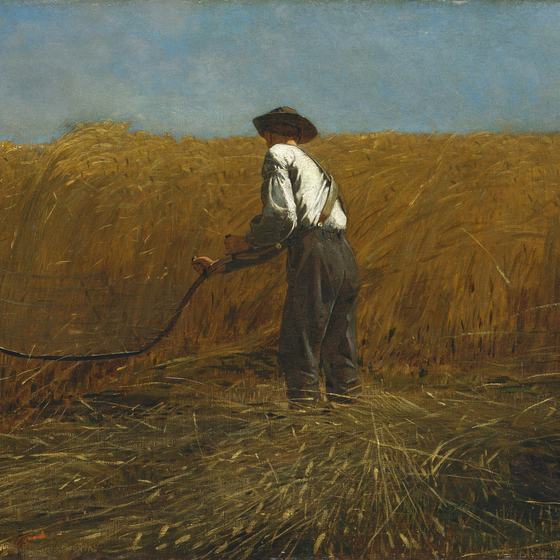
The Veteran in a New Field, painted in 1865, shows a man from behind cutting wheat beneath a broad sky. His discarded Union jacket and canteen lie in the corner. The title converts agricultural ground into a recollection of battlefields, while the scythe joins harvest to the ancient image of death. Wheat promises food, seasonal return and civilian productivity; its repeated stalks can also evoke the numberless fallen. The veteran’s hidden face makes him both individual labourer and representative survivor.[16]
The painting is persuasive because Homer does not illustrate a speech about reunion. He concentrates on light, muscular rhythm and material signs. The man has returned to work, but the field cannot become innocent again. Peace and mourning occupy the same action. This doubleness became fundamental to postwar realism: a contemporary object could hold public history without abandoning everyday life.[16] [18]
Homer’s celebrated Prisoners from the Front of 1866 also turns a military encounter into a study of bodies and social types. Confederate prisoners face a Union officer across a shallow interval. Uniform, posture, age and bearing differentiate them, but no melodramatic violence occurs. The picture’s apparent specificity was carefully synthesised rather than copied from one witnessed event. Its credibility depends upon selected details organised into an emblem of victory and possible reconciliation.[14]
During Reconstruction, Homer represented Black life in Virginia and later in the Caribbean. Current scholarship has asked how these works register newly claimed freedom while remaining shaped by the gaze of a white Northern artist and by the racial language of their period. In A Visit from the Old Mistress, formerly enslaved women meet the woman who once owned them across an uncomfortable interior. The tense line of bodies refuses easy reconciliation. Other pictures can be more ambiguous or paternalistic. Close attention must hold dignity, observation and unequal representation together.[15] [19]
Homer’s peacetime subjects were not a retreat from history. Children, schools, courtship, farm work and seaside leisure addressed a nation imagining its future. Breezing Up (A Fair Wind), completed in the Centennial year 1876, shows an older sailor and boys guiding a small boat through lively water. The open horizon and swelling sail encouraged readings of confidence and renewal after war. Yet Homer worked on the painting for roughly three years, revising positions and design. Its brilliant immediacy is the result of prolonged construction.[17]
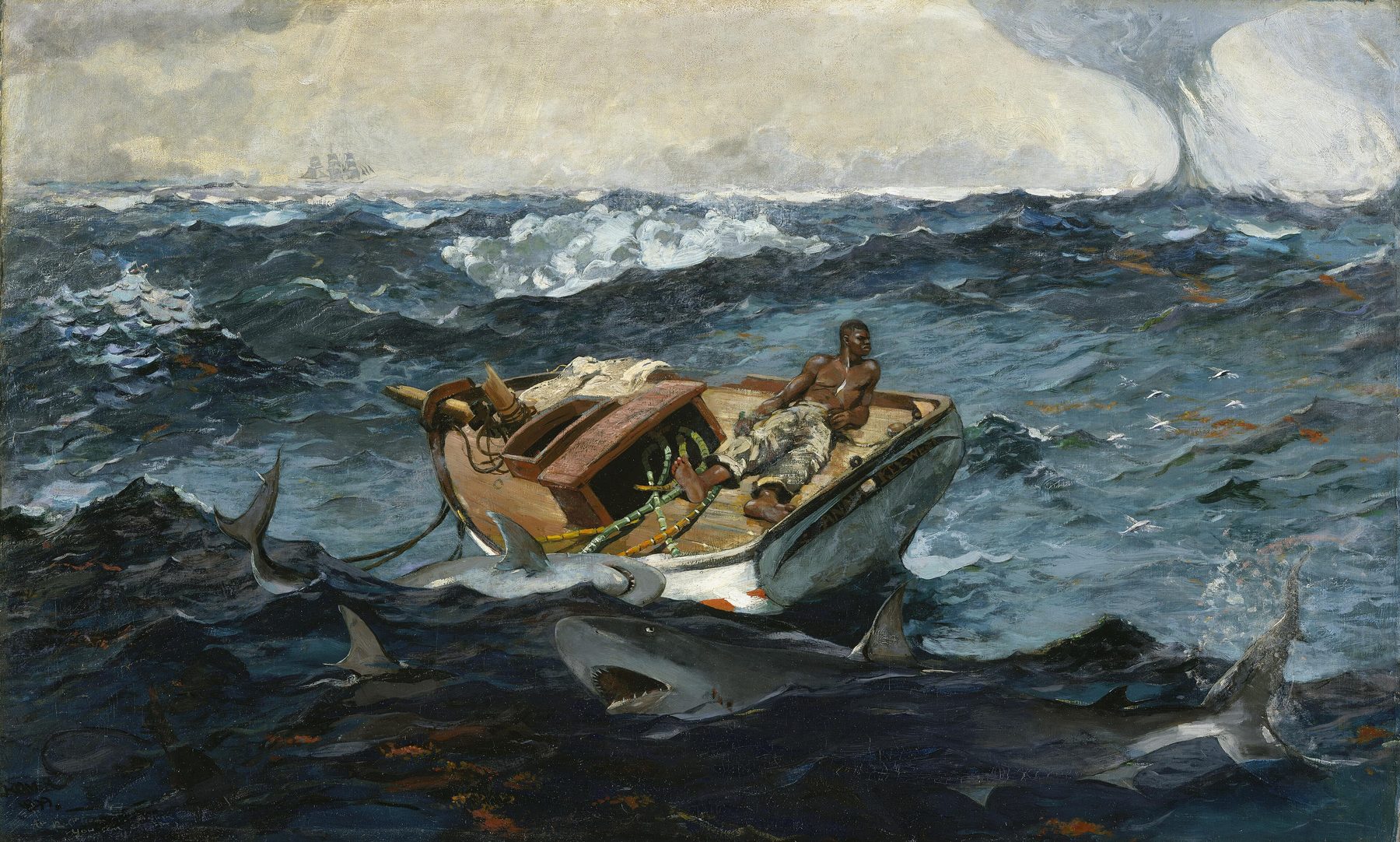
The lesson applies throughout his career. Homer’s watercolours can look rapidly taken from life, but their spare forms depend on judgement about paper, reserve and transparent wash. His later Maine seas magnify the relation between human survival and indifferent force. In The Gulf Stream, a Black sailor lies on a damaged boat surrounded by waves and sharks; distant rescue remains uncertain. Caribbean colour, imperial history, racial vulnerability and marine spectacle converge. A “real” sea becomes an arena of historical power.[15]
Homer’s realism is therefore neither photographic detail nor plain American honesty. It is selective compression. Illustration taught him public legibility; travel expanded his subjects; repeated revision made apparently simple structures resonant. He could turn a uniform, sail, schoolroom bench or wave into the point where private action meets national memory.
Thomas Eakins and bodily knowledge
Thomas Eakins made the human body the centre of an exacting Philadelphia realism. He studied at the Pennsylvania Academy of the Fine Arts, attended anatomy lectures at Jefferson Medical College and trained in Paris under Jean-Léon Gérôme. A period in Spain deepened his admiration for Velázquez and Ribera. When he returned home in 1870, he chose local athletes, surgeons, musicians, teachers and friends rather than pursue an expatriate career.[10] [12]
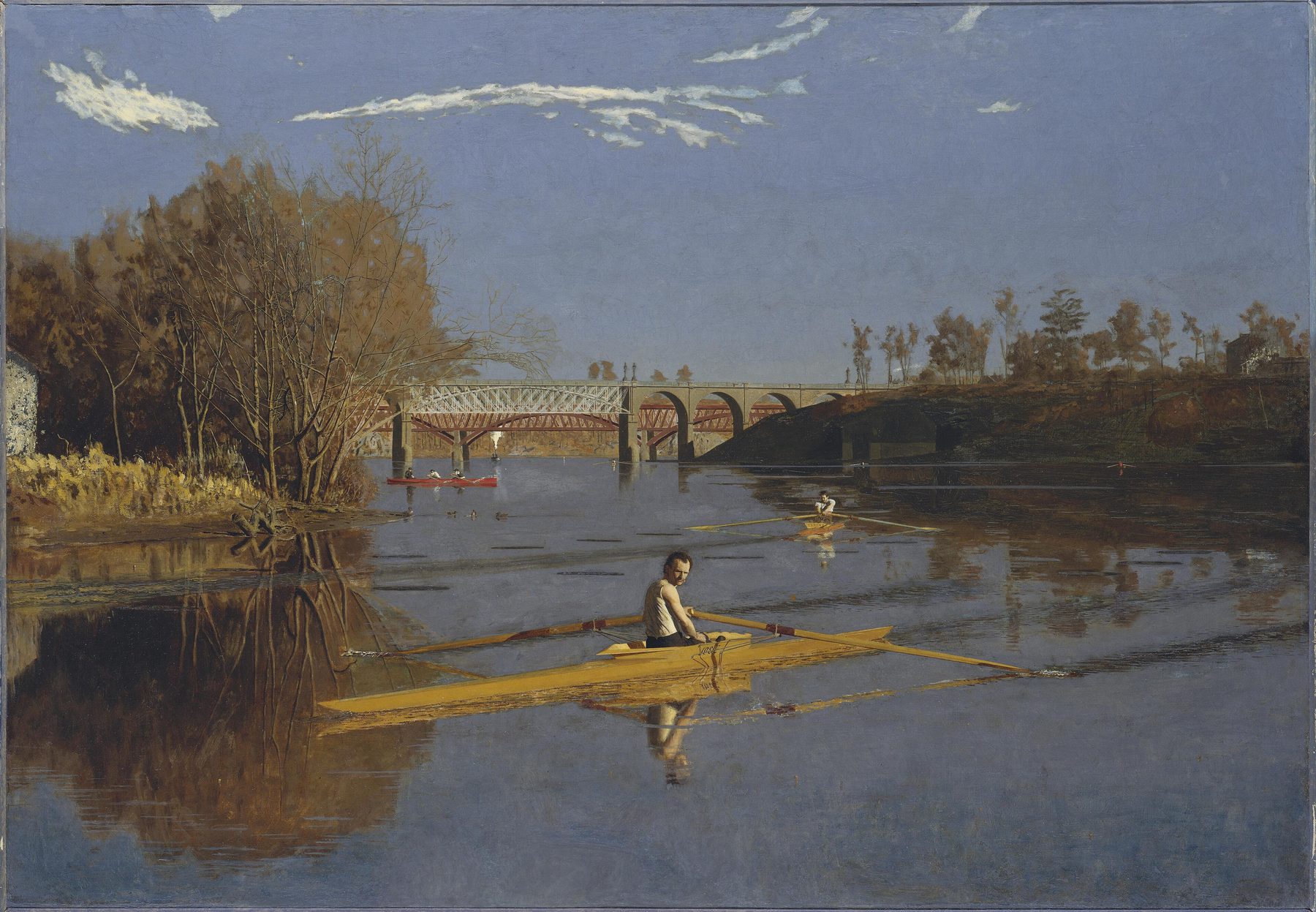
Rowing supplied an ideal early subject. The Schuylkill River was a modern leisure and sporting environment, and a shell moving through water demanded knowledge of anatomy, perspective and reflected light. In The Champion Single Sculls, Eakins depicts his friend Max Schmitt resting between strokes while the artist rows in the middle distance. Oars, shoreline and boat create a measured geometry, but the picture does not feel like a diagram. Technical order gives a fleeting athletic action credibility.
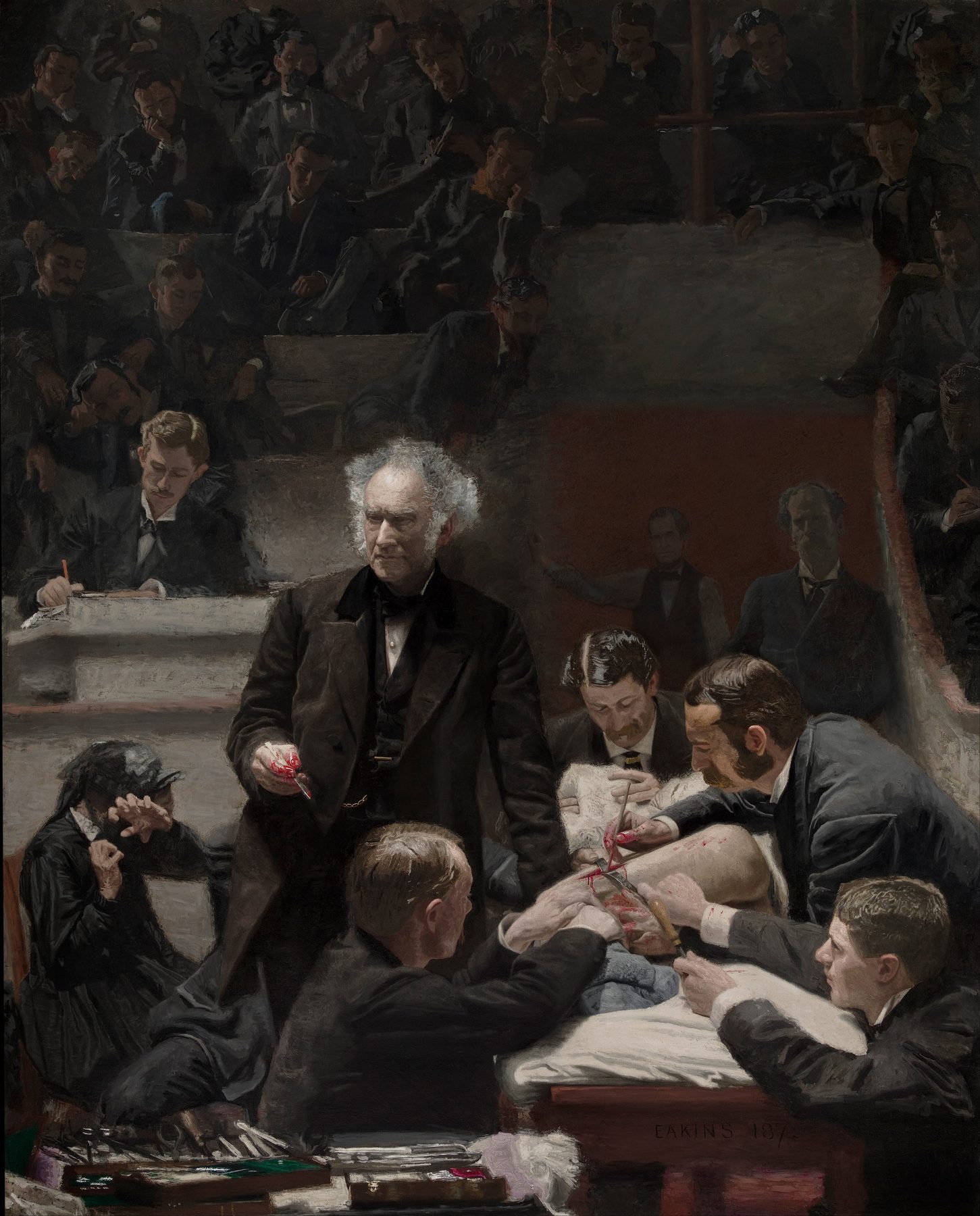
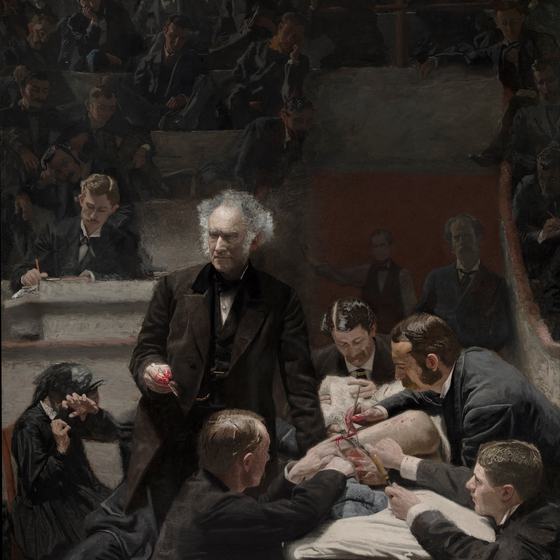
Eakins’s ambition reached a public test in The Gross Clinic of 1875. Dr Samuel Gross stands in a surgical amphitheatre, bloody scalpel in hand, directing an operation on a patient whose exposed body is partly obscured by assistants. Students rise in dark tiers; a recoiling woman brings private distress into the professional arena. The painting was intended for the Philadelphia Centennial exhibition, where it could proclaim the city’s medical modernity and Eakins’s ability. The art jury rejected it from the main display, probably because the subject and blood seemed too brutal. Critics divided between admiration for its composition and revulsion at its “ugly” realism.[10] [11]
The work is not simply a photographically accurate operation. Eakins controls visibility. Gross’s head and stained hand emerge against black clothing; the patient becomes the bright horizontal centre but remains anonymous; the mother’s curved body counters the surgeon’s vertical authority. Viewers occupy the students’ side of the amphitheatre, made spectators to knowledge and vulnerability. Realism here creates an ethical discomfort: professional mastery depends upon an opened body.
Photography became part of Eakins’s method and teaching. He and his circle made sequences of athletes, studies of nude models and images used to investigate movement. He sometimes projected photographs and incised reference points into paint. This practice did not remove drawing or design. It allowed him to test proportion, isolate phases of action and build a picture from several kinds of evidence. A photograph was a working instrument, not a command to copy.[10] [12]
His commitment to nude study challenged conventions at the Pennsylvania Academy, where he became director. Eakins advocated anatomical understanding and greater access for women students, but his own authority could disregard boundaries. In 1886 he removed a loincloth from a male model before a mixed class during an anatomy lecture. Protests forced his resignation. The episode should not be simplified into a modern genius persecuted by prudery. It reveals a collision between reform, institutional power, gendered respectability and consent.[12]
Eakins later concentrated on portraits, often of sitters he knew rather than paying patrons. Their dark settings and extended stillness resist flattering display. Hands, posture and the direction of attention may reveal intellectual labour more strongly than facial likeness. Sitters did not always appreciate the melancholy or severity he found. His realism was investigative, but investigation could feel invasive.
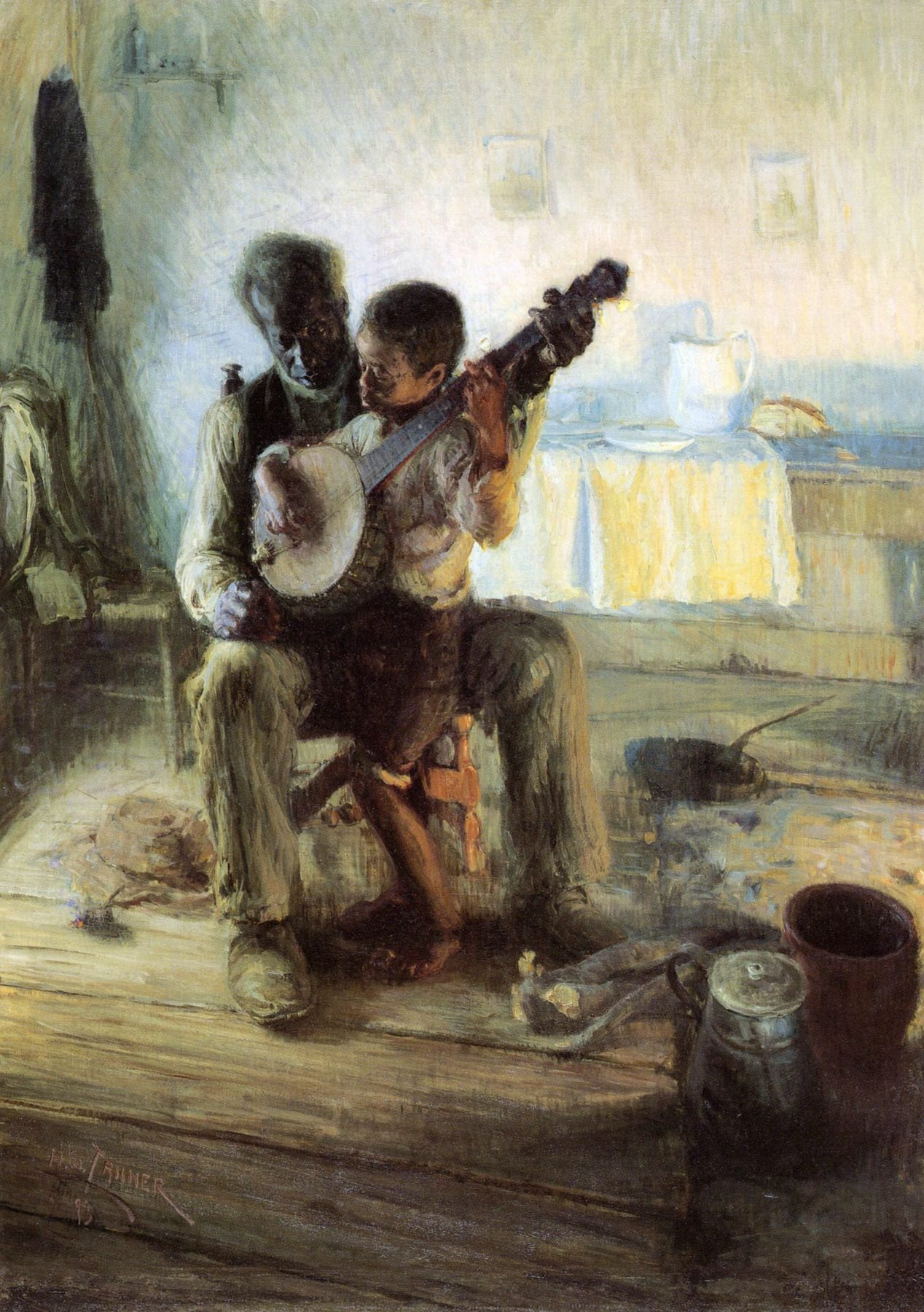
Henry Ossawa Tanner carried Eakins’s influence into a career shaped by racism and expatriation. Tanner studied at the Pennsylvania Academy as its only Black student among a largely white body, and Eakins encouraged his work. In The Banjo Lesson, an older Black man guides a child’s hands on an instrument. The painting rejects the minstrel stereotype of the banjo by turning music into intimate intergenerational knowledge. Tanner moved to France, where he found greater professional possibility, and became internationally renowned for religious works that joined observation, academic modelling and spiritual light.[49]
Tanner’s place in American Realism exposes the limits of national categories. He remained an American artist while living mainly abroad because overt discrimination constrained his life at home. His biblical paintings do not cease to be realist because they pursue transcendence; bodies, rooms and illumination make sacred experience humanly present. His career also shows that formal lineage alone cannot explain who inherited Eakins’s Philadelphia realism. Institutions distributed opportunity unequally.
Essential works
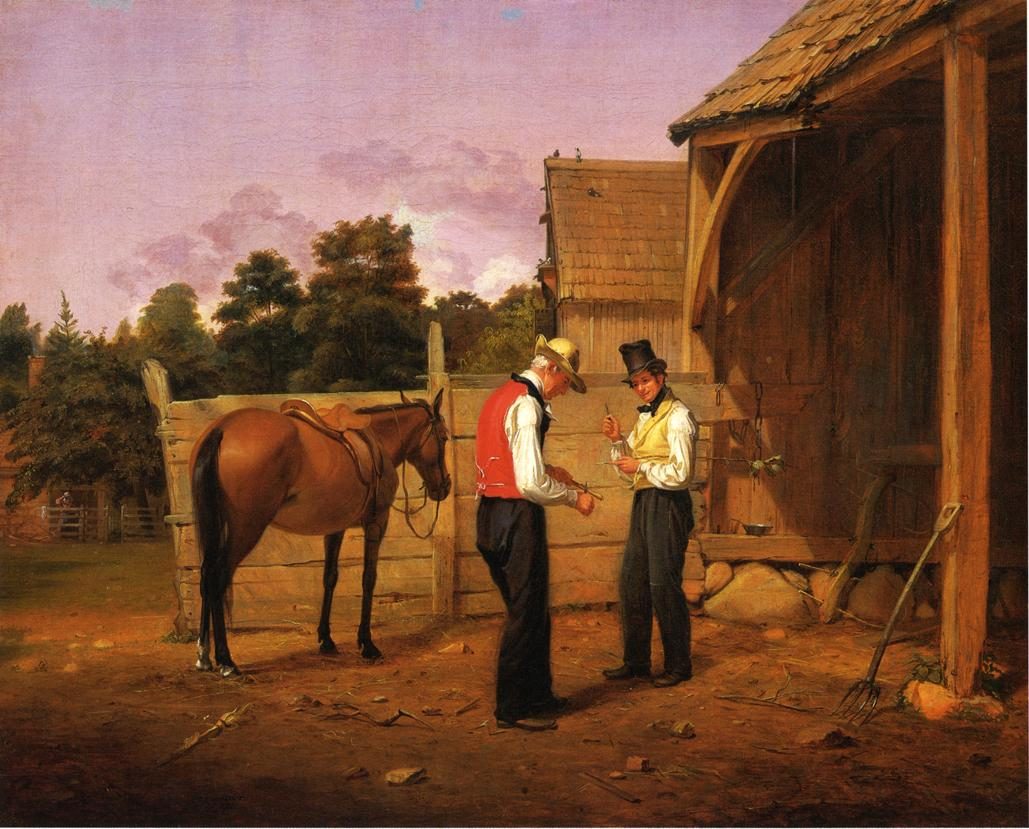
Bargaining for a Horse
William Sidney Mount, 1835
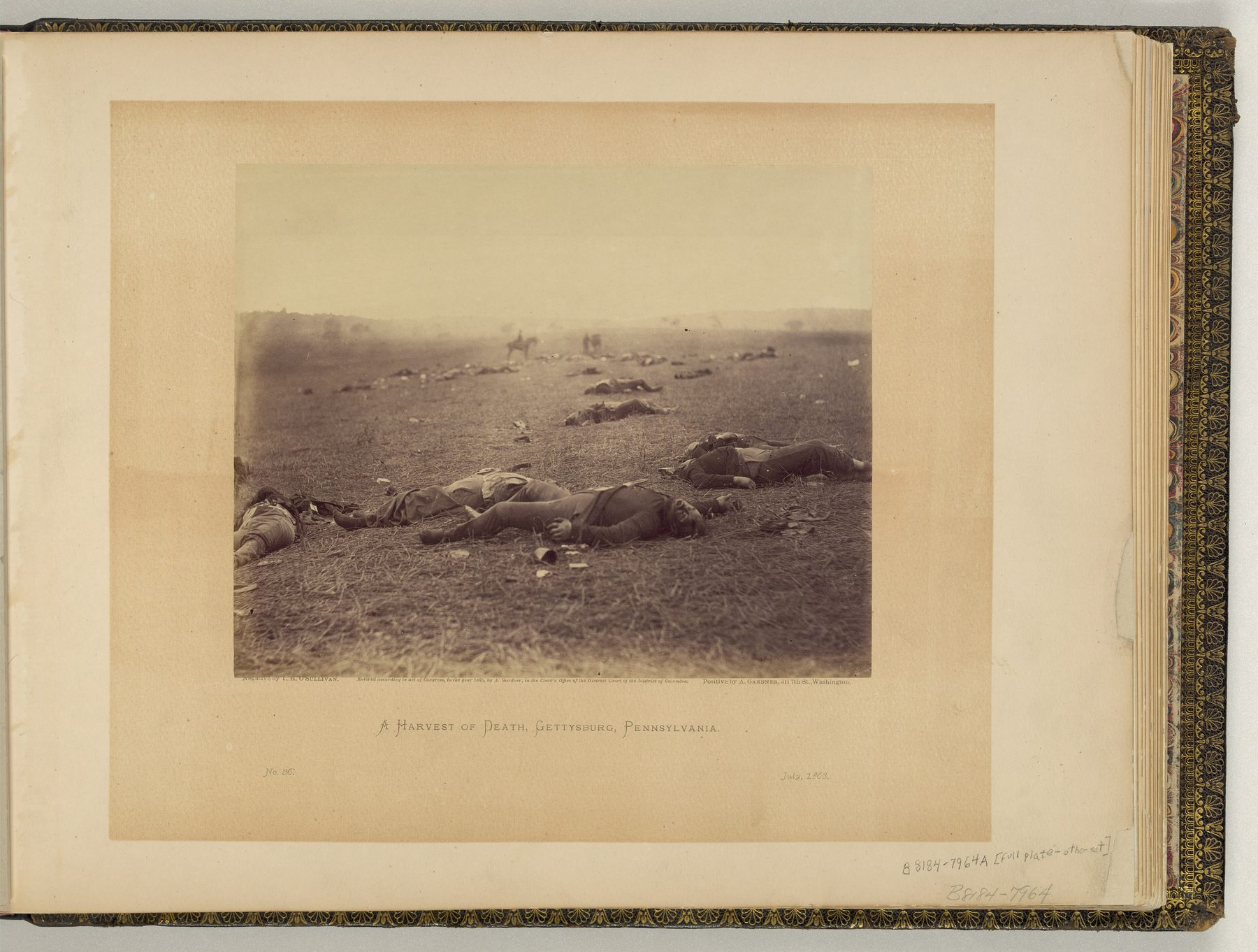
A Harvest of Death
Timothy H. O’Sullivan and Alexander Gardner, 1863
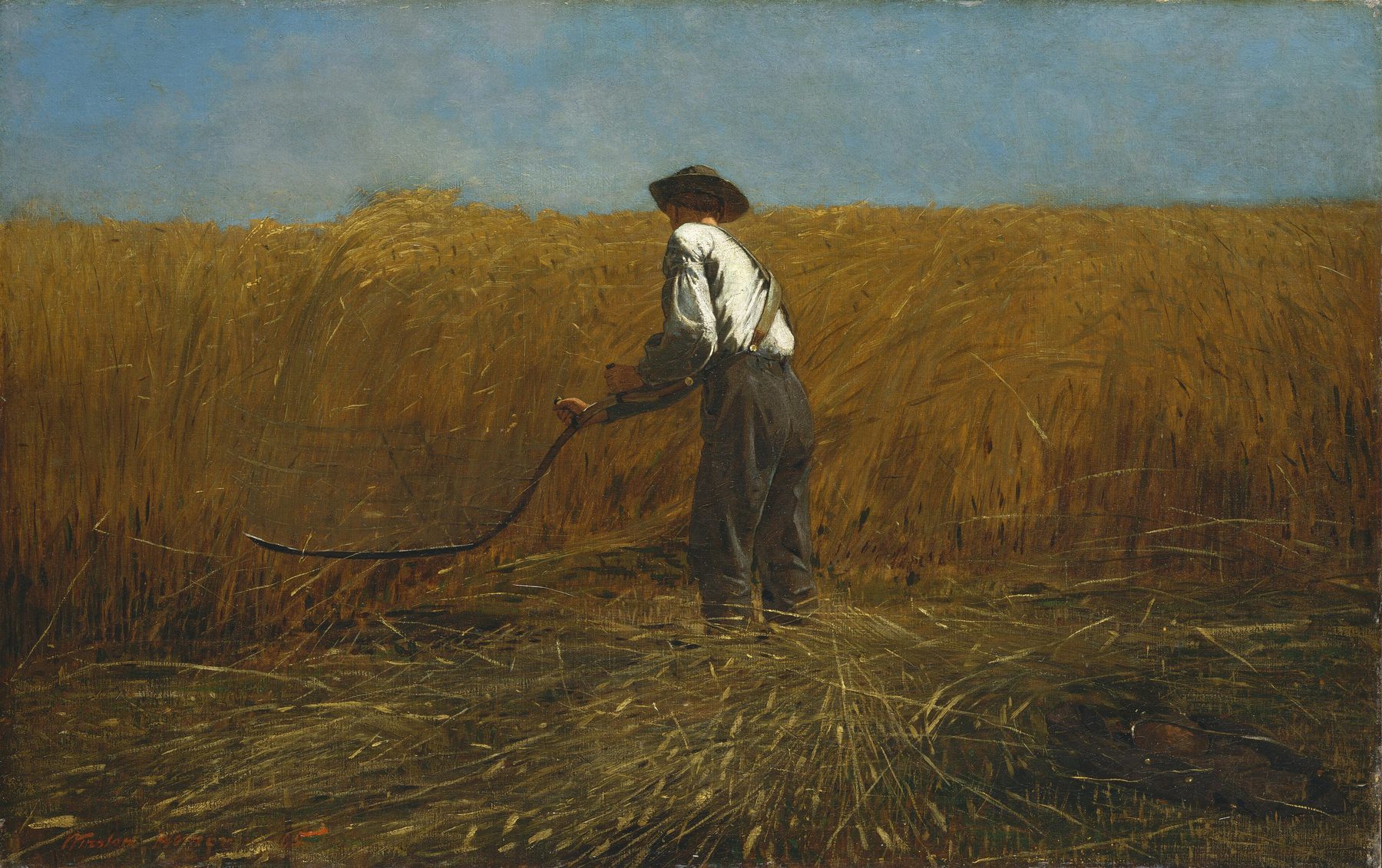
The Veteran in a New Field
Winslow Homer, 1865
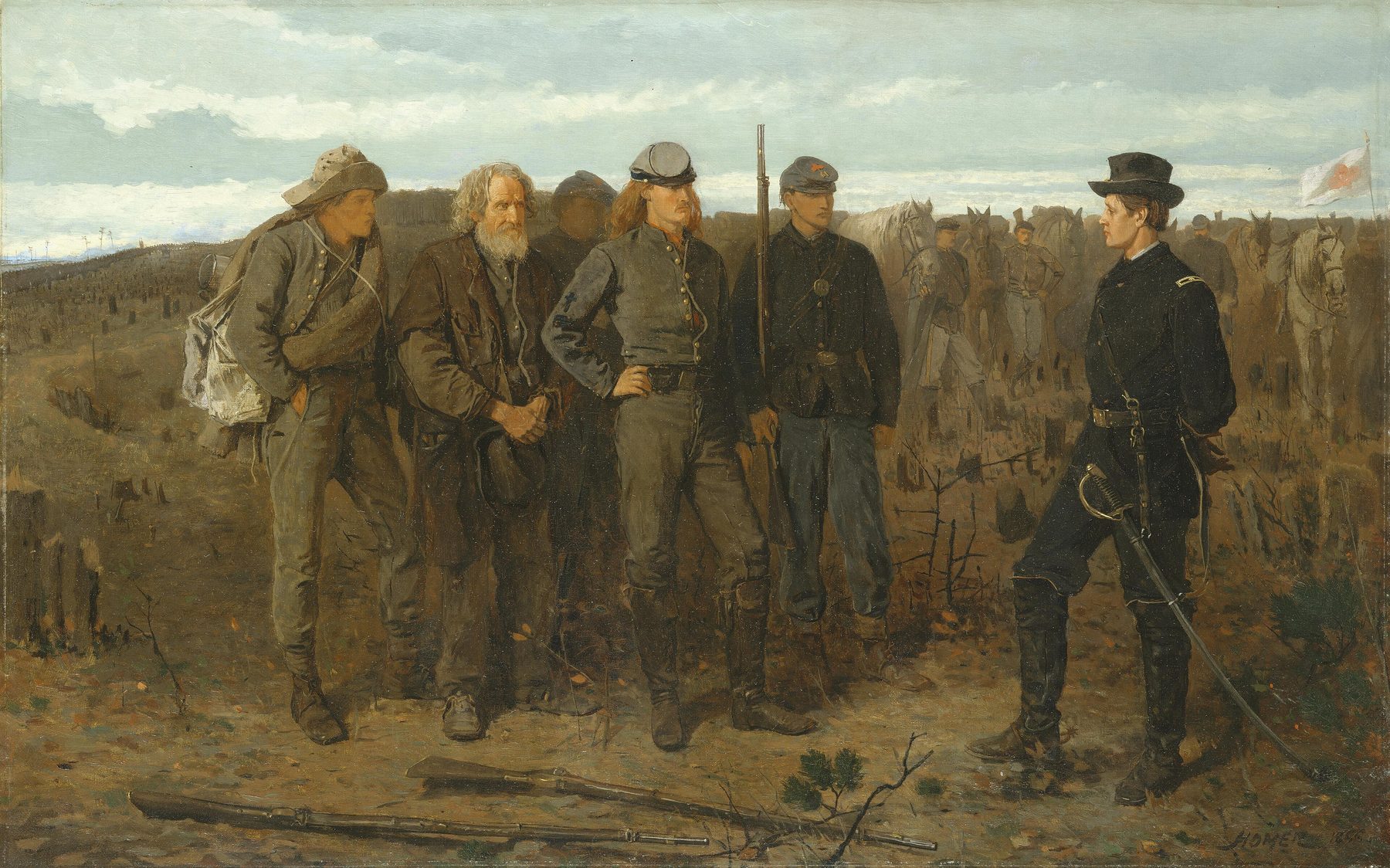
Prisoners from the Front
Winslow Homer, 1866
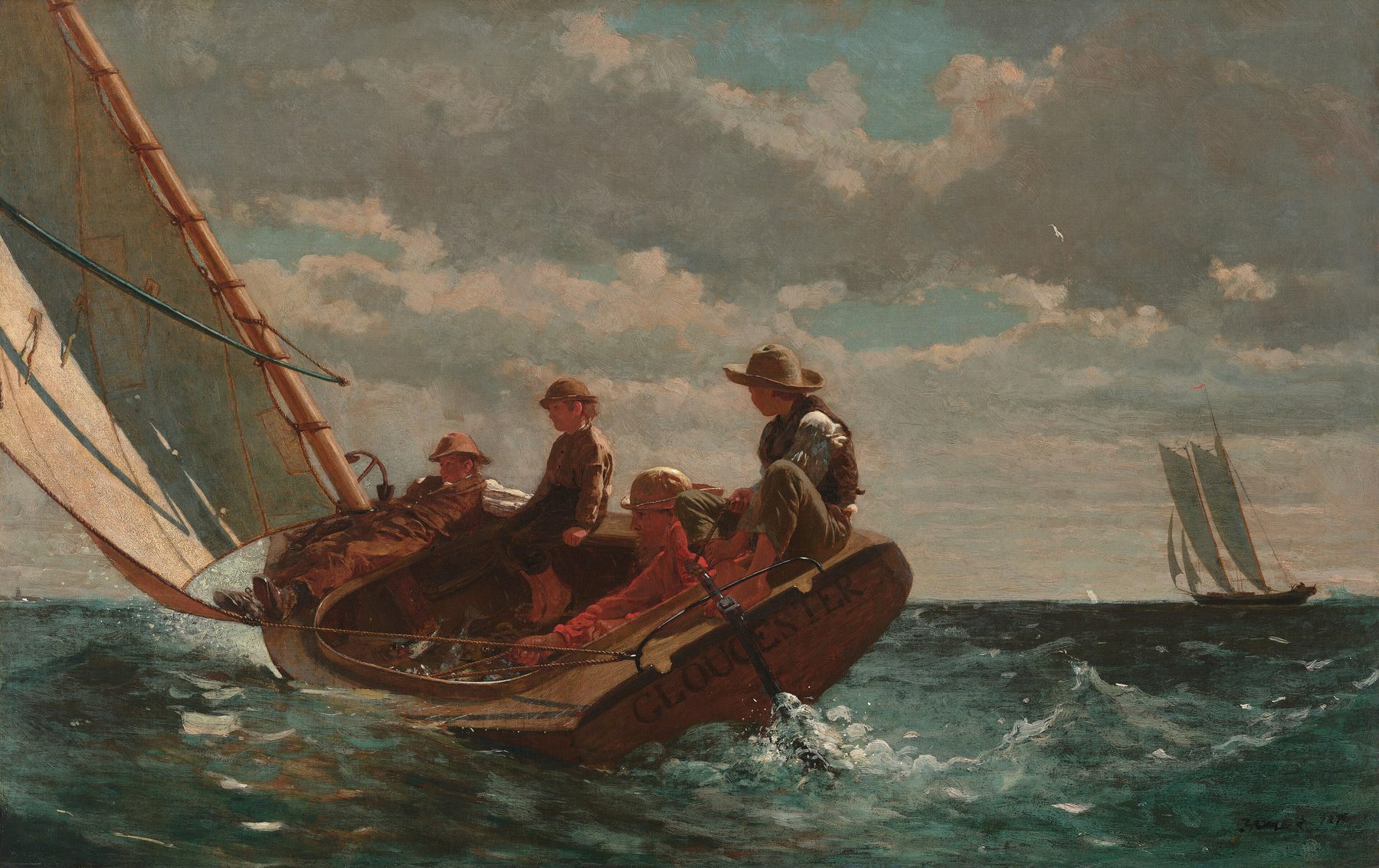
Breezing Up (A Fair Wind)
Winslow Homer, 1873–76
Objects, illusion and the Gilded Age
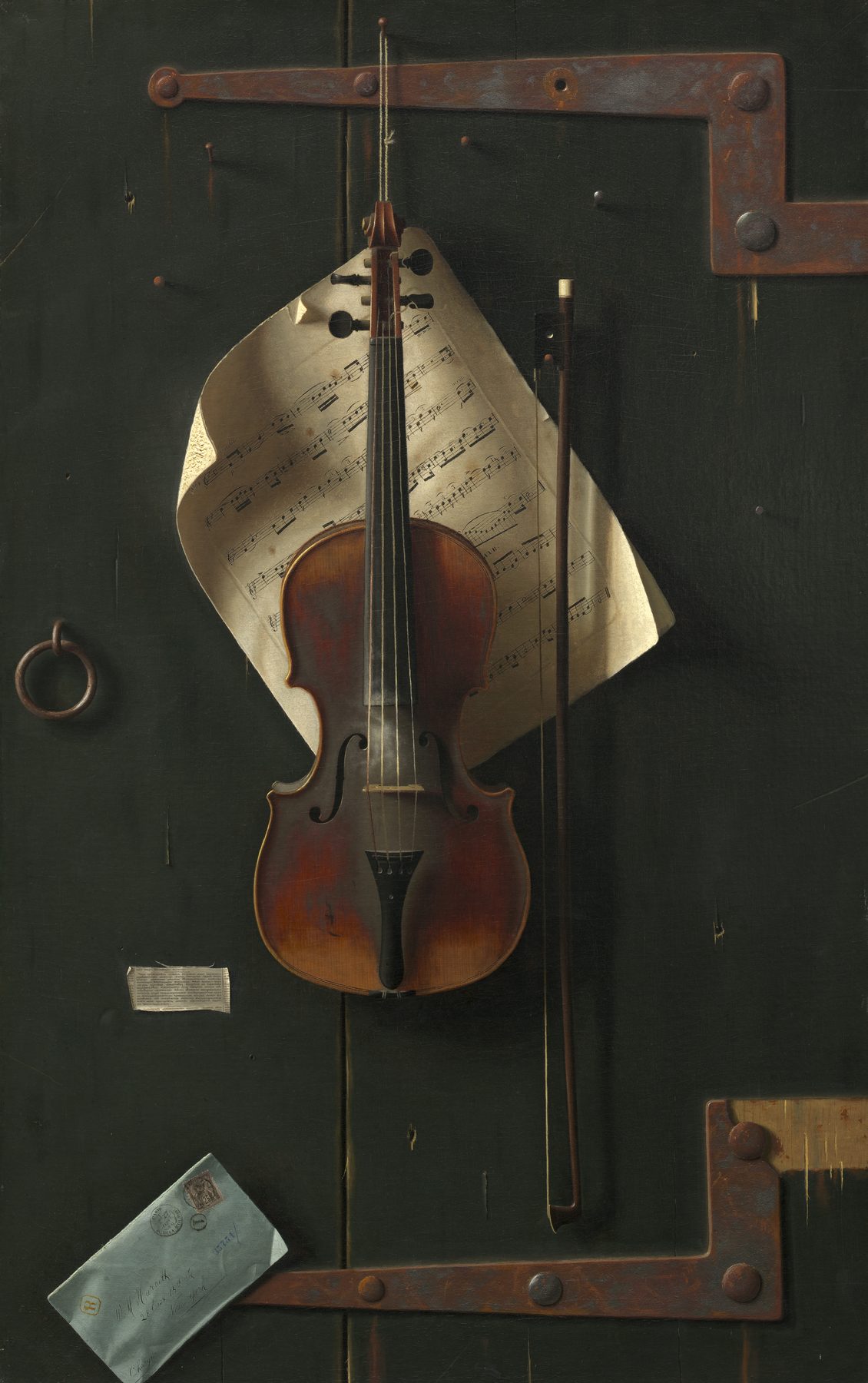
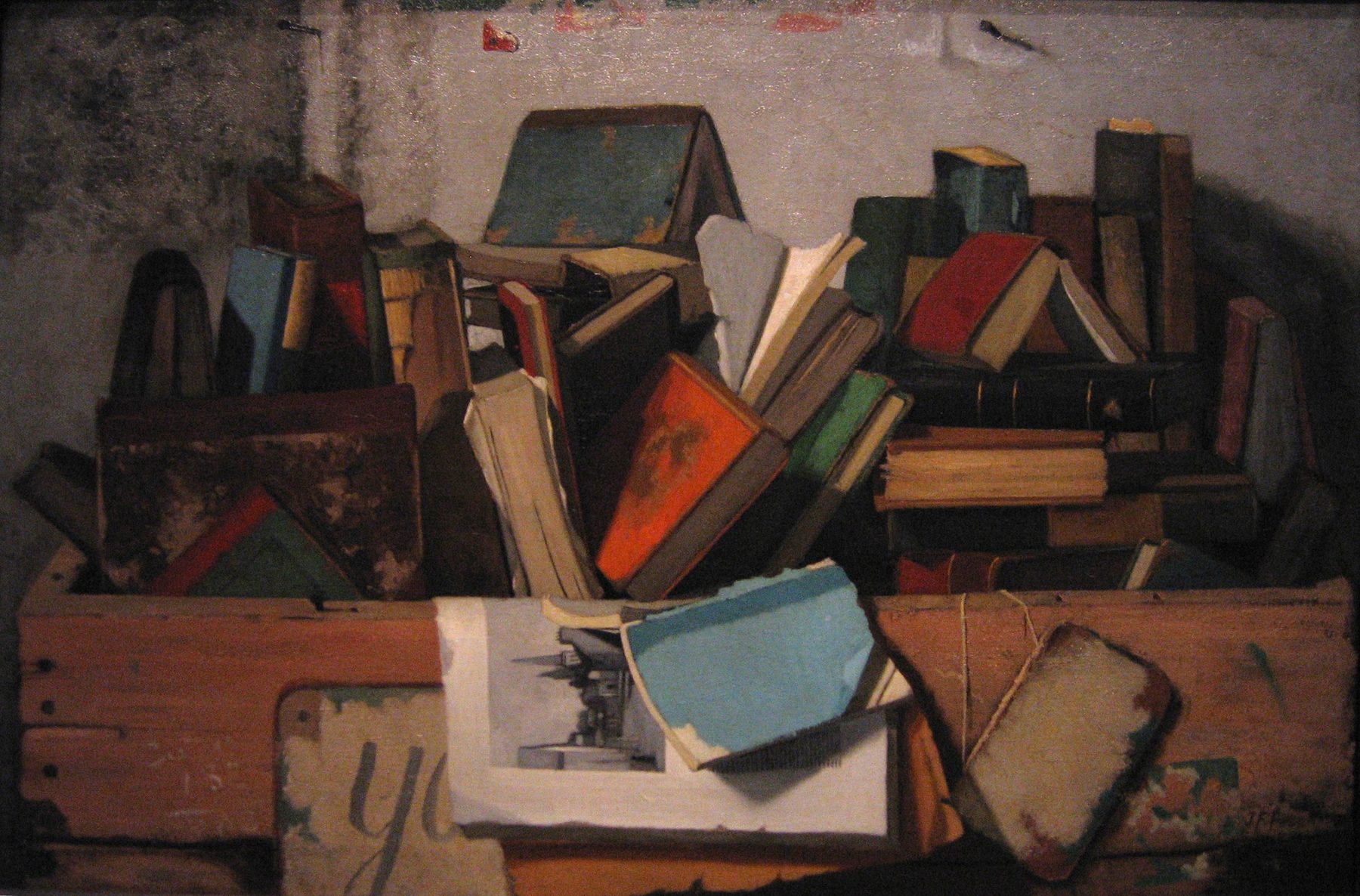
Late nineteenth-century realism was not limited to bodies and outdoor life. William Michael Harnett and John Frederick Peto made still-life painting into a theatre of perception. Their trompe-l’oeil works depict violins, currency, books, letters, pipes and worn paper at or near life size. The French phrase means “deceive the eye”, but the pleasure is not permanent confusion. Viewers move between believing an object is present and admiring the painted labour that produced the deception.[20] [22]
Harnett’s The Old Violin places a violin and bow against a wooden door, with sheet music and a small hinge adding layers of texture. Wood, paper, metal and taut string appear materially distinct. The restrained palette and suspended objects slow looking until minor abrasions become events. Such paintings appealed beyond academic audiences, including businessmen and saloon patrons, even when connoisseurs dismissed illusion as mere imitation. Their success belongs to a Gilded Age culture preoccupied with commodities, authenticity and display.[20]
The work also frustrates touch. A painted hinge will never open and the violin cannot sound. The more fully the picture resembles an object, the more firmly it declares its flat, inaccessible surface. Trompe-l’oeil is realist and self-conscious at once. It asks what kind of truth a skilful counterfeit can deliver in a society filled with circulating goods, paper claims and new forms of advertising.
Peto painted related rack pictures and instruments but developed a different emotional register. In Old Souvenirs, faded papers, a photograph and personal fragments gather on a worn board. Edges blur, inscriptions lose legibility and objects seem to decay into paint. Where Harnett often perfects a polished demonstration, Peto turns possession into memory. His realism concerns the afterlife of use as much as optical exactitude.[21] [22]
For decades, some Peto paintings bore false Harnett signatures and circulated under the more marketable name. Attribution research eventually reconstructed Peto’s achievement. This history belongs inside the work’s meaning. A realist picture may appear to offer uniquely identifiable objects, yet the identity of its own maker can be overwritten by dealers and reputation. Connoisseurship, provenance and price help determine which reality the public sees.[21]
The larger Gilded Age art world was likewise changing. Museums, art schools, commercial galleries and collectors expanded. Drawing, watercolor and pastel gained professional status alongside oil painting. Artists moved between illustration, portrait commissions, exhibitions and teaching. Economic inequality grew even as new institutions made art more publicly visible. Realism could scrutinise work and material life, but it could also serve elite portraiture and luxurious consumption.[23] [24]
Everyday life and American Impressionism
From the 1880s, American painters working at home and abroad made contemporary experience through increasingly varied techniques. City parks, beaches, rail travel, domestic rooms and suburban retreats entered both realist and Impressionist pictures. Pastel offered a luminous, immediate surface; watercolor travelled easily; etching could circulate intimate observations. The choice of medium helped define what counted as modern life.[4] [23]
American Impressionists emphasised broken colour and changing light, but they did not abandon social specificity. Cassatt’s women read, attend the theatre, wash, sew and care for children within carefully designed spaces. Sargent’s portrait brushwork can seem dazzlingly free while describing costume, confidence and rank with ruthless precision. Conversely, Eakins’s controlled surfaces or an Ashcan painter’s dark palette do not guarantee greater access to reality. Realism and Impressionism are overlapping modes, not moral alternatives.[4] [50]
Gender shaped access to subjects. Women artists faced restrictions on training, movement through public space and life drawing. Cassatt made domestic and cultural environments formally ambitious rather than treating them as lesser themes. Cecilia Beaux used portraiture to claim intellectual and professional authority. Their work broadens realism beyond the masculine arenas of surgery, rowing and saloons without implying that home life was socially neutral.
By 1910, critics contrasted genteel Impressionist leisure with the rougher city subjects of the Ashcan circle. The contrast contains some truth but can become a caricature. Ashcan artists also painted parks, theatre and recreation; American Impressionists recorded factories and urban architecture. The more useful difference lies in exhibition politics, graphic habits and the Ashcan commitment to subjects that conservative juries considered coarse.[5] [50]
The Ashcan circle and The Eight
The central Ashcan network formed in Philadelphia around Robert Henri and four newspaper illustrators: John Sloan, William Glackens, George Luks and Everett Shinn. Henri encouraged them to paint the life immediately around them and became an influential teacher. By the first years of the twentieth century they had all moved to New York, where crowded streets, elevated trains, tenements, theatres and working-class leisure offered an expanding field.[5] [6]
“Ashcan School” was not the name of a formal association. The term gained currency later and compressed varied careers into a convenient urban-realist group. Henri painted forceful portraits; Glackens developed brighter colour and leisure scenes; Shinn favoured theatrical interiors; Luks and Sloan differed sharply in handling and politics. George Bellows, Henri’s student, is often treated as a second-generation member even though he did not participate in the foundational exhibition of The Eight.[5] [8]
The Eight itself was not identical to Ashcan. Henri organised its 1908 show at Macbeth Gallery after conservative jury decisions excluded work by his colleagues. The exhibitors included the five central urban realists but also Arthur B. Davies, Ernest Lawson and Maurice Prendergast, whose approaches were very different. What united them was resistance to institutional control, not a shared palette or subject. Their exhibition demonstrated that organisational independence could be modern even when styles diverged.[5] [32]
Henri pushed the principle further in the 1910 Exhibition of Independent Artists, organised under “no jury, no prizes”. That formulation challenged academies’ power to determine quality and access. It did not eliminate the market or social networks; independent shows still required money, space, publicity and selection. But the politics of display became part of American Realism’s history. A contemporary subject needed a route to a contemporary public.[6]
Journalism shaped this route. Newspaper artists learned to observe quickly, isolate gesture and make dense incidents legible for reproduction. Their paintings are not enlarged news reports: colour, memory and studio revision transformed the initial encounter. Still, cropping and emphasis can retain the pressure of a passing scene. The ordinary city became newsworthy enough for art.[7] [33]
City looking and George Bellows
Ashcan New York was a city seen through movement. Pedestrians cross, elevated railways divide streets and entertainment crowds spill towards the frame. Windows create stages: someone in a lit room can be visible to neighbours without knowing it, while a shop display turns looking into consumption. These pictures ask how urban proximity produces both intimacy and anonymity.
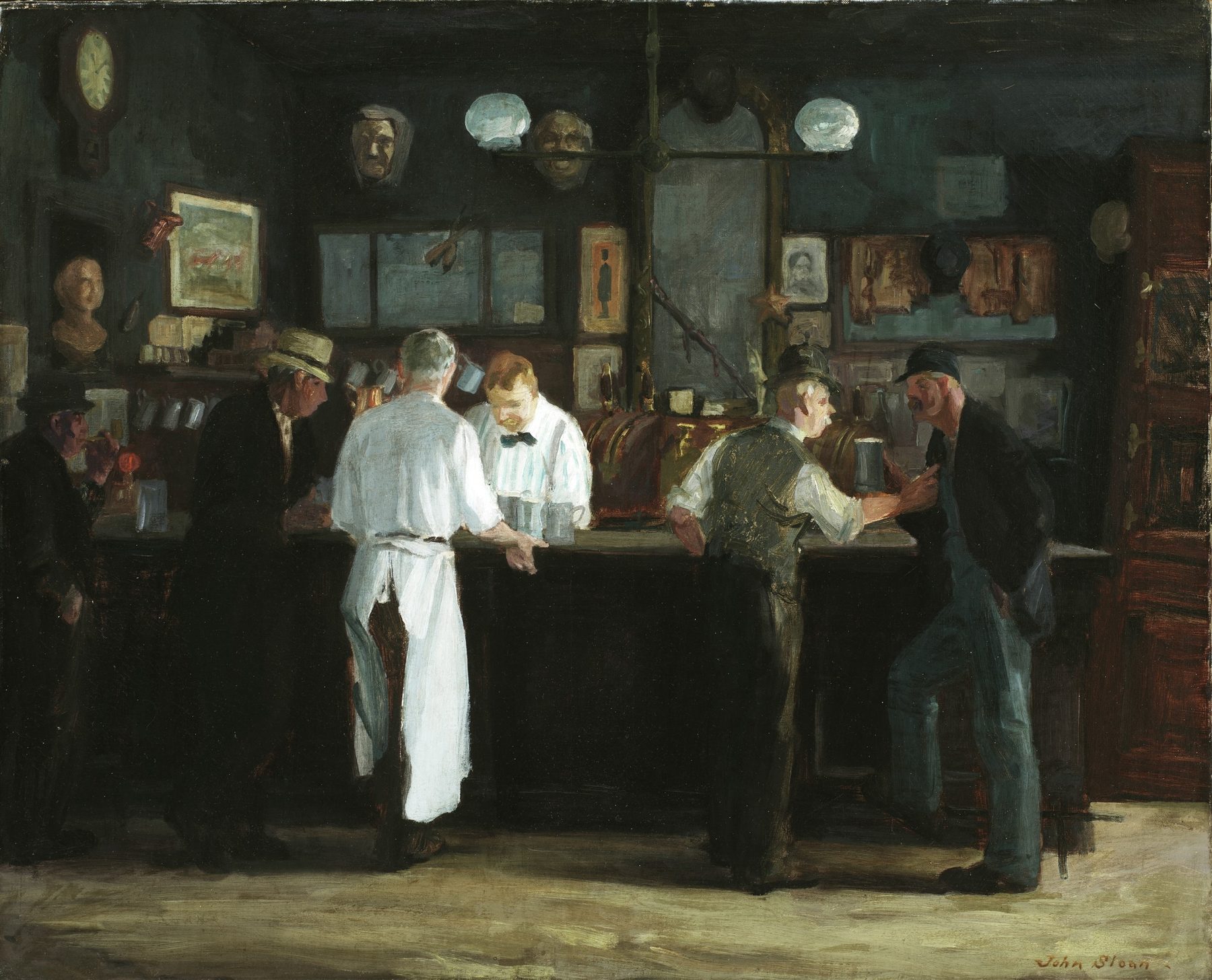
John Sloan’s etchings are especially alert to that problem. Rooftops, back windows and modest interiors reveal people reading, undressing, flirting or escaping summer heat. Sunbathers on the Roof treats an informal encounter with humour, but the viewpoint also places the viewer in the position of an unseen observer. Sloan’s sympathy does not erase voyeurism; it makes the ethics of city looking part of the image.[34]
Sloan’s political commitments were unusually explicit. He joined the Socialist Party and served as art editor of the radical journal The Masses. His urban pictures nevertheless rarely illustrate a programme. A crowded street or woman hanging laundry may show class conditions without delivering a simple reform message. He wanted ordinary lives to be worthy of art, but observation, pleasure and political analysis do not align automatically.[7]
George Bellows brought a different bodily force to the city. He studied with Henri after moving from Ohio to New York and quickly gained notice for streets, river excavation, crowds and boxing. His paint often appears thick and urgent, yet large compositions depend upon controlled diagonals and tonal organisation. Bellows could make urban energy feel physically transmitted without pretending it was uncomposed.[8]
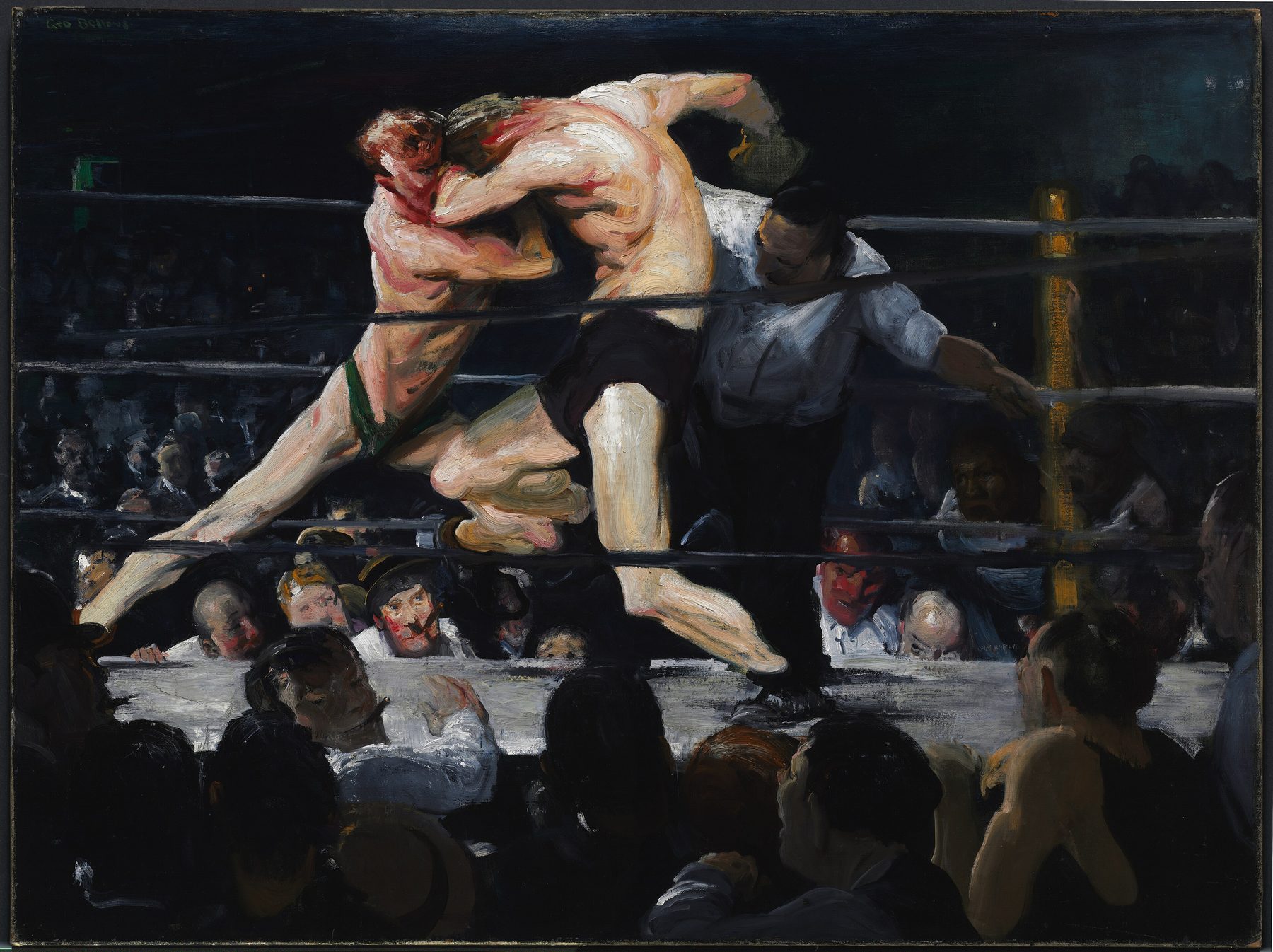
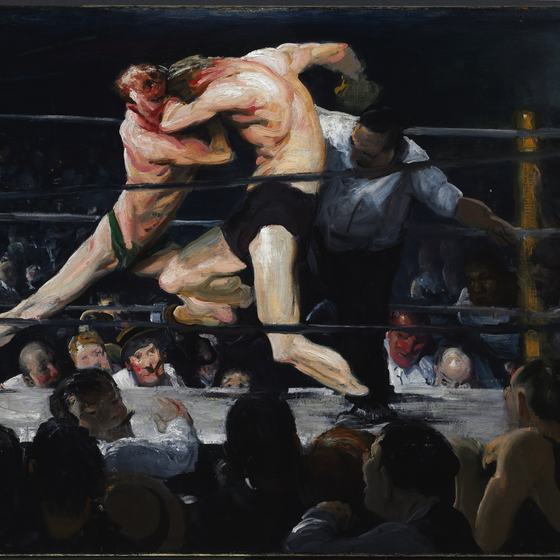
Stag at Sharkey’s of 1909 shows two boxers locked together above a dense ring of spectators. Public prizefighting was illegal in New York, so an outsider given temporary club membership was called a “stag”. Bellows places viewers nearly at ring level. The fighters’ bodies form a knotted, unstable mass; the referee reaches between them; faces rise from darkness below. Thick highlights turn sweat and flesh into paint while the crowd’s compressed heads make spectatorship itself aggressive.[9]
The scene carried arguments about class and masculinity. Boxing had strong working-class associations but was gaining genteel advocates, including Theodore Roosevelt, who praised strenuous manhood. The club converted violence into regulated entertainment while skirting the law. Bellows neither simply condemns nor celebrates it. The painting’s exhilaration implicates the museum viewer in the appetite of the crowd.[9]
Urban realism could exoticise the poor or ethnic minorities for middle-class audiences. Ashcan artists were interested in immigration, pluralism and social mixing, but their labels and caricatures sometimes repeat the hierarchies they appeared to challenge. “Unvarnished life” is not a defence against stereotype. We must ask whose body supplies vitality, humour or pathos and who controls the terms of display.
Follow American Realism through four stages
–1865
Genre roots, conflict and evidence
Everyday narrative painting and Civil War photography establish competing claims to national visibility, constructed incident and documentary truth.
–1900
Postwar bodies, objects and national memory
Homer, Eakins, trompe-l’œil painters, Cassatt and Tanner turn veterans, surgeons, domestic encounters and ordinary things into difficult arguments about modern life.
–1925
Ashcan streets and early modernism
Sloan, Bellows and Hopper make crowds, bars, boxing clubs, nocturnal streets and edited architecture carry the pressure of metropolitan spectatorship.
–1945
Regionalism, public art and documentary
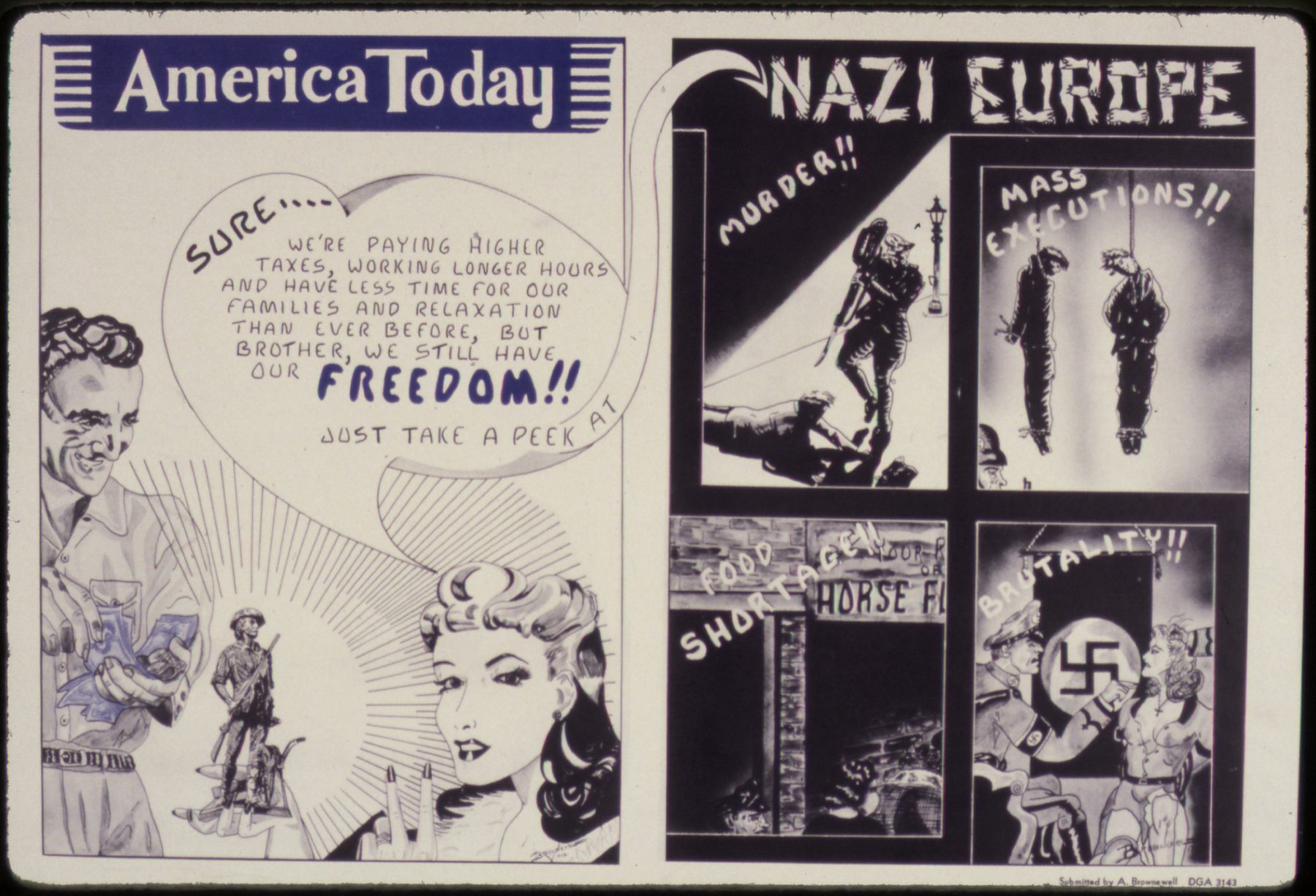
Regionalists, Social Realists and government photographers debate rural identity, labour, segregation, crisis and who may stand for the nation.
Politics, gender and representation
Henri described a democratic art and selected portrait sitters from different races, nationalities and occupations. His straightforward likenesses could grant visual importance to people excluded from elite portrait traditions. Yet choice remained with the artist, and a colourful title or costume could still mark a sitter as socially “other”. Democratic intention should be examined through the particular encounter rather than accepted as a guarantee.[6]
The position of women was similarly uneven. Ashcan streets contain female workers, shoppers, performers and sex workers, but male artists often frame them as spectacle. Isabel Bishop, a later realist associated with the Fourteenth Street School, studied the public life of Union Square from a studio she maintained for decades. Office workers and shoppers become substantial moving figures, not anonymous accents within masculine crowd energy.[35]
Bishop learned from Kenneth Hayes Miller and studied Piero della Francesca, Mantegna and Chardin. Old-master structure helped her give a lunch-hour conversation or walking pair unusual monumentality. This combination undermines the claim that realism simply records whatever is nearby. She selected, drew repeatedly and balanced bodies until temporary urban actions acquired durable form.[35]
Reginald Marsh also looked to Renaissance and Baroque compositions while sketching Coney Island, burlesque theatres, Union Square and the Bowery. In The Bowery, unemployed men stand beneath signage and the elevated railway in Depression New York. Tempera gives the scene a dry, layered surface. Classical rhythms organise social hardship, showing that old art could intensify rather than escape modern conditions.[36] [37]
Marsh’s crowded women can be energetic agents and objects of a heterosexual male gaze at once. Bishop’s office workers offer another relation to public femininity; they are not always available to the viewer as spectacle. Comparison reveals that “the city” is never one neutral subject. It changes according to who moves through it, who watches and what artistic traditions frame the encounter.
The Armory Show and modernism
The International Exhibition of Modern Art opened at New York’s 69th Regiment Armory in February 1913, then travelled to Chicago and Boston. More than three hundred American and European artists participated. US audiences encountered major examples of Cézanne, Matisse, Picasso, Duchamp, Brancusi and Kandinsky alongside American work. Press ridicule made the exhibition famous, but its institutional effect was deeper: collectors, artists and museums could no longer treat European modernism as a distant rumour.[31]
The show changed the relative position of Ashcan realism. A painting that had seemed rebellious because of its street subject and broad brushwork could look formally traditional beside Cubism. But the relationship was not a simple defeat. Sloan exhibited and absorbed brighter colour; Hopper also participated; Stuart Davis carried Henri’s lesson about contemporary subjects into increasingly abstract design. Realist observation and avant-garde form became available for new combinations.[7] [31]
The Armory Show also clarifies that subject alone does not determine modernism. A recognisable street can be organised radically, while an abstracted painting may preserve familiar objects. American Realism remained modern when it asked how mass culture, speed, work and psychological distance could be given form. Its future did not depend upon refusing abstraction, only upon refusing the idea that abstraction owned innovation.
Edward Hopper
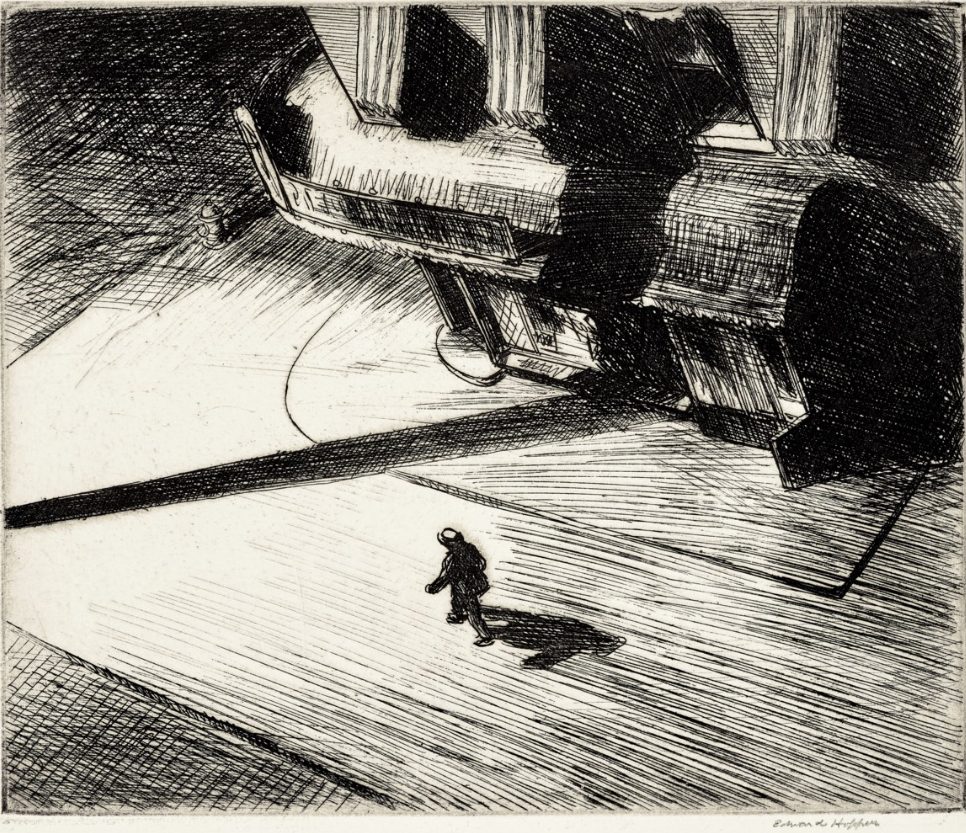
Edward Hopper studied in New York with William Merritt Chase and Henri, who urged students to address the world around them. He worked unhappily as a commercial illustrator and made several trips to Paris, where Degas and Manet mattered more to him than the newest avant-garde groups. Etching brought his first sustained recognition. Its black-white contrasts helped him develop the dramatic windows, roads and artificial light that later defined his paintings.[26]
Hopper’s subjects are ordinary but not found whole. He drew houses, theatres, offices, gas stations and restaurants, then altered them through memory and design. Windows become frames within frames; walls block movement; strong sunlight divides a façade into distinct zones. Figures pause as if a longer story has been suspended, but the picture withholds what happened before or after. Realism provides clues, not resolution.[29]
This is why “loneliness” is both relevant and insufficient. Hopper’s people are often physically separated or absorbed in private thought, and he acknowledged that Nighthawks may unconsciously convey big-city loneliness. Yet he resisted fixed symbols and obvious anecdotes. Emptiness can create attention, suspense, desire or calm. Architectural relations generate emotion without translating every room into the artist’s biography.[27] [29]
Nighthawks, painted in 1942, began from a restaurant at an angular intersection on Greenwich Avenue. Hopper enlarged and simplified it. A continuous pane of glass surrounds three customers and a server under fluorescent light; no entrance is visible. The counter’s wedge repeats the corner while the empty pavement pushes the viewer away. Cups, stools and containers are precisely present, but the relationship among the figures remains undecidable. The painting is realist in detail and radically constructed in space.[27]
Josephine Nivison Hopper modelled for the red-haired woman and for most mature female figures. She was also an artist, exhibited her watercolours before Hopper’s decisive breakthrough, encouraged him to work in that medium and maintained detailed ledgers of his production. Their partnership was difficult and unequal, but her record-making is essential to present knowledge of his work. The archive resists the myth of a solitary observer whose career organised itself.[28]
Hopper’s city was also culturally selective. He favoured older low-rise architecture even as skyscrapers transformed Manhattan, and often emptied streets that were densely populated. He watched from elevated trains, pavements and theatres, turning fragments into controlled tableaux. The result is not a census of New York but one artist’s highly edited modernity.[28] [29]
Rural and coastal pictures use the same method. In Cape Cod Evening, a couple sits near a house while a dog responds to something outside the frame. Tall grass, advancing woodland and lowering light disturb the apparent domestic calm. The details come from a real region, but their arrangement produces a condition that cannot be reduced to location. A scholarly catalogue aptly describes Hopper as only superficially realist: the visible world is the material from which he constructs psychic tension.[30]
His persistence became especially important after abstraction gained critical dominance. Some mid-century critics dismissed his work as illustrative, while later Pop artists and Photorealists recognised its severe selection and iconic ordinary subjects. Cinema, fiction and advertising repeatedly borrowed Hopper-like windows and nocturnal interiors. The legacy shows that realism can become culturally powerful through abstraction of experience rather than accumulation of detail.[25] [26]
Depression, Regionalism and the American Scene
The economic collapse that followed 1929 intensified demand for art about shared conditions. “American Scene painting” became a broad description for recognisable national subjects, but it included opposed political and regional positions. Regionalism is the narrower term most often associated with Thomas Hart Benton, John Steuart Curry and Grant Wood. They turned towards rural, small-town and historical imagery while many advocates contrasted their work with European abstraction and New York cosmopolitanism.[2] [40]
Regionalist art was not simply provincial observation. Benton lived in New York for more than two decades and developed his rolling figures through old-master and Mannerist study. His mural America Today combines factories, mines, agriculture, transport, cinema and urban leisure into a national panorama. Labouring bodies power its rhythms, yet race, industry and spectacle are arranged through a commanding authorial synthesis. The work celebrates energy while exposing strain and excess.[41]
Curry painted Kansas farming, storms, religious gatherings and the violent abolitionist history of John Brown. His subjects were praised nationally as authentic heartland culture, but Kansans did not always welcome the image he made of their state. Local resistance to his capitol murals shows that a region does not speak in one voice. “Indigenous American” subject matter was itself a claim made by artists, critics and patrons.[40]
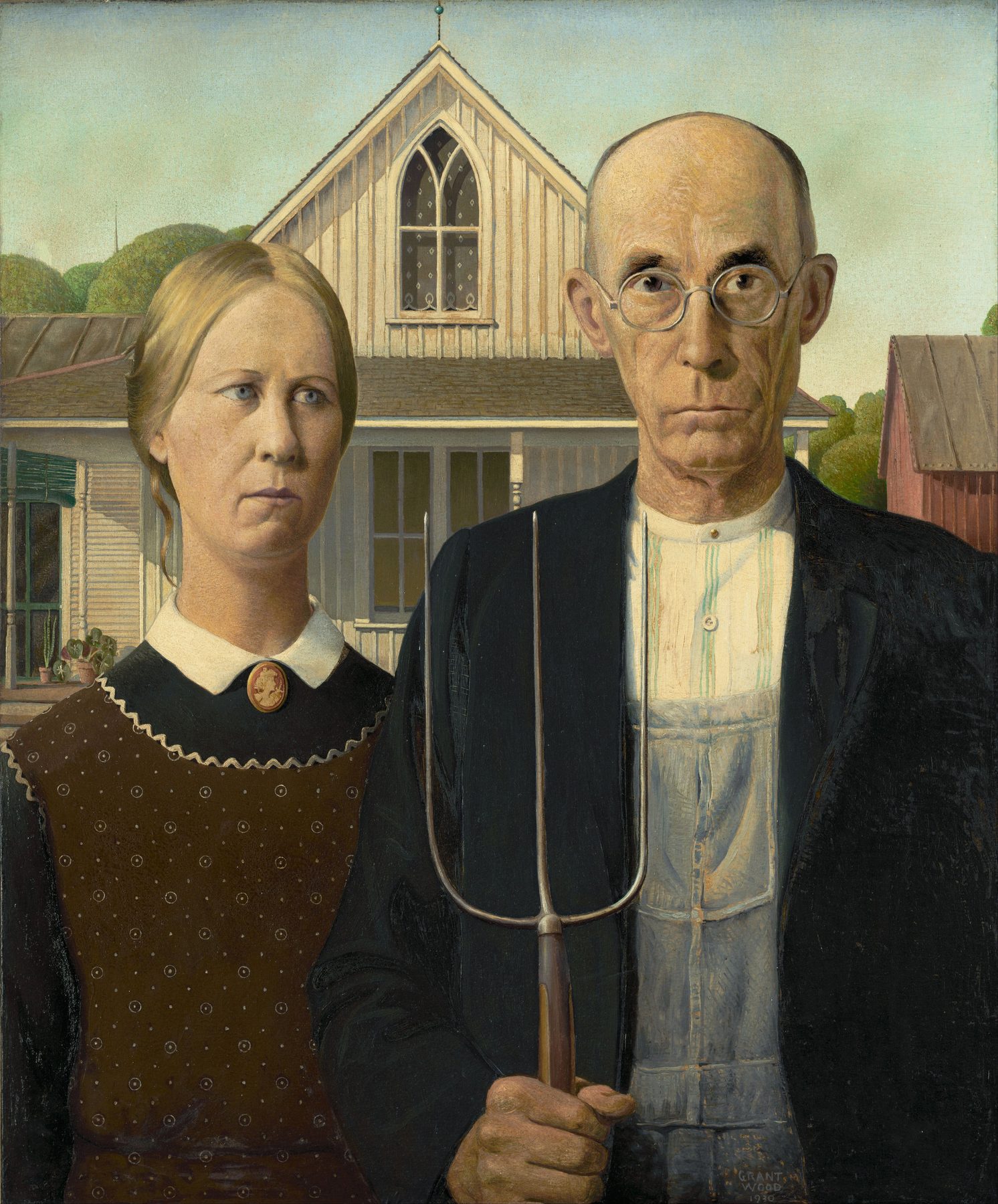
Wood’s American Gothic became the most famous Regionalist image. He asked his dentist and sister to pose as a farmer and daughter before a Carpenter Gothic house he had seen in Eldon, Iowa. The pitchfork echoes the man’s overalls and the building’s vertical boards; the woman’s patterned dress corresponds with curtains. Frontal arrangement and hard precision recall Northern Renaissance painting and nineteenth-century family photographs.[42]
The picture’s tone remains unstable. Iowa farm wives initially protested what they perceived as caricature, while Wood described the figures as a positive statement about endurance and rural values. Their tightly joined world can appear admirable, severe, funny or claustrophobic. The painting’s cultural durability comes from this controlled ambiguity. It does not reveal what Midwesterners are; it stages a national debate about how they should be seen.[42]
Regionalism’s rhetoric could marginalise urban, immigrant, Indigenous and Black experience by presenting a predominantly white heartland as the national centre. At the same time, individual works could criticise exploitation, ecological hardship and intolerance. The movement should not be treated as politically uniform. Narrative realism made national belonging available for celebration and dispute.[40] [43]
New Deal art, Social Realism and documentary
The New Deal changed who paid for art and where it appeared. Federal programmes employed artists, commissioned thousands of murals, supported community art centres and documented design traditions. Paintings entered post offices, schools and other public buildings rather than remaining only in private collections and museums. Opportunities widened for women and Black artists, although access and administrative power remained unequal.[38] [39]
Government commissions encouraged legible public narratives. Murals might celebrate local industry, settlement or technological progress, sometimes suppressing conflict and dispossession. Artists negotiated community expectations, architectural sites and official review. Public realism was democratic in reach but not free from state purpose.
Social Realism placed inequality, labour conflict, unemployment and political struggle more directly at the centre. Ben Shahn, the Soyer brothers and artists around radical organisations used painting, print and mural to address contemporary injustice. Reginald Marsh’s crowds and Bishop’s workers overlap with this field, but not every representation of poverty is Social Realism. The term implies a sustained social or political orientation, whereas American Scene painting can be descriptive, nostalgic or nationalist.[1] [38]
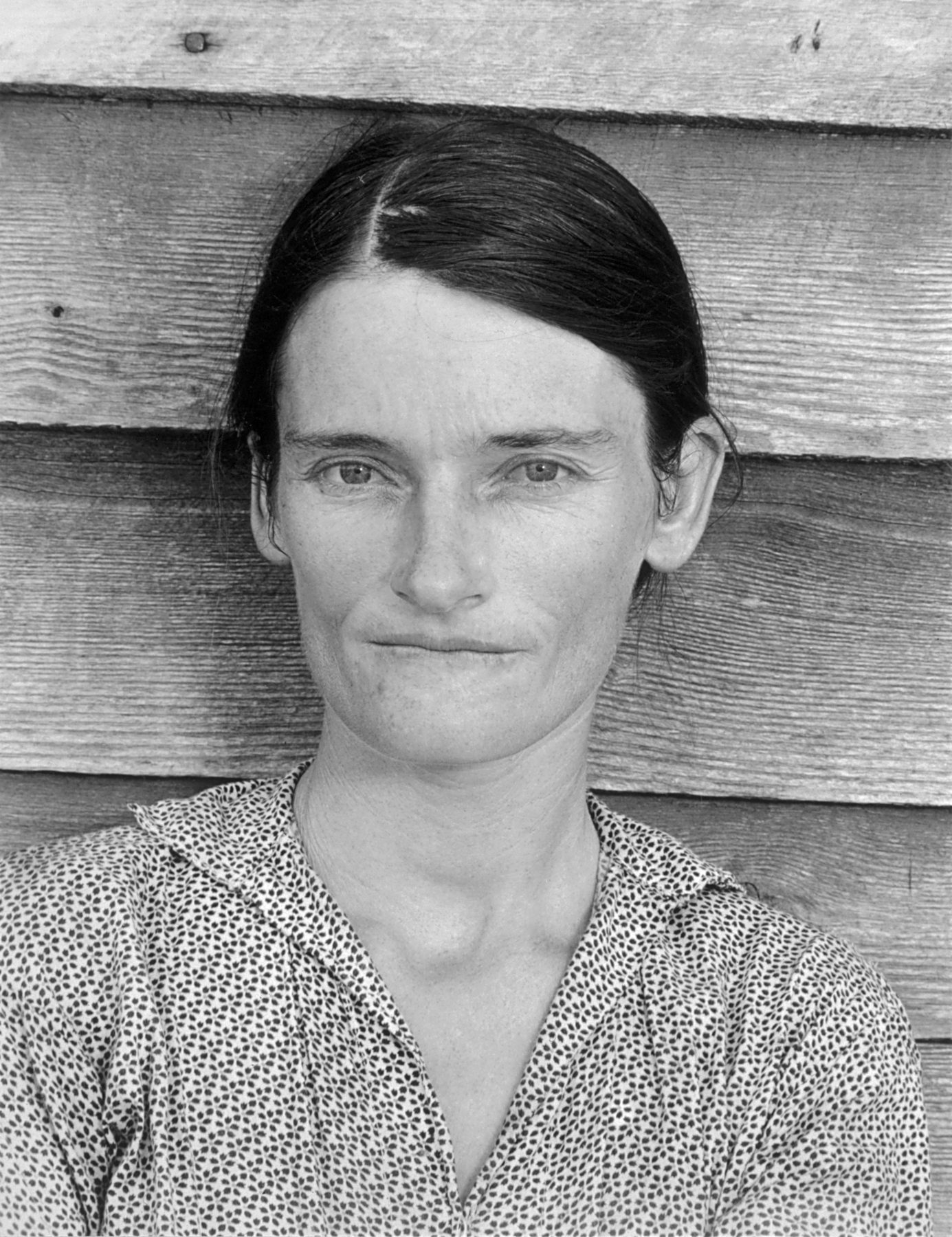
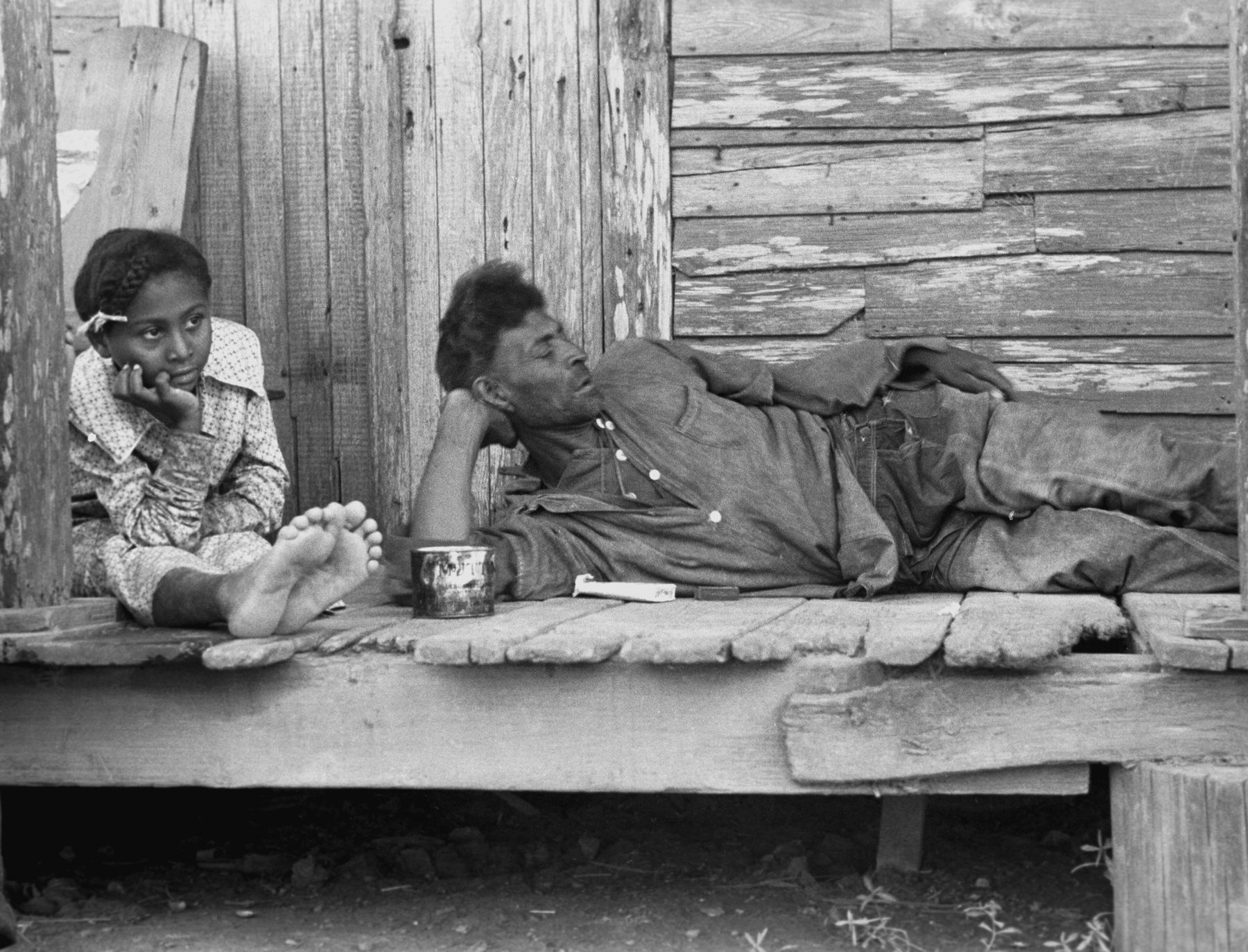
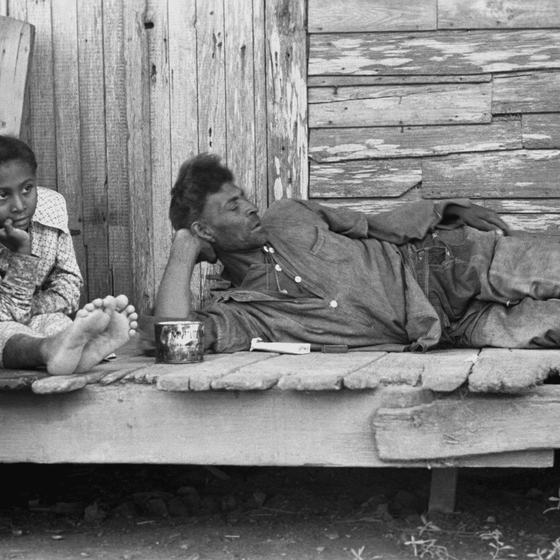
Photography became crucial to the era’s public imagination. The Resettlement Administration and Farm Security Administration employed photographers including Lange, Walker Evans, Russell Lee, Marion Post Wolcott and Arthur Rothstein. Their pictures recorded migrant labour, tenant farming, drought, housing and community life. Reproduction in newspapers, magazines, exhibitions and government reports made individual faces into evidence of national crisis.[39] [48]
Yet documentary authority was constructed. Roy Stryker’s agency selected assignments and captions; government need for public support affected distribution; direct depictions of racial oppression could be discouraged. Photographers selected frames and moments, while editors chose which images became representative. The camera registered people who were really present, but institutional meaning accumulated around the negative.[38] [39]
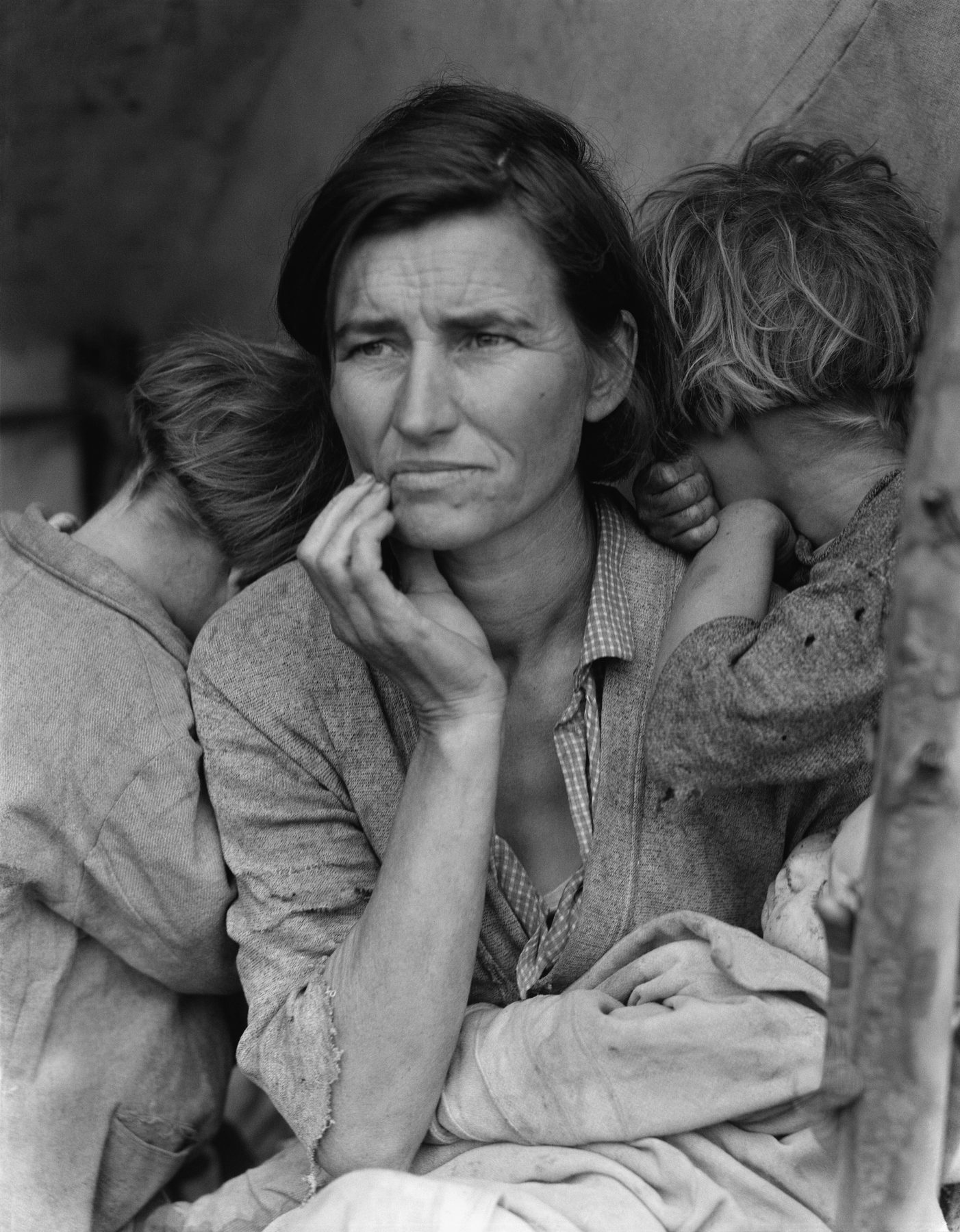
Dorothea Lange’s Migrant Mother demonstrates both power and difficulty. Lange encountered Florence Owens Thompson and her children in a California pea-pickers’ camp in 1936, making several exposures and moving progressively closer. The best-known frame concentrates on the mother’s worried face while two children turn away. It became an emblem of Depression hardship, but Thompson’s name and Native ancestry were absent from early circulation; she later regretted allowing the photograph. An icon of compassion can also detach a person from control of her image.[47] [48]
Lange’s wider practice makes clear that she did not only create one symbol. She photographed strikes, migration, rural poverty, Black communities under Jim Crow and the forced incarceration of Japanese Americans. Government authorities restricted wartime images whose sympathy exposed injustice. Her goal that photographs be useful places art in a public relationship, but usefulness must include accountability to the people pictured.[47]
Black modern life
Black artists transformed what American realism could claim. Tanner’s expatriate career had exposed the racial limits of US institutions. During the Harlem Renaissance, artists and writers asserted that Black identity, history and modern life would be represented from within rather than filtered through stereotype. Magazines, community workshops, patrons and migration created new networks in Harlem and other cities.[43] [44]
Archibald Motley worked in Chicago rather than Harlem, but his portraits and Bronzeville scenes participate in the era’s redefinition of Black modernity. Nightlife of 1943 fills a cabaret with dancers, drinkers, tables and a bar under intense violet-red light. Diagonal limbs and repeated bottles create a syncopated rhythm. The people are not sociological examples of hardship; they inhabit pleasure, fashion, flirtation and community.[45]
Motley’s artificial colour is essential to the work’s realism. It does not reproduce ordinary flesh or illumination, but communicates the nightclub’s energy and social density. Black urban experience enters modern painting through formal exaggeration, not academic naturalism. This is another reason American Realism cannot be defined as literal appearance.[44] [45]
Jacob Lawrence developed serial painting as historical narration. Growing up in Harlem, he studied through community art centres and researched Toussaint Louverture, Frederick Douglass, Harriet Tubman and the Great Migration. The sixty panels of his Migration Series use recurring colours, angled bodies and short captions to connect individual departure with collective history. Flatness makes repetition and movement legible across the sequence.[46]
Lawrence’s work is realist because it gives social processes coherent human form, even though its style is highly abstracted. His Bar and Grill of 1941 divides a New Orleans interior into unequal white and Black sections, making Jim Crow segregation spatially visible. The skewed viewpoint and colour intensify an actual legal structure. Social truth can require design that exposes relations more clearly than optical imitation.[43] [46]
These artists revise the national map rather than merely adding representation. Harlem, Bronzeville, migration routes and segregated interiors become centres of American modernity. Their work also warns against making realist value depend on recognition by a white-dominated mainstream. Communities built their own institutions, knowledge and audiences.
Artists and places to know
Winslow Homer
Illustrator, painter and watercolourist who made Civil War experience, Reconstruction, childhood, sea travel and survival carry national memory without reducing them to slogans.[13] [15] [16]
George Bellows
Painter of construction sites, crowds and boxing whose vigorous surface is held by calculated structure.[8]
Edward Hopper
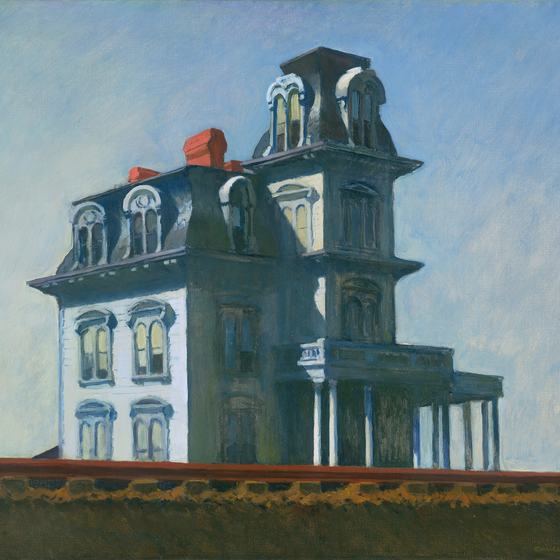
Painter and printmaker who edited ordinary buildings, roads, windows and artificial light into severe spaces of suspense, privacy and psychological distance.[26] [27] [29]
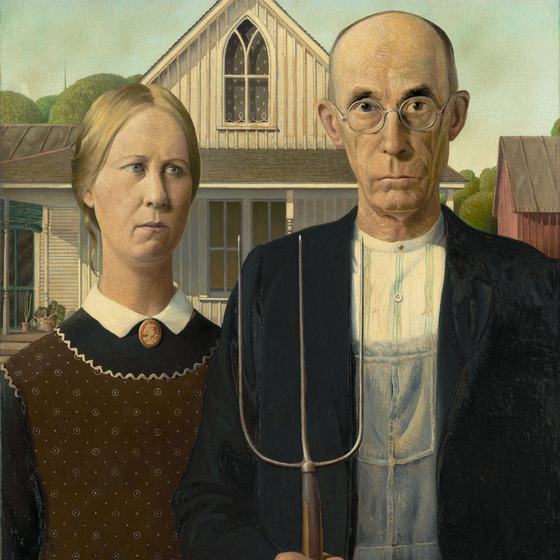
Grant Wood
Regionalist painter whose exact surfaces and Northern Renaissance references made Midwestern identity appear enduring, satirical, admirable and claustrophobic at once.[42]
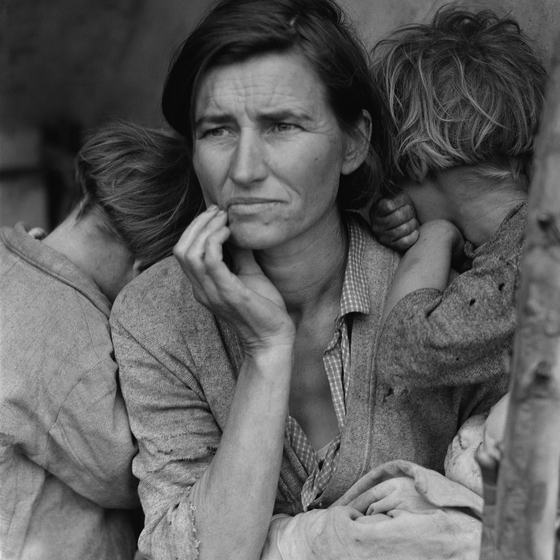
Dorothea Lange
Photographer who linked portraiture with public documentary while leaving a record that demands ethical attention to naming, caption and consent.[47]
Further people and places
Philadelphia
The institutional centre of Eakins’s anatomy, teaching, rowing and surgery, and a formative city for Henri’s journalist circle and Tanner’s education.
New York
The primary stage for Ashcan streets, independent exhibitions, the Armory Show, Hopper’s architecture, Fourteenth Street realism and Depression-era politics.
Chicago and Bronzeville
The setting for Wood’s breakthrough at the Art Institute and for Motley’s representation of Black metropolitan life.
Robert Henri
Painter and charismatic teacher whose advocacy of contemporary subjects and independent exhibitions mattered more than any single Ashcan formula.[6]
John Sloan
Illustrator, painter, printmaker and socialist whose windows, roofs and streets turn everyday urban encounters into questions about looking.[7]
Isabel Bishop
Fourteenth Street realist who gave working women and shoppers monumental bodily presence.[35]
Archibald Motley and Jacob Lawrence
Modernists who made Black social experience central through very different uses of colour, rhythm and narrative.[45] [46]
Major artists directory
| Name | Nationality | Key Works |
|---|---|---|
| Archibald Motley | American | Nightlife |
| Ben Shahn | American | Unemployed Trappers, Louisiana |
| Dorothea Lange | American | Migrant Mother |
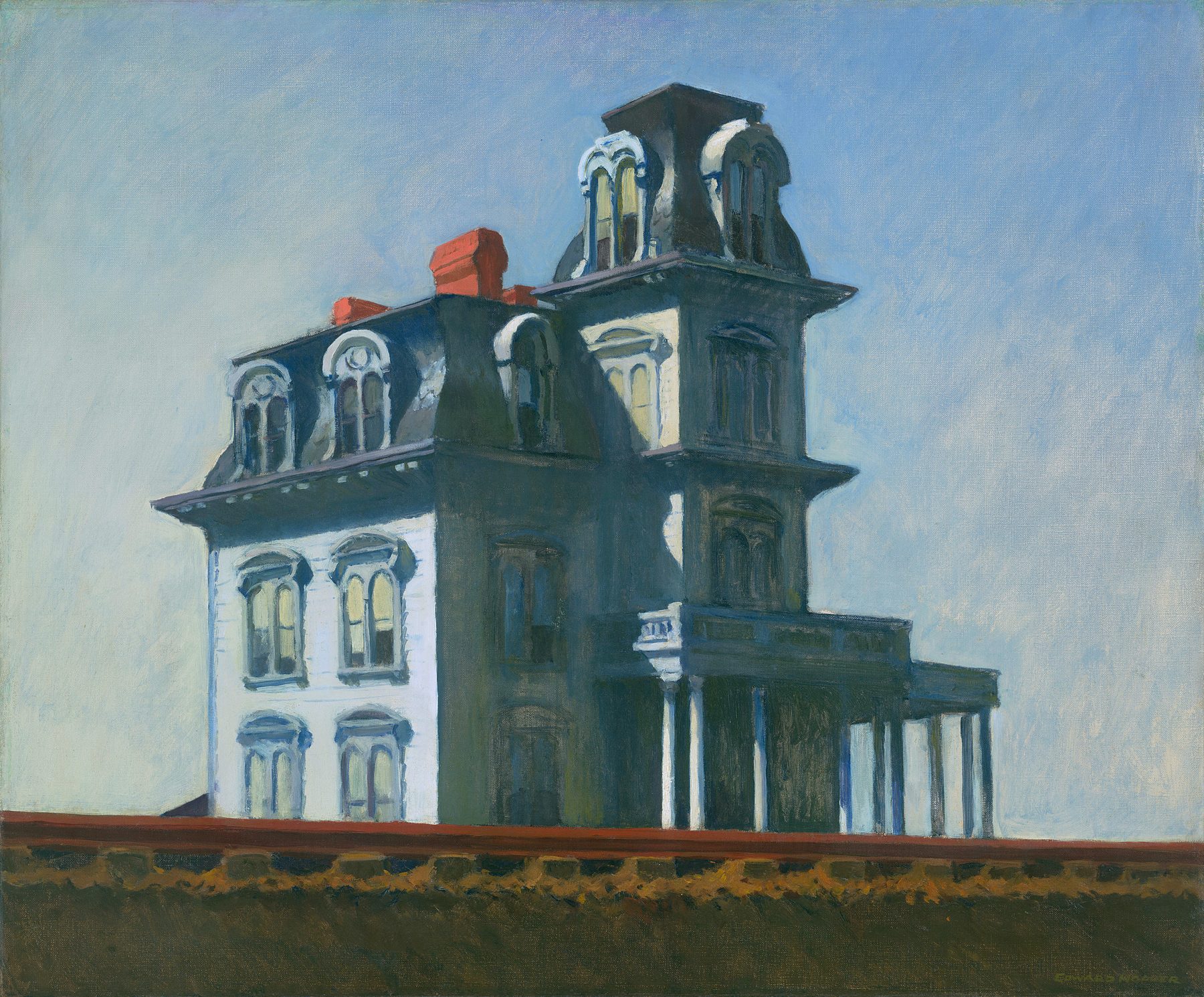
| Edward Hopper | American | Night Shadows, House by the Railroad |
| George Bellows | American | Stag at Sharkey’s, Cliff Dwellers |
| Grant Wood | American | American Gothic |
| Henry Ossawa Tanner | American | The Banjo Lesson |
| Isabel Bishop | American | Tidying Up |
| Jacob Lawrence | American | The Migration Series, Bar and Grill |
| John Frederick Peto | American | Take Your Choice |
| John Singer Sargent | American | Madame X, The Daughters of Edward Darley Boit |
| John Sloan | American | McSorley’s Bar |
| John Steuart Curry | American | Tragic Prelude |
| Mary Cassatt | American | The Child’s Bath |
| Reginald Marsh | American | The Bowery |
| Robert Henri | American | Salome |
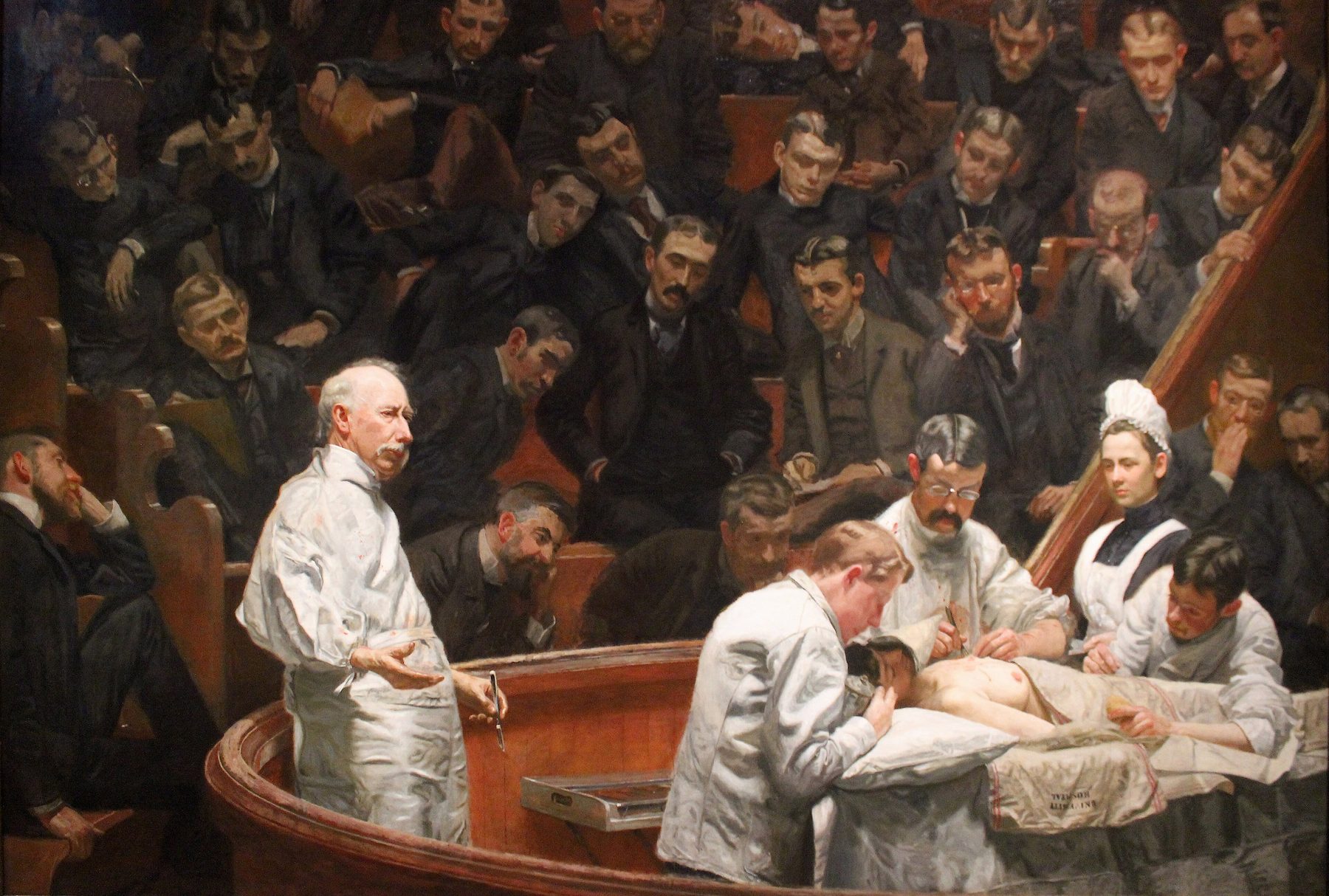
| Thomas Eakins | American | The Champion Single Sculls, The Gross Clinic, The Agnew Clinic |
| Thomas Hart Benton | American | America Today |
| Walker Evans | American | Allie Mae Burroughs |
| William Michael Harnett | American | The Old Violin |
| Winslow Homer | American | The Veteran in a New Field, Prisoners from the Front, Breezing Up (A Fair Wind), The Gulf Stream |
How to look at American Realism
Begin by identifying what the work asks you to treat as evidence. Is credibility located in anatomical detail, a recognisable street sign, worn paper, photographic tone or a caption? Then ask what has been left out. Realism directs attention as forcefully as it records.
Trace the composition before accepting the story. A seemingly candid Homer may have been revised for years; Bellows’s chaos rests on diagonals; Hopper’s restaurant is enlarged and sealed by glass; Lawrence repeats colours across panels. Construction is not a failure of truth. It is how the work makes a claim persuasive.
Consider the viewer’s position. Do you stand with medical students above an anonymous patient, among boxing spectators, outside a diner or unseen beside a rooftop? The viewpoint assigns power and responsibility. A picture can make you sympathise and intrude at the same time.
Read the medium. Trompe-l’oeil oil imitates texture while denying touch; tempera can give a Depression crowd dry density; watercolor depends on reserve and transparency; a photograph gathers meaning through negative, crop, caption and publication. “Realistic” is not one surface.
Finally, identify who is named. The artist, sitter, labourer and institution may possess very different degrees of control. Recovering Florence Owens Thompson’s identity changes Migrant Mother without cancelling the image’s public force. Realism becomes more truthful when its relationships are visible.
Frequently Asked Questions
American Realism is a broad art-historical name for artists who represented recognisable aspects of life in the United States while making contemporary experience central to their work. It includes several different groups and periods rather than one organisation. Its art can be carefully detailed, painterly, photographic, simplified or abstracted.[1] [2]
Realist genre traditions existed earlier, but about 1865 is a useful beginning for the central story. The Civil War, emancipation and Reconstruction changed how artists represented national identity, labour, bodies and everyday life. Homer’s postwar paintings give this transition unusual concentration.[3] [18]
The terms overlap, and museum classifications are not always consistent. Realism generally stresses engagement with contemporary or recognisable experience. Naturalism often implies a more systematic, materially detailed account shaped by environmental or social conditions. Neither term means that an artist stopped selecting, composing or interpreting.
No. Robert Henri mentored a central circle of Philadelphia illustrators who later worked in New York, but “Ashcan School” was a later nickname. Their styles and politics varied. The Eight was also not another name for the group: its 1908 exhibition included three artists outside the central Ashcan circle.[5] [32]
Eakins grounded painting in anatomy, perspective, modern professions, athletics, portraiture and photography. His pictures make bodies and intellectual labour convincingly present, but they are highly organised rather than mechanically copied. The Gross Clinic uses realism to examine both surgical knowledge and the vulnerability it requires.[10] [11] [12]
Hopper studied with Henri and came of age near the Ashcan generation, but he developed a distinct mature art. His streets and interiors are quieter, more architecturally simplified and less crowded than most Ashcan scenes. He belongs to American Realism without being reducible to that school.[2] [26]
Regionalism is one part of the broader realist tradition. It is chiefly associated with Benton, Curry and Wood in the 1930s and with narrative images of rural or regional America. American Realism also includes postwar painting, urban Ashcan work, Hopper, Social Realism, Black modern life and documentary photography.[38] [40] [41]
Grant Wood described the painting in affirmative terms, and its figures can embody endurance and disciplined rural values. Many early viewers nevertheless saw a hostile caricature. The design supports both responses: exact repetition and frontal severity can feel admiring or claustrophobic. Declaring one final meaning weakens the work.[42]
They record people and places that stood before a camera, but they are not neutral. The photographer chooses timing and frame; an editor or agency chooses crop, caption and circulation. Lange’s Migrant Mother reveals both documentary photography’s extraordinary public power and the ethical cost when an identified person becomes a general symbol.[47] [48]
Discussion
Which work makes the strongest claim to truth: one that records more visible detail, or one that changes appearances to make a social or psychological relationship clearer?
Reader Insights
Ask what has been selected, cropped, recombined or captioned before accepting a realist image as neutral evidence.
Trace who occupies the centre, who watches, and how architecture or framing regulates access and visibility.
Look for the sitter’s name, agency and later testimony, especially when one image has become a national symbol.
Join the Conversation
Which American realist work most changes your idea of what counts as truthful representation?
References
- “Modern American Realism: Highlights from the Sara Roby Foundation Collection,” Smithsonian American Art Museum, americanart.si.edu. View Source
- “Modern Life: Edward Hopper and His Time,” Whitney Museum of American Art, whitney.org. View Source
- “American Scenes of Everyday Life, 1840–1910,” Metropolitan Museum of Art, metmuseum.org. View Source
- American Impressionism and Realism: The Painting of Modern Life, 1885–1915, Metropolitan Museum of Art, metmuseum.org. View Source
- “The Ashcan School,” Metropolitan Museum of Art, metmuseum.org. View Source
- “Robert Henri,” National Gallery of Art, nga.gov. View Source
- “John Sloan,” National Gallery of Art, nga.gov. View Source
- “George Bellows,” Smithsonian American Art Museum, americanart.si.edu. View Source
- “Stag at Sharkey’s,” Cleveland Museum of Art, clevelandart.org. View Source
- “Thomas Eakins: American Realist,” Philadelphia Museum of Art, philamuseum.org. View Source
- “Portrait of Dr. Samuel D. Gross (The Gross Clinic),” Philadelphia Museum of Art, philamuseum.org. View Source
- “Thomas Eakins (1844–1916): Painting,” Metropolitan Museum of Art, metmuseum.org. View Source
- “Civil War and Its Aftermath,” National Gallery of Art, nga.gov. View Source
- “Winslow Homer (1836–1910),” Metropolitan Museum of Art, metmuseum.org. View Source
- “Winslow Homer: Crosscurrents,” Metropolitan Museum of Art, metmuseum.org. View Source
- “Art for Solace: Winslow Homer’s The Veteran in a New Field,” Metropolitan Museum of Art, metmuseum.org. View Source
- “A New View for America’s Centennial,” National Gallery of Art, nga.gov. View Source
- “The Civil War and American Art,” Metropolitan Museum of Art, metmuseum.org. View Source
- Winslow Homer at the Metropolitan Museum of Art, Metropolitan Museum of Art, resources.metmuseum.org. View Source
- “The Old Violin,” National Gallery of Art, nga.gov. View Source
- “Old Souvenirs,” Metropolitan Museum of Art, metmuseum.org. View Source
- American Paintings of the Nineteenth Century, Part II, National Gallery of Art, nga.gov. View Source
- “Gilded Age Drawings at The Met,” Metropolitan Museum of Art, metmuseum.org. View Source
- “New York Art Worlds, 1870–1890,” Metropolitan Museum of Art, metmuseum.org. View Source
- “Edward Hopper: Overview,” Art Institute of Chicago, archive.artic.edu. View Source
- “Edward Hopper,” National Gallery of Art, nga.gov. View Source
- “Nighthawks,” Art Institute of Chicago, archive.artic.edu. View Source
- “Edward Hopper’s New York,” Whitney Museum of American Art, whitney.org. View Source
- “The City,” Art Institute of Chicago, archive.artic.edu. View Source
- “Cape Cod Evening, 1939,” National Gallery of Art, nga.gov. View Source
- “Armory Show Scrapbooks and Ephemera,” Museum of Modern Art Archives, moma.org. View Source
- “The Ashcan School, The Eight, and the New York Art World,” Metropolitan Museum of Art, metmuseum.org. View Source
- “John Sloan,” Smithsonian American Art Museum, americanart.si.edu. View Source
- “Sunbathers on the Roof,” Smithsonian American Art Museum, americanart.si.edu. View Source
- “Isabel Bishop,” Whitney Museum of American Art, whitney.org. View Source
- “The Bowery,” Metropolitan Museum of Art, metmuseum.org. View Source
- “Reginald Marsh,” Smithsonian American Art Museum, americanart.si.edu. View Source
- “Great Depression,” National Gallery of Art, nga.gov. View Source
- Drawing on America’s Past, National Gallery of Art, nga.gov. View Source
- “John Steuart Curry,” Whitney Museum of American Art, whitney.org. View Source
- Thomas Hart Benton’s America Today, Metropolitan Museum of Art, metmuseum.org. View Source
- American Art: American Gothic, Art Institute of Chicago, artic.edu. View Source
- “African American Art: Harlem Renaissance, Civil Rights Era, and Beyond,” Smithsonian American Art Museum, americanart.si.edu. View Source
- “Harlem Renaissance,” National Gallery of Art, nga.gov. View Source
- “Nightlife,” Art Institute of Chicago, archive.artic.edu. View Source
- “Jacob Lawrence,” Smithsonian American Art Museum, americanart.si.edu. View Source
- “The Real Lives of People in Dorothea Lange’s Portraits,” National Gallery of Art, nga.gov. View Source
- “Dorothea Lange,” Museum of Modern Art, moma.org. View Source
- “Henry Ossawa Tanner,” Smithsonian American Art Museum, americanart.si.edu. View Source
- “American Impressionism,” Metropolitan Museum of Art, metmuseum.org. View Source
- Image references 51–73: open-access reproductions and institutional collection records.
View 23 image sources
01 · commons.wikimedia.org02 · commons.wikimedia.org03 · commons.wikimedia.org04 · commons.wikimedia.org05 · commons.wikimedia.org06 · commons.wikimedia.org07 · commons.wikimedia.org08 · commons.wikimedia.org09 · commons.wikimedia.org10 · commons.wikimedia.org11 · commons.wikimedia.org12 · commons.wikimedia.org13 · commons.wikimedia.org14 · commons.wikimedia.org15 · commons.wikimedia.org16 · commons.wikimedia.org17 · commons.wikimedia.org18 · commons.wikimedia.org19 · commons.wikimedia.org20 · commons.wikimedia.org21 · commons.wikimedia.org22 · commons.wikimedia.org23 · commons.wikimedia.org
More ART Movements
Ashcan School
Regionalism
Social Realism