


 by
Tom Gurney
Tom Gurney BSc (Hons) is an art history expert with over 20 years experience
Email:
tomgurney1@gmail.com
/ Phone:
+44 7429 011000
Eastman Johnson: Paintings, Drawings and American Life: Introduction
Eastman Johnson made small actions carry substantial meaning. A child concentrating on a lesson, a woman writing beside a wounded man or neighbours gathered around a harvest could become the centre of an ambitious picture. His paintings join close observation with the choices required to turn people and places into a scene for others to see.
Born in Maine in 1824, Johnson trained in Europe before building a New York career as a genre and portrait painter. His work includes representations of Black life before and after the Civil War, Nantucket harvest gatherings, domestic interiors and substantial family portraits. Drawing remained important throughout a career that ended in 1906. [1]
The range matters. Johnson’s subjects can seem warmly familiar while raising difficult questions about labour, freedom, learning, social position and the expectations of an audience. Looking at the arrangement of a room or a group is often the first step towards understanding those questions.
Explore Eastman Johnson’s artworks
At a Glance
- Artist Eastman Johnson, 1824–1906 [1]
- Fields Genre painting, portraiture and drawing [1]
- Training Düsseldorf, The Hague and Paris [1]
- Subjects Interiors, family groups, work and national life
Eastman Johnson in context
Bars show approximate historical periods. c. means circa (about).
American genre painting
c. 1830–1880 [24]The genre-painting range marks a period of nineteenth-century prominence; the genre continued beyond it. Other subjects and practices are retained in Notes and sources.
Notes and sources
American genre painting. Everyday actions with public meanings. Johnson’s American subjects join observed rooms and activities to questions of community and national life. The wider American Realism page offers related reading. [1]
Portraiture. A practice continuing across his career. Early portrait drawings, major family groups and later public commissions belong to a continuous practice. [1]
Civil War subjects. Escape, injury, reading and care. Military journeys supplied material for pictures whose action often centres on individuals and families. This is a subject grouping, rather than a formal movement. [1]
Each bar runs from the person’s birth to their death.
Henry Wadsworth Longfellow
1807–1882 · Birth–death [25]Thomas Couture
1815–1879 · Birth–death [26]Emanuel Leutze
1816–1868 · Birth–death [27]Sanford Robinson Gifford
1823–1880 · Birth–death [28]Eastman Johnson
1824–1906 · Birth–death [29]Notes and sources
Henry Wadsworth Longfellow. Crayon commissions from 1846. The poet commissioned likenesses of sisters and friends, connecting Johnson with a literary household. [2]
Thomas Couture. Paris study, 1855. Study in Couture’s Paris studio followed the artist’s years in Düsseldorf and The Hague. [1]
Emanuel Leutze. Düsseldorf training, 1849–51. Work in Leutze’s studio formed part of Johnson’s extended European education. [1]
Sanford Robinson Gifford. Friendship and an 1880 portrait. The two artists were friends and neighbours in the Tenth Street Studio Building. The Met considers the portrait possibly posthumous. [3]
Eastman Johnson. Follow selected objects through his career while keeping studies and versions distinct. [1]
Negro Life at the South
1859; New York Historical originalA Ride for Liberty—The Fugitive Slaves
About 1862; Brooklyn versionThe Hatch Family
1870–71The Girl I Left Behind Me
About 1872The Cranberry Harvest, Island of Nantucket
1880; Timken canvasNotes and sources
Negro Life at the South. A Washington yard brings everyday encounters into the contested setting of slavery. [4]
A Ride for Liberty—The Fugitive Slaves. A family’s movement towards freedom carries the whole composition. [5]
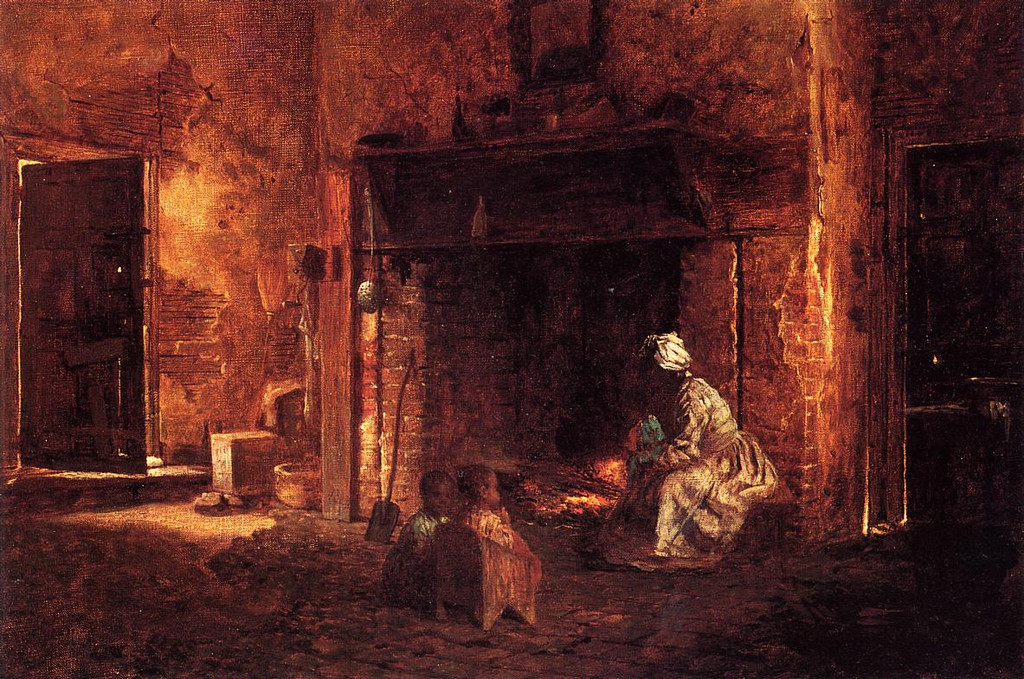
The Lord Is My Shepherd. A lowered head and open book concentrate attention within a dark room. [6]
The Hatch Family. Fifteen figures inhabit a library through a carefully distributed set of activities. [7]
The Old Stagecoach. Children give a broken vehicle a new purpose through play. [8]
The Girl I Left Behind Me. A still figure, books and wind-driven clothing hold competing directions of attention. [9]
The Cranberry Harvest, Island of Nantucket. Repeated working figures spread across a panoramic field beneath an expansive sky. [10]
The Nantucket School of Philosophy. A shoemaker’s shop becomes a place for work, company and conversation. [11]
Johnson’s artistic connections
Teachers, a literary patron and a fellow artist connect different parts of Johnson’s working life.
- Emanuel Leutze: Johnson worked in Leutze’s studio during his first extended European period. This training preceded his years in The Hague and Paris. [1]
- Thomas Couture: Johnson studied with Couture in Paris before returning to the United States in 1855. The encounter formed one part of a varied European education. [1]
- Henry Wadsworth Longfellow: Longfellow commissioned crayon portraits of sisters and friends. The National Park Service identifies ten of those portraits in the house collection and a double portrait of his sons from 1848. [2]
- Sanford Robinson Gifford: Gifford and Johnson were friends and neighbours in the Tenth Street Studio Building. The Met considers Johnson’s portrait possibly posthumous, so its date does not establish a sitting from life. [3]
Contents
- Start with three major works
- An American career shaped by European study
- Washington, slavery and the limits of a picture
- War, care and the possibility of freedom
- Nantucket: working, playing and gathering
- Maine and the unfinished Sugaring Off
- Learning, books and concentrated attention
- Domestic interiors and women’s work
- Family groups and a continuous portrait practice
- Drawing and the making of an apparently informal scene
Start with three major works
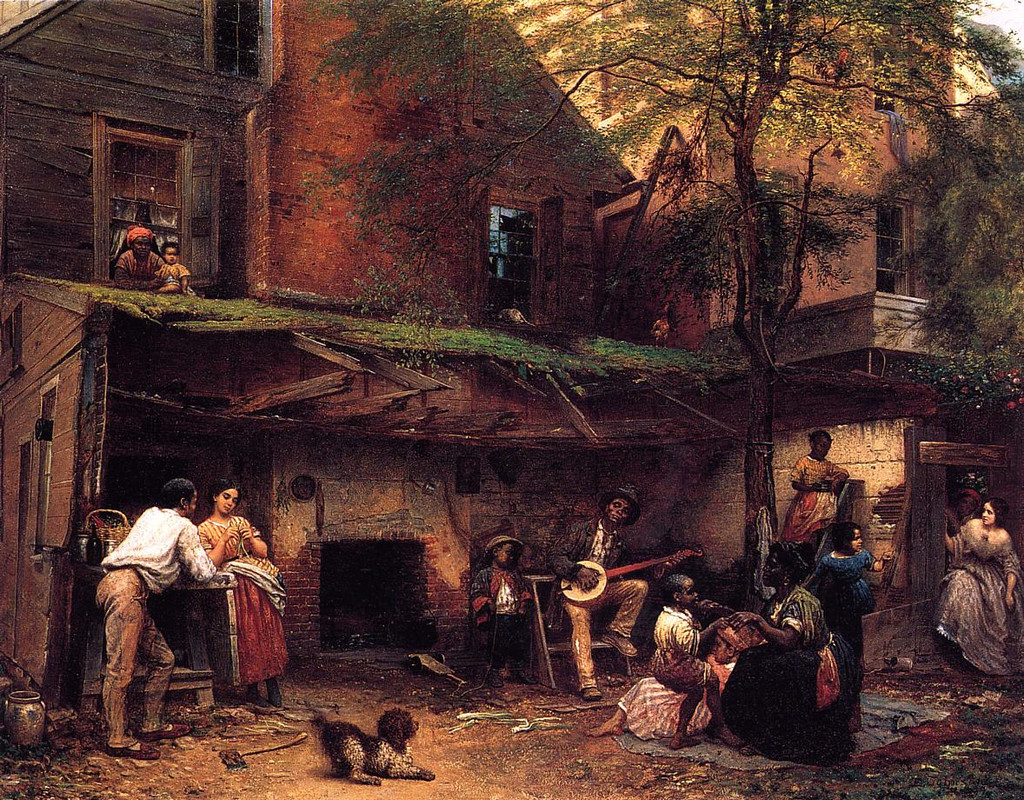
Negro Life at the South established Johnson’s reputation in 1859. Its crowded yard, damaged buildings and varied interactions invite an extended look. The familiar alternative title, Old Kentucky Home , can obscure the scene’s actual Washington, D.C. setting. Its conflicting interpretations make it a particularly useful introduction to the relationship between a picture and its audience. [12]
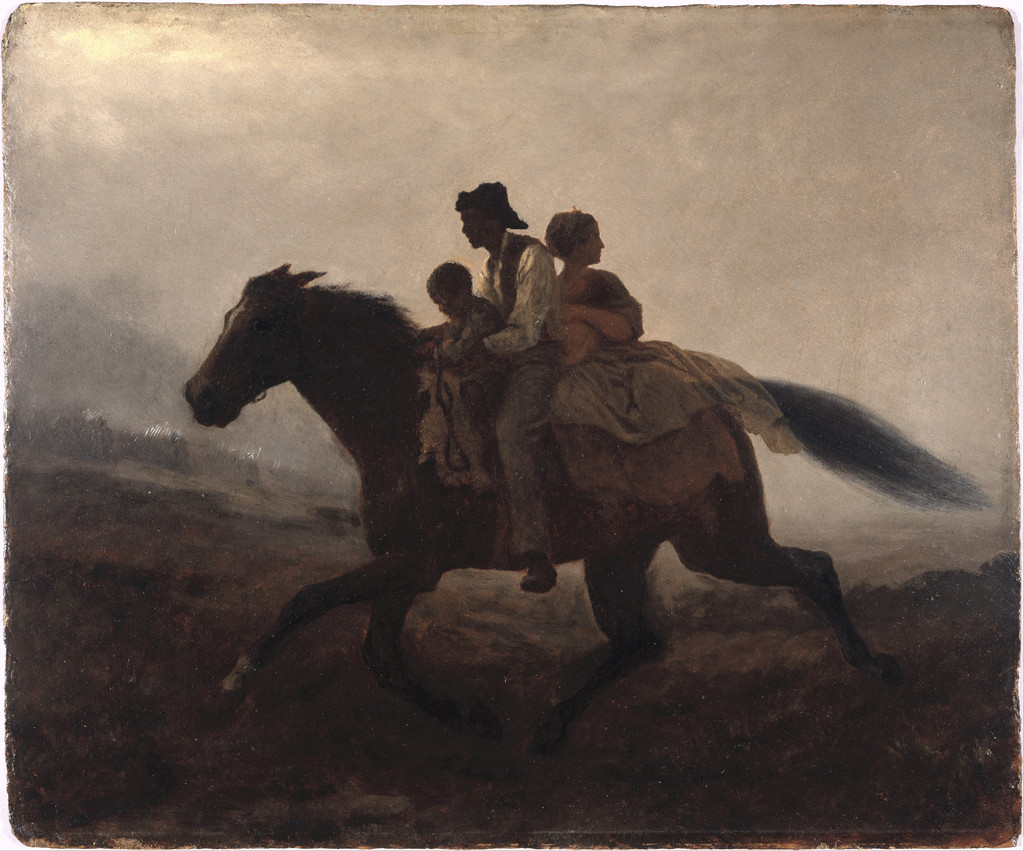
A Ride for Liberty concentrates action into a horse and a family moving through a subdued landscape. The direction of flight and the woman’s backward glance give the scene immediate urgency. The separate Brooklyn and Virginia versions also show why collection, support and inscription have to follow the exact object, rather than the most familiar reproduction. [13]
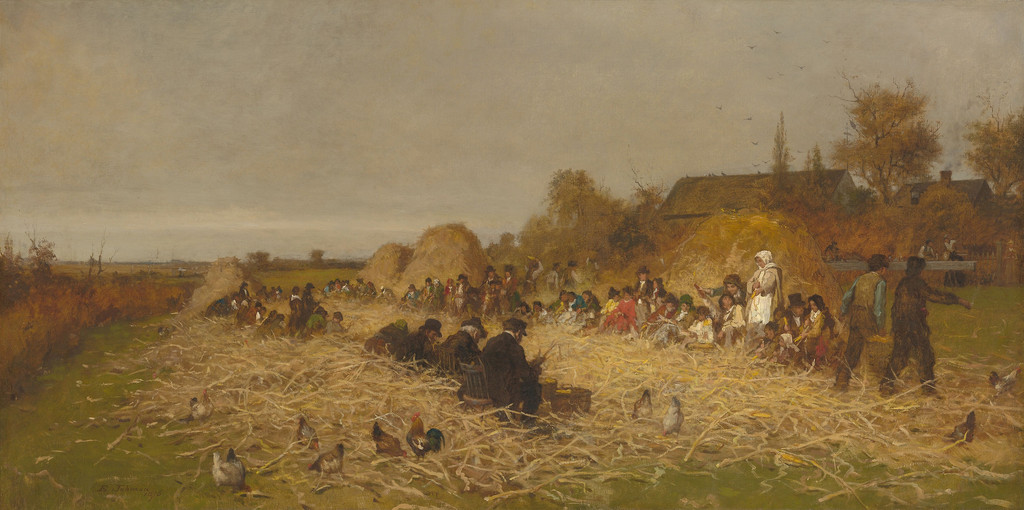
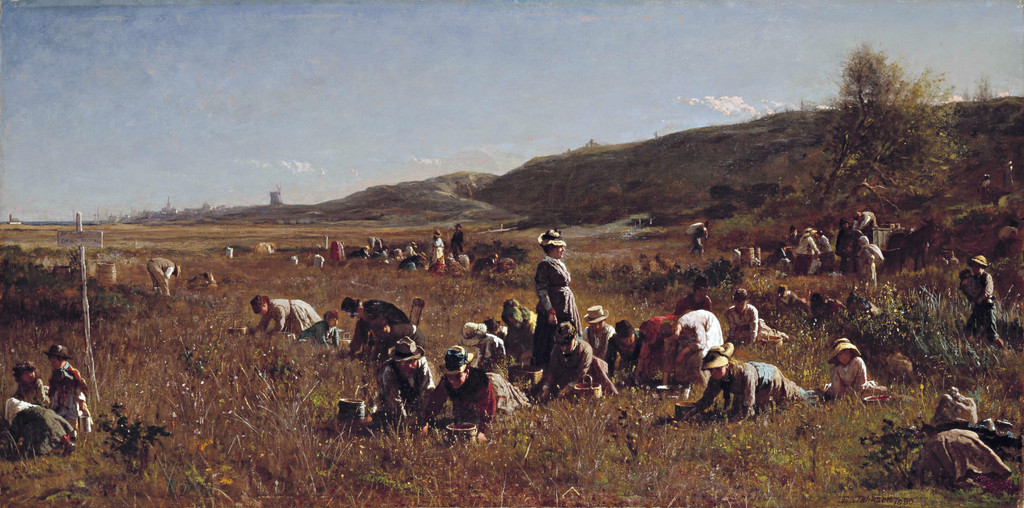
The Cranberry Harvest opens a different world of activity. Figures spread across a wide Nantucket field, with picking, carrying and attention to children creating several centres of interest. The finished 1880 canvas developed within a larger series of studies. Its breadth makes a productive comparison with the compact escape group. [14]
Together, the three pictures offer distinct starting points: an inhabited urban yard, an urgent journey and a communal rural task. Each asks the viewer to follow relationships among people rather than seek only one isolated protagonist.
Four stages of Eastman Johnson’s career
These periods group related developments; painting, travel and local work overlap across their boundaries.
From professional likenesses to painting abroad
Portrait drawing supplied early employment in Maine, Washington and Boston. Johnson’s European years included Leutze’s studio in Düsseldorf, study in The Hague and work with Couture in Paris. [1]
People, places and contested national life
Work around Lake Superior and in Washington preceded the New York success of Negro Life at the South. During the Civil War, Johnson developed subjects of escape, military experience and life away from the battlefield. [1]
Portrait groups alongside harvest gatherings
Marriage and family life accompanied a sustained engagement with Nantucket. Family portraits and scenes of harvest, play and company developed alongside one another, culminating in the broad Timken cranberry canvas. [1]
Public commissions with a continuing interest in genre
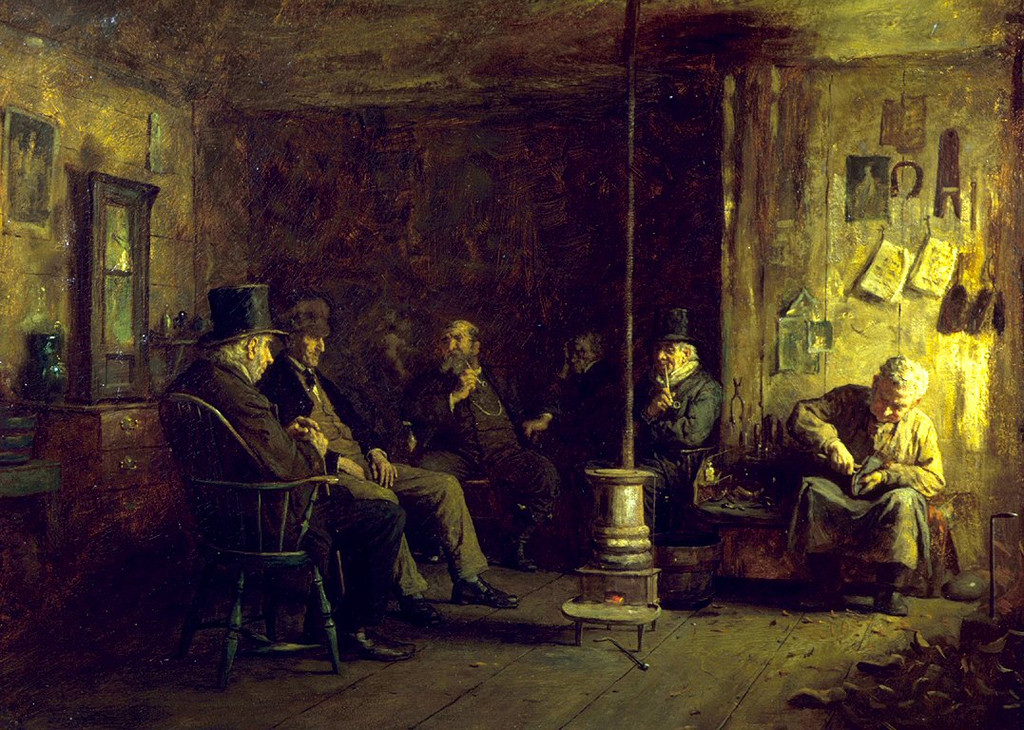
Portrait commissions increasingly occupied Johnson’s later career. The Nantucket School of Philosophy, painted in 1887, nevertheless shows that everyday gatherings remained part of his work. His activity continued into the early twentieth century. [1]
An American career shaped by European study
Johnson began as a portrait draughtsman in Maine, Washington and Boston. Longfellow’s household commissioned crayon likenesses from 1846, giving the young artist access to a circle of relatives and literary friends. The National Park Service records ten portraits in that series and a double portrait of the poet’s sons in 1848. [2]
European study followed in 1849. Düsseldorf and Emanuel Leutze supplied academic and studio experience; The Hague offered prolonged engagement with Dutch painting; Paris brought a period with Thomas Couture. Johnson returned to the United States in 1855 with a broader range of methods for making figures, light and interiors work together. [1]
His later American subjects cannot be separated neatly from that training. A room could carry the tonal richness associated with Dutch art while containing people and social relationships specific to the United States. Technical sophistication and local observation operated together rather than belonging to separate phases.
The biography follows the full chronology, including his Washington household, Lake Superior visits, marriage, Nantucket summers and later commissions. Here, the paintings provide routes through the recurring concerns that connect those periods.
Washington, slavery and the limits of a picture
The Washington setting of Negro Life at the South is essential to its meaning. John Davis reconstructs the yard’s relationship to Johnson’s family home and a particular city block. That argument brings the represented Black community into the capital’s urban geography, close to the institutions through which slavery was debated. [12]
The scene’s apparent ease does not establish the conditions of every life represented. Music, conversation and family care could occur within enslavement, while the city also contained free Black residents. Clothing, complexion and a position within the group cannot provide a complete legal or biographical identity for each figure.
This is one reason the painting generated opposed readings. A damaged building could support an indictment of slavery, while a pleasant interval of leisure could be used for reassurance. The same visible details entered different arguments, and an apparently sympathetic response might still depend on paternalistic expectations. Davis’s study and Patricia Hills’s scholarship make those differences part of looking at the work. [12] [13]
Kitchen at Mount Vernon offers an earlier setting in which people and deteriorated architecture share the picture. Its familiar title needs qualification, and its 1857 canvas should remain distinct from the 1864 board at Mount Vernon. The article follows those objects separately while asking how a famous estate was made into a domestic scene.
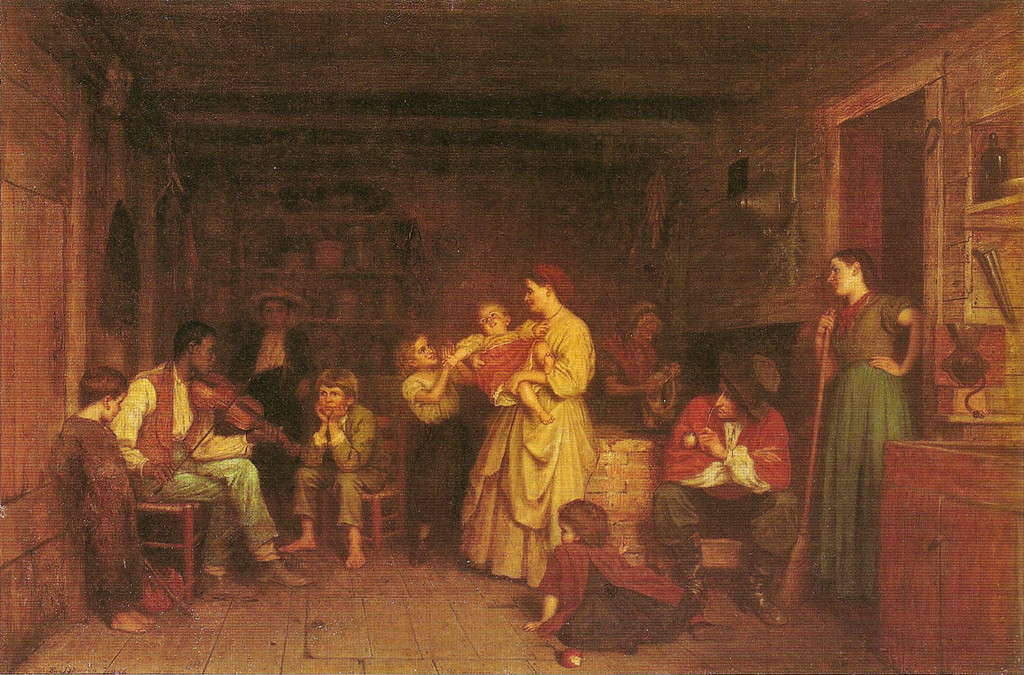
Fiddling His Way returns to music after the war. In the Chrysler canvas, a Black musician sits at the edge of a white household’s gathering. Hills reads that position through the limits of a welcome based on musical service and expectations of economic self-support. The scene’s conviviality gives a viewer something to examine, rather than settling whether its social relationships are equal. [13]
Eastman Johnson, Negro Life at the South, also known as Old Kentucky Home, 1859. Oil on linen, 94 × 116.8 cm. The New York Historical, The Robert L. Stuart Collection, the gift of his widow Mrs. Mary Stuart, S-225. Public domain faithful reproduction via WikiArt. The depicted yard is in Washington, D.C.
Image source
.
Public domain
.
War, care and the possibility of freedom
Johnson’s Civil War subjects often concentrate on people whose actions carry consequences beyond their immediate surroundings. The family in A Ride for Liberty acts to obtain freedom, while the reader in The Lord Is My Shepherd makes literacy visible within a modest room. Hills considers these works through agency, citizenship and the expectations placed on Black Americans. [13]
The distinction between a historical setting and a recovered biography remains important. Johnson’s recorded claim to have witnessed an escape does not give the riders names or a known outcome. Likewise, a man reading cannot be assigned an exact education or legal history solely from a painting’s date and title.
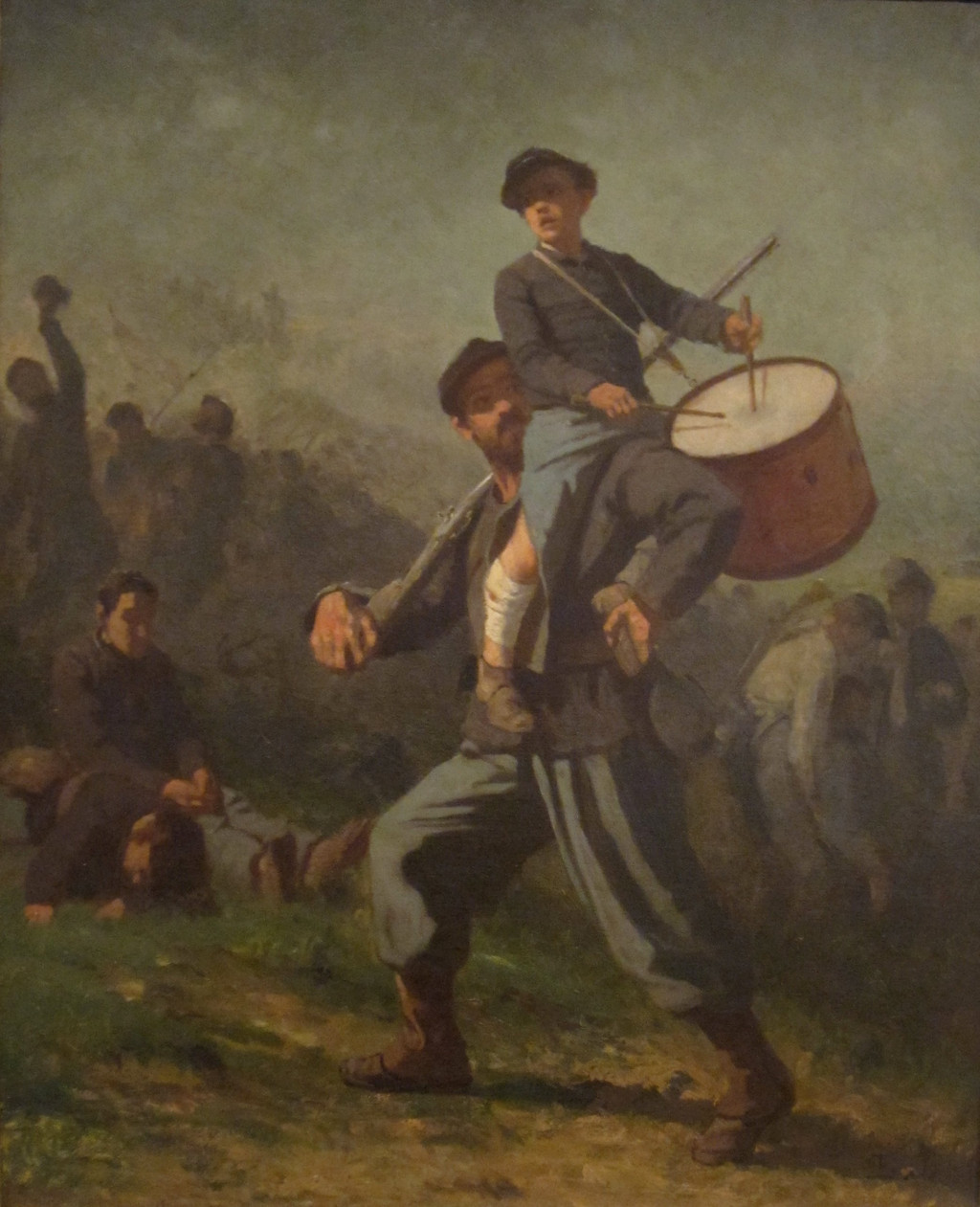
The Wounded Drummer Boy turns assistance into continued action: a soldier carries the injured child, who keeps performing. The Letter Home gives care a quieter form, with a woman writing beside a wounded man. Their different arrangements make support, dependence and the demands placed on an injured person visible.
The Girl I Left Behind Me adds an image of waiting and uncertainty. The books held close, streaming hair and steady profile make a clear figure against an unsettled distance. Its song-associated title opens a wartime connection without establishing that the painting was made during the conflict or that its unidentified model was a widow.
These works do not need a single label of optimism or tragedy. Johnson could make resolve visible while leaving the circumstances and consequences unresolved. The individual articles distinguish the studies, finished works, printed versions and later interpretations through which each subject is known.
Eastman Johnson, A Ride for Liberty—The Fugitive Slaves, about 1862. Oil on paperboard, 55.2 × 66.7 cm. Brooklyn Museum, Gift of Gwendolyn O. L. Conkling, 40.59a–b. Public domain faithful reproduction. The recorded eyewitness inscription belongs to the separate Virginia version.
Image source
.
Public domain
.
Nantucket: working, playing and gathering
Regular Nantucket summers from around 1870 gave Johnson a sustained setting for scenes of rural sociability. The island appears through children, harvest workers and older residents, while studies and studio arrangements helped shape the effect of everyday observation. [1]
In The Old Stagecoach , children turn a wrecked vehicle into a game of travel. Their climbing, pulling and riding distribute different roles around one object. Looking at who carries out which part of the game makes the play more complicated than a general image of carefree childhood.
Husking Bee organises a different gathering through paired rows extending into distance. Individuals remain visible within a repeated structure, and small foreground incidents keep the work from becoming a simple diagram of cooperation. The Chicago canvas and the Met study have separate dates, dimensions and collecting histories. [15]
The Cranberry Harvest disperses activity more widely. Baskets, small groups and figures moving across the field create connections without making everyone participate in one identical action. The series of studies and later history of the finished canvas reveal a composition developed and reconsidered over time. [14]
The Nantucket School of Philosophy makes conversation itself a subject. Several men occupy a cobbler’s workshop, with gestures and postures giving their exchange a structure. The Walters account records the artist’s reported identifications, but those names come through documentation rather than through the men’s faces alone. [11]
The island pictures can invite nostalgia, yet they also show how differently people participate in an activity. A quiet observer, a worker, a performer and a child may share a setting without sharing a role. That variation is often where Johnson’s social interest becomes most visible.
Maine and the unfinished Sugaring Off
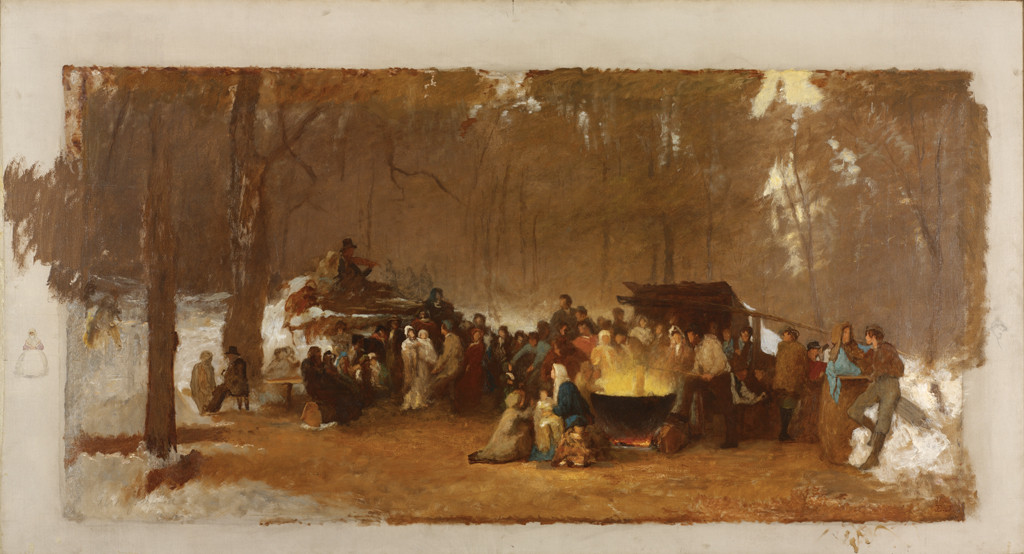
The maple-sugar subjects belong to Maine rather than Nantucket. Sugaring Off provides a broad outdoor gathering and a revealing unfinished surface. The RISD Museum’s discussion connects its tonal preparation and trial passages with Johnson’s response to Couture’s teaching. [16]
The exposed stages of work make the painting useful for understanding how an informal-looking crowd could be constructed. Some areas are more resolved than others, while the underlying arrangement remains open to revision. The incomplete state gives evidence of decisions without telling us why the artist stopped.
The article also treats The Sap Gatherers as a separately identified later work within this subject. Its size, support and reported collaboration should not be transferred to the large RISD canvas. Keeping related works together for comparison does not require making them one object.
Learning, books and concentrated attention
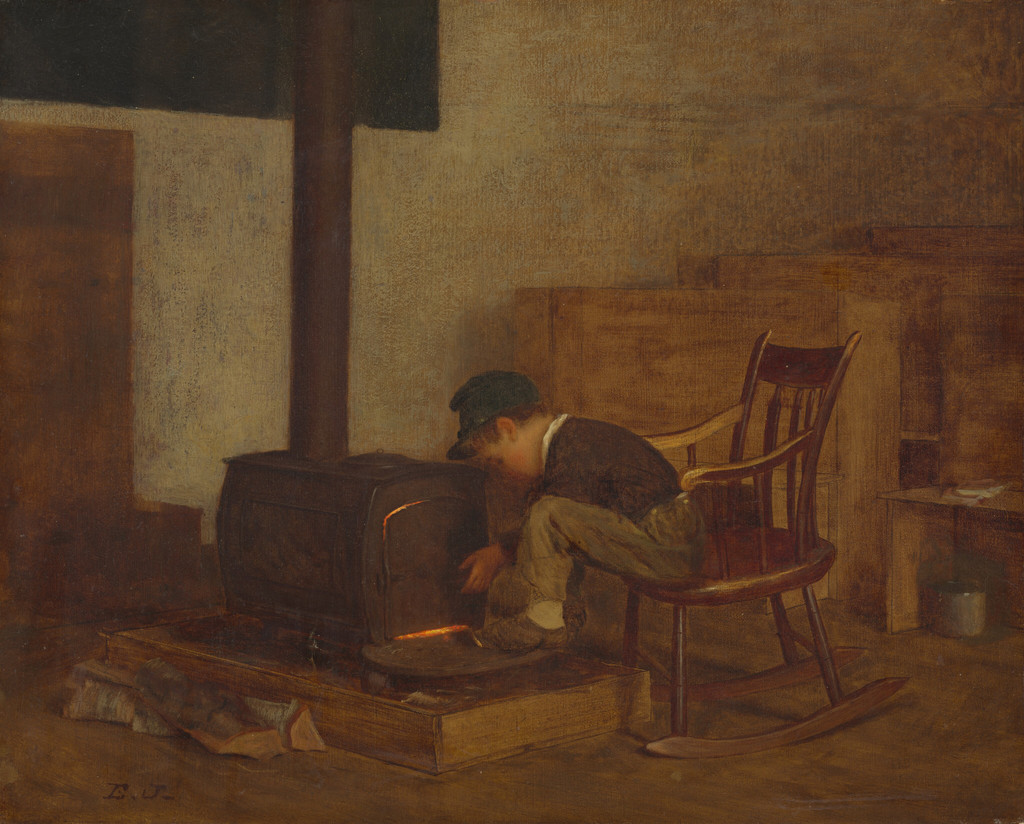
The Early Scholar gives a child’s absorbed attention a strong pictorial form within a dim classroom. A desk, the curve of a back and the distribution of light can carry the scene without a crowded narrative. Its studies and finished versions show Johnson revisiting the same central idea.
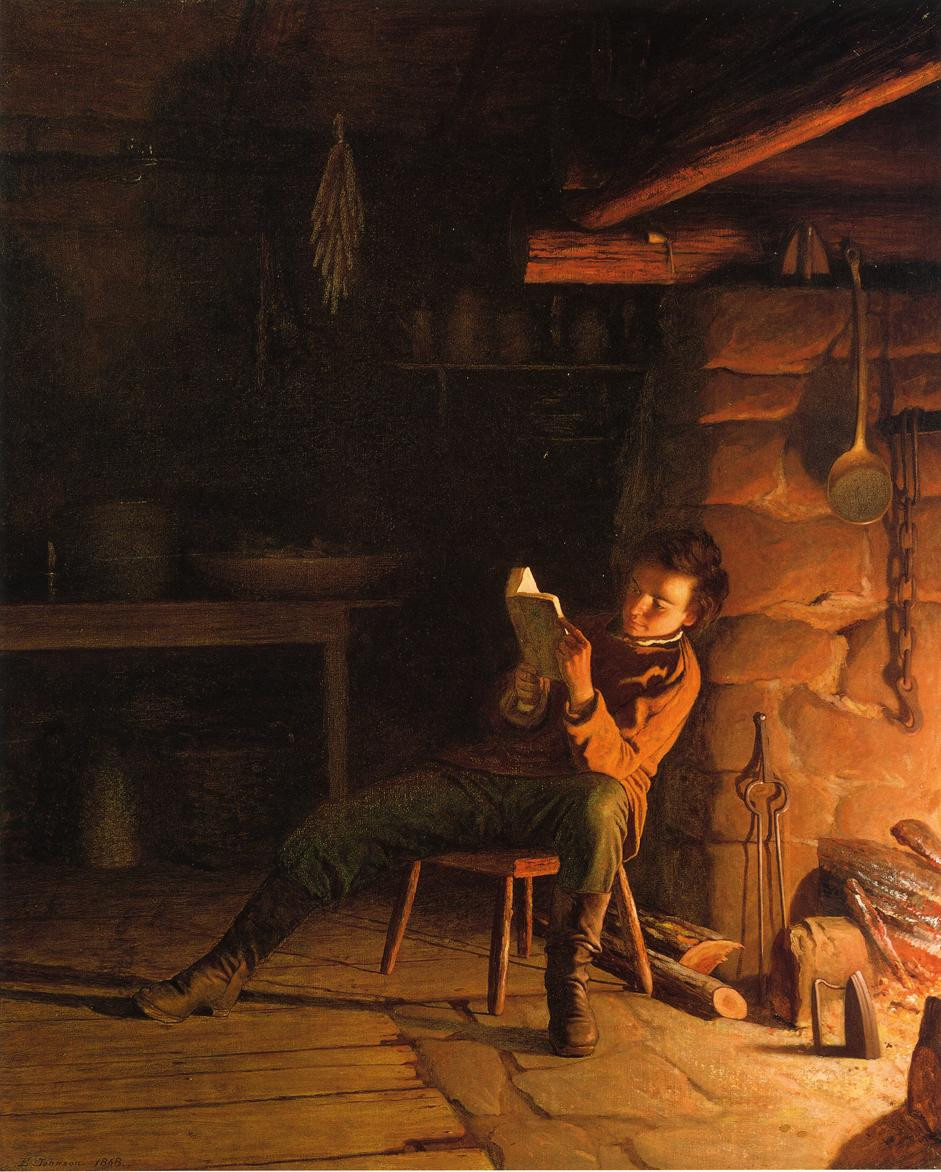
The Boyhood of Lincoln places reading beside a hearth within an imagined presidential childhood. The boy’s concentration becomes meaningful through the future identity known to the audience. The Michigan canvas, Kalamazoo board and Prang-related oil painting have to be distinguished from the reproductive print.
Placed beside The Lord Is My Shepherd , these pictures show that reading is not one interchangeable subject. An identified national figure, an unnamed older Black reader and a child at school bring different histories to the act. The shared posture of concentration makes the differences easier to compare.
Domestic interiors and women’s work
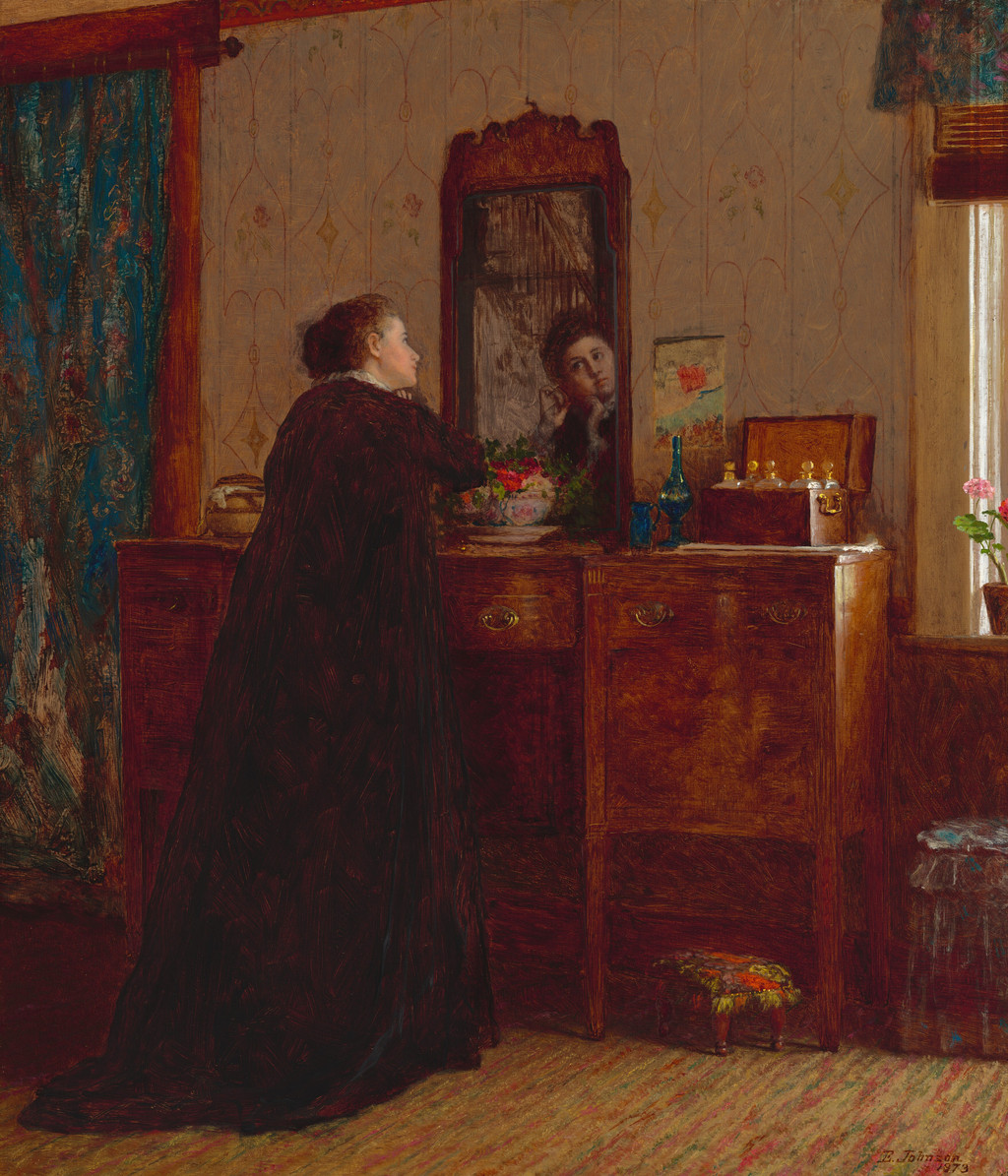
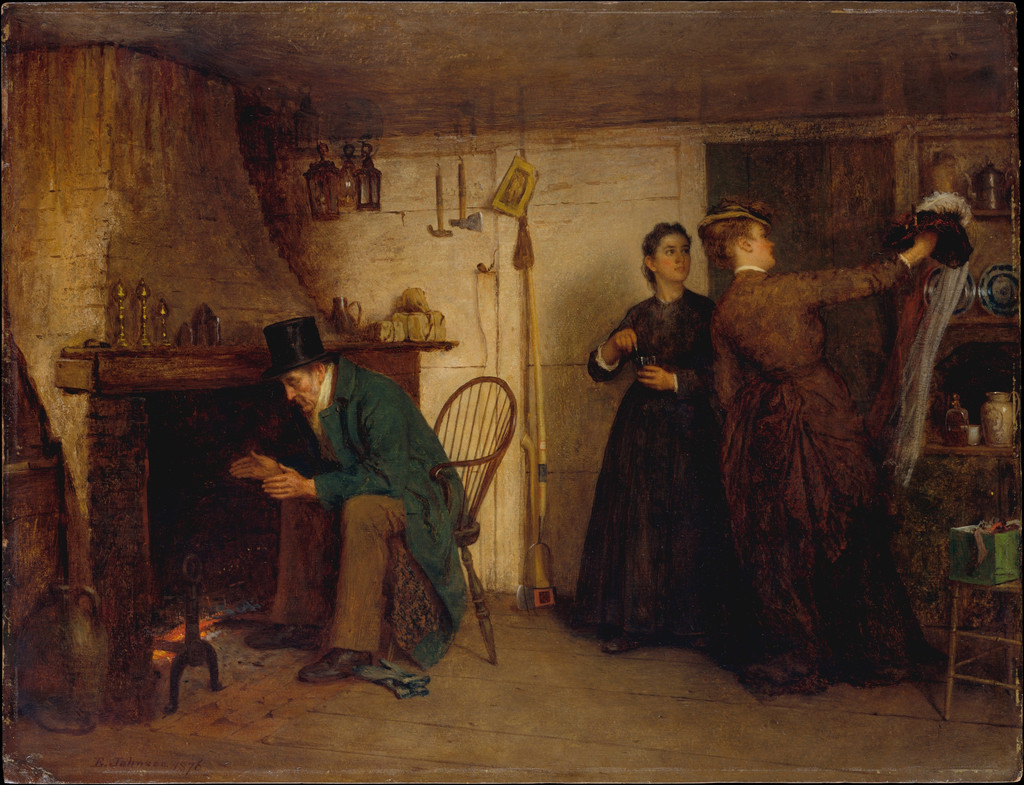
The New Bonnet draws attention to looking, preparation and work within a room. The Toilet uses furniture, a mirror and the relation between figures to make a domestic action into a carefully organised composition. The National Gallery’s account of the latter also considers its historically resonant furnishings. [17]
The titles can make the activities sound immediately familiar. Looking at the paintings slows that first recognition: which person performs an action, who watches, and how does furniture divide the space? Johnson’s interiors often depend on those relationships more than on a dramatic event.
They also reveal the limits of assigning identities from appearance. A persuasive scene of domestic intimacy does not prove that every figure is the artist’s wife or child. Object records, preparatory studies and letters provide a different kind of information from the expressions and gestures visible in the painting.
Watch: Eastman Johnson
Choose a film to explore the artist’s work, its interpretation and its wider setting.
Director's Choice - The Girl I Left Behind Me by Eastman Johnson
The Smithsonian American Art Museum looks at Johnson’s The Girl I Left Behind Me.
Watch on YouTubeFamily groups and a continuous portrait practice
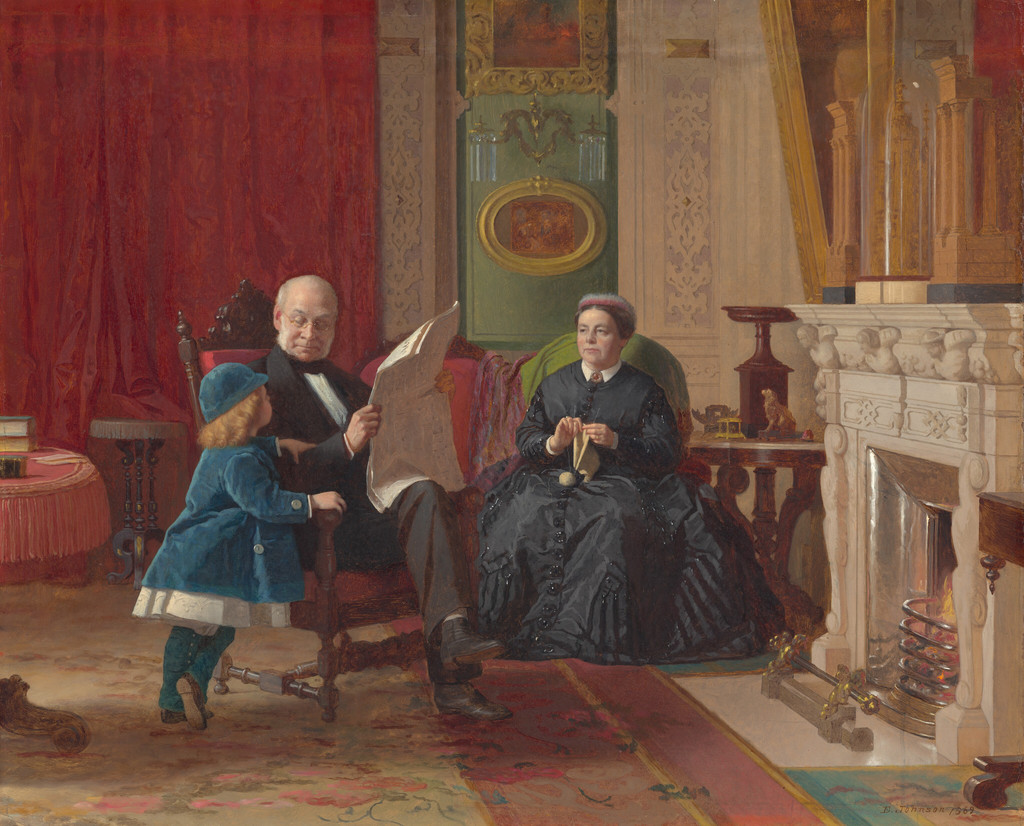
Johnson’s portraits were part of his work long before later public commissions became prominent. The Brown Family and The Hatch Family turn rooms into frameworks for relationships among named sitters. They combine likeness with the larger challenge of distributing people, objects and attention. [18] [19]
The Hatch group contains fifteen figures across three generations. Their differing activities allow the family to inhabit the library while the painter manages a substantial formal commission. The smaller National Gallery Brown version, meanwhile, complicates the assumption that a work on paper must be only a preliminary sketch. [18] [19]
The portrait of Sanford Robinson Gifford connects this practice with Johnson’s professional friendships. Dated 1880, it may be posthumous according to the Met. The available museum image is monochrome and should be read as such, with no invented account of the original colours. [3]
The studio photographs published in 1906 offer another way to see the portrait practice. Johnson appears beside large painted likenesses and the equipment of his work. They are documentary photographs of the artist and paintings, rather than photographs proving that the represented clients were present at the same moment. [20]
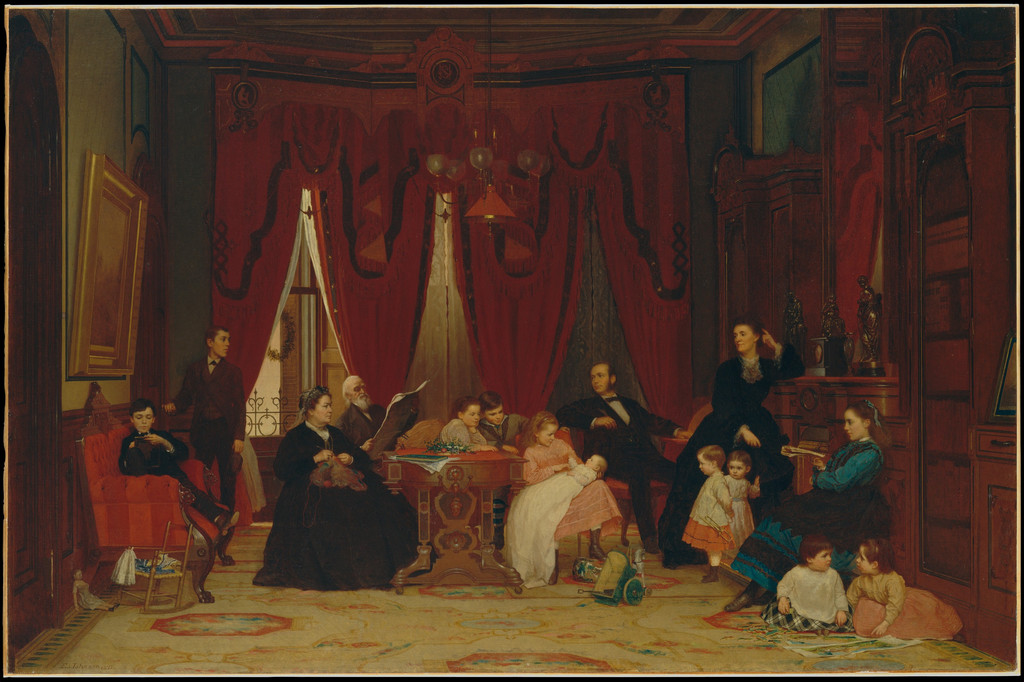
Eastman Johnson, The Hatch Family, 1870–71. Oil on canvas, 121.9 × 186.4 cm. The Metropolitan Museum of Art, Gift of Frederic H. Hatch, 1926, 26.97. Public domain.
Image source
.
Public domain
.
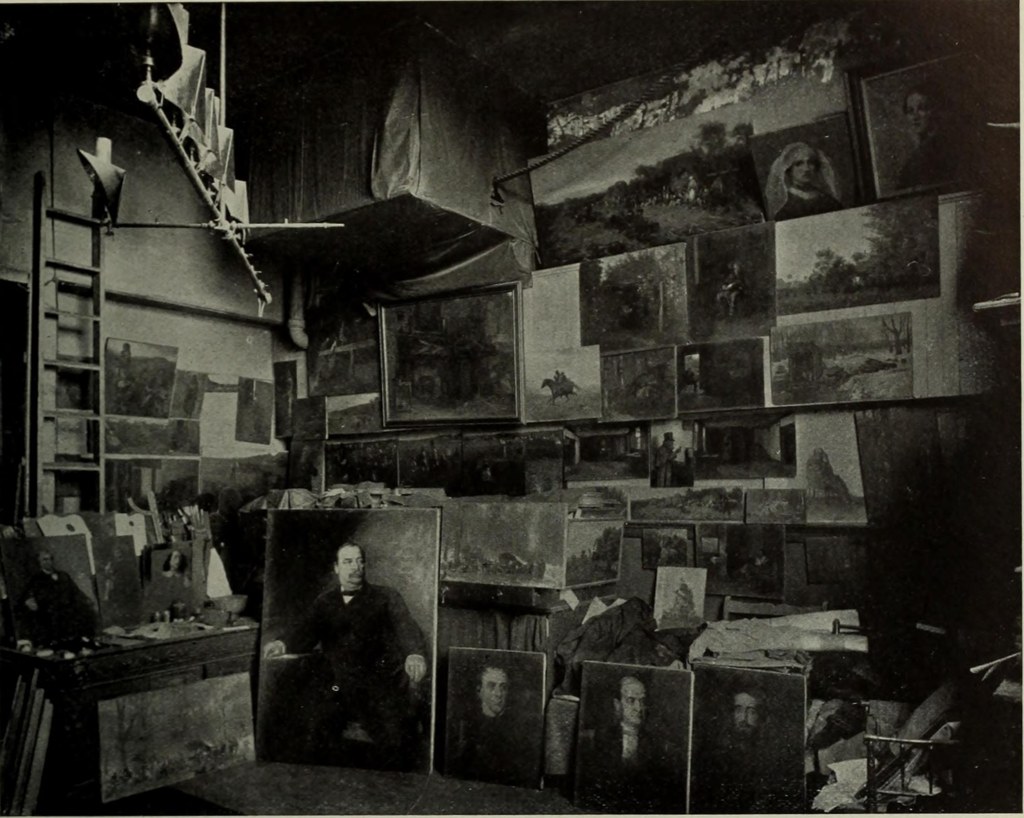
Eastman Johnson’s studio, photograph published in The World’s Work, December 1906, p. 8317. The Met catalogue identifies harvest studies in this view. Exact photograph date and photographer are not established. The World’s Work; Robarts Library, University of Toronto; Internet Archive. Public domain.
Image source
.
Public domain
.
Drawing and the making of an apparently informal scene
The separate drawings page follows commissioned crayon portraits, Ojibwe studies and Civil War-era sheets. It treats drawings as works with their own purposes, including substantial compositions such as The Letter Home , rather than assuming every sheet was a quick preparation for oil painting.
The technique page brings that work together with tonal preparation, underdrawing, transfer and revisions observed in individual paintings. It distinguishes museum examination findings from general accounts of Johnson’s methods. The variety of supports—paper, canvas and different boards—also prevents one simple material description from covering the entire career.
These practices help explain the convincing ease of many scenes. A figure may look momentary while preserving a carefully prepared drawing; a busy gathering may rest on repeated studies. Observation and construction work together in the final effect.
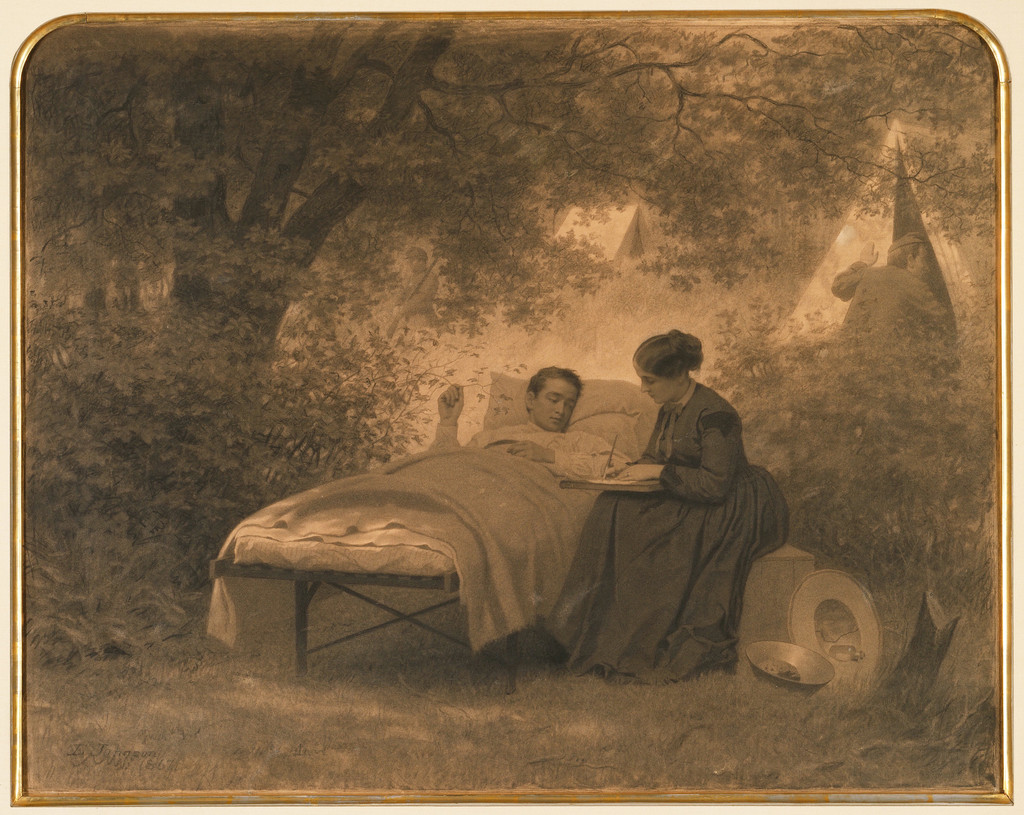
Eastman Johnson, The Letter Home, 1867. Charcoal and graphite on paper; image 60.96 × 76.2 cm, sheet 68.74 × 87.63 cm. Minneapolis Institute of Art, The Julia B. Bigelow Fund, 74.17. Public domain.
Image source
.
Public domain
.
Collections and useful comparisons
The works are distributed across collections, which makes the individual object record an important starting point. The Met’s Hatch group, New Bonnet and Gifford portrait bring family portraiture, a domestic encounter and an artist’s likeness into one institutional collection. Comparing them allows differences of purpose and scale to become as noticeable as a shared name on the label. [18] [3] [21]
The National Gallery’s Brown Family and Early Scholar offer another pairing: a richly furnished room occupied by named relatives and a child absorbed in a task. Their support structures and versions also make useful case studies in the difference between a museum’s physical object and the broader subject known from several pictures. [19] [22]
The Art Institute’s Husking Bee and the Timken’s Cranberry Harvest can be compared through their broad formats and repeated figures. The first draws the eye along rows; the second spreads activity across a field. Similar scale does not produce an identical account of communal work, and the preparatory studies complicate the apparent ease of both scenes. [14] [15]
The RISD Sugaring Off adds an unfinished large gathering to that comparison. Its less resolved passages offer a different kind of access to construction. Looking between these works can be more revealing than treating one finished harvest image as a complete summary of Johnson’s outdoor painting. [16]
Collection histories matter as well as subject groupings. A family gift, a collector’s bequest and a museum purchase bring works into public collections through different relationships. The Gifford portrait’s passage through the sitter’s widow and Richard Butler, for example, preserves a network of friendship and patronage alongside the painted face. [3]
Research and changing interpretations
Johnson’s catalogue raisonné provides entries for individual works, related versions, exhibitions and bibliographies. It is especially useful when a familiar title covers several objects. Looking up the exact collection and accession before following the related works helps prevent a study’s support or an inscription from being assigned to the wrong painting. [1]
Museum catalogues add a different level of detail. The Met’s 1985 volume and the National Gallery’s 1996 volume include longer discussions of sitters, ownership and physical evidence than a short label can carry. Their dates remain important: a technical note records an examination at a particular point, while a current collection record may give revised measurements or a changed title. [18] [19]
Historical writing can reveal how Johnson’s reputation was made. French’s 1906 article foregrounded the portraitist’s links with successive generations of public figures. The photographs it published preserve working settings, while its celebratory account requires the same care given to other retrospective recollections. A period source is valuable evidence of a viewpoint, even where later research corrects its details. [20]
The studies by Davis and Hills show why modern interpretation also needs attribution. Their accounts examine the relation between visual form, racial representation, location and audience. Bringing those arguments alongside object records allows disagreement to remain visible, instead of replacing one inherited certainty with another. [12] [13]
Finding a route through the works
For a first visit, begin with the Washington yard, the escape scene and the cranberry harvest. Follow the linked articles for the exact object, its images, numbered sources and the distinctions between related versions. The broader themes then provide useful comparisons across subjects that initially seem far apart.
Readers interested in intimate interiors can move through The Early Scholar , The Lord Is My Shepherd , The New Bonnet and The Toilet . Those interested in collective activity can compare Husking Bee , Sugaring Off and the stagecoach game. The portrait groups offer another route into the problem of arranging people within a shared space.
Johnson belongs within the larger history of American artists , with American Realism providing a useful context for his attention to contemporary people and settings. His friendships with landscape painters are part of that artistic world, but the pictures considered here reward a focus on figures, social encounters and the making of everyday scenes.
The most productive question is often a concrete one: who acts, who watches, who occupies the edge and what does the setting allow us to see? Following those details keeps Johnson’s art visually specific while opening the histories of freedom, labour, family and public memory that surround it.
Essential Eastman Johnson works
Negro Life at the South
1859; New York Historical original · A Washington yard brings everyday encounters into the contested setting of slavery.
A Ride for Liberty—The Fugitive Slaves
About 1862; Brooklyn version · A family’s movement towards freedom carries the whole composition.
The Cranberry Harvest, Island of Nantucket
1880; Timken canvas · Repeated working figures spread across a panoramic field beneath an expansive sky.
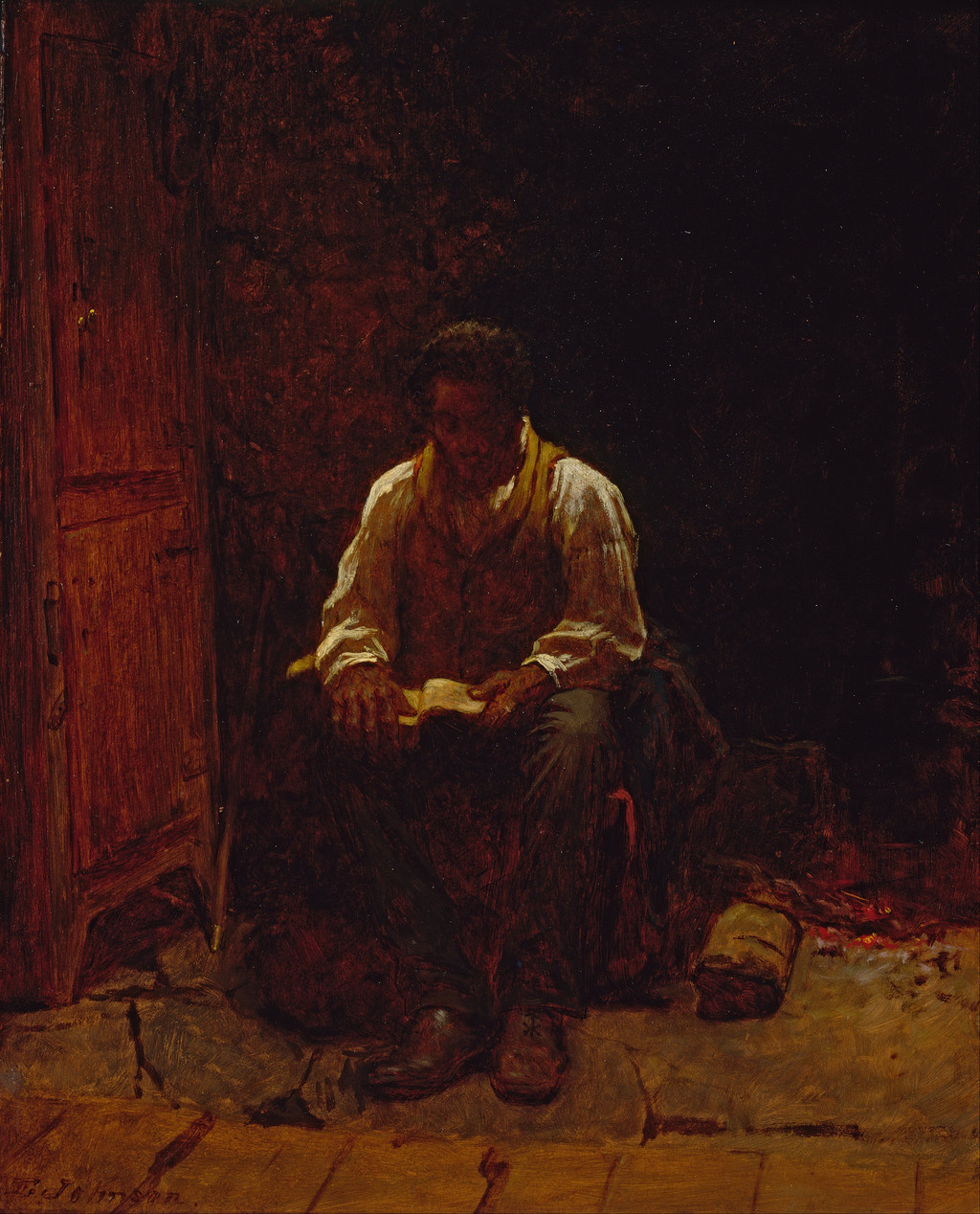
The Lord Is My Shepherd
1863 · A lowered head and open book concentrate attention within a dark room.
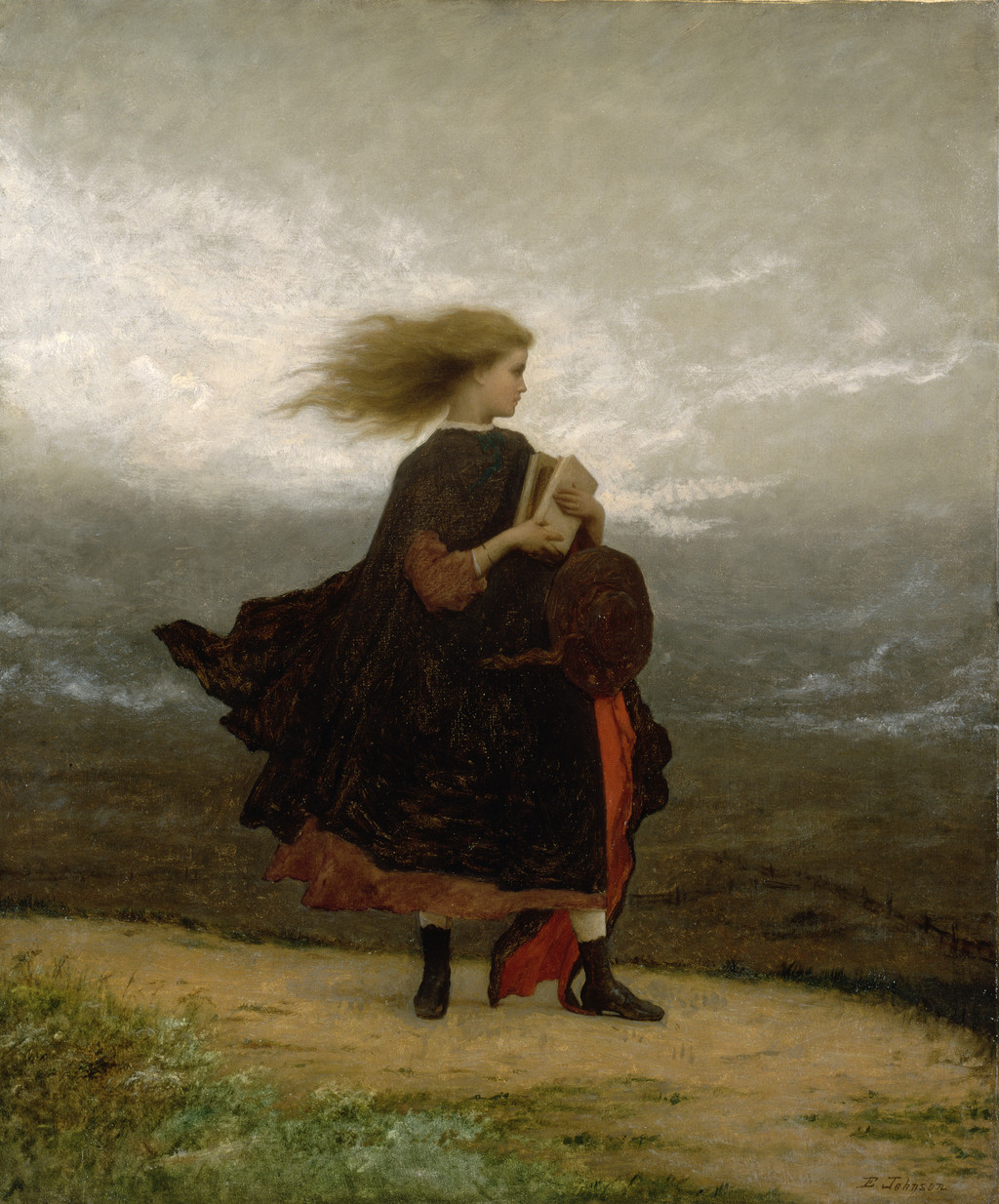
The Girl I Left Behind Me
About 1872 · A still figure, books and wind-driven clothing hold competing directions of attention.
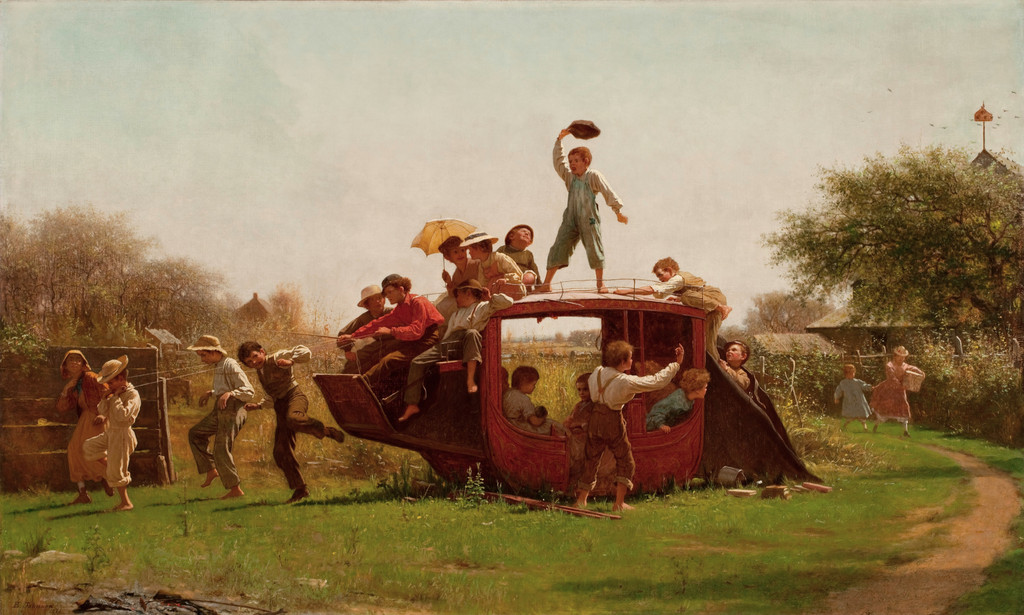
The Old Stagecoach
1871 · Children give a broken vehicle a new purpose through play.
The Hatch Family
1870–71 · Fifteen figures inhabit a library through a carefully distributed set of activities.
The Nantucket School of Philosophy
1887 · A shoemaker’s shop becomes a place for work, company and conversation.
Artworks directory
Browse twenty-one selected objects discussed in these articles, including the Gifford portrait and the Prang print after Johnson. Dates identify individual objects, including the San Diego Drummer Boy study. Use All media to include the chromolithograph.
| Name | Date | Medium |
|---|---|---|
| Kitchen at Mount Vernon | 1857; Charles Butt canvas | Oil on canvas |
| Negro Life at the South | 1859; New York Historical original | Oil on linen |
| A Ride for Liberty—The Fugitive Slaves | About 1862; Brooklyn version | Oil on paperboard |
| The Lord Is My Shepherd | 1863 | Oil on fiberboard |
| Sugaring Off | About 1864–65; unfinished RISD canvas | Oil on canvas |
| The Wounded Drummer Boy (San Diego study) | About 1864–71; study, not the finished canvas | Oil on board |
| The Early Scholar | About 1865; NGA study | Oil on academy board on canvas |
| Fiddling His Way | 1866; Chrysler canvas | Oil on canvas |
| The Letter Home | 1867; Minneapolis drawing | Charcoal and graphite on paper |
| The Boyhood of Lincoln | 1868; Michigan canvas | Oil on canvas |
| The boyhood of Lincoln—An evening in the log hut (Prang after Johnson) | About 1868; separate reproductive print | Chromolithograph, W. Harring / L. Prang & Co., after Johnson |
| The Brown Family | 1869; NGA version | Oil on paper on canvas |
| The Hatch Family | 1870–71 | Oil on canvas |
| The Old Stagecoach | 1871 | Oil on canvas |
| The Girl I Left Behind Me | About 1872 | Oil on canvas |
| The Toilet | 1873 | Oil on paper board |
| Husking Bee, Island of Nantucket | 1876; Chicago canvas | Oil on canvas |
| The New Bonnet | 1876 | Oil on academy board |
| Sanford Robinson Gifford | 1880; possibly posthumous | Oil on academy board |
| The Cranberry Harvest, Island of Nantucket | 1880; Timken canvas | Oil on canvas |
| The Nantucket School of Philosophy | 1887 | Oil on panel |
Frequently Asked Questions
He is known for genre paintings of American life, including Negro Life at the South, A Ride for Liberty and Nantucket harvest scenes, alongside substantial portrait and drawing practices. [1]
Old Kentucky Home is the familiar alternative title for his 1859 Negro Life at the South. The actual setting is a Washington, D.C. yard. [12]
The three opening selections offer contrasting subjects and formats. Use their individual articles to distinguish exact museum objects, studies and later versions before moving through the thematic routes.
Discussion
Look again at the images and ideas explored in Eastman Johnson: Paintings, Drawings and American Life. These editorial prompts invite your observations.
Reader Insights
Compare the yard, the escape and the harvest. How does each arrangement direct your attention towards particular people?
Which interior changes most when you follow the direction of every figure’s gaze? Explain the visual evidence.
Choose two works with different subjects. What shared use of light, gesture or space makes the comparison useful?
Join the Conversation
Share a detail, comparison or question about Eastman Johnson: Paintings, Drawings and American Life below.
References
- Patricia Hills and Abigael MacGibeny , About Eastman Johnson, Eastman Johnson Catalogue Raisonné. Career, European study, genres, Nantucket and institutions. View source
- National Park Service , Longfellow House Fine Art Collection. Early crayon commissions and the 1848 double portrait. View source
- The Metropolitan Museum of Art , Sanford Robinson Gifford, 1880, 88.16. Professional friendship, object identity and possible posthumous execution. View source
- Negro Life at the South,1859,S-225. View source
- A Ride for Liberty–The Fugitive Slaves, Brooklyn version, Hills 10.0.11r. View source
- The Lord Is My Shepherd, 1863, 1979.5.13. View source
- The Hatch Family, 1870–71, 26.97. View source
- The Old Stagecoach, 1871, L1888.22. View source
- The Girl I Left Behind Me, c.1872, 1986.79. View source
- The Cranberry Harvest, Island of Nantucket, 1880, 1972:002. View source
- Walters Art Museum , The Nantucket School of Philosophy, 37.311. Workshop, reported identifications and object information. View source
- John Davis , Eastman Johnson’s Negro Life at the South and Urban Slavery in Washington, D.C., The Art Bulletin 80, no. 1, 1998, pp. 67–92. Washington geography, urban slavery, title and divided reception. View source
- Patricia Hills , Painting Race: Eastman Johnson’s Pictures of Slaves, Ex-Slaves, and Freedmen, in Eastman Johnson: Painting America, 1999, selected consulted sections, particularly pp. 136, 140, 148, 150–151. Agency, literacy, representation and postwar musical encounters; no claim of full essay consultation. View source
- Hills and MacGibeny , The Cranberry Harvest, Island of Nantucket, 1880, Hills no. 26.4.11. Finished canvas, studies, exhibitions and physical history. View source
- Art Institute of Chicago , Husking Bee, Island of Nantucket, API object 81564. Final canvas, interpretation and collection history. Museum description attributed to the Art Institute, CC BY 4.0; object data and image follow the separate CC0 terms recorded for the accepted image. View source 1 · View source 2
- Maureen C. O’Brien , New Ways to Paint: Sugaring Off, RISD Museum, 2014. Unfinished composition, studies and Couture-related preparation. View source
- Laura Groves Napolitano , The Toilet, in Corcoran Gallery of Art: American Paintings to 1945, 2011, pp. 136–137 and notes p. 267. Domestic composition, furnishings and attributed interpretations. View source
- Natalie Spassky and others , American Paintings in The Metropolitan Museum of Art, Volume II, 1985, pp. 223–225. Hatch family group, sitters, setting and later testimony. View source
- National Gallery of Art , American Paintings of the Nineteenth Century, Part I, pp. 376–382. Brown family versions, materials and reception. View source
- Edgar French , An American Portrait Painter of Three Historical Epochs, The World’s Work 13, no. 2, December 1906, pp. 8307–8323. Retrospective portrait account and studio photographs; publication date is not an established exposure date. View source
- Spassky and others , American Paintings in The Metropolitan Museum of Art, Volume II, pp. 229–232. New Bonnet object and preparatory-work discussion. View source
- National Gallery of Art , American Paintings of the Nineteenth Century, Part I, pp. 373–376. The Early Scholar, its versions, support and examination history. View source
- Splash image source.
Eastman Johnson, The Cranberry Harvest, Island of Nantucket, 1880. Oil on canvas, 69.5 × 138.4 cm. Putnam Foundation, Timken Museum of Art, 1972:002. Public domain faithful reproduction. Public domain .
View source - George Michael Cohen, A Regional Study of American Genre Painting from 1830–1880 (Boston University, 1962). This is a period of nineteenth-century prominence, not an end date for the genre. View source
- US National Park Service, Henry Wadsworth Longfellow: 1807–1882. Artist life dates. View source
- National Gallery, London, Thomas Couture: 1815–1879. Artist life dates. View source
- Smithsonian American Art Museum, Emanuel Leutze: 1816–1868. Artist life dates. View source
- US National Park Service, Sanford Robinson Gifford: 1823–1880. Artist life dates. View source
- New Britain Museum of American Art, Eastman Johnson: 1824–1906. Artist life dates. View source