


 by
Tom Gurney
Tom Gurney BSc (Hons) is an art history expert with over 20 years experience
Email:
tomgurney1@gmail.com
/ Phone:
+44 7429 011000
Emanuel Leutze: Introduction
Emanuel Leutze made history painting an art of people acting together. His most famous canvas, Washington Crossing the Delaware , gathers a commander and working boatmen into an image of revolutionary resolve. Elsewhere, a royal court watches Henry VIII approach Anne Boleyn, travellers climb towards the American West, and diplomats consider the purchase of Alaska. These scenes differ in place and period, but each asks how an important action can be made visible through a group of figures. [1] [4] [6]
Born in Germany in 1816 and raised in Philadelphia, Leutze developed his mature work in Düsseldorf before returning to the United States in 1859. Portraiture, European art, political convictions and American patrons all contributed to his career. His famous Washington painting is a starting point for understanding that career, alongside the less familiar pictures that reveal its range. [1]
At a Glance
- Full name Emanuel Gottlieb Leutze
- Lived 1816–1868
- Born Schwäbisch Gmünd, Württemberg, now Germany
- Raised Philadelphia, following the family’s migration in 1825
- Principal European centre Düsseldorf
- Fields History painting, portraits and public murals
- Famous painting Washington Crossing the Delaware , 1851
- Major public work Westward the Course of Empire Takes Its Way , U.S. Capitol, 1861–62
- Context German-American art, the Düsseldorf School and nineteenth-century history painting
Emanuel Leutze in context
Bars show approximate historical periods. c. means circa (about).
Romanticism
c. 1800–1850 [14]Düsseldorf School
c. 1819–1918 [15]Notes and sources
Romanticism. Imagination and emotional historical subjects belong to the wider early nineteenth-century context. Kathryn Calley Galitz, Met.
Düsseldorf School. Leutze in Düsseldorf, 1841–1858. Academy training and an independent studio formed overlapping parts of his German career. [1]
Each bar runs from the artist’s birth to their death.
Emanuel Leutze
1816–1868 · Birth–death [16]Worthington Whittredge
1820–1910 · Birth–death [17]Eastman Johnson
1824–1906 · Birth–death [18]Albert Bierstadt
1830–1902 · Birth–death [19]Notes and sources
Emanuel Leutze. The deeper chronology follows his migration, training and public commissions. [1]
Worthington Whittredge. Leutze’s friend and model, also the subject of his 1856 portrait. Met life dates.
Eastman Johnson. A studio colleague who made a reduced copy for the Delaware engraving. Smithsonian life dates.
Albert Bierstadt. An American painter associated with Leutze’s Düsseldorf community. Met life dates.
Washington Rallying the Troops at Monmouth
1857 replica; original 1854Westward the Course of Empire Takes Its Way
1861 (oil study); mural 1861–62Signing of the Alaska Treaty
c. 1867Contents
- American history between two countries
- Philadelphia beginnings
- Düsseldorf and political ambition
- Washington and the public picture
- Portraits and European subjects
- The Capitol and later commissions
- Looking beyond the national icon
American history between two countries
Leutze belongs to the history of American artists , but his career cannot be understood entirely within American borders. His family’s move to Philadelphia gave him an American upbringing and his first professional opportunities. His return to Europe brought further study, a German home and a studio community. Pictures about the United States could consequently be designed and painted in Düsseldorf for patrons and viewers across the Atlantic. [1]
This movement between places shaped more than the practical location of his easel. American revolutionary history offered Leutze material for a public art concerned with liberty and political change. European history supplied encounters involving monarchs, reformers and religious authority. His subjects could address the interests of different audiences while remaining connected through questions about power, action and conviction.
The Düsseldorf School provided a substantial setting for such work. Its academy and independent studios encouraged attention to narrative, expressive figures and historical detail. Leutze developed within that environment without following every academic restriction. He established an independent studio and participated in artistic associations, drawing American visitors into a community whose importance extended beyond formal instruction. [1]
His place within nineteenth-century history painting is therefore particularly useful. This field brings portrait skills, costume, setting and a chosen incident together in one composition. The result can offer an interpretation of the past without reproducing every documented detail. Leutze’s art repeatedly turns a complicated history into a concentrated encounter that viewers can examine as a group of relationships.
The historical event, the artist’s own period and the later life of the picture remain distinct. Washington crossed the river in 1776; Leutze completed the famous Met canvas in 1851; later audiences have encountered it through museums, prints and other reproductions. Recognising these different times helps explain how an old event could become a nineteenth-century national image and subsequently a subject of renewed argument. [3]
Four stages of Emanuel Leutze’s career
These periods group related developments; painting, travel and local work overlap across their boundaries.
Portraits and patrons
Family migration, John Rubens Smith’s instruction, portrait commissions and patrons in Philadelphia preceded the 1841 European journey. [1]
Academy, travel and independence
Düsseldorf study, travels in Germany and Italy, an independent studio and marriage to Juliane Lottner enlarged the artist’s work. [1]
Washington and the Düsseldorf studio
The two monumental Delaware versions, the 1851–52 American visit and artistic friendships gave historical painting an international public life. [5]
The Capitol and diplomatic history
Work in New York and Washington included the 1861–62 Capitol mural, continuing portraits and the Alaska treaty painting of about 1867. [1]
Philadelphia beginnings
Leutze’s first professional field was portraiture. His family settled in Philadelphia after migrating in 1825, and by 1834 he was studying with the drawing master John Rubens Smith. Portrait commissions introduced him to the practical work of establishing a likeness, representing a sitter and finding customers. Before becoming a painter of monumental historical scenes, he had to succeed with individual people at a much smaller scale. [1]
Work associated with an illustrated national portrait publication brought public figures into his early career. The financial difficulties of the late 1830s disrupted those opportunities, and Leutze travelled as a portrait painter before returning to Philadelphia. These beginnings placed him within networks of publishers, exhibitions and patrons. The public reach of an image mattered well before he produced his most famous composition. [1]
His portraits and other early subjects attracted support from Edward L. Carey and Joseph Sill, who helped make further European study possible. He reached Amsterdam in January 1841 and proceeded to Düsseldorf. The move enlarged his training and opportunities, but it did not remove portraiture from his practice. That field continued beside his increasingly ambitious historical work. [1]
The biography follows these journeys and changing sources of support in greater detail. They provide a useful context for a career often remembered through one enormous canvas. Patrons, colleagues and the demands of earning a living contributed to Leutze’s choices alongside his artistic and political ambitions.
Düsseldorf and political ambition
Düsseldorf gave Leutze a setting in which a promising portrait painter could become an internationally recognised historical artist. Early Columbus subjects attracted favourable attention and purchases in Europe and America. His training was followed by an independent studio, while travels in Germany and Italy broadened the examples available to him. He studied forceful figure compositions as well as the colour and presence of Venetian painting. [1]
Political questions were closely connected with this development. Leutze supported liberal aspirations during the revolutionary period of 1848 and became involved in the city’s artistic organisations. American independence could provide an earlier example through which German audiences considered political change. His revolutionary subjects were not confined to a single national audience or a single moment of patriotic remembrance. [1]
He also offered friendship and practical support to Americans studying in Düsseldorf. Worthington Whittredge and Eastman Johnson were among the artists associated with his studio. Their involvement in Washington Crossing the Delaware demonstrates the value of those relationships: models, colleagues and work intended for reproduction helped bring the large picture into being. The studio was a place of shared activity as well as individual ambition. [5]
Leutze’s enthusiasm for historical action did not require him to record every stage of an event. In the letters and critical discussion preserved by Henry T. Tuckerman, the artist’s concern is the idea a picture can convey through a selected incident. A meeting, a confrontation or a crossing becomes a way to make a larger argument accessible through visible bodies and gestures. [2]
This background gives his dramatic arrangements a purpose beyond spectacle. It also calls for care when interpreting them. A painter’s liberal commitments do not make every representation historically exact or politically inclusive. The relationships between Düsseldorf and American history include both the possibilities of international exchange and the limits of nineteenth-century ideas about freedom and progress.
Washington and the public picture
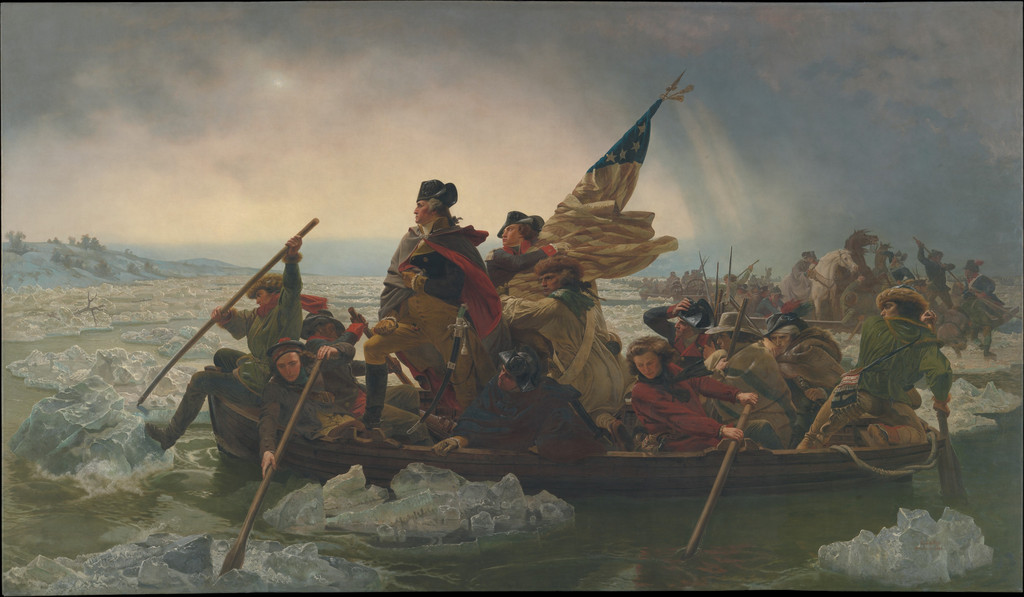
Washington Crossing the Delaware is Leutze’s defining work because it combines an immediately recognisable leader with a complicated shared effort. Washington stands above the boat’s other occupants, while the men around him row, steer, brace themselves and contend with the river. His composure becomes conspicuous against their activity. The flag provides a national emblem, but the movement depends on the bodies and equipment beneath it.
The Met’s canvas, completed in 1851, measures 378.5 by 647.7 centimetres. At that scale, the foreground figures can be examined as substantial individual presences. A small reproduction may deliver Washington and the flag almost immediately; the large painting leaves room for a spectator to attend to clothing, hands, oars, ice and the boats in the distance. Monumentality gives the familiar image a more varied physical experience. [3]
It is also an image with a complicated material history. A fire damaged Leutze’s first large version in 1850; that painting later entered the Kunsthalle Bremen and was destroyed in 1942. The surviving Met canvas is the second monumental treatment. Smaller related works, an engraver’s copy and later reproductions belong to different categories. They should not be treated as interchangeable originals simply because they show a similar arrangement. [5]
The historical crossing took place on the night of 25–26 December 1776. Leutze’s bright, carefully arranged scene is not an eyewitness account of it. The flag is anachronistic, the precise vessel Washington used remains uncertain, and familiar identifications of some passengers cannot be proved. Such distinctions allow the real operation and the later act of commemoration to be understood together. [7] [8]
Its public reputation grew through exhibitions and printed circulation. The image could confront an audience as a monumental canvas and then enter other settings through reproduction. Museum acquisition, conservation and the recreation of its elaborate frame added later chapters to that history. The dedicated Washington article explores the painting’s figures, design, versions, technical evidence and changing interpretations.
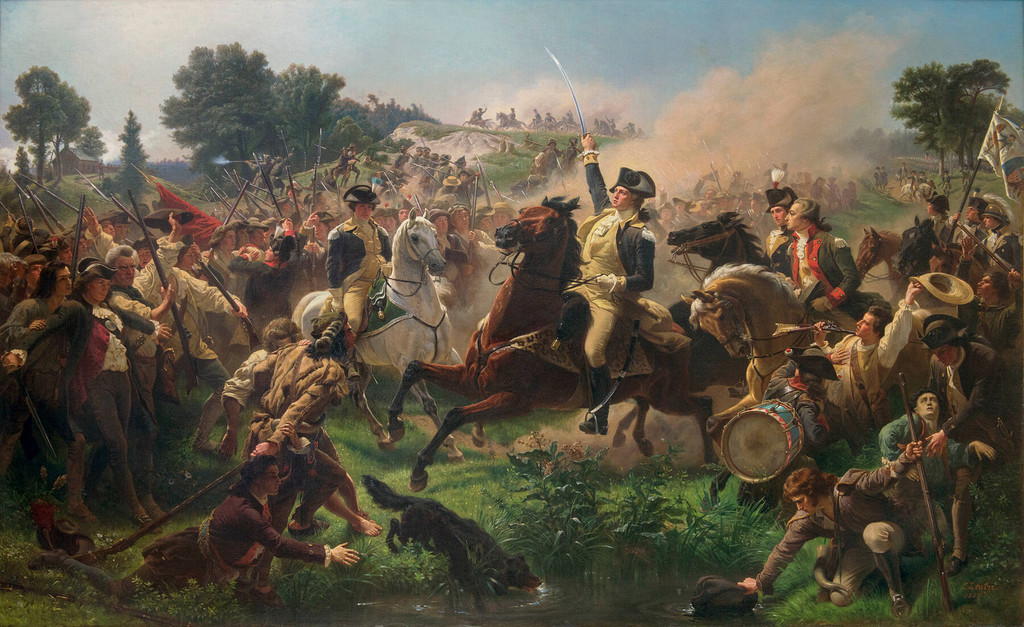
Leutze also painted Washington rallying troops at Monmouth, choosing another moment when leadership could be represented through a crowded group. That composition shifts attention from an anticipated operation to intervention amid disorder. Comparing the Washington subjects reveals how changing the selected action changes the relationships between commander, soldiers and spectators. It also expands Leutze’s Revolutionary work beyond the boat everyone recognises. [1]
Watch: Emanuel Leutze
Choose a film to explore the artist’s work, its interpretation and its wider setting.
It's not only about the American Revolution, Leutze's Washington Crossing the Delaware
Smarthistory considers the ideas and historical distance behind Washington Crossing the Delaware.
Watch on YouTubePortraits and European subjects
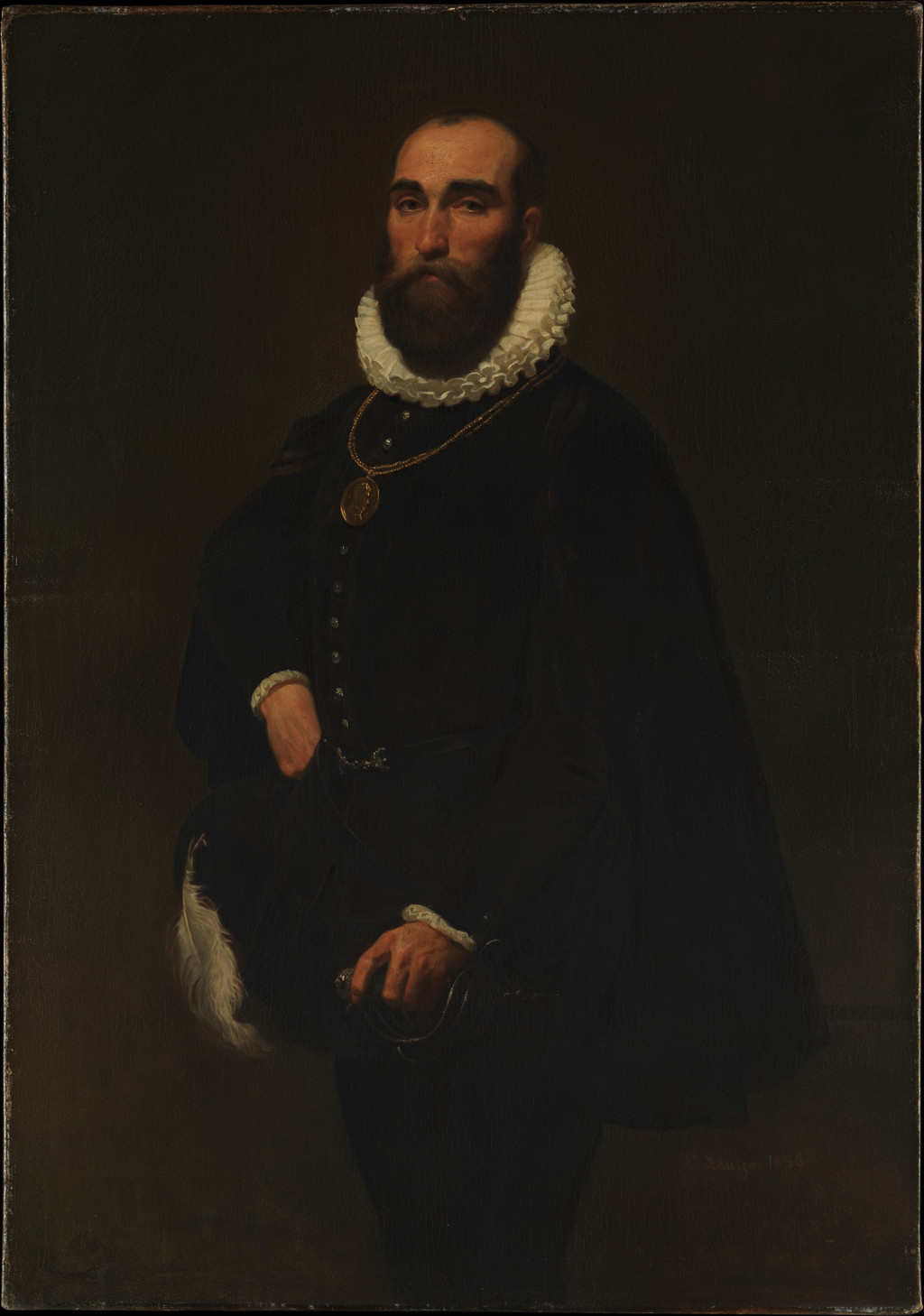
The portrait of Worthington Whittredge brings a different kind of historical imagination into view. Painted in 1856, it represents a living fellow artist in elaborate period costume. The ruff, chain and dark clothing recall an earlier portrait tradition, while the face belongs to someone within Leutze’s own artistic circle. A contemporary friendship and an interest in the appearance of the past meet in one picture. [9]
Family provided other subjects. The double portrait The Amber Necklace , painted in 1847, shows his wife Juliane with their daughter Ida. The museum in Schwäbisch Gmünd has also documented portraits of relatives including Maria and Heinrich Lottner. These works establish an important personal dimension to his production. They invite attention to likeness, light and the relationship between sitters rather than to a famous public event. [10]
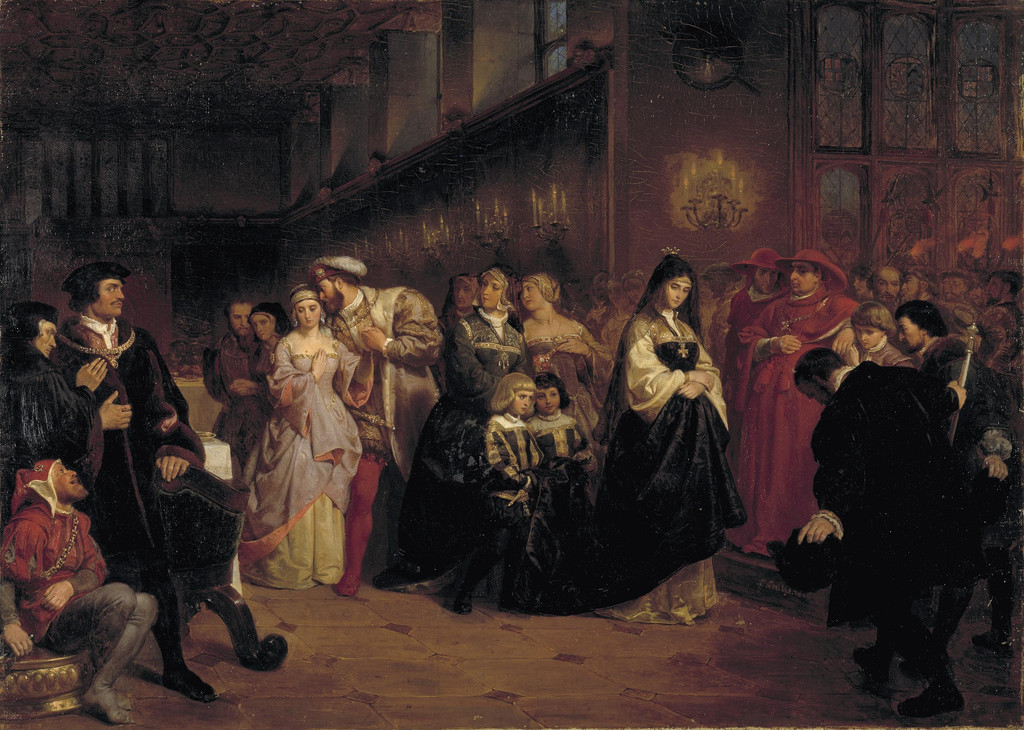
The European historical pictures move between those scales of interest. In The Courtship of Anne Boleyn , Henry’s attention to Anne takes place before other people whose reactions differ. Leutze makes a personal relationship visible as a public situation. The surrounding figures give the spectator several ways to encounter the royal action, rather than presenting courtship as an isolated exchange. [4]
The Smithsonian suggests that the subject may reflect Leutze’s distaste for royalty. That is a qualified interpretation, not a recorded explanation for every choice within the painting. The visible scene supports discussion of attention, power and disagreement, while its particular political meaning requires care. Leutze’s historical figures are constructed through nineteenth-century painting, even when their identities belong to a much earlier world. [4]
The paintings , portraits and drawings and prints offer different routes into this range. A portrait is not the same kind of object as a scene containing historical personalities, and a print after Leutze has its own maker and medium. Keeping those distinctions clear makes the variety of his work easier to understand.
Emanuel Leutze, Worthington Whittredge, 1856. Metropolitan Museum of Art, 03.16. Gift of several gentlemen, 1903. The Metropolitan Museum of Art.
Image source
.
CC0 / Public domain
. Resized only; native appearance, complete image and margins preserved.
The Capitol and later commissions
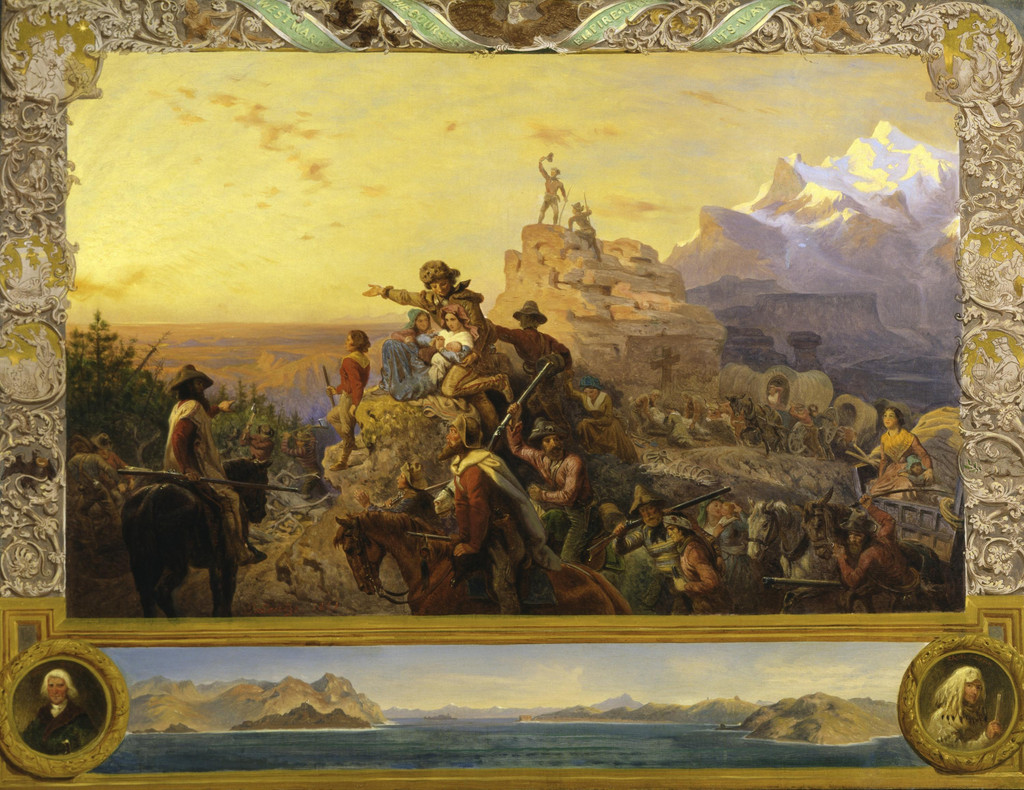
Leutze’s return to America in 1859 opened a later phase centred on New York and Washington. In 1861 Montgomery C. Meigs commissioned him to create Westward the Course of Empire Takes Its Way for the Capitol’s House wing. Leutze travelled to the Colorado region to study the Rocky Mountains before painting the large mural, completed in 1862. The commission placed his historical ambition within a building of national government. [6]
The composition directs covered wagons and families towards a western destination. Its extensive painted border adds other histories and allegories to the main journey. It was executed in stereochromy, using pigments on plaster sealed with waterglass. The Westward article distinguishes this public mural from its smaller oil studies, whose differences are part of the subject’s development. [6]
The work also demonstrates why a national picture needs more than one historical perspective. Its organised movement presents expansion through the travellers’ effort and anticipated destination. The lands through which that movement passes already had inhabitants and histories. A scene of shared purpose among settlers cannot stand for all the people affected by expansion, just as the varied Delaware boat does not settle the terms of national belonging.
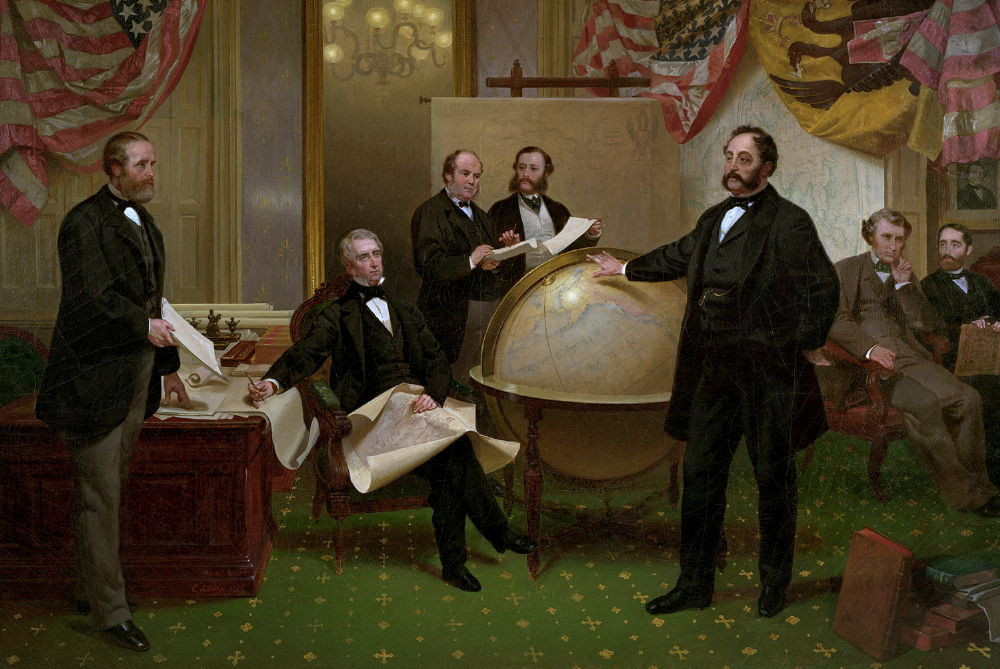
In Signing of the Alaska Treaty , dated about 1867, Leutze gave another form to public history. Named diplomatic participants appear with documents, maps and a globe. Seward House identifies the painting as a gift from Peter Cooper to William H. Seward. An indoor negotiation becomes an occasion for representing territorial change, extending Leutze’s interest in significant groups beyond battle or migration. [11]
Leutze died in Washington in July 1868. Portraiture had continued beside the historical and public commissions, rather than disappearing after the success of the Washington canvas. The later work completes a career whose fields repeatedly overlapped. An individual likeness, an assembled historical scene and a monumental public image could each draw on his ability to give people expressive presence. [1]
Emanuel Leutze, Westward the Course of Empire Takes Its Way, mural study, 1861. Oil on canvas. Smithsonian American Art Museum, 1931.6.1, Bequest of Sara Carr Upton.
Image source
.
CC0 / Public domain
. Resized only; native appearance, complete image and margins preserved.
Looking beyond the national icon
Leutze’s pictures benefit from looking at the relationships around the leading person. In the Delaware boat, Washington’s visibility depends on the labouring figures below him and the open sky behind him. In the royal courtship, other people’s attention makes the encounter public. In the Alaska painting, documents and the globe connect the individuals to the negotiation. The group gives each main subject its particular setting and meaning.
His style and technique can be approached through these arrangements as well as through colour and materials. Faces, costumes, diagonals and differences of scale help turn a selected action into a substantial picture. Technical findings from the Met canvas add evidence about its making, while the Capitol mural requires attention to a different medium. One famous object cannot supply a complete recipe for every work in the career.
Contemporary Native interpreters at the Met have also returned to Washington Crossing the Delaware to question the history it commemorates. Alan Michelson and Scott Manning Stevens bring attention to Native participation, dispossession and the unequal consequences of the nation’s development. These named perspectives enlarge the questions available to viewers without pretending to recover an unrecorded statement of Leutze’s own intention. [12] [3]
The painting’s endurance includes admiration, investigation and disagreement. Its fame gives readers an accessible beginning; the broader career reveals the training, friendships, patrons and choices behind it. Looking across the works makes Leutze’s achievement more specific: he repeatedly found ways to represent historical significance through the physical presence and relationships of people.
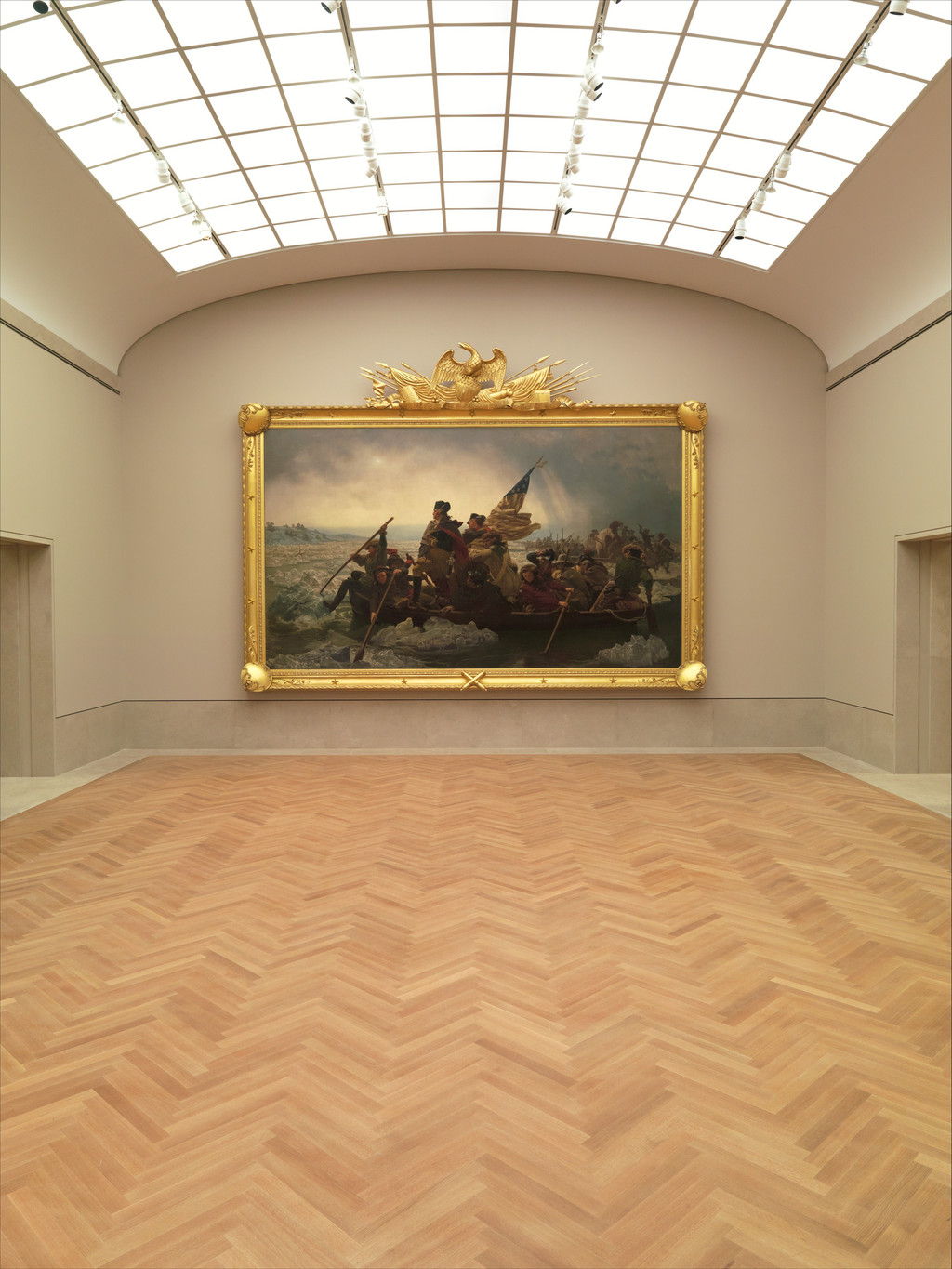
Leutze’s Washington Crossing the Delaware in the Metropolitan Museum of Art, with its modern recreated frame. Museum photograph. The Metropolitan Museum of Art.
Image source
.
CC0 / Public domain
. Resized only; native appearance, complete image and margins preserved.
Essential Emanuel Leutze works
Washington Crossing the Delaware
1851 · Washington and boatmen organise a revolutionary crossing into a monumental public image.
Westward the Course of Empire Takes Its Way
1861 (oil study); mural 1861–62 · The Smithsonian oil study introduces the composition and painted border of the Capitol mural.
Washington Rallying the Troops at Monmouth
1857 replica; original 1854 · Washington intervenes among retreating troops; the 1857 replica is distinct from the earlier large canvas.
The Courtship of Anne Boleyn
1846 · A royal courtship becomes a public encounter shaped by the reactions of surrounding figures.
Worthington Whittredge
1856 · A living fellow artist appears in elaborate historical costume.
Signing of the Alaska Treaty
c. 1867 · Diplomatic figures, papers and a globe turn a negotiation into a scene of public history.
Artworks directory
A selected directory of paintings and drawings discussed in these articles. Different versions are listed separately.
| Name | Date | Medium |
|---|---|---|
| Washington Crossing the Delaware (Met canvas) | 1851 | Painting |
| Westward the Course of Empire Takes Its Way (oil study) | 1861 | Painting |
| Westward the Course of Empire Takes Its Way (Capitol mural) | 1861–62 | Painting (mural) |
| Washington Rallying the Troops at Monmouth (large original) | 1854 | Painting |
| Washington Rallying the Troops at Monmouth (replica) | 1857 | Painting |
| The Courtship of Anne Boleyn | 1846 | Painting |
| Worthington Whittredge | 1856 | Painting |
| Signing of the Alaska Treaty | c. 1867 | Painting |
| The Last Drop (McGuire Scrapbook) | Date not specified | Drawing |
| The Amber Necklace | 1847 | Painting |
| Maria Lottner | c. 1842 | Painting |
| Heinrich Lottner | 1858 | Painting |
| Cromwell at Milton’s Home (Schwäbisch Gmünd version) | 1855 | Painting |
| Titian’s Lagoon Voyage | 1857 | Painting |
| Mary Stuart’s First Mass in Holyroodhouse | 1866 | Painting |
| Evening Party at Milton’s (National Gallery of Art canvas) | 1854 | Painting |
| Friedrich Wilhelm Hütz | 1863 | Painting |
| Waving figure from Westward the Course of Empire Takes Its Way | c.1860 | Drawing |
Frequently Asked Questions
He is best known for Washington Crossing the Delaware , completed in Düsseldorf in 1851. His wider career included portraits, European historical subjects and the Capitol mural Westward the Course of Empire Takes Its Way .
He was born in Germany, grew up in Philadelphia and worked extensively in both countries. His German-American career brought European training together with American subjects, patrons and audiences.
No. Leutze was born in 1816, forty years after the operation. His painting is a later historical interpretation, not a visual eyewitness record of the night of 25–26 December 1776.
Yes. Portraiture was his first professional field and continued throughout his career. His subjects included relatives, friends such as Worthington Whittredge, and public figures.
The finished Capitol work is a stereochrome mural of 1861–62. Smaller oil studies, including the Smithsonian’s 1861 canvas, are separate objects connected with its development.
Discussion
Look again at the images and ideas explored in Emanuel Leutze. These editorial prompts invite your observations.
Reader Insights
Which work most expands your understanding of Leutze beyond the Delaware crossing?
How do the figures surrounding a leader or ruler affect your response to the main subject?
What changes when you compare a monumental history painting with a portrait of a living friend?
Join the Conversation
Share a detail, comparison or question about Emanuel Leutze below.
References
- Natalie Spassky , American Paintings in the Metropolitan Museum of Art , volume II (1985), Emanuel Leutze, printed pp.13–25. View source
- Henry T. Tuckerman , Book of the Artists: American Artist Life (1867), Leutze, printed pp.333–345. View source
- Metropolitan Museum of Art , Washington Crossing the Delaware , 1851, accession 97.34; object record and interpretation including Scott Manning Stevens. View source
- Smithsonian American Art Museum , The Courtship of Anne Boleyn , 1846, accession 1980.28. View source
- Carrie Rebora Barratt et al. , Washington Crossing the Delaware: Restoring an American Masterpiece , Metropolitan Museum of Art Bulletin (Fall 2011). View source
- Architect of the Capitol , Westward the Course of Empire Takes Its Way . View source
- Washington Crossing Historic Park , Myths and Legends . View source
- Guy Sava , Washington Crossing Historic Park, Where Exactly Did Washington Cross the Delaware? (2019). View source
- Metropolitan Museum of Art , Worthington Whittredge , 1856, accession 03.16. View source
- Museum und Galerie im Prediger , Schwäbisch Gmünd, Emanuel Leutze (2016 exhibition). View source
- Seward House Museum , Signing of the Alaska Treaty , c.1867. View source
- Metropolitan Museum of Art , Native Perspectives , Alan Michelson on Washington Crossing the Delaware . View source
- Splash image source.
Emanuel Leutze, Washington Crossing the Delaware, 1851. Oil on canvas, 378.5 × 647.7 cm. Metropolitan Museum of Art, 97.34, Gift of John Stewart Kennedy, 1897. The Metropolitan Museum of Art. CC0 / Public domain . Resized only; native appearance, complete image and margins preserved.
View source - Kathryn Calley Galitz, “Romanticism”, Metropolitan Museum of Art (2004). Emergence around 1800 and flourishing until mid-century. View source
- Museum Kunstpalast, Düsseldorfer Malerschule. Defines the school’s institutional and artistic context from 1819 to 1918. View source
- Smithsonian American Art Museum, Emanuel Leutze: 1816–1868. Artist life dates. View source
- National Gallery of Art, Worthington Whittredge: 1820–1910. Artist life dates. View source
- New Britain Museum of American Art, Eastman Johnson: 1824–1906. Artist life dates. View source
- National Gallery of Art, Albert Bierstadt: 1830–1902. Artist life dates. View source