 by
Tom Gurney
Tom Gurney BSc (Hons) is an art history expert with over 20 years experience
Email:
tomgurney1@gmail.com
/ Phone:
+44 7429 011000
Emanuel Leutze: Style and Technique: Introduction
Emanuel Leutze made history visible through the arrangement of bodies, gestures, clothing and light. A standing commander, an inclined royal figure or a line of travellers could organise a crowded scene around a recognisable action. His pictures invite viewers to follow individual faces while holding a larger public story in mind. That combination of human detail and dramatic design became central to his reputation as a history painter. [1]
His working methods emerge most clearly when several kinds of evidence are considered together: his own explanation of pictorial storytelling, the surviving paintings and the physical discoveries made during conservation. Washington Crossing the Delaware provides unusually detailed evidence of drawing and revision beneath the finished image. The Capitol mural, meanwhile, shows how he adapted his ambitions to another material and architectural setting. [2] [3] [7]
At a Glance
- Principal field History painting, alongside portraiture and work on paper
- Training Düsseldorf from 1841; subsequent study of art in Germany and Italy
- Composition Leading figures, directed gestures, overlapping groups and strong contrasts
- Studio resources Posed models, historical costume and earlier representations
- Canvas technique Oil painting, with drawing and changes documented in the Delaware canvas
- Technical evidence Visible underdrawing, infrared examination and pentimenti
- Mural technique Stereochromy, using pigments on plaster sealed with waterglass
- Important distinction The Smithsonian’s Westward study is an oil painting; the Capitol work is a mural
Contents
- An idea before an incident
- Düsseldorf and a broader handling of paint
- The leading figure and the surrounding group
- Models, likenesses and costume
- Drawing beneath the Delaware painting
- Revisions that strengthen the action
- Colour, surface and the effects of conservation
- Stereochromy and the Capitol wall
An idea before an incident
In a letter reproduced by Henry T. Tuckerman, Leutze explained that an artist should first form a clear thought and then choose or devise an incident from history or life through which to express it. He called painting “essentially a contemplative art.” The distinction concerns what a picture can do with time: a single arrangement must give viewers enough to consider without unfolding every event in sequence. [2]
This helps explain the concentrated action of his famous Delaware scene. Washington occupies a moment of composure while the boatmen exert themselves around him. Their different activities can be understood together, and the commander’s stillness becomes meaningful through their labour. The painting gives the viewer a sustained relationship between leadership, collective effort and physical danger.
Leutze’s account also makes the artist’s intervention explicit. Historical subject matter required selection and design. An expression, a hand or the position of a body could make the chosen idea more legible. Looking at his paintings consequently involves asking both what event is represented and how its visual arrangement directs attention.
Düsseldorf and a broader handling of paint
Leutze enrolled at the Düsseldorf academy in 1841, but his relationship with its teaching soon became independent. The Metropolitan Museum’s scholarly catalogue describes his dissatisfaction with an emphasis on minute detail and meticulous finish. He established his own studio while continuing to take part in the city’s artistic life. His association with Düsseldorf and American history painting was therefore wider than his period of formal study. [1]
Travel extended his sources. In Munich he studied the historical and religious compositions of Peter Cornelius and Wilhelm von Kaulbach. In Venice, the colour of Titian, Veronese and Bellini attracted him; in Rome, Michelangelo’s vigorous invention made an impression. These encounters help explain the range of European painting available to him as he developed his historical subjects. [1]
The catalogue characterises his mature handling as broader than the academy’s painstaking approach, with energetic brushwork and theatrical gestures that attracted criticism as well as admiration. Such an assessment is useful beside the pictures themselves. Elaborate costume and recognisable objects could coexist with forceful overall effects. The spectator’s first encounter with a large composition depends heavily on the grouping, movement and distribution of light. [1]
The leading figure and the surrounding group
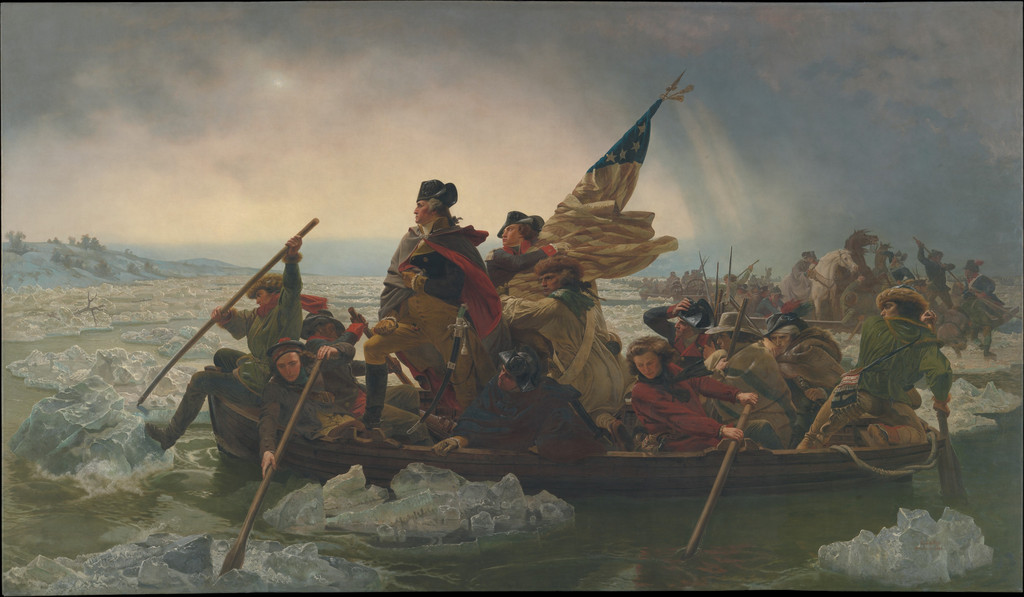
In the Delaware canvas, Washington rises above the seated and bent figures beside him. Oars, the pole and the flag introduce different diagonals around that upright presence. The men lean, pull and brace themselves, making the boat appear full of effort. Their overlapping bodies also give the foreground group a compressed, precarious character.
The distant boats extend the undertaking beyond this one crowded vessel. Lighter passages of sky and ice lead the eye away from the foreground, while dark clothing and the boat’s side give the nearer action weight. The composition works at several distances: the broad silhouette is immediately apparent, and particular hands, faces and obstacles reward a closer look.
Colour helps individual bodies remain distinct within that mass. The red-shirted rower near the right provides a warm accent against the pale ice and greenish water. Washington’s dark coat separates his upper body from the illuminated sky, while the red lining of his cloak connects him with warmer passages elsewhere in the boat. These relationships are visible effects of the finished picture. They can be discussed without assigning an unverified pigment mixture to each patch of colour. Following them across the canvas reveals how Leutze balances the central figure with the surrounding labour.
The Courtship of Anne Boleyn uses a quieter encounter to organise another group. Henry VIII inclines towards Anne, whose more reserved bearing gives their exchange its tension. Other people watch, so the courtship becomes a public spectacle within the painting. The Smithsonian identifies the Spanish ambassador at the left as a disapproving observer. His reaction supplies a counterpoint to the central exchange. [6]
These pictures demonstrate different uses of the surrounding cast. Boatmen make a leader’s determination visible through shared labour; court observers make a relationship visible through competing responses. Leutze could distribute the meaning of an episode across several bodies rather than placing its entire burden on the central face.
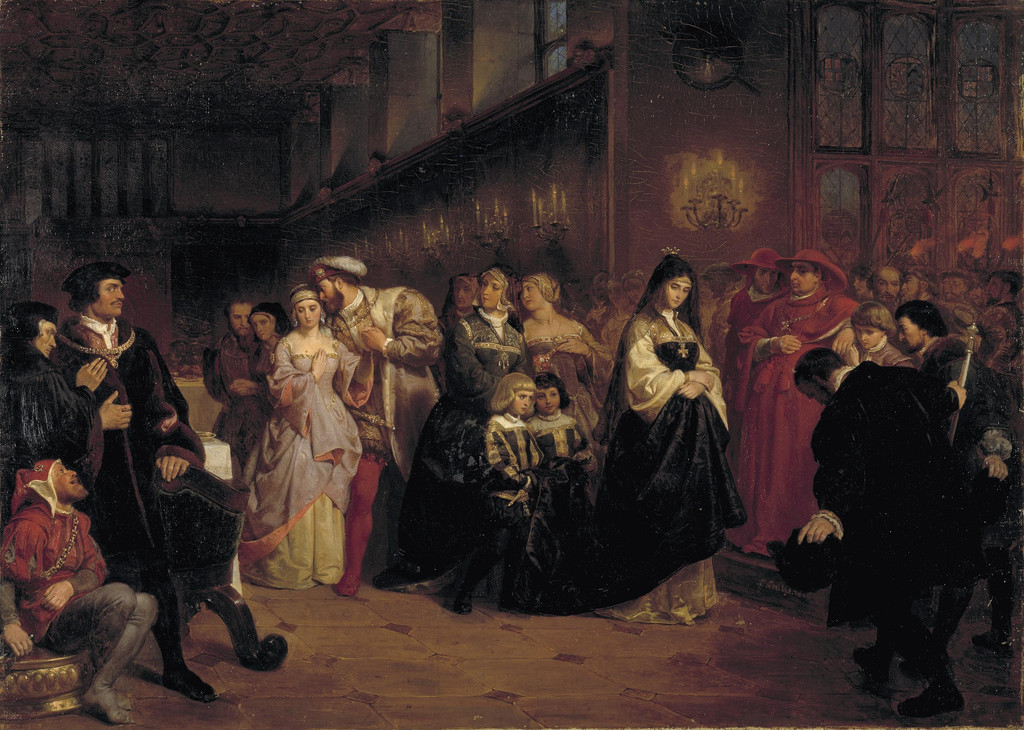
Emanuel Leutze, The Courtship of Anne Boleyn, 1846. Oil on canvas, 72.4 × 101.8 cm. Smithsonian American Art Museum, 1980.28. Museum purchase.
Image source
.
CC0 / Public domain
. Resized only; native appearance, complete image and margins preserved.
Models, likenesses and costume
Living models helped turn those arrangements into paintable bodies. Worthington Whittredge posed for Washington’s body and for the steersman in the Delaware picture. For Washington’s head, Leutze drew on Houdon’s sculptural likeness. The figure thus combines separate sources for bodily presence and historical identity. It should not be understood as Whittredge’s face dressed up as Washington. [3]
The 1856 portrait of Whittredge offers another use of historical dress. A contemporary landscape painter appears with a white ruff, dark clothing and a gold chain. The museum catalogue suggests that the costume probably came from Leutze’s own collection. It places the named sitter within a visual tradition associated with an earlier age. [1] [5]
Look at how the white collar frames the beard and face, then follow the chain and cuffs into the darker clothing. The costume carries detail, but its light and dark divisions also organise the body. The same practical concern extends into Leutze’s historical groups: clothing has to suggest a period while helping one figure remain intelligible beside another.
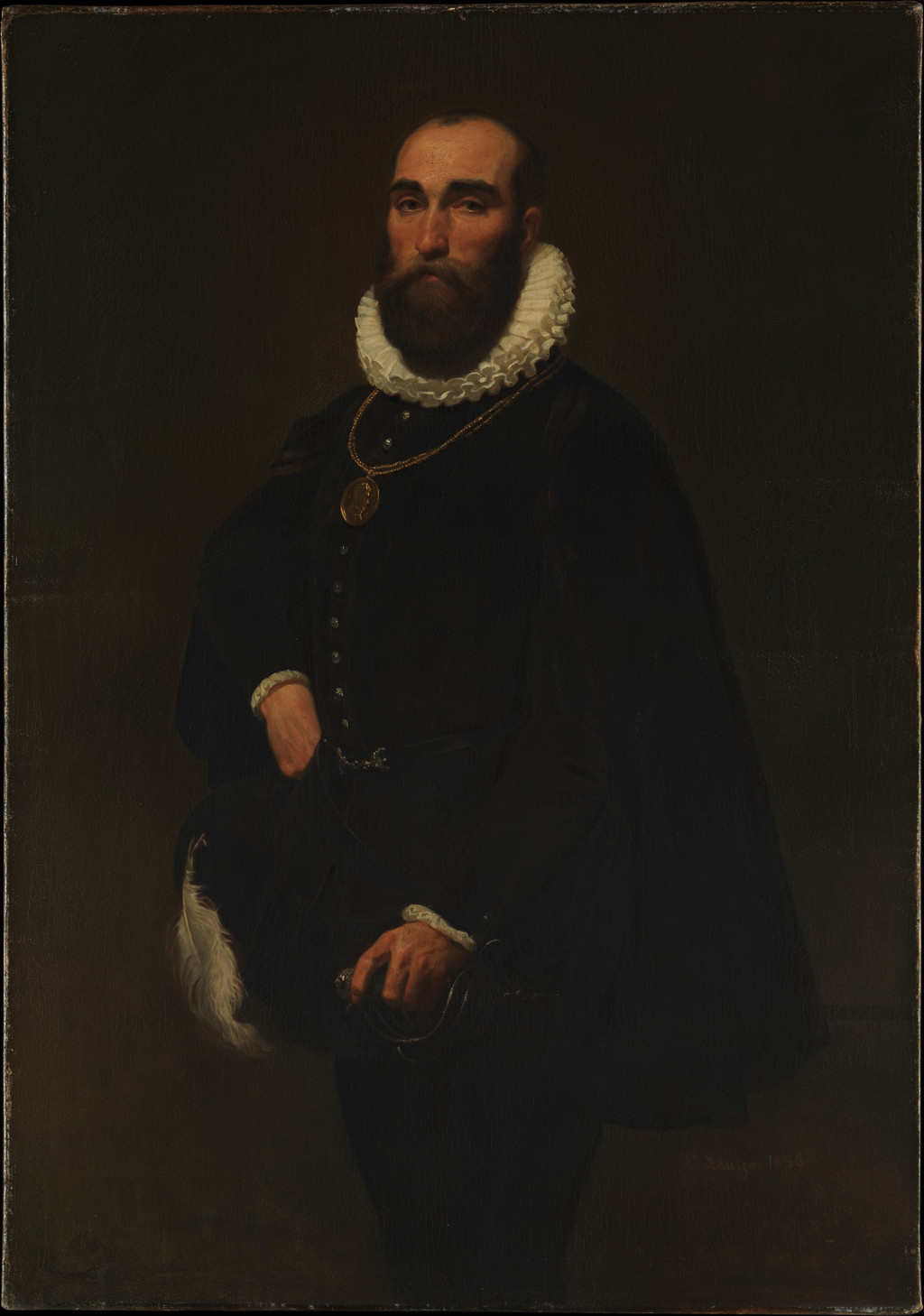
Emanuel Leutze, Worthington Whittredge, 1856. Oil on canvas, 129.2 × 102.9 cm. Metropolitan Museum of Art, 03.16. Gift of Several Gentlemen, 1903. The Metropolitan Museum of Art.
Image source
.
CC0 / Public domain
. Resized only; native appearance, complete image and margins preserved.
Drawing beneath the Delaware painting
The Met’s 1851 canvas measures about 3.8 by 6.5 metres. At that scale, the relationships between figures had to remain convincing across an exceptionally wide surface. Conservation has revealed some of the drawing with which Leutze prepared it. Red lines are visible around Washington’s bent leg, while black lines survive elsewhere, including near the poleman at the right. [4] [3]
These marks belong to the underdrawing , the planning beneath the paint. Infrared examination revealed further differences between drawn contours and the finished image, including changes to Washington’s hat, hair ribbon and facial profile. It also showed a version of the flag extending farther to the right. Many areas revealed no drawing to the infrared camera, so the examination supplies particular discoveries rather than a complete map of every preparatory decision. [3]
The findings make drawing part of an evolving process. Leutze could establish a contour and subsequently reconsider it as neighbouring shapes developed. His drawings and prints also show why different stages and kinds of work on paper deserve separate attention: a preparatory figure, a finished drawing and an engraving after a painting each have their own purpose.
Watch: Emanuel Leutze
Choose a film to explore the artist’s work, its interpretation and its wider setting.
It's not only about the American Revolution, Leutze's Washington Crossing the Delaware
Smarthistory considers the ideas and historical distance behind Washington Crossing the Delaware.
Watch on YouTubeRevisions that strengthen the action
Some changes took place during painting itself. Such alterations are called pentimenti . Conservators identified them in the hats and flag of the Delaware picture. The oarlock beside the man in the red shirt was also moved to the right. As the overlying paint has become more transparent with age, the previous position has become faintly visible. [3]
The conservation study also compares the Met canvas with photographs of Leutze’s earlier Bremen version. In the later painting, the man at the bow pushes a bent pole against the ice, making the force of his action more apparent. Changes to the water, ice and arrangement of the boat refine the impression of a difficult crossing. The dramatic effect depended on many connected adjustments. [3]
These discoveries encourage close looking at apparently small features. A revised outline can clarify an object’s shape; the position of an oarlock can affect the plausibility of a hand’s movement. Across the large canvas, practical details contribute to the sense that human effort is meeting resistance.
Colour, surface and the effects of conservation
The painting’s present appearance also reflects its material history. Before the Met’s modern conservation treatment, a matte, hazy surface obscured dark passages and reduced the range of visible tones. Wax, grime and remnants of earlier coatings complicated cleaning. The conservators varied their treatment according to the condition of each area, then applied a thin synthetic resin varnish and retouched losses and disfiguring old repairs. [3]
Restoring depth to the dark colours helped the space become legible again. This matters for understanding Leutze’s design: the foreground boat needs to stand in a convincing relationship with ice, water and figures farther away. A surface coating can influence the apparent success of that relationship even when the underlying composition remains unchanged. [3]
The treatment account describes glazing and scumbling used by modern conservators in retouching the sky. Those passages explain their restoration methods; they do not establish that Leutze used the same procedures throughout his original painting. Technical evidence is most informative when it stays attached to the particular layer, object and intervention being described. [3]
Stereochromy and the Capitol wall
For Westward the Course of Empire Takes Its Way , Leutze worked on a wall about twenty feet high and thirty feet wide in the Capitol’s House wing. The Architect of the Capitol identifies the technique as stereochromy: pigments were applied to plaster and sealed with waterglass, a silica solution. This method gave the mural a different physical construction from the oils on canvas. [7]
The Smithsonian’s 1861 study is oil on canvas. Its central scene, decorated border and lower view of the Golden Gate allow the composition to be considered as a whole, but it remains a separate object from the finished wall painting. Its medium should be retained when the study is reproduced or discussed. Calling both works fresco would conceal an important difference in how they were made. [8] [7]
Across these materials, Leutze’s persistent concern was the organisation of a large idea through visible human action. His portraits concentrate attention on a sitter; his historical canvases and mural extend that attention across a group and its setting. Following the figures, then examining the marks and revisions that support them, brings the spectacle back to the decisions of a working painter.
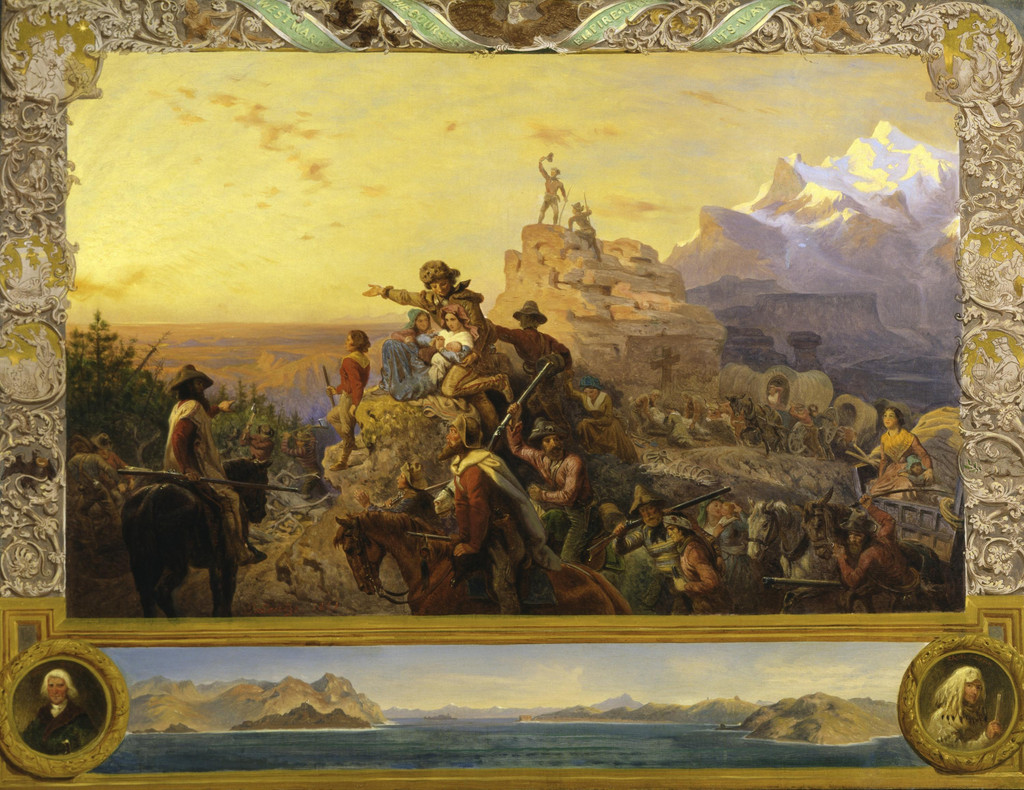
Emanuel Leutze, Westward the Course of Empire Takes Its Way (mural study, U.S. Capitol), 1861. Oil on canvas, 84.5 × 110.1 cm. Smithsonian American Art Museum, 1931.6.1, Bequest of Sara Carr Upton.
Image source
.
CC0 / Public domain
. Resized only; native appearance, complete image and margins preserved.
Artworks directory
A selected directory of paintings and drawings discussed in these articles. Different versions are listed separately.
| Name | Date | Medium |
|---|---|---|
| Washington Crossing the Delaware (Met canvas) | 1851 | Painting |
| Westward the Course of Empire Takes Its Way (oil study) | 1861 | Painting |
| Westward the Course of Empire Takes Its Way (Capitol mural) | 1861–62 | Painting (mural) |
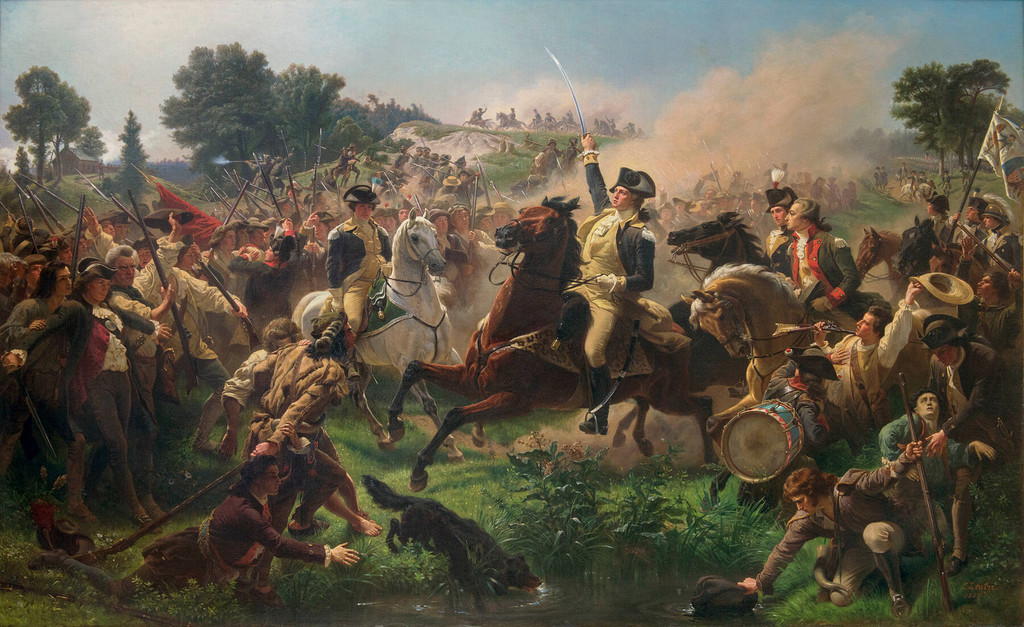
| Washington Rallying the Troops at Monmouth (large original) | 1854 | Painting |
| Washington Rallying the Troops at Monmouth (replica) | 1857 | Painting |
| The Courtship of Anne Boleyn | 1846 | Painting |
| Worthington Whittredge | 1856 | Painting |
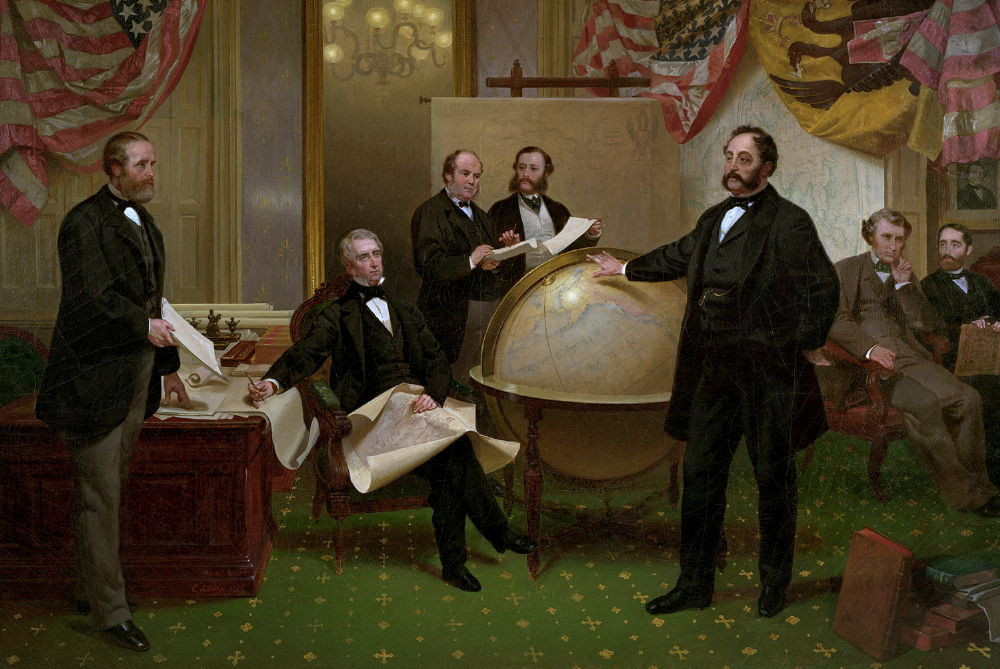
| Signing of the Alaska Treaty | c. 1867 | Painting |
| The Last Drop (McGuire Scrapbook) | Date not specified | Drawing |
| The Amber Necklace | 1847 | Painting |
| Maria Lottner | c. 1842 | Painting |
| Heinrich Lottner | 1858 | Painting |
| Cromwell at Milton’s Home (Schwäbisch Gmünd version) | 1855 | Painting |
| Titian’s Lagoon Voyage | 1857 | Painting |
| Mary Stuart’s First Mass in Holyroodhouse | 1866 | Painting |
| Evening Party at Milton’s (National Gallery of Art canvas) | 1854 | Painting |
| Friedrich Wilhelm Hütz | 1863 | Painting |
| Waving figure from Westward the Course of Empire Takes Its Way | c.1860 | Drawing |
Frequently Asked Questions
His historical paintings often use prominent leading figures, expressive gestures, carefully arranged groups and contrasts of light and colour to make a historical episode visually legible.
Yes. Visible lines and infrared examination of the Met’s Washington Crossing the Delaware reveal underdrawing and differences between that drawing and the final paint layers.
They are changes made during painting, including alterations to hats, the flag and an oarlock. Some became easier to see as the overlying paint grew more transparent.
The Architect of the Capitol identifies its technique as stereochromy, with pigments on plaster sealed using waterglass. The Smithsonian’s preparatory study is a separate oil painting on canvas.
Discussion
Look again at the images and ideas explored in Emanuel Leutze: Style and Technique. These editorial prompts invite your observations.
Follow one gesture through the Delaware canvas or the Anne Boleyn scene. How do the positions and reactions of surrounding figures change its significance?
Reader Insights
Which gesture most clearly conveys effort in the Delaware scene?
How does Whittredge’s costume compare with clothing in the historical groups?
How do the discoveries beneath the paint affect your view of a finished composition?
Join the Conversation
Share a detail, comparison or question about Emanuel Leutze: Style and Technique below.
References
- Natalie Spassky , American Paintings in the Metropolitan Museum of Art , Volume II, 1985, Leutze section, pp. 13–25, especially pp. 14–16 and 25. Training, European study, critical assessment and Whittredge’s costume. View source
- Henry T. Tuckerman , Book of the Artists , 1867, Leutze chapter, pp. 333–345, especially p. 339. Artist’s letter on the relationship between an idea and a historical incident; quoted through Tuckerman. View source
- Carrie Rebora Barratt and contributors , Washington Crossing the Delaware: Restoring an American Masterpiece , Metropolitan Museum of Art Bulletin , Fall 2011. Barratt on models, p. 6; Lance Mayer and Gay Myers on painting and conservation, especially pp. 22–28. View source
- Metropolitan Museum of Art , Washington Crossing the Delaware , 1851, accession 97.34. Medium and dimensions. View source
- Metropolitan Museum of Art , Worthington Whittredge , 1856, accession 03.16. Object record and image. View source
- Smithsonian American Art Museum , The Courtship of Anne Boleyn , 1846, accession 1980.28. Object record, image and identification of the Spanish ambassador. View source
- Architect of the Capitol , Westward the Course of Empire Takes Its Way . Mural dimensions, setting and stereochromy. View source
- Smithsonian American Art Museum , Westward the Course of Empire Takes Its Way (mural study, U.S. Capitol) , 1861, accession 1931.6.1. Oil study, image and medium. View source
- Splash image source.
Emanuel Leutze, Washington Crossing the Delaware, 1851. Oil on canvas, 378.5 × 647.7 cm. Metropolitan Museum of Art, 97.34, Gift of John Stewart Kennedy, 1897. The Metropolitan Museum of Art. CC0 / Public domain . Resized only; native appearance, complete image and margins preserved.
View source