 by
Tom Gurney
Tom Gurney BSc (Hons) is an art history expert with over 20 years experience
Email:
tomgurney1@gmail.com
/ Phone:
+44 7429 011000
Washington Crossing the Delaware by Emanuel Leutze: Introduction
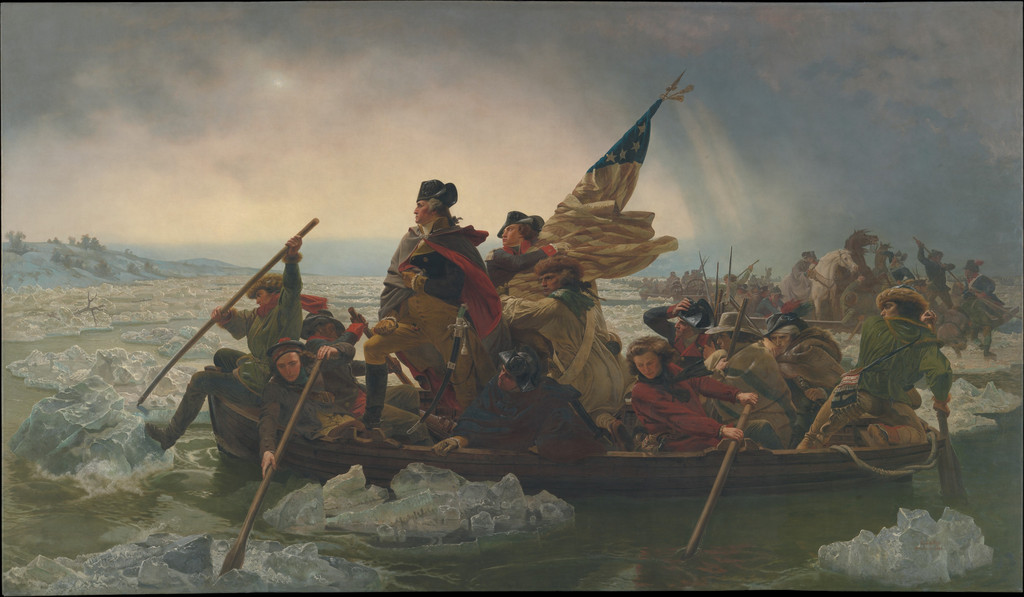
Emanuel Leutze’s Washington Crossing the Delaware turns a difficult military operation into a commanding image of collective resolve. Washington stands above a crowded boat while the men around him row, steer, brace themselves and contend with ice. Completed in Düsseldorf in 1851, the monumental canvas depicts the crossing of the Delaware River on the night of 25–26 December 1776, before the attack on Trenton. The Metropolitan Museum of Art owns this version, accession 97.34. Its history connects American commemoration with German political hopes, commercial exhibitions, reproductive prints and changing ideas about national belonging. [1]
The painting rewards two kinds of attention. Looking closely reveals how Leutze organised bodies, equipment, water and sky into a persuasive action. Historical investigation shows where that action departs from the surviving record. Both matter: the familiar Washington is a nineteenth-century construction, and the people doing the physical work make the picture more complicated than a solitary hero’s portrait.
At a Glance
- Artist Emanuel Leutze (1816–1868)
- Title Washington Crossing the Delaware
- Date 1851
- Medium Oil on canvas
- Dimensions 378.5 × 647.7 cm (149 × 255 inches)
- Collection Metropolitan Museum of Art, New York
- Accession 97.34
- Credit Gift of John Stewart Kennedy, 1897
- Depicted event Crossing of the Delaware River, 25–26 December 1776
- Version Leutze’s second monumental treatment; distinct from the earlier Bremen canvas and later copies
This work across Emanuel Leutze’s career
Washington Rallying the Troops at Monmouth
1857 replica; original 1854Westward the Course of Empire Takes Its Way
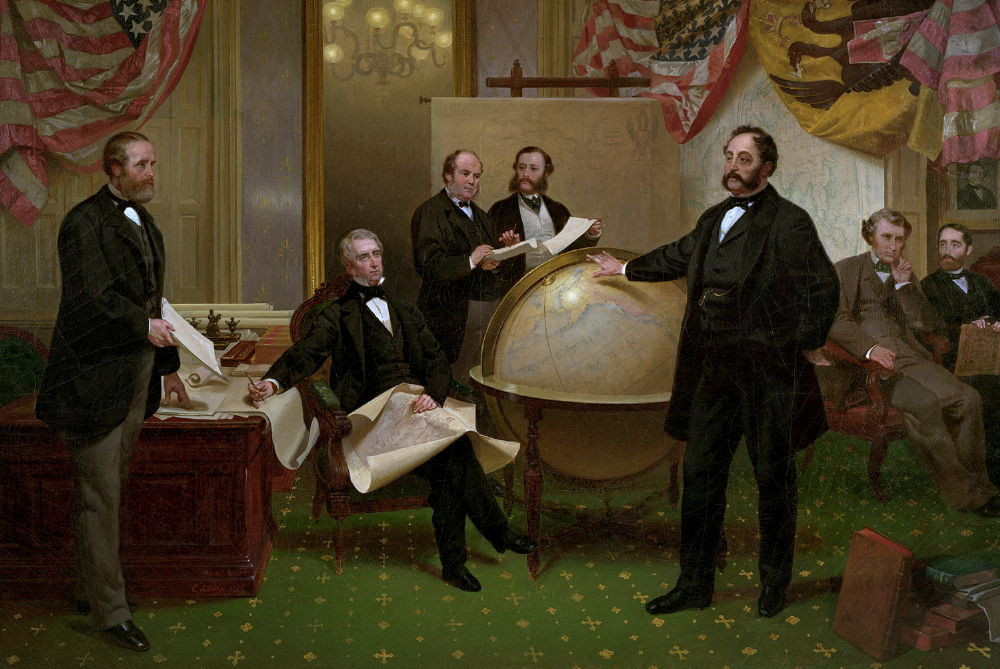
1861 (oil study); mural 1861–62Signing of the Alaska Treaty
c. 1867Contents
- The 1851 canvas and its scale
- The crossing of 25–26 December 1776
- An American Revolution painted in Düsseldorf
- Composition and shared effort
- Figures, models and historical accuracy
- Versions and the making of the picture
- Exhibitions, prints and changing reception
- Conservation and the recreated frame
- Native perspectives and later responses
- Annotated details
The 1851 canvas and its scale
The painting is almost six and a half metres wide. Its size matters because the foreground boat approaches the scale of the viewer’s own body. On a small reproduction, its occupants can resemble a compact emblem arranged around Washington. Before the canvas, they become a sustained assembly of people, with room for separate faces, gestures and exertions. The width allows Leutze to connect this large foreground action with other boats extending across the river. [1]
Washington occupies the most conspicuous upright position, but the picture does not distribute attention evenly around him. The flag rises beyond his shoulder, the nearest rowers lean toward the water, and the boat stretches across the lower part of the image. Above these dense forms lies an extensive sky. The general’s dark profile gains force partly because it appears against a comparatively open, lighter area. His prominence depends on the space surrounding him as much as on his rank.
The low foreground puts the spectator close to the river. There is no comfortable platform from which to survey the crossing. Broken ice occupies the space between us and the boat, and the nearest oar enters that space diagonally. The composition offers unusually immediate access to a historical subject, while placing obstacles in the way. We seem near enough to understand the labour without being able to stand safely among the participants.
Distance changes the terms of the picture. Behind the principal boat, figures and animals gather into smaller, less distinct groups. Farther across the river, the bank becomes a thin band of land, vegetation and buildings. Leutze gives the army a destination, but does not make it a broad, inviting foreground. The men must reach something still remote from their crowded vessel. That interval gives the crossing its suspense.
The date of the painting and the date of its subject should remain separate. Leutze was born in 1816, four decades after the operation. He created the scene in Germany from historical knowledge, studio preparations and pictorial invention. The work cannot supply eyewitness evidence about who occupied Washington’s boat. It can tell us how a painter in the middle of the nineteenth century wished an earlier revolutionary moment to be encountered. [1]
Its title concentrates attention on Washington, although the action extends beyond him. “Crossing” names a process, rather than the victory that followed. The general has not yet reached the opposite shore, and the viewer cannot see the battle at Trenton. Leutze selects a moment when a successful outcome still depends on practical work. The title’s famous name and the image’s numerous labouring figures pull our attention in different directions.
This makes scale more than a display of ambition. A small image can deliver Washington and the flag almost immediately; a large one lets the eye remain with an oar, a bent wrist, a slumped body or a distant horse. The scene becomes less uniform as it becomes more visible. Its public authority is supported by many individual actions, some forceful and some vulnerable.
Annotated Details from Washington Crossing the Delaware
The numbered points identify visible features discussed in this article. Return from each detail to the whole composition. Emanuel Leutze, Washington Crossing the Delaware, 1851. Oil on canvas, 378.5 × 647.7 cm. Metropolitan Museum of Art, 97.34, Gift of John Stewart Kennedy, 1897. The Metropolitan Museum of Art. Image source. CC0 / Public domain. Separate resized overview with numbered points; details cropped from the original. Original colour and appearance retained.
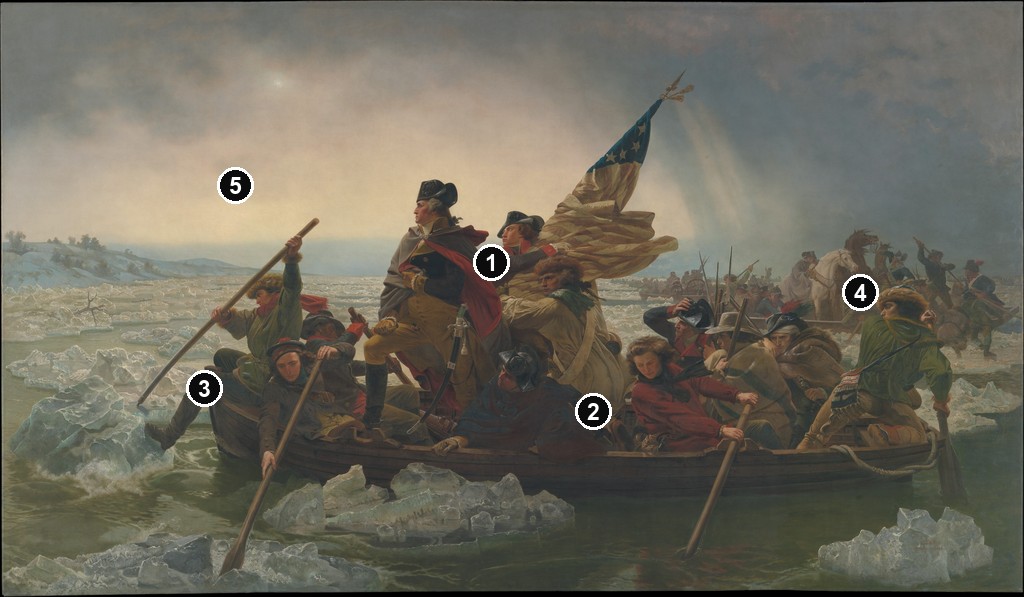
Details from WASHINGTON CROSSING THE DELAWARE
Compare the cropped details with the complete images above. Notice how their colours, shapes and positions contribute to the larger compositions.
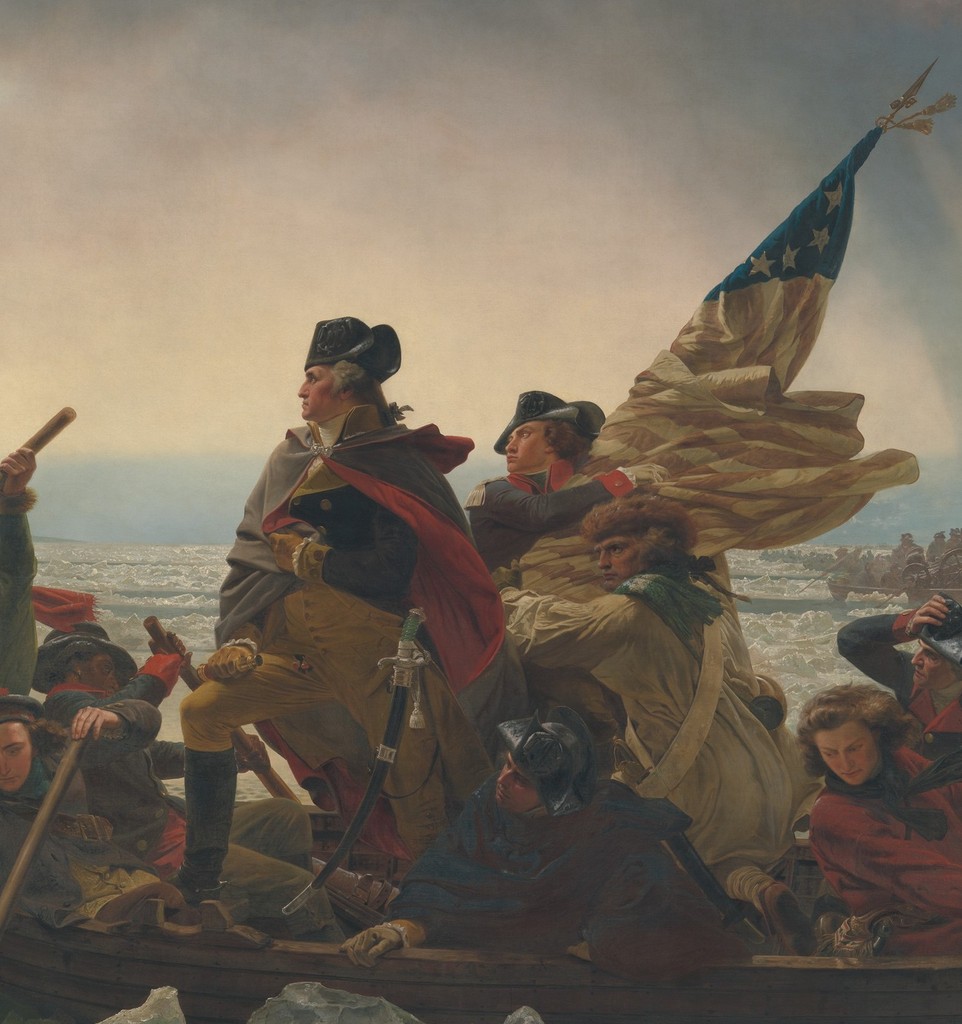
Washington and the flag
Washington’s upright figure and the folding flag rise above the bent bodies beside him. The dark coat stands against the light sky, while the flag spreads the group’s silhouette towards the right.
Rowers along the boat
Seated and bent boatmen pull at different angles. Their hands, oars and overlapping bodies give the near side of the vessel a rhythm of effort.
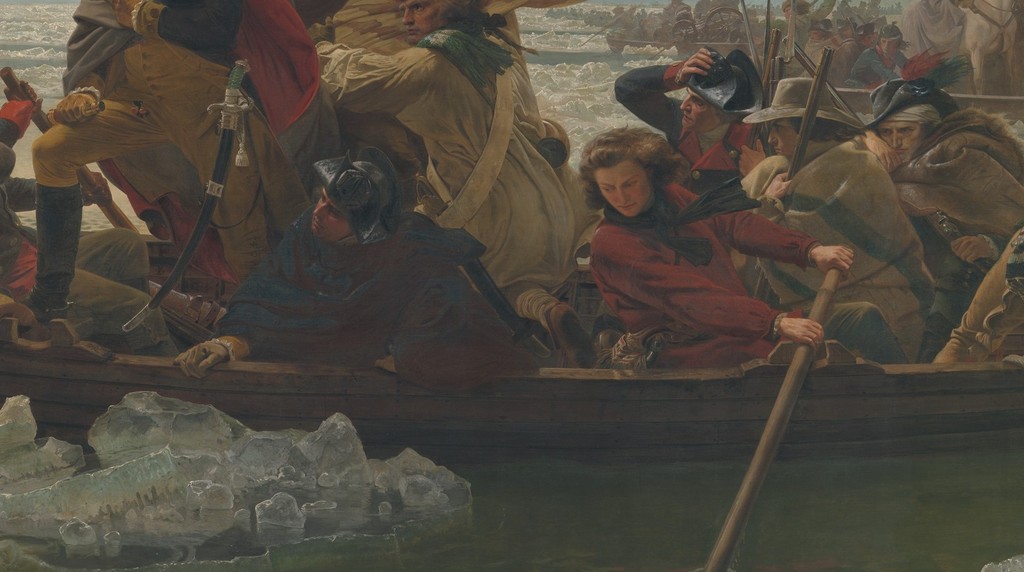
Pole and ice at the bow
The bow figure braces a boot against the ice while working with a long pole. The diagonal shaft and broken floes make resistance visible at the front of the boat.
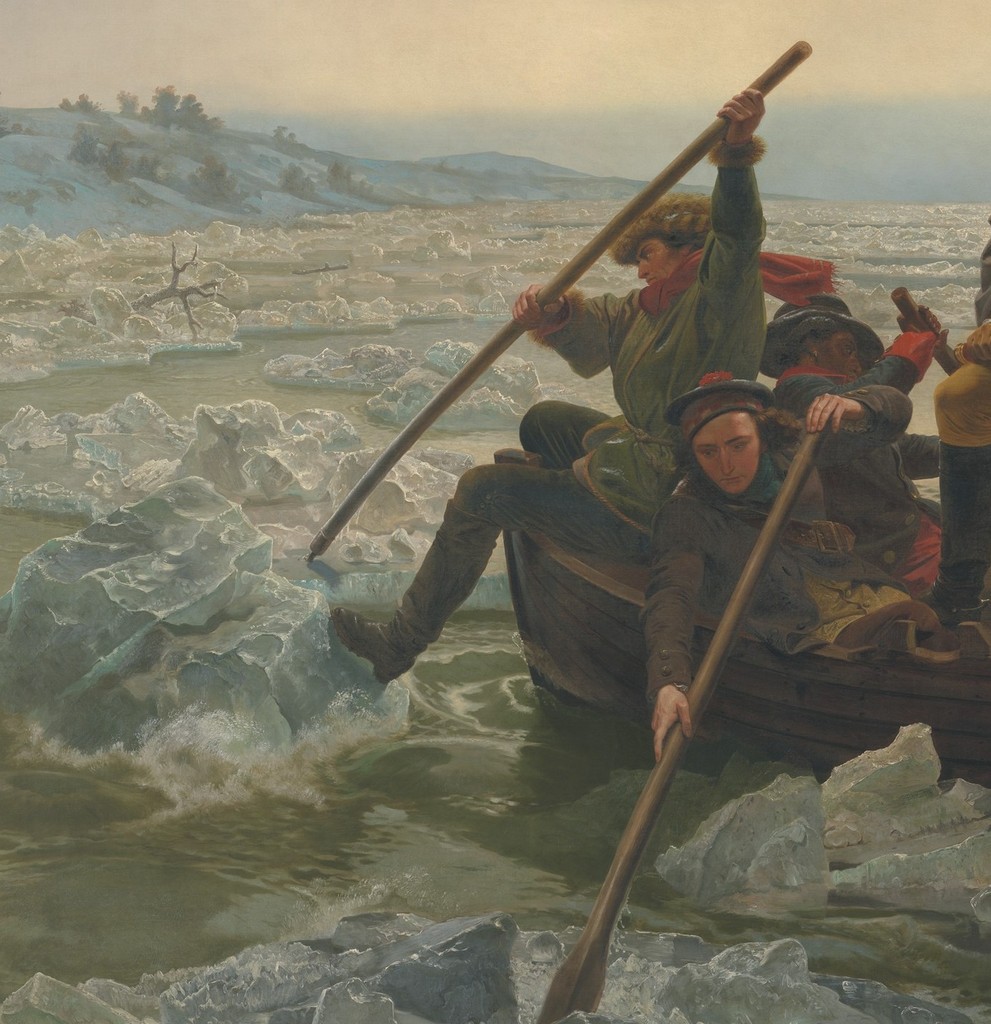
Horses and figures beyond the boat
Smaller figures and horses crowd the water beyond the principal boat. Their reduced scale extends the crossing into a collective undertaking at several distances.
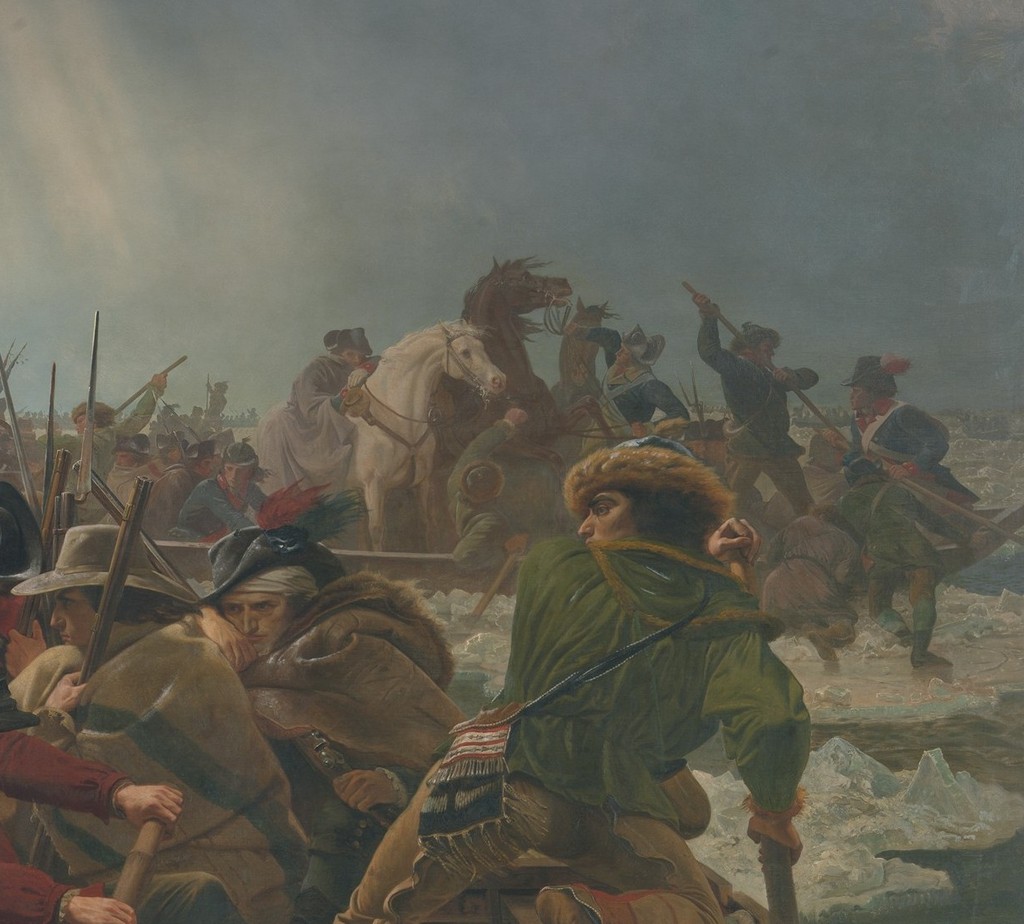
Light across the sky and river
A pale opening spreads above the far bank and the distant ice. The broad sky contrasts with the crowded foreground, giving the human action a larger setting.
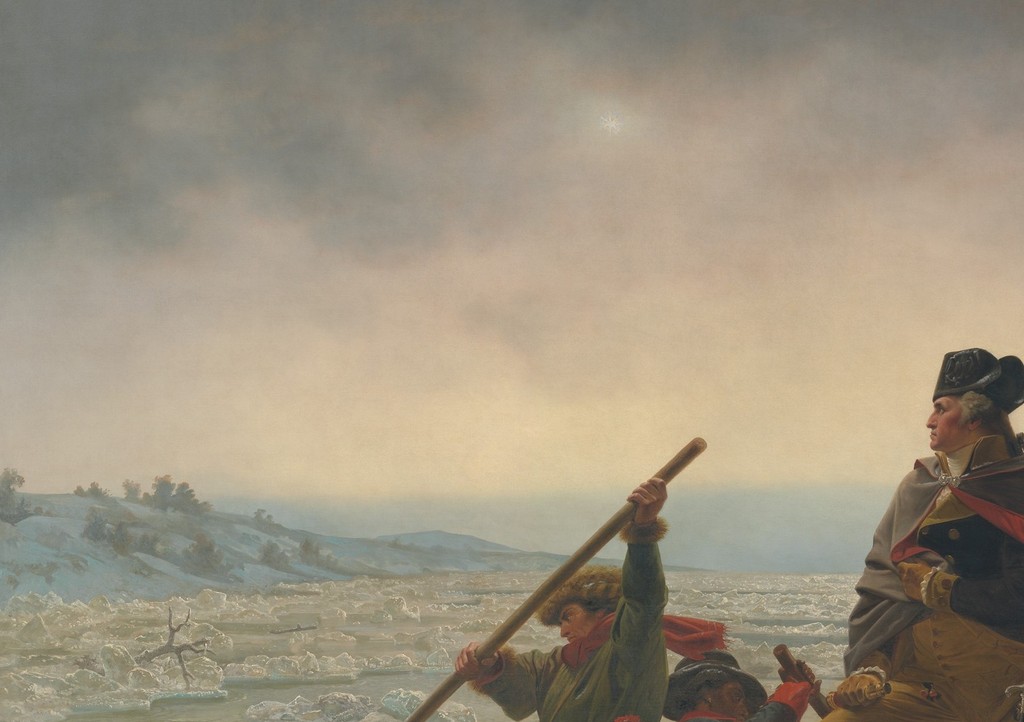
The crossing of 25–26 December 1776
Washington’s report to John Hancock, written on 27 December 1776, provides a useful account of the operation. He described ordering approximately 2,400 troops to assemble behind McKonkey’s Ferry on the evening of the 25th. His plan was to move the troops and artillery across by midnight, then reach Trenton before dawn. Ice delayed the boats: the artillery was not fully across until about three in the morning, and the march began near four. [3]
The letter explains how a carefully timed surprise could become an uncertain undertaking. Washington feared that the delay would prevent an unnoticed approach, yet judged a withdrawal across the river dangerous. He continued toward Trenton and divided the force between two roads. His account places the attack at about eight in the morning. The crossing and the battle were successive stages, separated by a march of roughly nine miles, rather than one uninterrupted spectacle. [3]
That separation matters when reading Leutze. The painting gives us anticipation, not combat. There is no visible opponent in the foreground and no military success already achieved. The danger comes from the river, weather, overcrowding and the difficulty of moving an army. Washington’s composure can therefore be read against an unfinished operation. The history of the subsequent victory explains why this precarious moment acquired such a prominent place in national memory.
Washington also reported that other intended crossings had failed. General Ewing could not get across at Trenton Ferry because of the ice. Cadwalader moved some infantry over from Bristol but could not transport the artillery and abandoned that attempt. The successful passage was part of a larger plan whose elements did not all work. The familiar image of irresistible progress should be set beside this record of delay and interruption. [3]
The commander’s testimony describes a severe night and a march through snow and hail. It praises the troops’ conduct under those conditions. It is an interested report by the leader of a successful attack, rather than a complete account of every participant’s experience. Even so, its emphasis on the men’s behaviour offers a productive comparison with the painting: Washington commended a shared effort, while Leutze made that effort visible around the elevated commander. [3]
The Historic Park’s interpretation distinguishes the vessels used for different tasks. Large Durham boats transported troops; flat-bottomed ferries carried artillery and horses. The painted boat resembles a smaller craft than the long Durham vessels associated with the operation. Its compact proportions let Leutze bring faces and bodies together where they can be read clearly. That pictorial advantage should not be mistaken for an accurate diagram of military transport. [6]
There is an additional uncertainty about Washington himself. Park interpreter Guy Sava explains that the precise place at which the general crossed, and the particular vessel he used, cannot be established conclusively. Arguments for a Durham boat or a ferry remain arguments. We know substantially more about the operation than about the exact arrangement of passengers around Washington at one instant. The painting’s apparently complete scene fills a gap the documentary record does not close. [5]
Several popular stories obscure this distinction between evidence and remembrance. The crossing began on Christmas Day, continuing into the following morning; it was not a Christmas Eve operation. The Historic Park also rejects the familiar claim that Washington simply surprised drunken Hessian soldiers after their celebrations. Such stories give the event a memorable shape, but their familiarity does not make them reliable historical explanations. [4]
Leutze’s sky introduces another departure from a literal account. The scene is bright enough for the spectator to examine people and equipment, whereas the principal crossing took place at night. This illumination is a means of displaying the action. If the figures disappeared into darkness, their coordinated effort would become harder to understand. The choice makes the painting legible and expressive, while separating it from a reconstruction of the recorded hour.
The battle at Trenton supplies the picture with an outcome that its own action withholds. Viewers who know the story can regard the boat as moving toward a victory already familiar to them. Viewers attending only to the painted moment encounter unresolved exertion. Holding these perspectives together helps restore some uncertainty to an image that repetition has made reassuring. The people in the boat have no visible guarantee of what lies ahead.
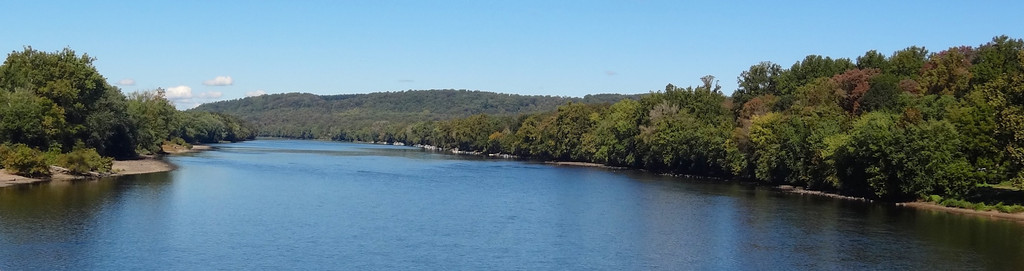
The Delaware River near the historic crossing area, looking north from Washington Crossing Bridge, 28 September 2013. Pennsylvania is on the left and New Jersey on the right. Photograph by Zeete, Wikimedia Commons, CC BY-SA 3.0. Resized only. Zeete, Wikimedia Commons, CC BY-SA 3.0. Resized photograph distributed under the same licence.
Image source
.
Creative Commons Attribution-ShareAlike 3.0 Unported
. Resized only; complete image and native appearance preserved. Resized photograph distributed under CC BY-SA 3.0.
An American Revolution painted in Düsseldorf
Leutze’s relationship with America began through migration. His family settled in Philadelphia after arriving from Germany in 1825, and he developed as a portrait painter before travelling to Europe for further training. In 1841 he reached Düsseldorf, where the academy, independent studios and artistic associations offered a substantial community for historical painting. His career crossed national boundaries before his best-known picture gave one American event such an enduring visual form. [2]
The Düsseldorf setting was an active source of ideas and working relationships. Leutze did not merely borrow a technique and carry it away. He developed an independent studio, worked among other painters and became involved in artistic organisations. American visitors encountered him as a colleague and adviser. This social world helps explain why an American historical subject could be assembled from models, costumes and discussions in a German studio. [2]
In a letter reproduced by Henry T. Tuckerman, Leutze described painting as “essentially a contemplative art.” He argued that a historical anecdote should convey a clear idea, rather than exhaust itself in telling a story. The statement does not explain every choice in Washington Crossing the Delaware , but it gives a valuable context for the picture’s concentration. A single visible action can carry a larger proposition about resolve, leadership or freedom. [7]
The distinction between anecdote and idea is evident in what the painting selects. It omits the long preparation, most of the army’s passage, the march and the battle. In their place, it presents a small group whose movements can be understood together. A flag, a standing commander, an obstructed river and a distant shore provide a structure that can be grasped at a glance. Longer looking then reveals how many separate acts sustain that structure.
German political circumstances sharpened the American subject’s significance. Leutze’s liberal commitments and his activity in the revolutionary period of 1848 belonged to the background of the painting. The Met’s scholarly catalogue places its revolutionary theme within the aftermath of those upheavals, as well as within American patriotic demand. The image could address more than one audience: American viewers might commemorate their independence, while German viewers could consider the possibility of political change through an earlier example. [2]
This does not make every painted figure a coded reference to a particular German revolutionary. Nor does it establish that all viewers understood the work in the same way. Its transatlantic importance lies partly in its capacity to move between contexts. The subject is geographically specific, yet its arrangement of danger, concerted labour and forward movement offers a more general heroic language. Different audiences could attach that language to different hopes.
Leutze’s studio also complicates a simple division between American subject and German execution. Worthington Whittredge later recalled posing for Washington and for the steersman. Eastman Johnson worked alongside Leutze and made a reduced copy connected with the planned engraving. Their participation joined American artists to a European workshop. The painted bodies are not documentary portraits of the people who crossed in 1776; they are the result of a later community’s work. [8]
Whittredge’s reminiscence offers a vivid account of the discomfort of posing in Washington’s costume. Such testimony brings the image back to a studio situation: a living person holding an arranged position while fabric and bodily weight are studied. It also reminds us that memories of making a famous painting are retrospective. They provide evidence about working practices without settling every question about which passage was painted, revised or assisted at which moment. [8]
The general’s historical identity and the model’s present body are different ingredients. Washington’s recognisable profile could be shaped through established representations of him, while the cloak and stance required physical information. Leutze combined those forms of knowledge. His Washington persuades through familiarity, bodily presence and compositional placement together; none of these requires a claim that the painter witnessed the commander on the river.
Understanding this construction strengthens the picture’s historical interest. The canvas preserves an encounter between a nineteenth-century artistic community and an eighteenth-century event. Its authority was made through research, performance, invention and public reception. Düsseldorf is therefore part of the painting’s subject history, even though the German city does not appear anywhere in its painted landscape.
Composition and shared effort
The most obvious movement runs upward from the boat toward Washington and the flag. Bodies form a compressed, irregular base; the commander rises from it, and the flagstaff carries the arrangement still higher. Against that ascending structure, the long boat keeps the action spread horizontally. Leutze makes the general conspicuous without allowing his figure to occupy the whole picture. The vessel and the sky both extend far beyond him.
The flag’s folds contribute to this balance. Its cloth expands across the central sky, carrying warm colour and a varied outline above the darker clothing below. It connects the commander with a national sign, while giving that sign a material body. The flag is folded, held and moved, rather than displayed as a flat diagram. Its legibility as an emblem coexists with its behaviour as cloth.
Washington’s profile interrupts the surrounding activity. He looks toward the destination while several nearby figures look down, across the boat or toward immediate obstacles. His face receives a clear outline and his upper body remains comparatively still. This difference creates an image of command: the man assigned to think about the next stage appears above the men occupied with the present task. The contrast is a visual organisation of responsibility, rather than proof of his actual posture.
His steadiness would have less force without the strained bodies below it. At the left, an oar and a raised pole establish long diagonals. Near the lower edge, another figure reaches toward the water. Around the middle and stern, torsos bend and shoulders turn in different directions. There is no single uniform military gesture. The boat advances through a combination of actions, some visible from the front and some partly concealed.
The oars cross the boundary between human effort and the river. Their straight shafts differ from the broken shapes of the ice. Where the wood enters the water, the painting joins an intentional movement to a resistant surface. Looking at these intersections changes the meaning of “crossing” from a simple direction on a map into a physical task. The destination can be imagined quickly; each stroke still has to be made.
The foreground ice also makes the boat’s passage uneven. Some pieces appear broad and low, while others rise in angular clusters. Their pale surfaces catch the light and their edges break the darker water into channels. The boat is surrounded by material that does not share its smooth, elongated shape. The eye encounters interruptions before it can follow the vessel’s full length, repeating visually the difficulty of moving through the river.
Leutze gives the water more than one role. It separates the near boat from the far shore, supports the action and reflects changing light. Near the lower boundary, dark passages help distinguish the ice and oar blades. Farther away, water and atmosphere become lighter and less sharply defined. This change permits a gradual recession, even though the central figures occupy a compressed foreground band.
The wounded or exhausted-looking figures modify the heroic energy. One man sits low, with a bandaged head; another body is drawn inward rather than extended into an active rowing movement. Their vulnerability can be observed without assigning them invented biographies. They prevent every passenger from becoming an interchangeable symbol of strength. Some people in this collective action must be carried as well as depended upon.
Clothing creates a similar variety. Uniform-like garments appear beside practical caps, rougher coats and fur or buckskin details. The differences separate the figures before a viewer has identified any particular person. They suggest an assembly gathered from distinct circumstances, rather than a perfectly standardised formation. Their historical precision requires separate investigation, but their visible variety is fundamental to the painting’s design.
Red appears in concentrated accents: the lining of Washington’s cloak, details near the flag, a cap and clothing toward the stern. These areas help the eye move across the group. Brown, blue, green and pale fabric supply other intervals. The colour does not merely decorate individual costumes; it gives rhythm to a crowded mass that might otherwise merge into a continuous dark band.
A conspicuous horse in the following boat enlarges the operation beyond infantry. Animals and additional passengers suggest the burden of moving an army’s resources. They also introduce a second scale of motion behind the principal group. The foreground boat is the most readable episode within a larger passage, and the painter permits the rest of the operation to continue beyond the faces we can examine closely.
The distant craft fade into atmosphere. Their diminished clarity is useful because it stops every boat from competing equally for attention. It also makes the river seem populated beyond the immediate spectacle. We can distinguish a leading group without seeing the entire force. The army’s collective presence depends on both the definite foreground and the less definite background.
The sky opens around a faint point of light near the upper left. Its small scale invites a different kind of looking from the substantial foreground ice. A spectator moving from the nearest obstacles toward that point passes through the whole depth of the image. It is possible to read the light as hopeful within the dawn-like atmosphere, but that reading should remain distinct from an astronomical reconstruction of the crossing.
The broad cloud forms do not repeat the rigid angles of the oars and weapons. They offer a slower, more expansive movement above the clustered figures. Leutze makes a tense human assembly appear within a larger environment that is not entirely under its control. The sky can seem to promise an opening, while the river keeps the present action difficult. That tension is one reason the image remains more compelling than an uncomplicated victory scene.
Figures, models and historical accuracy
Washington is the one unmistakable historical identity at the centre of the composition. Other names have been attached to the surrounding figures through exhibition descriptions, scholarship and popular tradition. The Met’s catalogue notes that no complete identification key is known. Recognising this limit is essential: a painted person may represent an intended historical figure, a social type, a studio model or a combination of these things. [2]
The flag bearer has traditionally been identified as James Monroe. Monroe participated in the Trenton operation, but the Historic Park explains that he crossed with an advance party under William Washington. He was a young lieutenant, not the colonel sometimes named in older accounts of the painting. Identifying Leutze’s figure as Monroe therefore does not establish that the future president rode beside George Washington in the depicted arrangement. [4]
The Black boatman is particularly important because attempts to give him a name can turn a valuable act of representation into a doubtful historical assertion. Prince Whipple is often proposed. The Historic Park states that the identification cannot be proved. The presence of Black men in the Revolutionary army provides a sound context for discussing the figure, but it does not supply an exact passenger list for this boat. [4]
An unnamed figure can still be central to the picture’s meaning. The boatman contributes to its movement; he does not simply occupy a marginal place as an observer. His bodily effort belongs to the same task as that of the white figures nearby. A viewer can examine that relationship without claiming to recover an individual identity the available evidence does not establish. The distinction protects both historical accuracy and the seriousness of the representation.
The potentially Native figure introduces another question about recognition. Contemporary Native interpreters at the Met have drawn attention to the boatman’s clothing and to the possibility of his inclusion within the crossing group. Such readings matter because a familiar patriotic image can make some participants easier to notice than others. They should be attributed as interpretations rather than converted into a definitive identification of a named Native soldier. [12]
Clothing is not an exact substitute for biography. Nor does a varied group prove that the political nation represented by the flag offered equal rights to everyone within it. The painting can picture cooperation while leaving the terms of citizenship unresolved. Looking at its figures raises questions about who is made visible, who performs the work and what the image asks us to imagine about their shared purpose.
The flag is a clearer chronological problem. The Stars and Stripes design shown in the painting belongs to a later phase of the Revolution; the Continental Congress adopted its flag resolution in June 1777. The Historic Park notes that the flags actually carried during the crossing are uncertain. Calling Leutze’s flag anachronistic is justified, but replacing it with another supposedly certain flag would go beyond the evidence. [4]
Within the painting, the flag performs a task that precise chronology could complicate. It gives the assembly a nationally recognisable identity and makes its intended outcome immediately legible to nineteenth-century viewers. The men appear to move under a sign associated with the country they helped establish. This is an example of commemoration organising the past through a later emblem. It helps explain the image’s effectiveness while leaving the historical discrepancy intact.
The boat’s design invites a similar distinction. The painted vessel concentrates a readable group in a shallow foreground space. Durham boats used for troop transport were substantially longer. We should neither accept this boat as an engineering record nor assume that knowing the general vessel types settles Washington’s exact journey. The image supplies a composition; the transport history supplies a different set of questions about capacity, equipment and practical movement. [5] [6]
Washington’s upright stance is often treated as the painting’s most obvious impossibility. Yet standing itself was part of handling some boats, and historical criticism should be more precise than a general claim that everyone necessarily sat down. The more secure observation is that Leutze gave the commander a pose designed for visibility and authority. The evidence does not allow us to confirm that he held this exact position in this exact vessel.
The daylight and the carefully displayed bodies are also pictorial decisions. A viewer can see expressions, clothing and equipment that a fully nocturnal scene might conceal. Leutze distributes information so that an audience can interpret the event. His clarity should not be confused with the clarity available to participants during a severe winter night. The remembered historical action has been arranged for spectators living much later.
Accuracy is therefore a useful question when it leads to specific distinctions. It becomes less useful when it produces only a verdict that the picture is either true or false. The date, river and military undertaking refer to a real event; the flag, group, illumination and elevated pose construct a public image of it. Understanding which details belong to which kind of evidence lets us appreciate the painting without allowing it to overwrite the record.
Versions and the making of the picture
The Met canvas was not Leutze’s first monumental version. A studio fire damaged an earlier painting in November 1850. That work was subsequently restored and exhibited, eventually entering the Kunsthalle Bremen. It was destroyed during the Second World War in 1942. The surviving 1851 painting in New York is a second large treatment, rather than the recovered Bremen original. [8]
This history changes how we understand repetition. A second version could preserve the central conception while altering the arrangement of figures, equipment and ice. Leutze returned to a subject whose scale and public promise had already demanded considerable work. The relationship between the two canvases belongs to the making of the composition, rather than to a later history of anonymous copying. Both were substantial attempts by the artist to give the event a public form.
There are also smaller paintings, preparatory works and reproductions associated with the subject. These categories should remain distinct. A study may record a stage in developing the design; a reduced copy may serve an engraver; a later painted reproduction may transmit a familiar image without preserving Leutze’s authorship. Similar titles and recognisable arrangements do not make these objects interchangeable. [2]
Eastman Johnson’s involvement is especially useful here. He worked on a reduced version connected with the proposed engraving. The relationship between painter, assistant or colleague, copy and printed plate shows that reproducing the image was already part of its early history. The monumental canvas and the portable representation answered different needs. One could confront a crowd with life-sized figures; the other could circulate through a much wider network of viewers. [8]
Leutze’s arrangement also required the movement from small conception to large surface. At monumental scale, a successful design cannot depend entirely on the viewer noticing tiny details. Washington’s silhouette, the flag and the boat establish an intelligible order from a distance. Nearer passages can then supply more particular information. The painting operates between these viewing distances, giving both an immediately recognisable structure and numerous reasons to move closer.
The studio models help explain how individual passages acquired bodily conviction. A cloak folds around an actual torso; a hand holds an oar; a shoulder turns under the strain of a pose. These separate observations do not automatically produce a coherent historical scene. Leutze had to fit them into an arrangement in which the group remained plausible as a shared action, even as its occupants were studied under controlled conditions.
The mixed relationship between observation and invention is particularly visible in the foreground. Ice, ropes, coats and faces offer distinct surfaces, while their arrangement serves the overall direction of the picture. If every detail demanded equal emphasis, the boat could dissolve into a catalogue of objects. Leutze instead gives some contours greater force and allows others to recede. The general’s outline remains clear amid an abundance of material.
Examination found preparatory lines in red and black. Infrared imaging disclosed differences between some of these lines and the final painting, including changes around Washington’s hat and the boat. These are specific traces of revision, not just a general expectation that painters change their minds. The conservators also explain why the absence of a visible infrared line does not establish that an area had no underdrawing: different materials respond differently to examination. [9]
The marks and changes revealed by modern examination provide another kind of evidence about making. Conservation research can show that a painted form developed through preparation and revision rather than appearing fully resolved at once. Such findings belong to this particular canvas. They should not be expanded into an invented universal recipe for all Leutze’s pictures or a precise list of materials unsupported by analysis. [9]
Nor should studio recollections be made to carry more certainty than they possess. Whittredge’s account of helping with the sky and remembering the introduction of a star is valuable testimony. It is a recollection recorded long after the painting’s production, not a daily log that fixes every collaborator’s contribution. The story gives us access to a working community while leaving room for questions about sequence and execution. [8]
The lost first canvas, surviving second version, smaller works and printed descendants make this an image with a complicated material history. A reproduction can show the composition without showing which object it represents. Comparing titles alone is insufficient. Dates, dimensions, collections, inscriptions and the character of the medium help distinguish objects whose visual resemblance can otherwise encourage mistaken claims about authenticity or location.
Watch: Emanuel Leutze
Choose a film to explore the artist’s work, its interpretation and its wider setting.
It's not only about the American Revolution, Leutze's Washington Crossing the Delaware
Smarthistory considers the ideas and historical distance behind Washington Crossing the Delaware.
Watch on YouTubeExhibitions, prints and changing reception
The painting’s fame was made through display and circulation. Its New York presentation in 1851 placed a very large historical canvas before an audience accustomed to encountering pictures as public attractions. The spectacle did not depend on the image alone: the size of the work, its lighting, the setting and the act of attending all shaped the experience. A familiar event became something spectators could go to see. [8]
This helps explain why a visitor’s response could differ so much from our encounter with a small digital reproduction. At large scale, the foreground figures and equipment occupied a substantial field of vision. The painting could appear closer to a staged drama than to an illustration in a book. The spectator had time and space to inspect the army’s effort, and the event’s patriotic importance supplied an additional reason to attend.
Henry James remembered seeing the picture as a child and later described the force of that early encounter. His retrospective response also acknowledged how differently the image could appear in later life. The same painting could be an overwhelming revelation in one setting and a diminished presence in another. His testimony belongs to the history of viewing: reputation, memory and display help determine what a picture seems able to do. [2]
Printmaking extended the composition’s reach beyond the monumental object. Paul Girardet’s engraving, published in 1853, made the scene available in a form that could enter homes and other settings where the canvas could never travel. The municipal museum in Schwäbisch Gmünd preserves an example associated with Leutze’s friend Julius Erhard. The print’s separate maker and date are part of its identity, even though the image follows Leutze. [10]
Translation into print changes the experience of looking. Colour relationships become contrasts of tone, engraved lines describe the surfaces, and scale is reduced. Yet the central arrangement survives well: Washington, flag, crowded boat and obstructed water remain recognisable. The composition’s capacity to travel in another medium contributed to its familiarity. Reproduction made a particular arrangement of the event easier to remember than many competing accounts of it.
That familiarity can narrow perception. Once Washington’s outline becomes an emblem, spectators may stop examining the people below him. The print or small reproduction can confirm what they expect to see before the picture’s less prominent passages receive attention. Returning to the large canvas, or to a clear whole-image reproduction, offers a way to recover the variations in labour, clothing, expression and distance that the emblem compresses.
The painting later entered the Met through John Stewart Kennedy’s gift in 1897. It also had periods of display elsewhere, including a loan to Washington Crossing in the twentieth century. The Historic Park records that the Met painting arrived there in 1952 and returned to New York in 1970. A copy made by Robert B. Williams, and a later reproduction, belong to a separate local display history. The painting now associated with a historic-site visit should not automatically be identified as Leutze’s monumental original. [1] [11]
Before its museum acquisition, the canvas belonged to the New York collector Marshall O. Roberts. Its public appearances included the Capitol Rotunda in 1852 and the Metropolitan Fair in 1864, held in support of the United States Sanitary Commission. The image could therefore serve different public settings while remaining a privately owned object. Its later museum status should not be projected backward onto its whole nineteenth-century history. [2]
Displaying the image near the crossing site gives it a strong geographical association, but geographical proximity does not transform its status as evidence. The historic landscape and the nineteenth-century interpretation illuminate different things. A river view helps us understand the physical separation between banks; Leutze’s canvas helps us understand how that passage was memorialised. Neither can replace the other’s particular value.
In a museum, the painting belongs to another set of relationships. It can be encountered among portraits, landscapes and other representations of American history. Its large format invites comparison with works that also sought a national audience through scale and ambition. The object becomes part of a history of art as well as a history of the Revolution. Questions about making, acquisition, conservation and interpretation become visible alongside the depicted event.
The movement between commercial attraction, domestic print, historic-site image and museum masterpiece explains why no single account of its reception is sufficient. Audiences do not encounter an unchanging patriotic message under identical conditions. They see the picture through different media, surroundings and expectations. Its recognisability has endured, while the meaning of that recognition has continued to change.
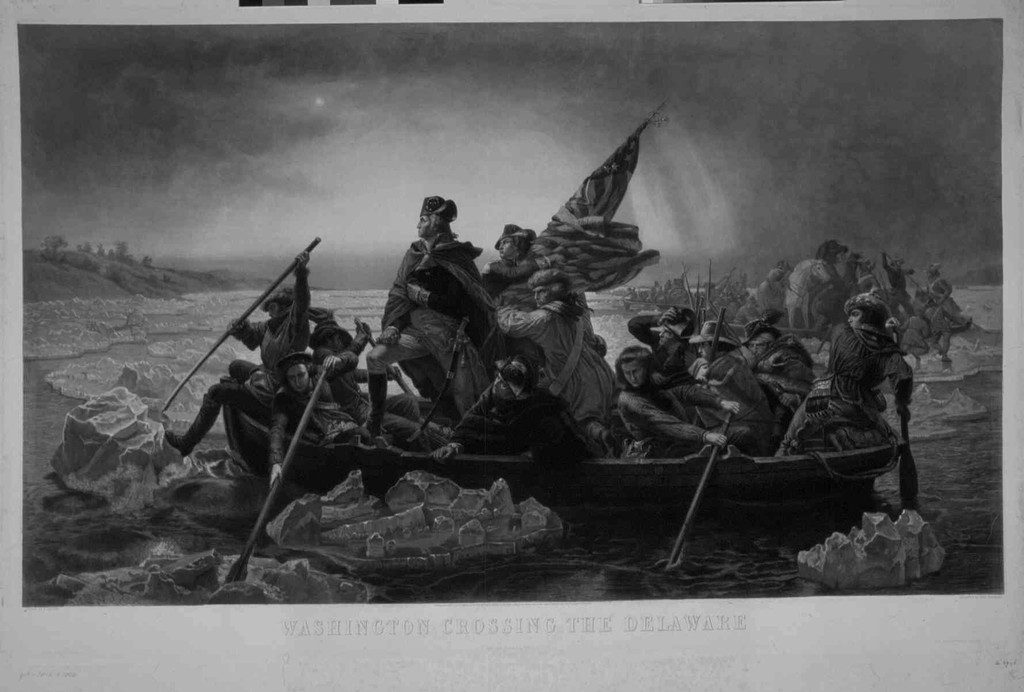
Paul Girardet after Emanuel Leutze, Washington Crossing the Delaware, engraving published in 1853. Leiden University Libraries, PK-P-126.302. Digitised reproduction via Wikimedia Commons, CC BY 4.0. Resized only. Paul Girardet after Emanuel Leutze; digitised by Leiden University Libraries, PK-P-126.302; reproduction via Wikimedia Commons, CC BY 4.0.
Image source
.
Creative Commons Attribution 4.0 International
. Resized only; complete supplied photograph including margins and calibration fragment retained; no appearance editing.
Conservation and the recreated frame
The Met’s technical study separates the artist’s painted surface from materials added during the object’s later care. Conservators Lance Mayer and Gay Myers examined and treated the canvas before its renewed presentation in 2012. Their account discusses accumulated coatings, earlier interventions and the choices involved in cleaning and retouching. Conservation was an investigation of a layered historical object, rather than a simple operation that made every colour brighter. [9]
An earlier treatment in 1947 had attached a supporting fabric with wax-resin adhesive. The later examination also identified wax-containing material on the surface, together with grime and remnants of older coatings. The new treatment used a synthetic-resin varnish and reversible retouching, while recognising the difficulty of some earlier additions. These findings explain why the painting’s changing appearance cannot be described simply as the removal of one yellow varnish. [9]
That distinction is important for anyone comparing reproductions. Different photographs may record different lighting, processing or states of treatment. A lighter digital image is not automatically a more truthful one, and a darker one is not necessarily closer to Leutze’s intention. The painting’s appearance has to be considered through object-specific examination. Brightness alone cannot establish authenticity, condition or the meaning of a passage.
Cleaning also affects relationships within an image. Greater distinction between a dark coat and its surroundings may change how a figure is seen; recovering a small light can alter the balance of an extensive sky. These effects matter because Leutze’s design depends on differences of emphasis. Conservation helps us understand what has become more or less visible, while responsible interpretation avoids turning every treatment result into a new symbolic certainty.
The frame presents a related problem of historical appearance. The elaborate frame seen around the painting today is a modern recreation informed by evidence including an 1864 photograph by Mathew Brady. It is not the surviving original frame. The Met’s publication explains the research and craftsmanship involved in reconstructing its ornamental form. Its eagle and trophy-like crest restore something of the emphatic setting through which nineteenth-century viewers encountered the work. [9]
The contrast between painted ice and gilded ornament is substantial. Within the canvas, the boat moves through difficulty; around it, a large decorative structure presents the event as worthy of public honour. The frame adds a different kind of authority to the scene. A photograph of the installation helps reveal this relationship, which disappears when a reproduction shows only the rectangular painted surface.
Seeing the recreated frame also allows us to distinguish the artwork’s several historical times. The event occurred in 1776; Leutze completed this canvas in 1851; the frame recreates an earlier presentation through modern work. A contemporary installation brings those histories together without making them identical. The visible object is a painting preserved, studied and presented through later decisions.
The museum setting gives scale a further meaning. The picture and its crest occupy a substantial portion of the wall, while the surrounding architecture provides a comparison with ordinary human movement and viewing distance. The isolated image gives us the composition; the installation photograph gives us information about the encounter. Both are useful, provided their captions state clearly what each photograph shows.
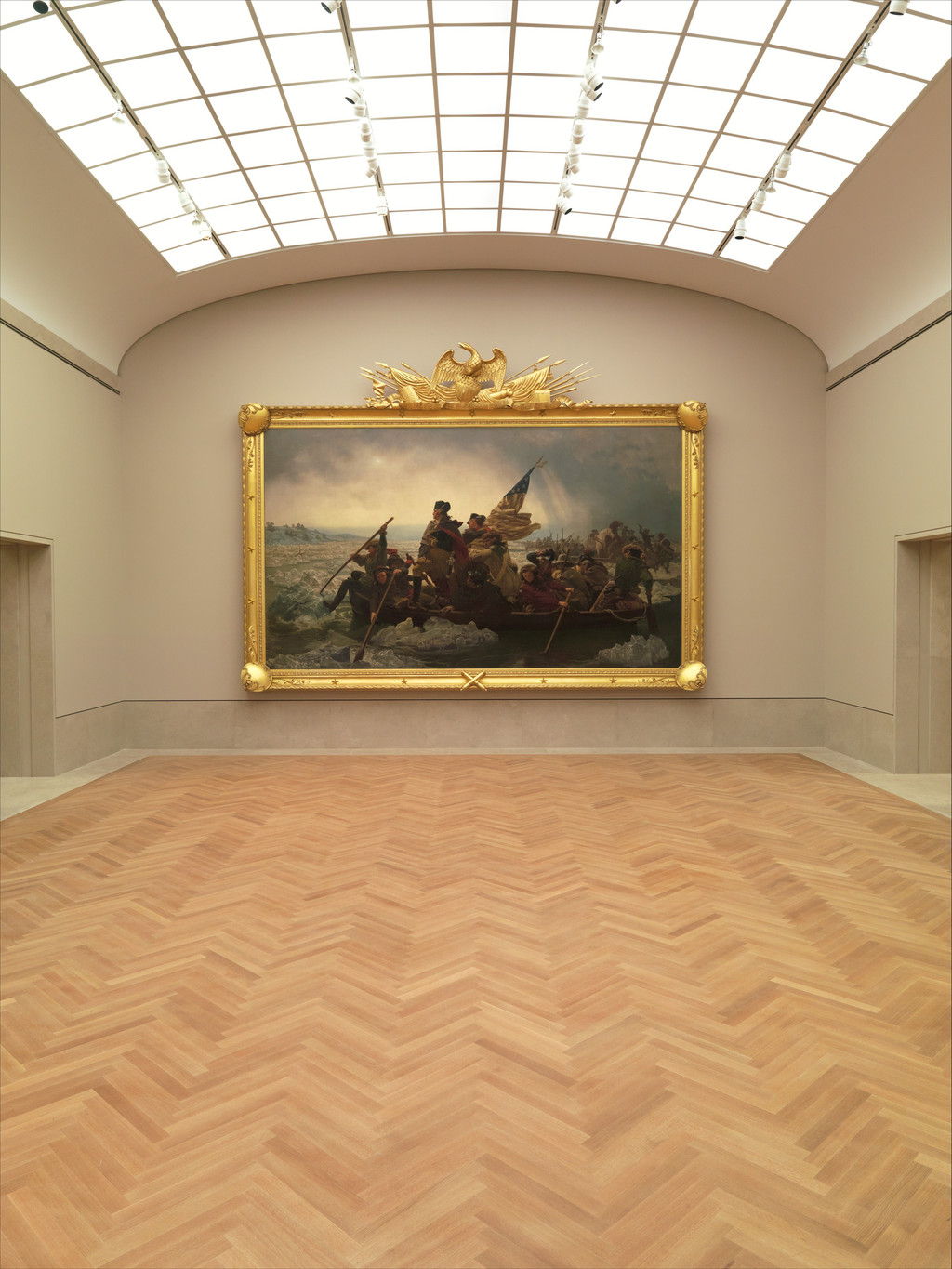
Leutze’s Washington Crossing the Delaware in the Metropolitan Museum of Art, with its modern recreated frame. Museum photograph. The Metropolitan Museum of Art.
Image source
.
CC0 / Public domain
. Resized only; native appearance, complete image and margins preserved.
Native perspectives and later responses
The boat’s varied figures make cooperation conspicuous, but they do not resolve the inequalities within the history of the United States. The flag can connect the passengers to a national future without explaining who would be included within its rights. This unresolved relationship has become a central reason to return to the image. A patriotic painting can remain powerful while the terms of its patriotism are questioned.
In the Met’s Native Perspectives project, artist Alan Michelson draws attention to the likely Native boatman and places the image within a history of alliances, dispossession and broken agreements. His interpretation challenges an account that treats the Revolution’s promise of liberty as sufficient for every community. The contribution is a named contemporary perspective, not evidence that Leutze recorded the same understanding of his own painting. [12]
Such a reading changes the relationship between foreground and outcome. The figures can appear to share the immediate labour of crossing, while their communities faced very different consequences in the nation that followed. Participation in a military effort does not establish consent to later policy or equality within later institutions. The painting’s compressed action brings people together more readily than history brought their interests together.
The Met’s interpretation also includes the perspective of Scott Manning Stevens, an Akwesasne Mohawk scholar. He connects the work’s apparent inclusiveness with the subsequent violence and dispossession affecting Native peoples. This approach asks viewers to hold more than one Washington in mind: the commander represented within a heroic revolutionary picture and the political figure whose later actions have a different place in Native history. [1]
These perspectives do not require the spectator to disregard the rowing, leadership or danger that Leutze painted. They ask for a fuller account of the image’s consequences. A figure can be visually included and historically marginalised; a shared action can support a national story that later excludes some participants. Those possibilities make looking at the boat’s different occupants a historical responsibility as well as an exercise in identifying details.
Artists have also responded by reworking the familiar image. The Met’s Crossings exhibition, held from October 2022 to February 2023, brought Leutze into conversation with works by artists including Robert Colescott, Kara Walker and Kent Monkman. The exhibition presented different approaches to race, national narrative and the authority of a widely recognised composition. It was a temporary exhibition, but the questions raised by these responses extend beyond its dates. [13]
Reworking a recognised arrangement can make an intervention legible quickly. A viewer who remembers Washington and the flag will notice when another artist changes the occupants, direction or emotional character of the scene. The earlier image provides a structure against which alteration becomes significant. This is one form of its continuing influence: its very familiarity makes it available for disagreement and reinterpretation.
The later responses should not be treated as interchangeable illustrations of one criticism. Different artists use different materials, histories and forms of address. Their relationship to Leutze is a point of entry, rather than a complete explanation of their work. The famous composition creates an encounter across time, but contemporary artists retain their own subjects and purposes within that encounter.
The painting’s endurance therefore includes both admiration and argument. It can be celebrated as an ambitious feat of history painting, examined as a constructed account of 1776 and challenged as a national image with exclusions. These are compatible forms of attention. A work that carries so much public recognition can sustain inquiry into how that recognition was made and whose experience it allows us to see.
Comparisons and how to look again
Thomas Sully’s The Passage of the Delaware , painted in 1819, offers a useful comparison because it selects a different moment. Sully places Washington on horseback at the riverbank before the crossing, rather than standing among rowers in a boat. Mount Vernon’s account of the subject in art sets the two treatments beside one another. Each chooses an arrangement that can make military resolve visible, but they locate that resolve in different relationships between commander, people and landscape. [14]
Sully’s shore-based scene allows the commander a position before movement onto the river. Leutze places him inside the transport itself, where authority depends on the labour of the surrounding men. Comparing the choices makes it easier to see how much the boat contributes to Leutze’s picture. It is a compact stage, a physical constraint and a means of assembling varied participants within one readable action.
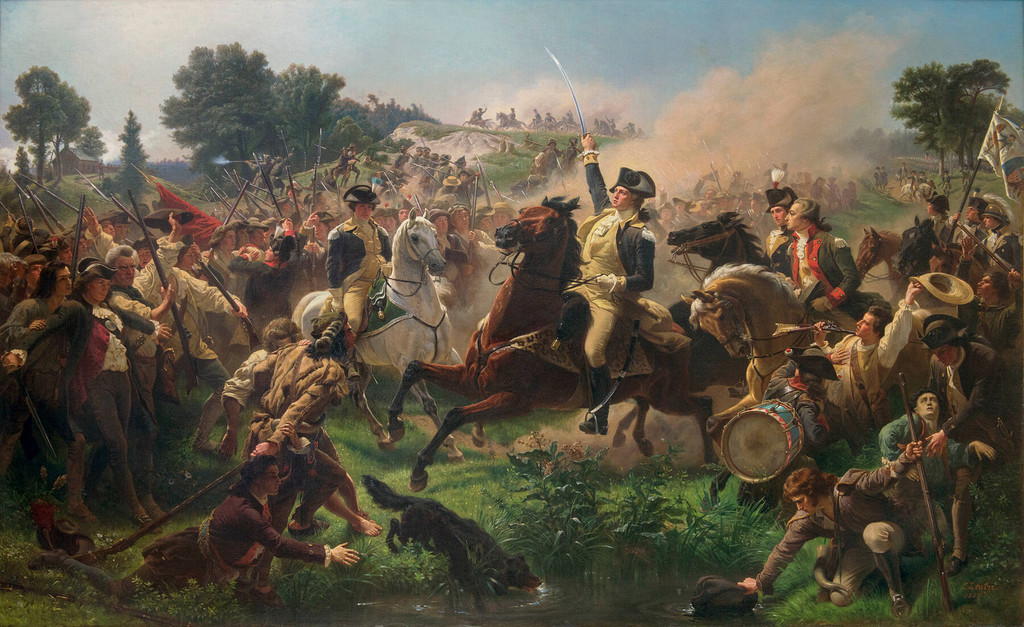
Leutze’s own Washington Rallying the Troops at Monmouth supplies another contrast. In the Monmouth subject, leadership is represented amid the confusion of a battle and retreat. The Delaware picture gives Washington a still profile before combat; the Monmouth composition calls for more immediate intervention. Both use a crowded group to make command visible, but their different actions produce different relationships between the central figure and those around him. [2]
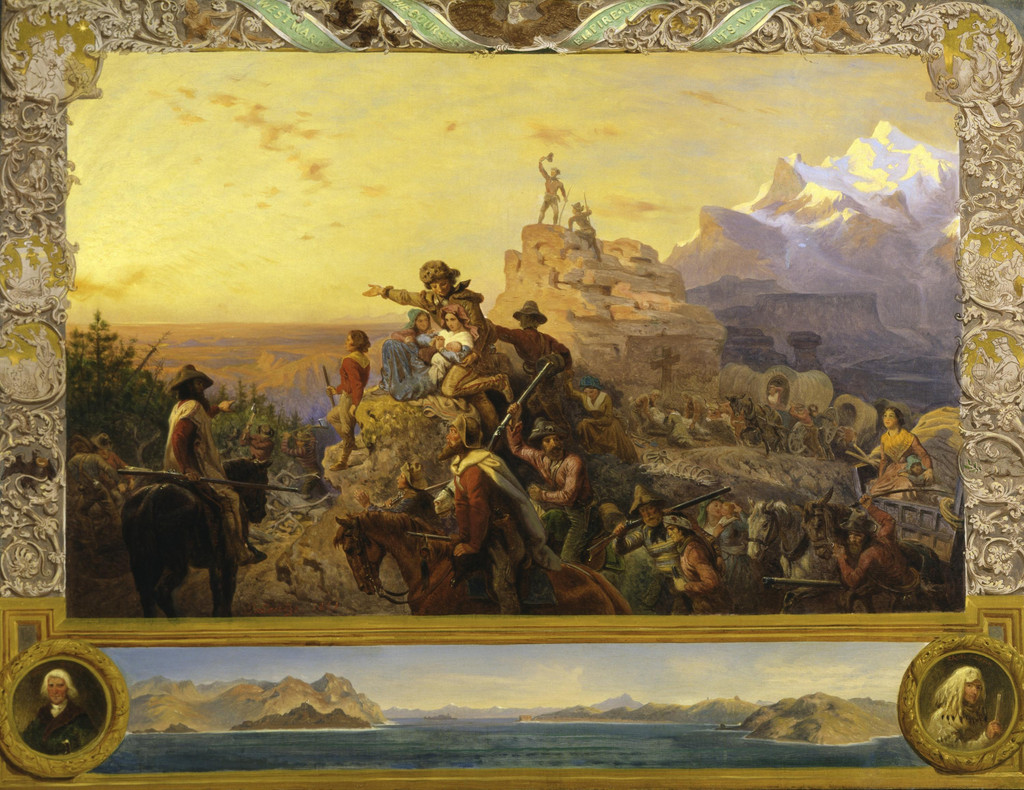
The Westward the Course of Empire Takes Its Way compositions extend the comparison beyond Washington. Figures again organise a movement toward a destination, now through a mountainous landscape and an account of national expansion. Placing the works beside one another reveals the usefulness of directed movement in Leutze’s public art. It also raises questions about the political stories attached to that direction, and about the people omitted from an apparently shared advance.
For a second look at Washington Crossing the Delaware , begin with someone other than Washington. Follow the nearest oar into the water; examine the bandaged figure; trace the hands that hold the boat’s equipment. Then move back toward the commander and ask how his composure depends on those surrounding movements. The familiar hero becomes more intelligible when the physical structure supporting his prominence has been noticed.
Next follow the river beyond the principal boat. The horses, distant craft and far shore restore the scale of an operation that the famous foreground group can obscure. The crossing involved the movement of an army, not just the passage of the most recognisable passengers. Leutze suggests that larger undertaking through diminution and atmosphere, leaving much of it outside the spectator’s detailed view.
Finally, compare the painting’s confident arrangement with the uncertainty in the historical record. The exact vessel and passenger list remain elusive, the flag belongs to later revolutionary chronology, and the darkness of the actual crossing differs from the displayed scene. These distinctions do not make close looking pointless. They let us see what Leutze added: a form through which later audiences could imagine resolve before success, and a national image whose meaning continues to be debated.
Artworks directory
A selected directory of paintings and drawings discussed in these articles. Different versions are listed separately.
| Name | Date | Medium |
|---|---|---|
| Washington Crossing the Delaware (Met canvas) | 1851 | Painting |
| Westward the Course of Empire Takes Its Way (oil study) | 1861 | Painting |
| Westward the Course of Empire Takes Its Way (Capitol mural) | 1861–62 | Painting (mural) |
| Washington Rallying the Troops at Monmouth (large original) | 1854 | Painting |
| Washington Rallying the Troops at Monmouth (replica) | 1857 | Painting |
| The Courtship of Anne Boleyn | 1846 | Painting |
| Worthington Whittredge | 1856 | Painting |
| Signing of the Alaska Treaty | c. 1867 | Painting |
| The Last Drop (McGuire Scrapbook) | Date not specified | Drawing |
| The Amber Necklace | 1847 | Painting |
| Maria Lottner | c. 1842 | Painting |
| Heinrich Lottner | 1858 | Painting |
| Cromwell at Milton’s Home (Schwäbisch Gmünd version) | 1855 | Painting |
| Titian’s Lagoon Voyage | 1857 | Painting |
| Mary Stuart’s First Mass in Holyroodhouse | 1866 | Painting |
| Evening Party at Milton’s (National Gallery of Art canvas) | 1854 | Painting |
| Friedrich Wilhelm Hütz | 1863 | Painting |
| Waving figure from Westward the Course of Empire Takes Its Way | c.1860 | Drawing |
Frequently Asked Questions
The Met’s monumental canvas was completed in 1851. It depicts an event from the night of 25–26 December 1776. An earlier monumental version was damaged in a studio fire in 1850 and later destroyed in Bremen in 1942.
The 1851 canvas belongs to the Metropolitan Museum of Art, New York, accession 97.34. Copies and other versions must be distinguished from this object; check the museum’s current information before planning a visit.
It depicts a real operation through a later dramatic composition. Its flag is anachronistic, the crossing took place at night, and the displayed boat and passenger arrangement are not a verified reconstruction.
That identification is a familiar tradition but cannot be proved. The figure can be discussed in relation to Black participation in the Revolutionary army without assigning him a certain name.
The present frame is a modern recreation informed by historical evidence, including an 1864 photograph. It is distinct from the painting’s lost original frame.
Discussion
Look again at the images and ideas explored in Washington Crossing the Delaware by Emanuel Leutze. These editorial prompts invite your observations.
Reader Insights
How does the picture change when you begin with a rower rather than Washington?
Which difference between the recorded crossing and the painting most affects your interpretation?
What does the museum installation photograph reveal that a reproduction of the canvas alone leaves out?
Join the Conversation
Share a detail, comparison or question about Washington Crossing the Delaware by Emanuel Leutze below.
References
- Metropolitan Museum of Art , Washington Crossing the Delaware , 1851, accession 97.34; object record and interpretation including Scott Manning Stevens. View source
- Natalie Spassky , American Paintings in the Metropolitan Museum of Art , volume II (1985), Emanuel Leutze, printed pp.13–25. View source
- George Washington to John Hancock , 27 December 1776, transcription published by Ohio State University’s History Teaching Institute. View source
- Washington Crossing Historic Park , Myths and Legends . View source
- Guy Sava , Washington Crossing Historic Park, Where Exactly Did Washington Cross the Delaware? (2019). View source
- Kimberly McCarty , Washington Crossing Historic Park, How Did Artillery and Horses Cross the Delaware? (2020). View source
- Henry T. Tuckerman , Book of the Artists: American Artist Life (1867), Leutze, printed pp.333–345. View source
- John K. Howat , Washington Crossing the Delaware , Metropolitan Museum of Art Bulletin 26, no.7 (March 1968), pp.289–299. View source
- Carrie Rebora Barratt; Lance Mayer and Gay Myers; Eli Wilner and Suzanne Smeaton , Washington Crossing the Delaware: Restoring an American Masterpiece , Metropolitan Museum of Art Bulletin (Fall 2011). View source
- Museum und Galerie im Prediger , Schwäbisch Gmünd, Emanuel Leutze (2016 exhibition). View source
- Washington Crossing Historic Park , A Tale of Two Paintings (2018). View source
- Metropolitan Museum of Art , Native Perspectives , Alan Michelson on Washington Crossing the Delaware . View source
- Metropolitan Museum of Art , Crossings , 27 October 2022–28 February 2023. View source
- George Washington’s Mount Vernon , Crossing the Delaware in Art . View source
- Splash image source.
Emanuel Leutze, Washington Crossing the Delaware, 1851. Oil on canvas, 378.5 × 647.7 cm. Metropolitan Museum of Art, 97.34, Gift of John Stewart Kennedy, 1897. The Metropolitan Museum of Art. CC0 / Public domain . Resized only; native appearance, complete image and margins preserved.
View source