


 by
Tom Gurney
Tom Gurney BSc (Hons) is an art history expert with over 20 years experience
Email:
tomgurney1@gmail.com
/ Phone:
+44 7429 011000
Emanuel Leutze Paintings: Introduction
Emanuel Leutze’s paintings turn history into encounters between people. A commander stands above working boatmen, a king approaches a woman before a watchful court, and diplomats gather around maps and a globe. Portraits bring the same interest in human presence to friends and relatives. His range becomes clearer when these pictures are considered together, with attention to the different purposes their figures serve.
Washington Crossing the Delaware remains the essential starting point, but it belongs within a career that moved between America and Europe. Leutze painted revolutionary leadership, English royal history, public visions of expansion and private likenesses. This selection follows those connections while distinguishing individual canvases, studies, murals and later reproductions. [1]
Selected Emanuel Leutze paintings
At a Glance
- Artist Emanuel Gottlieb Leutze, 1816–1868
- Principal field History painting
- Other important work Portraits, genre subjects, drawings and public murals
- Famous canvas Washington Crossing the Delaware , 1851
- European historical subject The Courtship of Anne Boleyn , 1846
- Artist portrait Worthington Whittredge , 1856
- Public commission Westward the Course of Empire Takes Its Way , 1861–62
- Late diplomatic subject Signing of the Alaska Treaty , about 1867
- Geographical context Philadelphia, Düsseldorf, New York and Washington
Contents
- A career across American and European history
- Washington and revolutionary leadership
- European rulers, writers and artists
- Portraits of friends and family
- Westward expansion and the Capitol
- Diplomacy, maps and Alaska
- Paintings, studies and printed images
A career across American and European history
Leutze’s American upbringing and European study gave his paintings more than one audience. His family settled in Philadelphia after emigrating in 1825, and portraiture supplied his earliest professional opportunities. In 1841 he travelled to Düsseldorf for further training. The large American historical subjects that later secured his reputation developed within an international artistic environment, supported by patrons across the Atlantic. [1]
Early Columbus paintings helped establish that reputation. The Metropolitan Museum’s catalogue records Columbus before the High Council of Salamanca in 1841 and The Return of Columbus in Chains to Cadiz in 1842. Their recognition preceded the Washington canvases. They show Leutze already choosing incidents through which a historical personality could be placed within a consequential relationship with other people. [1]
His subjects also extended into English religious and political history. In his contemporary account, Henry T. Tuckerman listed scenes involving Henry VIII, Elizabeth I, Cromwell and Mary Stuart among Leutze’s works. Such variety helps explain why an American revolutionary canvas and a Tudor courtship can belong to the same career. Both give a larger history the form of a concentrated human encounter. [2]
The biography follows the journeys and patrons behind this development. When approaching the paintings themselves, the most useful question is often how the chosen action is made legible. Gesture, costume, light and the reactions of surrounding figures give a scene its direction, whether the setting is a battlefield, court or office.
Washington and revolutionary leadership
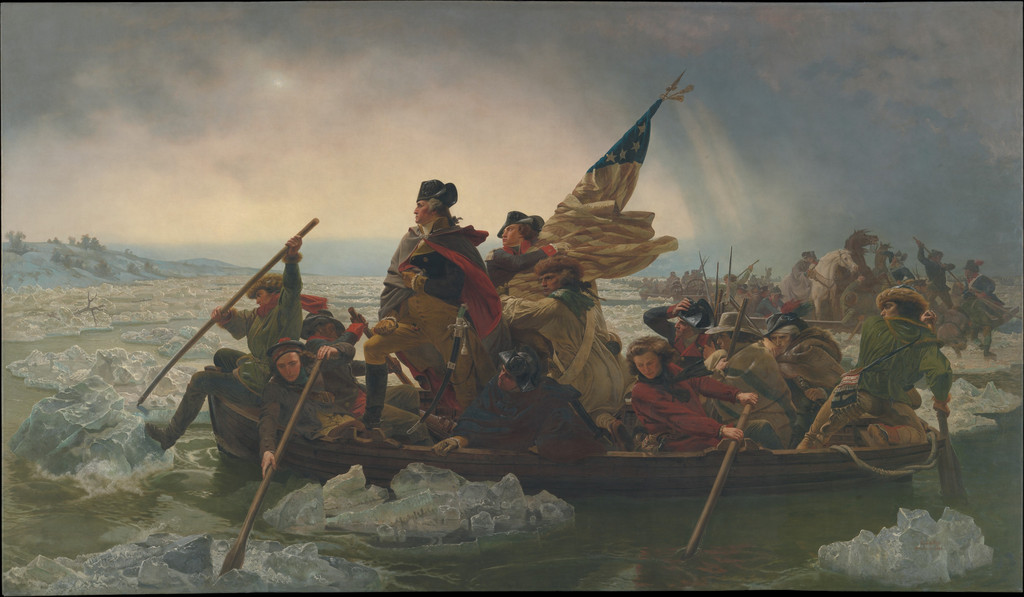
The Metropolitan Museum’s Washington Crossing the Delaware dates to 1851. Its monumental scale gives physical presence to the commander, flag and crowded boat, while the men’s different actions make the crossing a shared undertaking. Washington’s stillness becomes meaningful against the work beneath and around him. The picture’s fame depends on an immediately recognisable figure, but its visual force extends across the entire group. [3]
The canvas also has a specific history among related versions. An earlier large treatment was damaged by fire in 1850, restored and later acquired by the Kunsthalle Bremen, where it was destroyed in 1942. The Met painting is the second monumental version. Smaller paintings and the imagery circulated through prints belong to a wider family of objects whose dates and functions should remain distinct. [4]
Washington Rallying the Troops at Monmouth offers another kind of command. Washington appears mounted, raising his sword above an army whose bodies, weapons and horses fill the foreground. Men seeking water and groups turning towards him establish a difficult situation in which leadership can be demonstrated. The drama is intervention during a battle, rather than the anticipation of an operation still to come.
The illustrated Monmouth painting is the smaller replica of 1857 in the Monmouth County Historical Association. It follows the larger composition completed in 1854. According to the association, Leutze softened Washington’s expression in the replica after criticism of the earlier work’s angrier treatment. The difference makes the appearance of heroism part of the paintings’ history: a leader’s expression could affect how an audience judged the scene. [5]
Taken together, the Washington subjects demonstrate how Leutze varied the conditions around a familiar national figure. A boat and a horse provide different structures; ice and the exhausted army supply different obstacles. The detailed articles examine the historical events, individual versions and later interpretations behind those choices. Their concentrated compositions can then be appreciated without asking a single painted moment to account for an entire military operation.
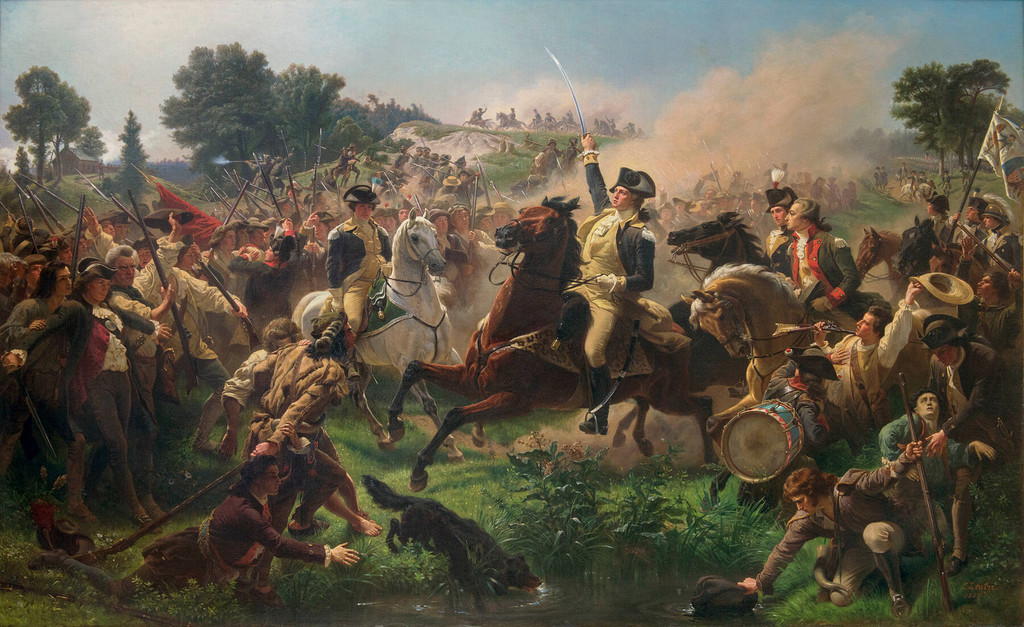
Emanuel Leutze, Washington Rallying the Troops at Monmouth, 1857 replica. Monmouth County Historical Association, 1029. Gift of the Descendants of David Leavitt, 1937. Emanuel Leutze; Monmouth County Historical Association, 1029; reproduction via Wikimedia Commons.
Image source
.
Public domain; faithful reproduction of a public-domain two-dimensional painting (PD-Art, PD-old-100).
. Resized only; complete image and native appearance preserved.
European rulers, writers and artists
In The Courtship of Anne Boleyn , painted in 1846, the surrounding company makes a personal relationship publicly consequential. Henry VIII leans towards Anne within an elaborate interior, while other people attend to them or form quieter exchanges of their own. The court gives the spectator several positions from which to encounter the king’s conduct. [6]
The Smithsonian identifies a disapproving observer to the couple’s left as the Spanish ambassador. It also suggests that Leutze may have used the subject to express distaste for royalty. That political reading remains tentative. The visible organisation of attention and disagreement provides a starting point for interpretation, while the painter’s precise intention cannot be supplied by the theme alone. [6]
Other English subjects broaden this interest in authority and belief. The Museum im Prediger’s documented selection includes Cromwell at Milton’s Home , dated 1855, and Mary Stuart’s First Mass in Holyroodhouse , dated 1866. The first brings political leadership into an encounter associated with a poet; the second places a religious ceremony within royal history. Their subjects connect public power with cultural or religious life rather than concentrating exclusively on military action. [7]
The National Gallery of Art’s Evening Party at Milton’s , dated 1854, is a separate canvas, measuring 153.04 by 213.36 centimetres. The Gmünd work of 1855 measures 78 by 110 centimetres. Related subjects and changing titles make the date, dimensions and collection useful parts of identifying an individual painting. [13] [7]
The Gmünd museum also records Titian’s Lagoon Voyage , dated 1857. This provides another route into Leutze’s historical imagination through the life of an artist. His interest in the past could include the world of art itself, alongside rulers, reformers and national founders. These works extend the range of the selection beyond the most widely reproduced American canvases. [7]
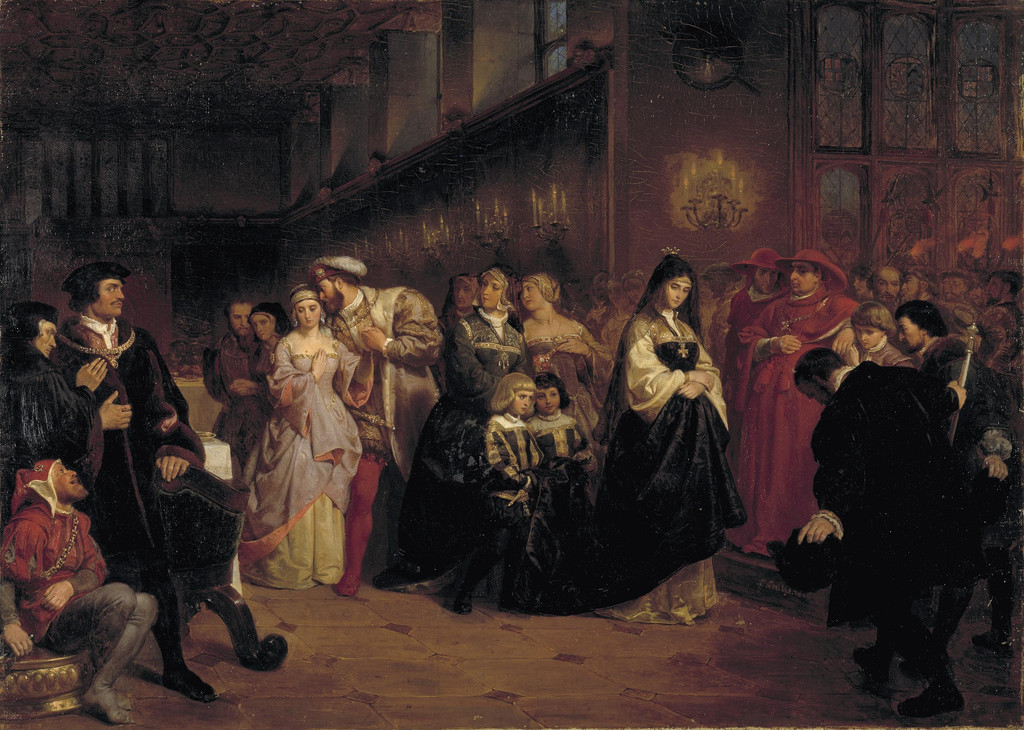
Emanuel Leutze, The Courtship of Anne Boleyn, 1846. Oil on canvas. Smithsonian American Art Museum, 1980.28. Museum purchase.
Image source
.
CC0 / Public domain
. Resized only; native appearance, complete image and margins preserved.
Portraits of friends and family
The portrait of Worthington Whittredge demonstrates how historical interests could operate within a contemporary likeness. Painted in 1856, it represents a fellow artist in seventeenth-century costume. The white ruff, chain and dark clothing evoke an older portrait tradition, while the sitter remains a member of Leutze’s own artistic community. A living friendship and the appearance of the past meet within one figure. [8] [1]
Its restrained arrangement encourages attention to the face and hands. The costume establishes an initial historical association, but differences of light and texture sustain a closer inspection. It offers a useful change of pace after the crowded history pictures. Leutze can make one person occupy a canvas with authority, just as he can make a principal figure stand out within a large group.
Family portraits introduce another dimension. The Amber Necklace , dated 1847, represents his wife Juliane with their daughter Ida. The Gmünd museum also documents Maria Lottner , painted about 1842, and Heinrich Lottner , dated 1858. These likenesses locate part of his work within relationships extending beyond public commissions and national subjects. [7]
The portraits article considers this field in greater depth. Its relationship with history painting is close but varied. A face can establish an individual sitter’s identity, while a historical composition uses likeness, pose and surrounding actions to make a public story intelligible. Leutze practised both across his career, and neither needs to be treated as a minor interruption of the other.
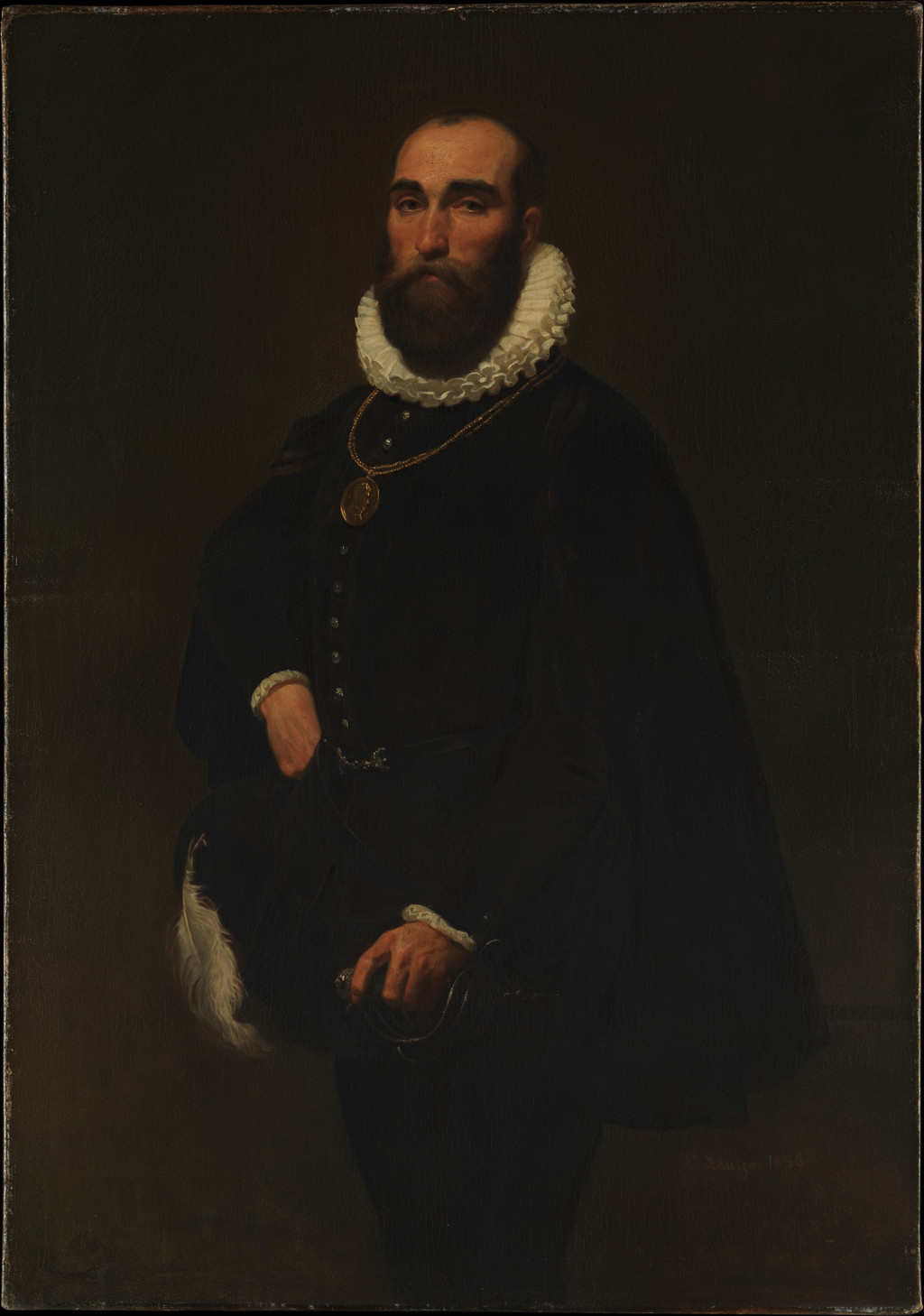
Emanuel Leutze, Worthington Whittredge, 1856. Metropolitan Museum of Art, 03.16. Gift of Several Gentlemen, 1903. The Metropolitan Museum of Art.
Image source
.
CC0 / Public domain
. Resized only; native appearance, complete image and margins preserved.
Watch: Emanuel Leutze
Choose a film to explore the artist’s work, its interpretation and its wider setting.
It's not only about the American Revolution, Leutze's Washington Crossing the Delaware
Smarthistory considers the ideas and historical distance behind Washington Crossing the Delaware.
Watch on YouTubeWestward expansion and the Capitol
Westward the Course of Empire Takes Its Way carries the ambitions of history painting into national architecture. Commissioned by Montgomery C. Meigs in 1861, the finished mural occupies the House wing’s west stairway in the Capitol. Travellers and covered wagons cross a mountainous divide towards a luminous western prospect. The composition gives expansion a visible direction and an anticipated reward. [9]
The Smithsonian’s oil study of 1861 preserves the design on a smaller canvas. Its painted border adds historical, biblical and legendary associations to the central migration, while a lower panorama identifies the Pacific destination through the Golden Gate. Keeping the whole study in view makes those surrounding elements part of the interpretation. They give the travellers’ exertion a larger historical argument. [10] [14]
The study and mural are separate objects with differences in medium and figures. The Capitol work uses stereochromy: pigment applied to plaster and sealed with waterglass. It also includes a young African American figure absent from the early oil sketches. Such changes make comparison a way to understand the project’s development, rather than merely an opportunity to see the same picture at different sizes. [9]
The composition’s organised movement also makes its viewpoint worth examining. It presents migration through the travellers’ effort and hopes. Their shared destination does not encompass all the people affected by expansion. Looking at the work’s national promise therefore involves attention both to the persuasive arrangement and to the experiences that the central group leaves outside its story.
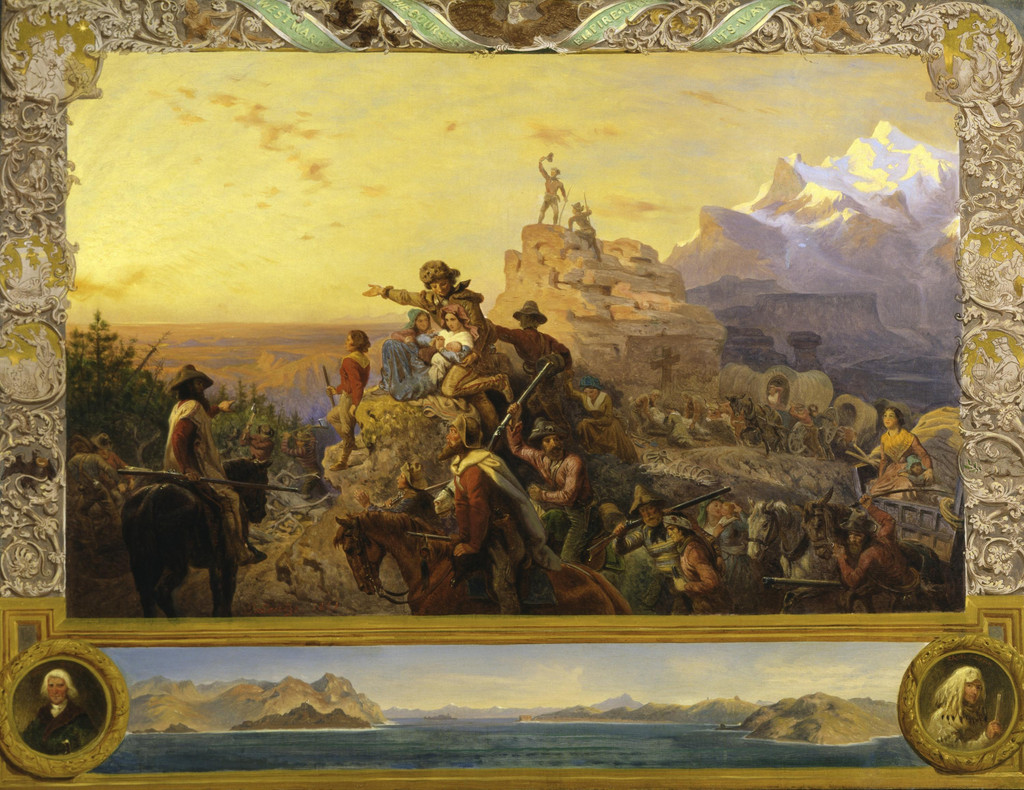
Emanuel Leutze, Westward the Course of Empire Takes Its Way (mural study, U.S. Capitol), 1861. Oil on canvas. Smithsonian American Art Museum, 1931.6.1. Bequest of Sara Carr Upton.
Image source
.
CC0 / Public domain
. Resized only; native appearance, complete image and margins preserved.
Diplomacy, maps and Alaska
Signing of the Alaska Treaty , dated about 1867, finds historical action within an office. Seward sits with a map across his knees, de Stoeckl stands beside the globe, and other officials attend to the documents and discussion. Geography becomes something represented through objects that the men can consult and handle. Their arrangement makes a distant territorial transaction legible as a group encounter. [11]
The painting shows another use of portrait skills within a public subject. Recognisable individuals matter, but the picture’s coherence comes from their relationship with the agreement. Pale papers link the dark-clothed figures, the globe occupies the centre, and national flags establish the setting above them. Smaller actions carry the narrative where a military canvas might rely on a broad commanding gesture.
The diplomatic group has clear limits as a representation of Alaska’s history. The Alutiiq Museum explains that Alutiiq people and other Alaska Native residents were not consulted about the sale. Reading that context beside the painting changes the apparent completeness of the meeting. The image records the viewpoint of an official transaction, while the people affected by it have histories extending beyond the room. [12]
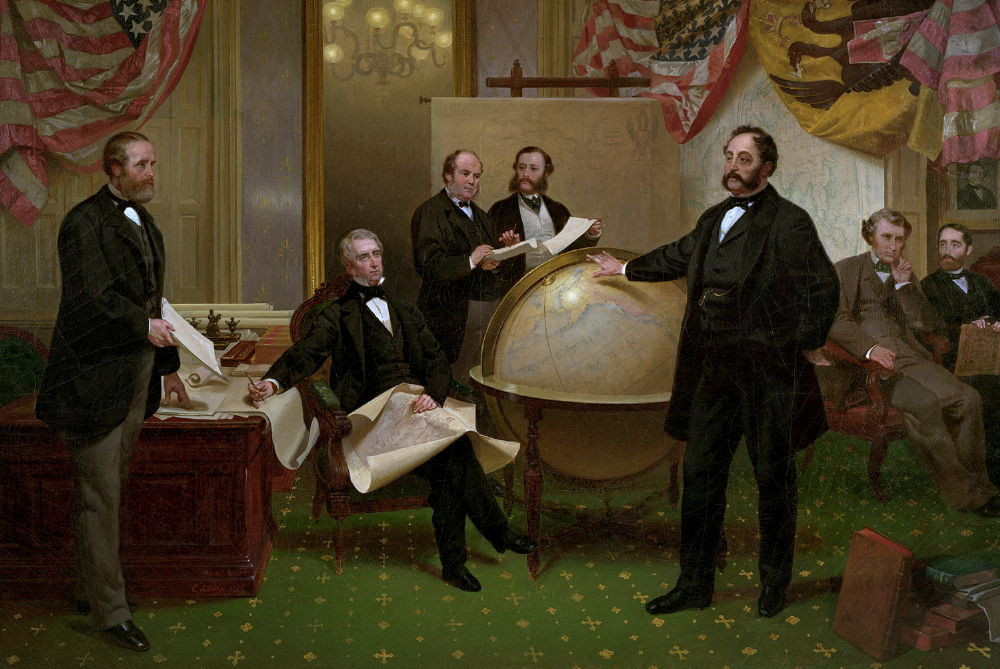
Emanuel Leutze, Signing of the Alaska Treaty, about 1867. Seward House Museum, Auburn, New York. A gift to William H. Seward from Peter Cooper. Emanuel Leutze; reproduction viaWikimediaCommons.
Image source
.
Public domain,faithful2Dreproduction
. Resized only; native appearance, complete image and margins preserved.
Paintings, studies and printed images
Identifying the kind of object is an important part of looking at Leutze. A monumental canvas, a portable oil study, a wall painting and an engraving can circulate the same subject through different settings. Each has a maker, material history and purpose. The painted source and a print made after it can be closely connected without becoming interchangeable objects.
Paul Girardet’s 1853 engraving after Washington Crossing the Delaware illustrates that relationship. The Gmünd museum documents an impression associated with Leutze’s friend Julius Erhard. Reproduction helped the composition travel beyond the audiences who could stand before the large canvas. It also introduced another artist’s work into the image’s public life. [7]
The drawings and prints provide a different way to explore that process. The choice of medium affects what can be seen and how an image reaches its audience. A careful caption naming the artist, work, date and version is consequently useful even when the subject appears familiar.
The selection here brings together major examples rather than attempting to reproduce every painting Leutze made. Following its different strands reveals a consistent interest in the historical significance of people acting, watching and working together. Returning from the famous Washington canvas to a portrait, royal interior or diplomatic group makes that larger practice easier to recognise.
Artworks directory
A selected directory of paintings and drawings discussed in these articles. Different versions are listed separately.
| Name | Date | Medium |
|---|---|---|
| Washington Crossing the Delaware (Met canvas) | 1851 | Painting |
| Westward the Course of Empire Takes Its Way (oil study) | 1861 | Painting |
| Westward the Course of Empire Takes Its Way (Capitol mural) | 1861–62 | Painting (mural) |
| Washington Rallying the Troops at Monmouth (large original) | 1854 | Painting |
| Washington Rallying the Troops at Monmouth (replica) | 1857 | Painting |
| The Courtship of Anne Boleyn | 1846 | Painting |
| Worthington Whittredge | 1856 | Painting |
| Signing of the Alaska Treaty | c. 1867 | Painting |
| The Last Drop (McGuire Scrapbook) | Date not specified | Drawing |
| The Amber Necklace | 1847 | Painting |
| Maria Lottner | c. 1842 | Painting |
| Heinrich Lottner | 1858 | Painting |
| Cromwell at Milton’s Home (Schwäbisch Gmünd version) | 1855 | Painting |
| Titian’s Lagoon Voyage | 1857 | Painting |
| Mary Stuart’s First Mass in Holyroodhouse | 1866 | Painting |
| Evening Party at Milton’s (National Gallery of Art canvas) | 1854 | Painting |
| Friedrich Wilhelm Hütz | 1863 | Painting |
| Waving figure from Westward the Course of Empire Takes Its Way | c.1860 | Drawing |
Frequently Asked Questions
Washington Crossing the Delaware is his best-known painting. The Metropolitan Museum of Art’s monumental canvas dates to 1851.
Yes. His work includes English royal and religious history, portraits, genre subjects and scenes associated with artists. Examples include The Courtship of Anne Boleyn and Titian’s Lagoon Voyage .
Both forms exist. The Smithsonian owns an oil study dated 1861; the finished Capitol mural dates to 1861–62 and uses stereochromy.
Yes. Leutze completed the earlier large composition in 1854 and painted the smaller Monmouth County Historical Association replica in 1857.
Discussion
Look again at the images and ideas explored in Emanuel Leutze Paintings. These editorial prompts invite your observations.
Which comparison changes your view of Leutze most: Washington beside the Tudor court, the artist portrait beside a historical group, or the Capitol mural beside the Alaska negotiation?
Reader Insights
How does the central figure direct your attention in the Washington and Tudor scenes?
What changes between Whittredge’s individual portrait and the diplomatic group?
How do a public commission and a family portrait address different audiences?
Join the Conversation
Share a detail, comparison or question about Emanuel Leutze Paintings below.
References
- Natalie Spassky , American Paintings in the Metropolitan Museum of Art , Volume II, 1985, Leutze section, pp. 13–25. Career, early Columbus subjects and Whittredge portrait. View source
- Henry T. Tuckerman , Book of the Artists , 1867, Leutze chapter, pp. 333–345, especially p. 335. Contemporary account of historical-subject range. View source
- Metropolitan Museum of Art , Washington Crossing the Delaware , 1851, accession 97.34. Object record and image. View source
- Carrie Rebora Barratt and others , Washington Crossing the Delaware: Restoring an American Masterpiece , The Metropolitan Museum of Art Bulletin , Fall 2011. Creation, versions, circulation and material history. View source
- Monmouth County Historical Association , Washington Rallying the Troops at Monmouth , 1857, object 1029. Replica and relationship to the earlier painting. View source
- Smithsonian American Art Museum , The Courtship of Anne Boleyn , 1846, accession 1980.28. Object record and interpretation. View source
- Museum im Prediger / City of Schwäbisch Gmünd , Emanuel Leutze: zum 200. Geburtstag , 2016 exhibition account. European historical pictures, family portraits and Girardet engraving. View source
- Metropolitan Museum of Art , Worthington Whittredge , 1856, accession 03.16. Portrait object record and image. View source
- Architect of the Capitol , Westward the Course of Empire Takes Its Way . Public mural, commission, medium and changes from the oil studies. View source
- Smithsonian American Art Museum , Westward the Course of Empire Takes Its Way (mural study, U.S. Capitol) , 1861, accession 1931.6.1. Study object record and image. View source
- Seward House Museum , Signing of the Alaska Treaty by Emanuel Leutze, about 1867. Diplomatic group and principal figures. View source
- Alutiiq Museum , American—MiRikaan’saaq , Word of the Week. Alaska Native residents’ exclusion from consultation. View source
- National Gallery of Art , Evening Party at Milton’s , 1854, accession 2015.19.111. Object details and provenance of the larger Cromwell and Milton canvas. View source
- Smithsonian American Art Museum , Westward the Course of Empire: Observation and Interpretation . Interpretive account of the painted border and lower panorama. View source
- Splash image source.
Emanuel Leutze, Washington Crossing the Delaware, 1851. Oil on canvas, 378.5 × 647.7 cm. Metropolitan Museum of Art, 97.34. Gift of John Stewart Kennedy, 1897. The Metropolitan Museum of Art. CC0 / Public domain . Resized only; native appearance, complete image and margins preserved.
View source