 by
Tom Gurney
Tom Gurney BSc (Hons) is an art history expert with over 20 years experience
Email:
tomgurney1@gmail.com
/ Phone:
+44 7429 011000
Washington Rallying the Troops at Monmouth: Introduction
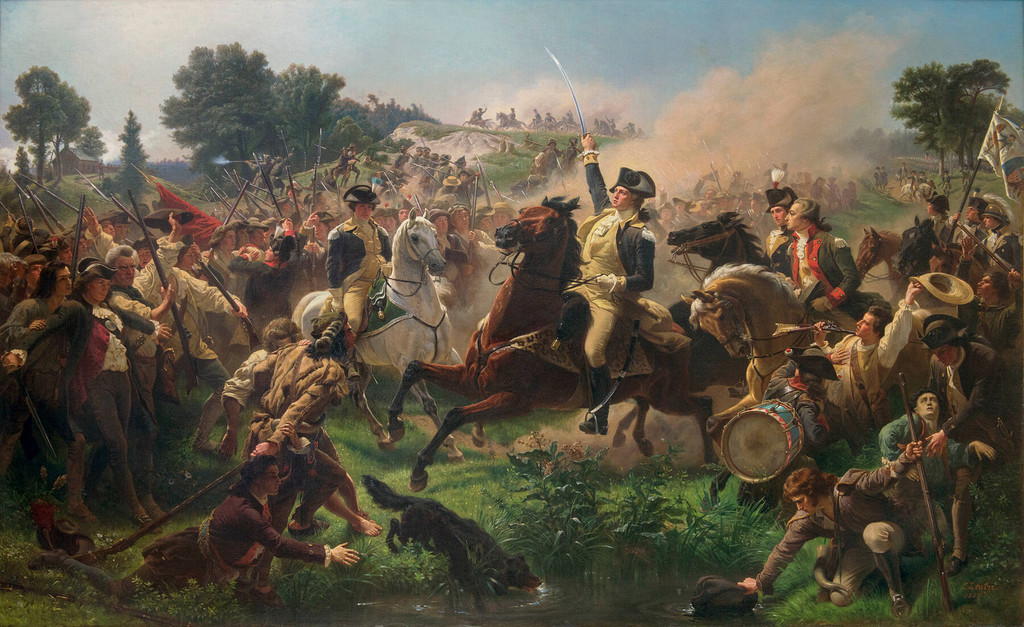
Emanuel Leutze’s Washington Rallying the Troops at Monmouth places military leadership amid exhaustion and disorder. Washington raises his sword above a crowded battlefield, while soldiers turn towards him, horses press together and men seek water in the foreground. The commander becomes the organising presence within a scene that gives the viewer many signs of strain.
The painting illustrated here is Leutze’s 1857 replica, now in the Monmouth County Historical Association. It follows an earlier, larger version completed in 1854 and associated with the University of California, Berkeley. Their shared subject should not obscure their separate histories or the change Leutze made to Washington’s expression. [1] [5]
At a Glance
- Artist Emanuel Gottlieb Leutze
- Title Washington Rallying the Troops at Monmouth
- Illustrated version 1857 replica
- Medium Oil on canvas
- Dimensions 132.1 × 221 cm, or 52 × 87 inches
- Collection Monmouth County Historical Association, 1029
- Credit Gift of the Descendants of David Leavitt, 1937
- Earlier version Completed 1854; Berkeley collection
- Historical event Battle of Monmouth, New Jersey, 28 June 1778
This work across Emanuel Leutze’s career
Washington Rallying the Troops at Monmouth (current article)
1857 replica; original 1854Westward the Course of Empire Takes Its Way
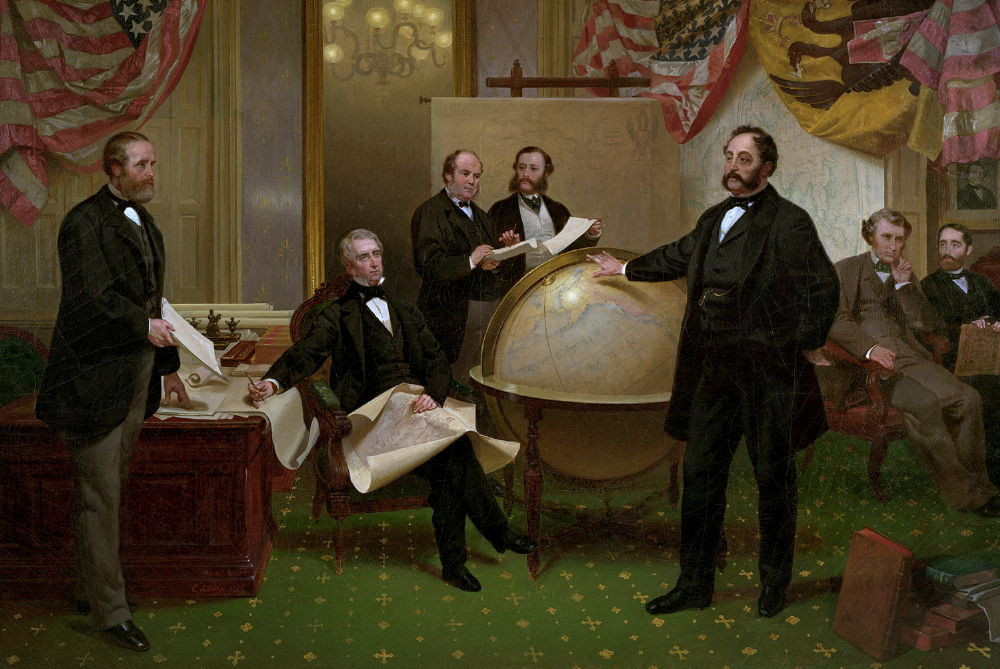
1861 (oil study); mural 1861–62Signing of the Alaska Treaty
c. 1867Contents
- Two paintings and a changed expression
- The battle of 28 June 1778
- Washington, Lee and the mounted group
- What the foreground soldiers contribute
- A companion to the Delaware canvas
- Looking beyond the familiar confrontation
- Reading the whole composition
- Annotated details
Two paintings and a changed expression
The Monmouth composition followed the success of Washington Crossing the Delaware . In April 1852 Leutze petitioned Congress about a further version of the Delaware painting and a companion Monmouth subject for the White House or Capitol. That proposal did not immediately result in a government commission. After returning to Düsseldorf, he developed the Monmouth picture, completed in 1854 for a private collector. [2]
The Monmouth County Historical Association identifies the patron as the banker David Leavitt. It explains that Leavitt subsequently ordered a smaller copy for his daughter Elizabeth in 1857. The museum also describes a significant alteration: Washington’s angry expression in the earlier canvas became calmer in the replica, following criticism that the original treatment diminished the hero. The 1855 review is known here through the museum’s account. [1]
That difference matters to the visible drama. A scowling commander and a composed commander can produce different readings of the same surrounding turmoil. In the 1857 image, the upward sword and energetic horse carry much of the force, while Washington’s face appears comparatively restrained. Heroism emerges through the contrast between his bearing and the varied bodies around him.
The earlier canvas acquired a different institutional history. BAMPFA’s account of the Berkeley collection records its donation to the university by Mrs. Mark Hopkins in 1882. The smaller painting remained associated with the Leavitt family before entering the Monmouth association’s collection. Versions of a successful historical composition could therefore serve different settings and audiences over time. [5] [6]
Annotated Details from Washington Rallying the Troops at Monmouth
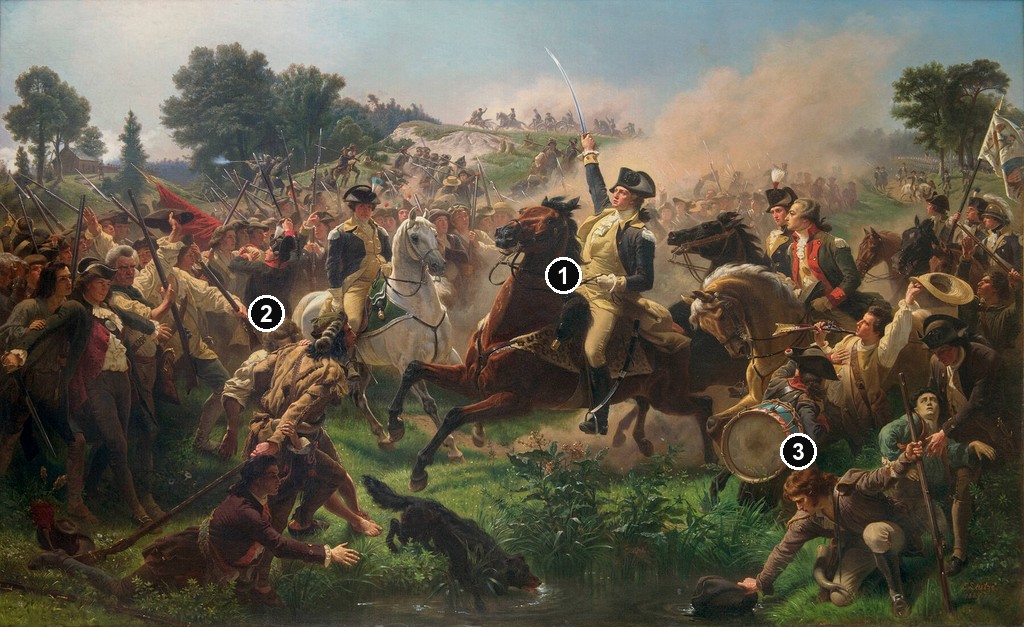
The numbered points identify visible features discussed in this article. Return from each detail to the whole composition. Emanuel Leutze, Washington Rallying the Troops at Monmouth, 1857 replica. Oil on canvas, 132.1 × 221 cm. Monmouth County Historical Association, 1029. Gift of the Descendants of David Leavitt, 1937. Emanuel Leutze; Monmouth County Historical Association, 1029; reproduction via Wikimedia Commons. Image source. Public domain; faithful reproduction of a public-domain two-dimensional painting (PD-Art, PD-old-100).. Separate resized overview with numbered points; details cropped from the original. Original colour and appearance retained.
Details from WASHINGTON RALLYING THE TROOPS AT MONMOUTH
Compare the cropped details with the complete images above. Notice how their colours, shapes and positions contribute to the larger compositions.
Commander and raised sword
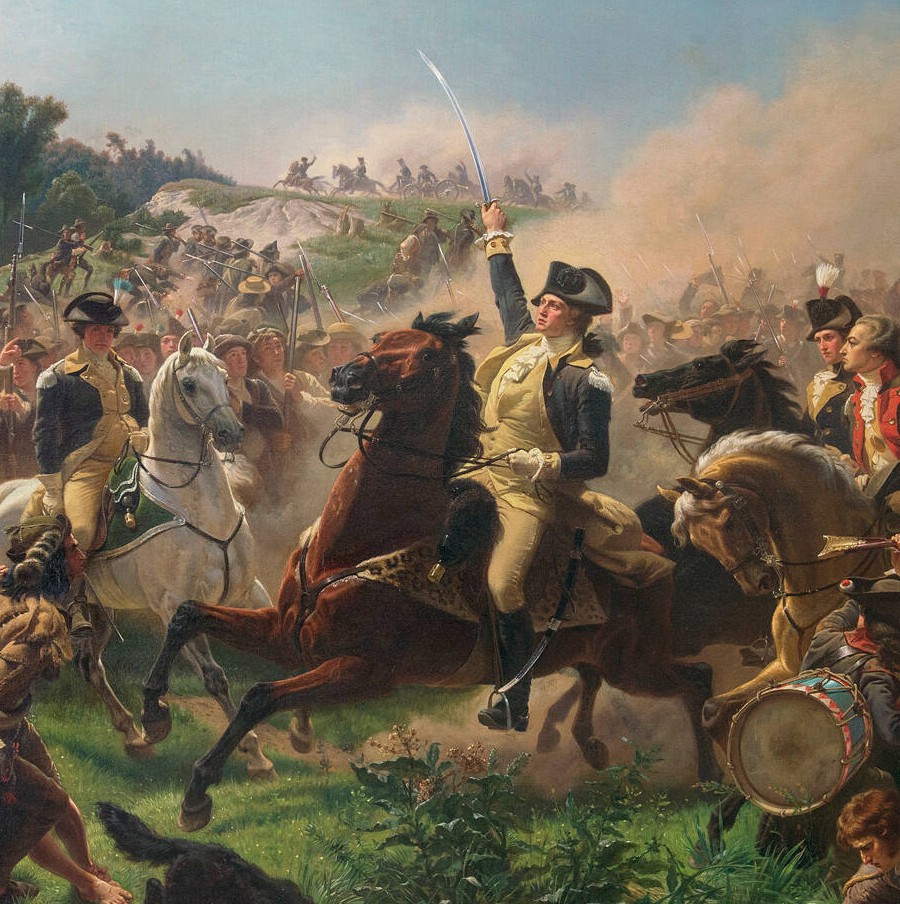
Washington’s raised curved sword and rearing brown horse organise the mounted group. Pale clothing separates his bent leg from the darker animal; this is the 1857 replica.
Infantry and the white horse
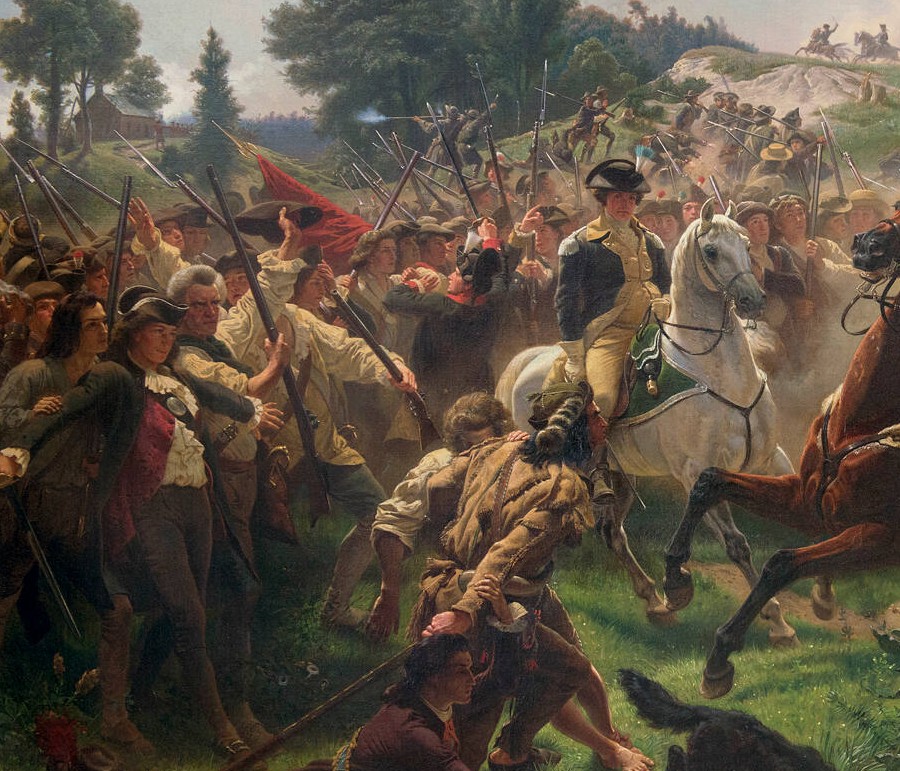
The pale horse and nearby infantry occupy the left of the command group. Repeated weapons and varied gestures carry the crowd back towards the wooded rise.
Water and foreground soldiers
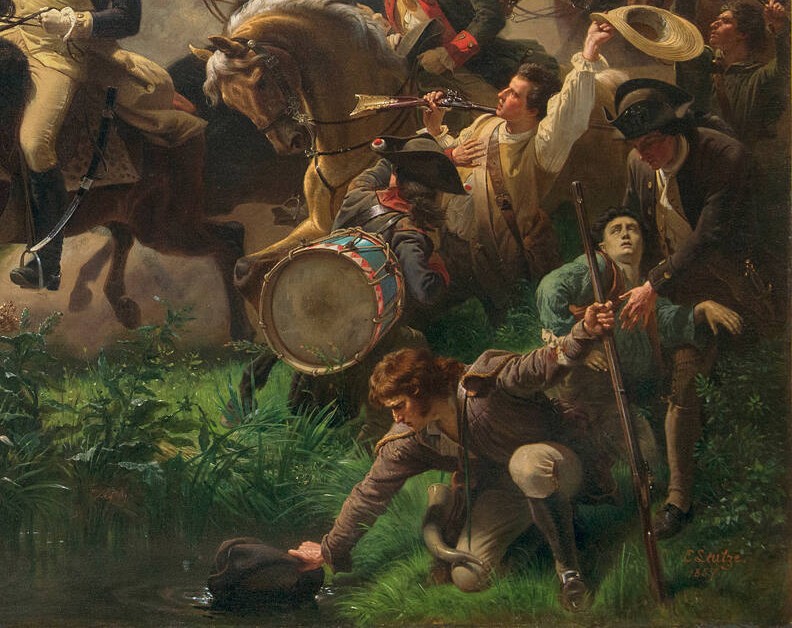
A figure reaches towards the water below the drum and other foreground soldiers. Their lowered bodies and varied postures bring exertion into the scene beside the mounted leaders.
The battle of 28 June 1778
Monmouth took place as British forces withdrew from Philadelphia through New Jersey. Washington sought an opportunity to attack, and an advance force under Major General Charles Lee engaged the British before the main American army arrived. The fighting developed on a fiercely hot day, making endurance and water important parts of the soldiers’ experience. [3]
Washington encountered Lee during the withdrawal and subsequently organised the main army’s defensive position. The battle ended as a tactical draw, with the Americans holding the field the following morning while the British continued towards their destination. Leutze’s chosen moment belongs within this longer operation; it does not represent a simple final victory over a defeated enemy. [3]
The distinction between an episode and a battle is essential to reading the picture. Leutze concentrates numerous experiences into a single dramatic gathering. The canvas can make Washington’s arrival seem decisive at once, whereas the military outcome depended on further fighting, the movement of formations and the actions of many officers and soldiers.
Washington, Lee and the mounted group
Washington’s brown horse occupies the centre, with its lifted forelegs and extended body increasing the commander’s prominence. The raised sword continues his upward movement into the sky. Pale trousers and a light waistcoat separate his figure from the darker uniform and surrounding smoke. The composition gives the viewer several ways to find him before studying his face.
Lee appears to the left on a white horse. The Monmouth association also identifies Lafayette, with red lapels, and Hamilton, with a white plume, in the mounted group behind Washington. These identifications belong to the painted arrangement; they do not establish that all those men occupied these exact positions at the same moment in the battle. [1]
The contrasting horses help distinguish the commanders. Lee’s white mount creates a pale mass beside Washington’s darker, more animated animal. Around them, heads, shoulders, reins and weapons produce a densely interlocking group. The differences in posture encourage a judgement about authority, but the painting’s visual contrast should not be mistaken for a complete assessment of either officer’s conduct.
What the foreground soldiers contribute
The foreground opens a more vulnerable view of the army. At the left edge of the water, a man bends low with an outstretched hand. At the right, another lowers his hat towards the pool. Their actions turn attention from the elevated commander to immediate bodily need. In a battle fought under severe heat, such details make the difficulty of remaining effective visible at the level of individual bodies. [3]
A drum and flute introduce another kind of military activity on the right. Their bright details and the player’s raised arms occupy a different register from the men at the water. Behind them, other figures sit, lean or look upwards. The composition avoids giving every soldier the same response to Washington’s arrival. That variety helps sustain interest across a crowded field.
On the left, muskets and bayonets form a thicket of diagonals above the men’s heads. Raised hands and turned faces repeat the movement towards the commander without producing a uniform line. Farther back, smaller horsemen and artillery extend the action over a rise. Smoke softens the distant groups, making the crowded foreground more immediate by comparison.
These details complicate an image that might otherwise be reduced to Washington and his sword. The hero occupies the most commanding position, but the surrounding people provide the conditions in which leadership can be demonstrated. The picture needs signs of effort and uncertainty to make intervention consequential. Its narrative is built from the relationship between the principal figure and the army’s differentiated experiences.
Watch: Emanuel Leutze
Choose a film to explore the artist’s work, its interpretation and its wider setting.
It's not only about the American Revolution, Leutze's Washington Crossing the Delaware
Smarthistory considers the ideas and historical distance behind Washington Crossing the Delaware.
Watch on YouTubeA companion to the Delaware canvas
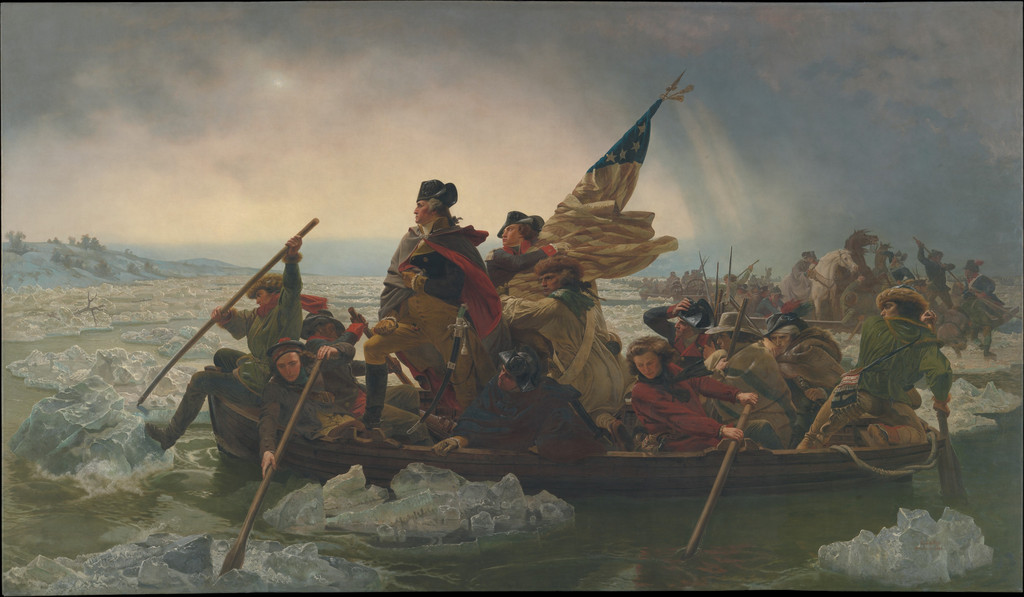
Comparing the two Washington subjects reveals Leutze’s ability to organise different forms of collective action. In the Delaware painting, the men’s work is concentrated within a boat. Oars, bodies, ice and the flag surround a standing commander whose composure remains striking. At Monmouth, the horse replaces the boat as Washington’s immediate support, and the army spreads across a much wider expanse.
The actions also differ in time and mood. The river crossing precedes the attack on Trenton; the Monmouth picture selects intervention during an engagement already under way. The first scene directs attention towards an anticipated operation, while the second asks how a commander appears when circumstances demand a response. Their relationship provides more than an opportunity to recognise the same famous person twice.
Both paintings use costume, equipment and a carefully arranged group to make revolutionary history visible to a nineteenth-century audience. Their German studio context is part of that history. Leutze developed the Monmouth composition during his Düsseldorf years, within a career that connected American patrons with European artistic training and historical ambition. The Düsseldorf and American history article explores that wider exchange. [2]
Looking beyond the familiar confrontation
Modern military scholarship complicates the image of Lee simply fleeing in panic. In his 2024 U.S. Army history, Mark Edward Lender describes a disciplined withdrawal under pressure and argues that it helped preserve the advance force. He also distinguishes the battlefield exchange from later, embellished accounts of Washington’s fury. His reading makes the familiar moral contrast between the commanders less straightforward. [4]
Lender further describes Lee and Wayne conducting a holding action that gave Washington time to establish the main defensive line. Read beside the painting, that account restores activity to a figure who can otherwise appear merely the defeated opposite of the commanding hero. The military sequence and Leutze’s concentrated dramatic arrangement answer different questions. [4]
The distinction need not diminish the painting’s interest. It makes the work more revealing as an act of commemoration. Washington’s image had to carry authority for viewers who already knew him as a national founder. The comparison between the earlier canvas and the calmer 1857 replica shows how the acceptable appearance of that authority could itself become a subject of argument.
Reading the whole composition
Begin with the raised sword, then follow the different levels of action beneath it. The commander’s face, the horses, the turning soldiers, the musicians and the men seeking water create a sequence of changing emphasis. The more closely the surrounding army is examined, the less adequate a description limited to one heroic gesture becomes.
The 1857 replica also rewards attention as a distinct object within Leutze’s paintings . Its date, collection history and adjusted expression belong to its particular afterlife. Recognising that identity allows the image to be discussed accurately while leaving space to compare the earlier version.
Leutze’s achievement lies in making a complicated military crisis readable through a gathering of bodies. Its limits follow from the same concentration: a clear visual hierarchy can simplify a disputed history. Looking with both concerns in mind preserves the force of the composition while allowing the people, decisions and later interpretations surrounding Monmouth to remain more complicated than a single moment can show.
Artworks directory
A selected directory of paintings and drawings discussed in these articles. Different versions are listed separately.
| Name | Date | Medium |
|---|---|---|
| Washington Crossing the Delaware (Met canvas) | 1851 | Painting |
| Westward the Course of Empire Takes Its Way (oil study) | 1861 | Painting |
| Westward the Course of Empire Takes Its Way (Capitol mural) | 1861–62 | Painting (mural) |
| Washington Rallying the Troops at Monmouth (large original) | 1854 | Painting |
| Washington Rallying the Troops at Monmouth (replica) | 1857 | Painting |
| The Courtship of Anne Boleyn | 1846 | Painting |
| Worthington Whittredge | 1856 | Painting |
| Signing of the Alaska Treaty | c. 1867 | Painting |
| The Last Drop (McGuire Scrapbook) | Date not specified | Drawing |
| The Amber Necklace | 1847 | Painting |
| Maria Lottner | c. 1842 | Painting |
| Heinrich Lottner | 1858 | Painting |
| Cromwell at Milton’s Home (Schwäbisch Gmünd version) | 1855 | Painting |
| Titian’s Lagoon Voyage | 1857 | Painting |
| Mary Stuart’s First Mass in Holyroodhouse | 1866 | Painting |
| Evening Party at Milton’s (National Gallery of Art canvas) | 1854 | Painting |
| Friedrich Wilhelm Hütz | 1863 | Painting |
| Waving figure from Westward the Course of Empire Takes Its Way | c.1860 | Drawing |
Frequently Asked Questions
He completed the earlier large version in 1854. The Monmouth County Historical Association’s smaller replica, illustrated here, dates to 1857.
He is General Charles Lee. Washington occupies the centre on the brown horse, with his sword raised.
The battle ended as a tactical draw. The Americans held the field the following morning, while the British continued their withdrawal.
The Monmouth subject was conceived as a companion to the Delaware composition. It presents Washington intervening during a battle rather than accompanying the earlier river crossing.
Discussion
Look again at the images and ideas explored in Washington Rallying the Troops at Monmouth. These editorial prompts invite your observations.
Does Washington’s comparatively calm expression strengthen the drama or sit uneasily within it? Consider how the picture changes when you begin with the soldiers seeking water rather than with the raised sword.
Reader Insights
How does the raised sword relate to Washington’s expression?
What changes when you begin with the soldiers seeking water?
How does knowing there are separate1854 and1857 paintings affect your reading?
Join the Conversation
Share a detail, comparison or question about Washington Rallying the Troops at Monmouth below.
References
- Monmouth County Historical Association , Washington Rallying the Troops at Monmouth , 1857, object 1029. Figure identifications, replica commission and comparison with the earlier version. View source
- Natalie Spassky , American Paintings in the Metropolitan Museum of Art , Volume II, 1985, especially p. 15. Leutze’s 1852 proposal and development of the Monmouth composition. View source
- Mary Stockwell , revised by Zoie Horecny, Battle of Monmouth , George Washington’s Mount Vernon, revised 12 August 2025. Battle context and tactical result. View source
- Mark Edward Lender , Valley Forge to Monmouth, 1778 , Center of Military History, United States Army, 2024, pp. 74–79. Lee’s withdrawal, Washington’s encounter and the subsequent holding action. View source
- Berkeley Art Museum and Pacific Film Archive , Collecting the Moment—The Berkeley Art Museum . Collection-history essay on early gifts, including the 1882 Hopkins donation. View source
- Wikimedia Commons , Washington Rallying the Troops at Monmouth, 1857, Leutze . Public-domain reproduction of the smaller painting and object metadata, credited to the Monmouth County Historical Association. View source
- Splash image source.
Emanuel Leutze, Washington Rallying the Troops at Monmouth, 1857 replica. Oil on canvas, 132.1 × 221 cm. Monmouth County Historical Association, 1029. Gift of the Descendants of David Leavitt, 1937. Emanuel Leutze; Monmouth County Historical Association, 1029; reproduction via Wikimedia Commons. Public domain; faithful reproduction of a public-domain two-dimensional painting (PD-Art, PD-old-100). . Resized only; complete image and native appearance preserved.
View source