 by
Tom Gurney
Tom Gurney BSc (Hons) is an art history expert with over 20 years experience
Email:
tomgurney1@gmail.com
/ Phone:
+44 7429 011000
The Signing of the Alaska Treaty by Emanuel Leutze: Introduction
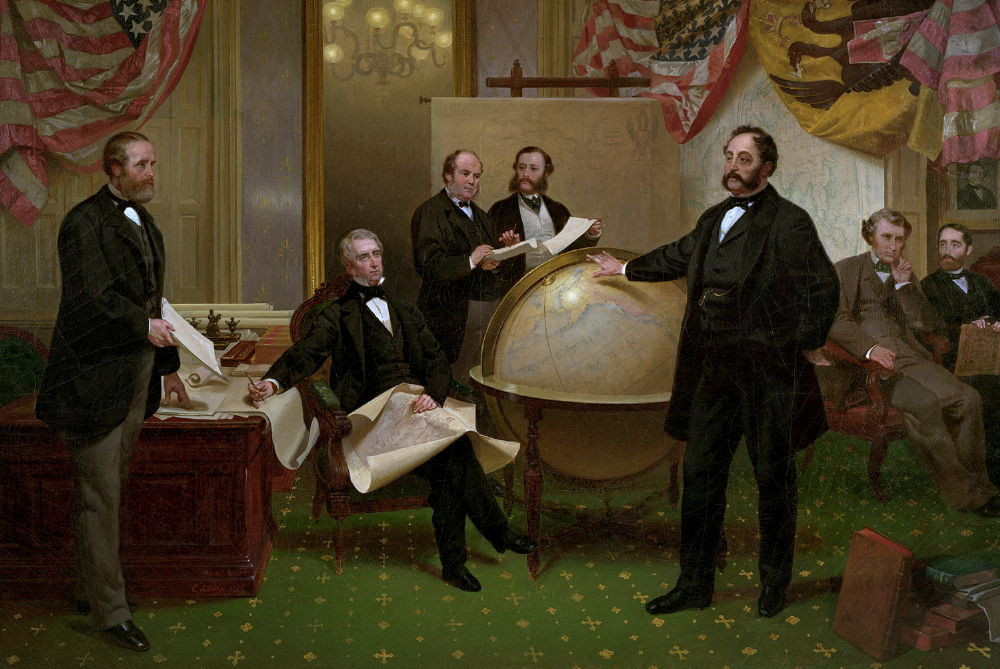
Emanuel Leutze’s Signing of the Alaska Treaty makes diplomacy visible through a room of people, papers and geographical images. William H. Seward sits with a map across his knees, while the Russian representative Eduard de Stoeckl stands beside an enormous globe. Clerks compare documents, and other men observe the proceedings. The scene turns the acquisition of a distant territory into a composed encounter between recognisable individuals. [1]
Dated about 1867 by the Seward House Museum, the painting belongs to the final phase of Leutze’s career. It is also a useful counterpart to his military subjects. Here, the instruments of historical action are maps, written agreements and official discussion. Their arrangement gives an office the public significance that a battlefield or river crossing carries elsewhere in his work. [1] [7]
At a Glance
- Artist Emanuel Gottlieb Leutze
- Title Signing of the Alaska Treaty
- Date About 1867
- Collection Seward House Museum, Auburn, New York
- Gift To William H. Seward from Peter Cooper
- Depicted event Negotiation of the Alaska treaty in Washington, 30 March 1867
- Principal figures Seward and Eduard de Stoeckl, surrounded by officials
- Key objects Maps, documents, globe and national flags
This work across Emanuel Leutze’s career
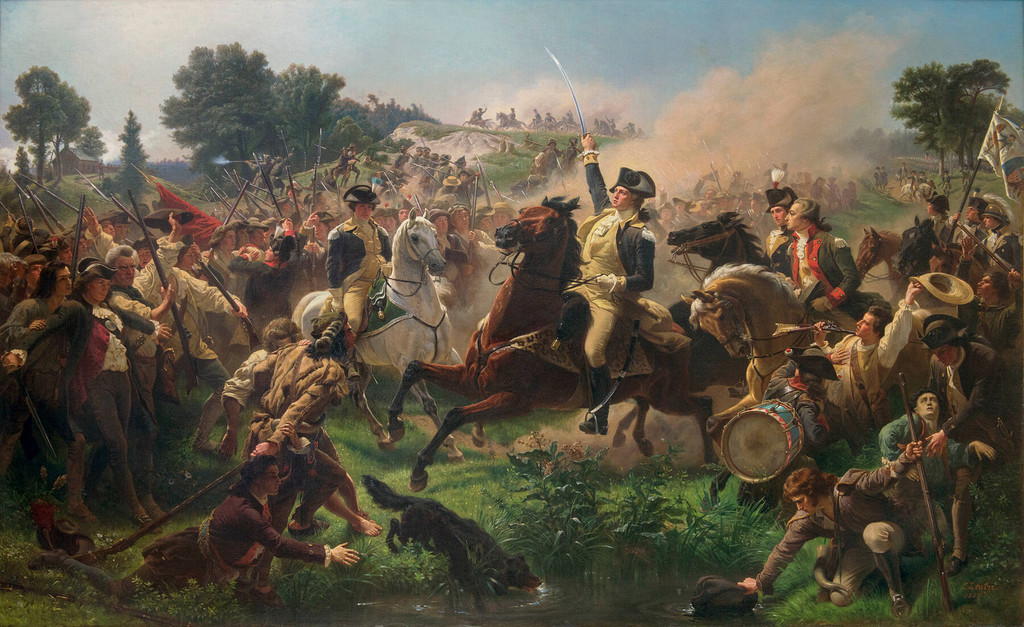
Washington Rallying the Troops at Monmouth
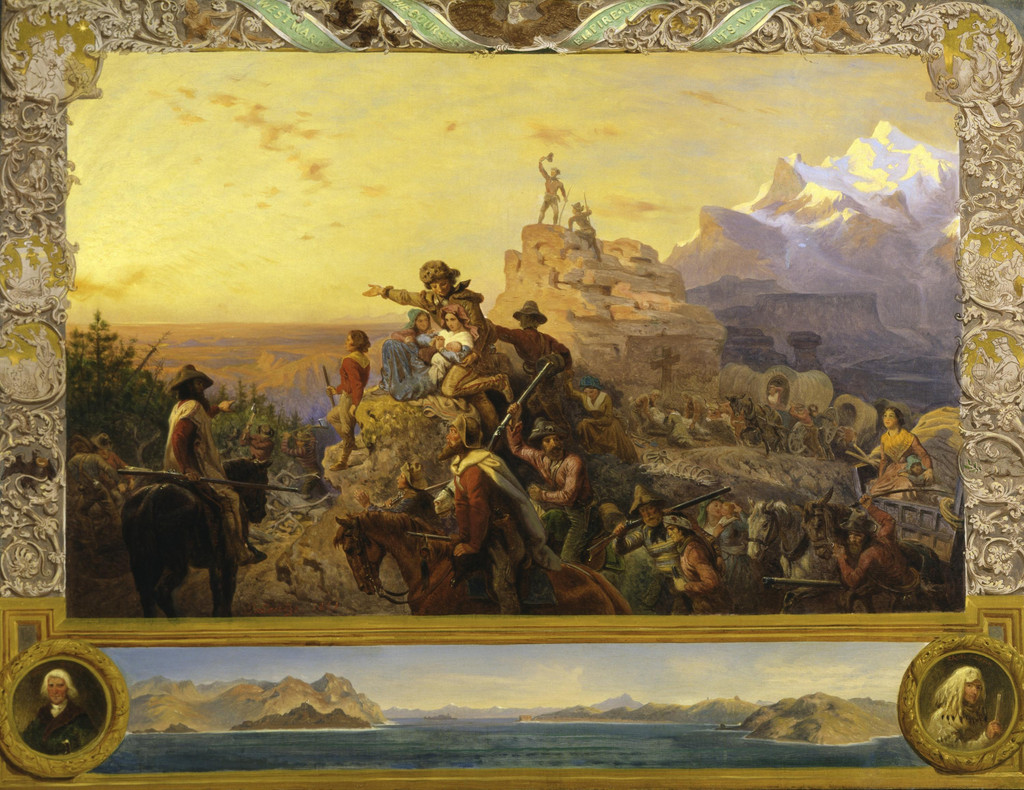
1857 replica; original 1854Westward the Course of Empire Takes Its Way
1861 (oil study); mural 1861–62Contents
- A late historical painting
- Agreement, transfer and payment
- The people around the globe
- Maps, light and the working room
- History painting through negotiation
- Alaska and the people outside the room
- The painting’s later encounter with Alaska
A late historical painting
Leutze’s later career brought him into the world of national government. After returning to the United States in 1859, he worked in New York and Washington, producing portraits and ambitious public subjects. His Capitol mural, Westward the Course of Empire Takes Its Way , had already given national expansion a monumental architectural setting. The Alaska painting approaches a related theme through a more concentrated interior. [7]
The Seward House Museum records the painting as a gift from Peter Cooper to Seward. That relationship gives the work a personal destination alongside its public subject. It commemorates an achievement associated with the recipient, presenting the statesman within an official company whose activity centres on the treaty. A national transaction becomes an image that could also serve friendship and remembrance. [1]
The approximate date deserves to remain approximate. The picture represents the negotiations of March 1867, but the event’s date does not establish the precise day on which Leutze finished the canvas. Its place among his last works is secure within the broader career: the artist died in Washington in July 1868. [1] [7]
Agreement, transfer and payment
Seward, the United States secretary of state, and de Stoeckl, Russia’s minister in Washington, reached their agreement on 30 March 1867. The price was $7.2 million. The purchase transferred Russia’s claimed North American territory to the United States and enlarged American interests in the Pacific. The painting selects the diplomatic encounter through which that agreement was made. [2]
The process continued beyond the room. The Senate approved the treaty on 9 April, and President Andrew Johnson ratified it on 28 May. Formal transfer followed on 18 October 1867. Keeping these stages distinct helps explain what a picture of the negotiation can represent: an important moment within a sequence of decisions and actions. [2]
Payment supplied another, later document. The National Archives preserves the cancelled check for $7.2 million, issued on 1 August 1868 and payable to de Stoeckl. The check and the painted negotiation represent different stages of the transaction. A familiar historical image can concentrate an event’s meaning while its surviving records reveal a longer chronology, extending beyond the meeting that Leutze chose to commemorate. [3]
The people around the globe
Seward occupies a seated position to the left of the globe, with one hand resting on the map across his knees. De Stoeckl stands to its right, extending a hand over the spherical surface. Their different postures create a principal exchange across the centre. The arrangement gives both men prominence without placing them in identical poses.
The owning museum identifies Chew, the chief clerk, at the left with a prepared copy of the agreement. Hunter and Bodisco compare the English and French texts behind Seward. Senator Charles Sumner and Assistant Secretary of State Frederick W. Seward complete the group at the right. These figures make documentary work and political observation part of the scene, alongside the two principal negotiators. [1]
Seven men occupy the room, but their attention is distributed unevenly. Some handle or inspect papers, while others look across the gathering. This variety gives the composition movement without requiring large physical gestures. A document held up behind the globe, a hand extended over it and Seward’s seated turn create a network of small actions through which the encounter becomes readable.
The contemporary subject also connects portraiture with historical narrative. Individual faces and official roles matter, yet the painting is more than a row of separate likenesses. Leutze makes their relationship to a shared undertaking the organising principle. The group becomes a picture of diplomacy because the people are arranged around its objects and activities.
Maps, light and the working room
The globe is unusually conspicuous. Its curved surface occupies a large part of the centre, with the stand raising it between the seated and standing figures. Maps offer a different kind of geographical representation: one lies across Seward’s knees, while others furnish the room behind the company. Territory is present through images that can be consulted, pointed towards and possessed within an office.
Papers create brighter accents against the men’s predominantly dark clothing. Their pale surfaces help connect figures who would otherwise merge into separate dark masses. The comparison of texts behind the globe is particularly useful to the composition, giving visible activity to a part of the room that could have remained background. The work of agreement appears as reading and handling as well as discussion.
Flags above the company establish a national setting for those actions. Their draped forms occupy the upper part of the picture, while the globe and map bring geography down to the level of hands and bodies. The painted room therefore works across several scales: individuals conduct business beneath national emblems, using representations of territory and the wider world.
The green patterned carpet and substantial furniture give the proceedings a settled, official environment. At the lower right, books and a portfolio-like object interrupt the floor’s regular pattern. The composition leaves enough open space for the figures’ stances to remain clear. Its sense of order depends on these intervals as much as on the number of meaningful objects gathered together.
Watch: Emanuel Leutze
Choose a film to explore the artist’s work, its interpretation and its wider setting.
It's not only about the American Revolution, Leutze's Washington Crossing the Delaware
Smarthistory considers the ideas and historical distance behind Washington Crossing the Delaware.
Watch on YouTubeHistory painting through negotiation
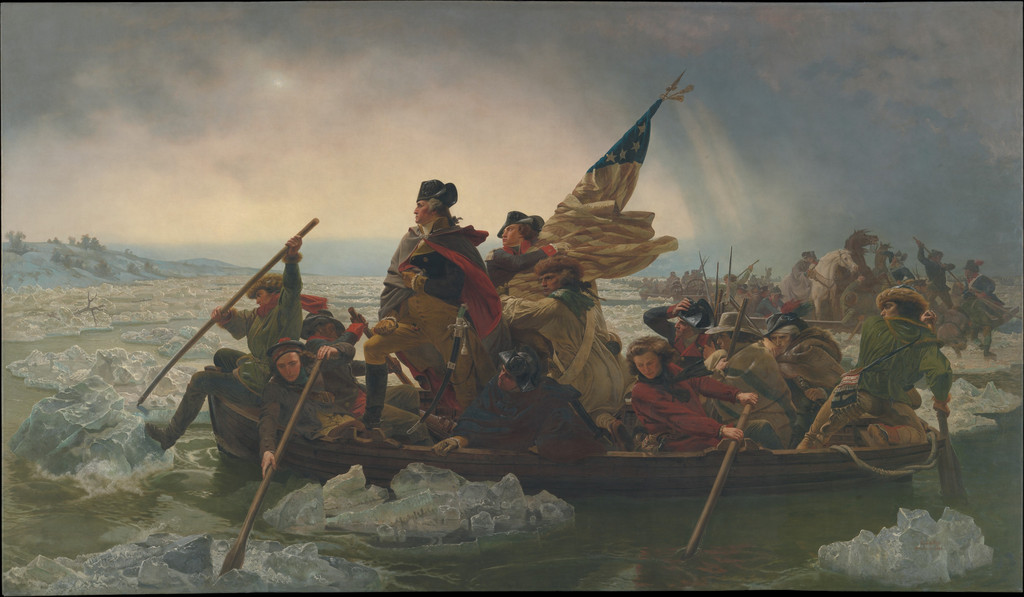
Leutze’s Washington Crossing the Delaware makes a national turning point depend on strenuous physical action. The Alaska painting finds drama in a quieter undertaking. The eye follows hands, faces and papers rather than oars, weapons or struggling horses. The difference reveals the flexibility of history painting as a way to give a public event a visible form.
The subject also belongs close to the artist’s own time. Leutze could portray living officials associated with a recent transaction, yet the finished group remains an arrangement designed to communicate significance. The University of Alaska’s account describes the office scene as imagined. Its credibility as a commemorative picture does not require every represented gesture to have occurred simultaneously. [4]
Seen beside Leutze’s portraits , the painting shows how likeness could support a larger historical composition. Seen beside the Capitol mural, it offers another representation of expansion. The mural sends travellers across a mountainous landscape; the treaty picture places control over a distant region within a room of officials. In each, a carefully selected group stands at the centre of the national story.
Alaska and the people outside the room
The group’s apparent completeness has limits. The Alutiiq Museum explains that Alutiiq people and other Alaska Native residents were not consulted about the sale. It also distinguishes commemoration of the purchase from celebration, recognising that the transfer brought further challenges for Native communities. That perspective changes what the diplomatic gathering can be understood to represent. [5]
The treaty itself records an unequal vision of the people whose lives it affected. Article III used discriminatory classifications and excluded the Native groups it placed within one category from its promise of admission to American citizenship. The University of Alaska’s Tribal Governance course discusses how these distinctions contributed to questions about Alaska Native status. These provisions belong beside the celebrated price and date when considering the agreement’s meaning. [3] [6]
No Alaska Native representative appears among the seven officials in the painting. The maps and globe make the territory available for discussion, but the people living there remain outside its visible company. Reading this absence does not require inventing a hidden intention for Leutze. It identifies the viewpoint embodied by the group and the limits of treating an official transaction as the whole history of a place.
The painting can consequently be examined as both a skilful diplomatic group and a selective image of national power. Attention to those excluded from the room enlarges the historical question rather than replacing the visible subject. It asks what the orderly arrangement makes persuasive, and what other experiences must be brought into view through sources beyond the canvas.
The painting’s later encounter with Alaska
The original remained associated with the Seward House collection, but its relationship with Alaska acquired another chapter in 2017. The University of Alaska Museum of the North displayed it in Fairbanks for the treaty’s 150th anniversary. Its announcement identified the original visiting from Auburn, discussed its importance within the state’s historical imagery and described a planned tour that would also include Anchorage and Juneau. [4]
That later journey placed an image of decisions made in Washington before audiences in the territory concerned. The encounter offered scope for different responses to its commemorative purpose. An anniversary could draw attention to Seward’s diplomacy while also making the exclusions and consequences of the transaction newly visible.
The wider selection of Leutze’s paintings helps situate the work within a career devoted to making history legible through people acting together. Here, the faces, papers and geographical objects produce a coherent account of agreement. Looking beyond that coherence reveals the continuing importance of asking whose action is shown, whose authority is assumed and whose history extends outside the frame.
Artworks directory
A selected directory of paintings and drawings discussed in these articles. Different versions are listed separately.
| Name | Date | Medium |
|---|---|---|
| Washington Crossing the Delaware (Met canvas) | 1851 | Painting |
| Westward the Course of Empire Takes Its Way (oil study) | 1861 | Painting |
| Westward the Course of Empire Takes Its Way (Capitol mural) | 1861–62 | Painting (mural) |
| Washington Rallying the Troops at Monmouth (large original) | 1854 | Painting |
| Washington Rallying the Troops at Monmouth (replica) | 1857 | Painting |
| The Courtship of Anne Boleyn | 1846 | Painting |
| Worthington Whittredge | 1856 | Painting |
| Signing of the Alaska Treaty | c. 1867 | Painting |
| The Last Drop (McGuire Scrapbook) | Date not specified | Drawing |
| The Amber Necklace | 1847 | Painting |
| Maria Lottner | c. 1842 | Painting |
| Heinrich Lottner | 1858 | Painting |
| Cromwell at Milton’s Home (Schwäbisch Gmünd version) | 1855 | Painting |
| Titian’s Lagoon Voyage | 1857 | Painting |
| Mary Stuart’s First Mass in Holyroodhouse | 1866 | Painting |
| Evening Party at Milton’s (National Gallery of Art canvas) | 1854 | Painting |
| Friedrich Wilhelm Hütz | 1863 | Painting |
| Waving figure from Westward the Course of Empire Takes Its Way | c.1860 | Drawing |
Frequently Asked Questions
It belongs to the Seward House Museum in Auburn, New York. It travelled to Alaska for a historical touring exhibition in 2017.
The Seward House Museum dates it to about 1867. The scene represents the negotiations of 30 March 1867.
They are William H. Seward, the United States secretary of state, seated with the map, and Eduard de Stoeckl, Russia’s representative, standing beside the globe.
The surviving check for $7.2 million was issued on 1 August 1868, after the agreement and formal transfer of 1867.
Discussion
Look again at the images and ideas explored in The Signing of the Alaska Treaty by Emanuel Leutze. These editorial prompts invite your observations.
How do the map and globe change your response to the group? Consider how the painting’s orderly room might look different when read alongside the perspectives of people excluded from the negotiation.
Reader Insights
How do the papers and globe organise attention around the officials?
How does this diplomatic group compare with Leutze’s scenes of physical action?
What changes when you consider the people excluded from the negotiation?
Join the Conversation
Share a detail, comparison or question about The Signing of the Alaska Treaty by Emanuel Leutze below.
References
- Seward House Museum , Signing of the Alaska Treaty by Emanuel Leutze, about 1867. Object description, gift and figure identifications. View source
- Office of the Historian , U.S. Department of State, Purchase of Alaska, 1867 . Historical account of the agreement, ratification and transfer. View source
- National Archives , Check for the Purchase of Alaska (1868) , with English transcript of the Treaty of Cession. Payment document and treaty Articles III and VI. View source
- Theresa Bakker , Painting on exhibit commemorates purchase of Alaska , University of Alaska Fairbanks, 6 February 2017. Historical touring exhibition and the imagined office scene. View source
- Alutiiq Museum , American—MiRikaan’saaq , Word of the Week. Native residents’ exclusion from consultation and the meaning of commemoration. View source
- University of Alaska Fairbanks , Tribal Governance, Russians in Alaska and U.S. Purchase . Historical treaty classifications and Alaska Native status. View source
- Natalie Spassky , American Paintings in the Metropolitan Museum of Art , Volume II, 1985, pp. 15–16. Leutze’s final career phase and the Alaska painting. View source
- Splash image source.
Emanuel Leutze, Signing of the Alaska Treaty, about 1867. Seward House Museum, Auburn, New York. A gift to William H. Seward from Peter Cooper. Emanuel Leutze; reproduction viaWikimediaCommons. Public domain,faithful2Dreproduction . Resized only; native appearance, complete image and margins preserved.
View source