 by
Tom Gurney
Tom Gurney BSc (Hons) is an art history expert with over 20 years experience
Email:
tomgurney1@gmail.com
/ Phone:
+44 7429 011000
Emanuel Leutze Drawings and Prints: Introduction
Emanuel Leutze’s work on paper offers a different encounter from his monumental historical paintings. A small drawing can bring the viewer close to the movement of a line, while a print after a famous composition makes that image available to a wider audience. Both belong to his artistic world, but their makers, purposes and relationships with a painted source need to be distinguished.
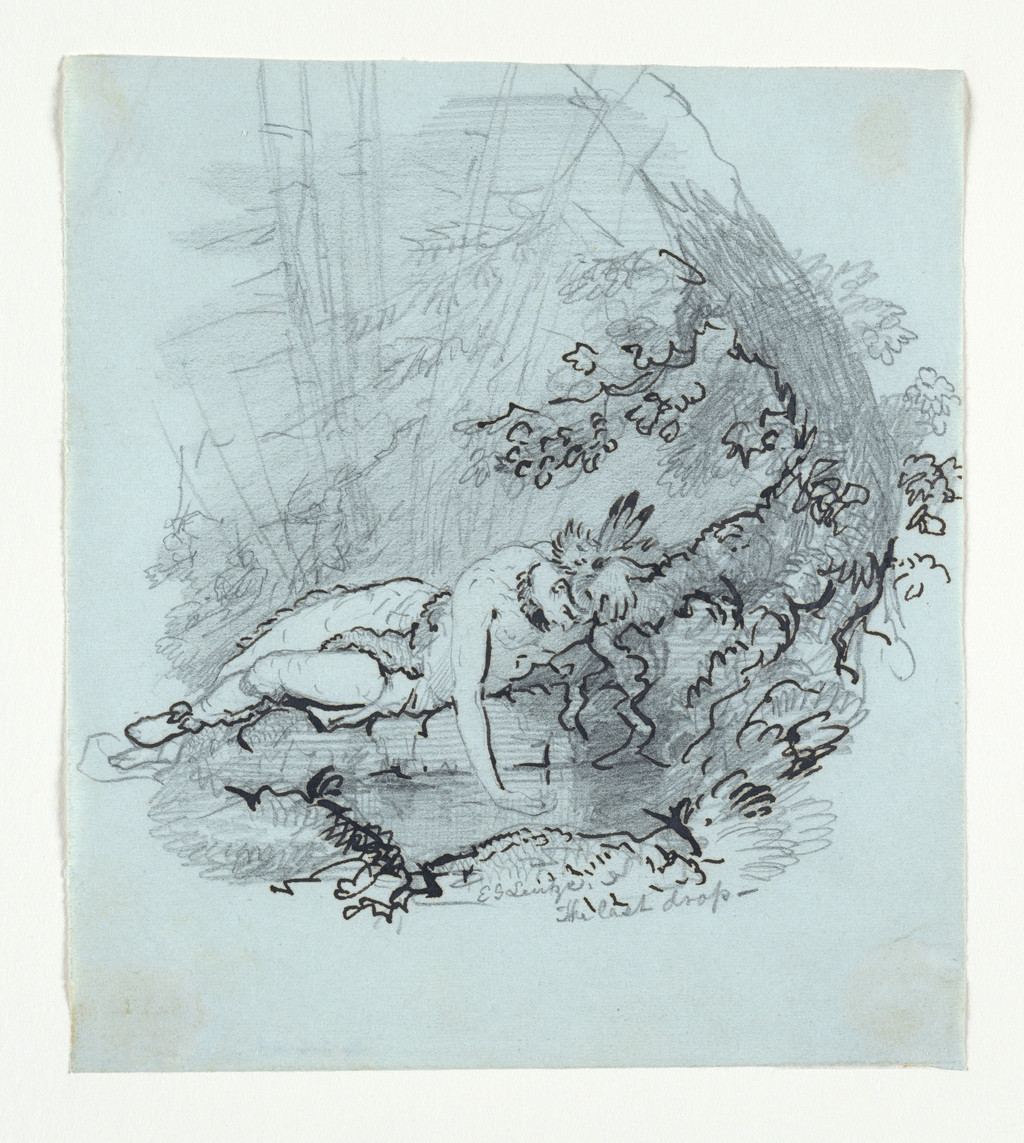
The Metropolitan Museum’s The Last Drop is a drawing by Leutze. Paul Girardet’s Washington Crossing the Delaware is an engraving after Leutze’s painting. Setting those descriptions beside one another establishes a useful starting point: the artist responsible for an image’s design and the person who made a particular object are not always the same. [1] [7]
Selected drawing and reproductive print
At a Glance
- Artist Emanuel Gottlieb Leutze, 1816–1868
- Illustrated drawing The Last Drop (from McGuire Scrapbook)
- Drawing date Not specified in the museum record
- Materials Iron gall ink and graphite on paper
- Drawing collection Metropolitan Museum of Art, 26.216.29
- Important reproductive print Washington Crossing the Delaware , engraved by Paul Girardet, published in 1853
- Key distinction A drawing by Leutze differs from a print made by another artist after his painting
- Related processes Figure studies, painted working versions and underdrawing beneath paint
Contents
- The Last Drop at an intimate scale
- Studies and the organisation of a figure
- Johnson and the engraver’s painted source
- Girardet’s Washington Crossing the Delaware
- Reproduction and a wider audience
- Reading the object as well as the image
The Last Drop at an intimate scale
The Last Drop measures only 13.5 by 12.4 centimetres. The Met describes its materials as iron gall ink and graphite on thin green wove letterpress paper. Its modest dimensions place it far from the physical experience of the enormous Delaware canvas. The viewer encounters a small arrangement of marks on a sheet rather than a group of life-size figures occupying a great expanse of paint. [1]
A reclining figure extends across the lower part of a wooded setting. Lighter graphite marks establish trunks, foliage and broader areas of shading, while darker lines give selected contours a much more emphatic presence. The difference between those marks is part of the drawing’s interest. A viewer can follow the stronger outlines and then discover the quieter surrounding structure.
The title invites a narrative reading, but it does not by itself establish a named character or literary source. Nor does the museum record give a particular year of execution. The drawing can be examined closely while those questions remain open. Its visible handling offers evidence of Leutze’s practice without requiring a complete story to be supplied around it.
The sheet’s relationship with a scrapbook adds another part of its history. The museum records the work as coming from the McGuire Scrapbook and credits the gift of James C. McGuire in 1926. A drawing’s survival can depend on such collecting and preservation, giving a small work a later life quite different from the public exhibition history of a celebrated canvas. [1]
Studies and the organisation of a figure
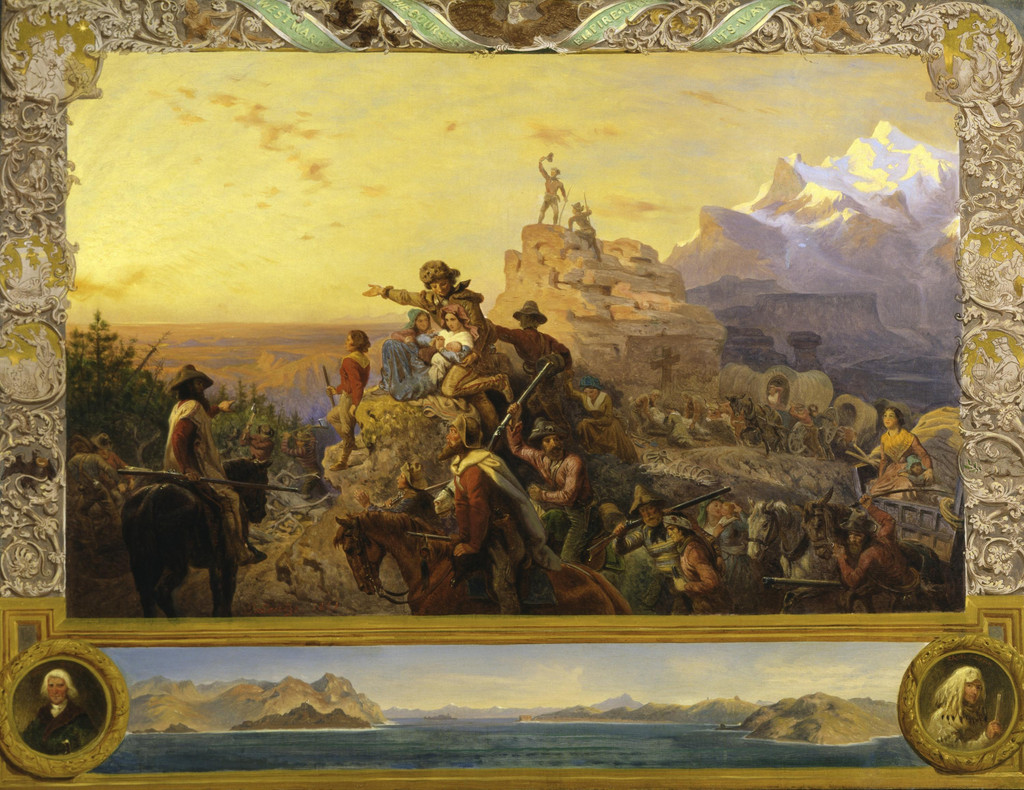
Other records connect drawing more directly with Leutze’s large projects. The Library of Congress catalogues a graphite sketch, Waving figure from “Westward the course of empire takes its way” , dated about 1860 and preserved in a sketchbook. Its title links a figure study with the Capitol subject. The catalogue gives a specific example of work on paper associated with a much larger composition. [3]
An isolated figure allows attention to concentrate on an action before it is considered within a crowd. A raised arm, a turn or the distribution of weight can help a larger historical scene become legible. This is a useful way to understand the role of a study, while keeping the particular object’s evidence distinct from a general account of artistic preparation.
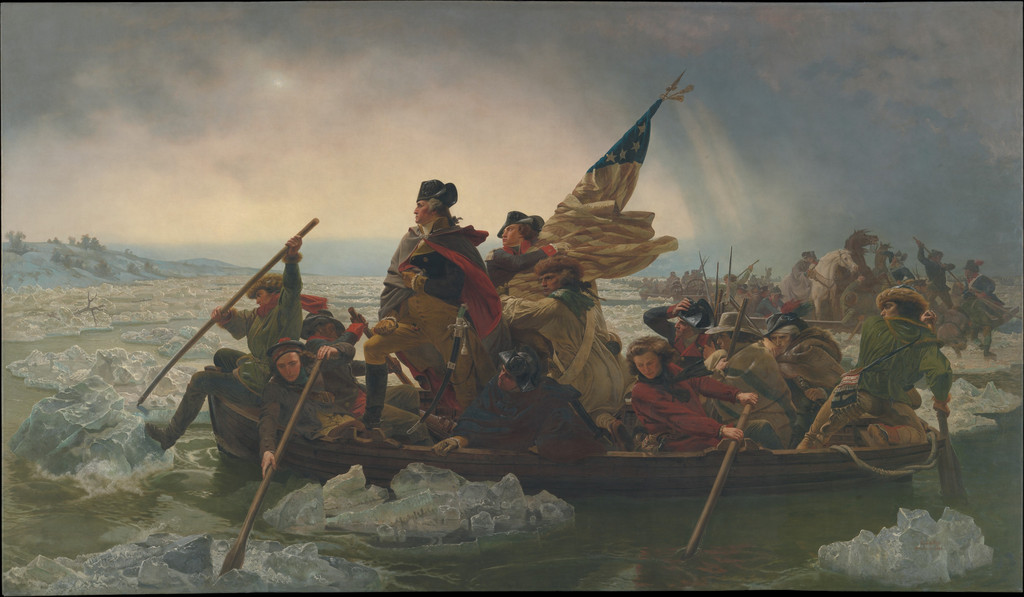
Drawing also exists beneath paint. The Met’s conservation study of Washington Crossing the Delaware describes red and black underdrawing lines and changes revealed through infrared examination. These belong to the canvas’s construction. They show another form of planning and revision, alongside the separate sheets and sketchbooks that survive as objects in their own right. [2]
That distinction helps keep the stages of work clear. A drawing on paper, lines laid onto a prepared canvas and a small oil painting can all contribute to the development of a subject. Their shared connection with planning does not make their materials or functions identical. The style and technique article considers the larger relationship between preparation and the finished paintings.
Johnson and the engraver’s painted source
The printed life of the Delaware composition involved an additional kind of working object. Smaller painted versions could make a monumental design easier to study and use in producing a reproduction. Their relationship with the famous canvas is therefore part of the print’s history, even though they remain paintings rather than works on paper.
The Eastman Johnson Catalogue Raisonné discusses one such version under the attribution Emanuel Leutze with the assistance of Johnson. Patricia Hills connects it with the engraver’s source and considers Johnson’s correspondence alongside visual comparisons. This is a scholarly interpretation of a particular smaller canvas and its collaborative making, rather than a reason to attribute every reduced version to Johnson alone. [4]
The example reveals how many kinds of work can lie behind a familiar printed image. Leutze’s conception, studio assistance, a smaller painted treatment, the engraver’s translation and the publisher’s distribution each contribute to its history. A caption that simply names Leutze may identify the source composition while leaving several of those activities unexplained.
Watch: Emanuel Leutze
Choose a film to explore the artist’s work, its interpretation and its wider setting.
It's not only about the American Revolution, Leutze's Washington Crossing the Delaware
Smarthistory considers the ideas and historical distance behind Washington Crossing the Delaware.
Watch on YouTubeGirardet’s Washington Crossing the Delaware
The Library of Congress records Girardet’s print as a steel engraving published in New York by Goupil & Co. in 1853. It identifies Paul Girardet as engraver and Leutze as the artist of the painted source. Those roles are complementary: the print carries Leutze’s historical image into another medium through Girardet’s work. [7]
The illustrated impression comes from Leiden University Libraries, where it is identified by the shelfmark PK-P-126.302. [8]
An engraving has to communicate a painted arrangement through the resources of a printed image. Outline, tonal relationships and the separation of forms become essential to recognising the crowded boat. Washington, the flag, the oars and the surrounding ice can retain their narrative relationships even when the spectator encounters an impression on paper rather than the monumental oil painting.
John K. Howat’s museum account explains that the engraving was advertised before its eventual publication in 1853. He also records different impressions offered on varying grades of paper, with prices ranging from fifteen to forty dollars. The print consequently belonged to a commercial undertaking with choices directed towards different purchasers, alongside its role in spreading a national image. [5]
The range of printed objects also encourages care with measurements. A catalogue may distinguish the engraved image from the sheet carrying it, including the margins and lettering. An individual impression has a physical identity as well as a recognisable subject. Naming the medium, maker and publisher helps establish that identity before questions of condition, edition or later colouring are considered.
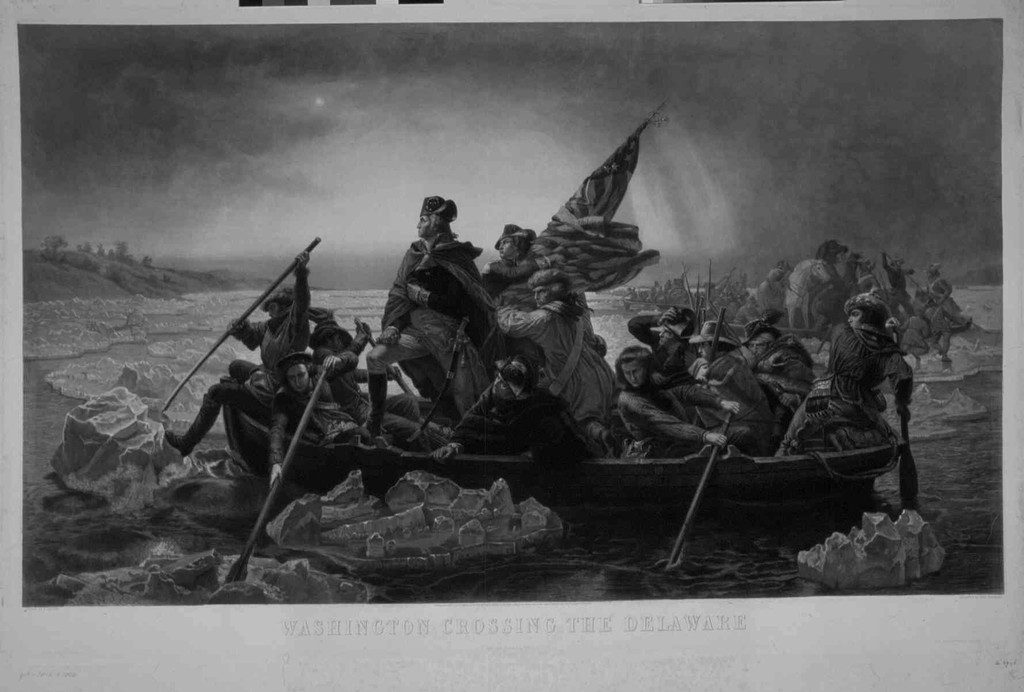
Paul Girardet after Emanuel Leutze, Washington Crossing the Delaware, engraving published in 1853. Leiden University Libraries, PK-P-126.302. Digitised reproduction via Wikimedia Commons, CC BY 4.0. Resized only. Paul Girardet after Emanuel Leutze; digitised by Leiden University Libraries, PK-P-126.302; reproduction via Wikimedia Commons, CC BY 4.0.
Image source
.
Creative Commons Attribution 4.0 International
. Resized only; complete supplied photograph including margins and calibration fragment retained; no appearance editing.
Reproduction and a wider audience
The Gmünd museum documents an 1853 Girardet engraving associated with Julius Erhard, Leutze’s friend and a figure in the formation of the museum’s collection. That connection shows the reproduced image entering a personal relationship as well as a market. A print could preserve an association with the artist while making a large composition accessible at a different scale. [6]
Printed circulation also changed how audiences knew the painting. People could recognise Washington’s pose and the shape of the crowded boat without having stood before the original canvas. The image’s reach consequently extended beyond the institutions and exhibitions capable of accommodating such a large painting. Reproduction helped make the composition familiar in settings where its monumental physical presence was absent. [5]
That wider familiarity can bring several objects under one remembered image. A painted version, engraving, later reproduction and modern photograph may all be called Washington Crossing the Delaware . Their relationship is close enough to encourage recognition, but their individual histories remain useful. Looking at the caption can reopen distinctions that familiarity tends to compress.
Reading the object as well as the image
Begin with the maker’s role. A drawing by Leutze, an engraving by Girardet after Leutze and a photograph of a painting describe different objects. Then consider the date and medium, followed by the relationship with any source composition. These details establish what the viewer is actually encountering before interpretation of the subject begins.
The Last Drop and Girardet’s Washington print reveal two scales of that encounter: concentrated attention to a small drawn sheet and participation in the circulation of a famous design. Together with Leutze’s paintings , they show an artistic practice reaching from individual marks to images known across a broad public.
Artworks directory
A selected directory of paintings and drawings discussed in these articles. Different versions are listed separately.
| Name | Date | Medium |
|---|---|---|
| Washington Crossing the Delaware (Met canvas) | 1851 | Painting |
| Westward the Course of Empire Takes Its Way (oil study) | 1861 | Painting |
| Westward the Course of Empire Takes Its Way (Capitol mural) | 1861–62 | Painting (mural) |
| Washington Rallying the Troops at Monmouth (large original) | 1854 | Painting |
| Washington Rallying the Troops at Monmouth (replica) | 1857 | Painting |
| The Courtship of Anne Boleyn | 1846 | Painting |
| Worthington Whittredge | 1856 | Painting |
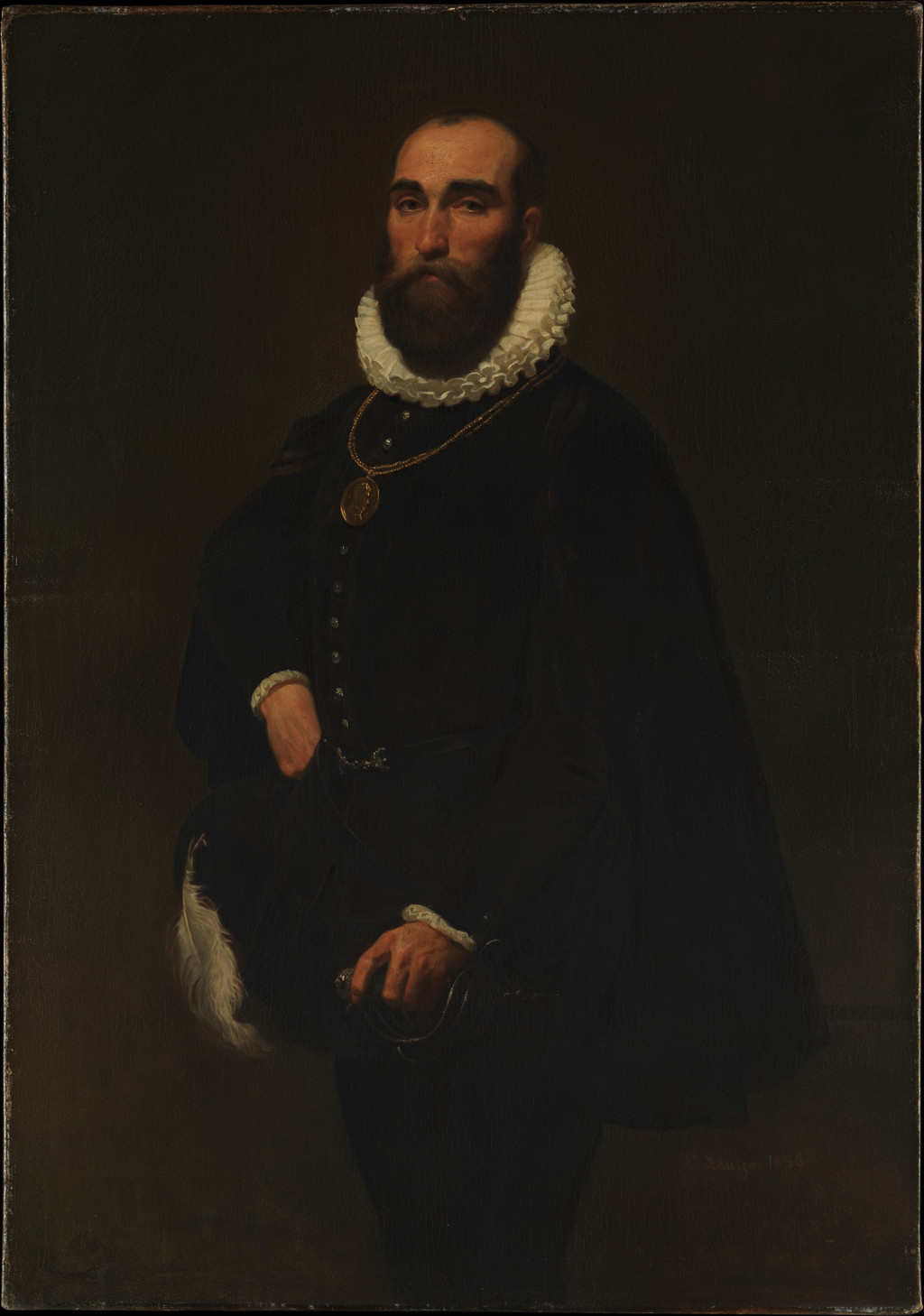
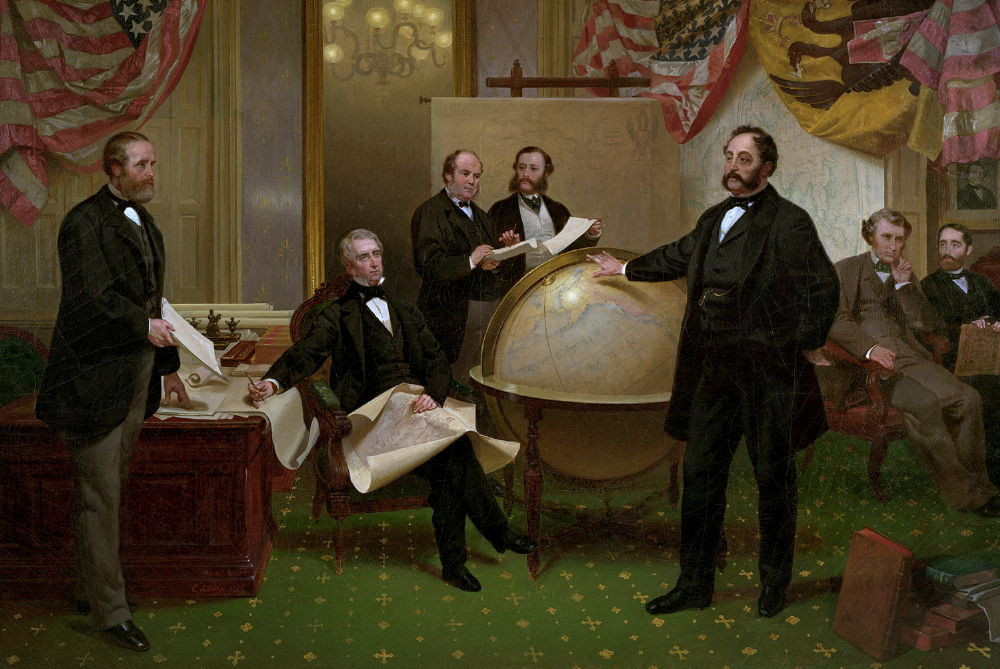
| Signing of the Alaska Treaty | c. 1867 | Painting |
| The Last Drop (McGuire Scrapbook) | Date not specified | Drawing |
| The Amber Necklace | 1847 | Painting |
| Maria Lottner | c. 1842 | Painting |
| Heinrich Lottner | 1858 | Painting |
| Cromwell at Milton’s Home (Schwäbisch Gmünd version) | 1855 | Painting |
| Titian’s Lagoon Voyage | 1857 | Painting |
| Mary Stuart’s First Mass in Holyroodhouse | 1866 | Painting |
| Evening Party at Milton’s (National Gallery of Art canvas) | 1854 | Painting |
| Friedrich Wilhelm Hütz | 1863 | Painting |
| Waving figure from Westward the Course of Empire Takes Its Way | c.1860 | Drawing |
Frequently Asked Questions
Yes. The Metropolitan Museum records it as a drawing in iron gall ink and graphite, from the McGuire Scrapbook, accession 26.216.29.
The museum record does not specify a particular date. Leutze’s lifetime should not be mistaken for an established year of execution.
Paul Girardet made the important engraving published by Goupil & Co. in 1853 after Leutze’s composition.
The engraving is by Girardet. Johnson’s involvement concerns a smaller painted version associated by scholars with the engraver’s source, under Leutze’s direction.
Discussion
Look again at the images and ideas explored in Emanuel Leutze Drawings and Prints. These editorial prompts invite your observations.
What changes when a composition is encountered as a small drawing, a monumental painting or a printed impression? Consider what the maker’s name and medium add to your reading of the image.
Reader Insights
Which marks make the figure in The Last Drop legible?
What survives when the coloured Delaware composition becomes an engraving?
How does identifying the engraver change your understanding of authorship?
Join the Conversation
Share a detail, comparison or question about Emanuel Leutze Drawings and Prints below.
References
- Metropolitan Museum of Art , The Last Drop (from McGuire Scrapbook) , accession 26.216.29. Medium, dimensions, scrapbook association and gift. View source
- Carrie Rebora Barratt and others , Washington Crossing the Delaware: Restoring an American Masterpiece , The Metropolitan Museum of Art Bulletin , Fall 2011, especially the conservation discussion. Underdrawing and revisions. View source
- Library of Congress , Waving figure from “Westward the course of empire takes its way” , about 1860. Graphite drawing in a sketchbook. View source
- Patricia Hills and Abigael MacGibeny , Washington Crossing the Delaware , Hills no. 5.0.2, Eastman Johnson Catalogue Raisonné , entry updated 8 September 2022. Smaller painted version, collaboration and proposed relationship with the engraving. View source
- John K. Howat , Washington Crossing the Delaware , The Metropolitan Museum of Art Bulletin , March 1968, pp. 289–299. Publication and circulation of the engraving. View source
- Museum im Prediger / City of Schwäbisch Gmünd , Emanuel Leutze: zum 200. Geburtstag , 2016 exhibition account. Girardet engraving and Julius Erhard. View source
- Library of Congress , Washington crossing the Delaware , Paul Girardet after Emanuel Leutze, published by Goupil & Co., 1853. Steel engraving, LC-DIG-ppmsca-71276. View source
- Leiden University Libraries / Wikimedia Commons , Washington crossing the Delaware , PK-P-126.302. Digitised impression of Girardet’s engraving; supplied reproduction licensed CC BY 4.0. Resized only. View source
- Splash image source.
Emanuel Leutze, The Last Drop (from McGuire Scrapbook), undated. Iron gall ink and graphite on paper, 13.5 × 12.4 cm. Metropolitan Museum of Art, 26.216.29. Gift of James C. McGuire, 1926. The Metropolitan Museum of Art. CC0 / Public domain . Resized only; native appearance, complete image and margins preserved.
View source