 by
Tom Gurney
Tom Gurney BSc (Hons) is an art history expert with over 20 years experience
Email:
tomgurney1@gmail.com
/ Phone:
+44 7429 011000
The Courtship of Anne Boleyn by Emanuel Leutze: Introduction
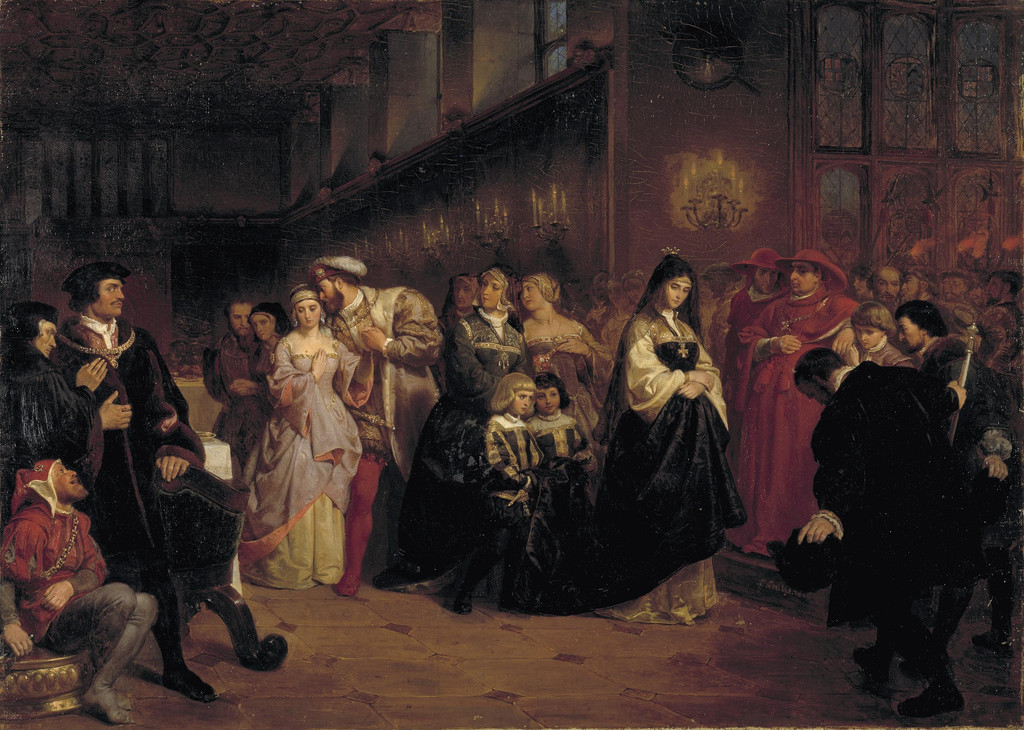
Emanuel Leutze’s The Courtship of Anne Boleyn places an intimate encounter before a crowded court. Henry VIII leans towards Anne, while the people around them watch, converse and register different responses. Painted in 1846, the scene makes royal desire a public matter: the king’s attention cannot be separated from the society that surrounds him. [1]
The painting belongs to Leutze’s European historical subjects, created before his famous Washington Crossing the Delaware . Its setting and costumes evoke the Tudor past, but the arrangement is the work of a nineteenth-century painter. The drama unfolds through visible relationships rather than through a record of a securely documented gathering.
At a Glance
- Artist Emanuel Gottlieb Leutze
- Title The Courtship of Anne Boleyn
- Date 1846
- Medium Oil on canvas
- Dimensions 72.4 × 101.8 cm
- Collection Smithsonian American Art Museum
- Accession 1980.28
- Credit Museum purchase
- Subject Henry VIII’s attention to Anne Boleyn, observed by the surrounding court
This work across Emanuel Leutze’s career
Washington Rallying the Troops at Monmouth
1857 replica; original 1854Westward the Course of Empire Takes Its Way
1861 (oil study); mural 1861–62Signing of the Alaska Treaty
c. 1867Contents
- An English subject in Leutze’s European career
- Henry and Anne within the crowd
- The watching court
- Space, costume and light
- The courtship and the Tudor chronology
- A criticism of royal power?
- Comparing Leutze’s historical groups
- Annotated details
An English subject in Leutze’s European career
Leutze painted this canvas during the European phase of his career. He had reached Düsseldorf in 1841 and subsequently travelled through Germany and Italy before returning to Düsseldorf in 1845. Historical painting offered him subjects from several countries and periods. English royal history was part of a much broader interest in encounters involving authority, religion and political change. [3]
The subject was recognised within that range during Leutze’s lifetime. Henry T. Tuckerman’s 1867 account lists Henry VIII and Anne Boleyn among the painter’s historical themes, alongside subjects involving Elizabeth I, Cromwell and Mary Stuart. The list helps place this work within an established field of interest, rather than treating it as an unexpected departure by a painter of American history. [4]
At 72.4 by 101.8 centimetres, the Smithsonian canvas has room for numerous figures within a comparatively compact interior scene. Its horizontal format encourages the viewer to move between groups. Henry and Anne establish the subject, but the painting’s meaning develops through the company in which Leutze places them. [1]
Annotated Details from The Courtship of Anne Boleyn
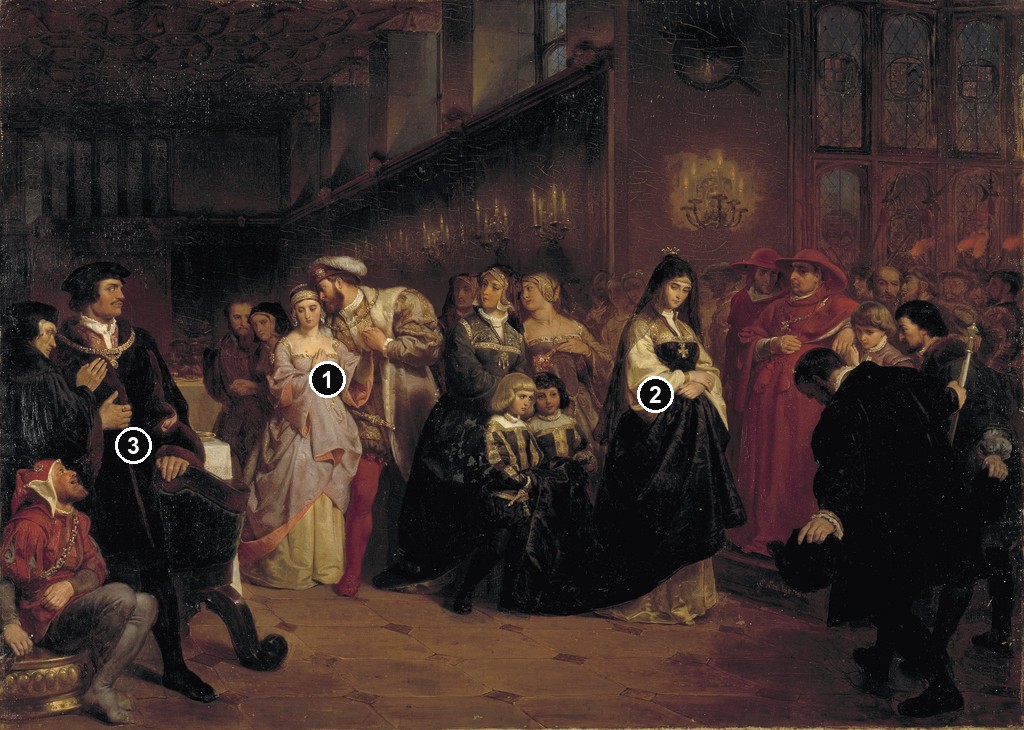
The numbered points identify visible features discussed in this article. Return from each detail to the whole composition. Emanuel Leutze, The Courtship of Anne Boleyn, 1846. Oil on canvas, 72.4 × 101.8 cm. Smithsonian American Art Museum, 1980.28. Museum purchase. Image source. CC0 / Public domain. Separate resized overview with numbered points; details cropped from the original. Original colour and appearance retained.
Details from THE COURTSHIP OF ANNE BOLEYN
Compare the cropped details with the complete images above. Notice how their colours, shapes and positions contribute to the larger compositions.
Henry and Anne within the crowd
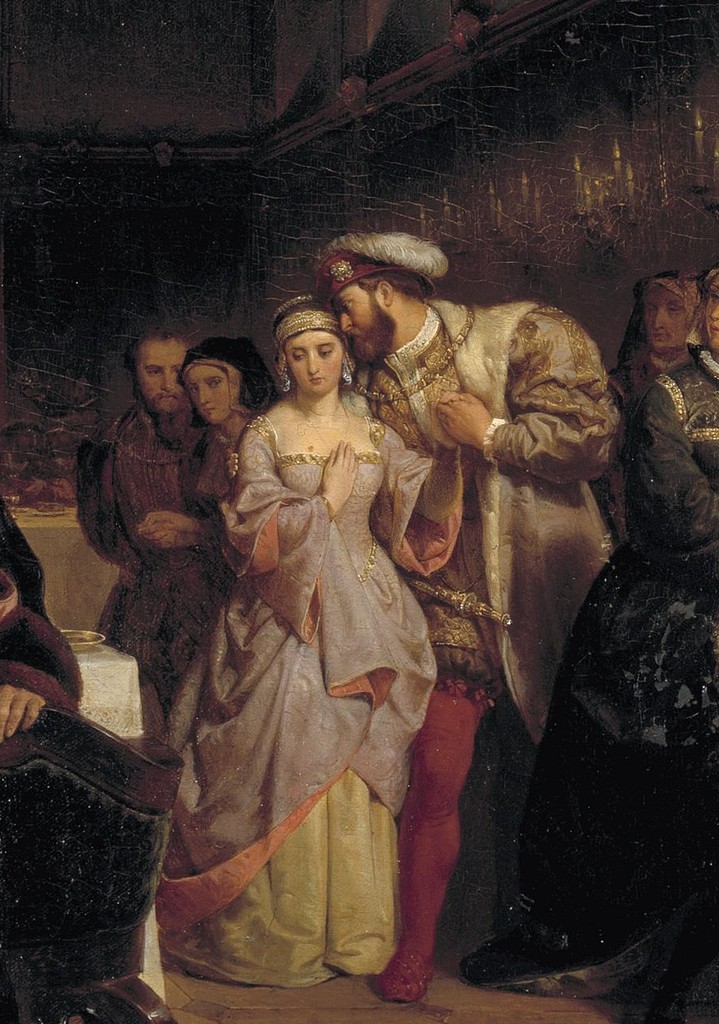
Henry inclines towards Anne while she maintains a more reserved posture. Their pale and richly worked clothing distinguishes the exchange from the darker bodies nearby.
The watching court
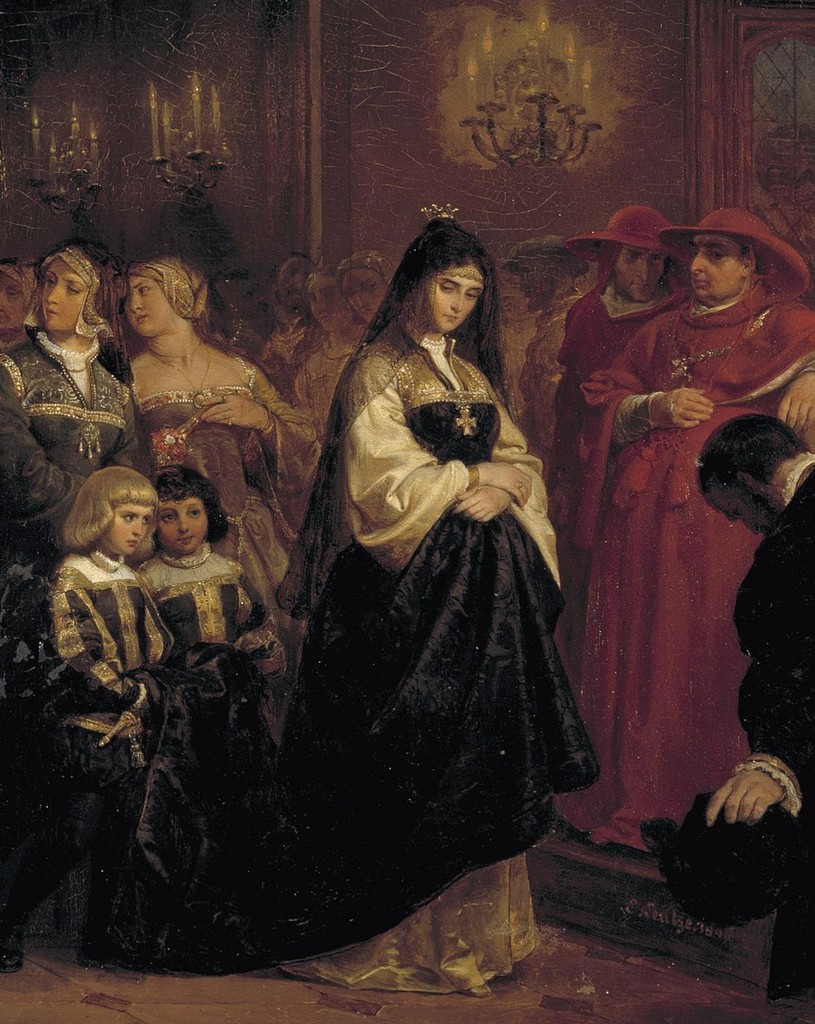
Faces, hands and changes of posture distribute attention across the court. Pale sleeves and darker dresses keep the overlapping figures distinct without making every observer react in the same way.
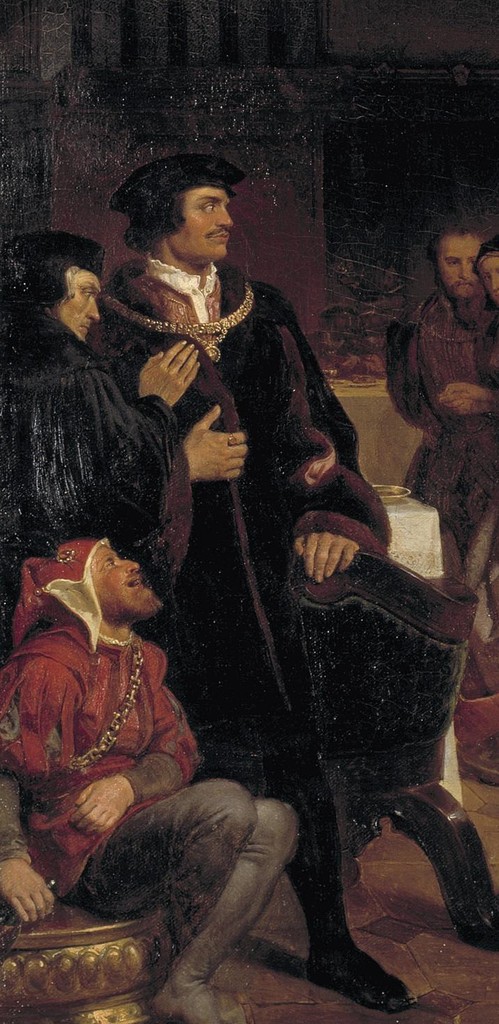
Contrasting onlookers at the left
The standing observer identified by the Smithsonian as the Spanish ambassador appears above a seated figure in red. Their different poses introduce contrasting forms of attention at the edge of the gathering.
Henry and Anne within the crowd
The couple stands left of centre. Henry’s substantial figure inclines towards Anne, bringing his face close to hers. His pale, patterned clothing and broad sleeves give him a conspicuous presence, while the feathered cap marks the upper edge of the group. He occupies the space assertively, even though the painting allows the surrounding figures considerable attention of their own.
Anne’s lighter dress creates another prominent passage within the darker room. Her lowered gaze and the hand held near her chest give the encounter a different rhythm from Henry’s forward movement. The contrast can suggest reserve beside the king’s insistence. It remains an interpretation of Leutze’s painted gestures, rather than evidence of Anne’s feelings at a particular historical meeting.
The pair is close enough to form a recognisable unit, but it is not secluded. Other faces appear immediately behind and beside them. Their courtship takes place within a network of observation. This arrangement gives private attention a public consequence before any viewer has identified a specific political opponent or recalled the subsequent course of Henry’s marriages.
The watching court
The Smithsonian identifies the figure to the couple’s left as the Spanish ambassador and interprets his expression as disgust at the king’s public conduct. That identification gives the surrounding company a diplomatic dimension. An observer can register an objection without interrupting the principal action, allowing disagreement to remain visibly present within the scene. [1]
Elsewhere, Leutze provides several forms of attention. Women stand behind the children near the centre, a dark-hooded woman occupies a prominent position farther right, and figures in red clothing form another group behind her. At the far right, a man seen largely from behind directs his body into the gathering. These arrangements prevent the court from becoming a simple line of equivalent spectators.
The two children in the foreground introduce a different scale of figure and a quieter encounter of their own. Their paired forms interrupt the movement between the adults, while their position brings part of the gathering closer to the spectator. At the lower left, the seated figure in red provides a further shift in level. Looking across these groups reveals how much of the narrative is carried by people outside the named couple.
Space, costume and light
The room gathers the figures within a richly furnished historical environment. Panelling, a rising stair and high windows give the interior depth, while candles and warm reddish-brown surfaces contribute to its enclosed atmosphere. The visible details establish a courtly setting without requiring the viewer to identify a particular surviving room or palace.
Leutze varies the clothing to keep the crowded composition legible. Pale fabrics surround the principal encounter; darker dresses and cloaks anchor other figures; red garments introduce stronger colour towards the sides. Chains, decorated borders, headdresses and sleeves supply smaller points of interest. Costume serves the practical work of separating bodies as well as the imaginative work of evoking another period.
Light is distributed selectively. The couple’s pale clothing draws the eye, but other faces and fabrics remain available for inspection across the picture. The audience is encouraged to return from Henry and Anne to the people watching them. The result is a scene with a principal focus and several subsidiary exchanges, rather than one bright episode surrounded by entirely passive darkness.
Watch: Emanuel Leutze
Choose a film to explore the artist’s work, its interpretation and its wider setting.
It's not only about the American Revolution, Leutze's Washington Crossing the Delaware
Smarthistory considers the ideas and historical distance behind Washington Crossing the Delaware.
Watch on YouTubeThe courtship and the Tudor chronology
Historic Royal Palaces places the king’s growing interest in Anne in 1526, when he was still married to Katherine of Aragon. Anne had served among Katherine’s ladies-in-waiting. Henry’s desire for a male heir and the contested future of his marriage made the relationship a dynastic and religious question as well as a personal one. [2]
The sequence matters. Henry married Anne in January 1533, before his marriage to Katherine was annulled in May that year. A simple account in which he first ended one marriage and then began the next obscures the conflict. Leutze’s scene can introduce those tensions, but it does not supply a precise date for every depicted gesture or identify a documented occasion when this particular company assembled. [2]
Historical context therefore gives the public setting greater significance without turning the painting into a transcript. The king’s choice affected relationships beyond the couple, and Leutze makes those wider interests visible through the presence of observers.
A criticism of royal power?
The Smithsonian suggests that Leutze may have chosen Henry’s conduct as a way to express his distaste for royalty. It is a plausible political reading, supported by the conspicuous presence of an unhappy observer. The museum presents it as a possibility, however, rather than a surviving declaration by Leutze explaining every figure. [1]
Leutze’s liberal commitments are relevant to that interpretation. The Metropolitan Museum’s catalogue documents his support for liberal, anti-Prussian aspirations during the German revolutionary period of 1848. This canvas dates to 1846. The later political activity helps explain the wider concerns of his career, but the painting should not be described as a response to events that had not yet occurred. [3]
The strongest starting point remains the scene itself. A powerful ruler acts in company; some people attend to him, while others create competing centres of interest. The arrangement permits a critical view of authority without reducing every surrounding face to one agreed political message. Leutze gives viewers room to notice the discomfort and unequal power contained within a ceremonious setting.
Comparing Leutze’s historical groups
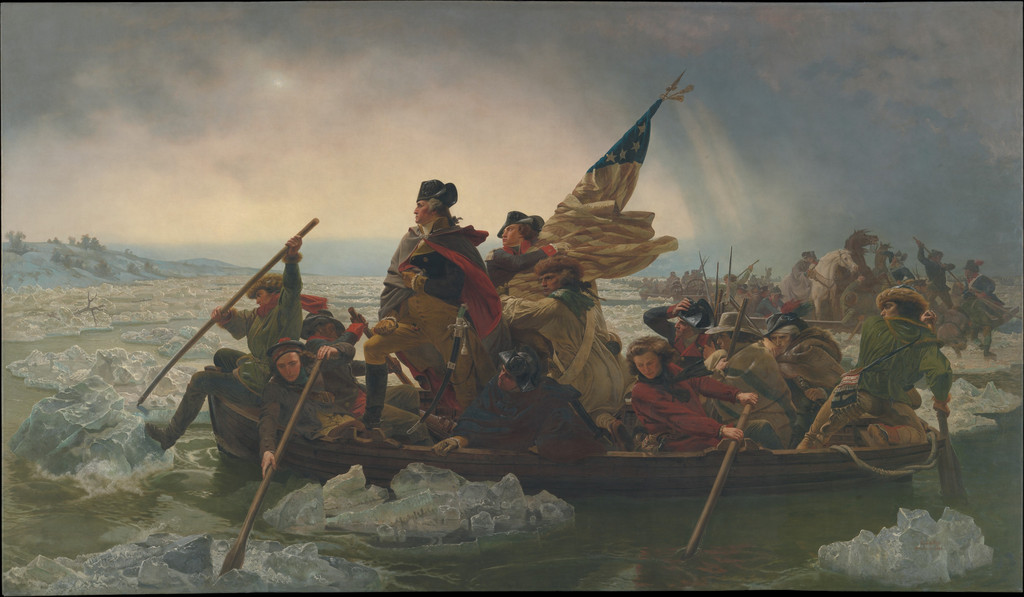
The painting offers a useful comparison with Leutze’s other historical pictures . In the Delaware canvas, the leader’s composure is set against the strenuous actions of the boat’s occupants. Here, Henry’s immediate interest is set against the court’s varied responses. Both compositions make the principal figure understandable through relationships with other bodies, though they direct the spectator towards different judgements.
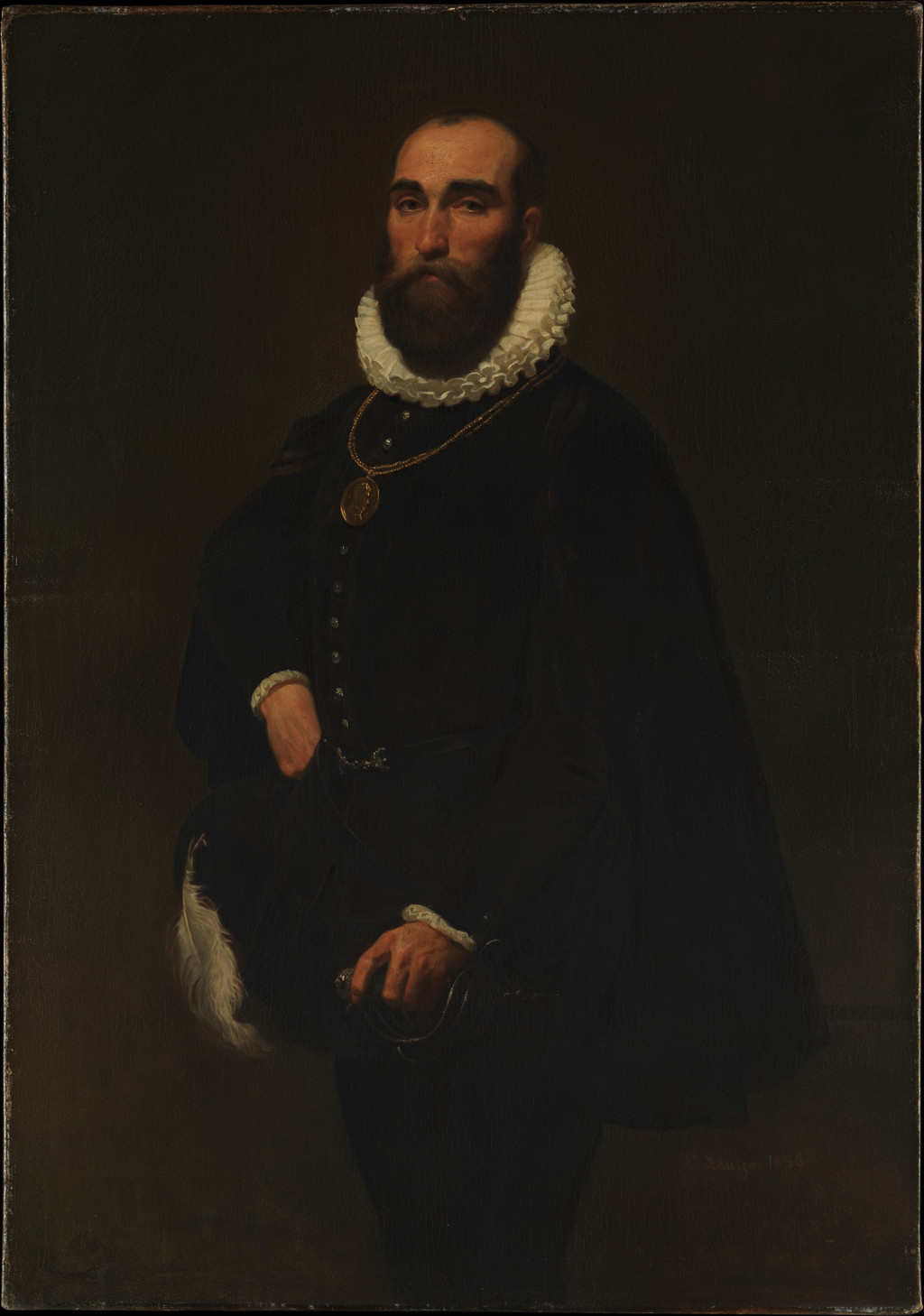
The courtship also reveals a different use of historical clothing from the portrait of Worthington Whittredge . Whittredge appears as a contemporary individual in period dress. Henry and Anne belong to an earlier story that Leutze reconstructs with an entire company and setting. Costume contributes to both pictures, but it serves different kinds of representation.
Looking again at the court after identifying the couple makes the richness of Leutze’s arrangement clearer. A personal encounter, a diplomatic objection, smaller exchanges and changes of posture all occupy the same room. The painting’s interest lies in the way those elements make courtship consequential: an apparently intimate gesture becomes an event that others must witness and interpret.
Artworks directory
A selected directory of paintings and drawings discussed in these articles. Different versions are listed separately.
| Name | Date | Medium |
|---|---|---|
| Washington Crossing the Delaware (Met canvas) | 1851 | Painting |
| Westward the Course of Empire Takes Its Way (oil study) | 1861 | Painting |
| Westward the Course of Empire Takes Its Way (Capitol mural) | 1861–62 | Painting (mural) |
| Washington Rallying the Troops at Monmouth (large original) | 1854 | Painting |
| Washington Rallying the Troops at Monmouth (replica) | 1857 | Painting |
| The Courtship of Anne Boleyn | 1846 | Painting |
| Worthington Whittredge | 1856 | Painting |
| Signing of the Alaska Treaty | c. 1867 | Painting |
| The Last Drop (McGuire Scrapbook) | Date not specified | Drawing |
| The Amber Necklace | 1847 | Painting |
| Maria Lottner | c. 1842 | Painting |
| Heinrich Lottner | 1858 | Painting |
| Cromwell at Milton’s Home (Schwäbisch Gmünd version) | 1855 | Painting |
| Titian’s Lagoon Voyage | 1857 | Painting |
| Mary Stuart’s First Mass in Holyroodhouse | 1866 | Painting |
| Evening Party at Milton’s (National Gallery of Art canvas) | 1854 | Painting |
| Friedrich Wilhelm Hütz | 1863 | Painting |
| Waving figure from Westward the Course of Empire Takes Its Way | c.1860 | Drawing |
Frequently Asked Questions
Emanuel Leutze painted the work in 1846. It belongs to the Smithsonian American Art Museum, accession 1980.28.
It shows Henry VIII paying attention to Anne Boleyn within a crowded court. The Smithsonian identifies a disapproving observer to their left as the Spanish ambassador.
It is a nineteenth-century historical painting. Leutze imagined the earlier scene through costume, gestures and a courtly setting.
The Smithsonian suggests that he may have used the subject to express distaste for royalty. That remains a qualified interpretation, rather than a documented explanation of every detail.
Discussion
Look again at the images and ideas explored in The Courtship of Anne Boleyn by Emanuel Leutze. These editorial prompts invite your observations.
Which observer most changes your reading of Henry and Anne’s encounter? Consider whether the surrounding court makes the scene feel more intimate, more uncomfortable or more political.
Reader Insights
Which observer most alters your reading of Henry and Anne?
How do costume and spacing distinguish the central pair from the court?
Does the surrounding audience make the courtship feel public or intimate?
Join the Conversation
Share a detail, comparison or question about The Courtship of Anne Boleyn by Emanuel Leutze below.
References
- Smithsonian American Art Museum , The Courtship of Anne Boleyn , 1846, accession 1980.28. Object details, image and qualified political interpretation. View source
- Historic Royal Palaces , Anne Boleyn , sections on courtship and marriage. Tudor chronology and the relationship’s dynastic context. View source
- Natalie Spassky , American Paintings in the Metropolitan Museum of Art , Volume II, 1985, pp. 13–16. Leutze’s European training, travels and liberal political commitments. View source
- Henry T. Tuckerman , Book of the Artists , 1867, Leutze chapter, especially p. 335. Contemporary account of his range of historical subjects. View source
- Splash image source.
Emanuel Leutze, The Courtship of Anne Boleyn, 1846. Oil on canvas, 72.4 × 101.8 cm. Smithsonian American Art Museum, 1980.28. Museum purchase. CC0 / Public domain . Resized only; native appearance, complete image and margins preserved.
View source