by
Tom Gurney
Tom Gurney BSc (Hons) is an art history expert with over 20 years experience
Email:
tomgurney1@gmail.com
/ Phone:
+44 7429 011000
Emanuel Leutze Biography: Introduction
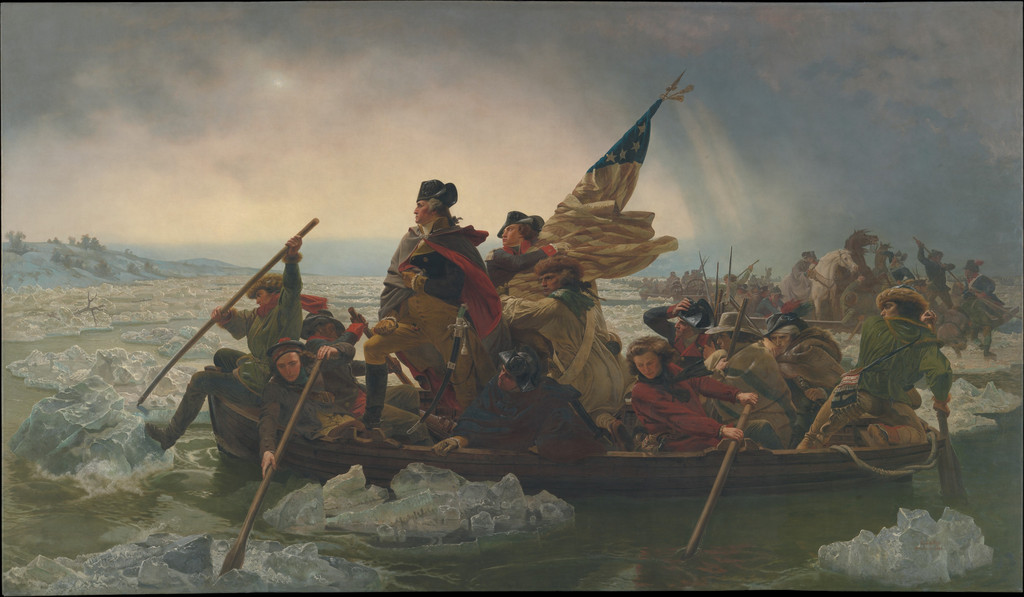
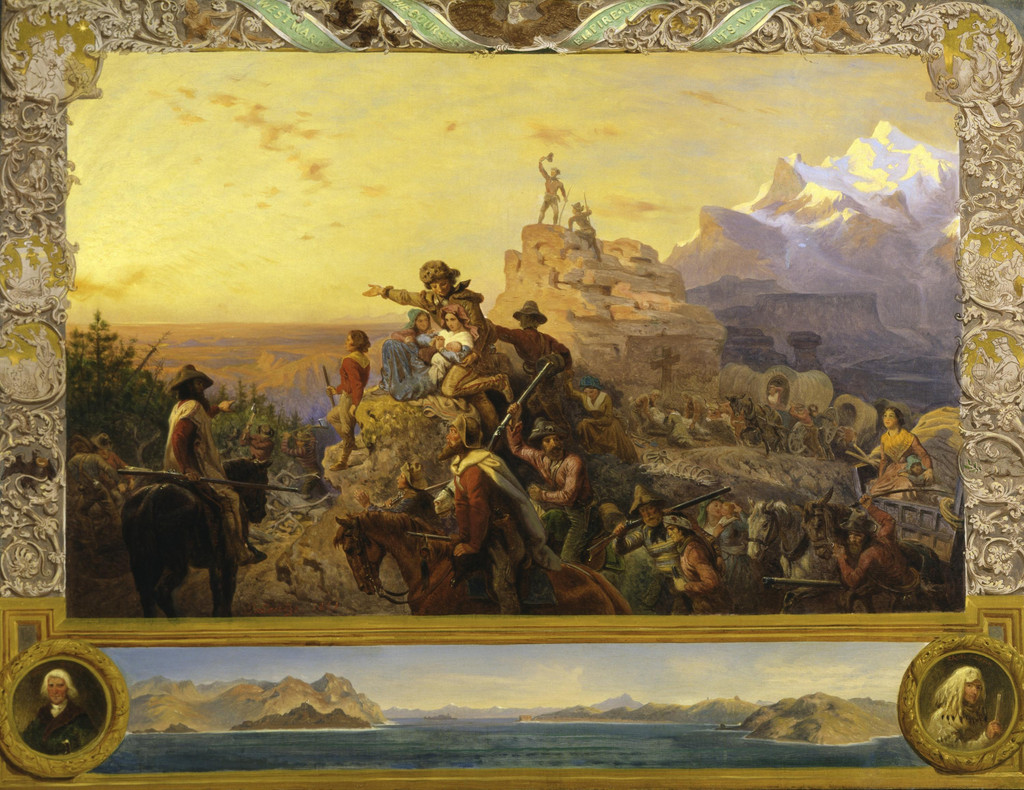
Emanuel Leutze built his career between the United States and Germany. Born in Schwäbisch Gmünd in 1816 and raised in Philadelphia, he began as a portrait painter before travelling to Düsseldorf in 1841. There he developed the historical compositions that made his reputation, including Washington Crossing the Delaware . His later work in New York and Washington extended that ambition into portraits, diplomatic history and the Capitol mural Westward the Course of Empire Takes Its Way . He died in Washington in 1868, leaving a career considerably broader than his most familiar painting suggests. [1] [2]
Portraiture and history painting remained connected throughout his life. The first required him to study particular people; the second allowed him to organise people into scenes about power, belief and political change. Understanding that relationship helps explain why the painter of an American national icon also devoted substantial attention to European rulers, religious disputes, friends and family.
At a Glance
- Full name Emanuel Gottlieb Leutze
- Born 24 May 1816, Schwäbisch Gmünd, Württemberg, now Germany
- Died 18 July 1868, Washington, D.C.
- Childhood home in America Philadelphia
- Early teacher John Rubens Smith
- European training Düsseldorf, from 1841
- Married Juliane Lottner, 1845
- Principal fields History painting, portraiture and public mural painting
- Best-known canvas Washington Crossing the Delaware , 1851
- Major public commission Westward the Course of Empire Takes Its Way , U.S. Capitol, 1861–62
Emanuel Leutze in context
Bars show approximate historical periods. c. means circa (about).
Romanticism
c. 1800–1850 [12]Düsseldorf School
c. 1819–1918 [13]Notes and sources
Romanticism. Imagination and emotional historical subjects belong to the wider early nineteenth-century context. Kathryn Calley Galitz, Met.
Düsseldorf School. Leutze in Düsseldorf, 1841–1858. Academy training and an independent studio formed overlapping parts of his German career. [1]
Each bar runs from the artist’s birth to their death.
Emanuel Leutze
1816–1868 · Birth–death [14]Worthington Whittredge
1820–1910 · Birth–death [15]Eastman Johnson
1824–1906 · Birth–death [16]Albert Bierstadt
1830–1902 · Birth–death [17]Notes and sources
Emanuel Leutze. The deeper chronology follows his migration, training and public commissions. [1]
Worthington Whittredge. Leutze’s friend and model, also the subject of his 1856 portrait. Met life dates.
Eastman Johnson. A studio colleague who made a reduced copy for the Delaware engraving. Smithsonian life dates.
Albert Bierstadt. An American painter associated with Leutze’s Düsseldorf community. Met life dates.
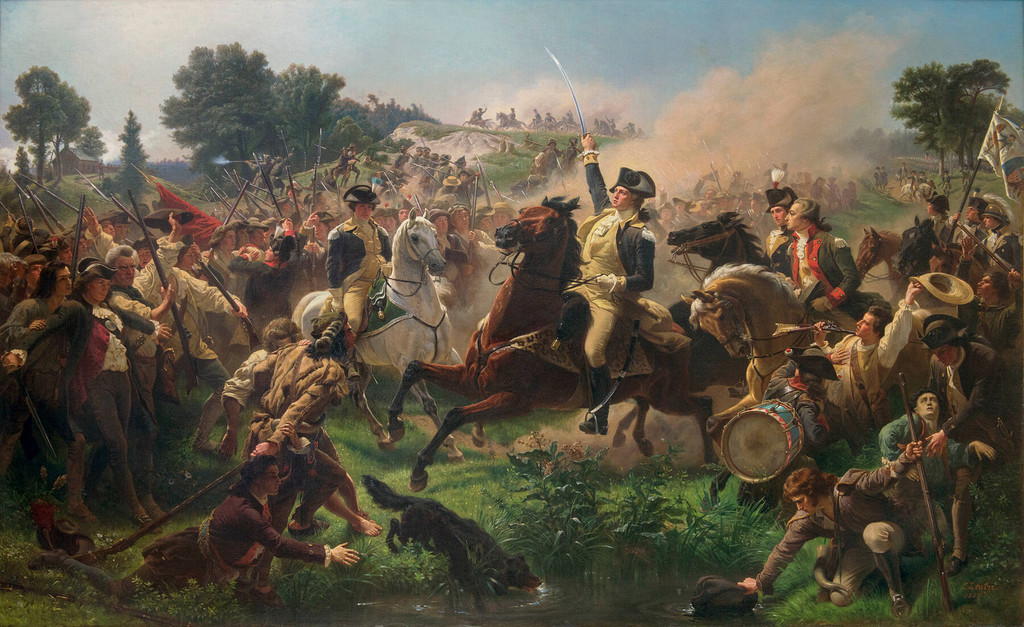
Washington Rallying the Troops at Monmouth
1857 replica; original 1854Westward the Course of Empire Takes Its Way
1861 (oil study); mural 1861–62Signing of the Alaska Treaty
c. 1867Contents
- Childhood and portrait training
- Patrons and the Atlantic voyage
- Academy and independence
- Italy, marriage and family portraits
- Revolution and the Düsseldorf studio
- The American visit of 1851–52
- Returning to America in 1859
- Capitol work and the last years
Childhood and portrait training
Leutze was born on 24 May 1816 in Schwäbisch Gmünd, then within Württemberg. The family moved to the United States in 1825 and settled in Philadelphia. The Met’s scholarly catalogue describes his father as a political refugee. Migration thus belonged to Leutze’s early experience before political history became the principal subject of his mature art. It does not, by itself, explain every later belief or painting. [1] [2]
Philadelphia provided a practical beginning. By 1834, Leutze was studying with the drawing master John Rubens Smith. His early professional opportunities lay in portraits rather than monumental historical scenes. Learning to establish a resemblance, organise a head and suggest the character of a sitter gave him skills that remained useful when he later arranged groups of figures around an important action. [1]
Henry T. Tuckerman’s nineteenth-century account describes a young artist struggling to make a living and to find encouragement. Its anecdotes about drawing, family responsibilities and disappointment belong to a sympathetic literary portrait of Leutze. They are valuable evidence of how contemporaries understood his beginnings, but should not be treated as direct access to his private thoughts. Tuckerman repeatedly turns practical difficulties into a story of heroic development. [3]
One early opportunity connected Leutze with the illustrated publication The National Portrait Gallery of Distinguished Americans . He received commissions associated with James Herring and James Barton Longacre, whose project brought portraits of public figures into print. The financial panic of 1837 disrupted that work. Leutze subsequently travelled as a portrait painter in Virginia, Maryland and Pennsylvania before returning to Philadelphia in 1839. [1]
These circumstances introduced him to more than the problem of making a likeness. A portrait had to secure a commission, obtain a sitter’s time and reach an audience through exhibition or reproduction. Tuckerman describes the difficulty of arranging sittings with busy politicians. Leutze’s later public pictures would operate at a much larger scale, but they too depended on patrons, distribution and the ability to make a subject intelligible to viewers. [3]
His development therefore did not begin with the sudden discovery of history painting in Germany. Before the European journey, he had already painted religious and literary subjects alongside portraits. The move abroad offered further training and a stronger setting for ambitious figure compositions. It built upon an existing practice rather than replacing an entirely unrelated occupation. [1]
Four stages of Emanuel Leutze’s career
These periods group related developments; painting, travel and local work overlap across their boundaries.
Portraits and patrons
Family migration, John Rubens Smith’s instruction, portrait commissions and patrons in Philadelphia preceded the 1841 European journey. [1]
Academy, travel and independence
Düsseldorf study, travels in Germany and Italy, an independent studio and marriage to Juliane Lottner enlarged the artist’s work. [1]
Washington and the Düsseldorf studio
The two monumental Delaware versions, the 1851–52 American visit and artistic friendships gave historical painting an international public life. [5]
The Capitol and diplomatic history
Work in New York and Washington included the 1861–62 Capitol mural, continuing portraits and the Alaska treaty painting of about 1867. [1]
Patrons and the Atlantic voyage
Exhibitions in Philadelphia and New York helped bring Leutze’s work to the attention of people who could support further study. The collector and publisher Edward L. Carey and the merchant Joseph Sill encouraged his European journey and provided financial assistance. Leutze reached Amsterdam in January 1841 and then travelled to Düsseldorf. The voyage was a professional undertaking made possible through patronage, rather than simply a return to his birthplace. [1]
Düsseldorf offered an academy and a substantial community of painters working in historical and narrative art. For someone interested in figures, costumes, expressive gestures and carefully arranged incidents, this was a useful environment. The city also gave Leutze access to independent studios and artistic friendships. His career would develop through both formal institutions and relationships outside them.
The journey reversed the direction of his childhood migration without erasing his American experience. He travelled as an artist whose upbringing, customers and emerging reputation were already connected with the United States. American subjects could consequently remain important within a European career. His pictures later crossed the Atlantic through exhibitions, sales and prints, even during the years when his studio remained in Germany.
Early Columbus subjects brought recognition. Columbus before the High Council of Salamanca , painted in 1841, attracted the approval of academy director Wilhelm von Schadow and was acquired by the Düsseldorf Art Union. The Return of Columbus in Chains to Cadiz , completed the following year, received a medal in Brussels and was purchased by New York’s Apollo Association. These successes connected Leutze with audiences on both sides of the Atlantic. [1]
Their importance lies partly in the kind of history he selected. An individual confronted authority, endured reversal or presented a claim before a group. Such situations offered recognisable relationships between a leading figure and surrounding witnesses. They could carry political and moral arguments while providing the gestures, costume and varied expressions expected of a substantial historical composition.
Columbus also demonstrates why the subject of an old painting and the assumptions behind its reception require separate attention. Nineteenth-century admirers could celebrate an explorer as a figure of progress without accounting adequately for the experiences of Indigenous peoples. A biography can establish that these subjects helped Leutze’s career without adopting the historical judgments through which some audiences welcomed them.
Academy and independence
The Met’s catalogue cites Düsseldorf student records for Leutze’s enrolment as a history painter. His association with the academy is therefore more substantial than a vague claim that he absorbed its style from a distance. Yet his mature practice also developed through dissatisfaction with academic restrictions and the establishment of his own studio. Academy training and later independence belong to the same career. [1]
The city’s artistic culture was divided by religious, political and aesthetic differences. In a letter reproduced by Tuckerman, Leutze contrasted a stricter Catholic tendency associated with the academy’s leadership with the freer Protestant spirit he connected with Carl Friedrich Lessing. This was Leutze’s account of a contested environment, rather than a neutral description of every artist within it. It shows that choosing an artistic direction could involve convictions as well as methods. [3]
Lessing’s example helped Leutze pursue history as an arena of argument. Rather than treating the past as a collection of costumes and memorable incidents, he wanted a composition to embody a clear idea. His statement that painting was “essentially a contemplative art” connects the visible anecdote with the thought a spectator could carry away from it. The event supplied a form through which a larger proposition became available. [3]
This approach helps explain his preference for charged encounters. A ruler and an adviser, a commander and his soldiers, or a religious reformer facing authority could be brought into one scene. Their relationships allowed gestures and expressions to organise an argument. Leutze’s historical pictures were consequently ambitious acts of selection, rather than attempts to narrate every stage of an event.
Independence did not mean departure from Düsseldorf. He established himself within its community and continued to benefit from colleagues, models, costumes and practical support. The academy remained part of his formation, while the studio gave him a different kind of authority. He could work on subjects for American patrons without requiring those subjects to correspond to one institutional programme.
The phrase “Düsseldorf School” is useful when it names this training and environment. It becomes less useful if it implies that all the city’s painters followed an identical formula. Leutze’s work was shaped by its attention to narrative, expressive figures and historical detail, but his choices also reflected travel, portrait experience and political commitments. His independence was exercised within those relationships, not beyond them.
Italy, marriage and family portraits
In 1843 Leutze began travels through Germany and Italy that broadened his knowledge of European art. In Munich he examined the work of Peter Cornelius and Wilhelm von Kaulbach. Venice offered the colour of Titian, Veronese and Bellini; in Rome, Michelangelo’s forceful figures particularly interested him. Tuckerman’s account records admiration as well as disappointment, giving the journey a more varied character than a simple list of favoured influences. [1] [3]
These encounters matter because Leutze’s later historical pictures combine clear arrangement with substantial colour and bodily presence. He sought more than accurate outlines. The figure had to appear capable of feeling and acting, while colour helped organise the spectator’s attention. His travels gave him examples against which to consider how painting could hold an event together without reducing it to an illustration.
He returned to Düsseldorf in 1845 and married Juliane Lottner, the daughter of a German officer. Family and friendship subsequently provided subjects for portraits alongside his public historical work. The museum in Schwäbisch Gmünd preserves and studies this part of his production, which offers a more personal scale than the enormous Washington canvas. [1] [2]
The double portrait known as The Amber Necklace , painted in 1847, represents Juliane with their daughter Ida. The municipal museum also identifies portraits of Leutze’s mother-in-law Maria Lottner and brother-in-law Heinrich Lottner. These objects show how people within his family entered his art. Their existence supports a fuller account of his subjects without requiring speculative conclusions about private relationships. [2]
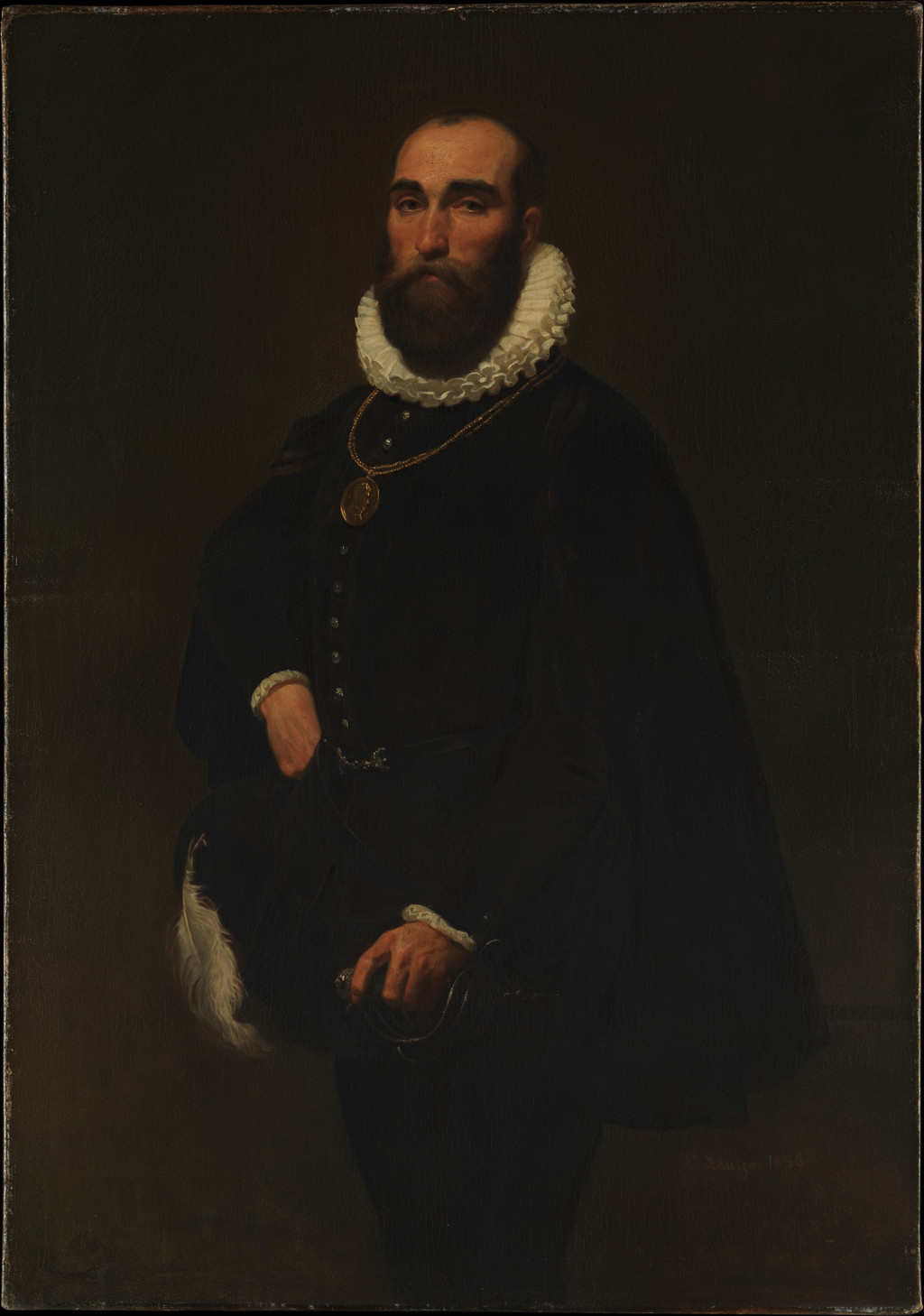
Portraiture remained a distinct field of accomplishment. In the 1856 portrait of Worthington Whittredge , a fellow artist appears in elaborate historical costume. The sitter is contemporary, while the ruff, chain and dark clothing recall an earlier portrait tradition. Leutze brings his interest in historical appearance into the representation of a person he knew. [10]
This connection between actual sitter and chosen costume helps explain the continuity of his career. Portraits trained attention on individual faces and bodily bearing; history painting placed such figures within a larger relationship. Leutze did not have to abandon the first pursuit to advance the second. Friends and relatives offered subjects with their own significance, even when public reputation increasingly rested on monumental scenes.
Revolution and the Düsseldorf studio
The revolutionary period of 1848 gave Leutze’s political commitments a direct setting. He aligned himself with liberal opposition to Prussian power and supported aspirations for a unified democratic Germany. The same period saw his involvement in artists’ organisations, including the founding of the Malkasten association. His activity within Düsseldorf extended beyond producing pictures for distant buyers. [1]
The studio became important to American artists who arrived in the city. Worthington Whittredge, Eastman Johnson, Albert Bierstadt and William Stanley Haseltine were among those associated with Leutze’s friendship and advice. Such relationships should not all be reduced to formal master-and-pupil instruction. Sharing a community, gaining access to a studio and exchanging practical assistance could also shape an artist’s experience abroad. [1]
Whittredge’s recollection of posing for Washington Crossing the Delaware gives a particularly clear example. A colleague’s body supplied information for the commander and the steersman, while Johnson worked on a reduced copy connected with an engraving. A painting later encountered as one artist’s national masterpiece emerged within a social and practical setting that included other artists’ contributions. [5]
The German political setting also helps explain Leutze’s choice of an American revolutionary subject. The crossing could commemorate the struggle for independence while providing an earlier example of political change to viewers disappointed by events in Germany. These meanings did not have to be identical for every audience. The picture’s ability to move between contexts was part of its power.
The large painting now at the Met was completed in 1851, after a studio fire had damaged an earlier monumental treatment in 1850. The first version later entered the Kunsthalle Bremen and was destroyed in 1942. Keeping these objects distinct is essential to the chronology: Leutze made the celebrated Met canvas during his Düsseldorf years, long before his more permanent return to America in 1859. [4] [5]
His connections with painters associated with American landscape art do not make his own work primarily landscape painting. He could use rivers, mountains and skies to organise a historical subject, but the action among people remained central. The Düsseldorf studio brought painters of different interests together. Their later reputations should not obscure the different purposes for which they worked there.
Emanuel Leutze, Worthington Whittredge, 1856. Metropolitan Museum of Art, 03.16. Gift of several gentlemen, 1903. The Metropolitan Museum of Art.
Image source
.
CC0 / Public domain
. Resized only; native appearance, complete image and margins preserved.
Watch: Emanuel Leutze
Choose a film to explore the artist’s work, its interpretation and its wider setting.
It's not only about the American Revolution, Leutze's Washington Crossing the Delaware
Smarthistory considers the ideas and historical distance behind Washington Crossing the Delaware.
Watch on YouTubeThe American visit of 1851–52
Leutze returned to the United States in September 1851 as Washington Crossing the Delaware began its American public life. The painting’s display in New York brought his European work before an audience for whom its subject had strong national associations. Its monumental scale and dramatic figures helped make that encounter a major event in his reputation. He was no longer approaching American patrons solely as a promising young portrait painter. [1]
The picture also offered a route toward government patronage. In April 1852 he petitioned Congress to commission another version and a companion representing Washington at Monmouth. Although that proposal did not produce the intended commission, the Monmouth subject subsequently developed for a private collector. Leutze’s ambitions moved between public institutions and private buyers rather than following one uninterrupted system of support. [1]
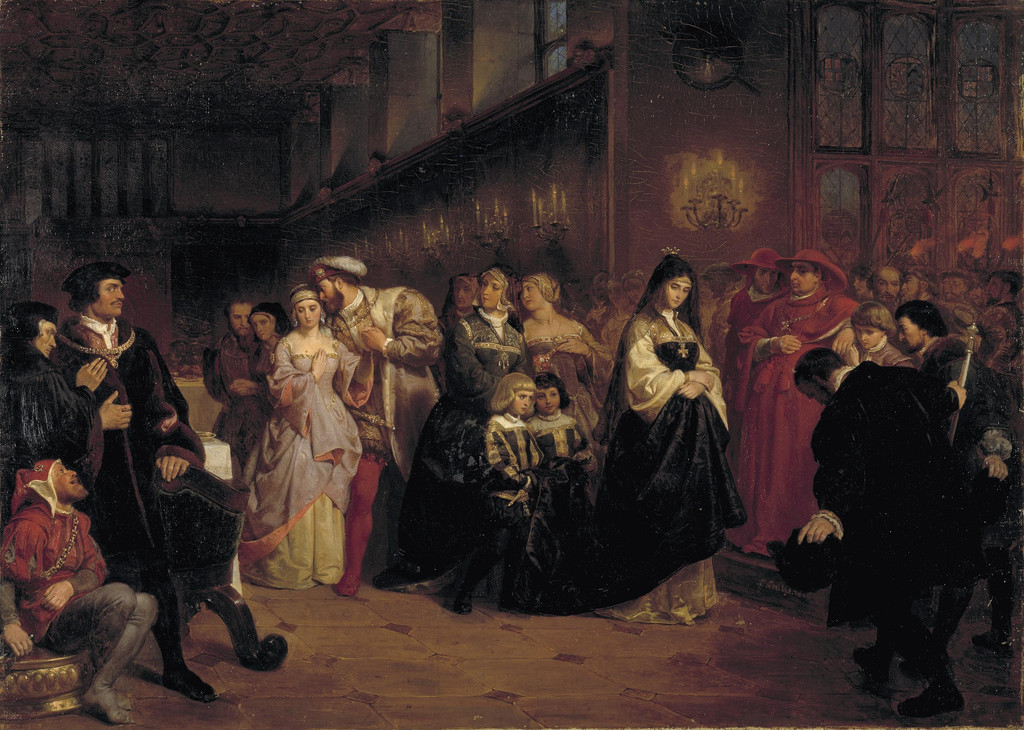
He returned to Düsseldorf in June 1852 and continued his historical painting. European subjects remained important beside the American Revolution. The Courtship of Anne Boleyn , completed in 1846, demonstrates that wider interest: a royal relationship becomes an occasion for displaying conflicting attitudes within a court. The historical painter’s range included personal and religious tensions as well as military leadership. [7]
Success in one famous image did not remove dependence on the art market. The dissolution of the American Art-Union deprived Leutze of an important source of promotion and patronage, while the economic panic of 1857 contributed to worsening conditions for commissions. Financial pressures formed part of the background to his eventual decision to return to the United States. Political disappointment in Germany and hopes for American public work also mattered. [1]
Leutze’s career is therefore better understood through repeated journeys and changing opportunities than through a single triumphant return. He had become an internationally recognised historical painter, but still had to secure work. The public life of a painting and the continuing livelihood of its maker did not necessarily advance at the same pace.
Returning to America in 1859
Leutze arrived in Boston in January 1859 and later established himself in New York’s Tenth Street Studio Building. He divided his subsequent work between New York and Washington. Portraits and historical commissions occupied these years, while the prospect of decorating the Capitol remained especially important. The move brought him closer to the people and institutions through which he hoped to obtain substantial public work. [1]
A letter to his friend Julius Erhard, discussed by the museum in Schwäbisch Gmünd, expresses his intention to return to America that winter and his disappointment with Germany. Such correspondence gives the move a personal dimension, although a single remark cannot explain its entire cause. The artist’s finances, political expectations and professional ambitions intersected with established relationships across the Atlantic. [2]
In 1860 the National Academy of Design elected him an academician. This recognition belonged to the American institutional setting he was re-entering, while his German friendships remained significant. He returned to Düsseldorf in 1863 to bring his family to America. Tuckerman records a warm reception from his former colleagues there, demonstrating that the relocation did not end his place within that community. [1] [3]
The welcome described by Tuckerman also contains racist performances in which artists dressed as Black and Native people. That detail complicates an uncomplicated picture of artistic fellowship and liberal ideals. It is evidence about the occasion and its participants, not a licence to invent Leutze’s unrecorded response. A community could speak warmly of friendship and freedom while treating other people through degrading stereotypes. [3]
This tension belongs to the wider interpretation of his public art. The mixed figures in the Delaware boat suggest shared effort, while later Native perspectives have questioned the national history such an image celebrates. Political liberalism in one context does not establish equality in every context. Leutze’s biography includes both his stated commitments and the historical limits within which they operated. [9]
Capitol work and the last years
In July 1861, Montgomery C. Meigs commissioned Leutze to paint a large mural for the Capitol’s House wing. Westward the Course of Empire Takes Its Way would occupy the west stairway, placing his work within a building of national government. Leutze travelled to the Colorado region that summer to study the Rocky Mountains in preparation. The commission brought landscape study into the service of a public historical and allegorical composition. [6]
The mural was completed in 1862 using stereochromy, a process in which pigments applied to plaster were sealed with waterglass. It should be distinguished from an ordinary oil painting or a true fresco. The surviving oil studies belong to the preparation and development of the subject; their smaller scale and differences of detail do not make them identical to the finished Capitol mural. [6]
Its covered wagons, families and mountain crossing organise westward expansion as a directed national movement. Painted during the Civil War, it also carried the Union flag into that account. The subject extended Leutze’s ambition from commemorating an earlier revolutionary event to representing the country’s geographical and political future. The image’s confidence should be read alongside the costs of expansion for Native communities, rather than as a complete account of the western lands. [6]
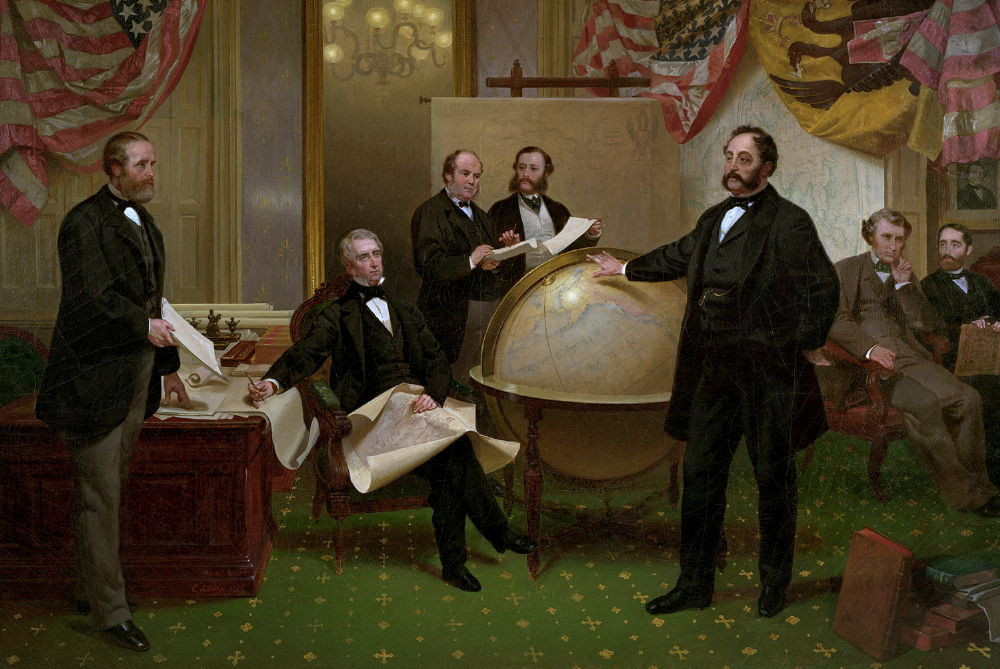
His late work also included Signing of the Alaska Treaty , associated with the negotiations of 1867. Seward House identifies the painting as a gift to William H. Seward from Peter Cooper. Here Leutze arranged diplomatic participants, maps and documents instead of battlefield action. Historical importance could be represented through a room of named people discussing territorial purchase, as well as through soldiers crossing a river. [8]
Portraits of political and military figures continued alongside such commissions. The relationship between an actual sitter and a national role remained important in this later work. Leutze’s historical ambition had not eliminated the practical skills with which he began; it gave them additional settings in which individual appearance and public identity could be considered together. [1]
Leutze died in Washington on 18 July 1868, aged fifty-two. His career had carried him from Philadelphia portrait commissions to European training and international historical painting, then to a major American public commission. Those stages overlapped rather than replacing one another neatly. Portraiture, historical subjects, artistic friendship and the pursuit of patronage recur across the chronology. [1] [2]
His reputation remains concentrated in Washington Crossing the Delaware , but the broader work clarifies how that picture became possible. Early portraits taught him to represent individuals; Düsseldorf supplied an environment for ambitious historical compositions; travel enlarged his artistic examples; colleagues helped sustain the studio; and American audiences provided a powerful setting for reception. The famous canvas brings those experiences together without exhausting the life behind it.
Emanuel Leutze, Westward the Course of Empire Takes Its Way, mural study, 1861. Oil on canvas. Smithsonian American Art Museum, 1931.6.1, Bequest of Sara Carr Upton.
Image source
.
CC0 / Public domain
. Resized only; native appearance, complete image and margins preserved.
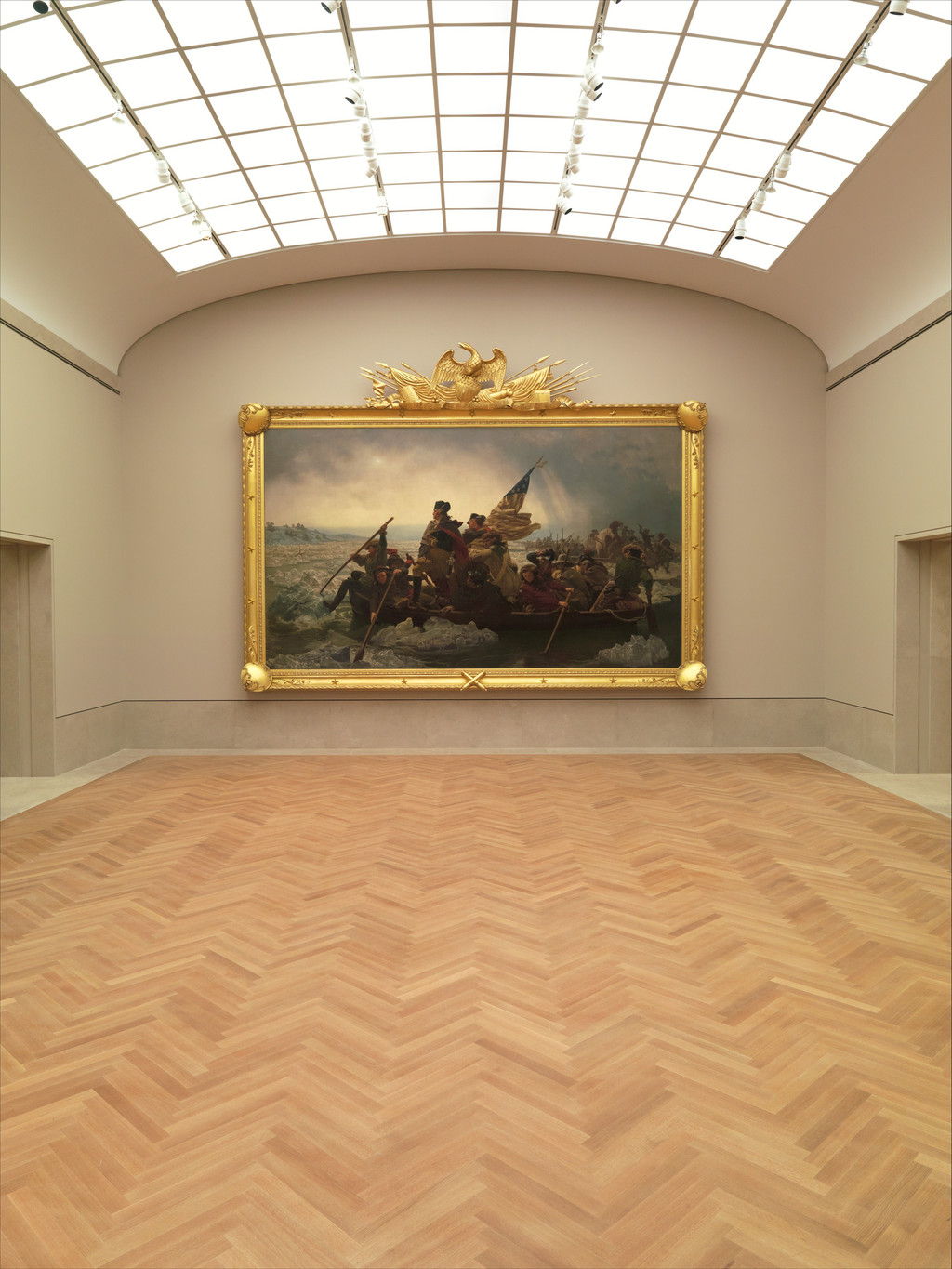
Leutze’s Washington Crossing the Delaware in the Metropolitan Museum of Art, with its modern recreated frame. Museum photograph. The Metropolitan Museum of Art.
Image source
.
CC0 / Public domain
. Resized only; native appearance, complete image and margins preserved.
Artworks directory
A selected directory of paintings and drawings discussed in these articles. Different versions are listed separately.
| Name | Date | Medium |
|---|---|---|
| Washington Crossing the Delaware (Met canvas) | 1851 | Painting |
| Westward the Course of Empire Takes Its Way (oil study) | 1861 | Painting |
| Westward the Course of Empire Takes Its Way (Capitol mural) | 1861–62 | Painting (mural) |
| Washington Rallying the Troops at Monmouth (large original) | 1854 | Painting |
| Washington Rallying the Troops at Monmouth (replica) | 1857 | Painting |
| The Courtship of Anne Boleyn | 1846 | Painting |
| Worthington Whittredge | 1856 | Painting |
| Signing of the Alaska Treaty | c. 1867 | Painting |
| The Last Drop (McGuire Scrapbook) | Date not specified | Drawing |
| The Amber Necklace | 1847 | Painting |
| Maria Lottner | c. 1842 | Painting |
| Heinrich Lottner | 1858 | Painting |
| Cromwell at Milton’s Home (Schwäbisch Gmünd version) | 1855 | Painting |
| Titian’s Lagoon Voyage | 1857 | Painting |
| Mary Stuart’s First Mass in Holyroodhouse | 1866 | Painting |
| Evening Party at Milton’s (National Gallery of Art canvas) | 1854 | Painting |
| Friedrich Wilhelm Hütz | 1863 | Painting |
| Waving figure from Westward the Course of Empire Takes Its Way | c.1860 | Drawing |
Frequently Asked Questions
He was born in Germany, grew up in Philadelphia and pursued a career in both countries. “German-American” usefully describes the migration, training and professional relationships that shaped his work.
His early teacher was John Rubens Smith in Philadelphia. He travelled to Düsseldorf in 1841, enrolled at the academy and subsequently developed an independent studio there.
No. The famous Met version was completed in Düsseldorf in 1851. The 1859 return marks a later phase of his career in New York and Washington.
He married Juliane Lottner in 1845. His portraits included family members, among them Juliane and their daughter Ida in the 1847 double portrait The Amber Necklace .
He painted Westward the Course of Empire Takes Its Way for the west stairway of the House wing in 1861–62, using stereochromy. Oil studies are separate objects from the finished mural.
Discussion
Look again at the images and ideas explored in Emanuel Leutze Biography. These editorial prompts invite your observations.
Reader Insights
Which part of Leutze’s career most changes your understanding of his famous Washington painting?
What does the portrait of Whittredge reveal about the relationship between portraiture and history painting?
How did working between two countries affect the subjects and audiences available to Leutze?
Join the Conversation
Share a detail, comparison or question about Emanuel Leutze Biography below.
References
- Natalie Spassky , American Paintings in the Metropolitan Museum of Art , volume II (1985), Emanuel Leutze, printed pp.13–25. View source
- Museum und Galerie im Prediger , Schwäbisch Gmünd, Emanuel Leutze (2016 exhibition). View source
- Henry T. Tuckerman , Book of the Artists: American Artist Life (1867), Leutze, printed pp.333–345. View source
- Metropolitan Museum of Art , Washington Crossing the Delaware , 1851, accession 97.34. View source
- Carrie Rebora Barratt et al. , Washington Crossing the Delaware: Restoring an American Masterpiece , Metropolitan Museum of Art Bulletin (Fall 2011). View source
- Architect of the Capitol , Westward the Course of Empire Takes Its Way . View source
- Smithsonian American Art Museum , The Courtship of Anne Boleyn , 1846, accession 1980.28. View source
- Seward House Museum , Signing of the Alaska Treaty , c.1867. View source
- Metropolitan Museum of Art , Native Perspectives , Alan Michelson on Washington Crossing the Delaware . View source
- Metropolitan Museum of Art , Worthington Whittredge , 1856, accession 03.16. View source
- Splash image source.
Emanuel Leutze, Washington Crossing the Delaware, 1851. Oil on canvas, 378.5 × 647.7 cm. Metropolitan Museum of Art, 97.34, Gift of John Stewart Kennedy, 1897. The Metropolitan Museum of Art. CC0 / Public domain . Resized only; native appearance, complete image and margins preserved.
View source - Kathryn Calley Galitz, “Romanticism”, Metropolitan Museum of Art (2004). Emergence around 1800 and flourishing until mid-century. View source
- Museum Kunstpalast, Düsseldorfer Malerschule. Defines the school’s institutional and artistic context from 1819 to 1918. View source
- Smithsonian American Art Museum, Emanuel Leutze: 1816–1868. Artist life dates. View source
- National Gallery of Art, Worthington Whittredge: 1820–1910. Artist life dates. View source
- New Britain Museum of American Art, Eastman Johnson: 1824–1906. Artist life dates. View source
- National Gallery of Art, Albert Bierstadt: 1830–1902. Artist life dates. View source