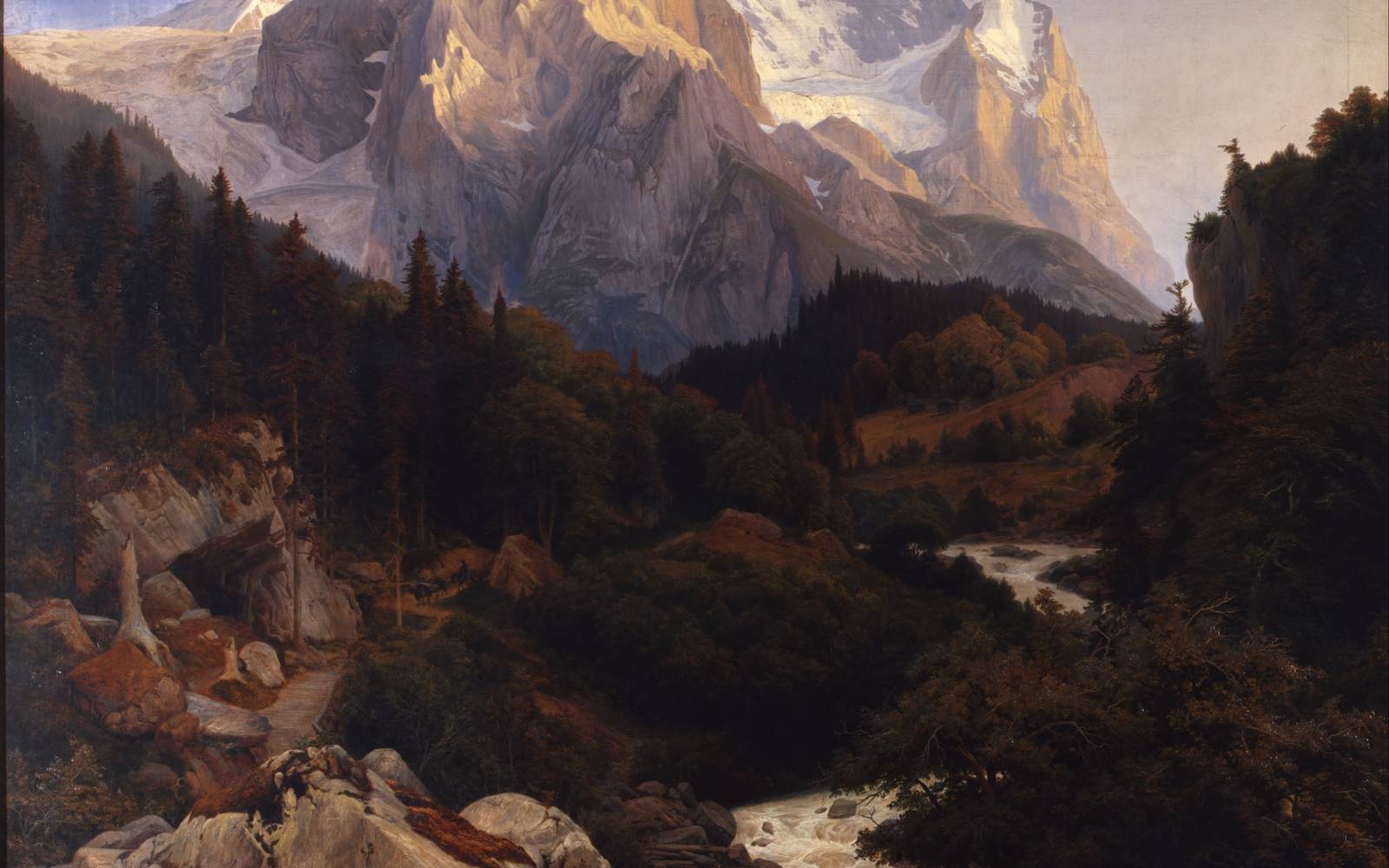
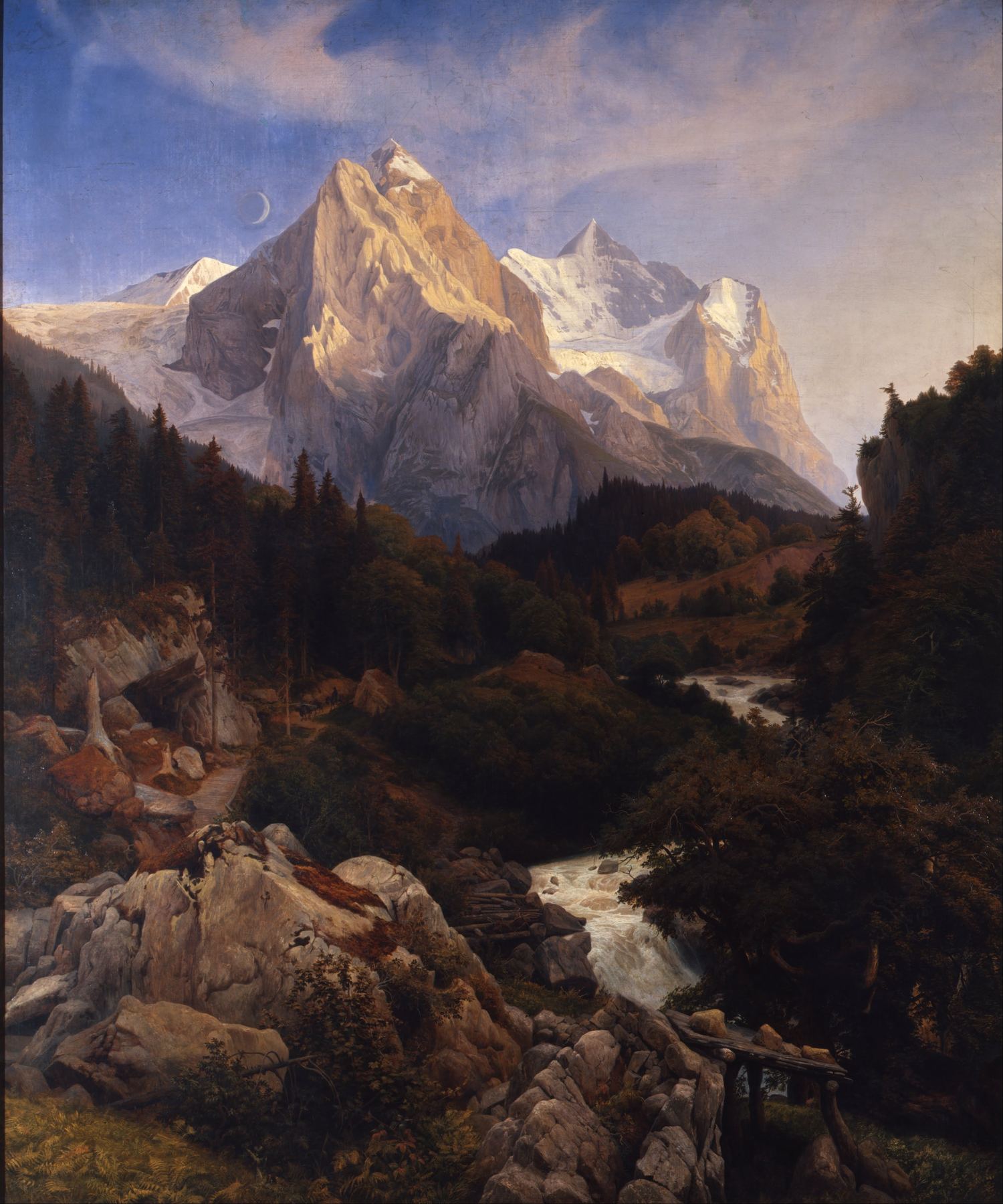
Image reference: The Wetterhorn by Johann Wilhelm Schirmer.
At a Glance
- Broad dates1819–1918
- Greatest international influenceApproximately 1830–70
- Institutional centreRoyal Prussian Academy of Art, Düsseldorf
- Key directorsPeter Cornelius and Wilhelm von Schadow
- Leading fieldsHistory painting, landscape, genre, portraiture and still life
- Important artistsSchadow, Eduard Bendemann, Carl Friedrich Lessing, Johann Wilhelm Schirmer, Andreas and Oswald Achenbach, Johann Peter Hasenclever and Emanuel Leutze
- International connectionsScandinavia, Finland, Russia and the Baltic, the United States and Australia
- Known forDisciplined drawing, composed narratives, finish, atmosphere and close relations between field study and studio invention
- Public infrastructureKunstverein für die Rheinlande und Westfalen, Malkasten, print publishers, travelling exhibitions and the Düsseldorf Gallery in New York
- Essential qualificationA broad school and network, not a uniform movement
Contents
- Where it fits
- What “school” means
- Academy and teaching
- Institutions and market
- Women outside the academy
- History painting
- Landscape
- American colony
- Essential works
- Where to see it
Where the Düsseldorf School fits
Wilhelm von Schadow
Key career periodCarl Friedrich Lessing
Key career periodJohann Wilhelm Schirmer
Key career periodAndreas Achenbach
Key career periodOswald Achenbach
Key career periodJohann Peter Hasenclever
Key career periodEmanuel Leutze
Key career periodAlbert Bierstadt
Key career periodJohann Wilhelm Schirmer’s The Wetterhorn looks like an encounter with the Swiss Alps, yet it is also an argument assembled in a Düsseldorf studio. A torrent begins near the viewer, dark trees frame the route, cliffs rise in measured stages and distant peaks close the scene. Tiny figures provide scale. The mountain named by the title is not even the most visually commanding summit. Nature has been observed closely, but observation has been reorganised into a journey.
That combination—careful study, lucid composition, emotional atmosphere and a picture designed to communicate—helps explain the Düsseldorf School. The term covers artists associated with the Royal Prussian Academy of Art and Düsseldorf’s wider artistic life between its refoundation in 1819 and the end of Prussian rule in the Rhineland in 1918. Kunstpalast research now identifies more than 4,000 artists in or around this network. No single appearance could unite so many people across a century.[1]
The Düsseldorf School was therefore not one brushstroke or doctrine. It was an ecosystem of teaching, studios, friendships, disputes, associations, print publishers, dealers and exhibitions. Its most influential decades ran roughly from 1830 to 1870. History painting first secured its reputation; landscape and genre then became exceptionally successful; still life, portraiture and illustration formed further specialisms. Students arrived from across Europe, Russia, the Baltic, the United States, Latin America and Australasia, adapting what they learned to very different political and geographical worlds.
What does “school” mean in Düsseldorf?
The word has three overlapping meanings. First, there was a literal academy with a curriculum, professors, examinations and advanced studios. Second, there was a “Schadow school”: pupils connected to the director Wilhelm von Schadow through training, shared ideals and personal allegiance. Third, there was a much wider Düsseldorf art world that included private pupils, independent artists, dealers, publishers, foreign colonies and artists’ associations.
The academy itself had older roots. Elector Palatine Carl Theodor founded an academy in 1773, but the institution was reconstituted as a Royal Prussian academy in 1819 after the Rhineland had passed to Prussia. Peter Cornelius introduced a staged course and an academic division for art-related sciences. Schadow, director from 1826, added the master class and consolidated an approach in which practising artists led groups of advanced students.[2]
Faculty history shows both continuity and turnover. Cornelius’s brief Düsseldorf directorship was followed by Schadow’s long tenure from 1826 to 1859. Carl Ferdinand Sohn taught painting for decades; Schirmer led landscape teaching; later appointments carried the institution into different phases of history, genre and landscape art.[3] “Düsseldorf School” consequently names a succession as much as a generation.
The broad dates 1819–1918 are documentary boundaries. They begin with the Prussian refoundation and end with war, revolution and the disappearance of the Royal Prussian institutional order. They should not imply one hundred years of unchanged prestige. Schadow’s 1831 regulations remained influential well into the twentieth century, but the artistic centre of Europe moved, new markets emerged and later Düsseldorf painters responded to Realism, Naturalism, Impressionism and modern exhibition societies.[4]
A Prussian academy built from reform
Düsseldorf’s rise depended partly on loss. The celebrated electoral collection had been transferred to Munich, leaving the city without the old-master resource that might normally anchor an academy. Cornelius and Schadow compensated through systematic teaching, public exhibitions and a new artistic community. Their model was idealist, but it was organisationally modern: instead of leaving students to copy indefinitely, it aimed to carry selected talents towards independent composition.
The timeline reveals astonishing speed. Schadow arrived with pupils from Berlin; academy displays won attention there by the late 1820s; the Kunstverein was founded in 1829; foreign students and collectors followed. The academy became intertwined with theatre, music, publishing and the growing civic life of a provincial capital.[5]
Cornelius and Schadow had both been shaped by Nazarene ideas. The Nazarenes sought moral and spiritual renewal through early Italian and German art, clear drawing, fresco and collective workshop practice. Their position belonged to Romanticism, but it did not resemble Romantic spontaneity. Art required an intelligible idea, disciplined execution and, ideally, a public or ethical purpose.[6]
The school’s most concentrated influence lay between about 1830 and 1870, when poetic history painting, landscape, genre and an international art market overlapped.[7] That narrower high period sits inside the broader institutional dates and prevents a useful documentary boundary from becoming a claim of unchanging artistic authority.
Schadow translated that aspiration into a ladder. Beginners copied drawings and casts; more advanced students studied the whole figure and nature; the strongest developed their own designs in a master’s studio. Drawing was not merely preliminary technique. It trained the student to make form readable and to convert a literary, historical or observed subject into a coherent pictorial thought.[8]
The system offered unusually close supervision and a route towards professional identity. It could also produce hierarchy, conformity and dependence. Admission to the highest level rested with teachers; history painting remained ideologically privileged; women were excluded from formal enrolment; pupils who opposed Schadow’s Catholic and Nazarene preferences could experience the “family” as paternal control.
Surviving regulations, student lists, letters, diaries, passports and artists’ estates make this institutional history testable. The Heinrich Heine Institute’s holdings include correspondence relating to Cornelius, Schadow, Bendemann, Lessing, the Achenbach brothers and Adolf Schrödter, while Julius Hübner’s papers document academy conditions and a cultural circle extending to music and literature.[9] A school is visible not only in paintings but in instructions, arguments, invitations and bills.
The institutions around the classroom
The academy could train artists, but it could not provide enough church, court or state commissions for them all. Düsseldorf therefore developed an audience-making machine. Founded in 1829 under Schadow’s direction, the Kunstverein für die Rheinlande und Westfalen held annual exhibitions, purchased works, organised lotteries and distributed art among a growing membership. Its earliest supporters came from the Rhineland and Westphalia; by around 1900 it counted nearly 14,000 members.[10]
The lottery mattered. A subscription could turn middle-class participation into ownership, while prints after paintings extended a composition far beyond its original buyer. Travelling displays carried Düsseldorf work through German cities and abroad. Dealers and auction houses eventually competed with the association. Industrial prosperity in the Rhineland supplied collectors, and the school learned to produce pictures suited to both large exhibition rooms and domestic interiors.
This infrastructure shaped subject and style. A painting needed to arrest viewers in a crowded exhibition, explain itself without a patron’s programme and survive translation into engraving. Strong silhouettes, legible gestures, contrasting expressions and finely described accessories helped. The result could be theatrical, but theatre was a practical language of public communication.
Malkasten: fellowship, freedom and contradiction
The revolutionary year 1848 exposed divisions within Düsseldorf’s art world. Artists participated in civic celebrations, militias and debates about German unity and political representation. The Malkasten association emerged in this climate with democratic aspirations and an initial commitment to include independent artists who had not trained at the academy. The proposed name “Germania” gave way to “Malkasten,” or Paintbox, a metaphor broad enough to contain political difference.[11]
Malkasten became one of Germany’s oldest enduring artists’ associations. Its buildings, theatre, cellar, park and archive preserve the union of visual art, music, literature, performance and sociability that characterised Düsseldorf culture.[12] Festivals, tableaux vivants, costume events and amateur theatre were not diversions from serious art. They trained collective organisation, scenery, publicity and the performance of artistic identity.
Fellowship did not abolish conflict. Research on the association distinguishes Schadow’s Catholic, academy-centred party from a freer circle around Lessing, Andreas Achenbach, Schirmer, Hasenclever, Carl Wilhelm Hübner, Schrödter and the German American Emanuel Leutze. Independent artists objected to academy privilege in exhibitions and acquisitions.[13] Malkasten helped reconnect factions, but its convivial mythology should not conceal struggles over religion, money, teaching and access.
Follow the Düsseldorf School through four stages
–29
A Prussian academy is rebuilt
Cornelius introduces a staged curriculum; Schadow arrives with pupils, adds the master class and helps join academy reform to the Kunstverein and a growing civic audience.
–47
History and landscape build international authority
Schadow’s circle, Schirmer’s landscape class, the Achenbachs and expanding print and exhibition markets make Düsseldorf a destination across Germany, Scandinavia and beyond.
–70
Revolution, genre and international transfer
Malkasten, Hasenclever’s politics, Nordic collaboration and the American colony expose conflict while Düsseldorf methods are adapted to new national subjects and markets.
–1918
The network persists as authority disperses
Portraiture, still life, later landscape, women’s private training and global careers continue while Paris, Naturalism, Impressionism and new institutions loosen the school’s old centre.
Women were excluded from the academy, not from the city
For most of the nineteenth century, women could not enrol at the Düsseldorf Academy. That fact once made them disappear from histories built from official student lists. New Kunstpalast research has identified roughly five hundred women artists who lived and worked in Düsseldorf between 1819 and 1919. Many studied privately with academy professors, rented studios, exhibited, sold work and joined international networks.[14]
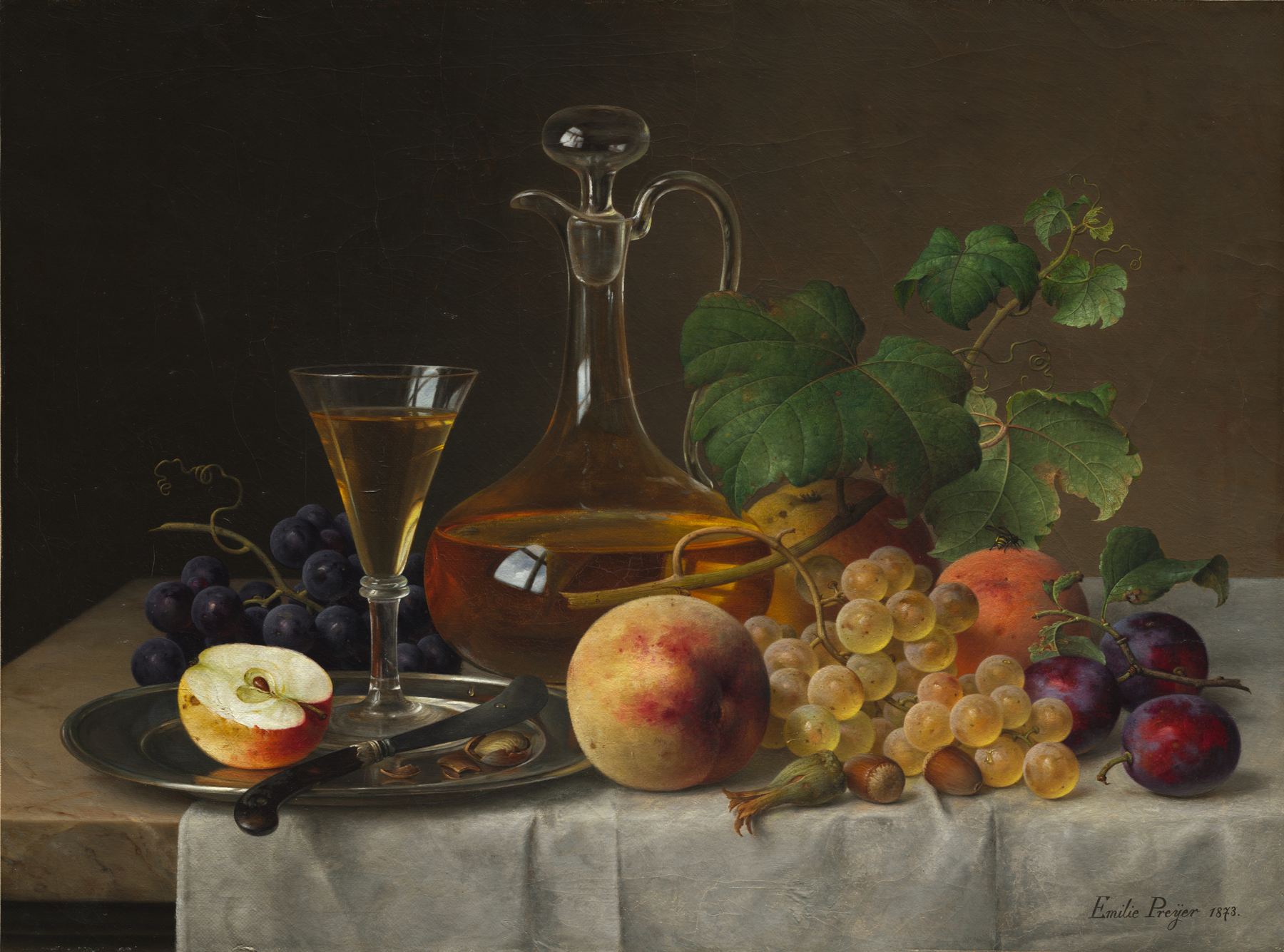
Elisabeth Jerichau-Baumann, Marie Wiegmann, Amalie Bensinger, Luise von Martens, Emilie Preyer and Paula Monjé were not marginal hobbyists simply because the academy denied them a register number. Jerichau-Baumann became one of Europe’s most recognised women painters; Wiegmann pursued portrait and genre painting; Preyer developed the still-life practice of her father Johann Wilhelm; Monjé campaigned near the end of the period for women’s access. Their later obscurity was produced by collecting and historiography as well as by nineteenth-century restrictions.[15]
Private tuition cost money and did not reproduce the whole curriculum. Life drawing from nude male models was treated as inappropriate for women. Portraiture, still life and indoor subjects were made more accessible, while travel and outdoor study required companions, funds and negotiation. Clothing itself could impede fieldwork. These conditions influenced which works were practical without determining what women were capable of imagining.[16]
The restriction also changes the meaning of “international.” Nordic and Baltic women came to Düsseldorf because German centres offered valuable professional networks, yet they entered them through separate doors. Some studied portraiture with male artists using clothed family members, writers, scientists and professional colleagues as sitters. A woman painting a man could itself test the gendered direction of artistic looking.[17]
Recovering these artists does more than add missing names. It reveals that the Düsseldorf School’s real field was always larger than the academy. Private studios, households, friendships, exhibitions and travel were parallel educational institutions.
Norway and Finland: a school remade as national art
In the 1840s and 1850s, Scandinavian artists formed one of Düsseldorf’s strongest foreign communities. The city supplied training, markets and a collaborative method at a moment when newer nations and national institutions were seeking visual identities. The result was not German scenery exported north. Artists used Düsseldorf composition to make local landscapes, costumes and customs legible as national culture.
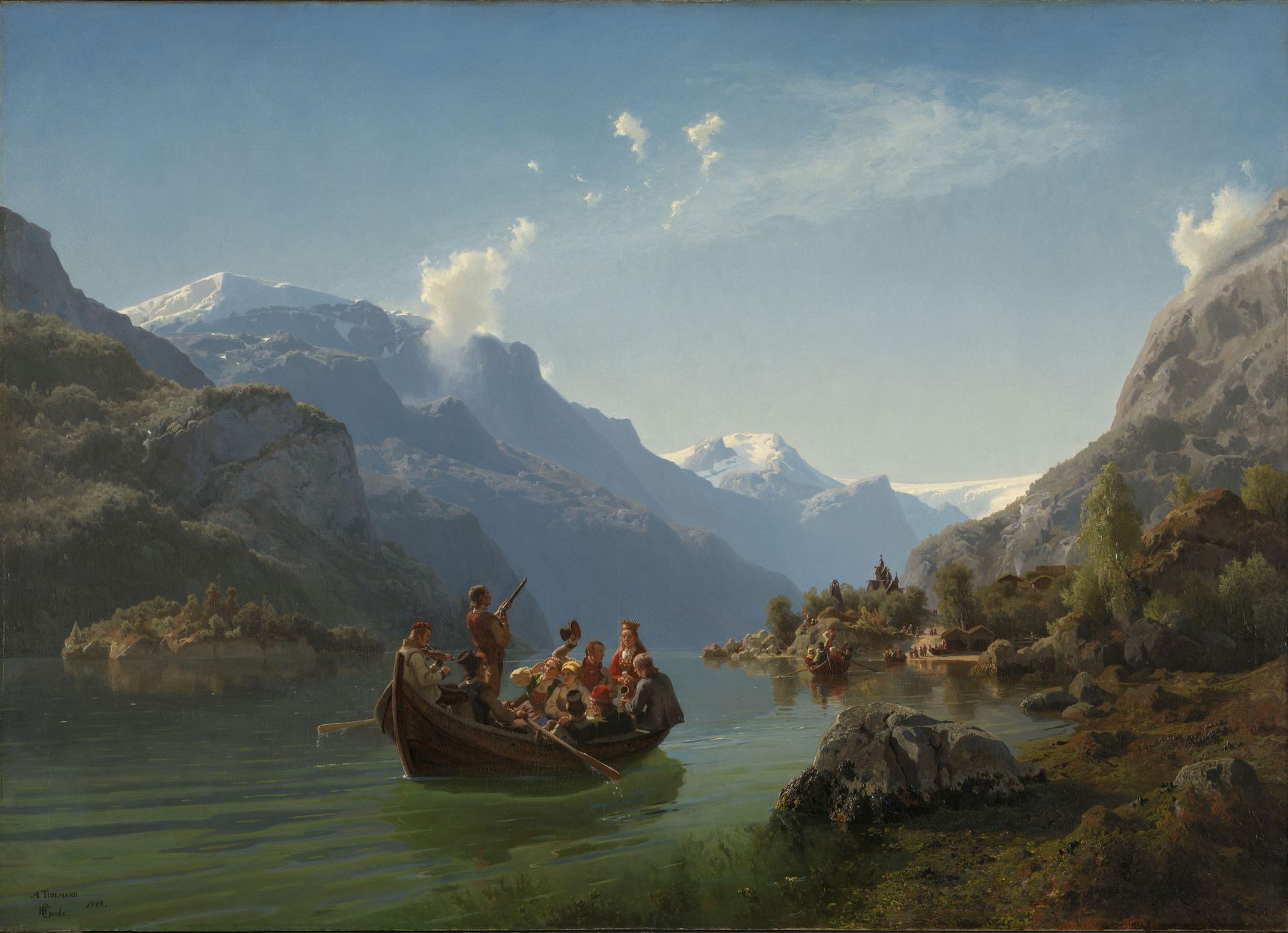
Adolph Tidemand and Hans Gude’s Bridal Procession on the Hardangerfjord is the best-known example. Tidemand painted the figures and Gude the landscape, joining specialisms exactly as Düsseldorf workshop culture encouraged. A fjord, glacier, boat, traditional dress, music and marriage ceremony become a harmonious national image. Its reception extended beyond the canvas: poem, music and a staged tableau accompanied a successful Christiania event in 1849.[18]
The picture is both observation and construction. Tidemand studied rural dress and interiors; Gude knew Norwegian terrain. Yet the wedding party presents peasant culture to an urban bourgeois audience as stable, festive and picturesque. Social conflict, poverty and regional difference disappear. National Romanticism does not simply record identity; it selects and performs it.
Norway’s national collection now treats the artist colonies of Düsseldorf, Dresden, Karlsruhe and Munich between about 1840 and 1870 as essential to its own art history.[19] That institutional framing captures a two-way truth: Norwegian artists relied on continental schools, and Düsseldorf’s international reputation relied on what foreign students accomplished after turning its methods elsewhere.
The Finnish painter Werner Holmberg worked in Düsseldorf during his short career and became Finland’s first internationally recognised artist. He made exact studies while travelling, then combined observation and memory in the studio. In A Road in Häme, the path, dense forest and summer atmosphere describe Finland even though the finished picture was produced in Germany.[20] Distance could sharpen national landscape rather than dilute it.
Women participated in these transfers under unequal conditions. Victoria Åberg, Fanny Churberg, Mathilde Dietrichson and Sophie Ribbing belonged to a broader Nordic movement through German centres. Current Finnish research reconstructs links among Nordic, Baltic, Polish and German artists rather than treating each national canon in isolation.[21] The recovered network makes the school look less like a German gift and more like a negotiated international resource.
Australia: observation, science and the colonial view
Eugène von Guérard trained with Schirmer in Düsseldorf from 1838, made close geological and botanical studies in the Eifel and carried that practice to Australia in 1852. His sketchbooks supported finished canvases long after expeditions. He later became the first curator and master of the art school at the National Gallery of Victoria, transmitting educational as well as pictorial methods.[22]
Von Guérard’s Australian landscapes combine detailed vegetation, geological structure, panoramic order and dramatic weather. Current museum interpretation values them as visual evidence of environments while stressing his interest in exploration and science.[23] The pictures can help reconstruct ecological change, but their accuracy is selective rather than neutral.
Colonial landscape turns occupied Country into a view for settlers. Indigenous presence, knowledge and ownership may be absent even when every plant is carefully differentiated. “Empty” grandeur can make possession appear natural. A responsible reading should hold together scientific curiosity, extraordinary observation and the political conditions that made European survey possible.
Technique travelled materially. Outdoor oil studies required portable pigments and prepared supports; collapsible metal tubes later made remote work easier. Von Guérard often worked on paper prepared with lead-white oil paint and chalk, then carried studies back to the studio.[24] The finished panorama rests on small, mobile encounters.
His career demonstrates that Düsseldorf was not simply copied overseas. Eifel geology helped him recognise volcanic western Victoria, but Australian vegetation, light and scientific expeditions required new knowledge. Transfer was an act of translation under colonial power.
History painting: belief, narrative and dissent
History painting originally stood at the top of the academy hierarchy. Its subjects came from scripture, mythology, literature and the political past. Schadow’s pupils were trained to clarify a central idea through expression, gesture, costume and setting. Technical finish carried moral responsibility: confused form could imply confused thought.
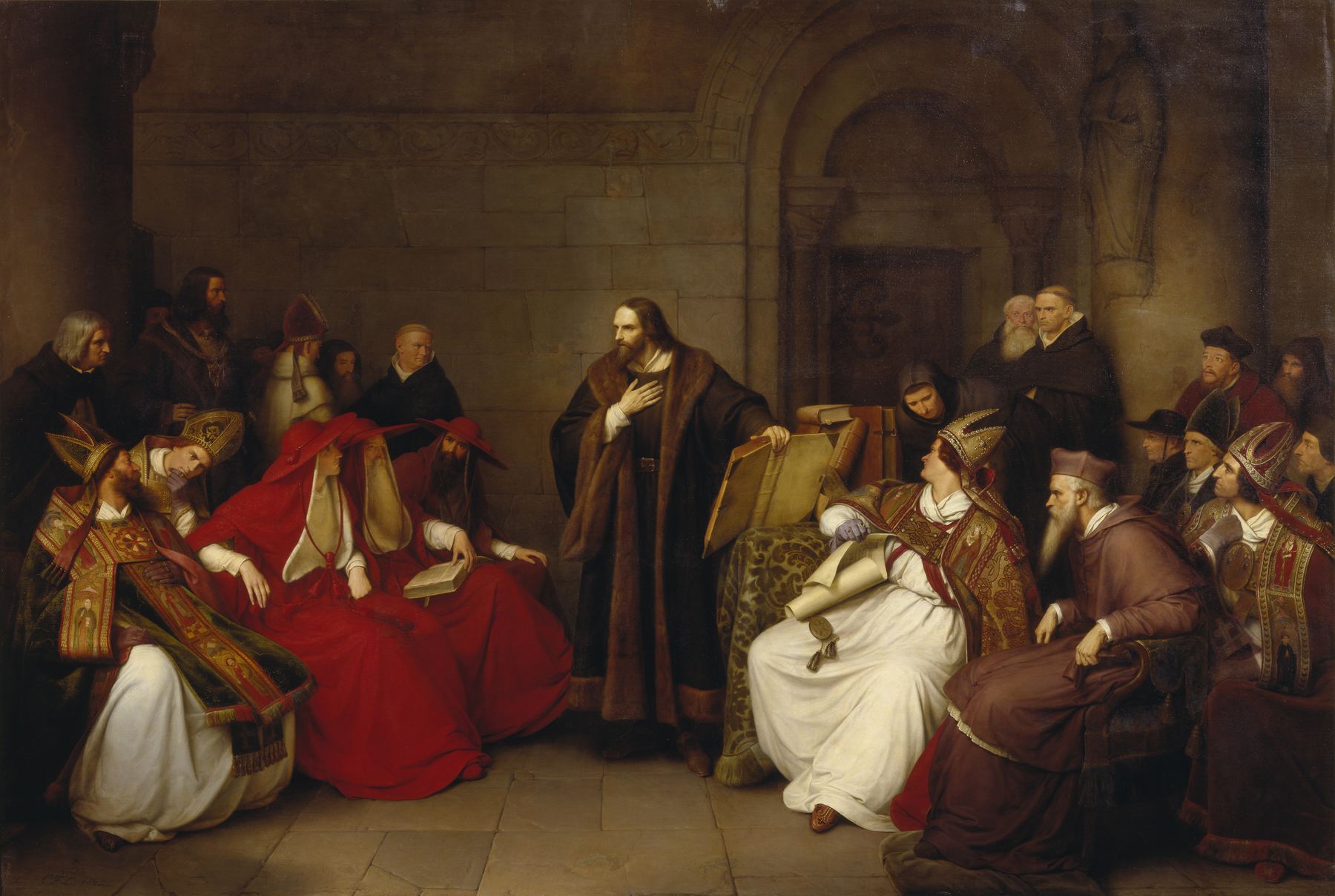
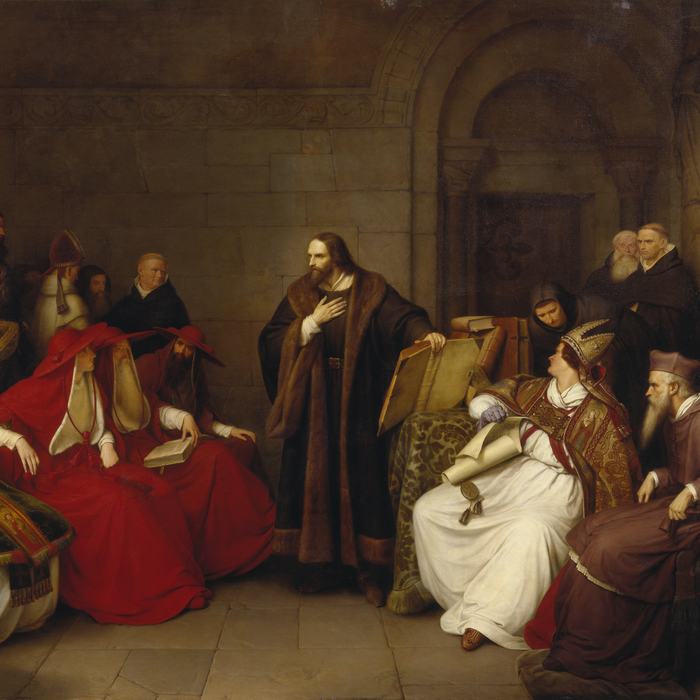
Carl Friedrich Lessing joined history to landscape. He studied architecture before following Schadow to Düsseldorf and became celebrated for ruins, forests, medieval subjects and religious conflict.[25] In Jan Hus at Constance, the reformer defends his beliefs before the council that will condemn him. Reactions ranged from acclaim to ridicule; the Städel’s purchase contributed to the resignation of its Nazarene director Philipp Veit. In the politically charged decades before 1848, Protestant opposition within a Catholic setting could look like an image of contemporary conscience.[26]
Lessing could also let buildings bear the historical argument. In Kloster Arnstein, the abbey dominates the centre while surrounding terrain becomes a carrier of memory.[27] The medieval ruin served nineteenth-century searches for a German past before political unification, but its distance from contemporary life also made history available as atmosphere.
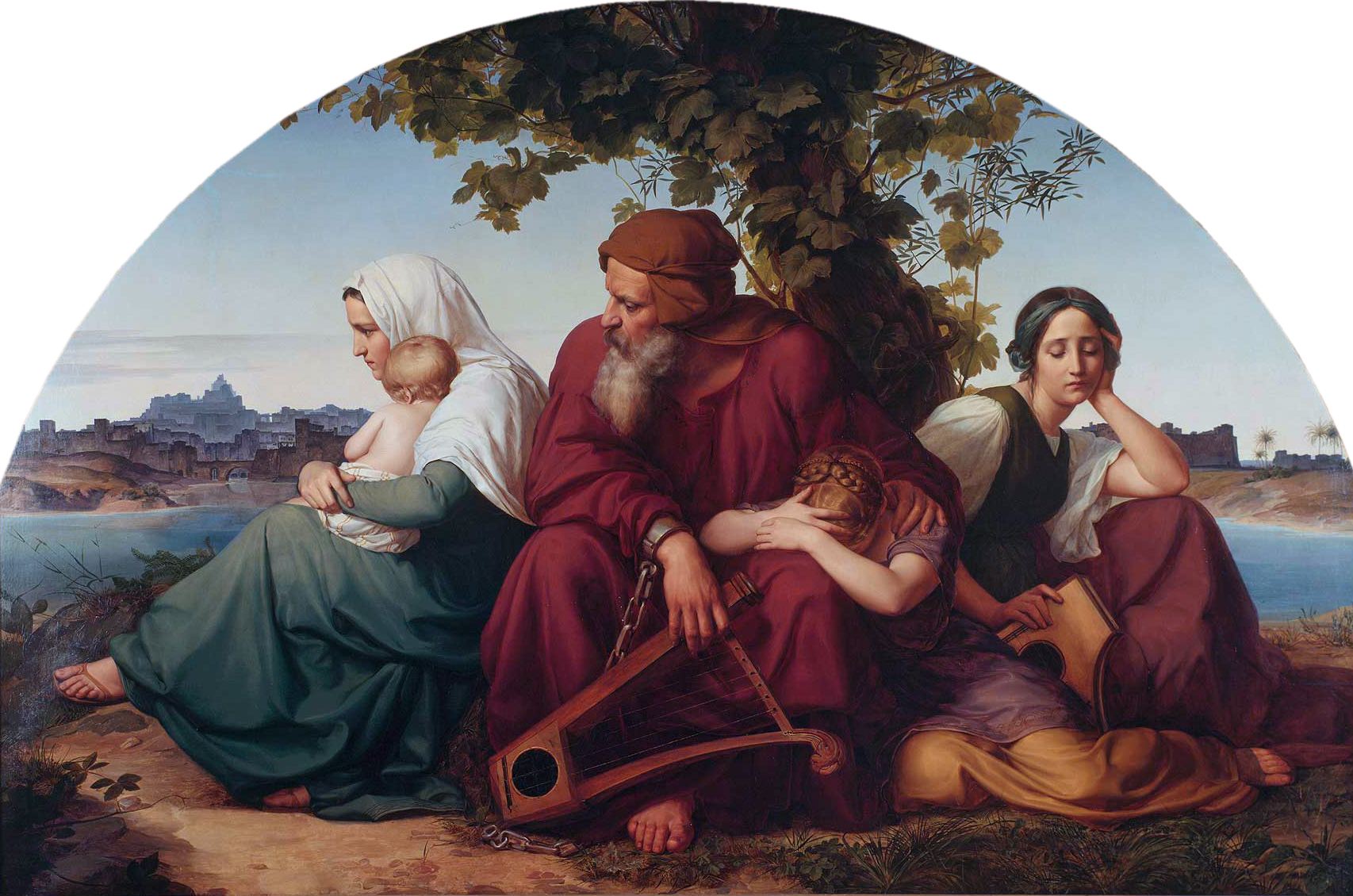
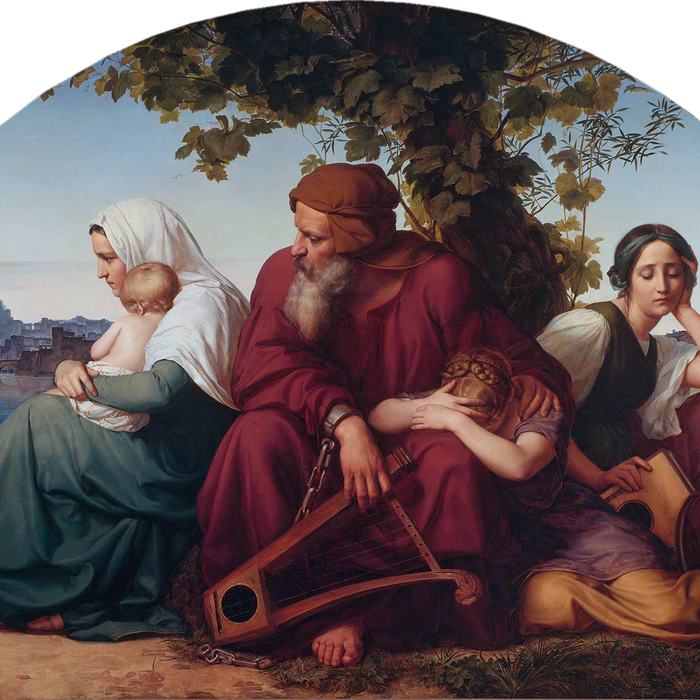
Eduard Bendemann’s The Mourning Jews in Exile brought the young school international attention. The artist, born into a Jewish banking family and baptised as a child, represented Psalm 137 through a group mourning Babylonian captivity. The work existed in several versions and circulated widely in prints.[28] Its success complicates any simple account of a uniformly Catholic school.
The painting nevertheless asks difficult questions. Jewish suffering is rendered through Christian Nazarene conventions and offered to a largely Christian public as pathos. Bendemann’s own family history gives the subject personal and historical force, but identity does not settle interpretation. Drapery, beauty and resignation may dignify exile while also making grief aesthetically consumable.
Bendemann followed Schadow from Berlin, travelled to Italy with the circle, became a leading history painter, taught in Dresden and later directed the Düsseldorf Academy.[29] His mobility shows how the school reproduced itself through appointments elsewhere.
Narrative painting was therefore not politically fixed. It could support church ideals, national memory, liberal resistance or state power. A student could use the academy’s clarity against the director’s theology. Later monumental painters would also place disciplined history painting in the service of empire and official commemoration.
French history painting—from Eugène Delacroix to Paul Delaroche—offered alternative models of colour, drama and historical spectacle. Düsseldorf artists exhibited across European circuits and did not develop behind a German wall. Yet their close teacher-pupil organisation and alliance of drawing, finish and poetic idea gave the local school a distinct institutional character.
Genre painting and the pressure of the present
Genre painting moved from anecdote towards contemporary social observation. Eduard Pistorius provided an early stimulus; Lessing and Theodor Hildebrandt painted everyday situations in the early 1830s. The academy did not establish a dedicated genre class until 1874, long after the market had demonstrated the field’s popularity.
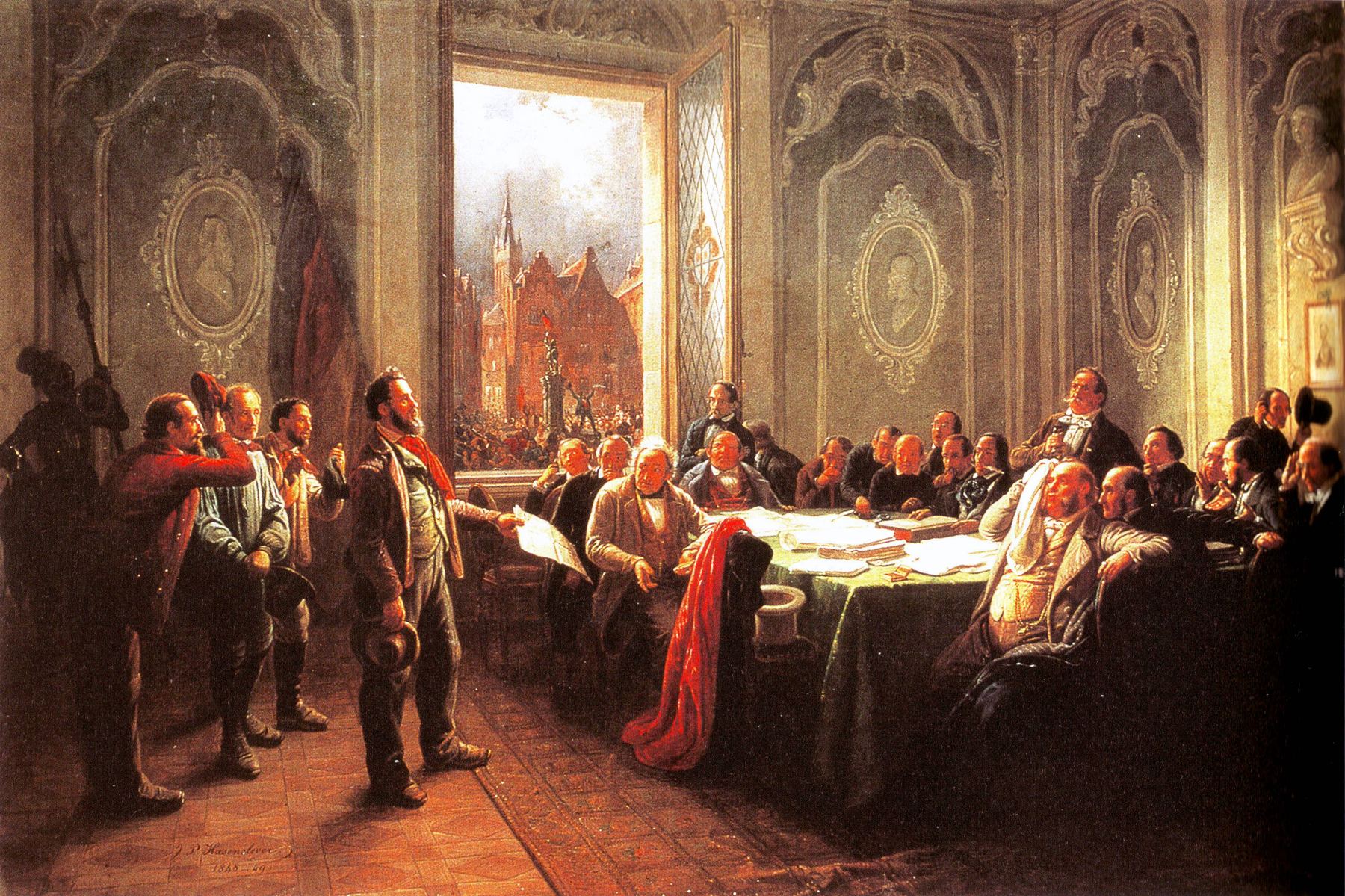
Johann Peter Hasenclever became its sharpest observer. His reading rooms, wine tastings, school scenes and political encounters use faces, hands, props and interior architecture to distribute attention. Humour can expose pretension; repetition can satisfy demand; a crowded scene can let viewers inspect a social system one reaction at a time. Hasenclever succeeded across Europe and America and helped found Malkasten.[30]
In Workers before the Magistrate, painted first as an oil sketch under the immediate pressure of 1848, five workers confront sixteen startled officials. One man carries a petition; another gestures towards the window; a raised fist makes the threat of revolution visible. Portraits in heavy frames and papers on the table embody institutional authority, while the standing delegation enters from the side as a force the room cannot absorb.[31]
The picture is partisan without being a manifesto for the whole school. Hasenclever served in Düsseldorf’s civic guard and knew revolutionary circles, whereas other artists held different loyalties. The work demonstrates what Düsseldorf narrative technique could do when applied to a current political event: turn expression and staging into conflict rather than sentimental closure.
Genre painting could also soften poverty into picturesque anecdote. Detailed interiors and expressive figures were commercially attractive, and suffering could be “perfumed” for middle-class viewers. Readers should ask whether labouring people act, speak and resist, or merely supply emotion to someone else’s domestic wall.
Landscape: from field study to composed world
Landscape became Düsseldorf’s most influential genre even though Schadow distrusted excessive specialisation. In 1827 Carl Friedrich Lessing and Johann Wilhelm Schirmer founded the Landschaftlicher Componirverein, a society devoted to landscape composition. Two years later Schirmer led the academy’s first landscape class. The sequence matters: collegial experiment preceded formal institutional recognition.
Students went into the Rhine country, Eifel, Neander Valley, Alps, Italy and northern coasts to draw trees, rocks, weather, architecture and terrain. They returned with studies rather than necessarily finished exhibition paintings. In the studio, these fragments could be selected, enlarged and joined into an ordered route. The process resembles neither pure fantasy nor a photograph of one instant.
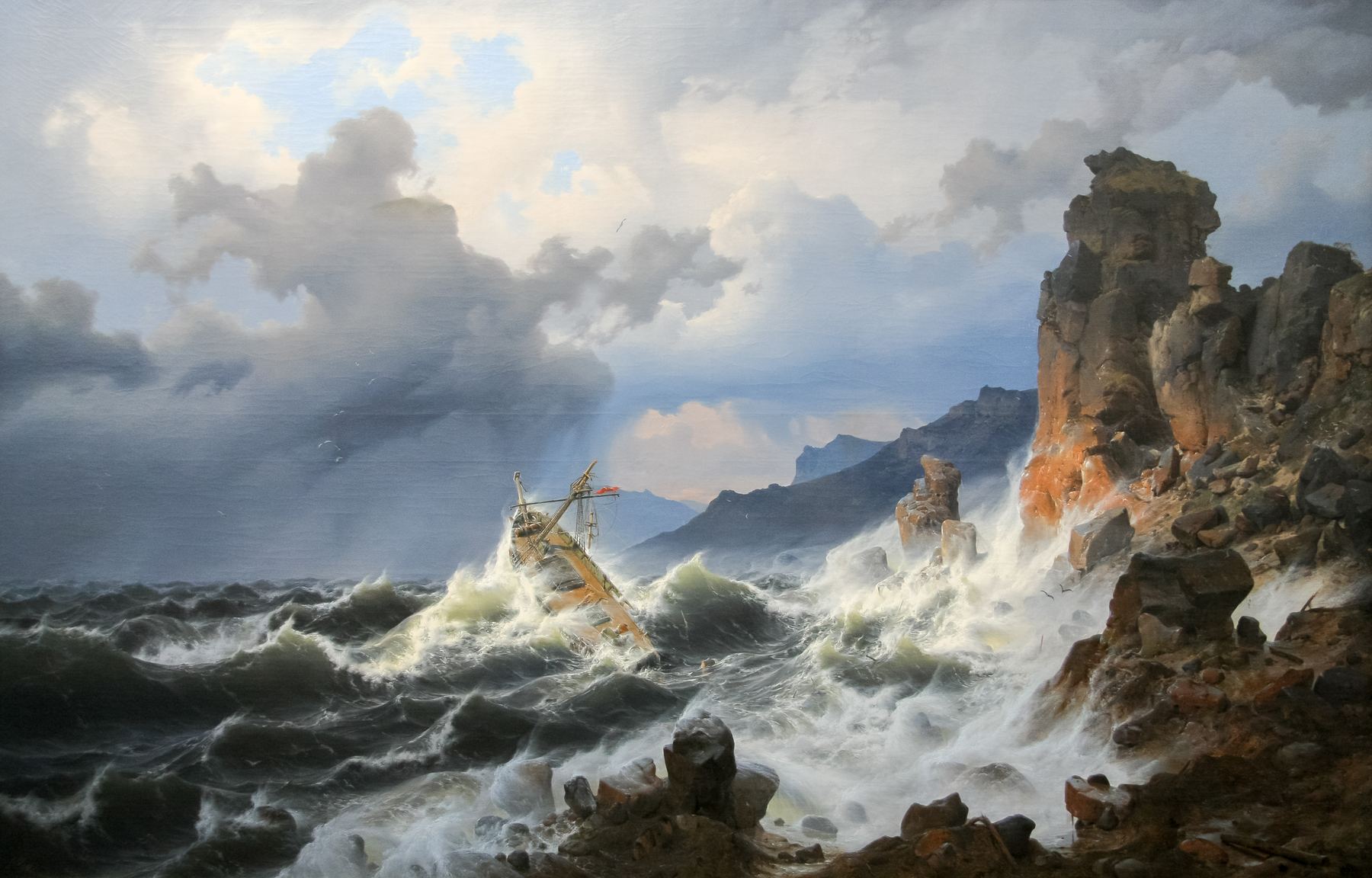
The Achenbach brothers then stretched the field in different directions. Andreas’s Storm at Sea off the Norwegian Coast uses a large canvas, violent surf, damaged vessels and minute human vulnerability. Bought by the Städel in 1837, it made meteorology into drama and helped establish his early reputation.[32] Exact wave and rigging detail serve an emotional machine.
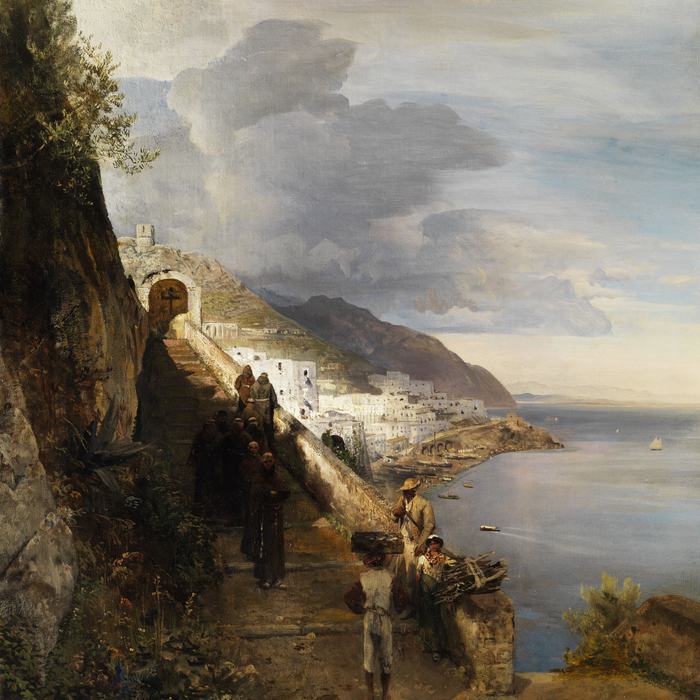
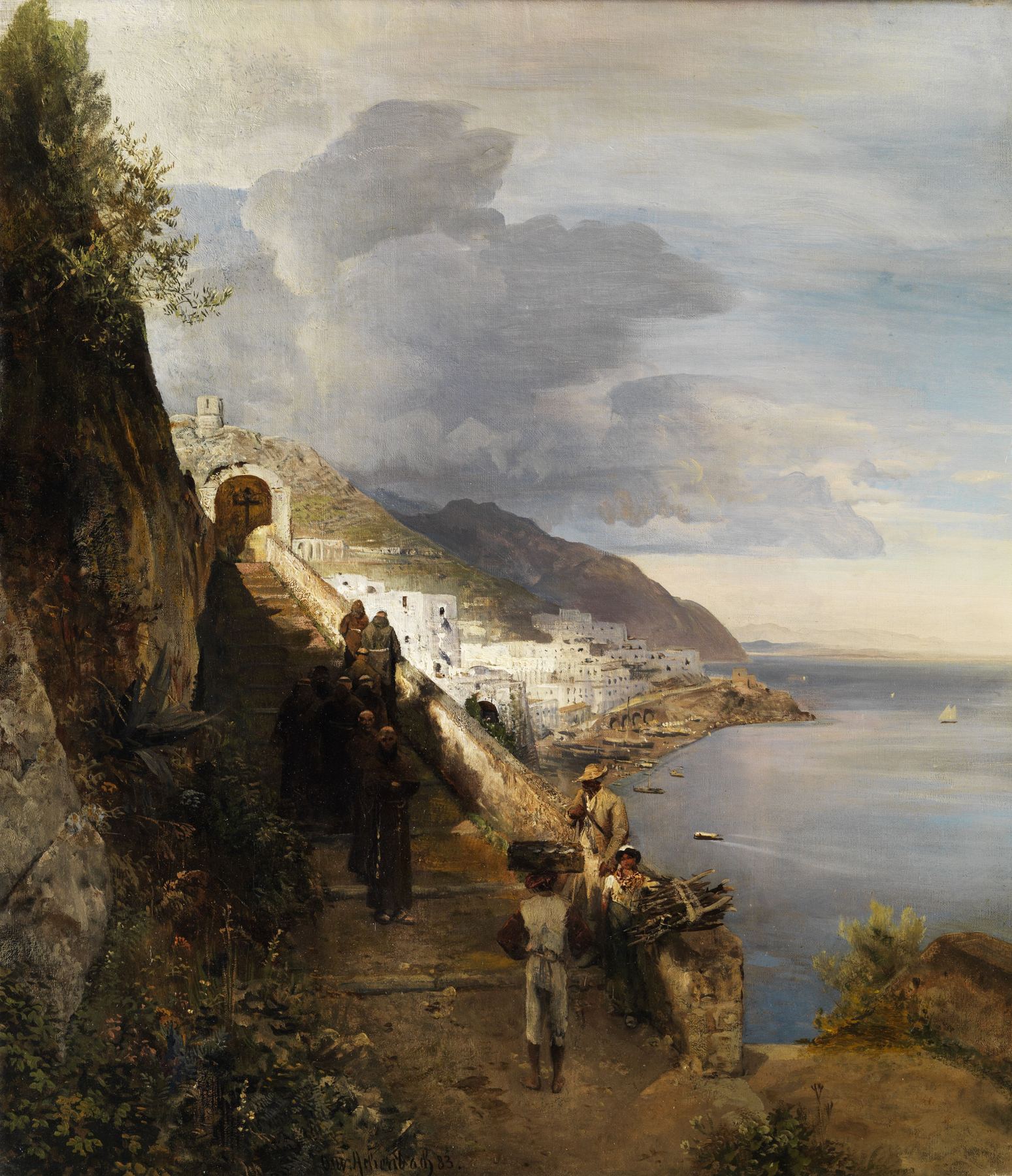
Oswald Achenbach specialised in Italy. He made pencil and oil studies on repeated journeys, noted colour, and later used both memory and photography in Düsseldorf. An Italian landscape could therefore combine field record, recollection and technological aid. His teaching and open studio spread an approach centred increasingly on atmosphere and overall effect rather than equal finish in every detail.[33]
Oswald’s European market, Paris Salon recognition and prosperous Düsseldorf household show that landscape painting could support public celebrity. As professor and host, he taught by demonstration and conversation as well as formal correction.[34] The artist’s studio was workshop, classroom, salon and commercial theatre.
Schirmer’s The Wetterhorn makes the underlying pedagogy visible. Water, forest, cliff and peak form successive zones like theatrical scenery, leading the eye from shade towards illuminated distance. The scale is monumental; tiny staffage figures convert geology into bodily experience. A public broadcaster’s museum study notes that the title mountain sits visually aside from the dominant double peak, a reminder that landscape naming and pictorial emphasis need not coincide.[35]
This is one difference from Caspar David Friedrich. Friedrich often uses emptiness, discontinuity and the solitary back-turned figure to make looking inward and uncertain. Düsseldorf landscapes more often narrate a passage, amplify scale and display technical control. The traditions interacted, and Düsseldorf artists admired as well as criticised Friedrich. There is no clean succession from mystical Romanticism to objective Realism.
Later French developments offer a useful comparison. The Barbizon School also valued sustained landscape study and local terrain, but its relation to the forest of Fontainebleau, looser naturalism and French exhibition culture differed from Düsseldorf’s academy system. Similar outdoor practices do not prove a single trans-European school.
Düsseldorf School artists to know
Wilhelm von Schadow
Schadow’s close master-class system made the academy internationally attractive while his Catholic Nazarene preferences also generated hierarchy, allegiance and dissent.
Carl Friedrich Lessing
Lessing joined ruins and terrain to national memory, then used the academy’s narrative clarity to stage conflicts of conscience that could challenge Schadow’s own theology.
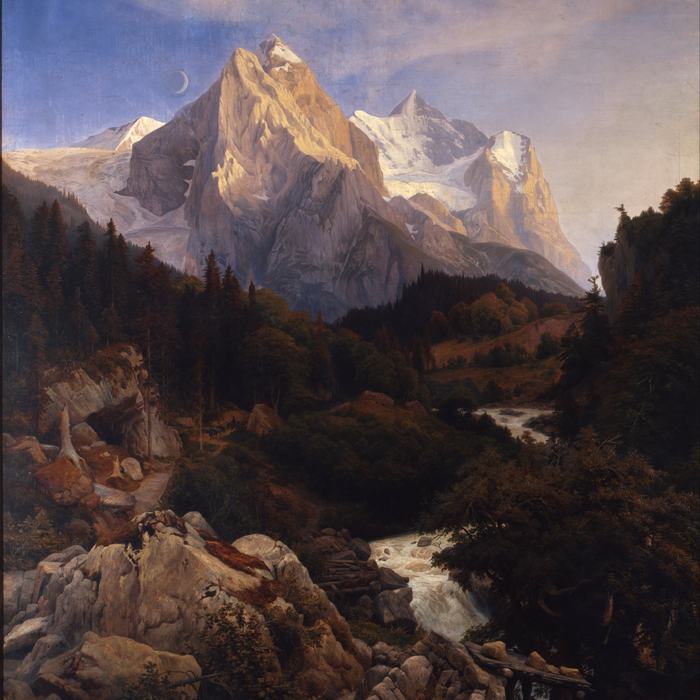
Johann Wilhelm Schirmer
Schirmer formalised landscape teaching after the collaborative Componirverein, showing students how observed fragments could become ordered, ambitious public compositions.
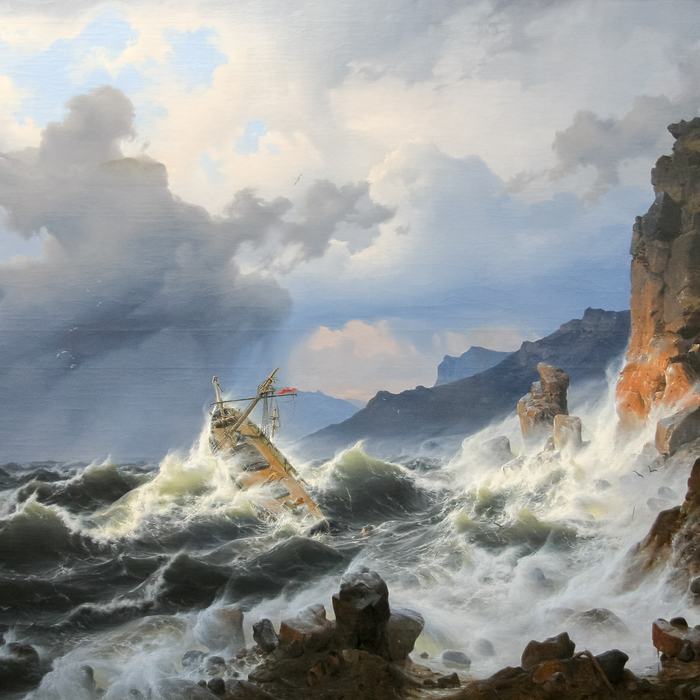
Andreas Achenbach
Achenbach made storm, coast and human vulnerability into large public drama, combining descriptive authority with emotional scale.
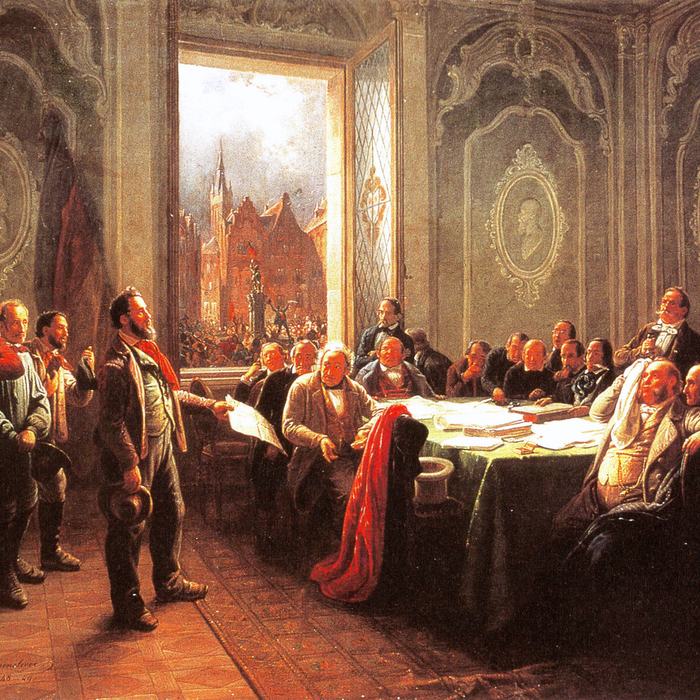
Johann Peter Hasenclever
Hasenclever distributed attention through faces, hands, props and crowded interiors, turning commercially successful genre into social comedy and revolutionary confrontation.
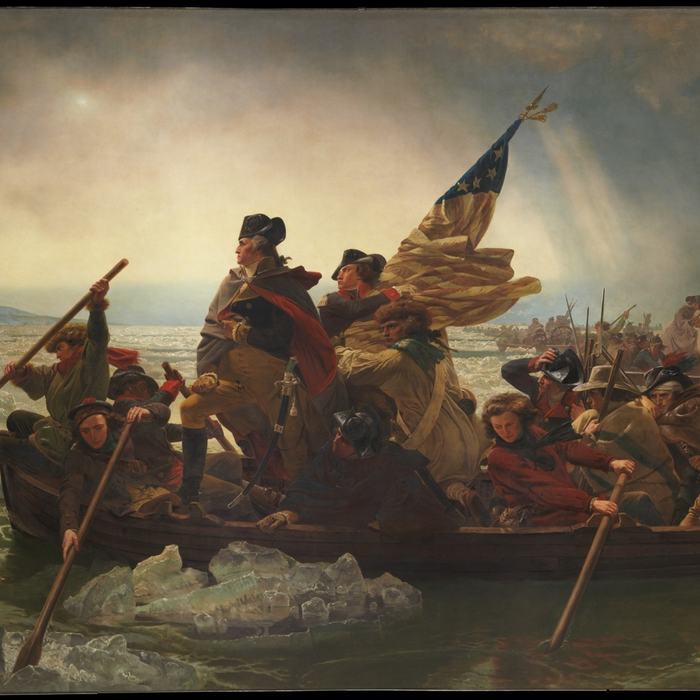
Emanuel Leutze
Leutze’s Düsseldorf studio anchored the American colony, while his monumental national subjects joined European revolutionary hopes to American memory and exhibition culture.
Print, collaboration and circulation
Düsseldorf art was never confined to unique canvases. Lithographers, engravers and publishers translated paintings into affordable images, illustrated poetry and made portfolios. Lieder eines Malers mit Randzeichnungen seiner Freunde, published in 1838, brought together contributions by Andreas Achenbach, Schadow, Lessing, Heinrich Mücke, Wilhelm Schirmer and Bendemann.[36] Its authorship is plural: school identity was printed into being.
Reproduction rewarded legible contour and narrative. It also detached images from original scale and colour. A monumental history painting might enter a home as a black-and-white engraving; a national image could circulate in countries where the original had never been seen. Copies, variants and prints were not secondary afterlives but part of the economic design.
Photography later joined this ecology. It supplied artist portraits, recorded festivals and helped painters preserve or reconstruct visual information. The Bierstadt family’s photographic work and Oswald Achenbach’s studio aids make any sharp opposition between academic painting and new media misleading.
Portraiture, still life and the domestic scale
The school’s reputation rests so heavily on history and landscape that its quieter fields can seem incidental. They were not. Portraiture and still life reveal how Düsseldorf methods entered households, professional identities and the daily art market. They also expose the cost of organising art history around the academy’s highest genres.
Carl Ferdinand Sohn’s long teaching career made portrait practice central to the city even when official theory ranked it below narrative invention. A portrait required recognisable likeness, but it also demanded decisions about costume, furniture, gesture, gaze and social role. The same compositional clarity that organised a council or battlefield could make one sitter’s occupation and self-command readable. Portraits helped artists build networks because the sitter, family and painter shared an interest in display and recommendation.
Women’s careers show why this field mattered. Exclusion from official classes limited access to the full programme of nude study and monumental composition, whereas private portrait teaching could use clothed sitters in a studio or home. Marie Wiegmann, Elisabeth Jerichau-Baumann and other women turned that restricted route into professional work rather than simply accepting a lesser artistic category. Their portraits ask who could occupy public authority as a sitter and who could claim authorship from the other side of the easel.
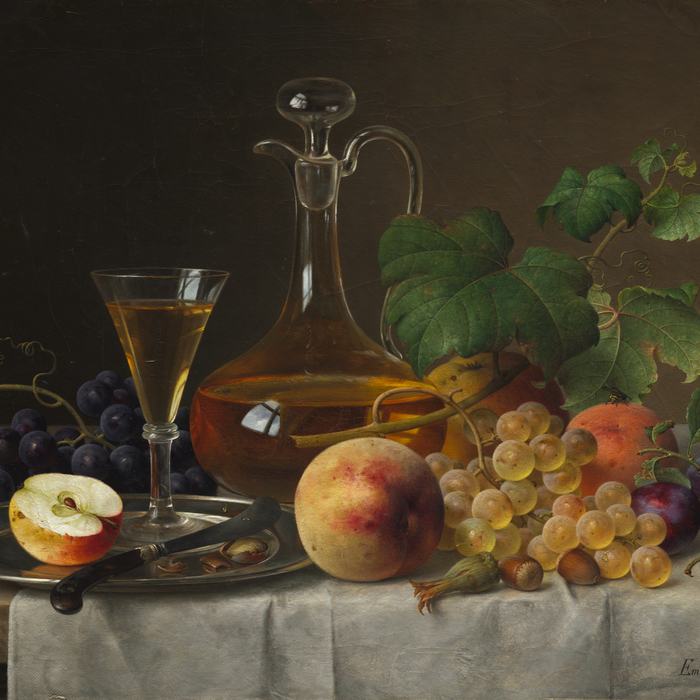
Still life offered another concentrated arena. Johann Wilhelm Preyer and his daughter Emilie Preyer painted fruit, glass, metal, flowers and other objects with an exactitude that rewarded sustained looking. A polished grape, curling peel or reflected window may appear to be a display of imitation, but the arrangement depends on balance, interval and controlled light. Small scale did not mean quick work, and apparent abundance could be built from a deliberately restricted group of motifs.
These pictures suited domestic collectors and travelled readily through exhibitions and dealers. That commercial fit has sometimes been used to diminish them as conventional. Yet the market did not remove artistic decisions; it changed their location. Surface, repeatable format and recognisable objects became ways to establish authorship within a competitive field. Repetition could be economic necessity, disciplined variation or both.
Portraiture and still life also revise the familiar story of Düsseldorf influence moving only through spectacular public pictures. A monumental mountain can export a national ideal, but a portrait can transport a model of professional identity and a still life can carry a standard of observation into a private interior. The school operated across scales because its institutions connected public exhibitions to household ownership.
The American colony: history, landscape and adaptation
From the 1840s through the 1850s, Düsseldorf attracted an important American colony. Students valued relatively structured instruction, lower costs than some alternatives, accomplished history and landscape painters, and a supportive expatriate circle. They did not return home as identical Düsseldorf stylists. Training supplied tools that were changed by American subjects, markets and politics.
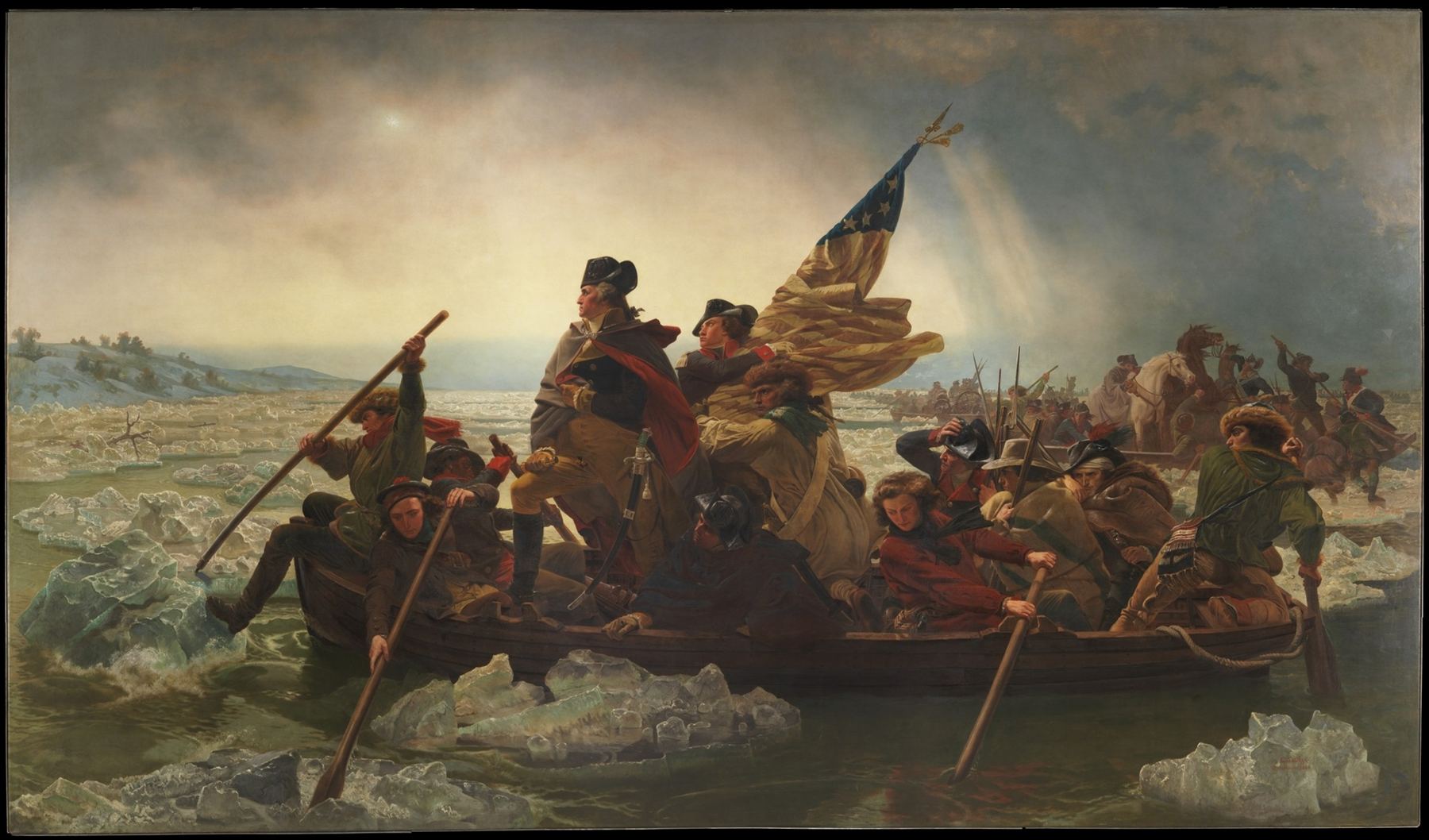
Emanuel Leutze was the colony’s organiser and most visible history painter. His studio became a meeting and working place for younger Americans. He painted Washington Crossing the Delaware in Düsseldorf in 1850–51. The American Revolution offered him a successful national subject and an image of political courage for Europeans living through failed uprisings. Fifty thousand people paid to see the canvas within four months of its arrival in New York. Its vast size, panoramic action and extraordinary finish unite Düsseldorf exhibition practice with American memory.[37]
The painting is not documentary truth. The boat, flag, ice, light and heroic standing Washington compress history into a clear upward movement. Black and Indigenous participants appear within a national crew but do not undo the contradictions of a republic built through slavery and dispossession. The image’s later reuse and critique show how forcefully academic narrative can naturalise political myth.
German-born and raised in Philadelphia, Leutze studied with Schadow and Lessing and supported the German revolutionary cause in 1848.[38] His biography helps explain why a scene from 1776 could address both American nationhood and the defeated hopes of contemporary Europe.
Worthington Whittredge spent seven years in Düsseldorf and travelled with Leutze, William Stanley Haseltine and Albert Bierstadt. Andreas Achenbach’s high-keyed grandeur initially affected him, but he later absorbed and transformed other approaches.[39] The value of training lay partly in learning how to stop imitating it.
Bierstadt’s biography exemplifies the network’s circularity: born near Düsseldorf, taken to the United States as a child, returned to Germany for training, then marketed western American scenery on both sides of the Atlantic.[40] National categories cannot contain such a career.
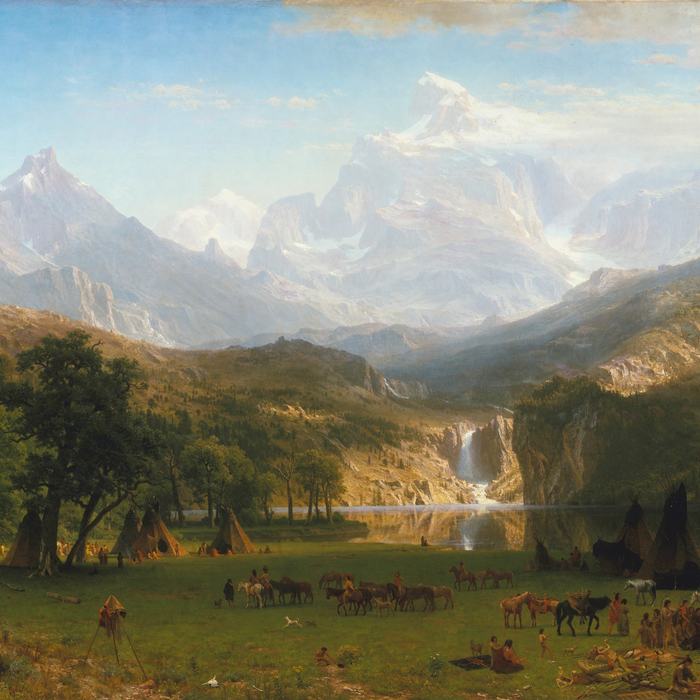
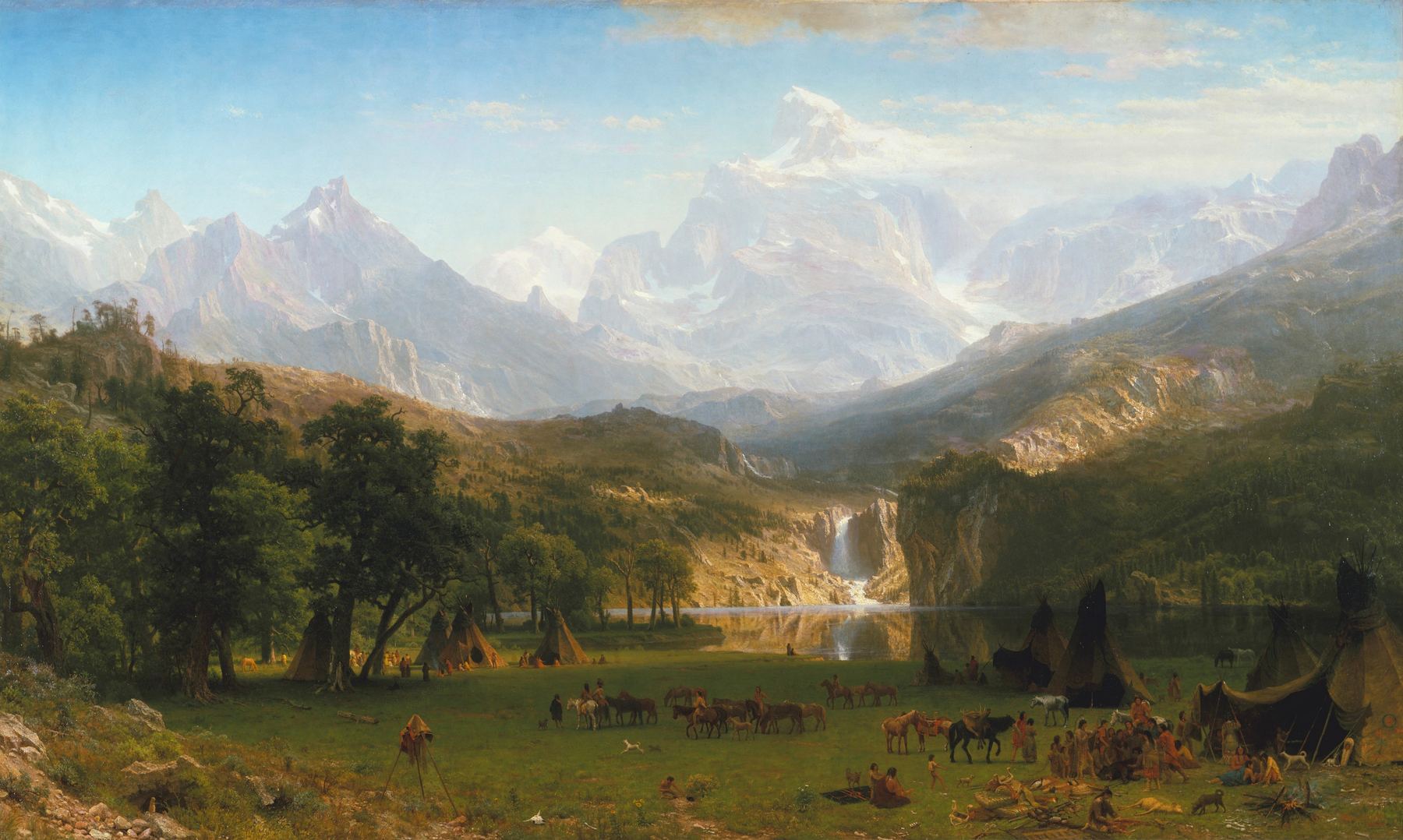
He arrived in 1853, shared the American network and gained technical maturity through European landscape and Alpine travel. When he joined a western survey in 1859, he brought experience in turning mountain study into large studio spectacle.[41] His Rocky Mountain canvases adapted the Düsseldorf route from foreground detail to luminous distance for a new national market.
These paintings helped audiences imagine the American West as sublime, available and providential. Indigenous figures might be reduced to small signs of a supposedly passing world, while settlement, military violence and extraction remained outside the frame. Düsseldorf technique did not dictate this ideology, but it made territorial myth spectacularly persuasive.
Eastman Johnson entered the academy in 1849 and worked in Leutze’s studio, helping with a reduced version of Washington intended for engraving. Formal study strengthened his drawing before he moved to The Hague and engaged deeply with Dutch painting.[42] His later American genre scenes cannot be assigned solely to Düsseldorf, but their staged groups and readable social situations belong partly to that training.
Johnson’s surviving letters and anatomy sketchbook clarify the chronology: academy enrolment, Malkasten membership, work with Leutze, travel and then Dutch study.[43] The sequence warns against a one-source influence model. Artists accumulated cities.
The Düsseldorf Gallery on Broadway, opened by Johann Gottfried Böker in 1849, converted exchange into infrastructure. Until 1862 it displayed Düsseldorf paintings to American audiences; reproductions and publicity extended their reach. Municipal research on Düsseldorf and photography identifies the gallery as an intercontinental bridge connecting academy, Kunstverein, artists and buyers.[44]
What actually travelled?
The international artist register documents Americans, Scandinavians, Russians, Baltic artists and individuals from Argentina, Chile, Peru, India, Java, Iran and New Zealand, alongside thousands from German states.[45] A roll call proves reach but not influence. The more useful question is what practices travelled and how they changed.
A staged route through space
Many Düsseldorf landscapes guide the eye from a detailed foreground through a middle-distance incident to a distant climax. Schirmer’s mountain structure, Gude’s fjords, Bierstadt’s western panoramas and von Guérard’s colonial surveys can use that route differently. It creates visual access, but it can also imply that terrain is organised for possession.
Study outdoors, compose indoors
Sketches preserve rock, tree, cloud, costume or gesture. The studio permits combination, enlargement and narrative emphasis. This method is not a failure of directness. It is the mechanism through which observed fragments become public pictures.
Readable human action
History and genre painters clarify relationships through pose, gaze and props. Leutze makes a boat’s crew converge on Washington; Hasenclever divides workers from officials; Tidemand organises wedding figures within Gude’s landscape. Readability can serve both political critique and national myth.
Finish and technical authority
Detailed surface advertised labour and skill to academy juries and buyers. Yet no single Düsseldorf finish existed. Andreas Achenbach could dramatise spray; Oswald could privilege atmosphere; oil sketches could remain rapid; later artists loosened handling. “Highly finished” is a tendency, not a password.
Specialisation and collaboration
The academy hierarchy favoured complete history painters, but the market encouraged specialists. Figure painters worked with landscapists; engravers translated canvases; photographers supplied records; publishers assembled group projects. Authorship could be networked even when the signature remained singular.
A portable professional culture
Foreign students learned how to run studios, join associations, exhibit, negotiate with dealers and teach. Gude, Bierstadt, Leutze and von Guérard carried social and institutional habits as well as visual devices. The school’s deepest export may have been a model for sustaining an artistic career.
Decline, mutation and the 1918 boundary
By the later nineteenth century, Paris had become the dominant destination for many ambitious artists. Critics associated Düsseldorf with anecdote, finish and sentiment even as its own painters diversified. Photography altered representation; Naturalism and Impressionism challenged studio construction; Berlin and Munich drew students and markets; international artists carried Düsseldorf habits into institutions that no longer advertised their source.
Decline was therefore neither sudden nor complete. Oswald Achenbach remained commercially successful; later genre and religious painters maintained international pupils; landscape classes changed under new professors. Düsseldorf hosted encounters with modern French art, and the Sonderbund exhibition of 1912 brought works by Cézanne, van Gogh, Munch, Braque and Picasso to the region after conflict had pushed the event to Cologne.
The First World War and 1918 revolution provide a clean institutional endpoint: monarchy fell, Prussian royal status ended and Germany’s cultural order changed. They do not erase artistic continuities. The academy continued and would generate very different twentieth-century formations, including the later Düsseldorf School of photography. The shared city name should not collapse Schadow’s painters into Bernd and Hilla Becher’s photographic students.
The nineteenth-century school was long dismissed through its own success. Pictures that had once appeared modern came to look theatrical; internationally famous artists fell outside national narratives organised around Paris. Recent exhibitions, archival projects and research on women have rebuilt a more complicated field. The aim is not to restore every old ranking. It is to understand how training, markets and migration made a provincial Rhine city one of the century’s great artistic exchanges.
How to look at a Düsseldorf School painting
Establish the artist’s relationship to the city
Was the painter an enrolled student, private pupil, professor, independent resident or foreign visitor? “Düsseldorf” may describe a few formative months or an entire career.
Identify the genre and its hierarchy
History, landscape, genre, portrait and still life carried different institutional status. Ask whether the picture reinforces that hierarchy or demonstrates how a supposedly lower genre gained authority.
Trace the route through space
Start at the foreground and follow roads, rivers, figures, light or architecture. A carefully staged passage often converts observation into narrative.
Separate study from finished composition
Look for oil sketches and drawings when possible. Which details came from direct encounter, and which were combined, enlarged or invented in the studio?
Read every gesture
Hands, gazes and poses distribute knowledge. Who understands the event? Who acts? Who is surprised, passive, heroic or excluded?
Examine finish unevenly
Do not label the whole surface “detailed.” Compare faces, fabric, vegetation, sky and distance. Selective finish tells the viewer where authority is being concentrated.
Ask what national imagery removes
Pictures of folk custom, wilderness and historic heroism construct collective identity. Look for labour, conflict, colonial occupation and social difference that the harmony of the scene may suppress.
Reconstruct the network
Identify teachers, collaborators, models, engravers, dealers and exhibition venues. A painting’s public meaning was often made by more people than its signature admits.
Essential Düsseldorf School works
The Wetterhorn
Johann Wilhelm Schirmer · 1838 · Observed water, trees, rock and mountain are reorganised into a staged ascent from shadowed foreground to illuminated distance—the school’s field-to-studio method made monumental.
Jan Hus at Constance
Carl Friedrich Lessing · 1842 · Readable gesture and costume make religious conscience a public conflict; the painting’s reception shows academy technique being used against the director’s own Catholic preferences.
The Mourning Jews in Exile
Eduard Bendemann · c. 1832 · Biblical exile, Nazarene clarity and Bendemann’s own Jewish family history meet in a work whose beauty and pathos complicate any simple account of a uniformly Catholic school.
Workers before the Magistrate
Johann Peter Hasenclever · 1848 · A petitioning delegation enters a room of startled officials, converting the immediate politics of 1848 into a sharply partisan narrative of expression, space and institutional power.
Storm at Sea off the Norwegian Coast
Andreas Achenbach · 1837 · Violent surf, damaged vessels and minute figures turn close marine description into exhibition-scale drama and helped establish Andreas Achenbach’s international reputation.
The Amalfi Coast
Oswald Achenbach · 1883 · Oswald Achenbach’s Italian subject privileges atmosphere and overall effect, showing how travel, memory and studio practice could loosen the school’s reputation for uniform finish.
Bridal Procession on the Hardangerfjord
Adolph Tidemand and Hans Gude · 1848 · Tidemand’s figures and Gude’s landscape join specialised practices in a national Romantic construction that travelled through painting, poetry, music and staged performance.
Washington Crossing the Delaware
Emanuel Leutze · 1851 · Painted in Düsseldorf for transatlantic display, Leutze’s compressed boat, flag, ice and heroic light make historical myth legible at monumental scale.
The Rocky Mountains, Lander's Peak
Albert Bierstadt · 1863 · Bierstadt adapts a Düsseldorf route from detailed foreground to luminous mountain distance for the American West, joining technical spectacle to territorial and national myth.
Still Life with Fruit
Emilie Preyer · 1873 · Fruit, glass, reflections and a restricted tabletop turn exact observation into a disciplined domestic composition while revealing a professional route outside formal academy enrolment.
Where to see the Düsseldorf School
Displays, loans, archive access and gallery opening arrangements change. Check current information before travelling.
- 01
Kunstpalast
The essential collection and research centre, with history, landscape, genre, portrait and works on paper by leading figures as well as the documentary centre for more than 4,000 associated artists.
Düsseldorf, Germany
Collection and research guideVisit official resource - 02
Kunstakademie Düsseldorf and its archive
The continuing institution preserves the setting and records of the teaching system, although access to historic material differs from a conventional museum visit.
Düsseldorf, Germany
Collection and research guideVisit official resource - 03
Städel Museum
Lessing’s Jan Hus at Constance and Andreas Achenbach’s Storm at Sea off the Norwegian Coast make political history and spectacular landscape directly comparable.
Frankfurt, Germany
Collection and research guideVisit official resource - 04
Wallraf-Richartz-Museum
Bendemann and other nineteenth-century German works place Düsseldorf history painting within longer European traditions and current technical research.
Cologne, Germany
Collection and research guideVisit official resource - 05
Nasjonalmuseet
Tidemand and Gude’s Bridal Procession on the Hardangerfjord anchors the school’s role in Norwegian national Romanticism.
Oslo, Norway
Collection and research guideVisit official resource - 06
Ateneum Art Museum
Werner Holmberg and pioneering women artists reveal Düsseldorf’s Finnish and Nordic afterlives beyond the familiar German canon.
Helsinki, Finland
Collection and research guideVisit official resource - 07
Metropolitan Museum of Art
Leutze’s Washington Crossing the Delaware is the movement’s most famous transatlantic history painting, surrounded by the American collection it helped shape.
New York, United States
Collection and research guideVisit official resource - 08
National Gallery of Victoria
Eugène von Guérard’s paintings and sketchbooks make it possible to examine Düsseldorf landscape training, environmental observation and colonial vision together.
Melbourne, Australia
Collection and research guideVisit official resource
Suggested books
The Düsseldorf School of Painting and Its International Influence 1819–1918 — edited by Bettina Baumgärtel
The indispensable two-volume exhibition catalogue. Twenty-five essays and hundreds of artist entries place academy, genres, religion, markets and international colonies within one research framework.[46]
Die Ausstrahlung der Düsseldorfer Schule nach Amerika im 19. Jahrhundert — Sabine Morgen
A major German-language study of the American colony, the Düsseldorf Gallery in New York, transatlantic reception and the later work of artists who returned to the United States.[47]
Lexikon der Düsseldorfer Malerschule 1819–1918 — Kunstmuseum Düsseldorf and Galerie Paffrath
The three-volume biographical reference for individual artists, works, exhibitions and bibliography. It is the place to test whether an unfamiliar painter belongs to the documented network.[48]
Die Düsseldorfer Malerschule: Kunst – Geschichte – Leben — Christa Holtei
An accessible German introduction connecting major paintings and academy directors to the city’s theatres, music, festivals, associations and commercial life.[49]
Künstlerinnen! Von Monjé bis Münter — edited by Kathrin DuBois
The essential correction to academy-centred histories, reconstructing a century of women’s artistic work in Düsseldorf through private study, travel, exhibition and professional persistence.[50]
Major Düsseldorf School artists
This directory samples the academy, private pupils, independent residents and international transfers rather than claiming one fixed membership or style.
| Name | Nationality | Key Works |
|---|---|---|
| Peter Cornelius | German | The Last Judgment · Joseph Reveals Himself to His Brothers |
| Wilhelm von Schadow | German | Mignon · The Wise and Foolish Virgins |
| Carl Friedrich Lessing | German | Jan Hus at Constance · Kloster Arnstein |
| Eduard Bendemann | German | The Mourning Jews in Exile · Jeremiah amid the Ruins of Jerusalem |
| Johann Wilhelm Schirmer | German | The Wetterhorn · The Forest Chapel |
| Andreas Achenbach | German | Storm at Sea off the Norwegian Coast · Clearing Up—Coast of Sicily |
| Oswald Achenbach | German | Italian Landscape with Cypresses · The Amalfi Coast |
| Johann Peter Hasenclever | German | Workers before the Magistrate · The Reading Room |
| Carl Ferdinand Sohn | German | Portrait of Mathilde Wesendonck · Tasso and the Two Leonores |
| Theodor Hildebrandt | German | The Warrior and His Child · The Murder of the Sons of Edward IV |
| Adolf Schrödter | German | Don Quixote in His Study · Falstaff and His Page |
| Carl Wilhelm Hübner | German | The Silesian Weavers · Emigrants |
| Heinrich Mücke | German | Saint Ambrose and Emperor Theodosius · Saint Catherine Carried by Angels |
| Emanuel Leutze | German-American | Washington Crossing the Delaware · Westward the Course of Empire Takes Its Way |
| Adolph Tidemand | Norwegian | Bridal Procession on the Hardangerfjord · The Haugeans |
| Hans Gude | Norwegian | Bridal Procession on the Hardangerfjord · Winter Afternoon |
| Werner Holmberg | Finnish | A Road in Häme · German Landscape |
| Victoria Åberg | Finnish | Olavinlinna · Finnish landscapes |
| Fanny Churberg | Finnish | Winter Landscape · Forest Interior |
| Eugène von Guérard | Austrian-Australian | Tower Hill · North-east View from the Northern Top of Mount Kosciuszko |
| Albert Bierstadt | German-American | The Rocky Mountains, Lander's Peak · Among the Sierra Nevada, California |
| Worthington Whittredge | American | Crossing the River Platte · Home by the Sea |
| Eastman Johnson | American | Negro Life at the South · The Old Stagecoach |
| Marie Wiegmann | German | Portrait of a Woman with a Prayer Book · Genre paintings and portraits |
| Elisabeth Jerichau-Baumann | Danish | Denmark · An Egyptian Pottery Seller |
| Johann Wilhelm Preyer | German | Still Life: Fruit and a Goblet · Still Life |
| Emilie Preyer | German | Still Life with Fruit · Fruit Still Life |
| Amalie Bensinger | German | Religious paintings · Portraits |
| Luise von Martens | German | Coastal and travel scenes · Genre paintings |
| Paula Monjé | German | Portrait of a Woman · Girl Reading |
Frequently Asked Questions
A network centred on Düsseldorf’s art academy and the city’s wider artistic community between 1819 and 1918. It included teachers, students, private pupils, independent artists, associations, dealers and publishers.
No. History painting, landscape, genre, portraiture and still life developed differently across a century. Shared teaching and institutions matter more than one appearance.
Peter Cornelius reorganised the refounded academy from 1819. Wilhelm von Schadow, director from 1826 to 1859, established the master-class system and led the period of greatest international prestige.
Students progressed from disciplined drawing and figure study towards independent composition under practising masters. They also learned through studios, travel, exhibitions and peer networks.
Schirmer and Lessing formalised collaborative landscape study in the late 1820s. Outdoor drawings and oil sketches could be transformed into ambitious studio compositions with strong atmosphere and spatial narrative.
It grew from Romantic and Nazarene ideals but became much broader. Some works pursue spiritual or historical emotion; others move towards naturalistic landscape, contemporary genre and social criticism.
Yes, but they were barred from formal academy enrolment until 1919. Around five hundred women nevertheless worked in Düsseldorf through private tuition, independent studios, exhibitions and international networks.
An artists’ association founded during the 1848 revolutionary period. It joined academy and independent artists through sociability, performance, debate and cultural events and still exists today.
The city offered respected, structured training in history, landscape and figure painting, an established market and a supportive American colony led in part by Emanuel Leutze.
No. Leutze completed the famous 1851 version in Düsseldorf before it was exhibited and sold in New York.
Artists used its compositional and professional methods to construct Norwegian, Finnish, American and Australian subjects. The results were local adaptations, not identical German exports.
Paris and other centres attracted students; newer forms of Realism, Naturalism, Impressionism and photography challenged its reputation; and the political order that defined the Royal Prussian academy ended in 1918.
Discussion
Reader Insights
Ask whether the artist was an enrolled student, private pupil, professor, independent resident or foreign visitor before treating Düsseldorf as a lifelong identity.
Follow spatial routes, gestures, studies and selective finish to see how observed fragments became legible public compositions.
Teachers, collaborators, engravers, dealers, associations and exhibition venues often shaped a work’s public meaning beyond the name in its signature.
Join the Conversation
When an art school becomes international, what travels most powerfully: a recognisable style, a method of organising pictures, or the professional network that allows artists to teach, exhibit and sell?
References
- The Düsseldorf School of Painting, Kunstpalast Düsseldorf, View Source
- Geschichte der Akademie, Kunstakademie Düsseldorf (German; consulted in German), View Source
- Ehemalige Professor:innen, Kunstakademie Düsseldorf (German; consulted in German), View Source
- Archivschätze Archiv der Kunstakademie Düsseldorf, AG Hochschularchive NRW (German; consulted in German), View Source
- Chronik der Düsseldorfer Malerschule 1815–2011, Bettina Baumgärtel / Kunstpalast (German; consulted in German), View Source
- Die Düsseldorfer Malerschule im 19. Jahrhundert, Denise Steger / Portal Rheinische Geschichte LVR (German; consulted in German), View Source
- Düsseldorf School, Städel Museum, View Source
- Ausbildung Der Weg zum Meister, Wallraf-Richartz-Museum (German; consulted in German), View Source
- Düsseldorfer Malerschule und Kunst, Heinrich-Heine-Institut Düsseldorf (German; consulted in German), View Source
- Institution and History, Kunstverein für die Rheinlande und Westfalen (German; consulted in German), View Source
- 1848 Malkasten founded, Landeshauptstadt Düsseldorf Stadtarchiv (German; consulted in German), View Source
- Geschichte und Leitbild, Künstlerverein Malkasten (German; consulted in German), View Source
- Der Künstlerverein Malkasten in den ersten Jahrzehnten, Sabine Schroyen / Heinrich-Heine-Universität Düsseldorf (German; consulted in German), View Source
- Women Artists in Düsseldorf 1819–1919, Kunstpalast Düsseldorf, View Source
- Women Artists From Monjé to Münter, Kunstpalast Düsseldorf, View Source
- Crossing Borders Travelling Women Artists in the 1800s, Ateneum Art Museum, View Source
- Gallery texts Crossing Borders, Ateneum Art Museum, View Source
- Bridal Procession on the Hardangerfjord, Nasjonalmuseet Norway (Norwegian; consulted in Norwegian), View Source
- Highlights Art from Antiquity to 1945, Nasjonalmuseet Norway, View Source
- Beloved classics tour Werner Holmberg, Ateneum Art Museum (Finnish; consulted in Finnish), View Source
- Pioneering women artists, Ateneum Art Museum, View Source
- Background The Artist Eugene von Guérard, National Gallery of Victoria, View Source
- Eugene von Guérard Nature Revealed, National Gallery of Victoria, View Source
- Eugene von Guérard Nature Revealed page 2, National Gallery of Victoria, View Source
- Carl Friedrich Lessing, Städel Museum, View Source
- Jan Hus at Constance, Städel Museum, View Source
- Kloster Arnstein, Kunstpalast Düsseldorf (German; consulted in German), View Source
- Die trauernden Juden im Exil, Jüdisches Museum Frankfurt (German; consulted in German), View Source
- Eduard Julius Friedrich Bendemann, Landeshauptstadt Düsseldorf eMuseum (German; consulted in German), View Source
- Johann Peter Hasenclever, Bayerische Staatsgemäldesammlungen (German; consulted in German), View Source
- Arbeiter vor dem Magistrat, LWL-Museum für Kunst und Kultur (German; consulted in German), View Source
- Storm at Sea off the Norwegian Coast, Städel Museum, View Source
- Italian Landscape with Cypresses, Kunstpalast Düsseldorf (German; consulted in German), View Source
- Oswald Achenbach, Portal Rheinische Geschichte LVR (German; consulted in German), View Source
- Johann Wilhelm Schirmer Das Wetterhorn, WDR / Kunstpalast (German; consulted in German), View Source
- Lieder eines Malers mit Randzeichnungen seiner Freunde, Metropolitan Museum of Art, View Source
- Washington Crossing the Delaware Restoring an American Masterpiece, Metropolitan Museum of Art, View Source
- Emanuel Gottlieb Leutze, Smithsonian American Art Museum, View Source
- Worthington Whittredge, Smithsonian American Art Museum, View Source
- Albert Bierstadt, Smithsonian American Art Museum, View Source
- Albert Bierstadt Prints, National Gallery of Art Washington, View Source
- Eastman Johnson, Smithsonian American Art Museum, View Source
- Eastman Johnson letters 1851–1899, Archives of American Art Smithsonian, View Source
- Düsseldorf and Photography, Landeshauptstadt Düsseldorf, View Source
- Artists of the Düsseldorf School selection, Kunstpalast Düsseldorf (German; consulted in German), View Source
- The Düsseldorf School of Painting and its International Influence 1819–1918, Toledo Museum of Art Library, View Source
- Die Ausstrahlung der Düsseldorfer Schule nach Amerika im 19 Jahrhundert, Sabine Morgen / Edition Ruprecht (German; consulted in German), View Source
- Lexikon der Düsseldorfer Malerschule 1819–1918, CiNii Books (German; consulted in German), View Source
- Die Düsseldorfer Malerschule Kunst Geschichte Leben, Christa Holtei / Droste Verlag (German; consulted in German), View Source
- Künstlerinnen Von Monjé bis Münter, Kathrin DuBois / Kunstpalast (German; consulted in German), View Source
- Düsseldorf School image records, Wikimedia Commons: The Wetterhorn (Public domain; Johann Wilhelm Schirmer, The Wetterhorn, 1838; Kunstpalast via Wikimedia Commons, public domain; cropped and compressed.), Jan Hus at Constance (Public domain; Carl Friedrich Lessing, Jan Hus at Constance, 1842; Städel Museum via Wikimedia Commons, public domain; cropped and compressed.), The Mourning Jews in Exile (Public domain; Eduard Bendemann, The Mourning Jews in Exile, c. 1832; Wallraf-Richartz-Museum via Wikimedia Commons, public domain; cropped and compressed.), Workers before the Magistrate (Public domain; Johann Peter Hasenclever, Workers before the Magistrate, 1848; Wikimedia Commons, public domain; cropped and compressed.), Storm at Sea off the Norwegian Coast (Public domain; Andreas Achenbach, Storm at Sea off the Norwegian Coast, 1837; Städel Museum via Wikimedia Commons, public domain; cropped and compressed.), The Amalfi Coast (Public domain; Oswald Achenbach, The Amalfi Coast, 1883; Wikimedia Commons, public domain; cropped and compressed.), Bridal Procession on the Hardangerfjord (Public domain; Adolph Tidemand and Hans Gude, Bridal Procession on the Hardangerfjord, 1848; Nasjonalmuseet via Wikimedia Commons, public domain; cropped and compressed.), Washington Crossing the Delaware (Public domain; Emanuel Leutze, Washington Crossing the Delaware, 1851; Metropolitan Museum of Art via Wikimedia Commons, public domain; cropped and compressed.), The Rocky Mountains, Lander's Peak (Public domain; Albert Bierstadt, The Rocky Mountains, Lander's Peak, 1863; Metropolitan Museum of Art via Wikimedia Commons, public domain; cropped and compressed.), Still Life with Fruit (Public domain; Emilie Preyer, Still Life with Fruit, 1873; Cleveland Museum of Art via Wikimedia Commons, public domain; cropped and compressed.).