


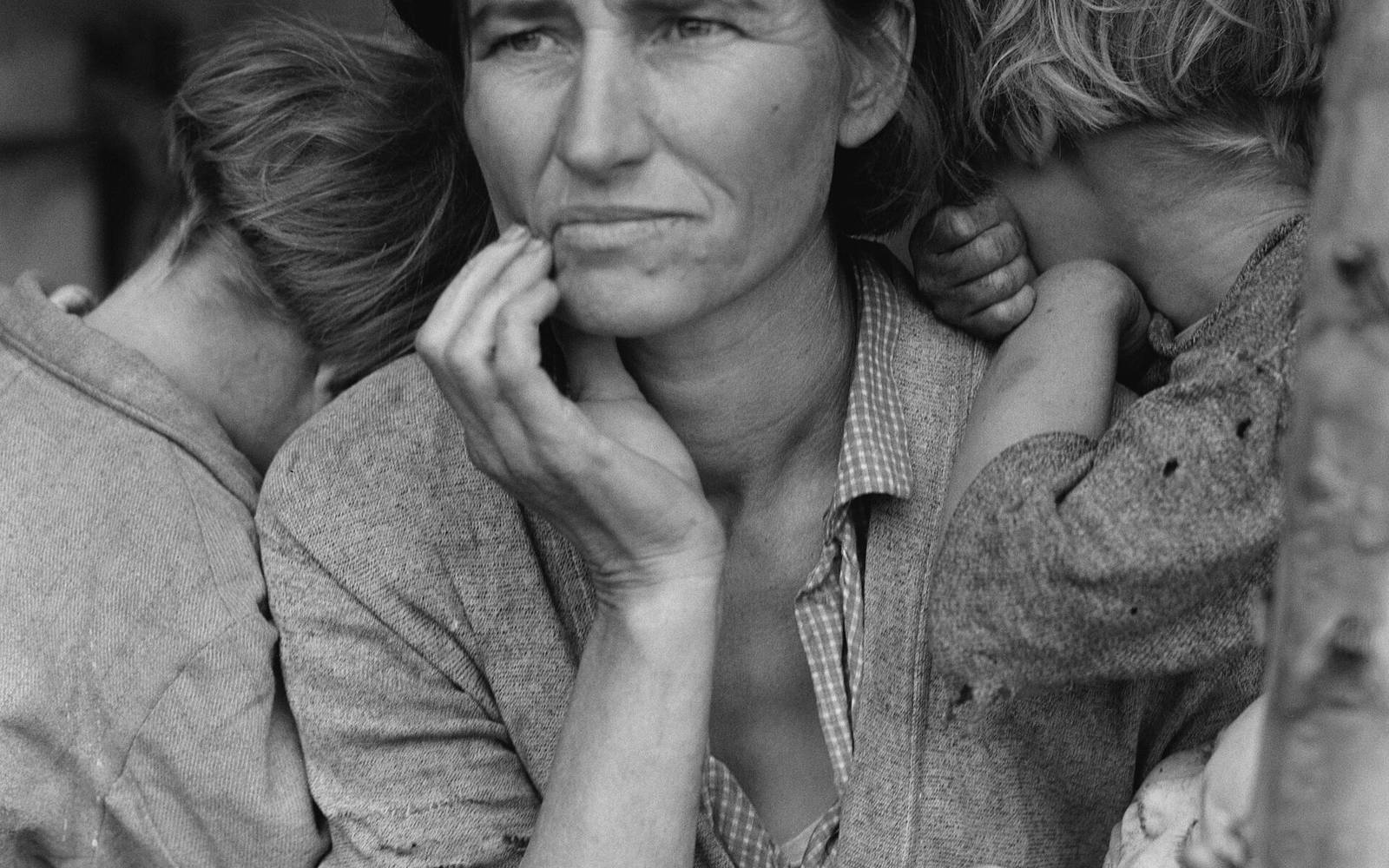
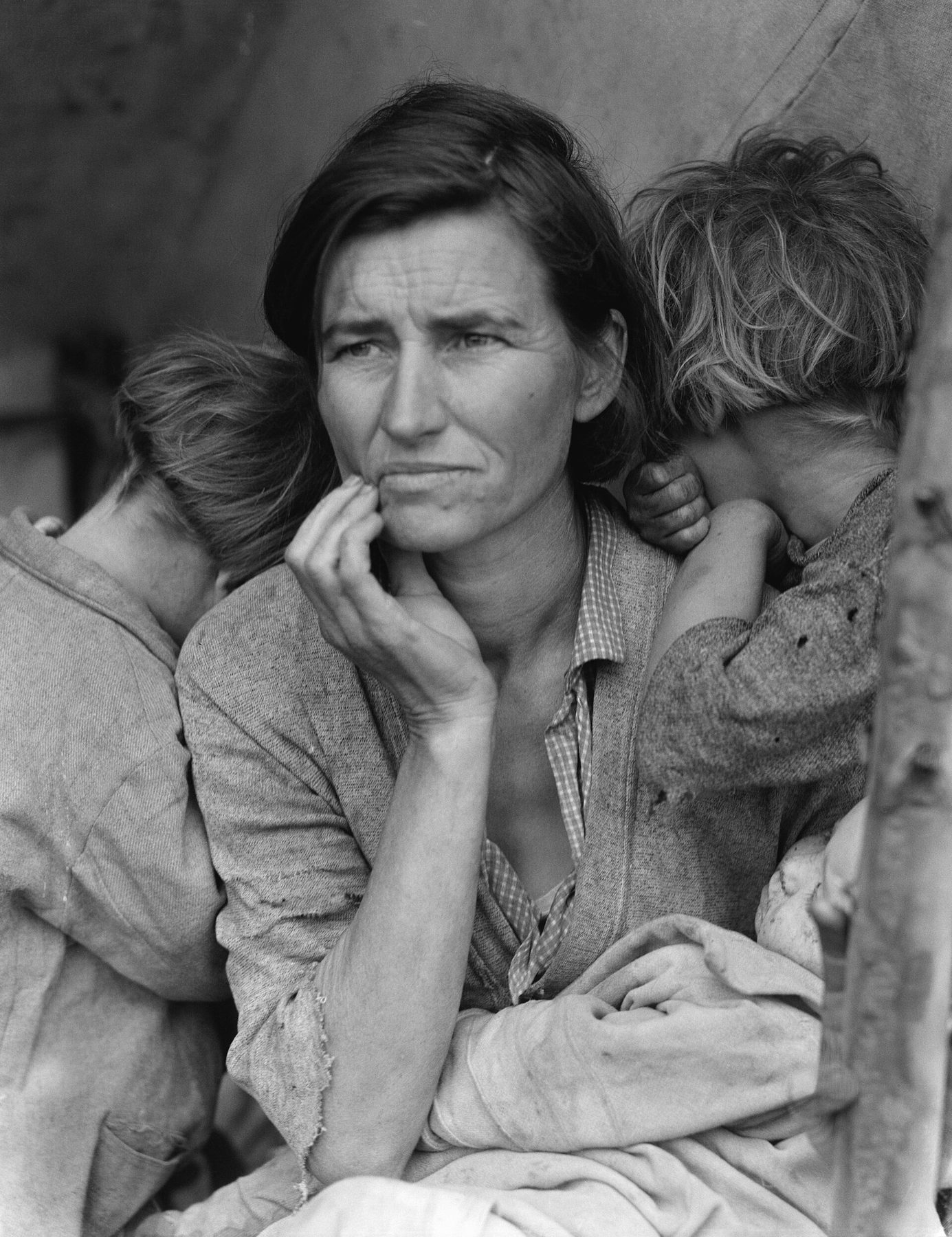
Image reference: Dorothea Lange's Migrant Mother, 1936.
At a Glance
- Core periodApproximately 1929–1945 in the United States, with earlier foundations and continuing legacies
- Principal centresNew York, Chicago, Washington, San Francisco, Mexico City, Berlin and other industrial cities
- Common subjectsLabour, unemployment, migration, housing, healthcare, racial injustice, war and political power
- Important mediaMurals, paintings, prints, posters, documentary photography, magazines and public graphics
- Major institutionsWPA Federal Art Project, Treasury art programmes, RA/FSA photographic unit, community art centres and artists' organisations
- Central questionHow can an artwork make social conditions visible without turning people into symbols of suffering?
Contents
- Where it fits
- Defining the term
- Foundations
- Käthe Kollwitz
- Four stages
- Artists to know
- Essential works
- Photography and witness
- Where to see
- Artist directory
Where Social Realism fits
Käthe Kollwitz
Principal activityDiego Rivera
Principal activityWilliam Gropper
Principal activityBen Shahn
Principal activityDorothea Lange
Principal activityJacob Lawrence
Principal activityCharles White
Principal activityElizabeth Catlett
Principal activitySocial Realism put ordinary life into public argument. Its artists pictured unemployment, dangerous work, racial violence, migration, inadequate housing, political corruption and the strain of raising a family without security. A clinic waiting room or railway platform could become a form of modern history painting when the work connected individual experience to healthcare, labour, law or ownership.
The name does not describe one organisation or a single way of painting. It gathers together representational practices that attend to working-class and poor people's lives while questioning the structures that keep hardship in place.[1] Some artists were Communists or socialists; others supported unions, liberal reform or anti-fascist coalitions; still others resisted a declared programme. They worked in oil and tempera, but also in murals, photographs, lithographs, woodcuts, linocuts, posters and illustrated magazines.
Social Realism is also not the same as Socialist Realism. The latter became the official Soviet doctrine in 1934 and favoured accessible, optimistic images of exemplary workers and socialist development.[2] Social Realists could be bitter, ambivalent and adversarial. Their art might attack a government, expose an employer or refuse the heroic ending that official propaganda required.
The movement's most concentrated American history belongs to the years around the Great Depression and the Second World War. Yet it was never made by the United States alone. Käthe Kollwitz's German prints gave grief and class struggle a powerful public form. Mexican muralists transformed the scale and ambition of US art. Migrant artists and cross-border workshops carried images, methods and arguments in several directions. The field is best understood as a network of conscience, patronage and contested representation.
Foundations: Realism, satire and reproducible form
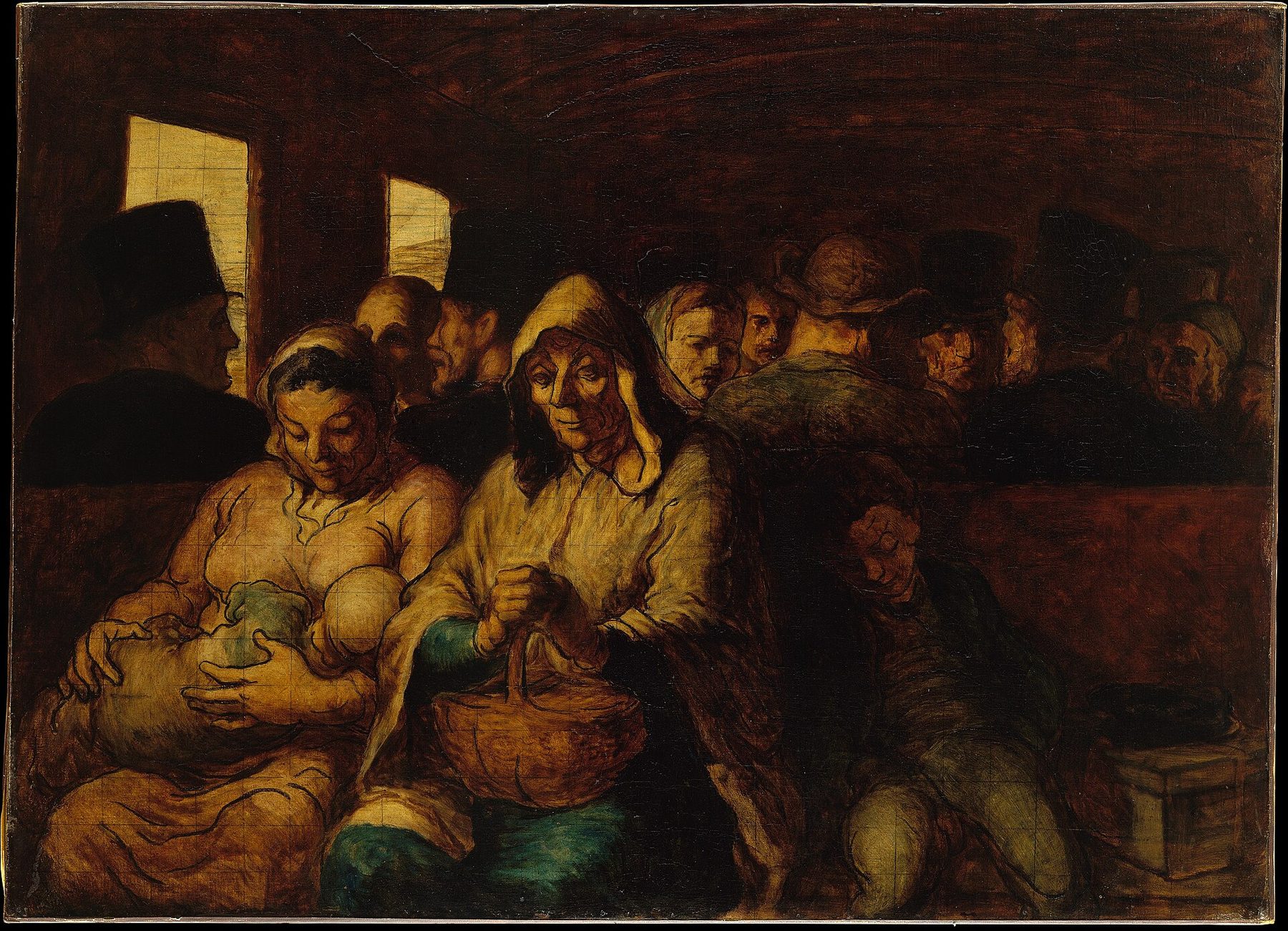
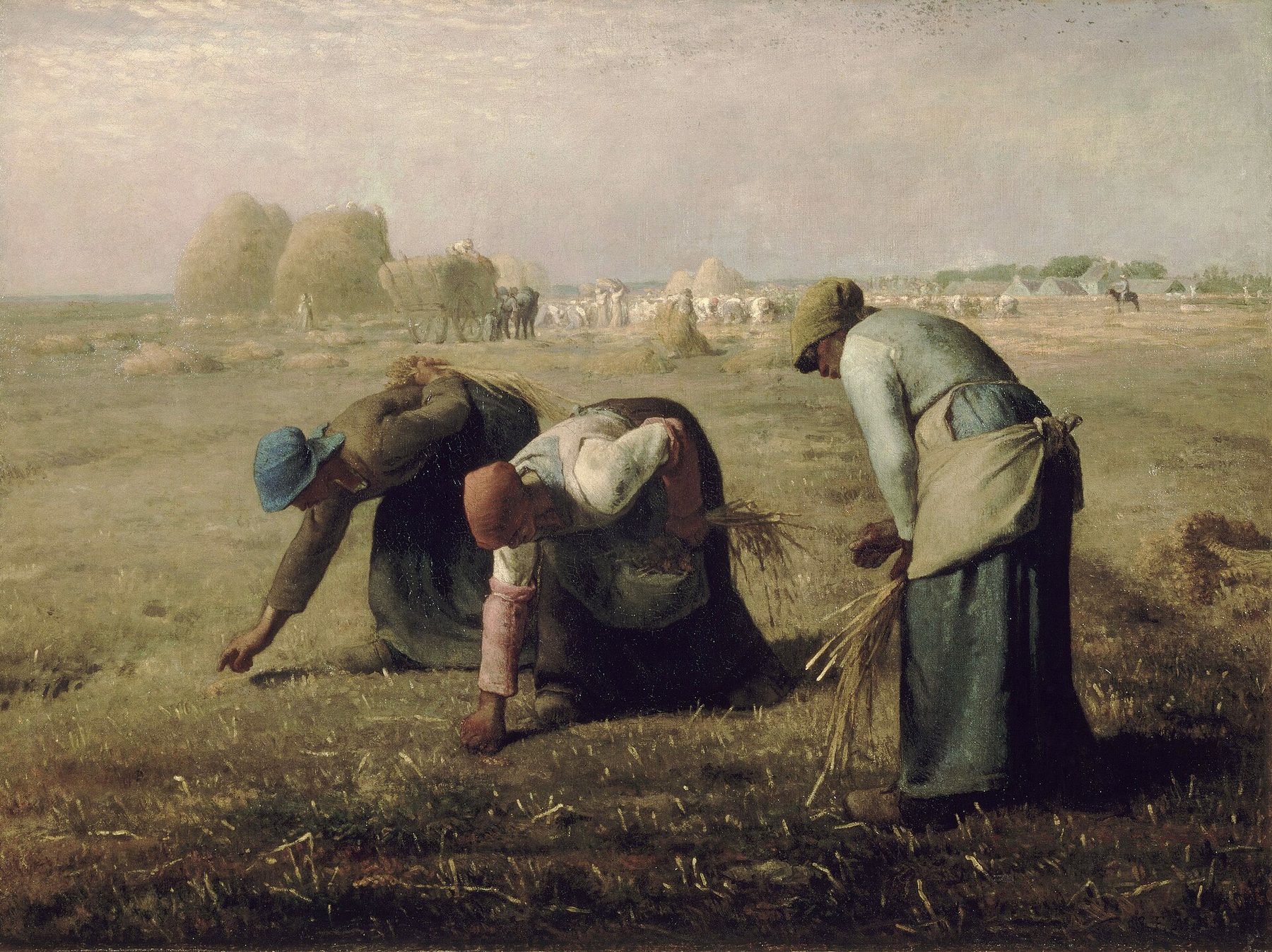
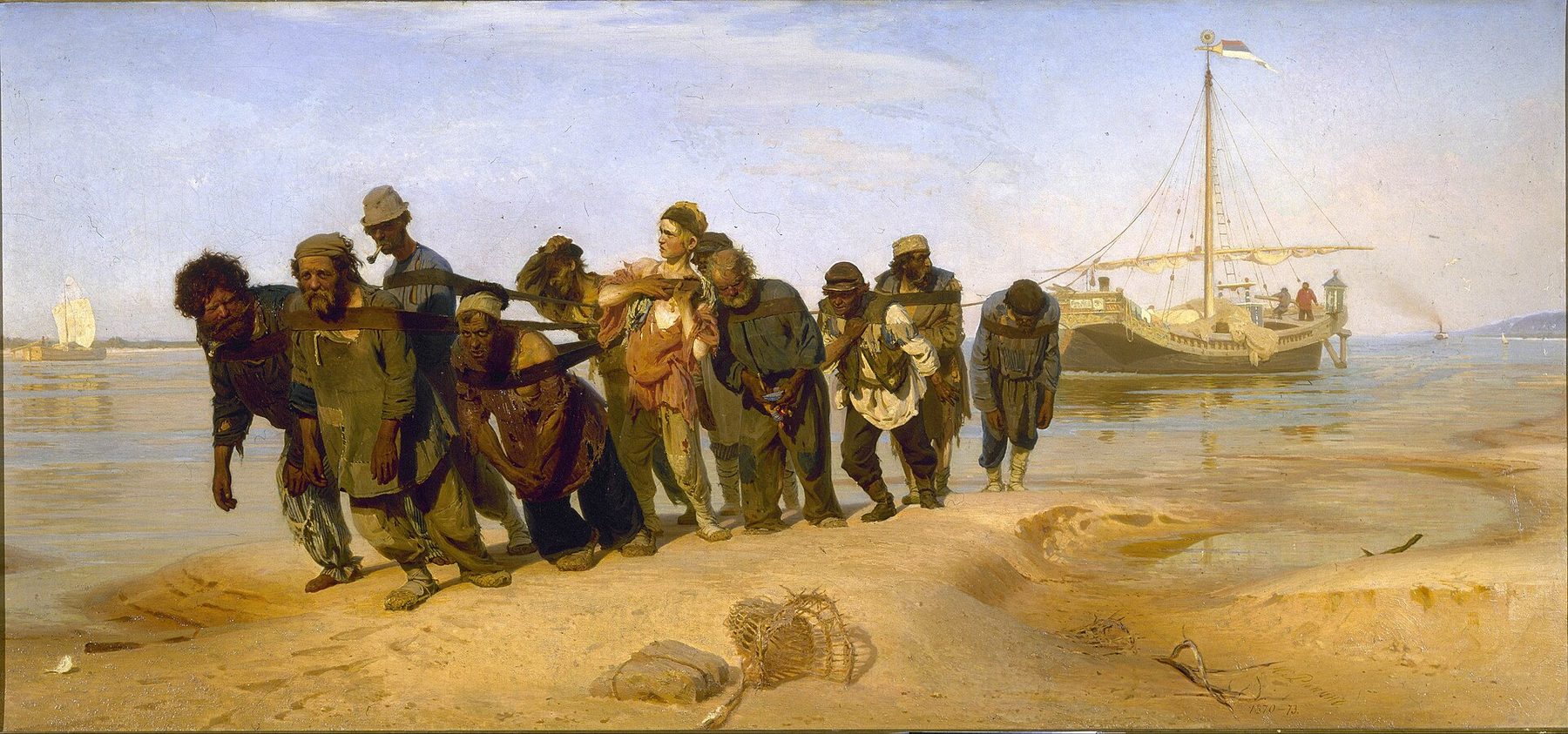
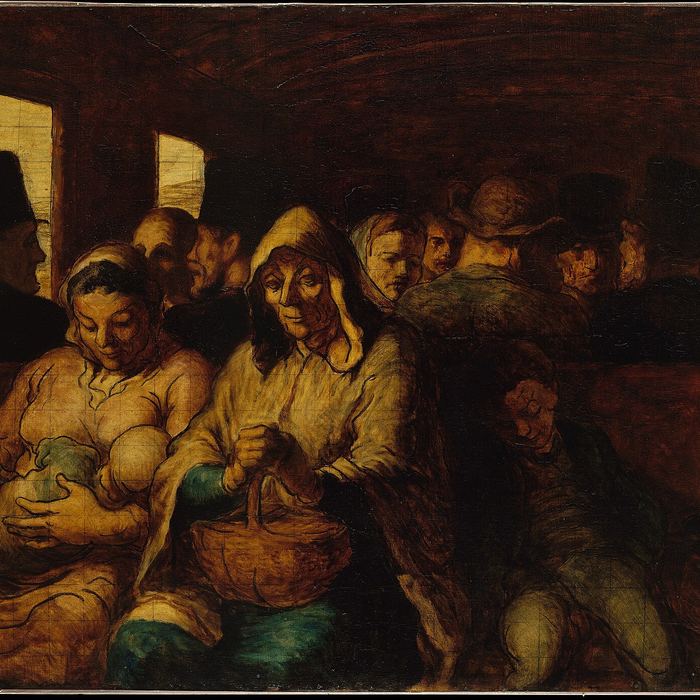
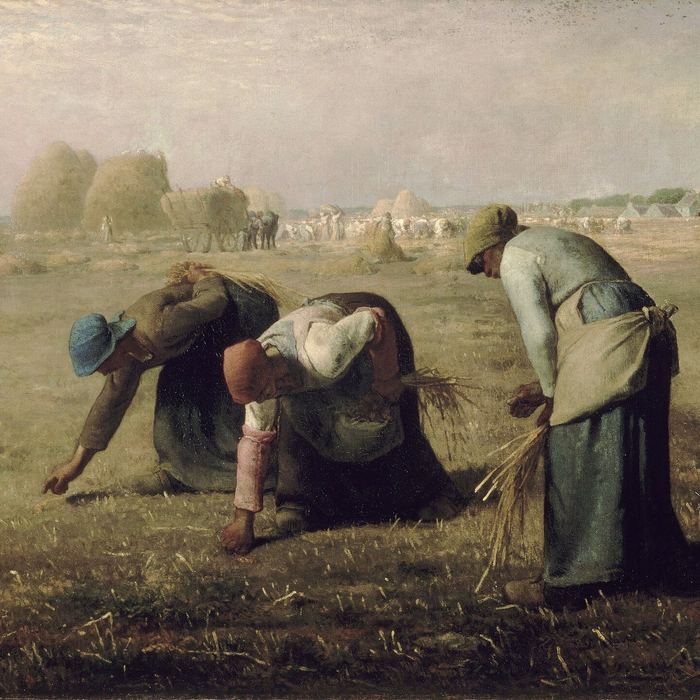
Nineteenth-century artists supplied several lineages. Courbet gave labouring people the scale previously reserved for grand history. Daumier used lithography and caricature to attack political power. Millet made rural work monumental, while Russian critical Realists brought narrative painting into debate about class, law and national life. Ilya Repin belongs to that longer ancestry rather than the Depression-era movement itself.
Reproduction was decisive. A painting might be encountered by a limited exhibition audience, but an etching, newspaper drawing or inexpensive lithograph could circulate through a union hall, home or political magazine. Social and political prints linked older satires to the radical US periodical The Masses, where George Bellows, John Sloan and Stuart Davis contributed images before the First World War.[4]
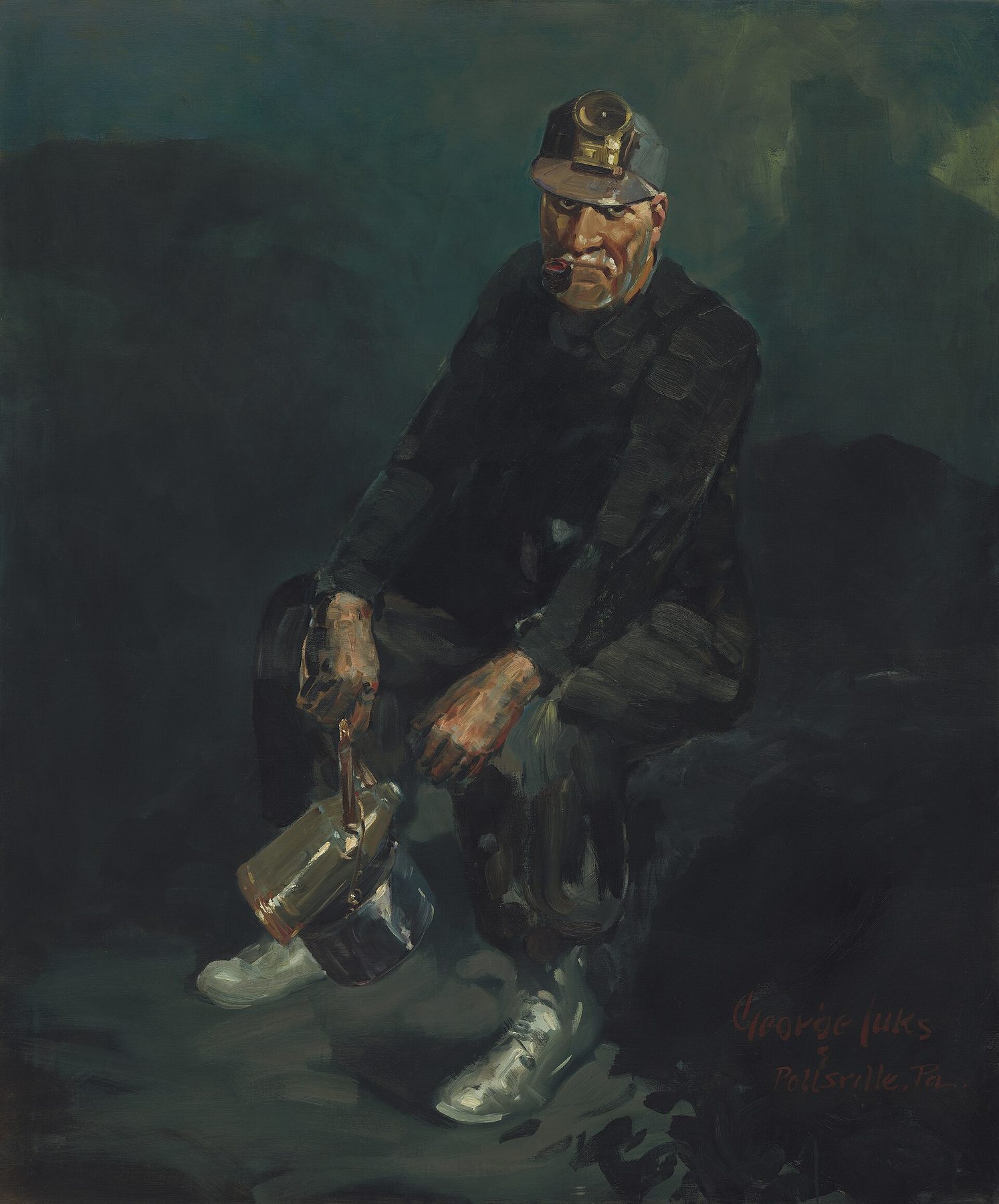
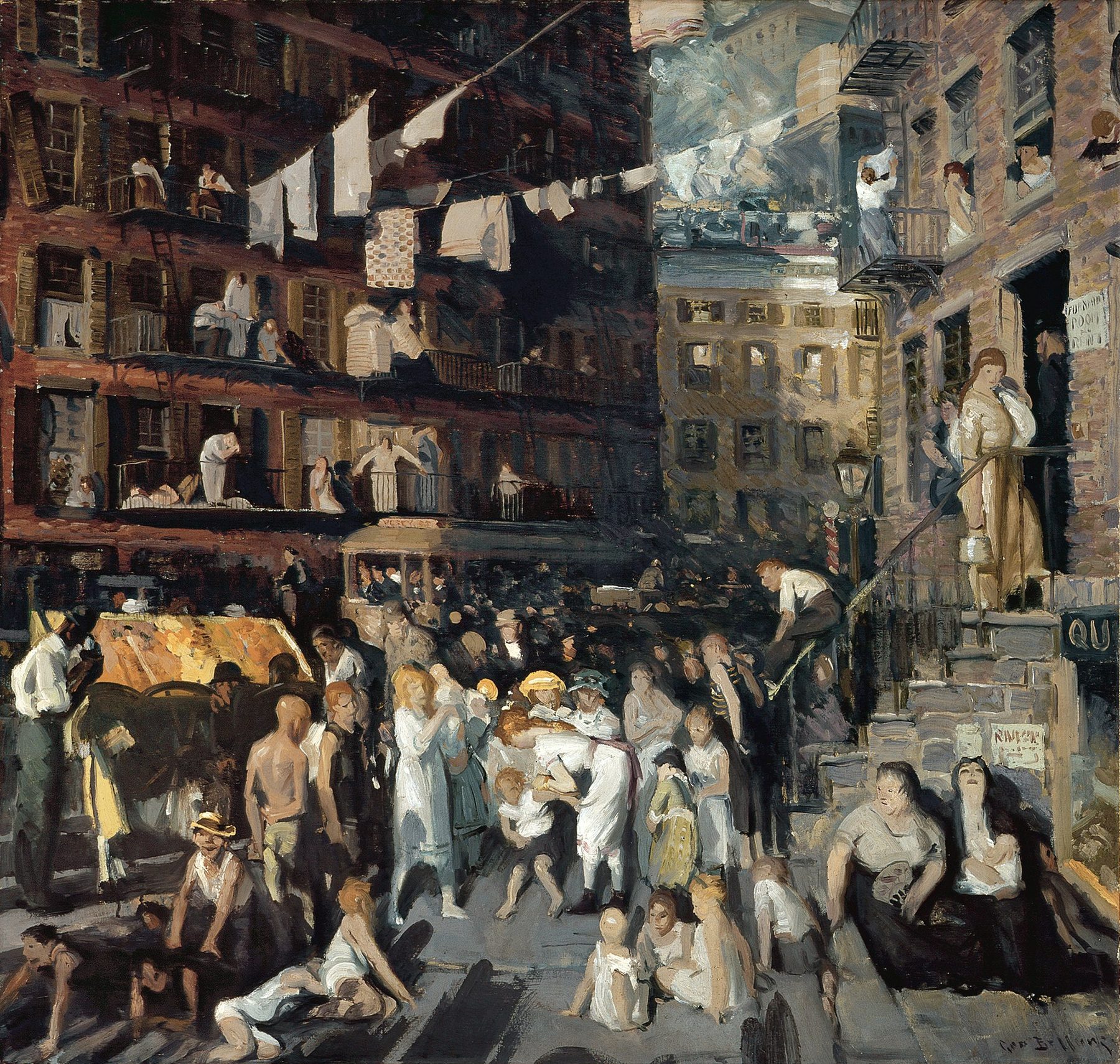
The Ashcan circle offered a nearer American foundation. Its crowded tenements, boxing clubs, street children and working districts challenged genteel exhibition subjects. Yet urban observation did not always equal reform advocacy. George Luks's The Fire Boss shows a coal miner sagging beneath exhaustion, and scholars have disagreed over whether the picture demands change or pursues a severe realism for its own aesthetic force.[47] That uncertainty is useful: subject matter cannot prove intention by itself.
Printmaking made another kind of commitment possible. Strong tonal contrast, compressed bodies and repeatable matrices turned working-class history into portable images. By the 1930s, government print workshops, radical presses and artist-run schools all used this capacity. The movement's public was formed not only in museums but through things that could be carried, posted, mailed, sold cheaply or reproduced again.
Social Realism artists to know
Käthe Kollwitz
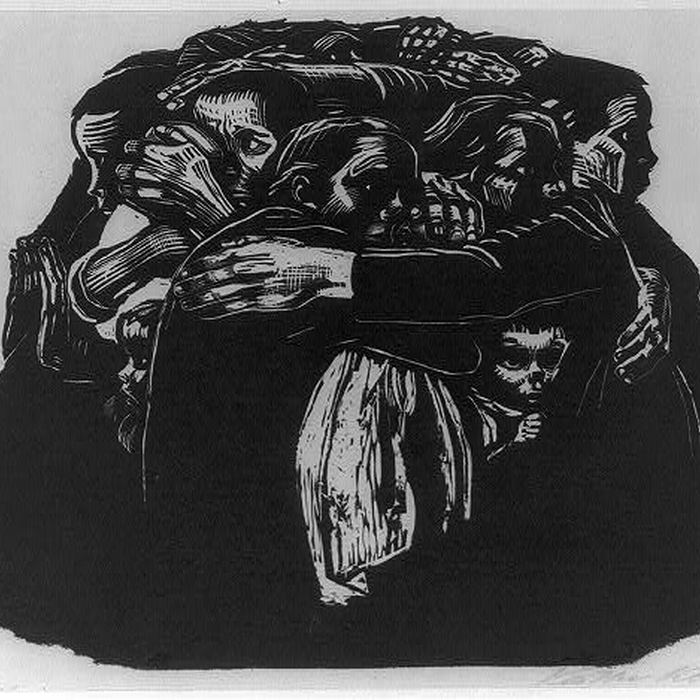
Kollwitz made mourning, hunger, labour and revolt physically immediate through compressed drawing, etching, lithography and woodcut.
Ben Shahn
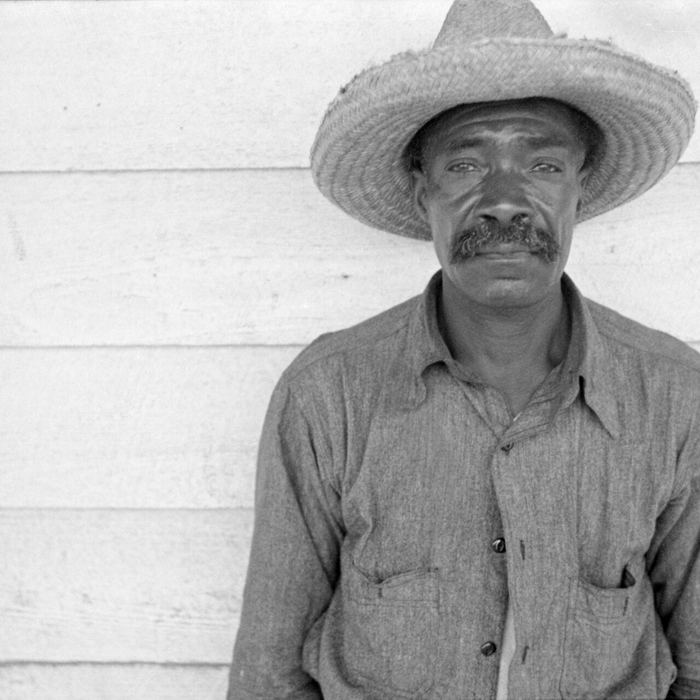
Shahn combined case history, documentary observation, lettering and a deliberately handmade line in images of injustice and public care.
William Gropper
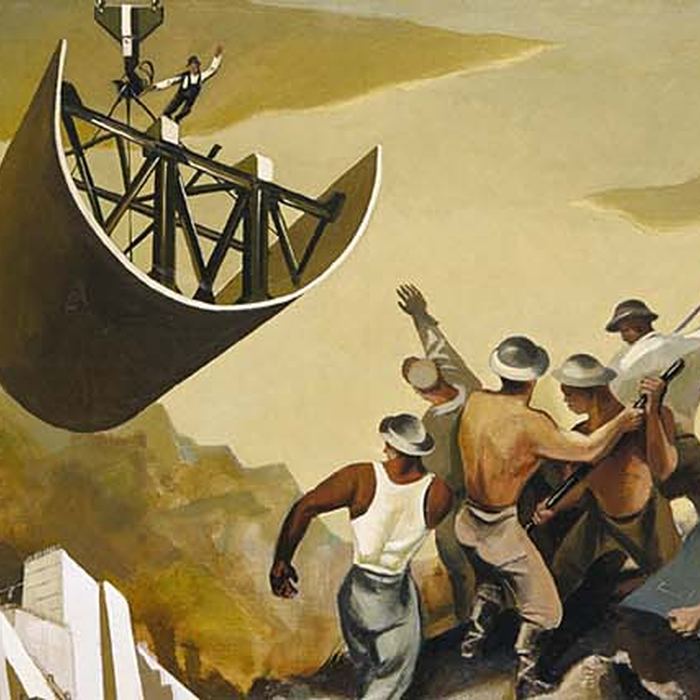
Gropper used caricature against political and economic power while also taking mass labour onto the federal mural wall.
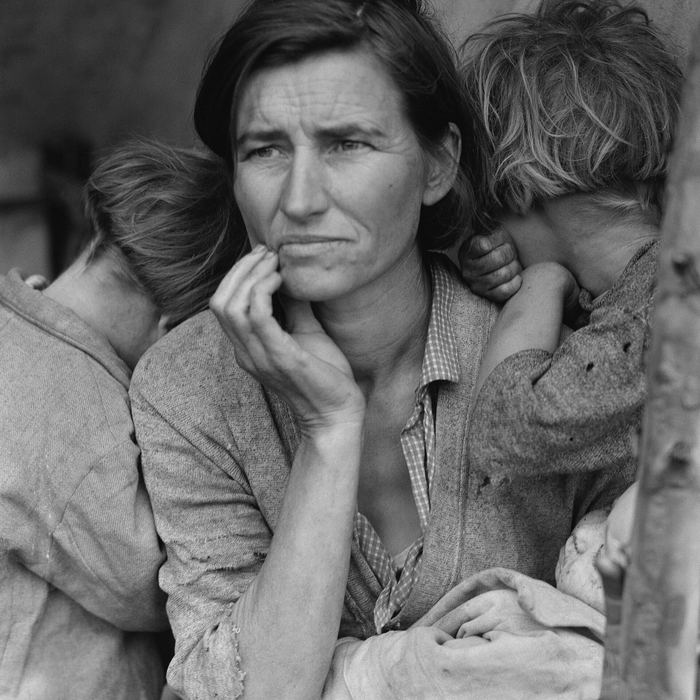
Dorothea Lange
Lange made displacement visible through attentive photographic structure, but captions and circulation also shaped how specific lives became public symbols.
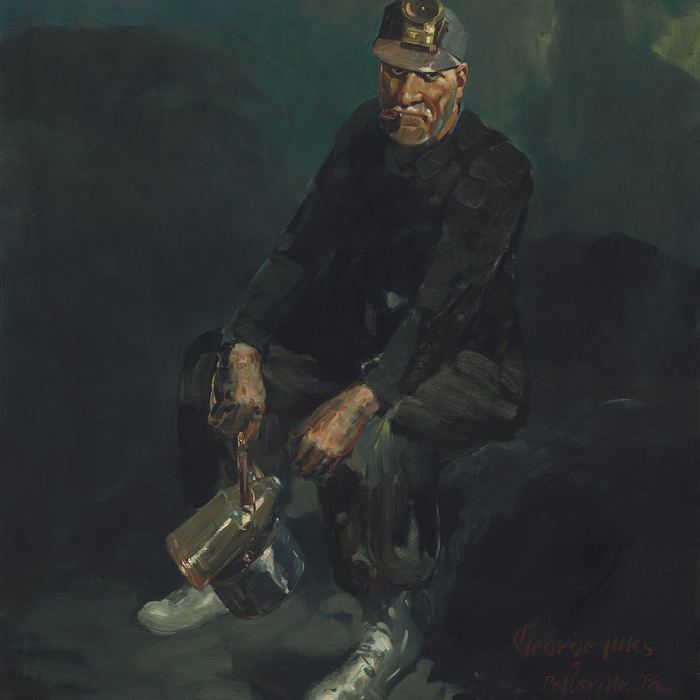
George Luks
Luks brought Ashcan immediacy to crowded streets and labouring bodies, helping establish a forceful American precedent for later Social Realism.
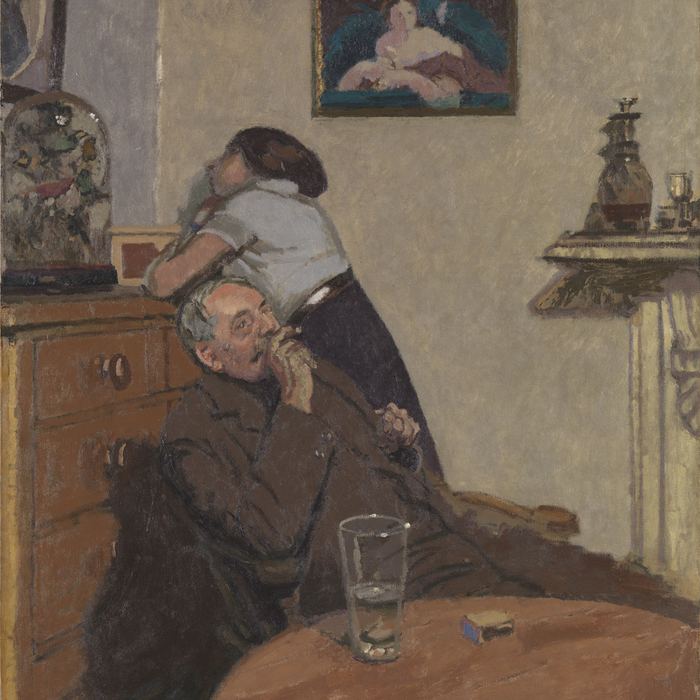
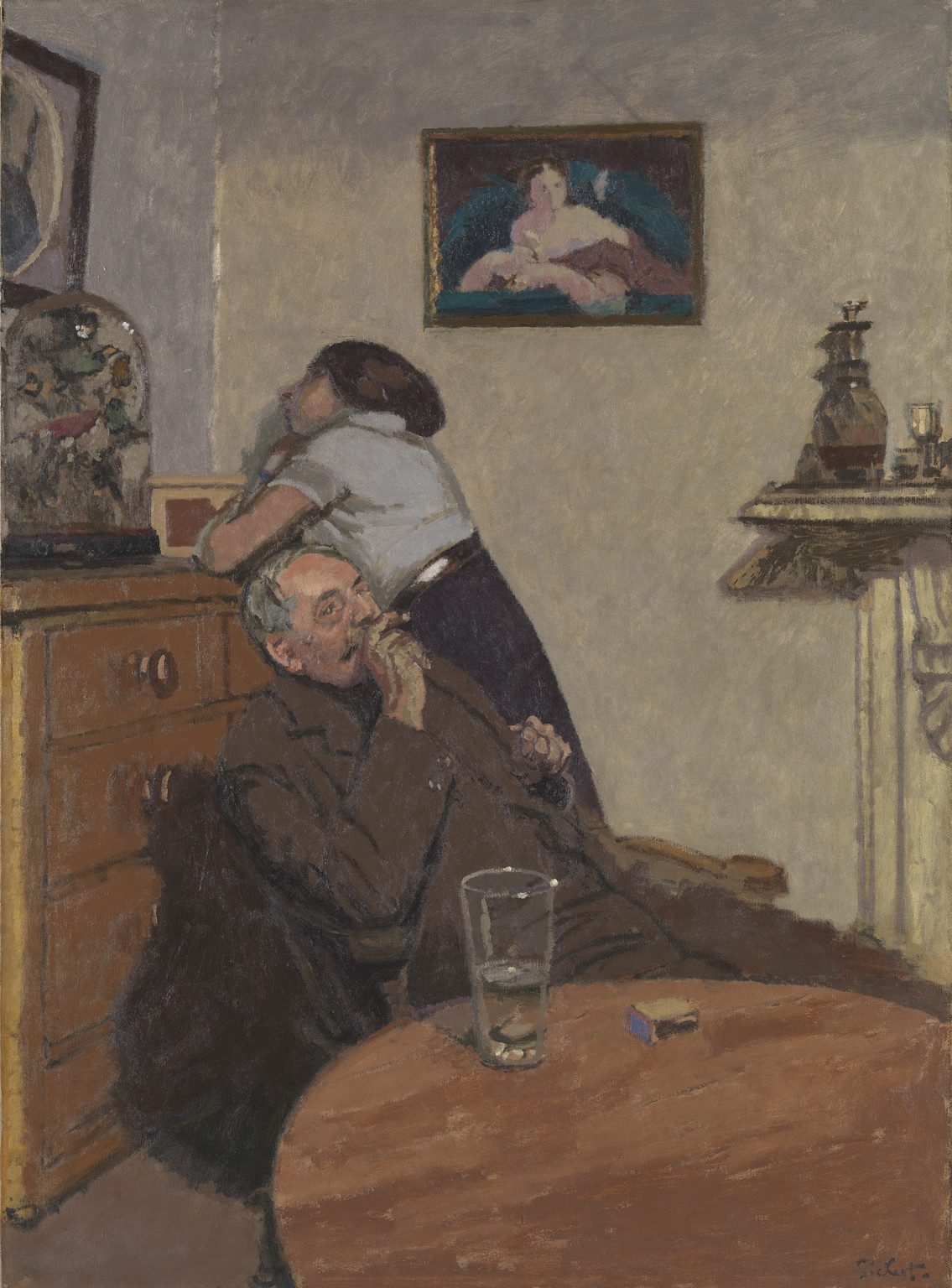
Walter Sickert
Sickert's enclosed rooms and indirect observation show how ordinary interiors could register boredom, repetition and class without declaring a programme.
Käthe Kollwitz: grief becomes collective resistance
Käthe Kollwitz created one of the movement's most important transnational foundations. Her husband's medical practice in a working-class Berlin district brought her into contact with women, labourers and families living under pressure. She did not simply record patients. She developed a graphic language in which hands, bent backs, darkness and shared physical weight could communicate conditions beyond one biography.[18]
Her early cycle A Weavers' Revolt grew from Gerhart Hauptmann's drama about the 1844 Silesian uprising. Peasants' War looked further back to sixteenth-century revolt but made exploitation and defeat urgent for modern viewers. The Prisoners compresses bound bodies into a pen so tightly that individuals almost fuse into one mass. The enclosure signals defeat, while the collective bodily force leaves open a memory of resistance.[22]
Kollwitz changed technique as her purposes changed. Etching and aquatint allowed dense atmosphere and tonal transition; lithography could make drawing direct; woodcut reduced a scene to blunt relations of black and exposed paper. The development was not a simple shedding of detail toward modernity. Each process altered how suffering could be encountered and reproduced.[23]
War, 1921–22, published 1923
The seven woodcuts of War refuse the conventional spectacle of battle. The portfolio moves through sacrifice, volunteers, parents, widows, mothers and the people. Combatants scarcely appear. Civilian bodies and those left behind carry the history.[19]
The change was personal and political. Kollwitz's younger son Peter volunteered in 1914 and died shortly afterward. In The Parents, two adults fold toward each other into an almost indivisible dark block. Their faces are buried; the woodcut offers no consoling portrait of patriotic sacrifice. She circulated the series through German cities as testimony against war, moving private bereavement into collective address.[20]
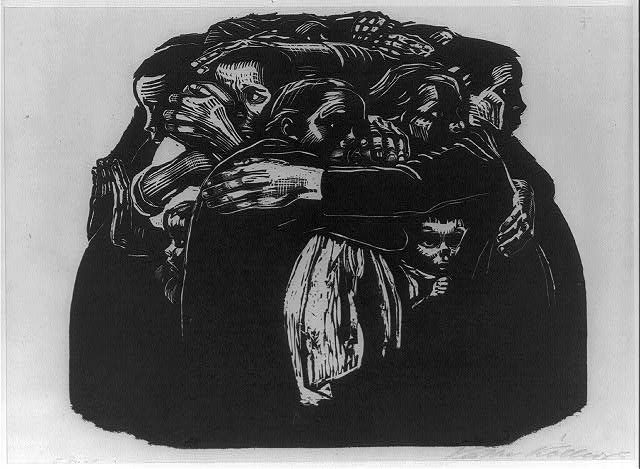
The Mothers creates a different structure. Women lock arms around children, their broad hands visible as barriers and supports. One adult looks outward while the others turn inward, producing both vigilance and shelter. The group does not attack, but it actively refuses another surrender of the young.[21] Black areas make the bodies seem besieged; white cuts reveal faces and fingers as points of life inside the mass.
Calling this work “universal” can honour its emotional reach while erasing its particular conditions. Kollwitz made it from German defeat, hunger, political rupture and her own loss. She also brought women's experience into antiwar art without reducing women to passive mourners. Protection becomes a political action.
Her career crossed the periods later divided into Expressionism, New Objectivity and Social Realism. German records trace her from the Weavers and Peasants' cycles through election as the first woman admitted to the Prussian Academy of Arts and eventual removal under Nazi rule.[24] She is best treated as a major independent artist whose example made socially committed representation possible across borders.
Mexican muralism changes the public scale
After the Mexican Revolution, government commissions placed national history and everyday life across the walls of schools and civic buildings. Murals addressed viewers who did not need to enter a private gallery or buy a canvas. They made peasants, workers, Indigenous traditions, revolution and industrial change subjects of monumental art.[26]
Diego Rivera, José Clemente Orozco and David Alfaro Siqueiros spent substantial periods in the United States between the late 1920s and 1940. US artists travelled south, assisted on projects and absorbed different lessons. Rivera offered large, interdependent worker bodies and panoramic historical sequence. Orozco's tragic view of history resisted uncomplicated heroism. Siqueiros joined militant politics to experimental materials, projection, photography and collective methods.[25]
This exchange changed US Social Realism. Artists shaken by the Depression saw a model of art that was modern, politically consequential and publicly legible without depending upon Parisian avant-garde authority. Ben Shahn worked with Rivera; Charles White and Hale Woodruff used mural history to centre Black emancipation; Jacob Lawrence found ways to compress epic sequence into a portable series.
The relationship was never simple copying. The Abelardo L. Rodríguez Market in Mexico City brought Mexican and US artists into one civic complex of market, childcare, theatre, health and education. Its murals addressed food production, hygiene and exploitation, and several US participants rejected affirmative themes for more direct accounts of agricultural and urban injustice.[28] Public art was already a place of disagreement.
Mexican muralism also has its own postrevolutionary institutions, nationalism and contested representations of Indigenous people. It should not be reduced to an influence that becomes important only after reaching the United States. Rivera's Dream of a Sunday Afternoon in Alameda Central, for example, remains embedded in Mexican public memory, museum history and preservation.[50] A later dedicated account can give that movement its full depth.
Follow social realism through four stages
–1928
Realist foundations and public print culture
Daumier, Millet, Repin, the Ashcan painters and Kollwitz make class, labour, urban life and collective grief central to modern representation.
–1933
Depression turns representation into public argument
Economic crisis intensifies pressure for accessible art about unemployment, hunger, corrupt authority and organised resistance.
–1939
New Deal programmes and documentary networks
Federal patronage, public walls, print workshops and FSA photography create new audiences while Mexican muralism reshapes scale and historical ambition.
–1945
Black history, anti-fascism and wartime change
Serial history painting, community institutions and anti-fascist work extend the movement before mobilisation and Cold War pressure transform its public conditions.
Depression, New Deal and the contested public wall
The 1929 crash intensified conditions that had longer histories: unequal wages, racial segregation, insecure tenancy and dangerous industrial work. Bank failure, unemployment, eviction, drought and falling agricultural prices made abstraction from social structures difficult. Artists pictured breadlines, ruined fields, temporary camps, idle machinery and people waiting.[5]
Federal patronage changed who could continue working and where art appeared. The Public Works of Art Project operated only from late 1933 into 1934, employing thousands to create recognisably American subjects for public buildings.[6] In 1935 the Works Progress Administration established Federal Project Number One, including the Federal Art Project. Its Graphic Art Division made prints, while other units supported murals, easel paintings, sculpture, teaching and community art centres.[8]
The familiar phrase “WPA mural” can be inaccurate. The Treasury Department's Section of Painting and Sculpture usually selected artists through competitions for federal buildings, while the WPA/FAP was founded as relief employment and administered through different offices. The programmes overlapped in time and public purpose but followed distinct procedures.[9]
Government art was not synonymous with Social Realism. Commissions included Regionalist landscapes, celebratory histories, abstract experiments, portraits, craft and design. The American Scene could mean optimism and civic endurance as readily as critique. Smithsonian collections preserve both the hardship of the Depression and affirmative images of work, land and community.[7]
Artists as workers
Federal employment made the artist a worker paid to make something for collective use. That idea carried democratic promise: schools, post offices and community centres became exhibition sites, while audiences previously excluded from museums encountered art. It also created administrative power over subject and design.
Artists negotiated sketches, architectural dimensions and approval. Communities sometimes welcomed workers represented at public scale and sometimes rejected painful or radical imagery. Fletcher Martin's proposed Mine Rescue was praised for its Social Realist design but opposed by residents who associated it with local deaths. Officials ultimately required a more reassuring replacement.[10] Public access did not guarantee public agreement.
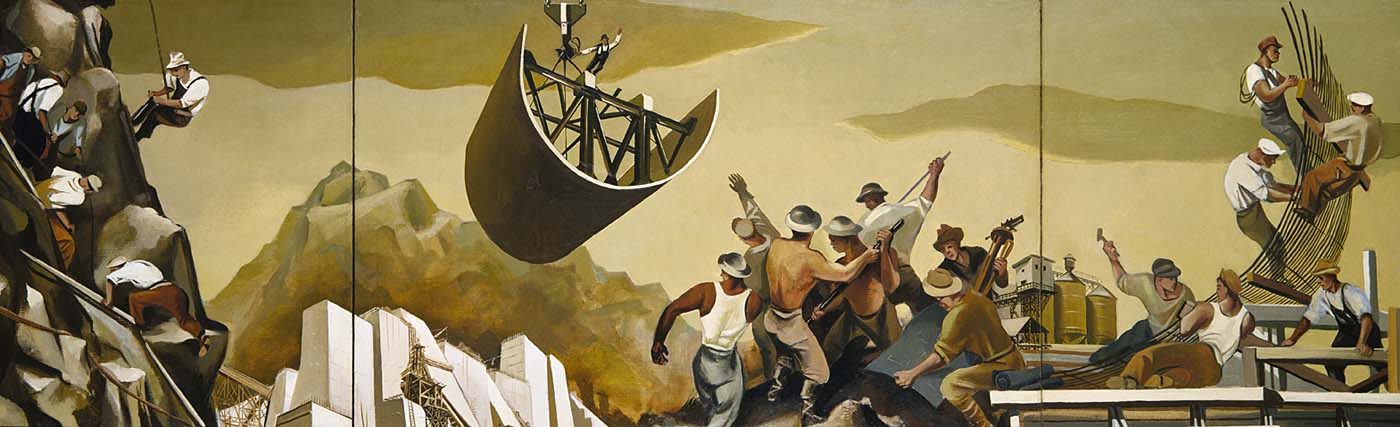
William Gropper's Construction of the Dam takes a divided government-building wall as its organising problem. Across three sections, labourers guide massive conduit, crane and concrete. Angled bodies echo machinery, but the workers' reliance upon each other's signals prevents them from becoming anonymous parts. In the finished mural, a red handkerchief offered a discreet political sign within an approved account of national construction.[43]
Posters reached another audience. WPA divisions advertised health campaigns, theatre, education, tourism, exhibitions and community events. Silkscreen and lithography encouraged flat colour, bold type and rapid reading; Bauhaus-derived design could coexist with folk imagery and direct public instruction.[12] Social communication did not require sombre realism.
Federal programmes also contained inequalities. Women and Black artists found employment and built institutions, but opportunities, pay, supervisory roles and representation were uneven. Community art centres in Harlem and elsewhere widened access while operating inside a segregated society. The New Deal created infrastructure, not equality completed by decree.
Ben Shahn: the case, the camera and the clinic
Ben Shahn's career makes the movement's media boundaries impossible to maintain. Born in Kovno and brought to the United States as a child, he apprenticed to a commercial lithographer. Letterforms, inexpensive print and irregular handmade line remained central as he moved among painting, photography, murals and posters.[30]
The Passion of Sacco and Vanzetti, 1931–32
Nicola Sacco and Bartolomeo Vanzetti were Italian immigrant anarchists convicted of murder and executed in 1927 after a case that provoked international protest. Shahn did not reconstruct the entire trial illusionistically. He selected witnesses, officials, coffins and architectural fragments, using repeated faces and spare settings to build an accusation.[33]
In the best-known panel, three members of the official committee stand above the coffins. Their elongated bodies and clasped flowers parody solemn civic virtue. The dead men become horizontal presences below a vertical architecture of authority. Shahn's awkward contours are not deficient academic drawing; they remove polish from the officials' performance and make judgement visible.
The series established his public reputation and attracted Rivera, who employed him during the Rockefeller Center project. Rivera's mural practice affected Shahn's later work at Roosevelt, New Jersey, but Shahn retained the intimate scale, documentary shard and brittle outline developed through prints and tempera.[29]
The camera as notebook and encounter
In 1935 Shahn travelled through the South and Midwest for the Resettlement Administration. He photographed cotton pickers, signs, porches, auction gatherings and families. Rather than hunt only for one self-contained masterpiece, he often moved through a situation in sequences—establishing view, group, face and detail—as if constructing a film.[14]
The photographs altered his knowledge of the country. They also entered paintings, posters and government publications. His later description of the project as having a moral purpose centred on people rather than soil-policy diagrams captures both the strength and risk of Social Realism: individual experience could make policy visible, but it could also be recruited to persuade an audience.
Prenatal Clinic, 1941
Two women in domestic-service uniforms sit apart in an institutional waiting room. Cold green tiles and hard benches deny comfort. Neither woman performs dramatic suffering, yet the distance between their bodies makes waiting feel isolating. A poster asks whether prenatal care is deserved, turning the room itself into a question about public worth.[5] [32]
The image connects race, gendered labour and healthcare without a crowd, strike or caricatured villain. Institutional neglect is built into colour, posture and spacing. Shahn's social argument is strongest precisely because the women remain absorbed in their own time rather than arranged to plead with the viewer.
Shahn later preferred the phrase “personal realism” for his changed practice. His continued posters and prints show that political attention did not end when the 1930s label became inadequate.[31] Social Realism was a formative method, not a cage capable of containing his whole career.
Documentary photography and the politics of witness
The Resettlement Administration and Farm Security Administration photographic unit made one of the era's largest visual records. Under Roy Stryker, photographers documented farm tenancy, migration, labour, housing, drought and eventually wartime life. The agency and its successors produced an archive whose scale changed the public image of the Depression.[13]
These photographs were evidence, art and advocacy at once. They helped justify programmes and gave editors images suitable for newspapers, magazines, exhibitions and reports. A 1938 international photographic exhibition assembled work by Lange, Shahn, Walker Evans, Arthur Rothstein, Russell Lee and Theodor Jung around rural workers, migrants, miners and families.[15]
Institutional direction does not make the pictures false, but it makes “document” a process rather than a guarantee. Photographers selected subjects and vantage points. Stryker's office organised files and captions. Editors chose sequences and crops. Some images were directed or altered for stronger effect. National Archives interpretation rightly notes both their exposure of hardship and their artistic and political manipulation.[11]
Migrant Mother, 1936
Dorothea Lange's famous photograph is usually seen alone: Florence Owens Thompson faces away from the camera while two children turn inward at her shoulders and an infant rests in her lap. The group forms a tight triangle. Thompson's hand touches her face, making thought and worry visible without theatrical gesture.
The image was one exposure in a sequence. Earlier frames place the family differently and include more surrounding information. Lange moved closer, gradually excluding the camp and concentrating attention on the mother's face and the children's dependence.[17] The celebrated composition was achieved through encounter and selection, not discovered as an untouched symbol waiting in nature.
Knowing Thompson's name matters. Later research has reconstructed more of the family's life and responses, challenging the generic title through which one woman came to stand for millions.[16] The photograph aided public recognition of migrant hardship, yet the subject did not control its fame or receive the cultural value created around her likeness.
Ethical looking does not require rejecting the image. It asks the viewer to hold its formal power, public effect and unequal authorship together. The sequence restores choices; the name restores a person who exceeds the icon.
Jacob Lawrence: migration as modern history painting
Jacob Lawrence was twenty-three when he completed sixty small casein-tempera panels about the Great Migration. He researched in Harlem's library, listened to family and neighbours whose lives had been shaped by movement north, and wrote captions before painting. His subject was historical, communal and personally adjacent without being autobiographical illustration.[34]
Lawrence spread every panel across his studio and applied one limited colour at a time throughout the series. That method created continuity: ochres, greens, reds, blacks and blues recur like themes in music. He considered the cycle one work, not sixty detachable pictures.[34]
Panels 1 and 13
Panel 1 begins inside a station. A crowd presses toward three ticket windows marked Chicago, New York and St Louis. Faces are reduced, but bodies differ in angle and direction. Luggage and signs make movement legible, while repeated railway imagery establishes the rhythm that returns across the cycle.[36]
The composition transforms demographic change into organised pressure. The destinations promise work and possibility, but the crowd's compression refuses an easy story of individual choice. People leave within systems of war industry, racial terror, labour demand and information carried through letters and networks.
Panel 13 removes the crowd. Dry fields lie beneath diagonal rays of heat; parched plants and thinly painted earth describe labour no longer sustained. Rough gesso remains visible beneath quick casein strokes.[37] Economy of means carries both environmental and economic information. Absence itself becomes historical evidence.
Across the full series, southern injustice gives way not to uncomplicated northern freedom but to industrial work, housing scarcity, segregation, education, worship, voting and racial violence. Adversity alternates with agency. The final return to migration prevents the story from closing.[35]
Its scale is conceptually monumental but physically intimate. Lawrence absorbed the narrative ambition of Mexican murals and transformed it into portable panels whose rhythm resembles film, illustrated books and serial print culture. The cycle entered Fortune magazine and was divided between MoMA and the Phillips Collection, becoming an early landmark acquisition of work by a Black artist.[35]
Black history, community institutions and print networks
Lawrence's achievement emerged from institutions built within Harlem. He studied through community workshops associated with Charles Alston and Augusta Savage, used the Schomburg collection and received WPA employment. Before Migration, he made historical cycles on Toussaint L'Ouverture, Frederick Douglass and Harriet Tubman.[38] Research was a form of claiming access to history.
The Harlem Renaissance and Great Migration established creative communities before the Depression, while New Deal centres provided classrooms, employment and exhibition during the crisis. Federal support helped, but Black artists and organisers had already built networks and continued to negotiate segregation within national programmes.
Charles White made public history central to his practice. His 1939–40 mural Progress of the American Negro assembled Sojourner Truth, Frederick Douglass, Booker T. Washington, Marian Anderson and George Washington Carver for a community-centre fundraiser. Mexican muralism offered a model of art “for and about the people,” but the content rebuilt US national history around Black resistance and achievement.[39]
White later worked through WPA programmes, created another historical mural at Hampton Institute and printed at Mexico's Taller de Gráfica Popular. He described himself as a spokesman, a position grounded in responsibility to a community rather than the artist speaking abstractly for “the poor.”[40]
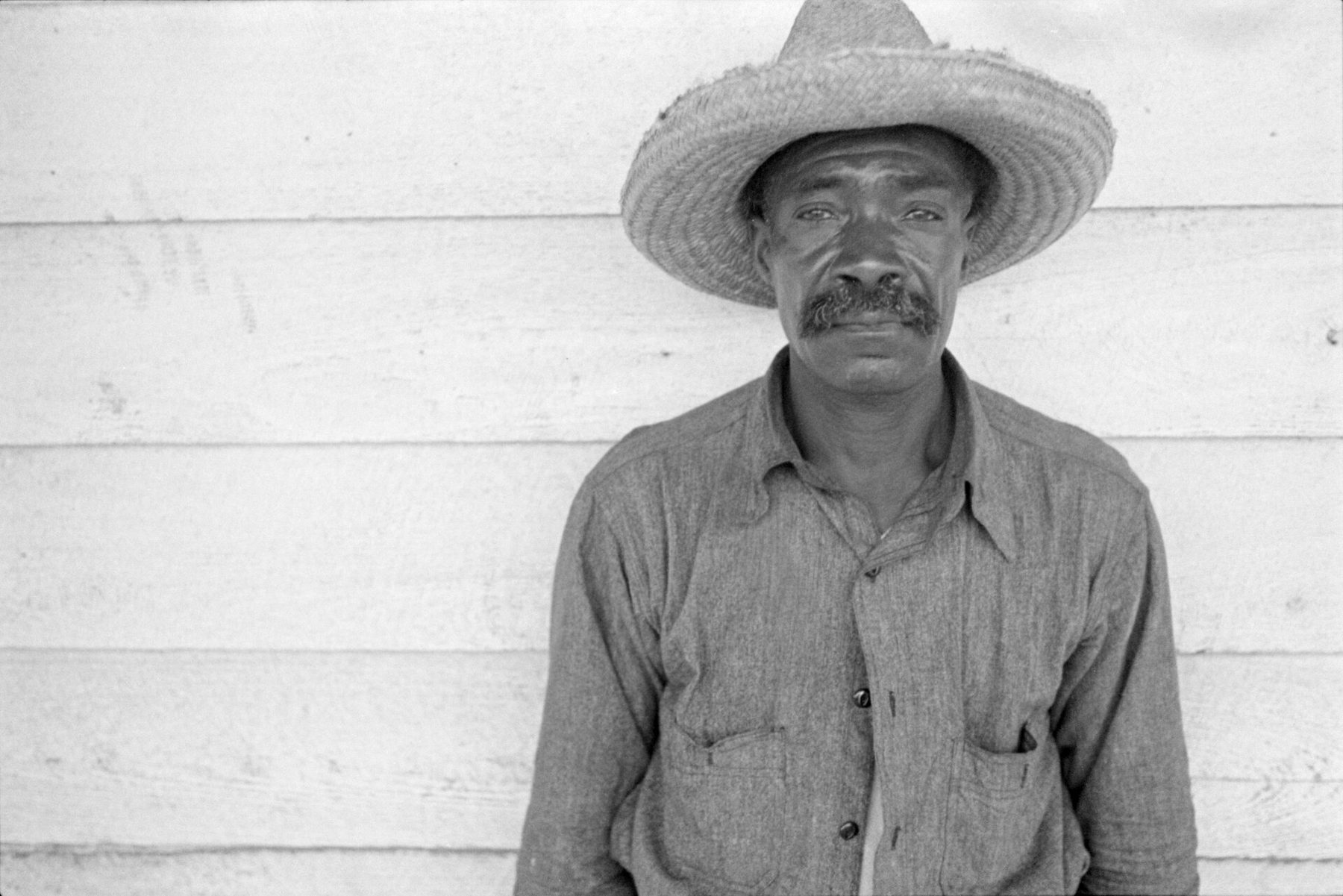
Elizabeth Catlett brought gender and transnational printmaking into the same argument. Sharecropper gives one Black woman monumental presence. A broad hat frames a weathered face; cut lines register age, sunlight and labour. The sitter's clothing is patched, yet her upward angle and close scale resist pity.[41]
Catlett developed the image after moving to Mexico and working with the Taller de Gráfica Popular. Linocut made bold contrasts and repeatable editions possible. The work addresses an exploitative US agricultural system through a Mexican collective print tradition, demonstrating that Social Realism crossed borders through workshops as well as famous murals.
Aaron Douglas and Hale Woodruff likewise reworked monumental narrative. They treated enslavement, emancipation, education and resistance as central national history, not special-interest additions. Whitney research on “epic histories” shows how Black artists adapted the muralists' public scale to construct collective identities from histories of oppression and liberation.[27]
City crowds, quiet observation and corrosive satire
Depression cities generated distinct forms of looking. Reginald Marsh filled The Bowery with unhoused men, commercial signage and the elevated railway. A brown palette and tempera medium evoke older painting, while the crowd's compressed rhythm turns a modern street into a frieze of economic displacement.[45] His work is observant, theatrical and sometimes voyeuristic; social subject does not guarantee solidarity.
Raphael Soyer preferred quieter encounters. Office workers, dressmakers, unemployed men and studio visitors inhabit spaces of waiting and fatigue. His paintings rarely announce a political programme, but their sustained attention to women at work and Depression-era New York reveals social reality without caricature.[46] The category must have room for observation that is critical through patience.
Edward Hopper shares subjects of urban solitude, commercial space and insecure modern life. He is better treated as a neighbouring American realist than enrolled automatically as a Social Realist. Isolation in a room can carry social meaning without proving an organised commitment to reform.
Walter Sickert supplies a British precedent. In Ennui, a man and woman occupy the same domestic interior without sharing attention. Heavy furniture, enclosed space and repetitive life make boredom almost architectural.[48] Sickert influenced Camden Town and the Euston Road School, but his indirect politics distinguish him from Depression activists.
Satire is less patient. William Gropper, the son of garment-district workers, drew for newspapers and radical journals including The Masses, The Liberator, Freiheit and the Daily Worker. His officials and wealthy men swell into grotesque systems of appetite. The distortion belongs to a tradition of Daumier-like attack rather than neutral reportage.[42]
Jack Levine's The Feast of Pure Reason sets a politician, policeman and affluent man into a corrupt communion. Thick, unsettled paint and old-master darkness make authority appear physically decayed. German Expressionist influence and caricature coexist with recognisable contemporary types.[44] Social Realism was not stylistically conservative simply because it retained figures.
These artists also clarify the boundary with Regionalism. Grant Wood and other Regionalists shared Depression chronology, public commissions and accessible representation, yet rural belonging, national character and formal pattern may dominate where structural critique does not. The later Regionalism manuscript can address that distinct debate.
Women, work and the social interior
The movement's most familiar scenes of public labour can conceal how much economic life occurred in kitchens, garment rooms, clinics, boarding houses and unpaid care. Women were workers and organisers as well as emblematic mothers. A complete account must examine who made these images and how domestic space became a social institution.
Isabel Bishop studied women arriving around Union Square, especially office employees whose wage work changed the city's daily movement. Raphael Soyer's dressmakers and dancers make fatigue and concentration visible without turning a workplace into a heroic factory mural.[46] Elizabeth Olds used lithography and wit to address crowds, machines and leisure. Bernarda Bryson Shahn travelled and photographed with Ben Shahn, then translated rural observation into prints such as Arkansas Sharecroppers. Marion Greenwood worked in Mexican and US mural settings. Their careers resist the assumption that social art's serious public voice was naturally male.
Representation could still reproduce gendered roles. New Deal murals often made muscular male labour the engine of recovery while women appeared as dependants, teachers or symbols of community. Federal patronage opened employment yet also carried administrative assumptions about suitable work and national family life. The archive is therefore evidence of both opportunity and constraint.[9]
Kollwitz and Catlett offer different ways of reversing that pattern. Kollwitz gives care physical strength: arms and hands construct a defensive architecture. Catlett makes a single agricultural worker fill the visual field, refusing to separate gender from race and class.[21] [41] Shahn's Prenatal Clinic locates inequality in an institution where domestic workers wait to be recognised as people entitled to care.[32]
The interior need not be private in meaning. A narrow room may reveal rent, overcrowding, shift work or emotional exhaustion. Sickert's Ennui does not advocate a policy, but its sealed domestic atmosphere helps explain why later British realists treated ordinary interiors as evidence of class and habit.[48] Social Realism expanded when artists understood that power enters homes through wages, medicine, food and time.
Organisations, magazines and collective audiences
Artists did not encounter politics only through subject matter. John Reed Clubs, artists' unions, schools, relief committees and radical magazines offered places to argue about audience and purpose. A drawing for a left periodical answered deadlines, editorial positions and readers unlike those of a commercial gallery. Exhibitions could raise funds, build solidarity or test the meaning of a workers' art.
These organisations also disagreed. Some demanded immediate political legibility; others defended experiment. Debates about “art for art's sake” could become crude when they treated form as indulgence and message as virtue. The strongest Social Realists demonstrate that form is what makes an argument durable. Lawrence's colour sequence, Kollwitz's carved black mass and Gropper's distortion are not packaging around content; they are the thought of the work.
Public workshops changed authorship in another way. Teachers shared presses and skills. Assistants executed walls. Community-centre students became artists and organisers. The Taller de Gráfica Popular made collective production and distribution central to political printmaking, later connecting Catlett and White to Mexican colleagues.[40] [41] A movement history built only from signed museum masterpieces loses this infrastructure.
The audience was never simply “the people.” Newspaper subscribers, union members, post-office customers, museum visitors, government officials and mural-site residents brought different expectations. A socially ambitious work could reach many of them, but not with one stable meaning. Dispute was part of its public life.
Titles and captions were another form of organisation. Lawrence wrote terse statements that move the Migration Series forward like historical propositions. FSA captions fixed place, work and government category around photographs, sometimes preserving valuable detail and sometimes narrowing interpretation. Shahn embedded hand lettering inside an image so that public speech became visual form. Words could identify a person, accuse an institution or turn a complex life into a type.
Reading the language beside the picture is therefore essential. Does a caption describe what can be seen, supply a cause or tell the viewer how to feel? Has later terminology replaced an original racial designation, and what does that revision disclose about changing public memory? Social Realism often seeks clarity, but its text-image relations show that clarity is constructed rather than innocent.[34] [36]
The ethical test of advocacy
Social Realism's moral confidence can be its strength and its danger. An artist may reveal a condition ignored by power, but visibility can turn a person into evidence. The distressed body may confirm what an audience already assumes about poverty, race or gender. An anonymous title may make a specific life available for universal sentiment.
Formal analysis helps identify agency. Kollwitz's mothers brace and protect rather than merely mourn. Lawrence's migrants form networks, vote, worship and continue moving. Catlett's sharecropper meets hardship with an unsentimental presence. Shahn's women wait without performing gratitude. These decisions prevent a social subject from becoming a passive lesson.
The commission matters too. Who paid, approved and displayed the work? A radical magazine addressed readers differently from a post-office mural. A federal photograph entered captions and policy files. A community mural answered local memory. Audiences could accept, reinterpret, protest or suppress what they saw.
There is no simple ethical formula. Outsider representation can be attentive; community identification can still stereotype; a government archive can preserve lives while directing their use. Responsible looking replaces the easy question “Is this compassionate?” with a harder sequence: compassionate in what form, for whom, under whose control and with what effect?
War, Cold War and a continuing method
During the later 1930s, anti-fascism linked artists across political divisions. The Spanish Civil War, Nazi persecution and racial violence widened Social Realism's frame beyond domestic economic recovery. Murals and prints made historical resistance contemporary; posters recruited audiences to meetings, relief and public campaigns.
US entry into the Second World War redirected government imagery toward mobilisation. The FSA unit moved into the Office of War Information, and some artists entered military or information work. Topical art acquired new official uses, making the boundary between witness and propaganda even more difficult.[3]
After 1945, anti-communism damaged left organisations and artists. Gropper was later called before a Senate investigations committee and lost exhibitions.[42] Museums and critics increasingly favoured abstraction, while representational political art carried the stigma of doctrinaire propaganda. The shift was neither immediate nor total, but it altered the canon.
Social Realism continued as method rather than one surviving style. Civil-rights artists, Puerto Rican and Taller-linked printmakers, Chicano muralists, feminist collectives, photographers and filmmakers renewed its questions. MoMA's later political-print exhibitions placed Depression artists inside a longer tradition of art addressing war, racism, gender and power.[4]
How to look at Social Realism
Start by identifying who is visible. Is the figure named or presented as a type? Do they meet the viewer, turn away, work with others or appear immobilised? Posture can grant agency or manufacture helplessness.
Reconstruct the making. Was the scene observed, staged, researched, remembered or assembled from photographs? A document is shaped by selection; a painting can carry rigorous historical research.
Study the medium and venue. The black-white force of a woodcut, serial rhythm of small panels, monumental mural wall and crop of a photograph establish different publics. Ask whether the work was bought privately, commissioned by government, printed by a collective or placed in a neighbourhood institution.
Look for structure rather than misery alone. What produces the condition—wages, land ownership, law, segregation, healthcare access, war or corruption? A work becomes socially incisive when form makes that relation legible.
Finally, consider reception. Did subjects object? Did residents resist a mural? Did an image influence policy, circulate as an icon or enter a museum after its politics had been softened? Social Realism is a history of encounters, not only intentions.
Essential works of Social Realism
Migrant Mother
Dorothea Lange · 1936 · Lange's close, triangular arrangement makes strain and family dependence immediately legible while the full sequence complicates the icon.
The Mothers
Käthe Kollwitz · 1922 · Interlocking bodies turn mourning and protection into a compact architecture of collective resistance.
Arkansas Sharecropper
Ben Shahn · 1935 · Shahn's FSA photograph joins close observation to a government archive whose captions and circulation shaped its meaning.
Construction of a Dam
William Gropper · 1939 · Gropper transforms public labour into a panoramic federal mural while retaining the force of massed bodies and machinery.
The Fire Boss
George Luks · 1925 · Luks gives the worker a monumental physical presence without smoothing away the grime and pressure of industrial labour.
Ennui
Walter Sickert · c. 1914 · A shared interior becomes an enclosure of repetitive life, emotional distance and class habit.
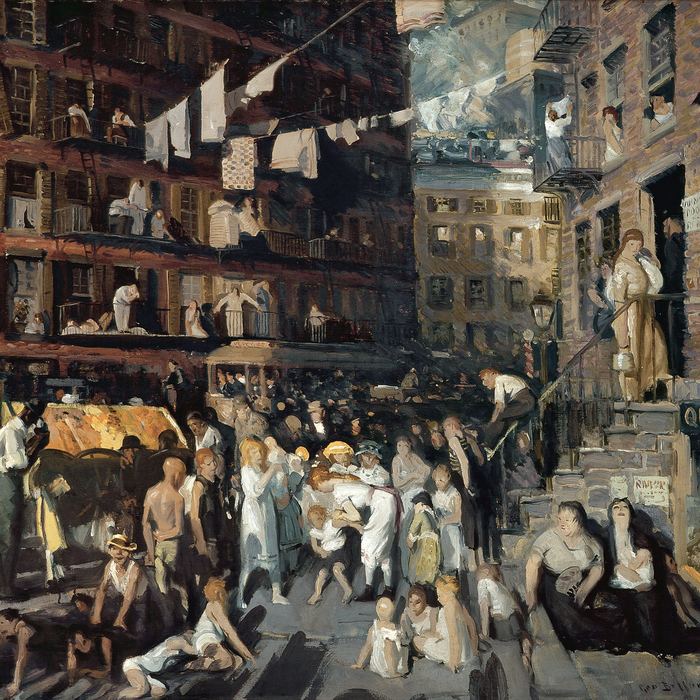
Cliff Dwellers
George Bellows · 1913 · Bellows compresses tenement street life into a crowded field whose energy does not conceal difficult housing conditions.
The Third-Class Carriage
Honoré Daumier · c. 1862–1864 · Daumier's passengers establish a powerful nineteenth-century precedent for class observation and social compression.
The Gleaners
Jean-François Millet · 1857 · Millet monumentalises rural labour while the distant harvest makes unequal access to land and abundance visible.
Barge Haulers on the Volga
Ilya Repin · 1870–1873 · Repin joins individual character to punishing collective labour, making social structure readable through bodies under strain.
Where to see Social Realism
Smithsonian American Art Museum, Washington
The museum's New Deal holdings make it possible to compare activist art with Regionalism, abstraction, labour imagery and affirmative public narratives. Shahn, Gropper, Levine and thousands of federally connected works demonstrate how diverse government-era production was.[6] [7]
Whitney Museum of American Art, New York
The Whitney is especially valuable for American art between the wars and for the revised transnational story developed through Vida Americana. Its research connects Mexican muralists to Shahn, Lawrence, White, Catlett, Woodruff and less familiar participants.[25]
Museum of Modern Art, New York
MoMA holds half of Lawrence's Migration Series, major Kollwitz prints and substantial Shahn material. Its exhibitions also reveal how institutions alternately admitted, marginalised and recovered socially engaged representation.[3] [18] [35]
National Gallery of Art, Washington
The collection and research resources span New Deal prints, American painting, Lange photographs, Shahn and Kollwitz. The Migrant Mother sequence is particularly important for looking beyond one reproduced icon.[16] [17]
Library of Congress, Washington
The FSA/OWI archive, WPA posters and Federal Art Project prints allow direct study of sequence, caption, government filing and mass circulation. Researchers can compare celebrated images with the surrounding exposures and administrative record.[8] [12] [13]
Käthe-Kollwitz-Museum Berlin
The museum places print cycles, drawings, sculpture and biography inside the city where Kollwitz lived and worked. German-language records help connect her social commitment to artistic process and changing political institutions.[24]
Detroit Institute of Arts, Detroit
Rivera's Detroit Industry murals surround the viewer with labour, machinery, raw material and industrial organisation. Their scale clarifies why Mexican muralism transformed the ambitions of artists working in the United States.[26]
Phillips Collection, Washington
The Phillips owns the odd-numbered half of the Migration Series. Seeing its panels alongside MoMA's history, or during a reunion of all sixty, makes division, sequence and shared stewardship part of the work's reception.[36] [38]
Where to see Social Realism
Displays rotate and some works travel or remain in storage. Check the current collection display before travelling.
- 01
Smithsonian American Art Museum
Washington, USA
New Deal holdings place Shahn, Gropper and Levine beside Regionalism, labour imagery, abstraction and thousands of federally connected works.
New Deal art and American Social RealismVisit collection website - 02
Whitney Museum of American Art
New York, USA
American art between the wars and the research behind Vida Americana reveal the decisive US dialogue with Mexican muralism.
Interwar America and Mexican connectionsVisit collection website - 03
Museum of Modern Art
New York, USA
Half of Lawrence's Migration Series, Kollwitz prints and Shahn material reveal both institutional recovery and earlier marginalisation.
Lawrence, Kollwitz and ShahnVisit collection website - 04
National Gallery of Art
Washington, USA
New Deal prints, Lange photographs, Shahn and Kollwitz support close comparison across painting, printmaking and documentary practice.
Prints and documentary photographyVisit collection website - 05
Library of Congress
Washington, USA
The FSA/OWI archive, WPA posters and Federal Art Project prints preserve sequences, captions and administrative records beyond famous single images.
FSA archives and federal print cultureVisit collection website - 06
Käthe Kollwitz Museum Berlin
Berlin, Germany
Print cycles, drawings, sculpture and biography connect Kollwitz's material process to class, grief and changing political institutions.
Kollwitz in depthVisit collection website - 07
Detroit Institute of Arts
Detroit, USA
Rivera's Detroit Industry murals surround the viewer with labour, machinery and raw material on the public scale that changed US art.
Rivera and industrial muralismVisit collection website - 08
The Phillips Collection
Washington, USA
The odd-numbered half of Lawrence's Migration Series makes sequence and divided stewardship part of the work's modern reception.
The Migration SeriesVisit collection website
Suggested books
Artists on the Left: American Artists and the Communist Movement, 1926–1956, by Andrew Hemingway
Hemingway reconstructs the organisations, arguments and political commitments often removed when 1930s art is absorbed into a general American Scene. It is essential for distinguishing left culture from one visual style.
Vida Americana: Mexican Muralists Remake American Art, 1925–1945, edited by Barbara Haskell
This catalogue revises a US-centred narrative through extensive evidence of travel, collaboration and adaptation. It gives Mexican artists historical agency while expanding the American roster well beyond a few canonical men.[25] [26]
Käthe Kollwitz, edited by Starr Figura
The study follows Kollwitz across techniques and political periods, integrating close material analysis with class, gender, mourning and public purpose. It prevents her images from becoming generic symbols detached from their making.
Jacob Lawrence: The Migration Series, edited by Leah Dickerman and Elsa Smithgall
All sixty panels are connected to Lawrence's sources, captions, technique and the history of the Great Migration. The book shows how a small-panel sequence can transform history painting.[34] [37]
The Shape of Content, by Ben Shahn
Shahn's lectures set out his mature thinking on form, integrity, communication and the artist's place in society. They are best read as a later reflection by a changing artist rather than a movement manifesto.
Major artists associated with Social Realism
| Name | Nationality | Key Works |
|---|---|---|
| Aaron Douglas | American | Aspects of Negro Life · Song of the Towers |
| Ben Shahn | Lithuanian-American | The Passion of Sacco and Vanzetti · Prenatal Clinic |
| Bernarda Bryson Shahn | American | Arkansas Sharecroppers · Resettlement Administration studies |
| Charles White | American | The Contribution of the Negro to Democracy in America · Progress of the American Negro |
| David Alfaro Siqueiros | Mexican | Tropical America · Echo of a Scream |
| Diego Rivera | Mexican | Detroit Industry · Man at the Crossroads |
| Dorothea Lange | American | Migrant Mother · White Angel Breadline |
| Dox Thrash | American | Defense Worker · Cabin Days |
| Edward Hopper | American | Nighthawks · New York Movie |
| Elizabeth Catlett | American-Mexican | Sharecropper · I Am the Negro Woman |
| Elizabeth Olds | American | Miner Joe · Burlesque |
| Grant Wood | American | American Gothic · Daughters of Revolution |
| Hale Woodruff | American | The Amistad Murals · Poor Man's Cotton |
| Honoré Daumier | French | The Third-Class Carriage · Rue Transnonain |
| Ilya Repin | Russian | Barge Haulers on the Volga · Religious Procession in Kursk Province |
| Isaac Soyer | Russian-American | Employment Agency · The Dancers |
| Isabel Bishop | American | Two Girls · Lunch Counter |
| Jack Levine | American | The Feast of Pure Reason · Welcome Home |
| Jacob Lawrence | American | The Migration Series · The War Series |
| Jean-François Millet | French | The Gleaners · The Man with a Hoe |
| Joe Jones | American | American Justice · Threshing |
| José Clemente Orozco | Mexican | The Epic of American Civilization · Prometheus |
| Käthe Kollwitz | German | War · The Weavers |
| Marion Greenwood | American | Blueprint for the Living · Mississippi mural studies |
| Moses Soyer | Russian-American | Artists on WPA · The Costume Designers |
| Philip Guston | Canadian-American | Bombardment · Gladiators |
| Raphael Soyer | Russian-American | Office Girls · In the City Park |
| Reginald Marsh | American | The Bowery · Twenty Cent Movie |
| Walter Sickert | British | Ennui · Camden Town interiors |
| William Gropper | American | Construction of a Dam · The Senate |
Frequently Asked Questions
Discussion
Choose one Social Realist work and ask who controls the encounter. Does the subject look back, act with others or become an emblem chosen by the artist? Then consider the commission and audience. Does that context strengthen the work's solidarity, or expose a tension its original viewers may not have acknowledged?
Reader Insights
Begin with the active element—a line, band, circle, plane, woven module or relief—and notice how repetition creates expectation.
Ask whether forms float, press into layers or surround the body, then look for ridges, corrections, woven texture and joins.
The same grid can serve spiritual order, rational design, social production or play; form alone never supplies the whole history.
Join the Conversation
Choose one work and ignore its title for a minute. Where does your eye stop, accelerate or change direction—and what changes when you restore its history?
References
- Social Realism. Smarthistory. View Source
- Socialist Realism. Smarthistory. View Source
- The Artist as Adversary. Museum of Modern Art. View Source
- Committed to Print. Museum of Modern Art. View Source
- Great Depression. National Gallery of Art. View Source
- 1934: A New Deal for Artists. Smithsonian American Art Museum. View Source
- Experience America. Smithsonian American Art Museum. View Source
- Fine Prints by Federal Art Project Artists. Library of Congress. View Source
- New Deal Arts. National Archives. View Source
- A New Deal for the Arts: Activist Arts Part 1. National Archives. View Source
- A New Deal for the Arts: Activist Arts Part 2. National Archives. View Source
- Works Progress Administration Posters. Library of Congress. View Source
- FSA/OWI Black-and-White Negatives. Library of Congress. View Source
- Documenting America: Ben Shahn. Library of Congress. View Source
- FSA Photographs in the First International Photographic Exposition. Library of Congress. View Source
- The Real Lives of People in Dorothea Lange's Portraits. National Gallery of Art. View Source
- Migrant Mother Series. National Gallery of Art. View Source
- Käthe Kollwitz. Museum of Modern Art. View Source
- War (Krieg). Museum of Modern Art. View Source
- The Parents from War. Museum of Modern Art. View Source
- Study for The Mothers. Museum of Modern Art. View Source
- Die Gefangenen (The Prisoners). Metropolitan Museum of Art. View Source
- Käthe Kollwitz. National Gallery of Art. View Source
- Biografie. Käthe-Kollwitz-Museum Berlin (German; consulted in German). View Source
- Vida Americana: Mexican Muralists Remake American Art, 1925–1945. Whitney Museum of American Art (English and Spanish; consulted in English and Spanish). View Source
- América: Mexican Muralism and Art in the United States 1925–1945. Whitney Museum of American Art / Barbara Haskell. View Source
- Vida Americana: Epic Histories. Whitney Museum of American Art. View Source
- Vida Americana: Abelardo L. Rodriguez Market. Whitney Museum of American Art. View Source
- Ben Shahn. Museum of Modern Art. View Source
- Ben Shahn. Smithsonian American Art Museum. View Source
- Ben Shahn. National Gallery of Art. View Source
- Uncovering America: Activism and Protest. National Gallery of Art. View Source
- Ben Shahn: The Passion of Sacco and Vanzetti. Smarthistory. View Source
- Jacob Lawrence. Museum of Modern Art. View Source
- Jacob Lawrence: The Migration Series. Museum of Modern Art. View Source
- The Migration Series Panel 1. Museum of Modern Art. View Source
- The Migration Series Panel 13. Museum of Modern Art. View Source
- Jacob Lawrence. Smithsonian American Art Museum. View Source
- Charles White: Progress of the American Negro. Whitney Museum of American Art. View Source
- Oh Freedom! Charles White. Smithsonian American Art Museum. View Source
- Sharecropper. Metropolitan Museum of Art. View Source
- William Gropper. Smithsonian American Art Museum. View Source
- Construction of the Dam. Smithsonian American Art Museum. View Source
- Jack Levine. Smithsonian American Art Museum. View Source
- The Bowery. Metropolitan Museum of Art. View Source
- Raphael Soyer. National Gallery of Art. View Source
- The Fire Boss. National Gallery of Art. View Source
- Ennui. Tate. View Source
- Traditional Chinese Painting in the Twentieth Century. Metropolitan Museum of Art (Italian and English; consulted in Italian and English). View Source
- Testimonios de un Mural. Instituto Nacional de Bellas Artes y Literatura (Spanish; consulted in Spanish). View Source
- Social Realism image records. Wikimedia Commons: Migrant Mother (Public domain; Library of Congress; Wikimedia Commons), The Mothers (Public domain; Library of Congress; Wikimedia Commons), Arkansas Sharecropper (Public domain; Farm Security Administration; Library of Congress; Wikimedia Commons), Construction of a Dam (Public domain; United States Department of the Interior; Wikimedia Commons), The Fire Boss (CC0; National Gallery of Art; Wikimedia Commons), Ennui (Public domain; Tate; Wikimedia Commons), Cliff Dwellers (Public domain; Los Angeles County Museum of Art; Wikimedia Commons), The Third-Class Carriage (CC0; Metropolitan Museum of Art; Wikimedia Commons), The Gleaners (Public domain; Musée d'Orsay; Wikimedia Commons), Barge Haulers on the Volga (Public domain; State Russian Museum; Wikimedia Commons).

Social Realism is not Socialist Realism
The near-identical names conceal opposite relations to power. Social Realism usually names art that identifies a social problem or reveals the unequal effects of an economic and political system. It may propose solidarity, but it can leave a scene unresolved. A weary miner, an intimidated migrant or a corrupt official need not become an ideal hero.
Socialist Realism was institutional doctrine. Soviet cultural authorities expected artists to present reality in its supposedly revolutionary development: legible bodies, productive labour and a future made affirmative through party leadership. Later states adapted that formula to their own political programmes, including in twentieth-century China, where artists navigated changing demands to “serve the people.”[49] The doctrine could produce varied objects, but approval and censorship established limits that the broad category Social Realism does not share.
The distinction does not mean that US Social Realists were politically moderate. Many worked on the left, joined organisations, drew for Communist publications or understood art as part of class struggle. Their field nonetheless included rival positions and independent makers. Government employment under the New Deal did not transform this plural culture into an American official style.
Nor does realistic appearance settle the matter. Jacob Lawrence's flat colours and angular figures can be socially incisive without looking naturalistic. A carefully observed street scene can remain politically ambiguous. The criterion is not photographic resemblance but the relationship among subject, structure, audience and historical purpose.