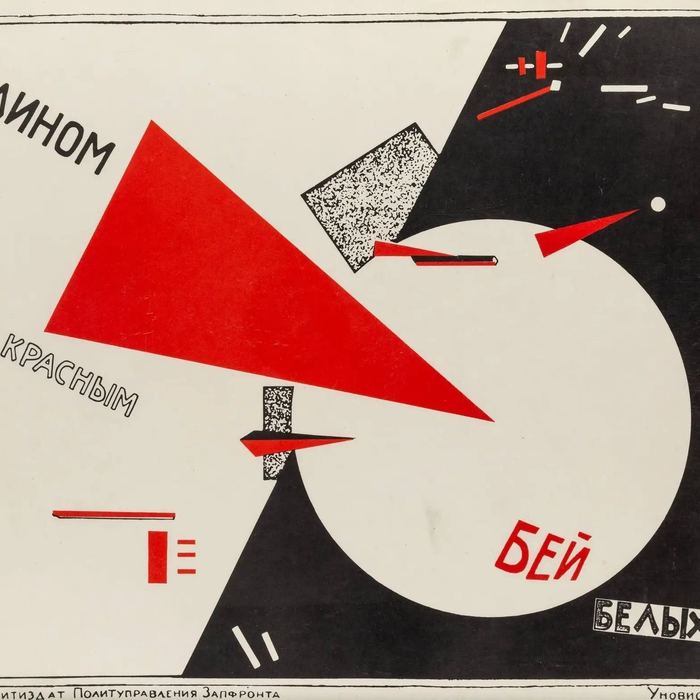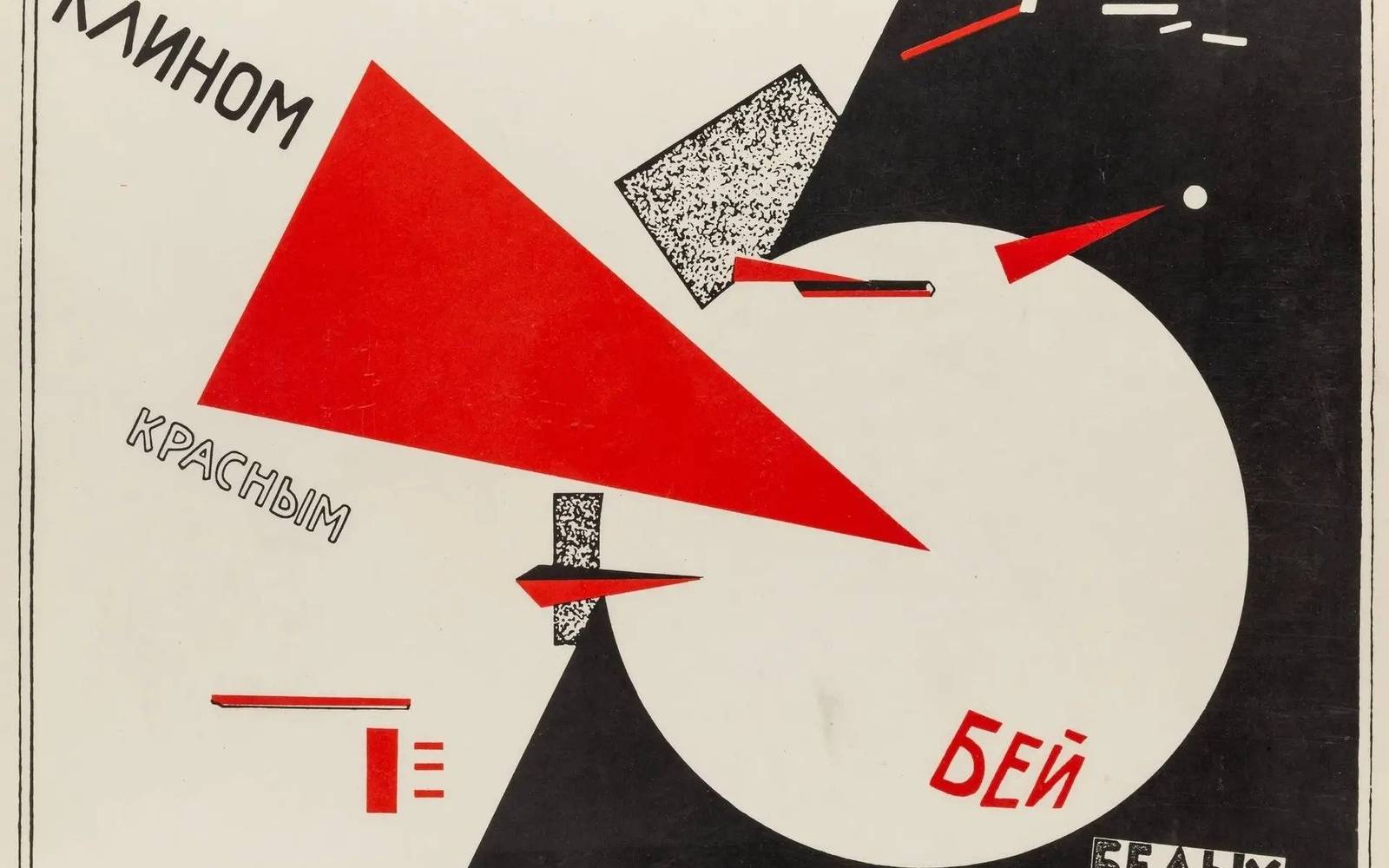
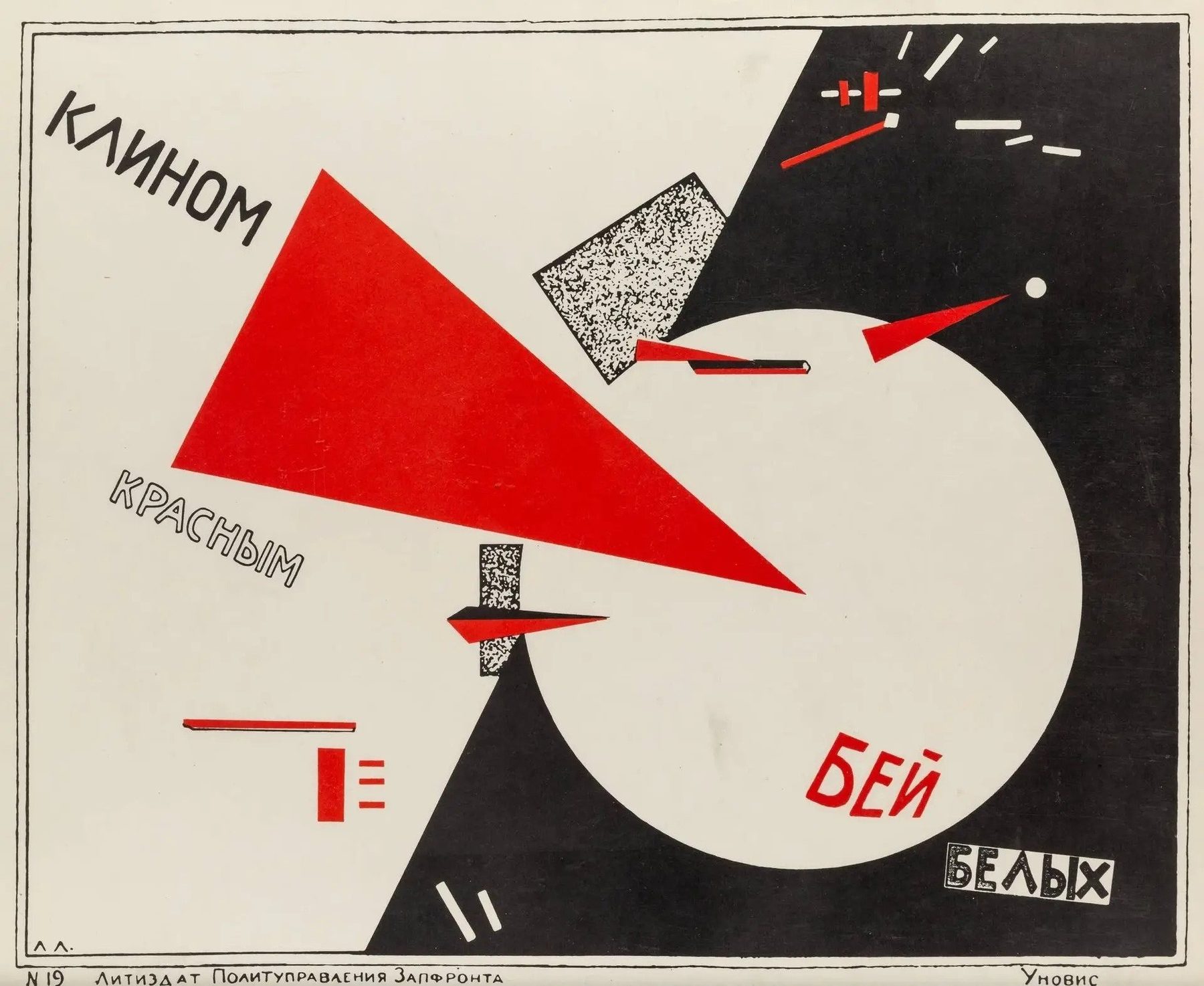
Image reference: El Lissitzky's Beat the Whites with the Red Wedge, 1919–20.
At a Glance
- Core periodc. 1920–1930, with material precedents from 1914
- Principal centresMoscow, Petrograd/Leningrad, Vitebsk, Kharkiv and Kyiv
- Known forconstruction, faktura, Productivism, photomontage, typography, theatre and social design
- Key figuresVladimir Tatlin, Aleksandr Rodchenko, Liubov Popova, Varvara Stepanova, El Lissitzky and Naum Gabo
- Major institutionsINKhUK, OBMOKhU and VKhUTEMAS
- Political contextrevolution, civil war, NEP, institutional centralisation and suppression
Contents
- Where it fits
- Before the name
- Composition to construction
- Four stages
- Artists and designers
- Popova and Stepanova
- Page and mass address
- Architecture
- Politics and suppression
- Essential works
Where Constructivism fits
Vladimir Tatlin
Principal activityAntoine Pevsner
Principal activityLiubov Popova
Principal activityEl Lissitzky
Principal activityNaum Gabo
Principal activityKonstantin Melnikov
Principal activityAleksandr Rodchenko
Principal activityVarvara Stepanova
Principal activityConstructivism changed the question an artist was expected to answer. Instead of asking how a picture should represent the world, its leading practitioners asked how materials could be organised, how an object could enter collective life and whether art ought to survive as a separate sphere at all. Wood, metal, glass, paper, photographs, type and cloth became elements in a programme that moved restlessly among the studio, workshop, school, stage, street and factory. The familiar red wedge and black diagonal belong to this history, but they are not its definition.
The organised Soviet movement was brief. Its most concentrated arguments unfolded between about 1920 and 1930, although Vladimir Tatlin's counter-reliefs had posed essential questions before the 1917 Revolution and Constructivist methods travelled internationally long afterwards. Even within that decade there was no single doctrine. Tatlin pursued the active life of materials. Aleksandr Rodchenko made constructions, books, advertisements, photographs and furniture. Liubov Popova and Varvara Stepanova moved between non-objective painting and designs intended for manufacture. Naum Gabo and Antoine Pevsner defended an autonomous, spatial art that Soviet Productivists rejected. El Lissitzky made works that hovered between image, architecture and exhibition. Together they turned “construction” into one of modern art's most consequential and disputed ideas.[1] [2]
Constructivism was also inseparable from revolution. Artists gained positions in new schools, museums and cultural agencies; they designed propaganda and tried to redefine themselves as engineers, agitators, constructors and workers. Civil war, material shortage and uneven industrial access limited those ambitions. The New Economic Policy created commercial commissions that sat awkwardly beside anti-capitalist commitments. By the end of the 1920s, political centralisation and attacks on “formalism” were closing the experimental institutions that had sustained the avant-garde. Socialist Realism became the sanctioned model during the following decade.[3] [4] [5] [6]
The movement's achievement therefore lies in neither a utopia realised nor a utopia simply betrayed. It lies in an extraordinary body of experiments about relationships: between a plane and the space around it, a word and the eye that reads it, a garment and a moving body, a building and a new pattern of social life. Its failures and contradictions are part of that achievement. Constructivism matters because it tested what art might become when formal invention was made answerable to material, labour and use.
Before Constructivism had a name
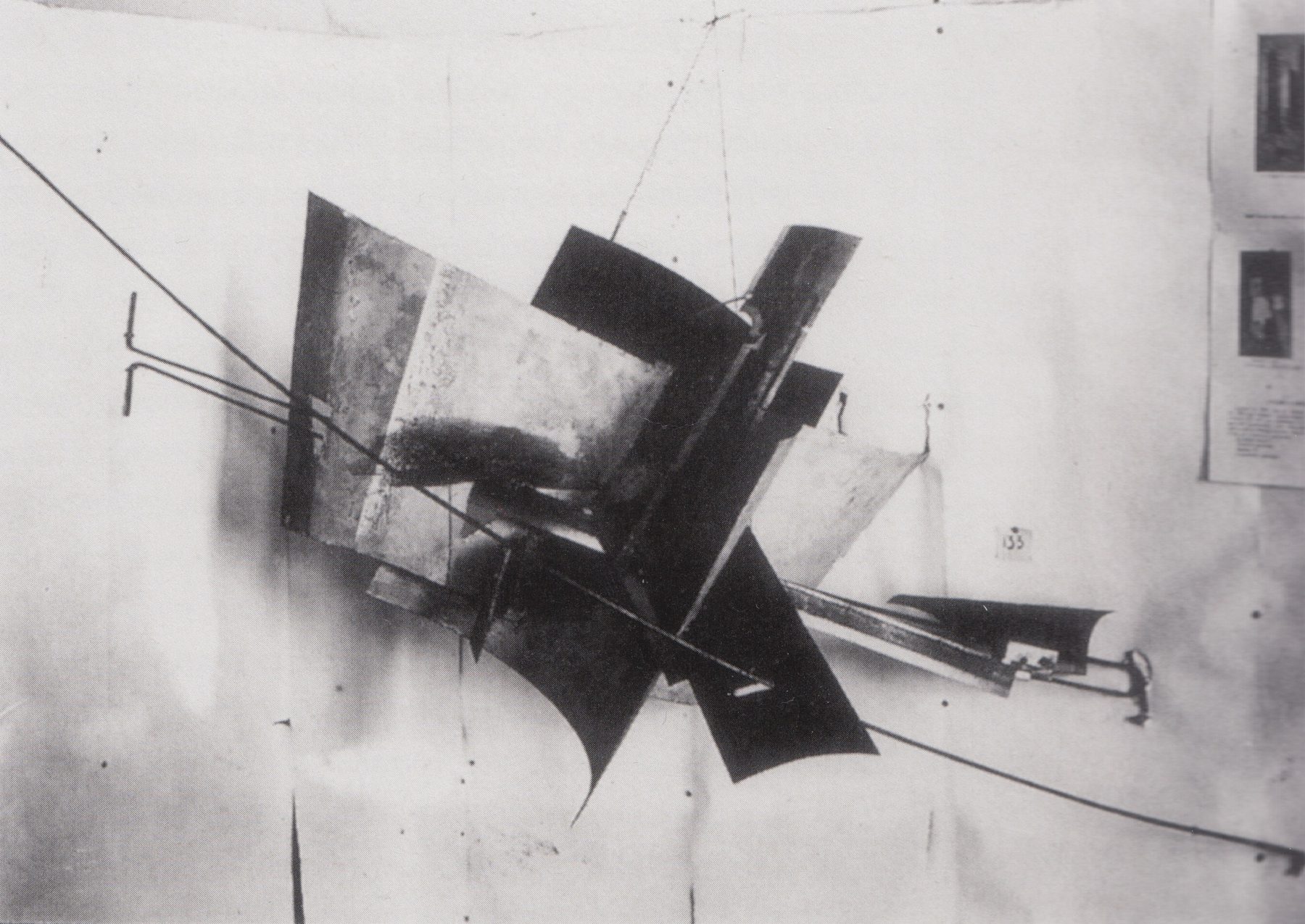
Tatlin's corner counter-reliefs of 1914 are the movement's most compelling prehistory. He attached pieces of metal, wood, wire and other substances across the junction of two walls. The works did not imitate an object or rest on a pedestal. They occupied actual space, and the tension, weight, flexibility and roughness of their materials became their subject. A sheet bent differently from a wire; a corner was no longer neutral architecture but an active field of forces. Tatlin's example encouraged artists to think of faktura—the worked and perceptible character of a material—not as surface decoration but as evidence of how a thing had been made.[21]
This material turn developed beside non-objective painting, not in isolation from it. Kazimir Malevich and Suprematism treated elementary forms as vehicles for sensation freed from the visible object. Constructivists inherited the square, circle, line and plane but asked them to perform different work. Where Suprematism could open a spiritual or cosmic space, Constructivism increasingly stressed objective organisation, physical substance and social destination. The boundary was never clean: Popova learned from both Malevich and Tatlin, and Lissitzky's early Proun works emerged from the Suprematist environment of Vitebsk. The distinction is one of developing priorities rather than mutually sealed styles.[11] [15] [44]
The Revolution changed the scale of the question. The old Academy had been abolished, collections reorganised and new cultural bodies placed artists inside the work of state formation. The visual-arts department of the People's Commissariat for Enlightenment, usually known through the abbreviations Izo and Narkompros, involved avant-garde figures in administration, teaching, museum policy and propaganda. The Institute of Artistic Culture, or INKhUK, became a particularly intense site of debate after its establishment in Moscow in 1920. Wassily Kandinsky initially proposed a programme grounded in psychological and expressive responses to form. Younger colleagues increasingly challenged that approach as subjective and insufficiently material.[7] [8]
In March 1921 Rodchenko, Stepanova, Aleksei Gan, Karl Ioganson, Konstantin Medunetsky and the Stenberg brothers formed the First Working Group of Constructivists at INKhUK. They did not invent every concern gathered under the new name, but they gave it organisational force. Analysis of material properties, spatial relations and structural necessity was to replace intuitive composition. Their debates supplied three terms that are useful if they are not turned into a rigid formula. Faktura concerned material character and handling. Konstruktsiia concerned the active organisation of elements. Tektonika joined that organisation to a broader material and social order. What counted as each—and whether a work achieved any of them—was fiercely contested.[8] [11]
The Free State Art Studios and their successor, VKhUTEMAS, carried similar arguments into education. Founded in Moscow in 1920, VKhUTEMAS joined art, architecture and industrial training. Its preliminary courses explored colour, volume, space and graphic organisation before students entered specialised workshops. Rodchenko, Popova and Stepanova were among the artists associated with this pedagogical world. Comparisons with the Bauhaus are illuminating because both schools tried to rethink the relation between art and production, but the institutions arose from different political systems and developed distinct courses, workshops and public roles.[9]
Artists, writers and designers to know
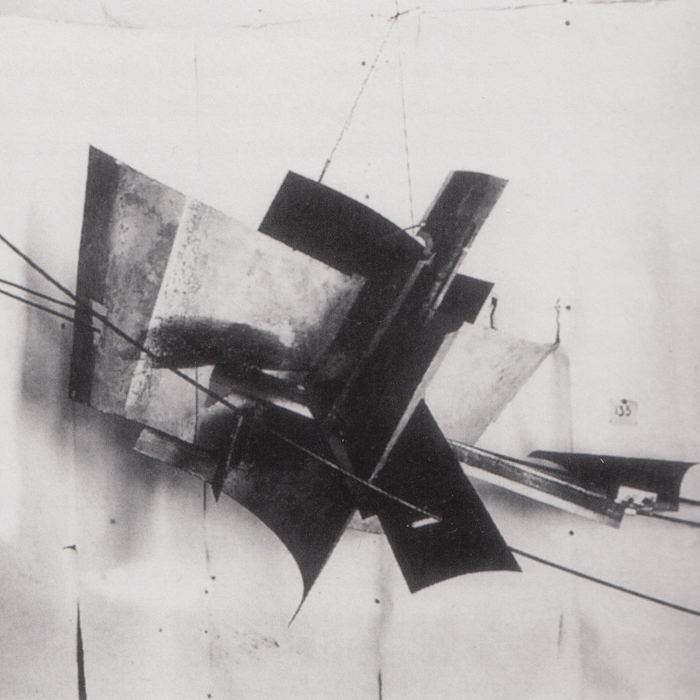
Vladimir Tatlin
Tatlin's counter-reliefs and tower made real materials, architectural space and collective ambition central to Constructivism's prehistory.
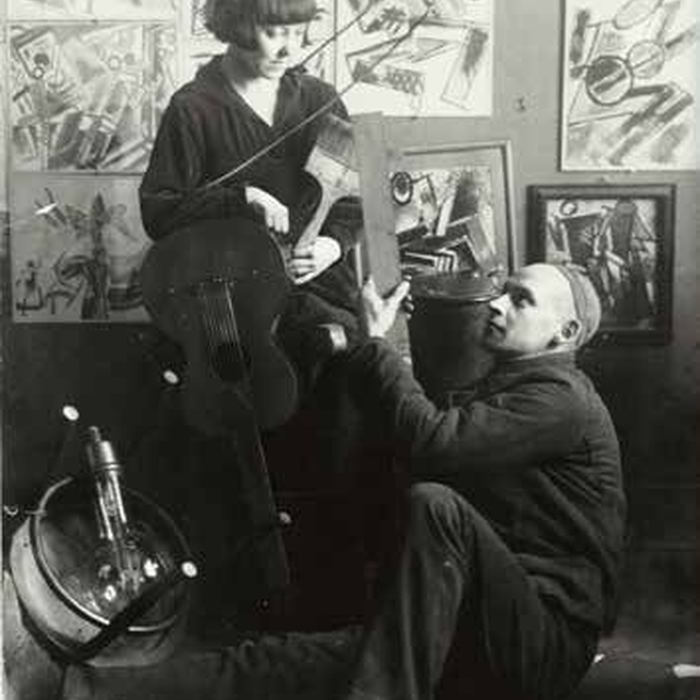
Aleksandr Rodchenko
Rodchenko moved from laboratory construction into books, advertisements, photographs and transformable social interiors.
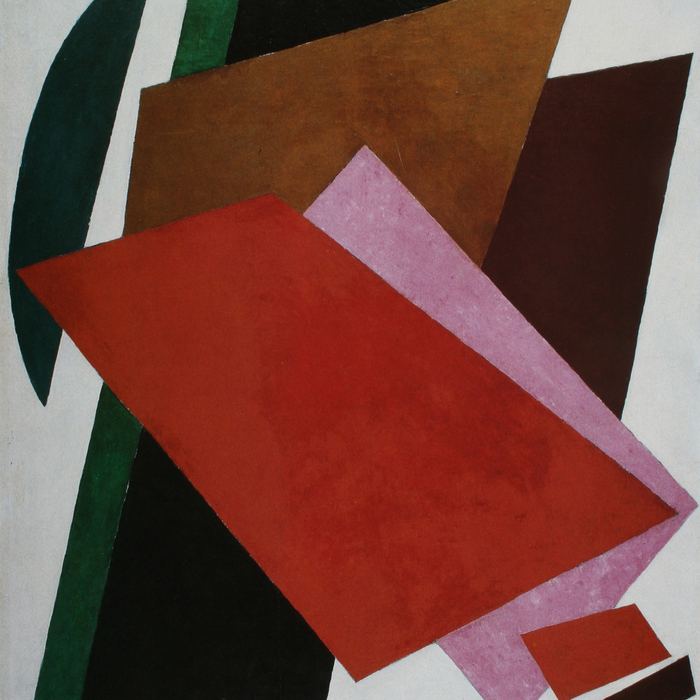
Liubov Popova
Popova carried structural rhythm from non-objective painting into stage machinery and mechanically repeated textiles.
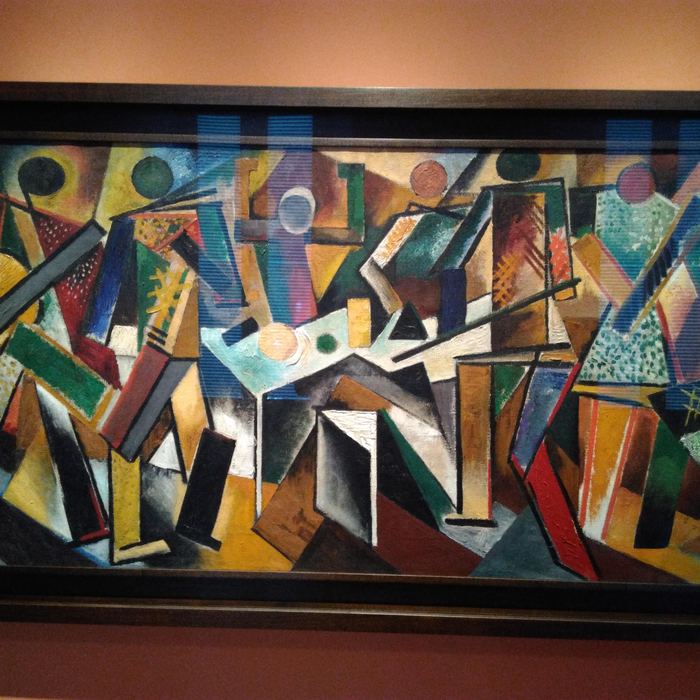
Varvara Stepanova
Stepanova joined verse, painting, theatre, clothing, textiles and publishing in a sustained Productivist practice.
El Lissitzky
Lissitzky treated image, architecture, page and exhibition as connected fields and carried Constructivist methods through European networks.
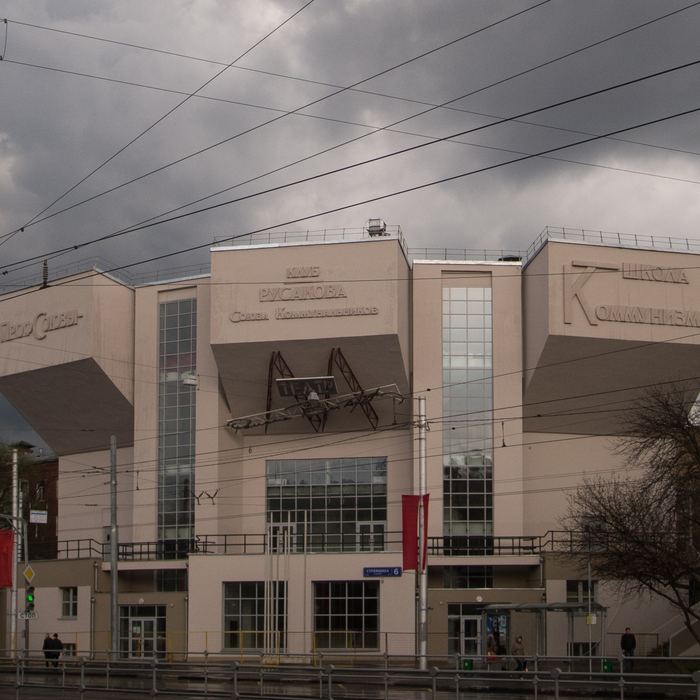
Konstantin Melnikov
Melnikov's built clubs gave adaptable programmes a vivid urban form without fitting neatly into a single Constructivist doctrine.
From composition to construction
The word “construction” promised that every part of a work would follow from material relations rather than from an artist's private taste. “Composition,” by contrast, came to signify the subjective arrangement of elements according to inherited pictorial habit. In practice, the opposition could be unstable. A construction still required choices, and a painting might reveal its process more rigorously than an object labelled useful. The debate mattered because it made form accountable: why this material, this joint, this direction, this relation to gravity, this means of reproduction?
Rodchenko's line drawings and spatial constructions made that accountability visible. In Spatial Construction no. 12, a flat sheet of plywood was cut into concentric components, opened and suspended. The method generated a complex volume without modelling a solid mass. As the elements rotate, hollows become as important as wood; shadows and the viewer's changing position continually remake the object. Suspension removes the conventional base and distributes attention through the surrounding air. The economy is striking: one plane, one repeated cutting principle and the force of gravity produce an object that seems much more materially elaborate.[13]
These constructions were shown in the 1921 exhibition of the Society of Young Artists, known as OBMOKhU. Most of the displayed objects disappeared, and later histories rely heavily on installation photographs. That loss is consequential. The photographs show an environment of hanging frameworks, projecting lines and skeletal volumes rather than a parade of isolated masterpieces. They also remind us that a movement celebrated for real materials is now often known through fragile documentary images and museum reconstructions.[7] [14]
The exhibition 5×5=25, held in Moscow later in 1921, offered another kind of ending and beginning. Five artists—Aleksandra Exter, Popova, Rodchenko, Stepanova and Alexander Vesnin—each presented five works. Rodchenko displayed three monochrome canvases in the primary colours red, yellow and blue. He and later commentators framed them as painting reduced to its logical limit, sometimes as the “death” or conclusion of painting. The gesture did not make images disappear, nor did it prevent Rodchenko from composing photographs and printed pages. It declared that the unique easel picture no longer held privileged status within his programme.[7] [10] [12]
The next step was Productivism. Constructivist laboratory experiments were to leave the protected art environment and enter manufacture, communication and everyday use. Artists adopted the vocabulary of production, workers and socially purposeful objects. Yet “art into life” was more programme than completed fact. Factories had their own technicians, supply chains and production targets. Artists did not automatically gain authority on the shop floor, and shortages could reduce prototypes to drawings. The most revealing history therefore follows both the objects that entered manufacture and the gaps between proposal, prototype and commodity.[3] [36] [40]
Follow Constructivism through four stages
–1919
Materials, non-objectivity and revolution
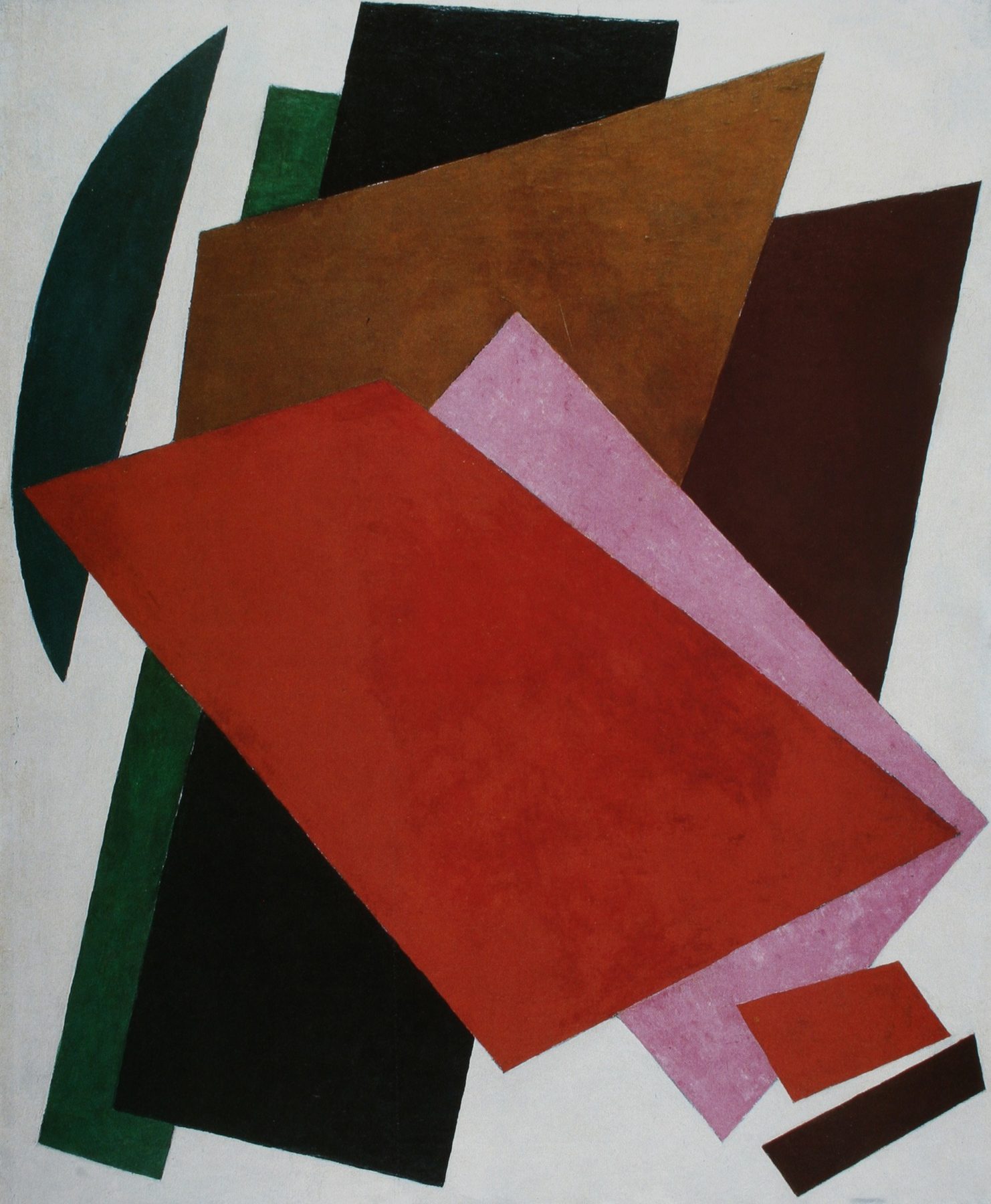
Tatlin's counter-reliefs, Popova's painterly structures and Lissitzky's early geometric address establish different paths from autonomous image toward construction.
–1921
Construction becomes an organised method
INKhUK, the First Working Group, OBMOKhU and 5×5=25 turn material analysis and the composition-construction debate into a collective programme.
–1928
Art enters page, stage, club and factory
Productivist ambitions spread through theatre, print, photomontage, textiles and active interiors while international exhibitions and journals carry the methods abroad.
–mid-1930s
Architecture, adaptation and suppression
Built social projects coexist with deepening state control as formalist attacks, institutional closure and Socialist Realism narrow the avant-garde's field of action.
Tatlin's corner and tower
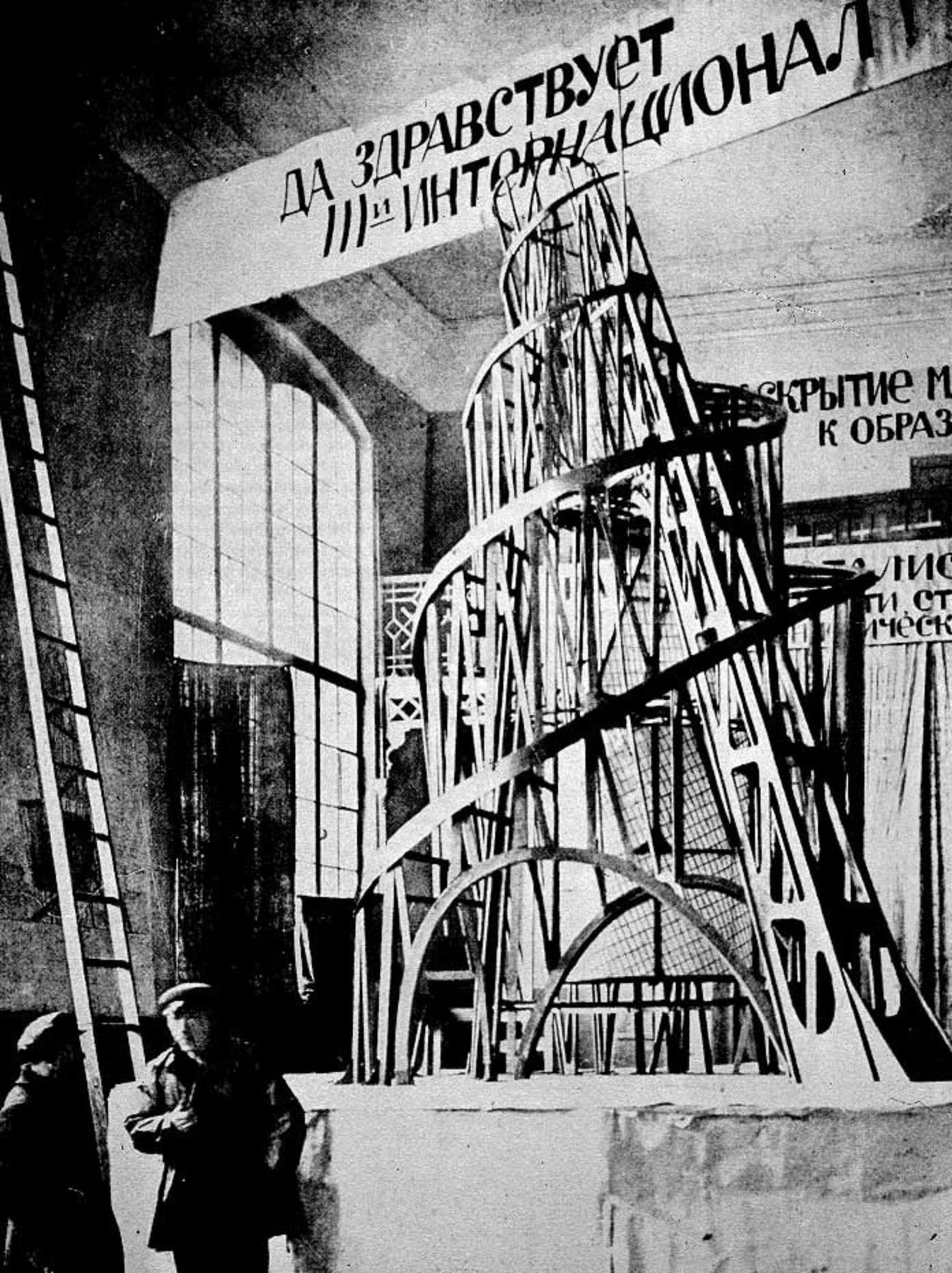
Tatlin's Monument to the Third International, designed in 1919–20, enlarged material construction into a revolutionary public symbol. An open, leaning framework was to rise around stacked geometric volumes. The internal forms—commonly described as a cube, pyramid and cylinder—were assigned to political and information functions and imagined rotating at different rates. Projectors, radio and telegraphic apparatus would turn the monument into a communications centre as well as the headquarters of the Communist International. Structure, movement and message were meant to become one system.[20] [21]
The tower was never built at architectural scale. That fact is not a minor qualification. Post-revolutionary Russia lacked the resources for such a vast structure, and the engineering claims were never resolved as they would have been for construction. The project existed through drawings, descriptions, publications, photographs and models. Tatlin worked with assistants on the first model, whose collective making can disappear when the tower is presented as the solitary vision of one man. That model and subsequent early versions were lost. The objects now encountered in museums are later reconstructions based on incomplete evidence, and they differ in proportion and detail.[20] [21] [22] [23]
Its unrealised status does not make the monument merely imaginary. A model was displayed, carried in a May Day procession and repeatedly reproduced. Its leaning spiral became an image of historical momentum; its open lattice made transparency and circulation seem like political virtues. At the same time, the design's scale and administrative programme could appear monumental in the traditional sense it claimed to overcome. It housed a hierarchy of political bodies, and its technological spectacle risked turning collective power back into an emblem to be admired from below.
Tatlin did not proceed along the same path as every later Constructivist. His work retained an artisanal attentiveness to material behaviour. In the 1930s his glider project, Letatlin, returned to organic structure, flight and hand fabrication at a moment when he had lost official support. To connect the counter-relief, tower and glider is to see an enduring fascination with how a material system might hold itself together, not a steady march from studio art to industrial design.[21]
Popova, Stepanova and the work of production
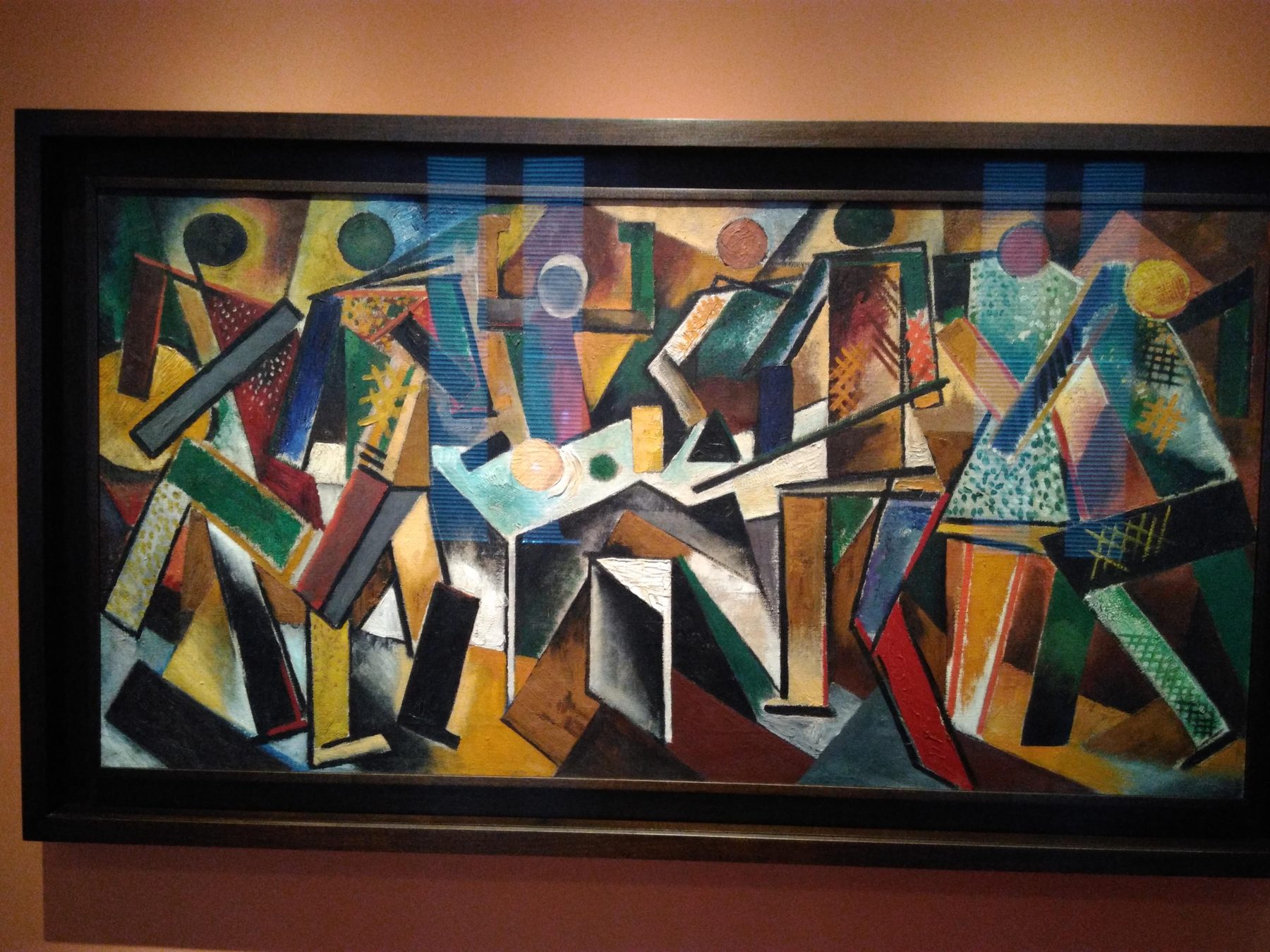
Liubov Popova's Painterly Architectonics demonstrate why Constructivism cannot be understood as an instant rejection of painting. In these works, broad planes collide, overlap and press toward the edges. Colour establishes weight and direction rather than filling outlined shapes. The surface remains a painted field, yet it behaves like a testing ground for structural relations. One well-known example in the Museum of Modern Art combines angled red, black, white and muted planes in a configuration that suggests load and counter-load without depicting a building.[15]
Popova's path from these paintings to stage and textile design involved both rupture and continuity. She renounced the autonomous easel picture as an adequate social destination, but she carried her understanding of interval, overlap, rhythm and colour into other media. Her career has often been compressed into a supporting role beside male theorists. Exhibition research instead shows an artist who studied widely, participated in central debates, taught and developed her own theory of painterly construction before committing to Productivist work.[16] [17]
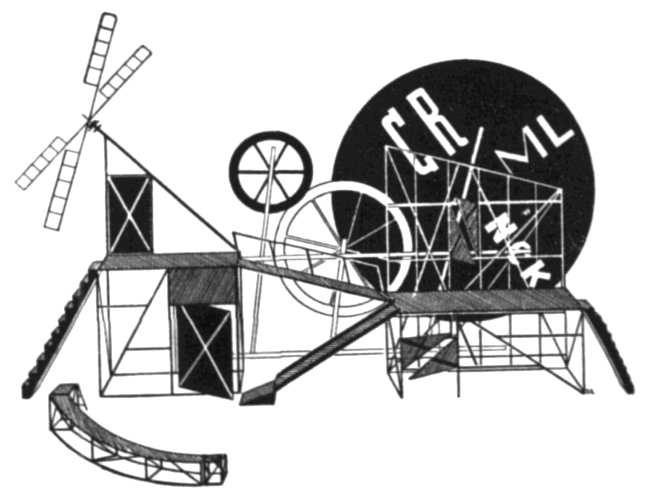
The 1922 production of Fernand Crommelynck's The Magnanimous Cuckold, directed by Vsevolod Meyerhold, made those ideas move. Popova designed a skeletal stage machine of wheels, platforms, stairs and revolving elements. It did not imitate a room or village. Actors in work-like costumes climbed, balanced and crossed the apparatus, using the disciplined physical system Meyerhold called biomechanics. Set, performer and time formed a construction in action. The theatre could therefore realise reciprocal relationships that a static object could only imply.[38] [39]
Varvara Stepanova's range was equally broad. She experimented with transrational verse and handmade books, made non-objective paintings, designed theatre costumes, work clothing, textiles, typography and magazines, and wrote about production. Her Figure paintings construct athletic bodies from cylindrical limbs, gears, pivots and emphatic contours. They do not document a particular machine. They reimagine the body as an organised apparatus, capable and rhythmic but also susceptible to standardisation.[18] [19]
In 1923–24 Popova and Stepanova designed printed cottons for the First State Textile Printing Factory in Moscow. Repeated circles, stripes, zigzags and intersecting bands were suited to mechanical repeat and legible across a moving garment. This was one of Productivism's clearest encounters with mass manufacture. The patterns entered production, and the artists engaged with the factory rather than merely illustrating an industrial ideal. Even here the relationship was uneven: commercial demand, technical limits and management choices affected which designs were printed.[16] [17]
Stepanova's proposals for prozodezhda, or production clothing, began from activity rather than fashion. Garments for sport, theatre or particular kinds of work were to allow movement and express function through seams, fastenings and contrasting fields. Few designs entered widespread manufacture. Their historical value lies partly in the attempt to replace the seasonal luxury garment with types shaped by collective need. Their limitation lies in how easily an abstract “worker” could stand in for the varied bodies, preferences and labour conditions of actual people.
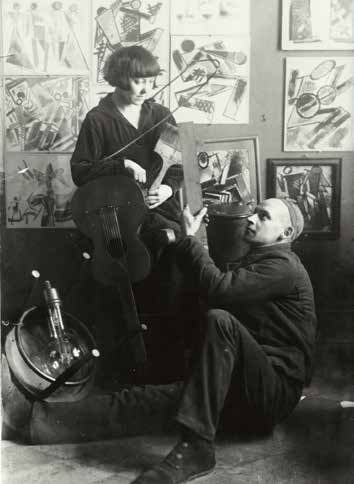
Women were central to Constructivist practice, but that does not mean revolutionary rhetoric removed gender hierarchy. Popova, Stepanova, Exter, Elena Semenova, Valentina Kulagina and Esfir Shub worked across fields later divided into fine and applied arts. Design, clothing, editing and collaborative production were often assigned less canonical prestige than sculpture or architecture. Restoring these practices changes the definition of the movement itself: Constructivism appears less as a succession of heroic objects and more as a network of pages, performances, interiors, textiles and shared labour.[5] [19]
The memorial issue of LEF published after Popova's death in 1924 makes that network tangible. Its pages brought together her image, Rodchenko's design and Stepanova's textile patterns. Commemoration, collective publication and production art occupied the same format. Popova's early death from scarlet fever at thirty-five curtailed an exceptionally compressed career; it should not encourage the false conclusion that her utilitarian work was merely a final appendix to her paintings.[32]
More than one Constructivism
Naum Gabo and Antoine Pevsner issued their Realistic Manifesto as a broadside in Moscow in August 1920. They too rejected illusion and the traditional solid statue, but their principles differed from the Productivist course. Mass was not sculpture's proper basis; space and time, revealed through constructed planes and dynamic rhythm, were. They defended art's independent, universal value at the very moment others demanded its merger with production.[24] [25]
Gabo's Head of a Woman builds a head from intersecting planes. The viewer mentally assembles volume from edges and intervals, a stereometric approach comparable to engineering sections but used toward contemplative sculpture. Gabo and Pevsner later worked outside the Soviet Union, and their international careers helped make “Constructivism” a broad name for abstract construction in Europe and the Americas. That genealogy is real, but it should not be retroactively imposed on the First Working Group's social and industrial programme.[25] [26]
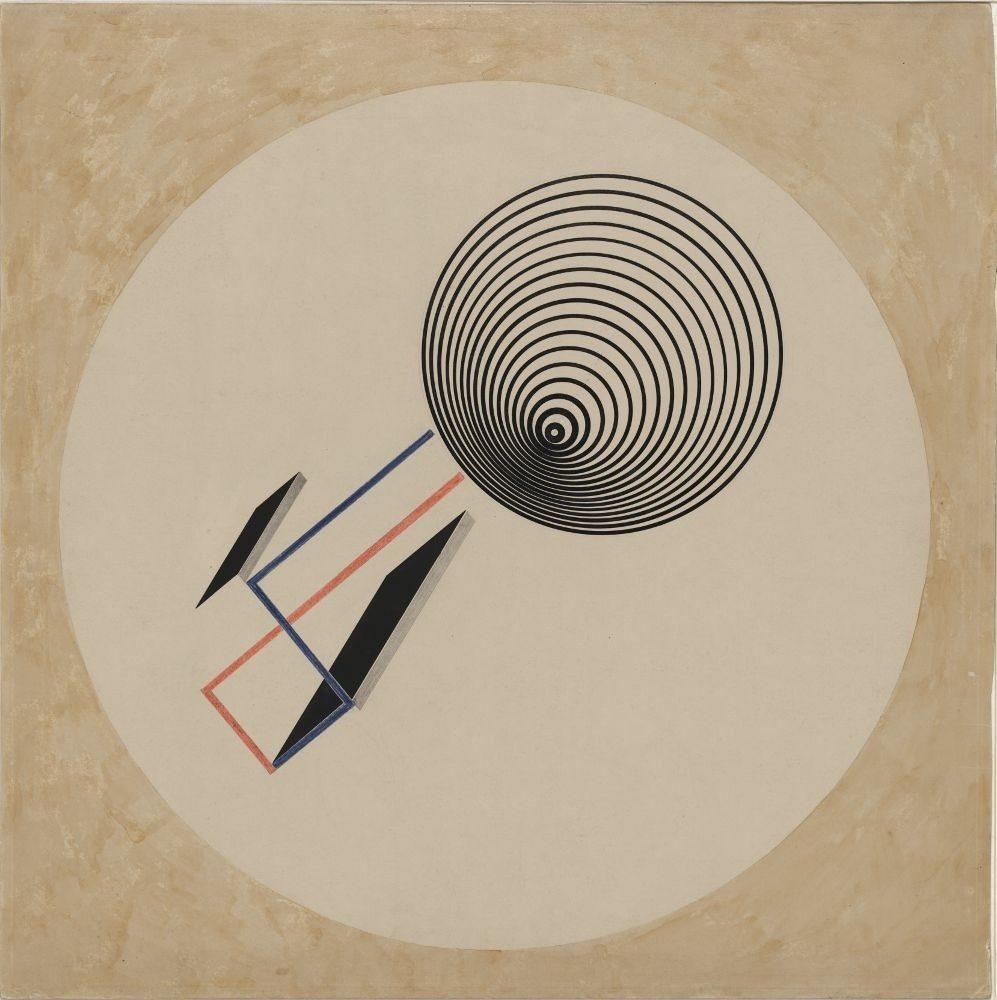
El Lissitzky occupied another shifting position. He called his Proun works “projects for the affirmation of the new,” treating them as stations between painting and architecture. In Proun 19D, geometric elements seem to rotate around several possible axes. There is no dependable top, foreground or horizon. Painted and collaged materials make the image physically layered while its axonometric suggestions invite the eye to imagine built space.[27]
The work's own history resists stability. It has carried different dates and orientations and moved among private, exhibition and museum contexts. Lissitzky took the Proun idea from Vitebsk into Berlin, room design, typography and exhibition architecture. He was not simply exporting a finished Soviet style. Translation altered the work: German and Dutch artists, architects and editors encountered its spatial grammar through magazines, books, talks and installations, then fitted it to their own debates.[28]
The page as a field of action
Print gave Constructivist methods a reach that a unique gallery object could not match. Books, journals, posters and advertisements placed geometric organisation in the hands of readers and on city walls. The page ceased to be a transparent support for orderly lines of text. Type could turn vertically, jump in scale, lock against a bar or collide with a photograph. White space became an interval to cross. A cover had to act at a distance, while a sequence of spreads could direct attention through time.[29] [33]
The apparent coherence of this language should not obscure the exchanges behind it. A major Reina Sofía exhibition brought roughly 350 works by Rodchenko and Popova together across painting, sculpture, drawing, photography, typography, theatre, cinema and applied design. Seen at that scale, Constructivism does not divide tidily into an early “fine-art” phase and a later design phase. A painted plane could become a lesson for a stage element; a photographic crop could answer an earlier experiment with line; a textile repeat could solve a problem of rhythm under entirely different conditions of production. Collaboration mattered, but so did disagreement and individual authorship. Rodchenko and Popova shared institutions and a commitment to redefining art, yet they did not make interchangeable work. Cross-media continuity is strongest when it preserves those differences.[37]
This graphic language emerged from a longer Russian avant-garde book culture. Futurist poets and artists had already used handmade papers, lithography, collage and zaum, or transrational language, to challenge conventional reading. Constructivist designers redirected experiment toward reproducibility and mass address. Their best pages are not random explosions. Hierarchy is made physical through weight, size, direction and contrast. The reader is asked to scan and compare before proceeding in a single line.[30]
Rodchenko's 1923 photomontages for Vladimir Mayakovsky's poem About This joined private emotion to mechanically reproduced imagery. A recurring photograph of Lilya Brik is cut, enlarged and placed among urban, technological and symbolic fragments. Photographs do not certify a stable reality; their changed scale and abrupt conjunction produce new relationships. The volume was an early sustained instance of photomontage carrying a Russian book's narrative and emotional structure.[31]
Rodchenko and Mayakovsky soon called their advertising partnership “Reklam-Konstruktor,” the Advertising Constructor. Their posters and packaging for state and cooperative enterprises combined compact slogans, bold type, photographic portraiture and directional geometry. The apparent paradox of revolutionary artists making advertisements belongs to the New Economic Policy, when limited market activity returned and state businesses competed for customers. The work demonstrates both Constructivism's adaptability and the difficulty of defining “social use” in a mixed economy.
The journals LEF and Novyi LEF offered a broader intellectual network. Writers, photographers, critics and filmmakers debated “factography,” documentary practice, literature of fact and the role of the cultural worker. Covers had to identify each issue while remaining part of a serial system. Inside, typography negotiated dense argument, captions and images. Constructivism here was not simply the look of a masthead; it was bound to disputes over what cultural evidence was and who should produce it.[32]
Photomontage was international from the start. Dada artists in Berlin, Soviet designers and Lissitzky's European circle borrowed and altered one another's methods. A white ground could make isolated fragments look like components ready for assembly; overlap could compress time and scale; photographic credibility could be turned against itself. The Centre Pompidou's French account places Rodchenko and Lissitzky within this exchange rather than presenting montage as the invention of a single city.[34]
The surviving theoretical record is equally collective. Aleksei Gan, Osip Brik, Nikolai Tarabukin, Boris Arvatov and others argued over production, the art object, labour and mass culture. Recent French publication projects that translate Constructivist writings are valuable because the movement was made in meetings, journals and polemics as much as in signed objects. “Art into life” was never one uncontested command. It described competing ideas about whether the artist would become an industrial specialist, an organiser of perception, a designer of “comradely things” or something else entirely.[35] [36]
Photography and learning to see
Rodchenko took up photography intensively in the 1920s, first through montage and then through the camera. He photographed buildings from below, streets from above, faces close to the lens and figures along steep diagonals. Such views broke the waist-height, centred perspective inherited from ordinary snapshots and much easel painting. The purpose was educational as well as visual: a transformed society supposedly required the eye to abandon automatic habits and discover the modern city anew.[48]
His photographs of stairs, balconies, radio towers and marching groups make structure legible through repetition. A staircase becomes a sequence of light-dark wedges; a balcony cuts a façade into arcs; a line of bodies becomes both a collective and a pattern. This double character is a source of their power and their ethical difficulty. Formal organisation can clarify shared action, but it can also turn individuals into units. Constructivist photography continually tests the border between collective representation and depersonalisation.
The camera also became a site of political conflict. Critics accused unusual angles and fragmented viewpoints of formalism—of valuing visual experiment above legible social content. Rodchenko responded that new subjects required new ways of seeing, but by the early 1930s his field of action had narrowed. He continued to photograph and design, including state publications, while the independent avant-garde networks that had sustained debate were dismantled. A heroic tale in which innovation simply confronted censorship would be incomplete: artists worked within official commissions, adapted, compromised and sometimes helped construct state imagery even as coercion intensified.[6] [7]
Film posters carried comparable methods to a genuinely popular audience. Georgii and Vladimir Stenberg designed startling advertisements for Soviet and imported cinema. Enlarged heads, foreshortened bodies, strips of repeated action and mechanical lettering condensed the logic of montage into a single sheet. The brothers often worked from stills and descriptions rather than viewing a completed film, reconstructing its attraction graphically. Their posters show Constructivism operating within entertainment, publicity and the rhythms of the street, not only within austere theoretical circles.[47]
Stage, club and active spectator
Theatre allowed artists to replace the passive painted backdrop with an environment activated by time. Popova's Meyerhold set is the best-known case, but Exter's dynamic costumes and Stepanova's stage work also treated performance as a coordination of body, geometry, light and apparatus. The Victoria and Albert Museum's survey of Russian avant-garde theatre stresses the cross-media nature of this field: war and revolution altered not only subject matter but the relationship among director, designer, actor and audience.[39]
Constructivist concern with active spectatorship also shaped the workers' club. These institutions were intended for collective education and leisure: reading, chess, meetings, radio, theatre and political discussion. For the great Paris decorative-arts exposition of 1925, Rodchenko built an ideal Workers' Club. Tables, chairs, display boards and a speaker's platform could be folded, turned or reconfigured. Red, white, black and grey clarified parts and joints. The room asked its users to act rather than sink into upholstered comfort.[41]
The club was a full-scale exhibit in a luxury-oriented international fair, not a typical interior transplanted from a Soviet neighbourhood. Its compact furniture performed an argument to foreign visitors about rational, collective life. That distance between model and everyday reality should remain visible. The exhibit's importance lies in making social behaviour part of design: reading posture, group arrangement, storage and transformation became formal problems.
Rodchenko was not the only designer of workers' interiors. Elena Semenova's lounge proposal used mobile furnishings and carefully differentiated areas for a changing programme of activities. Attention to her work unsettles the habit of attaching the movement's social spaces to a handful of famous men. It also makes the interior a serious scale of political design between handheld object and city.[42]
Constructivist architecture
Architecture promised to organise collective life most completely, yet it is where the word “Constructivist” is most often applied too loosely. Soviet architects formed changing associations and debated rationalism, functional method, standardisation and social condensers. Some had participated directly in visual-art Constructivism; others shared its vocabulary without accepting its genealogy. A useful account distinguishes a project's programme, structure and institutional setting instead of calling every angular 1920s building Constructivist.
The Vesnin brothers' 1924 competition design for the Moscow office of Leningrad Pravda is a landmark precisely because it remained a compact proposal. A narrow vertical frame carried lifts, stairs, signs, screens and communication equipment, turning the newspaper office into an urban information apparatus. Ivan Leonidov's later projects used suspended volumes, open frameworks and circulation diagrams at visionary scale. Their unbuilt status made them unusually free to propose new relationships, but it also meant that drawings rather than inhabited buildings carried their influence.[44]
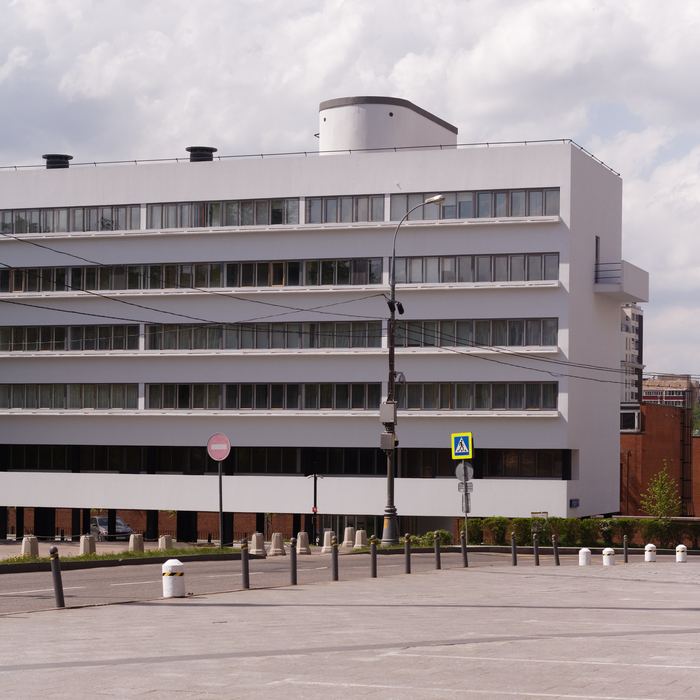
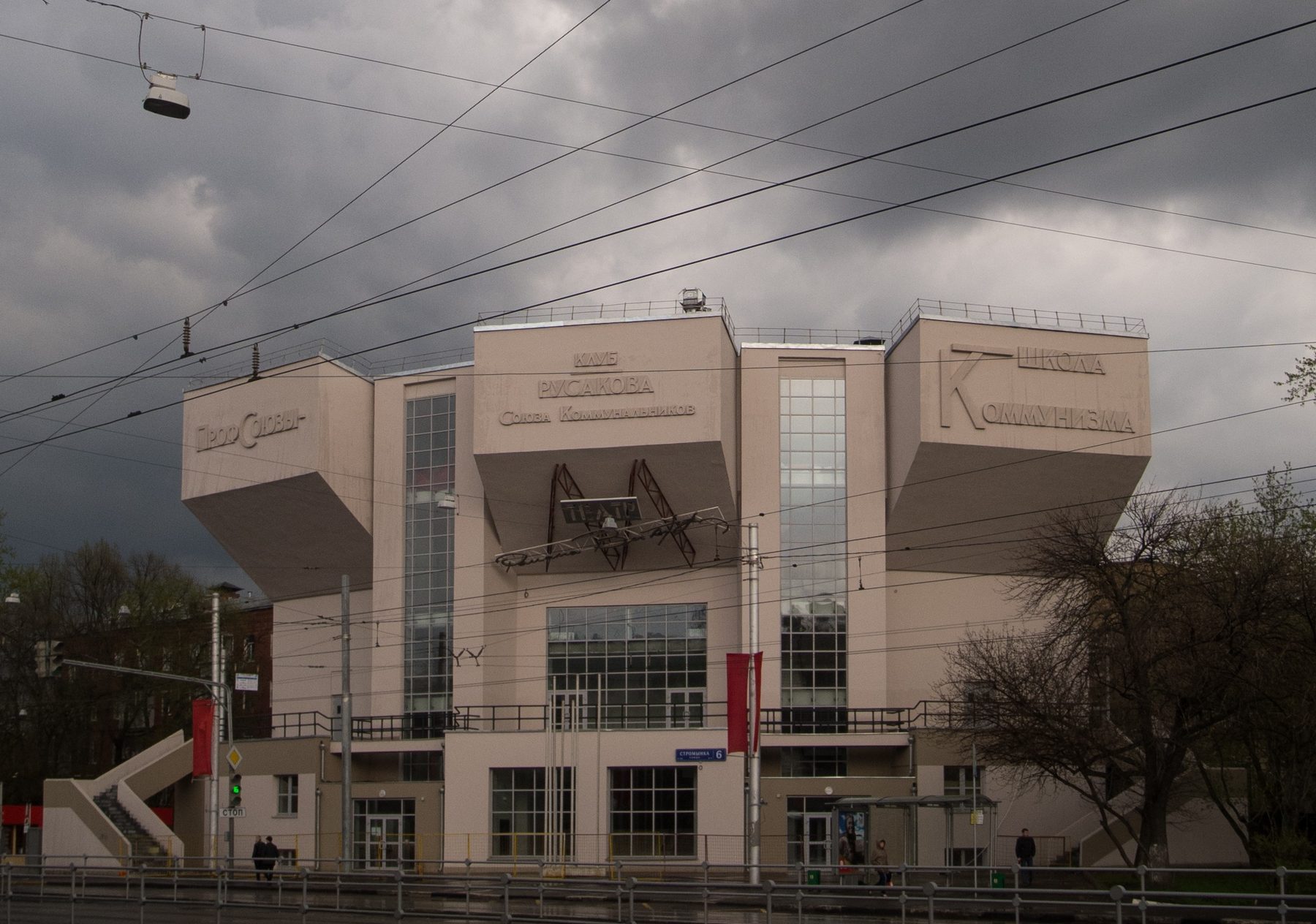
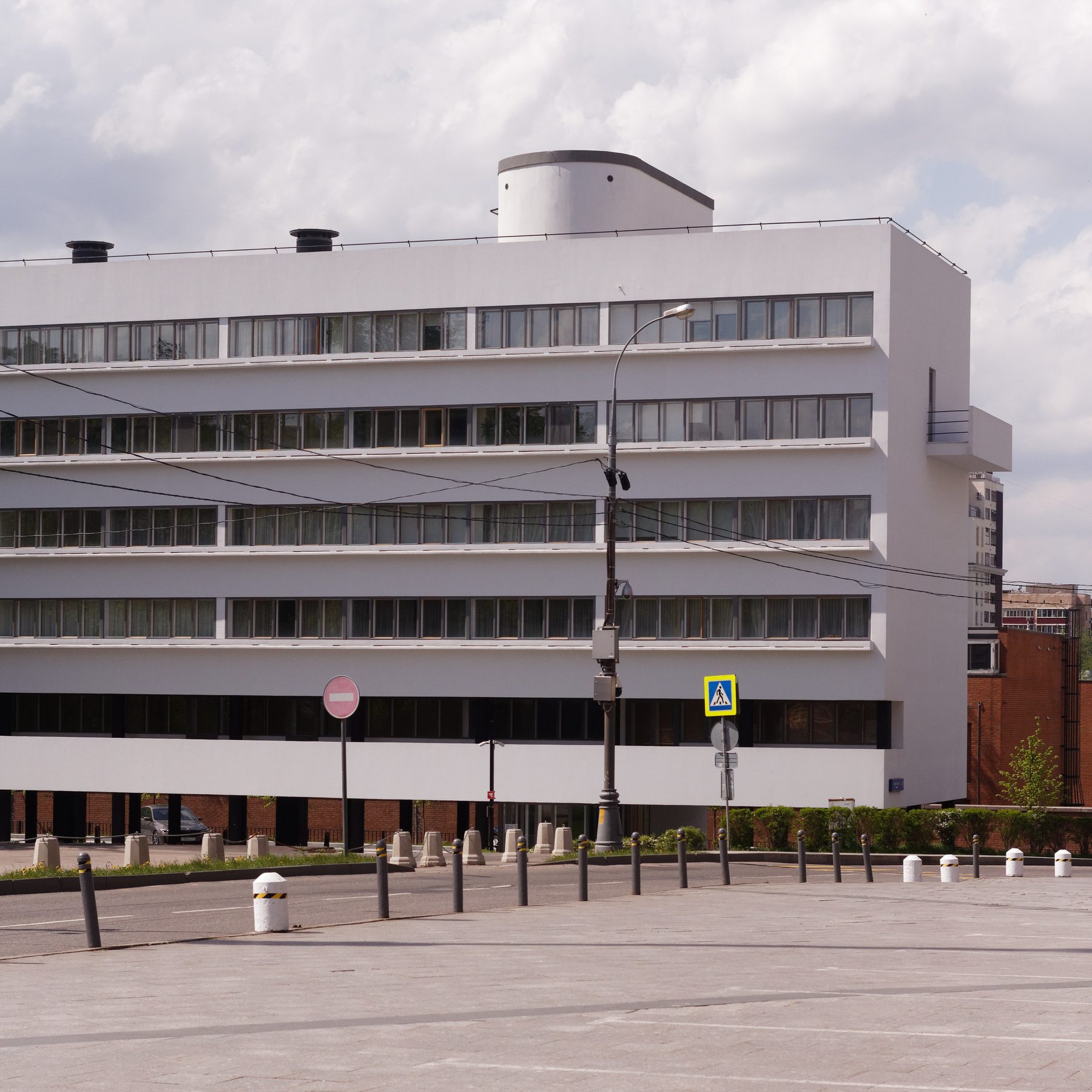
Konstantin Melnikov's workers' clubs were built in several Moscow districts. Their projecting volumes and adaptable halls gave different activities visible form. Melnikov maintained an individual position and should not be forced into a single doctrinal line, yet the clubs share Constructivism's concern with active leisure and social programme. Moisei Ginzburg and Ignaty Milinis's Narkomfin building, completed in 1930, experimented with duplex dwelling units and collective facilities. It sought to mediate a transition between family apartment and communal life rather than simply abolish privacy overnight.
Photographs are indispensable evidence for these buildings. Collections of Soviet avant-garde architectural photography preserve completed structures, models, construction states and projects that have since been altered or lost. They are not neutral records. Choice of angle, light and human presence could make a building appear more dynamic, complete or socially integrated than it was. The photograph was simultaneously document and participant in architectural modernism.[45]
Architecture also circulated through journals. Sovremennaia arkhitektura—Contemporary Architecture, or SA—published photographs, plans, diagrams, translations and polemics. Its pages connected housing research, urban proposals and international modernism. Alfred Barr's collected publications later helped frame Soviet work for Western museums, while exchange with the Bauhaus and European architects created a route that was neither one-way export nor simple imitation.[46]
A Soviet movement with many locations
Moscow supplied the movement's most influential organisations, but Constructivism did not belong to one city or one present-day nation. Petrograd and later Leningrad had distinct artistic and architectural networks. Vitebsk linked Suprematist teaching to Lissitzky's Proun experiments. Kyiv and Kharkiv sustained Ukrainian avant-garde cultures across graphic design, exhibition, painting, theatre and architecture. Berlin became a place of translation, publication and encounter for artists moving west.
Vasyl Yermilov's reliefs and graphic designs are crucial to a less centralised history. Working in Kharkiv, he combined wood, metal, paint and everyday substances in materially direct constructions while shaping Ukrainian journals, interiors and public displays. Composition Number 3 in the Museum of Modern Art is identified within this Constructivist field, but Yermilov's present-day recognition as a Ukrainian artist matters. “Russian avant-garde” remains a familiar historical and museum category; used without qualification, it can absorb the cultures of an imperial and then multinational Soviet space into Russian national history.[49]
Museum taxonomies reflect that problem as well as preserve extraordinary bodies of work. The State Russian Museum situates avant-garde and Constructivist artists inside a collection spanning late imperial, Soviet and contemporary periods. The Tretyakov Gallery reconstructs the movement through works, models and public programmes. These institutions are indispensable, but no collection heading settles an artist's national identity or the political meaning of a work. Labels should be read as acts of classification with their own histories.[21] [22] [50]
Revolution, institutions and suppression
Constructivism's relationship with the Soviet state changed because the state changed. During the civil-war and immediate post-revolutionary years, avant-garde artists held unusual institutional authority. They taught, organised museums, designed festivals and propaganda, and imagined cultural labour as part of social transformation. Scarcity made many proposals impossible, but it also encouraged inexpensive paper structures, agitational display and experiments with reproducible media.[2] [7]
The New Economic Policy from 1921 complicated the picture. State and cooperative firms needed advertisements and packaging; designers who had denounced bourgeois commodity culture now made commercial images. This was not simply hypocrisy. It exposed a real question: could modern advertising forms be redirected toward public enterprise, or would they reproduce the desire and competition of the old market? Reklam-Konstruktor answered practically with brilliant campaigns, without resolving the contradiction.
In the later 1920s, arguments over accessibility and social value hardened into administrative control. Experimental angles, abstract forms and independent groups could be condemned as formalist. Some artists shifted media, some accepted state commissions, some withdrew and some were marginalised or persecuted. The 1932 decree that dissolved independent artistic organisations did not erase every Constructivist method at once, but it removed the plural institutional field in which such debates had flourished. Socialist Realism's consolidation privileged optimistic, legible representation and increasingly treated the avant-garde as a politically suspect past.[2] [3] [6] [30]
It is therefore misleading to imagine Constructivists as outsiders who briefly decorated a revolution. Many were active participants in its cultural institutions and sincerely sought communist forms of life. It is equally misleading to turn participation into proof of complete political control from the beginning. The history moves through enthusiasm, authority, shortage, disagreement, adaptation and coercion. These conditions shaped what could be made and said.
International exchange and afterlives
Constructivism travelled through people and objects: Lissitzky in Berlin and Hanover; the 1922 First Russian Art Exhibition; books and photographs; the Paris exhibition of 1925; visiting architects, teachers and critics; émigré careers. German interest in Soviet functionality and mass communication met Soviet interest in industrial pedagogy. Agit-train displays, VKhUTEMAS courses and Bauhaus workshops entered comparison, but neither institution was a copy of the other.[43] [46]
De Stijl offered another geometric language, yet Piet Mondrian pursued equilibrium through painting rather than the Productivist dissolution of painting into social production. Paul Klee taught at the Bauhaus and belonged to the wider European network through which Soviet work was received, but he was not a Constructivist. Fernand Léger developed a separate French machine modernism. Diego Rivera visited the Soviet Union and shared a commitment to revolutionary public address, while his monumental figurative muralism represented a very different solution. Such comparisons clarify the movement only when difference remains as important as resemblance.
Constructivism's later influence is easiest to see in methods rather than motifs. Modular structure, exposed joints, asymmetric typography, montage, transformable furniture and active exhibition design recur across graphic design, architecture, sculpture and education. Museums have also turned lost projects into reconstructed icons, especially Tatlin's tower and Rodchenko's club. Reconstruction makes ideas encounterable, but it can give an unrealised or temporary experiment the solid authority of a surviving masterpiece.
The movement's most durable challenge is ethical as well as formal. Can design genuinely serve collective life without deciding in advance what people need? Can a useful object remain open to pleasure and choice? Can mass communication educate without becoming propaganda? Constructivism did not answer these questions once. It made them visible in objects whose clarity often conceals the unsettled politics of their making.
How to recognise Constructivism
No single feature proves that a work is Constructivist. Date, place, maker, institution and intended use matter. Several recurring traits can nevertheless guide looking:
- Real or visibly differentiated materials are organised so that their weight, tension, flexibility or method of joining remains legible.
- Open frameworks and intersecting planes define space without enclosing a conventional solid mass.
- Geometric elements follow a repeated or economical system rather than acting only as decoration.
- Type changes scale, angle and weight to direct reading; bars, rules and white space become active components.
- Photographic fragments are cut and recombined, often with extreme contrasts of scale.
- Camera viewpoints from above, below or along a diagonal disrupt habitual eye level.
- Furniture, clothing or stage apparatus is designed around movement, transformation and collective use.
- Architectural drawings display circulation, communication or social programme as visibly as façade.
A red triangle, sans-serif alphabet or photograph at an angle may quote the movement without sharing its social argument. Conversely, a modest textile repeat or book layout can be more fully Productivist than a dramatic abstract painting. The most useful question is not “Does it look Constructivist?” but “What is being constructed, from what, for whom and toward what kind of life?”
Essential works and experiments
Beat the Whites with the Red Wedge
El Lissitzky · 1919–20 · Lissitzky compresses political conflict into geometric pressure, turning a red triangle into an image of directed action.
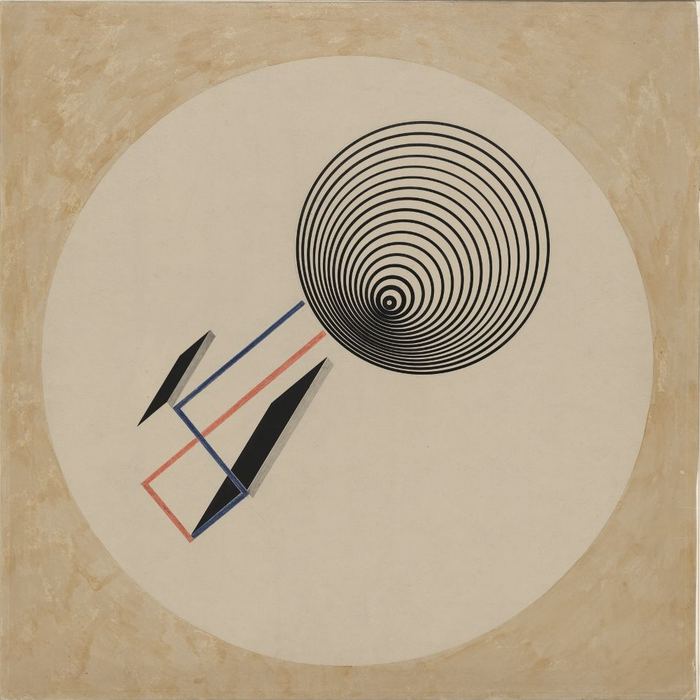
Proun 93
El Lissitzky · c. 1923 · Axes, planes and suspended forms make the picture behave like a proposal for architecture rather than a stable window.
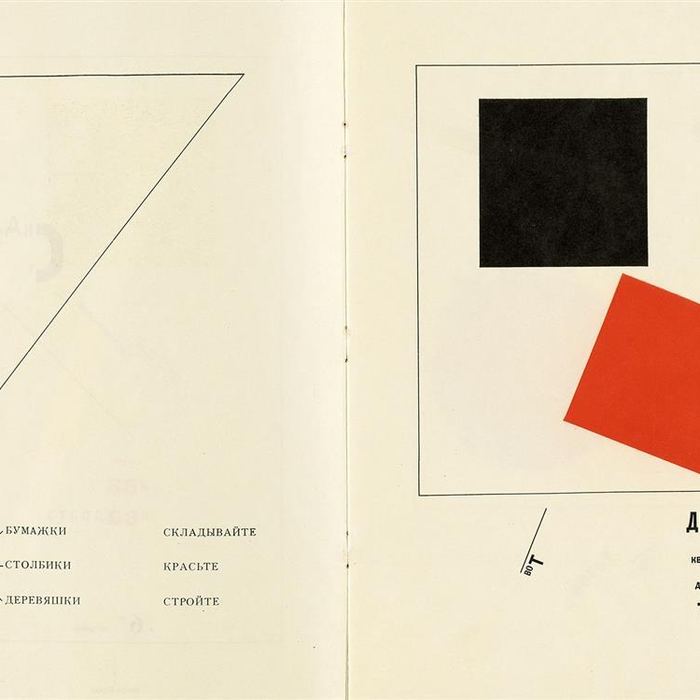
About Two Squares, page 4
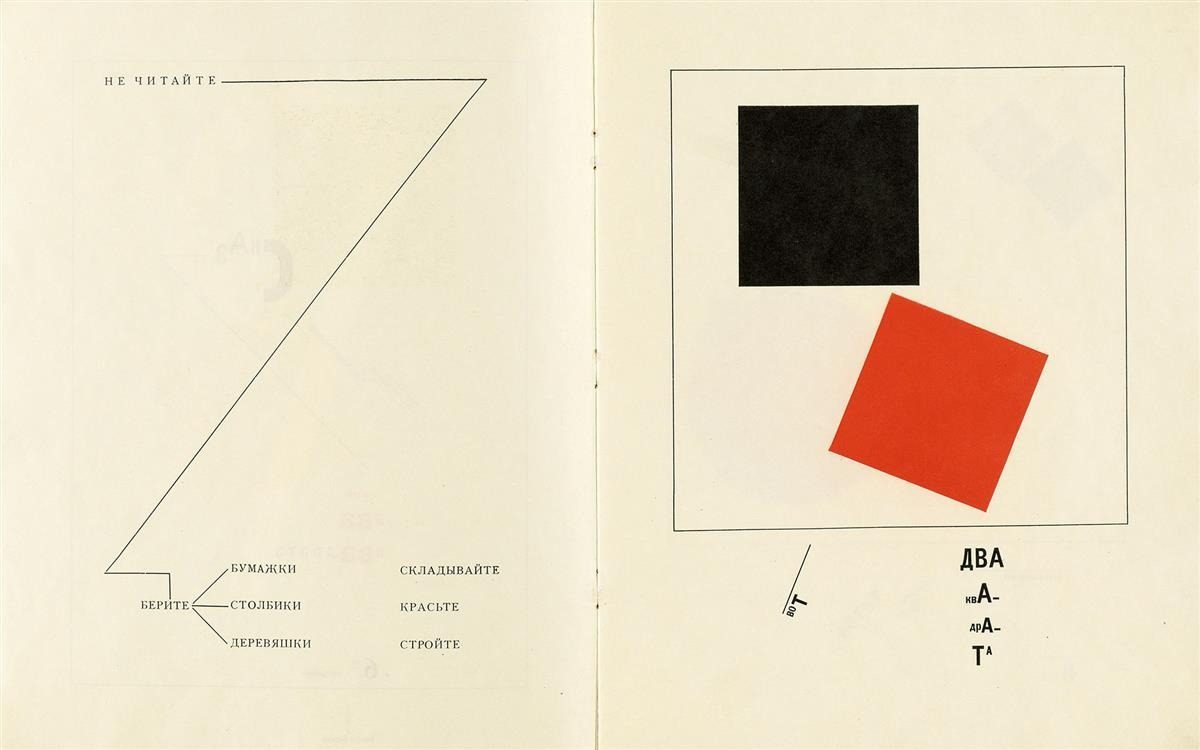
El Lissitzky · 1922 · The children's book turns elementary shapes, sequence and typography into a compact lesson in transformation.
Painterly Architectonic
Liubov Popova · 1917 · Popova gives colour, overlap and angled planes the force of structural loads without depicting a building.
Stage design for The Magnanimous Cuckold
Liubov Popova · 1922 · Popova's skeletal apparatus replaces painted scenery with a machine activated by actors, movement and time.
Model for the Monument to the Third International
Vladimir Tatlin and assistants · 1920 · The surviving photograph records an unrealised collaborative model whose spiral joined revolution, movement and communications.
Corner Counter-Relief
Vladimir Tatlin · 1915 · Tatlin makes the corner an active field of forces, allowing wood, wire and metal to declare their own weight, tension and handling.
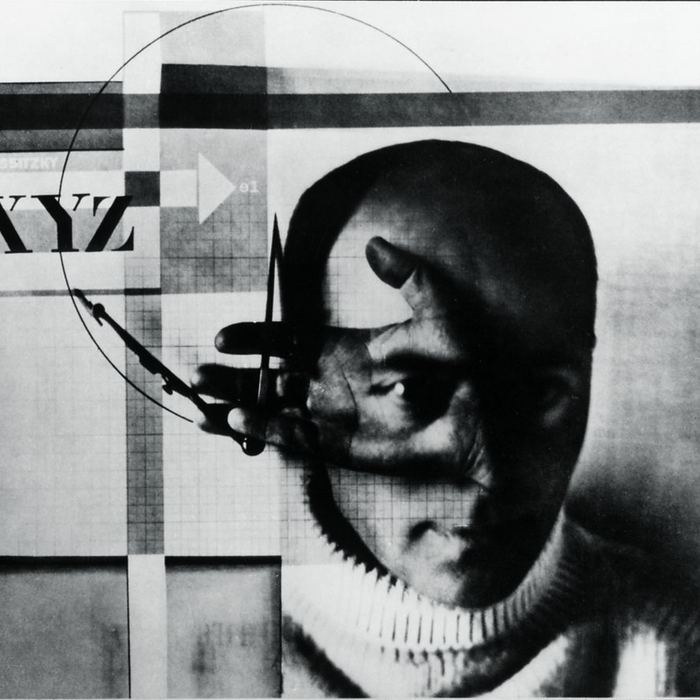
The Constructor (Self-Portrait)
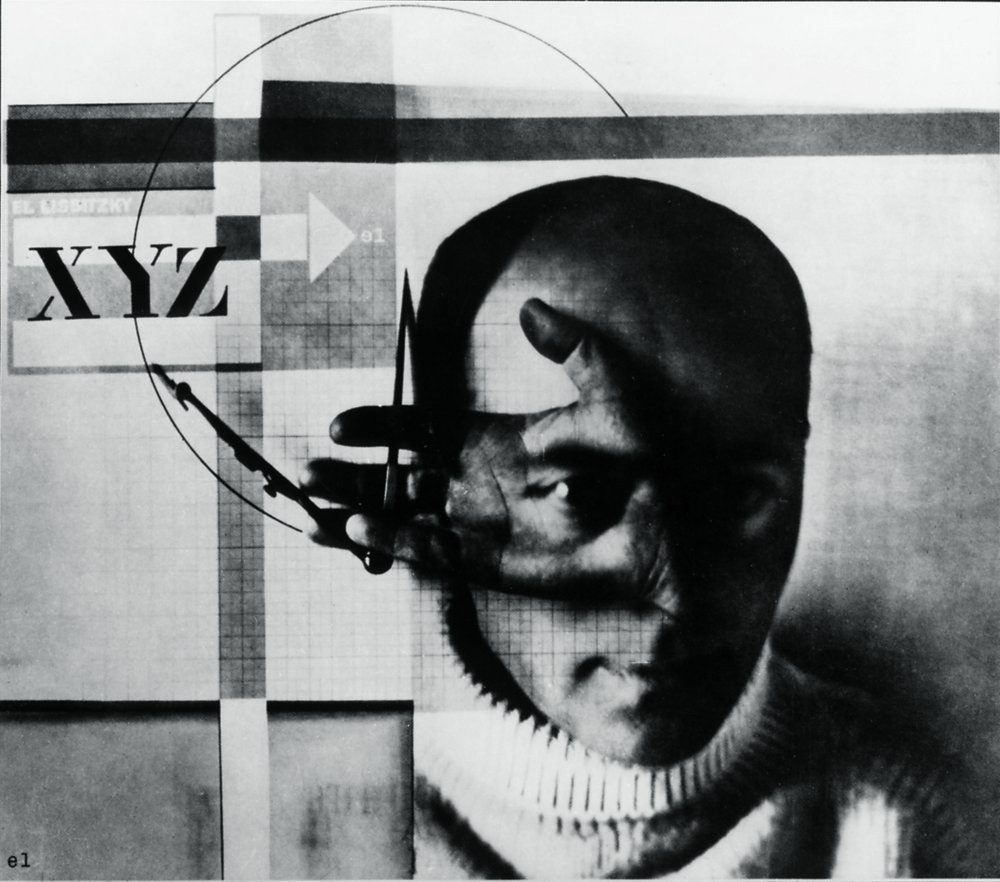
El Lissitzky · 1924 · Lissitzky superimposes eye, hand, compass and type so that authorship appears as a constructed technical process.
Rusakov Workers' Club
Konstantin Melnikov · 1927–29 · Melnikov gives the club's adaptable auditoria a forceful external form, making collective programme legible in the street.
Narkomfin Building
Moisei Ginzburg and Ignaty Milinis · 1928–30 · Ginzburg and Milinis tested duplex dwellings and shared facilities as an architectural mediator between family and communal life.
Where to see Constructivism
The State Tretyakov Gallery in Moscow provides essential Russian avant-garde context and has presented Constructivism through collection displays, lectures and reconstructions. The State Russian Museum in St Petersburg holds major paintings and works on paper across the relevant decades. Present political and travel conditions may affect access; their online collection and scholarly materials remain important research routes.
The Museum of Modern Art in New York holds works by Rodchenko, Popova, Stepanova, Lissitzky, Gabo, Pevsner and Yermilov, along with exceptional books and photographic archives. Its digital exhibitions are particularly useful for connecting objects to institutional chronology. The Museo Reina Sofía in Madrid has mounted substantial exhibitions on Rodchenko, Popova and the Russian avant-garde book, supported by Spanish-language research dossiers.
The Centre Pompidou in Paris combines art, design, photography and documentary holdings, while its Bibliothèque Kandinsky supports research into the movement's writings. The Victoria and Albert Museum in London is especially valuable for theatre and design. The Canadian Centre for Architecture in Montreal preserves photographs that document Soviet modernist buildings and projects. Bauhaus collections in Weimar, Dessau and Berlin help readers examine exchange and difference between the two great experimental school cultures.
Museums, collections and cities to explore
Collections, archives and reconstructed works may rotate or require appointments. Check current displays and access before travelling.
- 01
State Tretyakov Gallery
Moscow, Russia
Collection displays, scholarship and reconstructions place Constructivism inside the wider Russian and Soviet avant-garde.
Soviet avant-garde contextVisit collection website - 02
State Russian Museum
St Petersburg, Russia
Major paintings and works on paper clarify the overlap and distinction among Constructivism, Suprematism and Cubo-Futurism.
Painting and works on paperVisit collection website - 03
Museum of Modern Art
New York, USA
Works by Rodchenko, Popova, Stepanova, Lissitzky and Gabo are supported by exceptional books, catalogues and digital archives.
Objects, print and archivesVisit collection website - 04
Museo Reina Sofía
Madrid, Spain
Major exhibitions and Spanish-language dossiers connect Rodchenko, Popova and the Russian avant-garde book across media.
Cross-media researchVisit collection website - 05
Centre Pompidou
Paris, France
Art, design, photography and Bibliothèque Kandinsky resources support close study of photomontage and Constructivist texts.
Design and documentary holdingsVisit collection website - 06
Victoria and Albert Museum
London, UK
The collection is especially strong for Russian avant-garde theatre, graphic design and Lissitzky's photography.
Theatre and designVisit collection website - 07
Canadian Centre for Architecture
Montreal, Canada
Its photographic holdings preserve essential evidence for altered, lost and unrealised Soviet avant-garde architecture.
Architectural photographyVisit collection website - 08
Bauhaus collections
Weimar, Dessau and Berlin, Germany
The three principal Bauhaus centres let readers examine exchange and difference between German and Soviet experimental schools.
International exchangeVisit collection website
Suggested books
Christina Lodder, Russian Constructivism. A foundational study of the movement's institutions, theories and transition toward Productivism. It remains particularly useful for understanding why construction was a social claim as well as a formal method.
Maria Gough, The Artist as Producer: Russian Constructivism in Revolution. A close account of laboratory work, material experiment and the contested artist-producer. Gough is especially strong on the tension between autonomous research and entry into production.
Margarita Tupitsyn, El Lissitzky: Beyond the Abstract Cabinet. A focused route into Lissitzky's Proun works, exhibitions, photography and international networks, attentive to how works changed through movement and display.
Leah Dickerman, ed., Aleksandr Rodchenko. An extensively illustrated scholarly volume spanning painting, spatial construction, graphic design, photography and the Workers' Club, valuable for resisting a one-medium account.
John E. Bowlt, ed., Russian Art of the Avant-Garde: Theory and Criticism 1902–1934. A collection of translated primary texts that lets readers encounter manifestos and arguments directly. It is best read comparatively, because no single declaration speaks for the whole movement.
Major artists, writers and designers directory
| Name | Nationality | Key Works |
|---|---|---|
| Aleksandr Rodchenko | Russian | Spatial Construction no. 12 · Workers' Club |
| Aleksandra Exter | Ukrainian-French | 5×5=25 · theatre and costume design |
| Aleksei Gan | Russian | Konstruktivizm · First Working Group |
| Alexander Vesnin | Russian | Leningrad Pravda project · 5×5=25 |
| Antoine Pevsner | Russian-French | Realistic Manifesto · constructed sculpture |
| Boris Arvatov | Russian | Art and Production · Productivist theory |
| El Lissitzky | Russian | Proun 19D · About Two Squares |
| Elena Semenova | Russian | Workers' Club Lounge |
| Esfir Shub | Ukrainian-Soviet | The Fall of the Romanov Dynasty · compilation film |
| Georgii Stenberg | Russian-Swedish | film posters · OBMOKhU constructions |
| Gustav Klutsis | Latvian | photomontage posters · agitational design |
| Ignaty Milinis | Ukrainian | Narkomfin Building |
| Ivan Leonidov | Russian | Lenin Institute project · urban proposals |
| Karl Ioganson | Latvian | spatial constructions · First Working Group |
| Konstantin Medunetsky | Russian | OBMOKhU constructions · First Working Group |
| Konstantin Melnikov | Russian | Rusakov Workers' Club · Paris Pavilion |
| Leonid Vesnin | Russian | Leningrad Pravda project · architectural competitions |
| Liubov Popova | Russian | Painterly Architectonics · The Magnanimous Cuckold |
| Moisei Ginzburg | Belarusian-Soviet | Narkomfin Building · SA journal |
| Naum Gabo | Russian-American | Realistic Manifesto · Head of a Woman |
| Nikolai Tarabukin | Russian | From the Easel to the Machine · Productivist theory |
| Osip Brik | Russian | LEF · Productivist criticism |
| Valentina Kulagina | Russian | photomontage posters · exhibition design |
| Varvara Stepanova | Russian | Figure · textiles and production clothing |
| Vasyl Yermilov | Ukrainian | Composition Number 3 · Kharkiv graphic design |
| Viktor Vesnin | Russian | Leningrad Pravda project · industrial architecture |
| Vladimir Mayakovsky | Georgian-born Russian | About This · Reklam-Konstruktor |
| Vladimir Stenberg | Russian-Swedish | film posters · OBMOKhU constructions |
| Vladimir Tatlin | Russian | Corner Counter-Reliefs · Monument to the Third International |
| Vsevolod Meyerhold | Russian | biomechanics · The Magnanimous Cuckold |
Frequently Asked Questions
Constructivism was a predominantly Soviet avant-garde movement that treated art as the organisation of materials, space, visual communication and, increasingly, social use. Its organised core developed around 1920–30, though Tatlin's 1914 counter-reliefs were crucial precedents. It extended across sculpture, painting, typography, photography, theatre, textiles, furniture and architecture.[1] [2]
There was no sole founder. Tatlin's counter-reliefs established an early material model. In 1921, Rodchenko, Stepanova, Gan, Ioganson, Medunetsky and the Stenbergs organised a named working group at INKhUK. Popova, Exter, Vesnin, Lissitzky and others shaped related practices, while Gabo and Pevsner proposed a different Constructivist direction.[8] [24]
Suprematism emphasised non-objective sensation and the autonomy of elementary form. Constructivism increasingly emphasised material behaviour, objective organisation and a social destination. Artists moved between the two fields, so the distinction describes priorities rather than an absolute visual border.[11] [15]
Productivism was the drive to move beyond studio experiment and place artistic knowledge into production, communication and everyday life. It encouraged work in textiles, clothing, print, theatre and industrial design. Limited factory access and material conditions meant that many proposals remained prototypes or designs rather than mass-produced objects.[36] [40]
The Monument to the Third International compressed revolutionary ambition into a memorable open spiral that joined architecture, movement and communication. Models, photographs and publications circulated widely. The original models are lost, so museum versions today are reconstructions rather than surviving 1920 objects.[20] [22] [23]
Some publicly rejected easel painting's privileged status, especially around 5×5=25 in 1921. The change was neither simultaneous nor complete. Popova's paintings were central to the development of construction, and Rodchenko continued to compose images through photography and print after declaring painting exhausted.[10] [12] [16]
Yes. Popova, Stepanova and Exter were leading artists, teachers and designers; Semenova, Kulagina, Shub and others expanded the movement across interiors, graphics and film. Their work was often classified as applied or collaborative and consequently received less canonical attention, even though those fields were central to the movement's social purpose.[5] [39] [42]
It developed within the Russian Empire's aftermath and the early Soviet Union, with Moscow as a major institutional centre. It also included distinct Ukrainian, Belarusian and other locations and identities. “Russian Constructivism” is an established term, but it should not erase the multinational geography of Soviet culture or equate all participants with Russian ethnicity.[49] [50]
Rodchenko and others used steep views from above or below, diagonals, close cropping, repetition and montage. These devices were intended to challenge habitual perception and teach viewers to see a changing modern environment. Context matters because similar angles later became common throughout photography and advertising.[48]
Some Constructivists designed explicitly propagandistic publications, displays and public messages. They also made experimental constructions, commercial advertising, theatre, textiles, housing and educational work. The movement's close involvement with revolutionary institutions cannot be reduced either to state command or to politically innocent abstraction.[2] [6] [7]
Its institutions and networks weakened as Soviet cultural policy centralised in the late 1920s and early 1930s. Accusations of formalism narrowed permissible experiment, independent organisations were dissolved in 1932 and Socialist Realism became dominant. Individual artists continued working, but the open collective movement no longer operated under the same conditions.[2] [3] [6]
It offered transferable methods: modular construction, exposed material relations, asymmetric page design, photographic montage, active exhibition space and furniture organised around use. Later designers often adopted these methods—or only their visual signs—under very different political conditions.[4] [33] [47]
Discussion
Which Constructivist work most changes your idea of what art can be: a suspended object, textile, photograph, book, stage machine, club interior or architectural project? When does design for collective life become enabling, and when does it begin to prescribe how people should behave? Share the object that makes that tension clearest to you.
Reader Insights
Ask how wood, wire, paper, type, cloth or concrete determines the work instead of treating geometry as decoration.
Distinguish a proposal, prototype, reconstruction and manufactured object before judging whether art truly entered everyday life.
Schools, journals, workshops, state agencies and political restrictions are part of each object’s history, not background scenery.
Join the Conversation
Which Constructivist work most changes your idea of what art can be—and when does collective design begin to prescribe behaviour?
References
- Constructivism. The Museum of Modern Art. View Source
- A Revolutionary Impulse: The Rise of the Russian Avant-Garde. The Museum of Modern Art. View Source
- Revolution: Russian Avant-Garde, 1912–1930. The Museum of Modern Art. View Source
- Contrasts of Form: Geometric Abstract Art, 1910–1980. The Museum of Modern Art. View Source
- Engineer, Agitator, Constructor: The Artist Reinvented. The Museum of Modern Art. View Source
- Aleksandr Rodchenko: Introduction. The Museum of Modern Art. View Source
- Aleksandr Rodchenko: Chronology. The Museum of Modern Art. View Source
- Aleksandr Rodchenko: New Cultural Institutions. The Museum of Modern Art. View Source
- VKhUTEMAS. The Museum of Modern Art. View Source
- New in the Galleries: The Russian Avant-Garde. The Museum of Modern Art. View Source
- The Subject of Nonobjective Art. Post / The Museum of Modern Art. View Source
- The Death of Painting. The Museum of Modern Art. View Source
- Spatial Construction no. 12. The Museum of Modern Art. View Source
- Rodchenko: Spatial Constructions. The Museum of Modern Art. View Source
- Liubov Popova: Painterly Architectonic. The Museum of Modern Art. View Source
- Liubov Popova. The Museum of Modern Art. View Source
- Liubov Popova. The Museum of Modern Art. View Source
- Varvara Stepanova: Figure. The Museum of Modern Art. View Source
- Varvara Stepanova. The Museum of Modern Art. View Source
- Vladimir Tatlin: Monument to the Third International. The Museum of Modern Art. View Source
- Vladimir Tatlin. State Russian Museum (Russian; consulted in Russian). View Source
- Lecture: Constructivism. State Tretyakov Gallery (Russian; consulted in Russian). View Source
- Tatlin: Model for the Monument to the Third International. The Museum of Modern Art. View Source
- Gabo and Pevsner: Realistic Manifesto. The Museum of Modern Art. View Source
- Naum Gabo and Antoine Pevsner. The Museum of Modern Art. View Source
- Naum Gabo: Head of a Woman. The Museum of Modern Art. View Source
- El Lissitzky: Proun 19D. The Museum of Modern Art. View Source
- The Many Lives of El Lissitzky's Proun 19D. Post / The Museum of Modern Art. View Source
- The Russian Avant-Garde Book 1910–1934. The Museum of Modern Art. View Source
- El libro ruso de vanguardia 1910–1934. Museo Nacional Centro de Arte Reina Sofía (Spanish; consulted in Spanish). View Source
- Rodchenko: About This. To Her and to Me. The Museum of Modern Art. View Source
- Popova, Rodchenko and Stepanova: LEF no. 2. The Museum of Modern Art. View Source
- Constructivist Book Design. Margit Rowell / The Museum of Modern Art. View Source
- Accrochage Photos: Photomontage. Centre Pompidou (French; consulted in French). View Source
- L'Art dans la vie: le constructivisme soviétique dans les textes. Bibliothèque Kandinsky / Centre Pompidou (French; consulted in French). View Source
- L'Art dans la vie: une anthologie de la pensée constructiviste. Centre Pompidou (French; consulted in French). View Source
- Rodchenko y Popova: Definiendo el constructivismo. Museo Nacional Centro de Arte Reina Sofía (Spanish; consulted in Spanish). View Source
- Rodchenko y Popova: Dossier. Museo Nacional Centro de Arte Reina Sofía (Spanish; consulted in Spanish). View Source
- Russian Avant-Garde Theatre: War, Revolution and Design 1913–1933. Victoria and Albert Museum. View Source
- Russian Arc. Victoria and Albert Museum. View Source
- Rodchenko: Workers' Club 1925. The Museum of Modern Art. View Source
- Elena Semenova: Workers' Club Lounge. The Museum of Modern Art. View Source
- Der Blick nach Russland. Bauhaus Kooperation (German; consulted in German). View Source
- Architectural Drawings of the Russian Avant-Garde. The Museum of Modern Art. View Source
- Photographs of Soviet Avant-Garde Architecture. Canadian Centre for Architecture. View Source
- Unpacking Barr's Library: The Paper Trail from the Bauhaus to VKhUTEMAS. Post / The Museum of Modern Art. View Source
- Stenberg Brothers: Constructing a Revolution in Soviet Design. The Museum of Modern Art. View Source
- Photography Between the Wars. Metropolitan Museum of Art. View Source
- Vasyl Yermilov: Composition Number 3. The Museum of Modern Art. View Source
- Collections: Painting of the Late Nineteenth to Twenty-First Century. State Russian Museum (Russian; consulted in Russian). View Source
- Constructivism image records. Wikimedia Commons: Beat the Whites with the Red Wedge (Public domain; El Lissitzky), Proun 93 (Public domain; El Lissitzky), About Two Squares, page 4 (Public domain; El Lissitzky), Painterly Architectonic (Public domain; Liubov Popova), Stage design for The Magnanimous Cuckold (Public domain; Liubov Popova), Model for the Monument to the Third International (Public domain; Unknown photographer), Corner Counter-Relief (Public domain; Unknown photographer), The Constructor (Self-Portrait) (Public domain; El Lissitzky), Rusakov Workers' Club (CC BY-SA 4.0; Jihor), Narkomfin Building (CC0; Retired electrician), Aleksandr Rodchenko and Varvara Stepanova (Public domain; Unknown photographer), The Billiard Players (CC BY-SA 4.0; G41rn8).