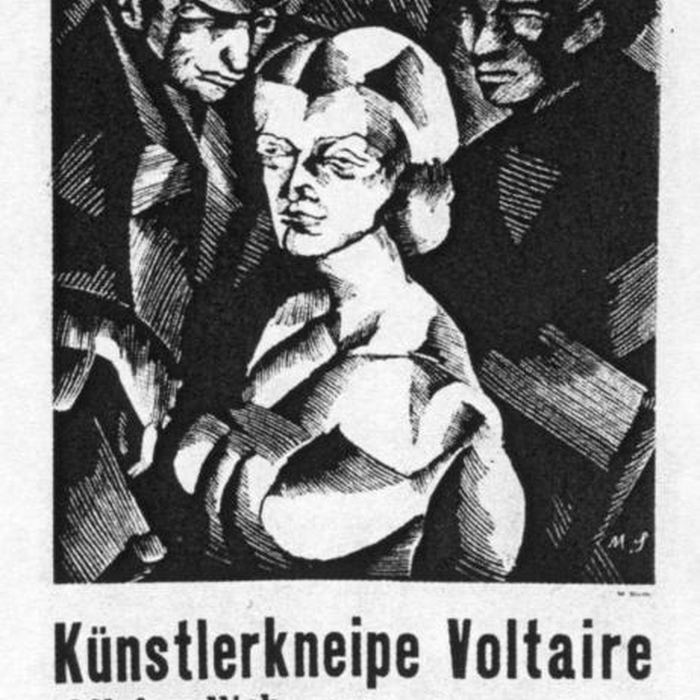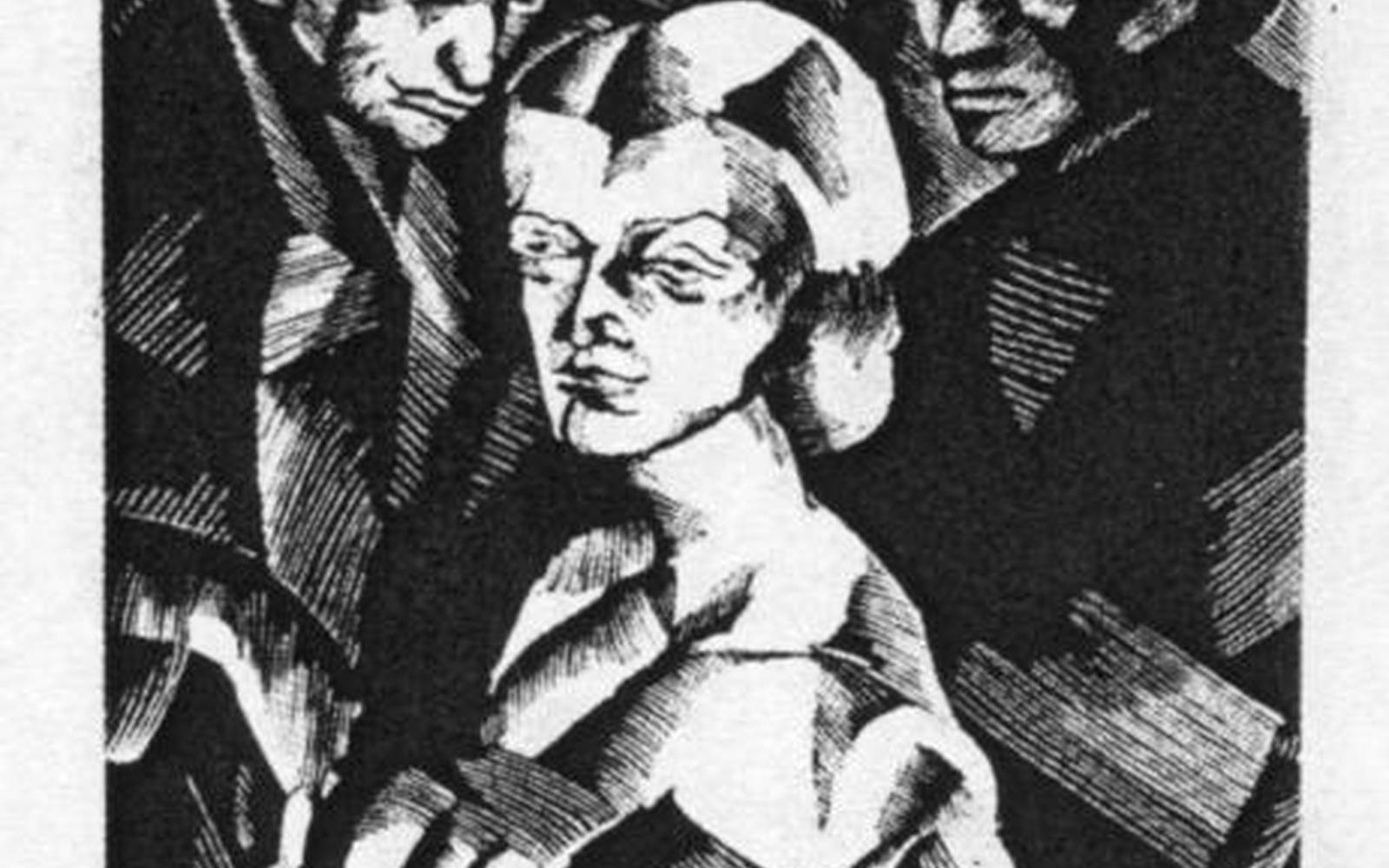
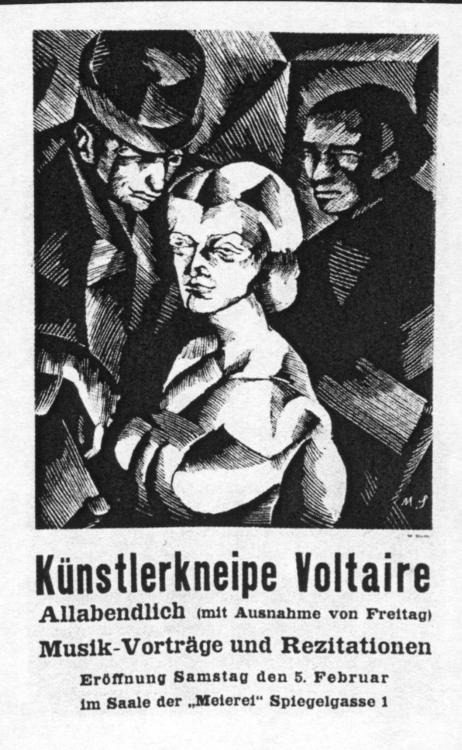
Image reference: Marcel Słodki's poster for Cabaret Voltaire, 1916.
At a Glance
- Core period1916–1924, with important prehistories before the name and extensions after the groups dispersed
- Principal centresZurich, New York, Berlin, Cologne, Hannover and Paris
- Known forperformance, sound poetry, chance, collage, photomontage, assemblage, readymades, experimental typography and film
- Historical settingthe First World War, exile, revolution, mass media, industrial production and distrust of cultural authority
- Key figuresEmmy Hennings, Hugo Ball, Tristan Tzara, Sophie Taeuber-Arp, Hans Arp, Marcel Janco, Marcel Duchamp, Man Ray, Elsa von Freytag-Loringhoven, Hannah Höch, Raoul Hausmann, John Heartfield, George Grosz, Max Ernst, Kurt Schwitters, Francis Picabia and Suzanne Duchamp
- Central questioncan art expose the irrational systems hidden inside respectable ideas of reason, order and taste?
Contents
- Where it fits
- What was Dada?
- Zurich
- New York
- Berlin
- Four stages
- Artists and writers
- Paris
- Essential works
- Where to see Dada
Where Dada fits
Emmy Hennings
Principal activityHugo Ball
Principal activitySophie Taeuber-Arp
Principal activityMarcel Duchamp
Principal activityHannah Höch
Principal activityMax Ernst
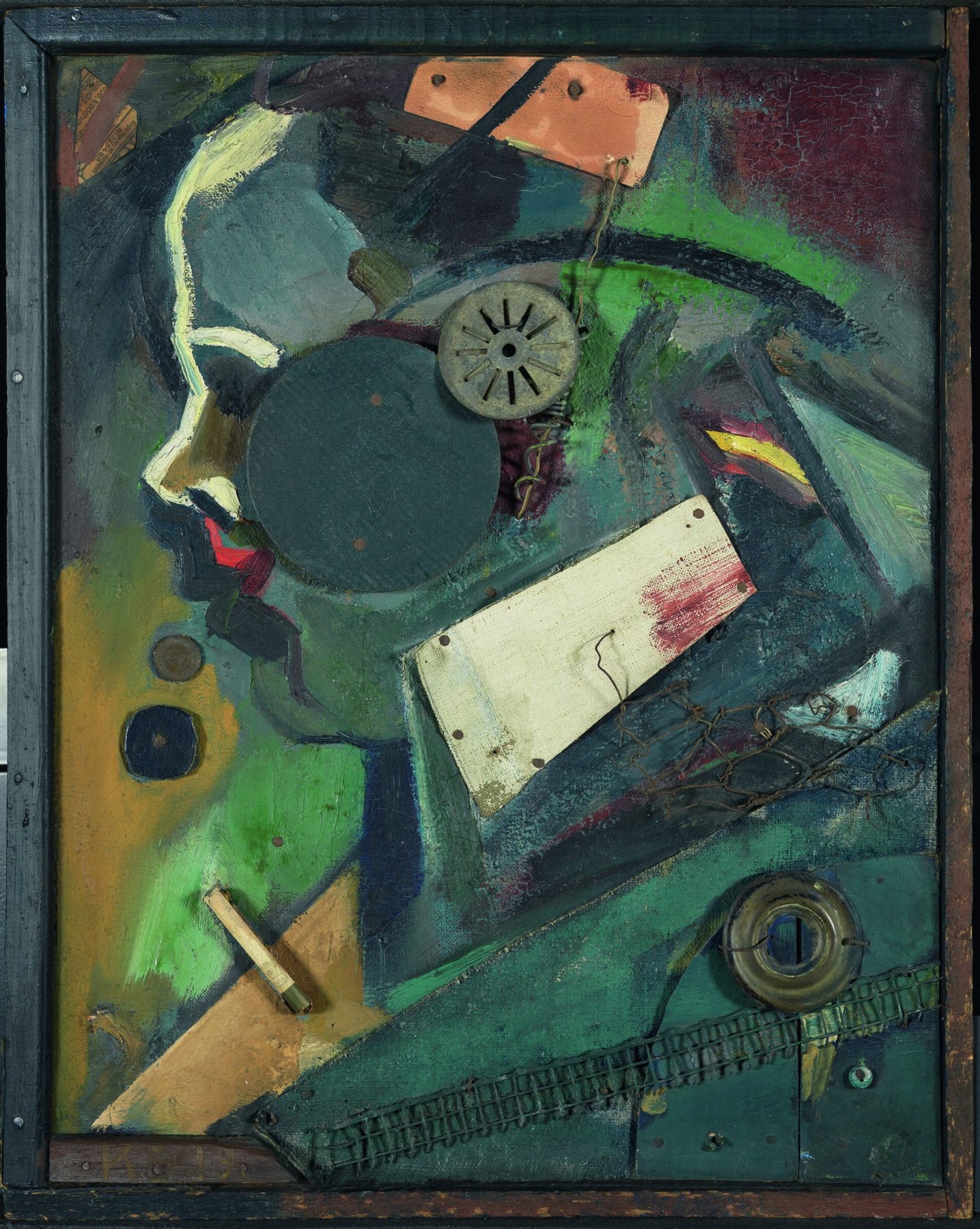
Principal activityKurt Schwitters
Principal activityFrancis Picabia
Principal activityDada refused to behave like a normal art movement. It had no stable style, no uncontested leader and no programme that survived its own appetite for contradiction. Between 1916 and about 1924, artists and writers in several cities turned cabaret songs, broken language, newspaper photographs, discarded objects, chance events and public scandal into instruments for testing what culture meant after mechanised war. They called their work anti-art, then made some of the century's most consequential art.[1]
The movement developed through exchanges among Zurich, New York, Berlin, Cologne, Hannover and Paris, but each centre answered different conditions. Zurich was a refuge for exiles. New York challenged exhibition systems and the cult of handcraft. Berlin converted the illustrated press into revolutionary photomontage. Cologne cultivated obstruction and impossible imagery. Kurt Schwitters built a separate world called Merz in Hannover. Paris made manifestos, festivals and quarrels into public theatre.[2]
Dada's methods now seem familiar because later art absorbed them: the found object, the collage of mass media, the artist's invented identity, the performance that survives as documentation, and the idea that context can change an ordinary thing. Their familiarity should not make them tame. Dada asked whether inherited reason, beauty and professional authority deserved obedience when the society that valued them had organised industrial slaughter.
What was Dada?
Dada was an international network and a repertoire of actions, not a common appearance. A geometric embroidery, a urinal, a political photomontage, a nonsense poem and a film of a runaway funeral can all belong to its history without looking alike. Participants worked through painting and sculpture, but also through dance, publishing, photography, theatre, advertising, typography, correspondence and the manipulation of exhibitions.[3]
The word itself resists a single origin. One story has it discovered by chance in a French dictionary, where dada means a child's hobbyhorse. Other explanations invoke baby talk or words that sound different across languages. The participants added incompatible anecdotes of their own. An empty, repeatable pair of syllables was useful precisely because nobody could own its definition.[4]
“Anti-art” is often used as shorthand. It did not mean that Dadaists stopped making things or wanted every cultural practice to vanish. They attacked the rules deciding which things counted as art, who possessed artistic authority and why technical skill or permanence should guarantee value. The resulting objects could be carefully composed, materially inventive and visually compelling. Their negation was productive: it opened the art object to accident, language, industrial manufacture, reproduction and the viewer's judgement.[5]
Nor was every absurd gesture empty fun. Curator Leah Dickerman has emphasised Dada as an ethical response to crisis, a point that corrects the image of pranksters making random noise for its own sake.[6] Humour mattered because solemn official language had justified war, nation and sacrifice. Laughter could puncture that authority. It could also be cruel, exclusionary or evasive. Dada's strongest work leaves those possibilities unsettled.
A short timeline
- 1913–15: Duchamp develops chance procedures and objects later called readymades; Picabia and Man Ray explore machine imagery and found materials in New York.
- 5 February 1916: Hugo Ball and Emmy Hennings open Cabaret Voltaire in Zurich.
- June–July 1916: sound poems, simultaneous verse, masks and the first Dada evening establish the movement's public vocabulary.
- 1917: Galerie Dada continues Zurich activity; Fountain is rejected in New York.
- 1918: Tzara publishes his major Dada manifesto; Huelsenbeck helps form Club Dada in Berlin; Sophie Taeuber creates the King Stag marionettes.
- 1919: Cologne Dada and Schwitters's Merz emerge; Paris receives Dada publications and personalities.
- 1920: Tzara settles in Paris; Berlin holds the First International Dada Fair.
- 1921: Paris festivals and staged trials intensify; Man Ray moves to Paris; New York Dada appears for one issue; Tzara's Dadaglobe remains unrealised.
- 1922–23: disputes fracture Paris Dada; Schwitters develops Merz publications and begins the Hannover Merzbau.
- 1924: Breton issues the first Surrealist Manifesto; Picabia's ballet Relâche and René Clair's film Entr'acte mark a late Dada threshold.
Museum surveys commonly use 1916–1924 because the named groups had largely dispersed or changed direction by the latter date.[7] The boundary is practical rather than absolute. Dada began before everyone used the word and continued through Merz, film, publishing and later alliances.
Follow Dada through four stages
–1915
Chance, machines and objects unsettle art
Duchamp, Picabia and Man Ray question measurement, painting and handcraft in New York and Paris before the Zurich name exists.
–1917
Cabaret makes a movement
Ball, Hennings, Tzara, Janco, Arp and Taeuber-Arp turn a short-lived Zurich venue into a multilingual laboratory of voice, costume, print and abstraction.
–1920
Dada splits into distinct cities
Berlin photomontage, Cologne obstruction, Hannover Merz and Zurich publications answer revolution, occupation, media and material waste through different procedures.
–1924
International publicity and fragmentation
Paris performances, Dadaglobe, journals, films and disputes make refusal public before Surrealism reorganises part of the network and other practices continue separately.
Zurich: a refuge that became a stage
Switzerland remained neutral during the First World War, and Zurich attracted refugees, political exiles, conscientious objectors, deserters and intellectuals displaced from several countries. Neutrality did not make the city tranquil. News of the fighting, economic hardship, surveillance and political argument filled daily life. Dada formed among people whose languages and passports embodied the failure of nationalist Europe.
On 5 February 1916, Ball and Hennings opened Cabaret Voltaire in the back room of the Meierei tavern at Spiegelgasse 1. Hans Arp, Marcel Janco, Tristan Tzara, Marcel Słodki and others joined quickly; Richard Huelsenbeck arrived later that month. The Kunsthaus Zurich describes the founders as migrants arriving from different corners of Europe, an international condition that was structural rather than decorative.[9]
The little room contained a piano, a small stage and an exhibition of modern art. Hennings and Ball wanted an open artists' cabaret, and they solicited contributions without imposing one movement. Events took place on most nights until the venue closed in July. Songs, piano music, dance, poetry, lectures, masks, puppet theatre and noise followed one another too rapidly for the categories to remain secure.[10]
This history restores cabaret to the origins of Dada. The movement was not born when painters agreed on a look. It emerged through a venue, a schedule, an audience and the labour required to keep a precarious entertainment space active. Ball and Hennings brought experience from German literary and variety cabaret; Tzara brought an instinct for publication and publicity; Janco brought masks and stage imagery; performers brought bodies and voices.[11]
The 1916 anthology Cabaret Voltaire carried that temporary room into print. Edited by Ball, it combined visual work and literature in several languages and announced a projected review called Dada. Its design, small edition and variant covers show that reproducibility did not require indifference to material form. Print made the local evening portable while preserving its international mixture.[12]
Emmy Hennings and the work of making a movement
Emmy Hennings was a cofounder, not the hostess standing beside a male theorist. She contacted potential contributors, performed songs and dances, recited poetry and supplied professional stage knowledge. Her writing drew on poverty, prison, street life, sexuality and religious searching. Dada histories centred on manifestos often pushed her aside because she did not turn self-promotion into a theoretical system.[13]
That omission changes the movement's meaning. Through Hennings, Dada begins partly in popular entertainment, women's paid performance and the unstable social worlds of cabaret. Her familiar songs shared a programme with experiments in broken language. The shock came from collision: sentimental melody beside abstract verse, a solemn recitation interrupted by percussion, or a recognisable dance displaced by a mask.
Sound poetry and the body of language
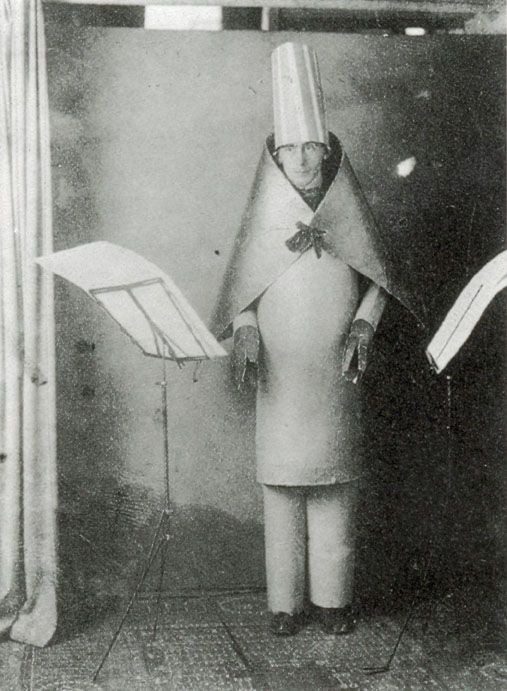
Ball's sound poems removed ordinary syntax while retaining the physical elements of speech: breath, vowel, consonant, tempo and emphasis. In his celebrated bishop-like cardboard costume, he could barely move naturally. Voice and garment worked together, turning recitation into an awkward ritual. The poem was neither a code awaiting translation nor merely babble. It staged a search for utterance outside words damaged by propaganda.
Simultaneous poems used several speakers at once. Distinct languages, whistles, shouts and rhythmic syllables competed until no single semantic line dominated. This was an image of modern communication and its breakdown, but also a practical form of international coexistence: speakers remained different without merging into a national chorus.
The movement's language experiments were not wholly without precedents. Futurist performance, Expressionist poetry, popular cabaret and theories of abstraction all mattered. Ball knew the writings and theatrical ideas surrounding Wassily Kandinsky, but Dada redirected total-art ambitions away from spiritual harmony toward collision and instability.
Janco's masks and the colonial archive
Marcel Janco built masks from cardboard, cloth, wire, paint and other cheap materials. Worn in dances, they enlarged or concealed the face and seemed to dictate stiff, exaggerated movement. Their impermanence suited the cabaret: the object existed to alter a body in time, not to sit silently on a pedestal.[15]
The masks also expose a central contradiction. Zurich Dadaists associated African and Oceanic objects, poems and music with a supposedly direct, instinctive alternative to European civilisation. Programmes used the racial language of their era, and Tzara's so-called African poems came through European ethnographic publications rather than collaboration with the cultures named. Janco's poster for Chant nègre belongs to this mediated primitivism.[14]
Rejecting European academic hierarchy did not free Dada from colonial power. Museums, books and imperial trade had removed objects and words from specific makers and communities, then presented them as anonymous evidence of “primitive” life. Dadaists transformed those forms but also used that anonymity. A responsible account can recognise the masks' performance innovation without repeating the fantasy that non-European cultures existed as raw material for European renewal.
Sophie Taeuber-Arp: dance, textiles and abstraction
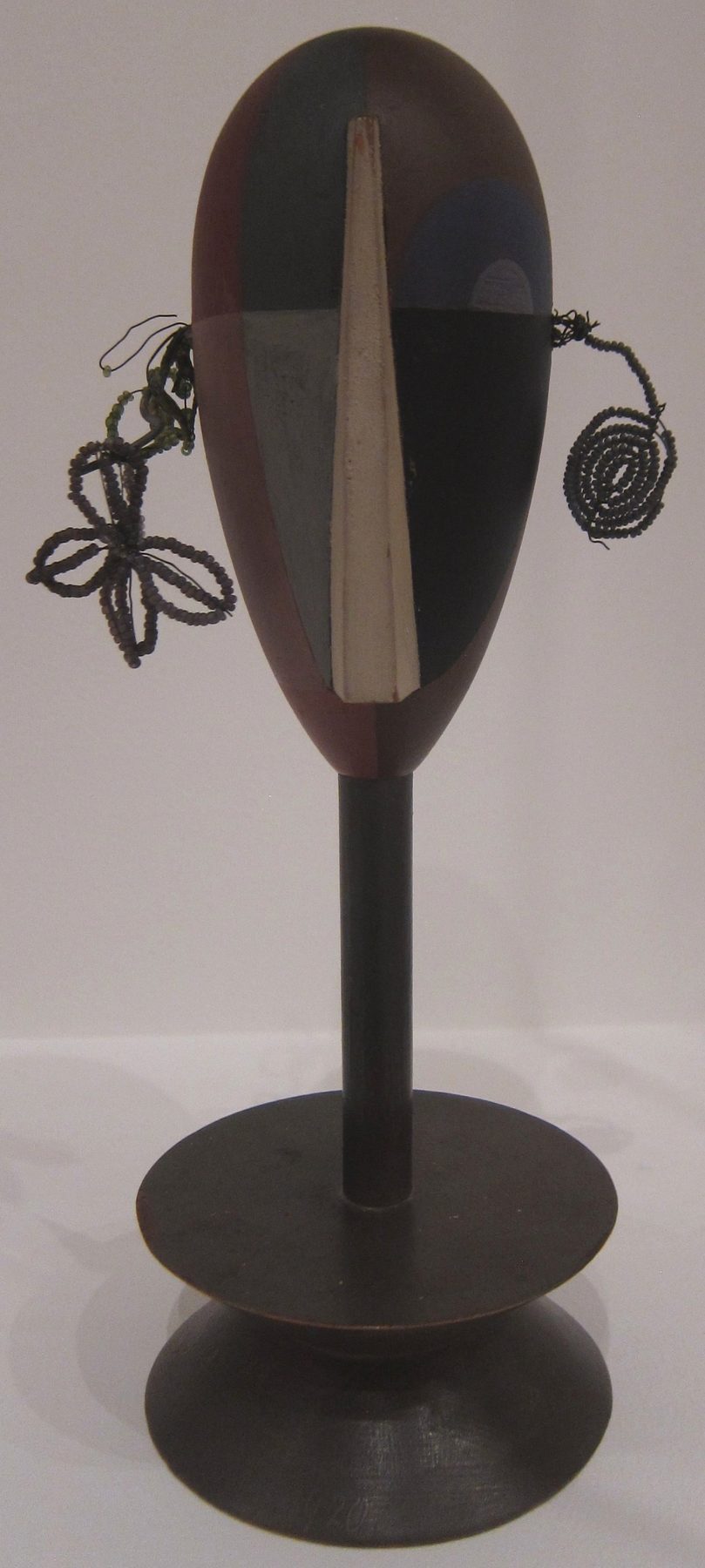
Sophie Taeuber-Arp moved across practices that art history long ranked unequally. She studied expressive dance, taught textile design, made beadwork and embroideries, developed geometric compositions, designed furniture and interiors, carved heads and performed in masked Dada events. Her work did not wander from craft into serious art; it demonstrated that the division was artificial.[16]
Her vertical-horizontal compositions grew through grids, repeated units, colour intervals and small disruptions. Textile logic was a source of abstraction, not an applied use of ideas invented elsewhere. Yet Dada publications and later histories often described her first as dancer or craftworker while granting male colleagues the status of autonomous artists. The Kunsthaus's study of Rythmes libres makes that imbalance part of the work's reception history.[17]
The 1918 marionettes for King Stag transformed turned wooden spheres, cones and cylinders into jointed characters. The adapted play mocked psychoanalysis through figures such as Freudanalyticus. Painted surfaces, dangling limbs and visible hardware made motion and construction inseparable. The puppets were so unconventional that the organisers doubted them, while Dada colleagues recognised their force immediately.[18]
Taeuber-Arp's masked dances and marionettes do something slogans alone cannot: they show a body becoming geometric without becoming mechanical obedience. Joints swing, costumes restrict, colours flash and identity remains hidden. Her work gives Dada a disciplined, constructive abstraction that complicates the cliché of pure destruction.
Arp and negotiated chance
Hans Arp's torn-paper collages are associated with the story that he dropped scraps and pasted them where they landed. The method surrendered part of composition to gravity. Close examination, however, suggests carefully prepared paper and possible adjustment. The result may represent chance as much as record it exactly.[19]
That ambiguity is valuable. Dada chance did not require an artist to disappear. It created a rule that weakened habitual choice, then left decisions about selection, preservation and presentation. Contingency became a collaborator. The procedure questioned the fantasy that a composition issued entirely from individual mastery.
Artists and writers to know
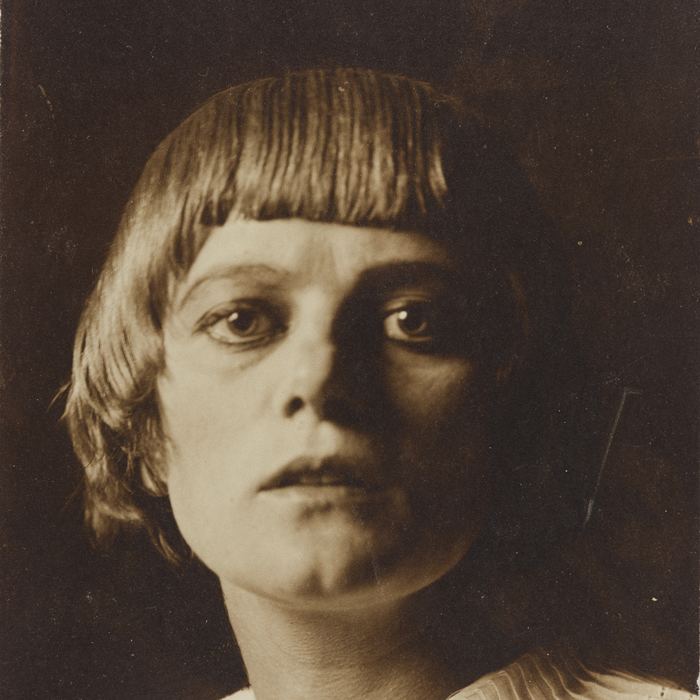
Emmy Hennings
Hennings co-founded Cabaret Voltaire, secured contributors and brought professional singing, dancing and recitation to Dada's first working stage.
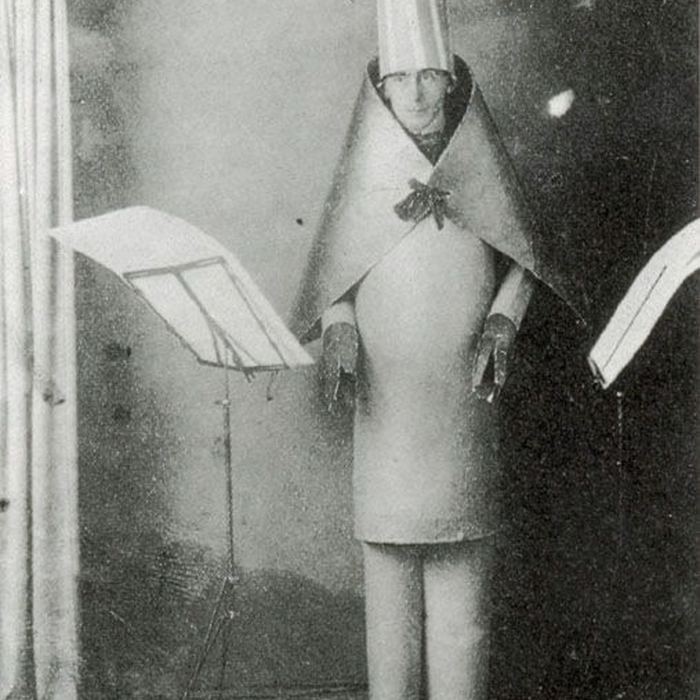
Hugo Ball
Ball turned breath, costume and invented syllables into a physical critique of national language damaged by propaganda.
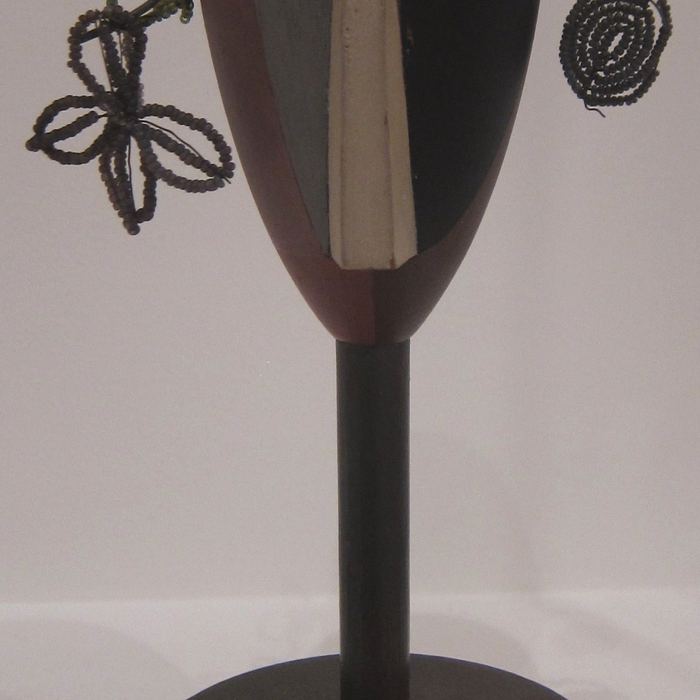
Sophie Taeuber-Arp
Taeuber-Arp dissolved the hierarchy between applied and fine art through disciplined abstraction, masked dance and constructed figures.
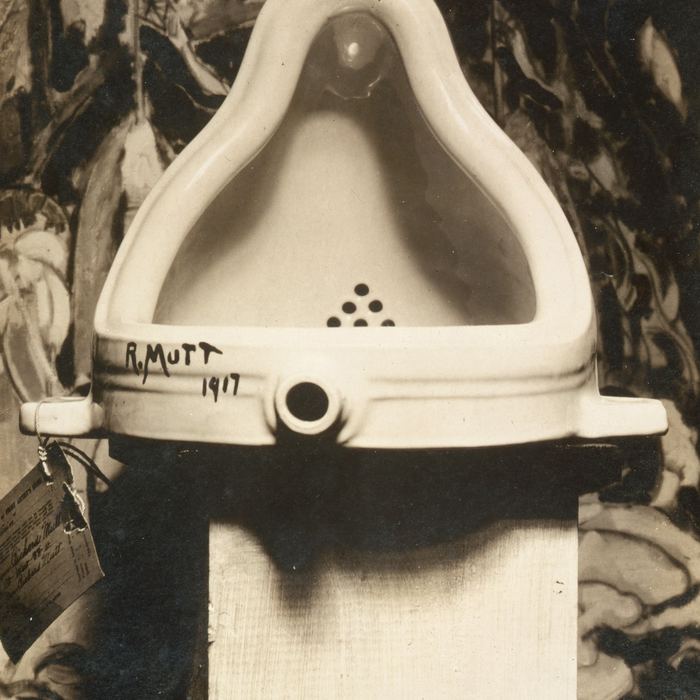
Marcel Duchamp
Duchamp shifted artistic action toward choice, title, context and reproduction, making institutions and documentation parts of the work.
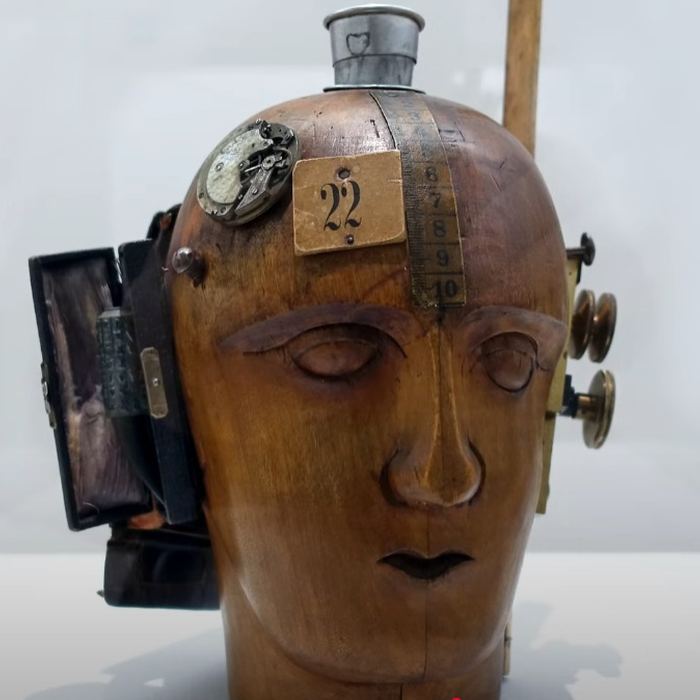
Raoul Hausmann
Hausmann treated photographs, type and found devices as components to be fitted together against mass-media authority.
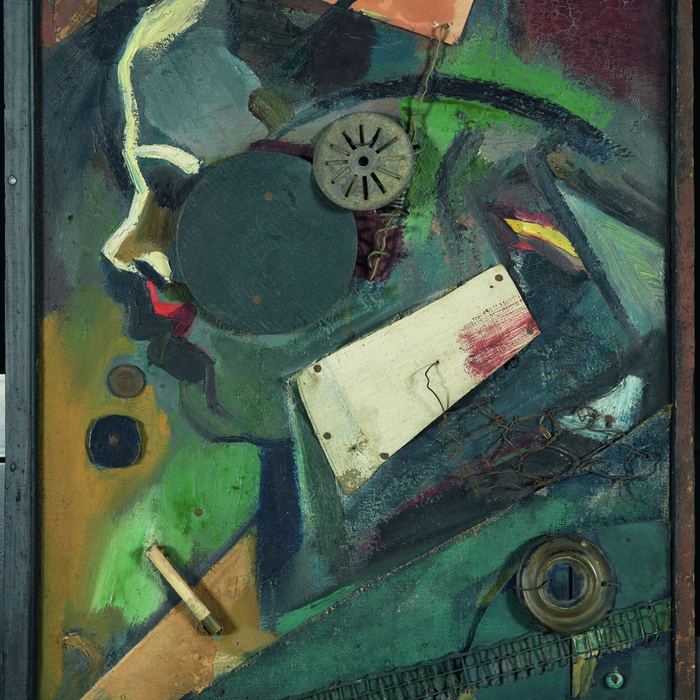
Kurt Schwitters
Schwitters developed the adjacent practice of Merz across collage, typography, performance and the changing architecture of the Merzbau.
New York: art chosen, photographed and argued into being
New York was not a branch planted after Zurich. Marcel Duchamp and Francis Picabia arrived through wartime travel, and Man Ray was already experimenting with new materials and camera processes. Their circle included artists, writers, collectors and publishers around Alfred Stieglitz, Louise and Walter Arensberg and Katherine Dreier. MoMA's six-centre account treats New York and Zurich as independent points of origin.[2]
The New York work was generally less tied to revolutionary parties than Berlin Dada would be. It attacked artistic conventions through galleries, exhibitions, magazines, collecting and the manufactured object. Its central theatre was the system that declared value.
Chance measures the metre
In 3 Standard Stoppages, Duchamp dropped three metre-long threads from a fixed height and preserved the curves in which they landed. Wooden templates copied those accidental lines. A unit defined by scientific regularity became three different shapes while remaining one metre long.[20]
The work looks like an experiment packed in a precision case, yet its experiment produces no universal law. Chance is captured, labelled and standardised. Duchamp used the authority of measurement against itself, asking whether systems appear rational only because their arbitrary origins have been forgotten.
The readymade
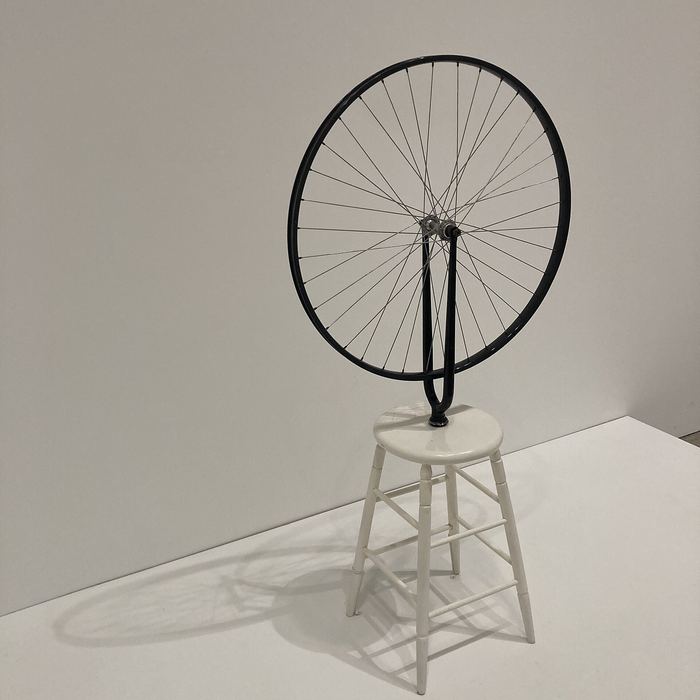
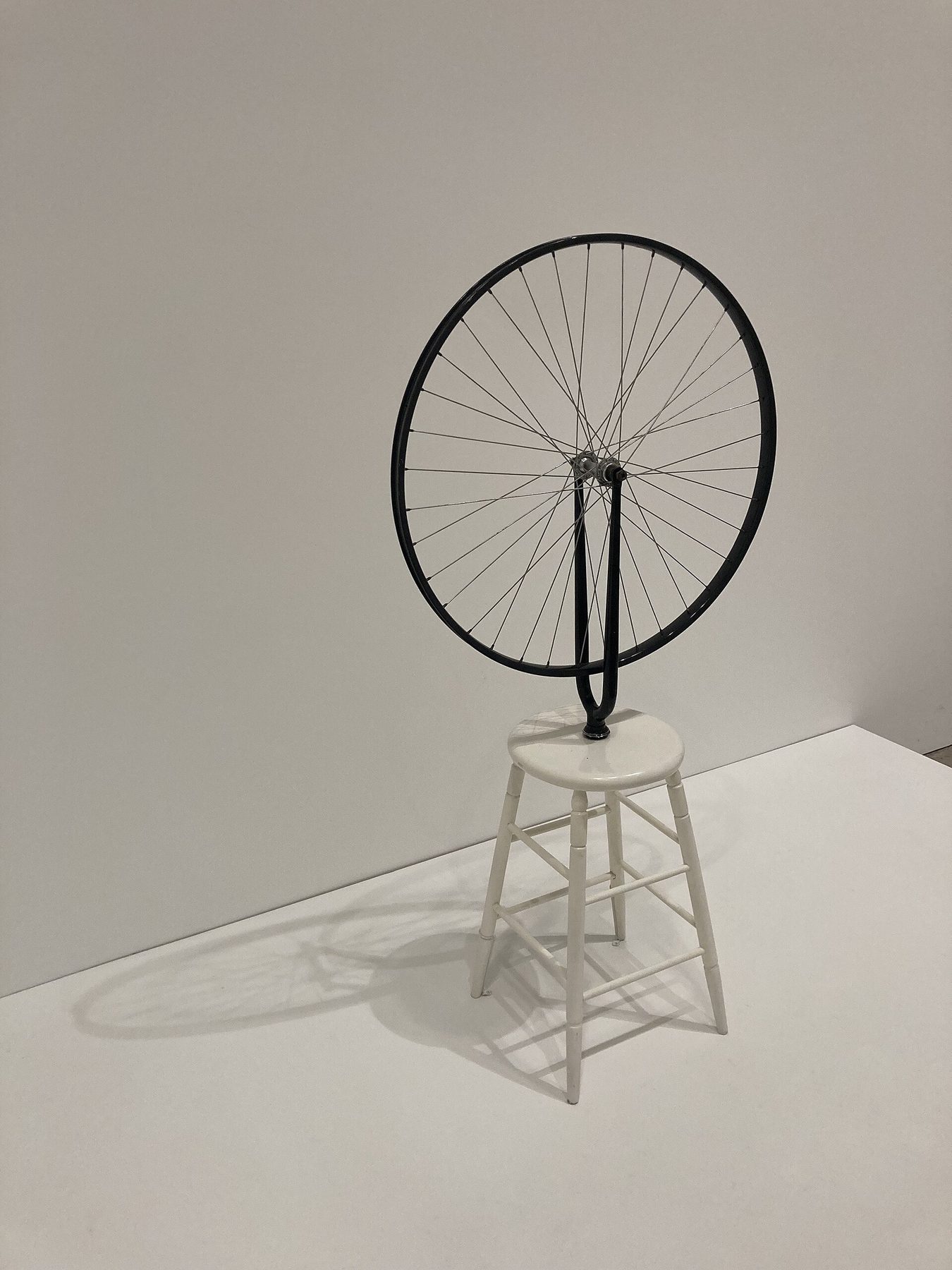
The readymade moved artistic work from fabrication toward selection, naming and placement. Duchamp's Bicycle Wheel of 1913 combined a wheel and stool before he coined the term. He later said that he enjoyed watching it turn like a fire. The original disappeared; the version familiar in museums was assembled decades later. The concept, not exact material continuity, carries the work across time.[23]
With a bottle rack, snow shovel or comb, the artist's hand is not absent so much as redistributed. Choice, purchase, inscription, title and exhibition replace carving or modelling. The Centre Pompidou defines Fountain through precisely that displacement: an industrial object becomes art because it is selected and presented for a different kind of attention.[21]
Fountain and the institution that said no
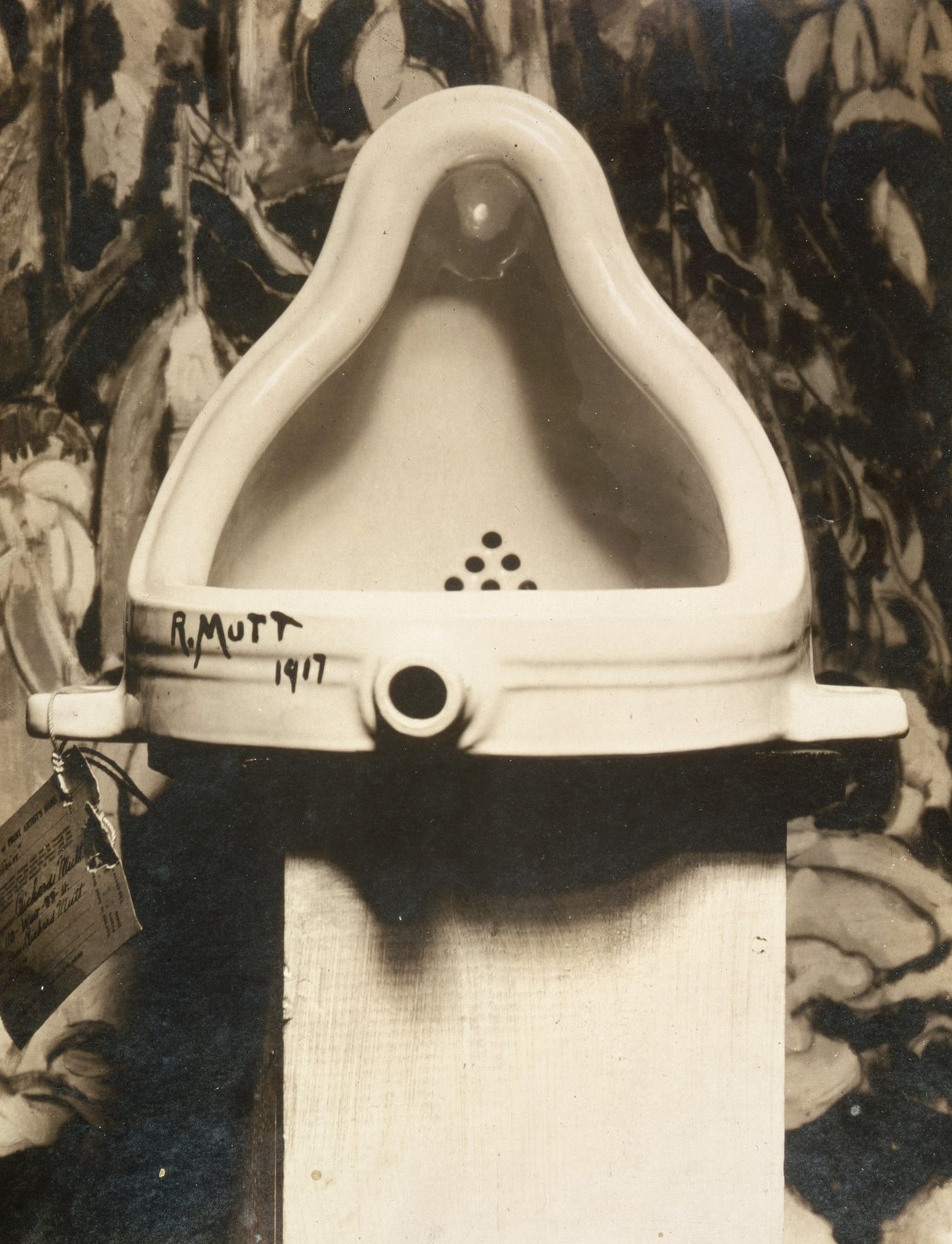
In April 1917, a urinal signed “R. Mutt” was submitted as Fountain to the Society of Independent Artists. The organisation promised no jury, provided contributors paid the fee. Its directors nevertheless withheld the object from display. Duchamp, who sat on the board, resigned. The scandal made the supposedly open exhibition reveal an unstated limit.[22]
Alfred Stieglitz then photographed Fountain. He placed it before a painting by Marsden Hartley and lit it so that the plumbing fixture acquired a sculptural silhouette. The magazine The Blind Man printed the photograph beside a defence of the anonymous submitter's act of choosing. The object disappeared soon afterwards.[25]
Everything important about Fountain therefore exceeds the lost urinal: the pseudonym, rejection, resignation, photograph, article, rumour and later replicas. Its survival is documentary and argumentative. Replicas do not merely imitate an original; they test the claim that the thought can persist when the commodity object is replaceable.
The standard attribution remains Duchamp's, but the Baroness Elsa von Freytag-Loringhoven appears in modern debate over authorship. Evidence does not justify replacing one certainty with another. What is certain is that Elsa was an audacious poet, performer and maker of found-object art whose body and daily dress became mobile assemblage. She was central to New York's radical scene, not an eccentric footnote to men around her.[24]
Man Ray, collaboration and altered use
Man Ray made objects in which a small intervention destroyed ordinary function. Gift adds a row of tacks to the smooth face of a flatiron. A domestic tool meant to remove wrinkles becomes dangerous to cloth and hand. Its deadpan title makes injury sound generous.[39]
His collaborations with Duchamp joined photography, product design and invented identity. Man Ray photographed Duchamp as Rrose Sélavy; their altered perfume bottle Belle Haleine turned gender presentation, authorship and advertising into one compact object. In 1921 they produced a single issue of New York Dada, simultaneously claiming and mocking affiliation with a movement that had become fashionable.[24]
New York Dada's humour was not politically neutral simply because it lacked Berlin's revolutionary posters. It questioned the ownership of identity, the institution's right to define art, the prestige of unique objects and the division between industrial commodity and cultural treasure. The city's version remained socially selective—dependent on patrons, studios and magazines—but it transformed those supports into visible parts of the work.[26]
Berlin: the mass press cut against itself
Richard Huelsenbeck returned from Zurich and helped establish Club Dada in Berlin during 1917–18. Germany was losing the war. Hunger, strikes, military collapse, revolution, the murder of socialist leaders and violent counterrevolution made the capital unlike neutral Zurich. Berlin Dada addressed a public sphere saturated with illustrated newspapers, political posters and competing claims to legitimate power.[28]
Raoul Hausmann, Hannah Höch, John Heartfield, George Grosz, Johannes Baader and the publisher Wieland Herzfelde shared opposition to militarism, nationalism, the church and bourgeois respectability. They did not share one party line or stable alliance. Some joined revolutionary communist organisations; others combined anarchist provocation with cultural criticism. The Berlinische Galerie's Höch and Hausmann archives preserve this intellectual and interpersonal conflict as part of the movement, not background gossip.[27]
Why call it photomontage?
Cutting photographs was not new, but Berlin Dada changed its scale and political address. The term photomontage compared the maker to a fitter assembling machinery. It rejected the image of a painter expressing an isolated inner self. Photographs and words already circulating through mass media became components to be detached, resized, repeated and forced into new relationships.[33]
This method made the press argue with itself. A general's head could be attached to a dancer's body; an advertisement for household efficiency could collide with a mutilated veteran; a politician might float among gears that exposed his speeches as mechanical production. Because the fragments retained the authority of photographs, their impossible combination felt both factual and unstable.
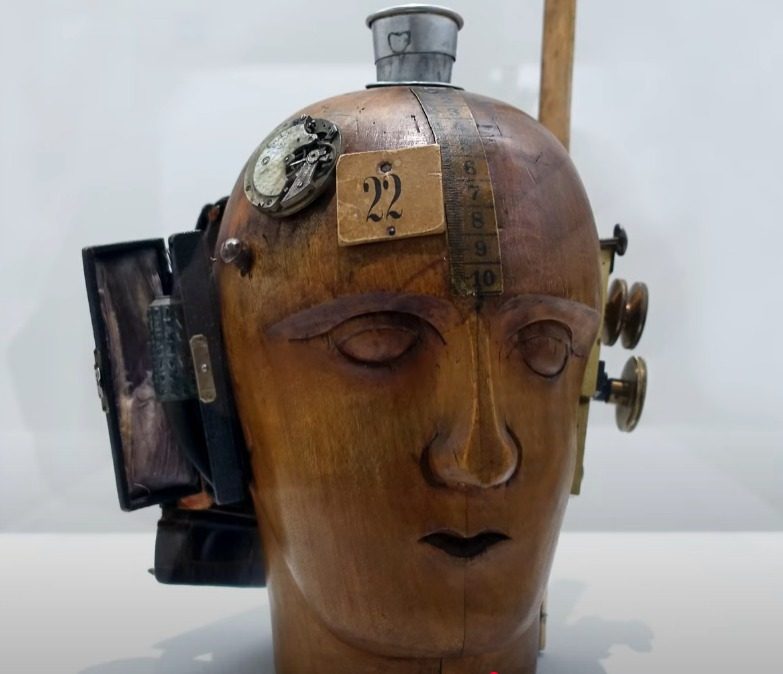
Heartfield made the engineer metaphor personal by anglicising his German name during wartime nationalism. Grosz supplied acid caricatures of officers, profiteers, clergy and complacent citizens. Hausmann created poster poems from typographic letters and constructed Mechanical Head, whose wooden skull acquires measures, a cup and other devices from the outside. Modern reason becomes an accumulation of social instruments rather than an inner human essence.
Hannah Höch cuts through Weimar culture
Hannah Höch understood printed images professionally. At the Ullstein publishing company, she designed patterns and worked among the photographs, fashion pages and household imagery addressed to modern women. Dada let her redirect that commercial vocabulary, but the combination of design employment and collage was long treated as less serious than the political identities of her male colleagues.[31]
Her large Cut with the Kitchen Knife Dada through the Last Weimar Beer-Belly Cultural Epoch of Germany of 1919–20 is structured chaos. Politicians, generals, dancers, artists, athletes, machines and printed words occupy a churning field. Dada figures gather against representatives of old authority. A small map identifies European countries where women had voting rights, locating gender inside the new political geography.[30]
The title's kitchen knife is strategic. A domestic implement slices the mass-media image of public life, and a woman artist cuts through a self-important masculine culture. Yet Höch also had to contest sexism inside Dada. Her participation in the 1920 fair was reportedly resisted by colleagues before Hausmann insisted. The movement that announced universal revolt did not automatically surrender male privilege.
Höch's later From an Ethnographic Museum series joins images of women with reproductions of African, Oceanic and Asian objects from museums and magazines. These hybrids disturb European ideals of the feminine body and the ethnographic display's claim to classify stable racial types. At the same time, they depend on photographs produced by colonial collecting and on the removal of objects from named cultures.[32] The tension cannot be solved by calling the works either emancipatory or appropriative; it is part of what they expose.
The First International Dada Fair
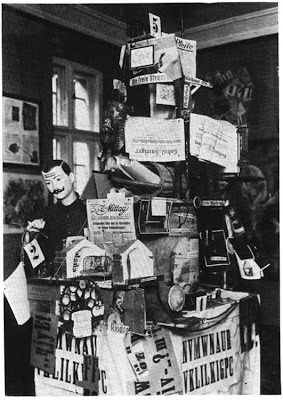
The First International Dada Fair opened on 1 July 1920 in Otto Burchard's Berlin gallery. Approximately 180 objects by 31 participants crowded the walls. Posters and slogans denied traditional art, while a pig-headed figure in military uniform hung from the ceiling. The catalogue adopted the format and visual aggression of a newspaper rather than a refined art publication.[29]
The installation converted a commercial gallery into a hostile media environment. Photomontages, assemblages, printed matter and caricatures competed rather than forming a calm sequence of masterpieces. The show's rhetoric called for the end of the art trade while its catalogue offered Dada products for sale. This contradiction was not accidental. Dada depended on the systems it attacked—printing presses, galleries, collectors, publicity—and repeatedly staged that dependence.
Berlin Dada fragmented soon after. Its techniques did not disappear. Heartfield turned photomontage into a sustained anti-fascist weapon; Höch continued collage across decades; Grosz's social satire moved into New Objectivity; Hausmann pursued photography, sound and theory. A short-lived group generated long political careers without owning their later work.
Cologne: printed authority made irrational
Cologne Dada formed in a city occupied by British forces after the war. Max Ernst, Hans Arp and Johannes Theodor Baargeld became its best-known figures. Luise Straus-Ernst—an art historian, journalist, organiser and Ernst's first wife—also helped make the circle possible, though older accounts reduced her agency.[34]
Cologne's challenge differed from Berlin's direct revolutionary satire. Ernst used diagrams, teaching aids, commercial catalogues and scientific illustrations as frameworks for impossible events. A small alteration could preserve the source's impersonal authority while making its world psychologically or physically incoherent. Collage became a way to discover images rather than illustrate a prior idea.
The group's 1920 Dada-Vorfrühling exhibition occupied the courtyard of a public house. Accounts describe entry through a lavatory and a police closure on grounds of obscenity. These provocations mixed obstruction with promotion: difficulty of access and official intervention became parts of the exhibition's story. Ernst's move to Paris in 1922 connected Cologne experiment to Surrealism, where collage, frottage and hallucinatory association developed in new directions.[37]
Hannover: Schwitters builds Merz
Kurt Schwitters associated with Dadaists but gave his work another name. Berlin Club Dada rejected him, and around 1918–19 he extracted the syllable “Merz” from a fragment of the printed word Commerzbank. He applied it to poems, collages, assemblages, performances, typography, advertising and eventually architecture.[35]
Merz collage admitted the city's small remains: tram tickets, wrappers, labels, wire, fragments of newsprint and discarded paper. Schwitters did not leave them as uncomposed rubbish. Works such as Merz Picture 32 A: The Cherry Picture organise scraps through strong diagonals, colour intervals and recurring shapes. Waste becomes both evidence of daily circulation and material for rigorous order.[37]
The Merzbau grew in Schwitters's Hannover home from about 1923. Assemblage spread from studio surfaces into columns, cavities and grottoes containing objects associated with friends. Visitors could contribute, and Schwitters repeatedly covered, altered and expanded the structure. It was architecture, sculpture, archive, social portrait and private mythology at once.[36]
An air raid destroyed the Hannover building in 1943. Three photographs and written memories became the basis for later reconstruction. What visitors see at the Sprengel Museum is therefore not an untouched original but a researched model of a lost, changing environment. That condition is appropriate to Dada and Merz: documentation, memory and remaking carry an impermanent work forward.
Schwitters also developed the Ursonate, a long vocal composition built from invented syllables and organised into recognisable musical sections. Its disciplined duration disproves the idea that sound poetry was simply spontaneous screaming. Merz could be unruly in material and exacting in form. Schwitters's tours with Theo and Nelly van Doesburg carried these performances through European networks while preserving Merz as a distinct identity.
Paris: Dada becomes public combat
Tristan Tzara arrived in Paris in 1920 to a scene already reading his publications. André Breton, Louis Aragon, Philippe Soupault, Paul Éluard, Francis Picabia, Suzanne Duchamp, Jean Crotti, Céline Arnauld, Man Ray and others organised readings, exhibitions, festivals, staged trials and public attacks. Paris Dada turned disagreement into a medium.[8]
Audiences were baited, newspapers courted and manifestos announced principles that the next event might overturn. The movement's refusal of coherence made powerful publicity but also exhausted alliances. Tzara's theatrical negation and Breton's demand for a more directed intellectual project increasingly collided.
Picabia's machines and signatures
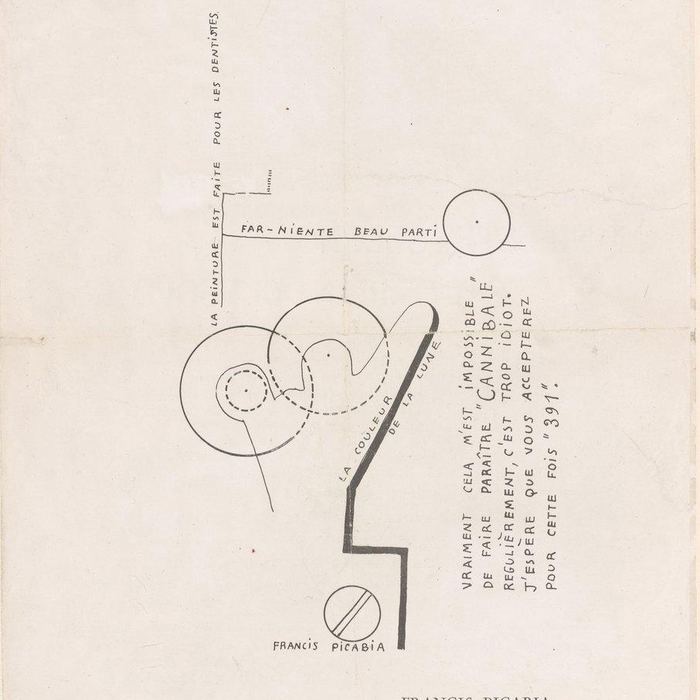
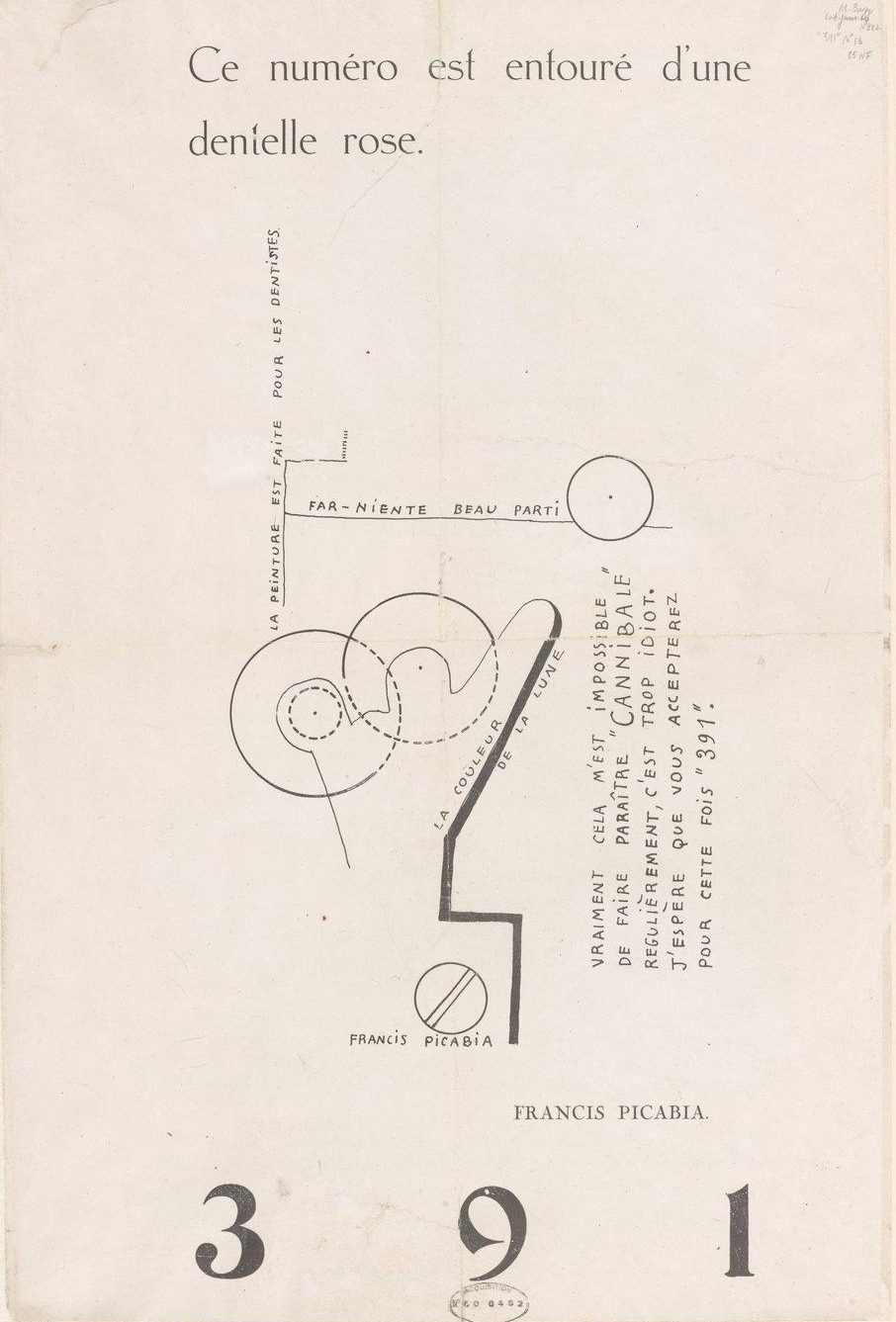
Francis Picabia travelled restlessly among Paris, New York, Barcelona and Zurich. His magazine 391 made print into a mobile exhibition. Mechanomorphic portraits borrowed pistons, wheels and schematic lines without proposing functional machines. Industrial paint, text and sexual suggestion converted technical authority into comic desire.[41]
In L'Oeil cacodylate of 1921, Picabia painted a large eye, then invited visitors to add signatures, phrases, photographs and small images. The surface became a record of a social circle rather than the expression of one hand. Its crowded names also parody modern authorship: a signature can certify presence even when it contributes almost no pictorial labour.[40]
The work is both collaborative and hierarchical. Picabia initiated, titled and retained the canvas; guests entered his field. Dada collaboration rarely dissolved every difference in power. It made authorship negotiable and visible.
Suzanne Duchamp and unstable reading
Suzanne Duchamp worked through painting, collage, metallic papers, found materials and language. In Broken and Re-Established Multiplication, text climbs, reverses and slips through a construction that seems at once diagrammatic and fractured. Reading requires the viewer to move attention across the surface, assembling phrases rather than receiving one stable message.[37]
Her work cannot be reduced to Marcel Duchamp's influence or her marriage to Jean Crotti. It developed a distinct combination of reflection, linguistic ambiguity and relational imagery. Restoring her authorship also reveals how Dada networks ran through sibling, marital and working partnerships that the myth of solitary male genius obscures.
Dadaglobe: the book that did not appear
Tzara planned Dadaglobe as an international anthology for publication in 1921. He contacted about fifty artists in ten countries and asked for newly made contributions: altered photographic portraits, photographs of artworks, drawings and designed pages. More than one hundred surviving works demonstrate a network capable of producing to common instructions without adopting a common style.[50]
Money and organisation failed, and the book never appeared. The failure is historically revealing. Dada's internationalism depended on postal systems, translation, reproduction, printers and credit. A movement devoted to ephemerality still required infrastructure. The unbound submissions make the unrealised book feel less like an absent masterpiece than a dispersed collaborative work.
From Dada conflict to Surrealist organisation
Paris Dada unravelled through public disagreements: the mock trial of nationalist writer Maurice Barrès, the failed Congress of Paris, Picabia's withdrawals and the violent disruption of Tzara's 1923 Cœur à barbe evening. These were not simply personal quarrels. They concerned whether refusal could remain an end in itself and whether a movement could claim freedom while demanding loyalty.
Breton's 1924 Surrealist Manifesto reorganised some Dada people and methods around dreams, automatism and the unconscious. Surrealism did not switch Dada off. Schwitters continued Merz, Höch continued collage, Duchamp pursued chess and complex long-term projects, and Picabia changed style repeatedly. Artists such as Joan Miró developed Surrealist languages from a different mixture of Catalan experience, poetry and pictorial invention. Dada's dispersal created several futures rather than one successor.
Printing, photography and the artwork that disappears
Dada often survives through something other than the first object or event. A performance remains as a diary entry and photograph. A lost readymade becomes a printed argument and replica. A collage consists of already reproduced fragments. An unrealised book exists as correspondence and submissions. This is not a defect in the archive; it is one of the movement's central subjects.
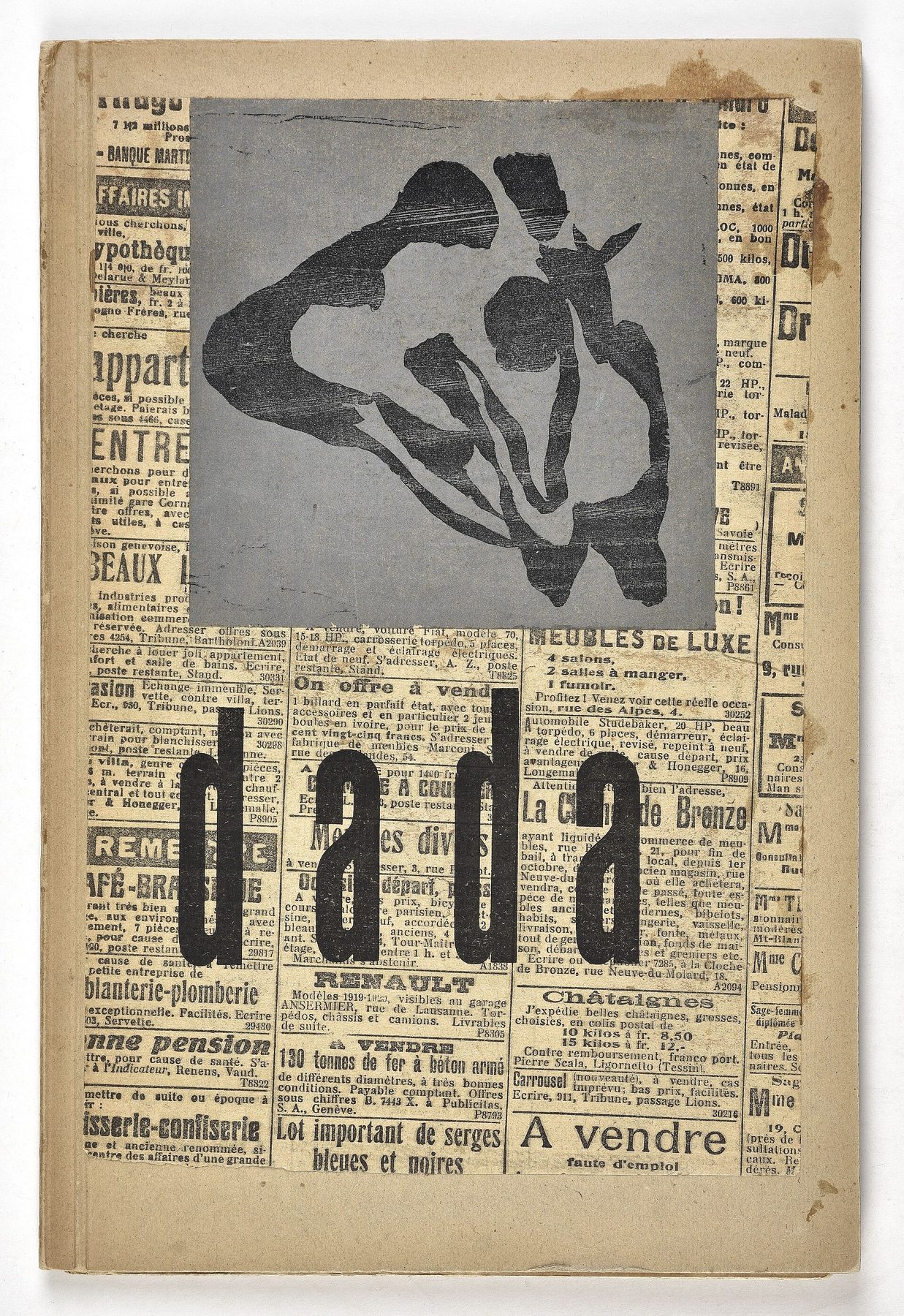
Typography allowed language to behave spatially. Letters changed scale, turned sideways, collided with pointing hands and broke linear reading. Tzara's Dada 3 and Berlin poster poems made a page resemble a performance score or street wall. Cheap paper enabled circulation, while unusual layouts demanded active handling.
Photography operated in opposite directions. Photomontage cut the apparent truth of press photographs into contradiction. Cameraless photography removed the lens and placed objects directly on sensitised paper. Man Ray's rayographs turned pins, coils, fabric and glass into luminous traces. The 1922 portfolio Champs délicieux, introduced by Tzara, circulated these experiments through print and across national networks.[38]
Reproduction could also manufacture historical presence. Stieglitz's image of Fountain is not a neutral record: lighting, background and viewpoint construct the sculpture later viewers remember. Documentation becomes interpretation. Dada anticipated an art world in which an idea, instruction or media image may matter as much as a unique physical object.
Dada on film
Film offered movement, reversal, repetition, accident and montage without requiring a story. Hans Richter's Rhythmus 21 animates expanding and contracting rectangles, making the frame itself feel elastic. Its exact abstraction connects Dada experiment to broader constructive film rather than to nonsense alone.[43]
René Clair's Entr'acte was projected during the interval of Relâche, a 1924 Ballets Suédois production conceived by Picabia with music by Erik Satie. Duchamp and Man Ray play chess; a cannon fires toward the viewer; action runs backward or changes speed; a funeral procession accelerates into a chase. The film does not illustrate the ballet. It interrupts an interruption.[42]
Other avant-garde collaborators crossed Dada's margins. Fernand Léger helped create Ballet mécanique, whose repetition of objects and machine movement belonged to the same experimental film ecology without making all of Léger's work Dada. The boundary is a network of shared problems, not a membership badge.
Duchamp's Anémic cinéma, completed in the mid-1920s with help from Man Ray and Marc Allégret, alternates rotating spirals and circular texts. Flat discs appear to deepen into funnels while French puns become readable and unstable as they turn. Collaboration, optics, language and mechanical repetition make it a late extension of Dada method.[44]
Beyond six centres
Zurich, New York, Berlin, Cologne, Hannover and Paris organise the clearest historical account, but Dada correspondence and compatible actions reached much farther. Tours and journals linked the Netherlands, Belgium, Italy, Spain, Czechoslovakia, Romania and Croatia. Artists and writers in Russia, Georgia, Chile and Japan developed anti-academic tactics through their own conditions.
The Russian avant-garde offers an important warning against centre-and-branch history. Transrational zaum poetry and Kazimir Malevich's attacks on academic tradition preceded or paralleled much named Dada activity. A Reina Sofía exhibition proposed “Russian Dada” as a lens for these anti-art projects, not as proof that Zurich caused them.[45]
Constructivists exchanged publications and exhibition ideas with Dadaists and shared typography, photomontage and unconventional material. Their declared aims could be very different. Constructivism often sought affirmative structures for a transformed society, whereas Dada cultivated negation and contradiction. Exhibitions pairing the movements reveal traffic across that distinction rather than erasing it.[46]
The Chilean poet Vicente Huidobro joined Parisian and Madrid avant-garde networks, contributed to Dada publications and maintained relationships with Tzara, Picabia and others. His Creationism asserted its own theory of poetic making. He is evidence of Latin American agency within transatlantic modernism, not a distant recipient waiting for Europe to export revolt.[47]
Dada also circulated through Theo and Nelly van Doesburg's campaigns, Romanian journals, Central European evenings and later Japanese groups such as Mavo. The historic network was wider than the canon, but the name should not swallow every radical experiment. Similar tactics can arise independently, meet through print and then separate again.
Politics without one party line
Dada opposed authority but did not share one politics. Ball's pacifism turned toward religious retreat. Berlin members announced revolution and attacked the military state. New York artists targeted exhibitions and authorship more than parties. Tzara made negation public theatre, while Breton eventually demanded a more organised intellectual direction. To call all of this anarchism is tempting but imprecise.
The movement's contradictions matter. It attacked nationalism while turning cultural difference into primitivist fantasy. It ridiculed bourgeois gender norms while male groups marginalised women. It denounced the market while using galleries, editions and publicity. These are not reasons to dismiss Dada. They show that opposition occurs inside the systems it contests.
Women therefore belong throughout the account. Hennings made the first venue work; Taeuber-Arp joined movement, design and abstraction; Höch cut the mass press against political and sexual hierarchy; Suzanne Duchamp transformed language and material; Elsa von Freytag-Loringhoven made self-presentation and urban debris inseparable. Their inclusion does more than correct a list of names. It reveals performance labour, domestic material, publishing and collaboration as core Dada practices.
Dada and neighbouring movements
Dada shared fragmentation with Cubism, speed and publicity with Futurism, anti-academic energy with Expressionism, geometric experiment with Constructivism and later artists' interest in the unconscious with Surrealism. The differences are as useful as the overlaps. Futurism often celebrated war and national virility that Dada repudiated. Constructivism sought social construction where Dada often staged breakdown. Surrealism built a new doctrine from methods that Dada preferred to keep unstable.
Artists in the surrounding avant-garde could exhibit with Dadaists or share patrons without joining the movement. Paul Klee belonged to the wider Swiss and German modern-art environment, but his sustained pictorial language should not be relabelled Dada. Names are most useful when they clarify a historical alliance rather than claim every nearby experiment.
How to recognise Dada
There is no reliable Dada palette or shape. Recognition begins with procedure and context.
- Look for displaced use. A urinal, iron, ticket or diagram stops performing its normal function.
- Read the title. A pun or false technical description may do as much work as the object.
- Trace the source. Newspaper photographs and catalogue illustrations often remain partly identifiable.
- Ask where chance enters. Falling, tearing or random selection may set a rule, but later choices still matter.
- Notice the institution. Rejection, gallery rules, catalogues, signatures and replicas may form part of the work.
- Treat documentation as active. A photograph can construct the meaning of an event or lost object.
- Listen for organisation inside noise. Sound poetry and film may be rigorously timed even when words or narrative collapse.
- Test the joke's target. Dada humour may attack war, gender, taste or authority, but it can also reproduce stereotypes.
A strange collage is not automatically Dada. Dates, city networks, publications and the artist's own affiliations matter. Dada is historical as well as attitudinal.
Essential works and designs
Cabaret Voltaire poster
Marcel Słodki · 1916 · Słodki's compressed poster makes the founding venue's mixed programme and typographic urgency part of Dada's public identity.
Hugo Ball performing at Cabaret Voltaire
Unknown photographer · 1916 · Ball's restrictive costume made breath, posture and invented syllables inseparable from the performed poem.
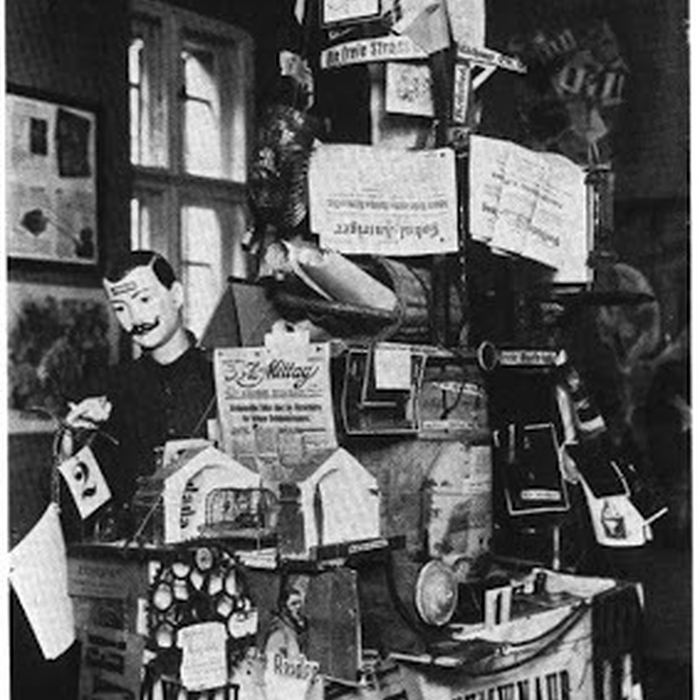
Dada Head
Sophie Taeuber-Arp · 1920 · Taeuber-Arp's turned and painted head carries geometric abstraction across craft, sculpture, identity and performance.
Bicycle Wheel
Marcel Duchamp · 1913; replica · The wheel and stool shift artistic action from fabrication toward selection, combination, naming and later reconstruction.
Fountain
Marcel Duchamp / R. Mutt; photograph by Alfred Stieglitz · 1917 · Stieglitz's photograph, the lost object, printed defence and later replicas make documentation and institutional refusal central to the work.
Mechanical Head (The Spirit of Our Time)
Raoul Hausmann · c. 1920 · Hausmann attaches instruments to a wooden head so that modern reason appears assembled from social measures outside the self.
The Great Plasto-Dio-Dada-Drama
Johannes Baader · 1920 · Baader's chaotic assemblage turns authority, biography and national history into a precarious anti-monument.
Merzbild 1A (The Psychiatrist)
Kurt Schwitters · 1919 · Schwitters organises tickets, print and debris into a disciplined collage, showing that Merz was more than uncomposed rubbish.
Dada 4–5 cover
Tristan Tzara, editor; Hans Arp cover · 1919 · Arp's cover and Tzara's journal show print acting as a portable exhibition, performance score and international connector.
391, no. 13
Francis Picabia · 1920 · Picabia's magazine made machinery, language, satire and reproduction travel between Dada's cities.
Where to see and study Dada
Kunsthaus Zurich and Cabaret Voltaire
Kunsthaus Zurich holds an exceptional collection of works and documents across the movement's centres. Cabaret Voltaire preserves the founding address as an active cultural venue. Together they connect museum objects with the scale and social texture of the original room.[48]
Berlinische Galerie and Staatliche Museen zu Berlin
The Berlinische Galerie holds the major Hannah Höch archive and part of Raoul Hausmann's estate. The Staatliche Museen collection includes Höch's Cut with the Kitchen Knife. These collections make Berlin's politics, publishing and interpersonal networks unusually tangible.
Sprengel Museum Hannover
The Sprengel Museum holds the central Schwitters archive, a major Merz collection and the researched reconstruction of the Hannover Merzbau. It is the essential place for understanding why Merz exceeds small collage.
Max Ernst Museum Brühl
The museum situates Ernst's Cologne Dada years inside his longer career, allowing the altered diagrams and collage logic to be followed into Surrealism.
Centre Pompidou, Paris
Its collections are particularly strong in Duchamp, Picabia, Man Ray, Höch and Dada film. The institution's 2005 survey also helped establish the six-centre interpretation used today.
Museum of Modern Art and Metropolitan Museum of Art, New York
MoMA combines readymades, Arp, Schwitters, Ernst, Taeuber-Arp, film and Dada archives. The Met's modern-art research resources illuminate the social worlds of Ball and Hennings, Duchamp, Man Ray and New York collectors.
Philadelphia Museum of Art
Philadelphia's Duchamp holdings make it possible to study Fountain through replicas and to place the readymade beside The Large Glass and the artist's wider attack on conventional authorship.
Museums, collections and cities to explore
Collections, archives and reconstructed works may rotate or require appointments. Check current displays and access before travelling.
- 01
Cabaret Voltaire
Zurich, Switzerland
The founding venue remains a working centre for exhibitions, performances and Dada research.
Founding siteVisit collection website - 02
Kunsthaus Zurich
Zurich, Switzerland
The collection is central for Zurich Dada, with works and archives connected to Arp, Taeuber-Arp and their circle.
Zurich DadaVisit collection website - 03
Berlinische Galerie and Staatliche Museen zu Berlin
Berlin, Germany
Together these collections illuminate Berlin photomontage, typography and the politically charged Dada network.
Berlin DadaVisit collection website - 04
Sprengel Museum Hannover
Hannover, Germany
Its major Kurt Schwitters holdings make Merz, collage and constructed environments unusually coherent.
Schwitters and MerzVisit collection website - 05
Max Ernst Museum Brühl
Brühl, Germany
The museum traces Ernst's Cologne experiments and the techniques that carried him beyond Dada.
Cologne DadaVisit collection website - 06
Centre Pompidou
Paris, France
Works, journals and documentary holdings connect Paris Dada with Duchamp, Picabia and the emerging Surrealist network.
Paris DadaVisit collection website - 07
Museum of Modern Art and Metropolitan Museum of Art
New York, USA
These New York collections provide complementary routes through readymades, photography, publications and Dada's institutional afterlives.
New York DadaVisit collection website - 08
Philadelphia Museum of Art
Philadelphia, USA
The Arensberg collection makes the museum an essential destination for Duchamp and the readymade.
Duchamp collectionVisit collection website
Five books for further reading
Dada: Zurich, Berlin, Hannover, Cologne, New York, Paris — Leah Dickerman, editor
The substantial catalogue behind the 2005–06 museum survey. Its city-centred structure is the strongest single foundation for comparing local conditions without forcing one style.
Dada: Art and Anti-Art — Hans Richter
A vivid participant history. Richter's proximity is invaluable, but his memories should be read alongside archival scholarship because Dadaists were talented makers of their own legends.
Women in Dada: Essays on Sex, Gender, and Identity — Naomi Sawelson-Gorse, editor
An important corrective to male-centred histories, examining women as artists and the movement's broader construction of gender.
Dada's Women — Ruth Hemus
A focused study of Emmy Hennings, Hannah Höch, Sophie Taeuber and Céline Arnauld that shows how their work changes the movement's history.
The Dada Seminars — Leah Dickerman and Matthew S. Witkovsky, editors
Specialist essays on objects, procedures and media, particularly useful for readers who want to move beyond a general chronology.[5]
Dada's afterlives
Dada did not travel into the present as a single bloodline. The readymade informed Conceptual art and institutional critique. Performance and sound poetry fed experimental theatre, music and Fluxus. Collage and photomontage became tools for advertising, protest and feminist critique. Merz anticipated installation environments; Dada's cheap-print urgency reappeared in punk graphics and artist publications.
Museums also transformed the movement. Ephemeral anti-institutional acts became protected objects, and replicas entered canons once challenged by the originals. The large Zurich and Paris fiftieth-anniversary exhibition of 1966, developed while several participants were alive, helped consolidate that historical Dada.[49] Canonisation is not simply betrayal. It creates access while changing the conditions under which a joke, refusal or fragile scrap is encountered.
The most durable legacy is therefore not a look but a permission: materials, identities and institutions can be reassigned. That permission remains demanding only when the question is specific. A found object without a target can become mannerism. Dada matters when disruption reveals who made a rule, whom it serves and what another arrangement might allow.
Major artists and writers directory
| Name | Nationality | Key Works |
|---|---|---|
| André Breton | French | Trial of Maurice Barrès · Surrealist Manifesto |
| Céline Arnauld | Romanian-French | Point de mire · Paris Dada performances |
| Elsa von Freytag-Loringhoven | German-American | God · Body Sweats |
| Emmy Hennings | German | Cabaret Voltaire performances · Gefängnis |
| Francis Picabia | French | 391 · L'Oeil cacodylate |
| George Grosz | German-American | The Pillars of Society · Dada Fair works |
| Hannah Höch | German | Cut with the Kitchen Knife · Dada-Rundschau |
| Hans Arp | German-French | Collage Arranged according to the Laws of Chance · Dada 4–5 cover |
| Hugo Ball | German | Karawane · Cabaret Voltaire |
| Jean Crotti | Swiss-French | Tabu Dada · Clown |
| Johannes Baader | German | Great Plasto-Dio-Dada-Drama · Dada Fair actions |
| Johannes Theodor Baargeld | German | Human Eye and Fish · Cologne Dada publications |
| John Heartfield | German | Dada photomontages · later anti-fascist montages |
| Kurt Schwitters | German | Merzbild 1A · Merzbau |
| Louis Aragon | French | Paris Dada journals · performances |
| Luise Straus-Ernst | German | Cologne Dada organisation · art criticism |
| Man Ray | American | Gift · Rayographs |
| Marcel Duchamp | French-American | Fountain · 3 Standard Stoppages |
| Marcel Janco | Romanian-Israeli | Cabaret Voltaire masks · Chant nègre poster |
| Max Ernst | German-French | Dada-Vorfrühling · altered diagrams |
| Nelly van Doesburg | Dutch | Dada-Merz performance tours · music |
| Paul Éluard | French | Paris Dada publications · poetry |
| Philippe Soupault | French | Littérature · Paris Dada events |
| Raoul Hausmann | Austrian-German | Mechanical Head · poster poems |
| Richard Huelsenbeck | German | Club Dada · Dada Almanach |
| Sophie Taeuber-Arp | Swiss | King Stag marionettes · Dada Head |
| Suzanne Duchamp | French | Broken and Re-Established Multiplication · Dada works |
| Theo van Doesburg | Dutch | Dada-Merz tours · De Stijl |
| Tristan Tzara | Romanian-French | Dada Manifesto 1918 · Dadaglobe |
| Wieland Herzfelde | German | Malik-Verlag · Dada Fair publishing |
Frequently Asked Questions
The name and organised movement emerged around Cabaret Voltaire in 1916. New York artists were already pursuing closely related strategies independently, so a two-origin account is more accurate than treating every centre as a Zurich offshoot.
No explanation is definitive. It can evoke a French hobbyhorse, childish syllables and other multilingual associations. Participants cultivated contradictory stories because a name without fixed content suited a movement hostile to definitions.
They opposed inherited standards of beauty, manual skill, permanence and institutional authority. Anti-art was a way to attack the existing category and enlarge it, not proof that they stopped producing images, objects or performances.
No. Surrealism inherited people and methods from Dada but developed a more organised programme around dreams, automatism and the unconscious. Dada was generally more resistant to stable doctrine.
A readymade is an existing manufactured object selected, titled or repositioned as art. The change lies in designation and context rather than traditional fabrication, though some readymades were combined or altered.
The accepted historical attribution is Duchamp, but the urinal was manufactured commercially rather than handmade. Debate about Elsa von Freytag-Loringhoven's possible role remains unresolved; it should broaden research, not be converted into unsupported certainty.
No. Chance could establish a procedure or interrupt habit, but artists still chose materials, rules and final presentation. Arp's collages and Duchamp's falling threads combine accident with preservation and judgement.
It is the construction of a new image from photographic and printed fragments. Berlin Dadaists used the term “montage” to compare themselves with industrial fitters and to turn mass-media imagery against political authority.
He worked closely with Dada networks and is normally included in its history, but he called his distinct practice Merz after Berlin Dadaists rejected him. Merz continued beyond the main Dada years.
Dada began through a cabaret, where voice, costume, dance, music and audience reaction met. Performance allowed meaning to arise through bodies and events rather than permanent objects, although it also made later history dependent on partial documentation.
Many participants opposed war, nationalism and bourgeois authority, and Berlin Dada had strong revolutionary-left commitments. The movement as a whole had no single party politics; its centres and individuals differed sharply.
Around 1924 is a useful boundary because the major groups had dispersed and Surrealism had declared a new programme. Individual Dada and Merz practices continued, and its methods have repeatedly returned under other names.
Discussion
Which Dada strategy still feels most disruptive: chance, the readymade, photomontage, invented identity or live performance? And when a once-rejected object enters a museum, does its challenge weaken—or does the institution become part of the question?
Reader Insights
Ask what changed when Dada moved between Zurich, New York, Berlin, Cologne, Hannover and Paris.
Read a performance, journal, photograph, collage or ordinary object as a different way of questioning artistic authority.
Dada was a disputed network, not one stable style: identify the people, place, date and procedure before generalising.
Join the Conversation
Which Dada strategy still feels most disruptive: chance, the readymade, photomontage or performance?
References
- Dada. National Gallery of Art. View Source
- Dada. The Museum of Modern Art. View Source
- DADA at MoMA. The Museum of Modern Art. View Source
- Dada. The Museum of Modern Art. View Source
- The Dada Seminars. National Gallery of Art. View Source
- Introduction to the exhibition: Dada. The Museum of Modern Art. View Source
- Dada. Centre Pompidou (French; consulted in French). View Source
- Dossier ressources sur le mouvement Dada. Centre Pompidou (French; consulted in French). View Source
- Dada im Kunsthaus Zürich. Kunsthaus Zürich (German; consulted in German). View Source
- Cabaret Voltaire – Geburtsort von Dada in Zürich. Cabaret Voltaire (German; consulted in German). View Source
- Hugo Ball and Emmy Hennings. Metropolitan Museum of Art. View Source
- Hugo Ball Cabaret Voltaire Recueil littéraire et artistique 1916. Kunsthaus Zürich (German; consulted in German). View Source
- Emmy Hennings / Sitara Abuzar Ghaznawi. Cabaret Voltaire (German; consulted in German). View Source
- Marcel Janco Plakatentwurf zu Chant nègre 1916. Kunsthaus Zürich (German; consulted in German). View Source
- Marcel Janco Untitled Mask for Firdusi. The Museum of Modern Art. View Source
- Sophie Taeuber-Arp. The Museum of Modern Art. View Source
- Sophie Taeuber Rythmes libres 1919. Kunsthaus Zürich (German; consulted in German). View Source
- Sophie Taeuber-Arp Deramo The King. The Museum of Modern Art. View Source
- Jean Hans Arp Untitled Collage with Squares Arranged according to the Law of Chance. The Museum of Modern Art. View Source
- Marcel Duchamp 3 Standard Stoppages. The Museum of Modern Art. View Source
- Fontaine. Centre Pompidou. View Source
- Marcel Duchamp Fountain. Philadelphia Museum of Art. View Source
- Marcel Duchamp Bicycle Wheel. The Museum of Modern Art. View Source
- Nonconformist Spirits. Metropolitan Museum of Art. View Source
- The Key Set 1902–1917. National Gallery of Art. View Source
- Marcel Duchamp 1887–1968. Metropolitan Museum of Art. View Source
- DADA Berlin. Berlinische Galerie (German; consulted in German). View Source
- Berlin Metropolis. Berlinische Galerie (German; consulted in German). View Source
- Katalog der Ersten Internationalen Dada-Messe. Berlinische Galerie (German; consulted in German). View Source
- Schnitt mit dem Küchenmesser Dada durch die letzte Weimarer Bierbauch-Kulturepoche Deutschlands. Staatliche Museen zu Berlin (German; consulted in German). View Source
- Dada-Rundschau 1919. Berlinische Galerie (German; consulted in German). View Source
- Mutter 1930. Centre Pompidou (French; consulted in French). View Source
- Raoul Hausmann Press Kit 2025. Berlinische Galerie (German; consulted in German). View Source
- Max Ernst Biography. Max Ernst Museum Brühl des LVR (German; consulted in German). View Source
- Kurt Schwitters Archives Finding Aid. Sprengel Museum Hannover (German; consulted in German). View Source
- Malerei und Skulptur. Sprengel Museum Hannover (German; consulted in German). View Source
- Dada Audio Guide. The Museum of Modern Art. View Source
- Man Ray's Champs Délicieux Turns 100. The Museum of Modern Art. View Source
- Objects of Desire. The Museum of Modern Art. View Source
- L'oeil cacodylate. Centre Pompidou (French; consulted in French). View Source
- Francis Picabia: de la lettre à l'image. Centre Pompidou (French; consulted in French). View Source
- Entr'acte. Centre Pompidou (French; consulted in French). View Source
- Film Vault Summer Camp Week Three Dada on Screen. The Museum of Modern Art. View Source
- Faire un cinéma: Duchamp du film. Centre Pompidou (French; consulted in French). View Source
- Dadá ruso 1914–1924. Museo Nacional Centro de Arte Reina Sofía (Spanish; consulted in Spanish). View Source
- Dada y constructivismo. Museo Nacional Centro de Arte Reina Sofía (Spanish; consulted in Spanish). View Source
- Vicente Huidobro 1893–1948. Memoria Chilena / Biblioteca Nacional de Chile (Spanish; consulted in Spanish). View Source
- Pocket Guide Dada Stadt Zürich. Cabaret Voltaire (German; consulted in German). View Source
- Dada-Ausstellung zum 50-jährigen Jubiläum. Kunsthaus Zürich (German; consulted in German). View Source
- Dadaglobe Reconstructed. The Museum of Modern Art. View Source
- Dada image records. Wikimedia Commons: Cabaret Voltaire poster (Public domain; Marcel Słodki), Portrait of Emmy Hennings (Public domain; Unknown photographer), Hugo Ball performing at Cabaret Voltaire (Public domain; Unknown photographer), Dada Head (CC0; Hiart), Bicycle Wheel (Public domain; Toohool), Fountain (Public domain; Alfred Stieglitz), Mechanical Head (The Spirit of Our Time) (CC0; Centre Pompidou; Harris and Zucker), The Great Plasto-Dio-Dada-Drama (Public domain; Johannes Baader), Merzbild 1A (The Psychiatrist) (Public domain; Kurt Schwitters), Dada 4–5 cover (CC BY-SA 4.0; Mathieu Bertola), 391, no. 13 (Public domain; Francis Picabia).