 by
Tom Gurney
Tom Gurney BSc (Hons) is an art history expert with over 20 years experience
Email:
tomgurney1@gmail.com
/ Phone:
+44 7429 011000
Westward the Course of Empire Takes Its Way: Introduction
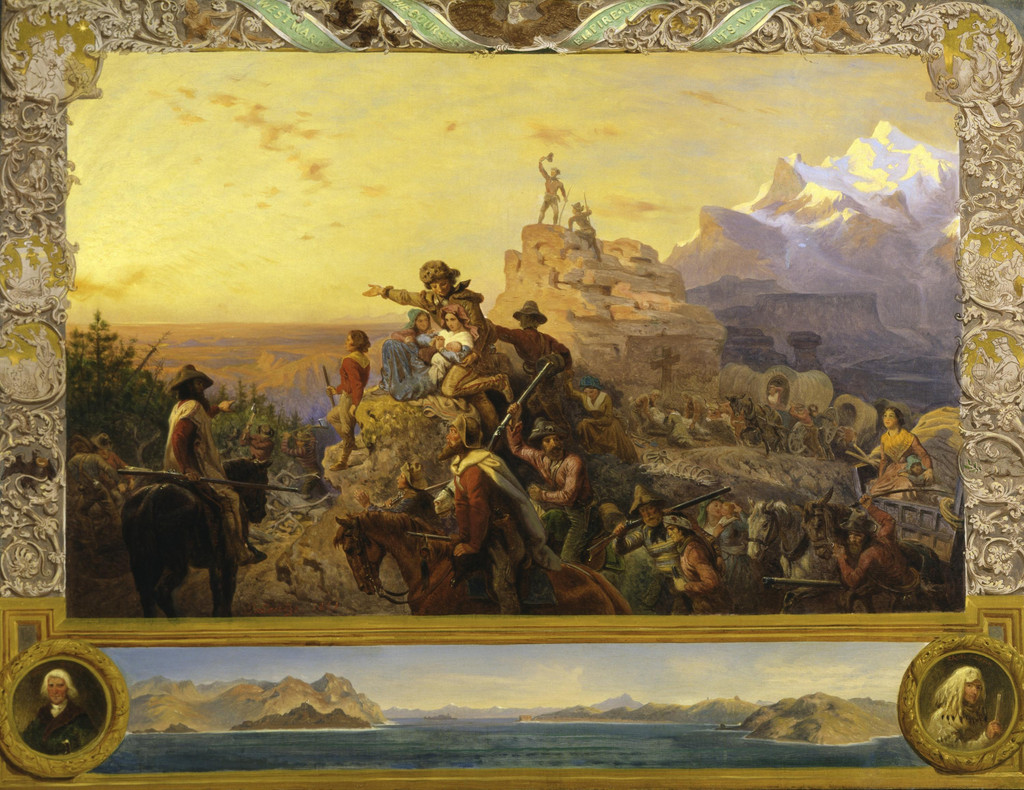
Emanuel Leutze’s Westward the Course of Empire Takes Its Way turns a difficult mountain passage into a promise of national expansion. Travellers, horses and covered wagons converge around a rocky height, beyond which a glowing western landscape opens. Families and labouring bodies give the journey its human interest; the light gives it an apparent destination. In the United States Capitol, this vision became an enormous public mural, painted during the Civil War. [1]
The illustration here shows Leutze’s smaller oil study of 1861, now in the Smithsonian American Art Museum. Its central scene, elaborate painted border and lower view of San Francisco Bay anticipate the public work, but the study and finished mural differ. Understanding those differences reveals a composition that developed in response to both an architectural commission and the urgent political circumstances of its creation. [1] [2]
At a Glance
- Artist Emanuel Gottlieb Leutze
- Title Westward the Course of Empire Takes Its Way , also known as Westward Ho!
- Illustrated work Mural study, 1861, oil on canvas
- Study dimensions 84.5 × 110.1 cm
- Study collection Smithsonian American Art Museum, 1931.6.1, Bequest of Sara Carr Upton
- Finished mural 1861–62, stereochrome, 20 × 30 feet
- Mural location West Stairway, House Wing, U.S. Capitol
- Commissioner Montgomery C. Meigs, July 1861
- Subject Westward migration presented through history painting and allegory
This work across Emanuel Leutze’s career
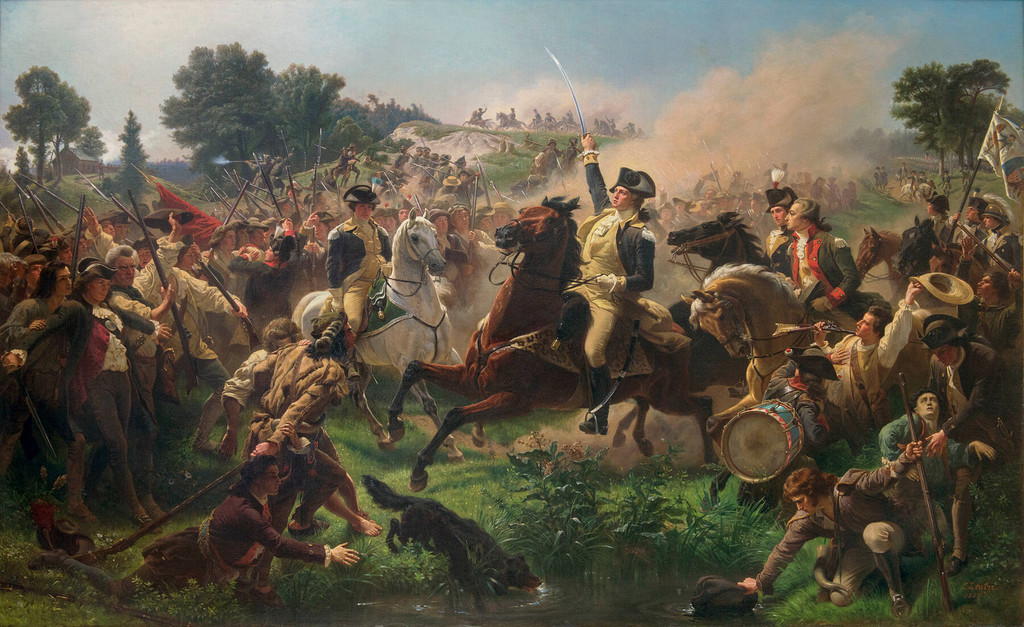
Washington Rallying the Troops at Monmouth
1857 replica; original 1854Westward the Course of Empire Takes Its Way (current article)
1861 (oil study); mural 1861–62Signing of the Alaska Treaty
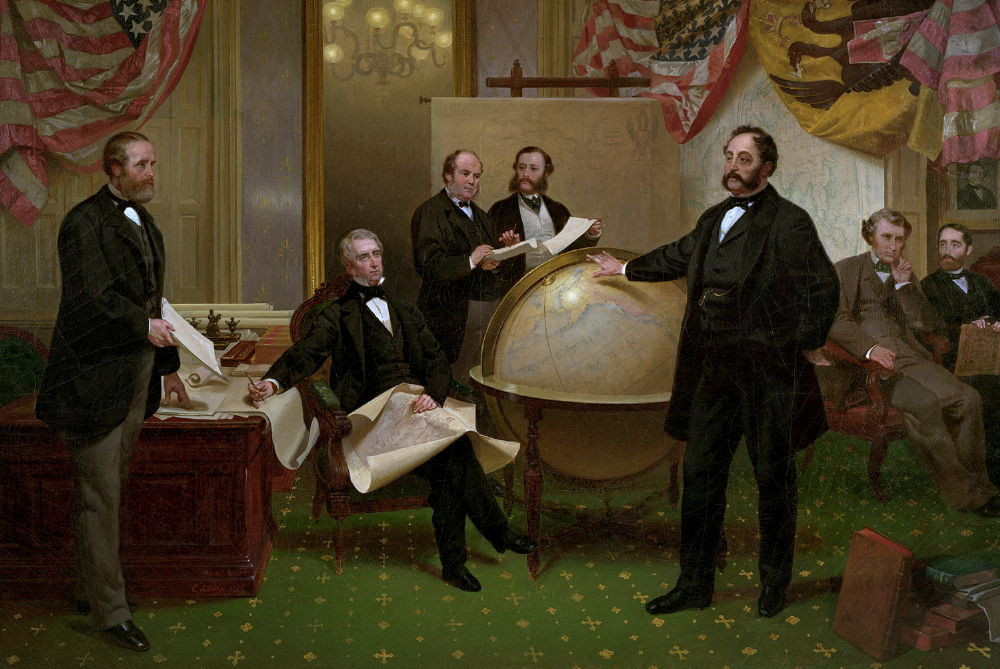
c. 1867Contents
- A public mural and a portable painting
- Following the movement towards the light
- Families, labour and the cost of passage
- The border enlarges the argument
- Expansion painted during the Civil War
- Stereochromy and the architectural surface
- Whose future does the picture imagine?
- Looking between the study and the mural
- Annotated details
A public mural and a portable painting
The Capitol commission brought a long-standing ambition within Leutze’s reach. After the success of Washington Crossing the Delaware , he had petitioned Congress in 1852 about a further Washington painting and a companion Monmouth subject. That proposal did not immediately secure the national commission he wanted. His return to America in 1859, following years in Düsseldorf, preceded the opportunity to work directly in the Capitol. [3]
In July 1861 Montgomery C. Meigs, superintendent of construction for the Capitol extensions and new Dome, commissioned the westward-expansion mural for $20,000. The finished work occupies a wall in the House wing’s west stairway. At twenty feet high and thirty feet wide, it belongs to the experience of moving through a government building as well as to the history of painting. Its dimensions help explain the broad masses and emphatic direction of the composition. [1]
The Smithsonian study is a separate oil painting measuring 84.5 by 110.1 centimetres. Its manageable scale allowed Leutze to bring figures, landscape and surrounding ornament together on canvas before their translation to a much larger wall. Calling it a study describes its relationship to the commission, rather than dismissing its complexity. The border, portrait medallions and harbour view form a carefully articulated pictorial whole. [2]
Its later ownership also belongs to a different history. Smithsonian research notes trace the study through William H. Seward, Olive Risley Seward and Sara Carr Upton. The museum’s collection record confirms Upton’s bequest and the accession number 1931.6.1. A portable painting could pass through private hands and enter a museum; the mural remained attached to the architecture for which it was commissioned. [2] [4]
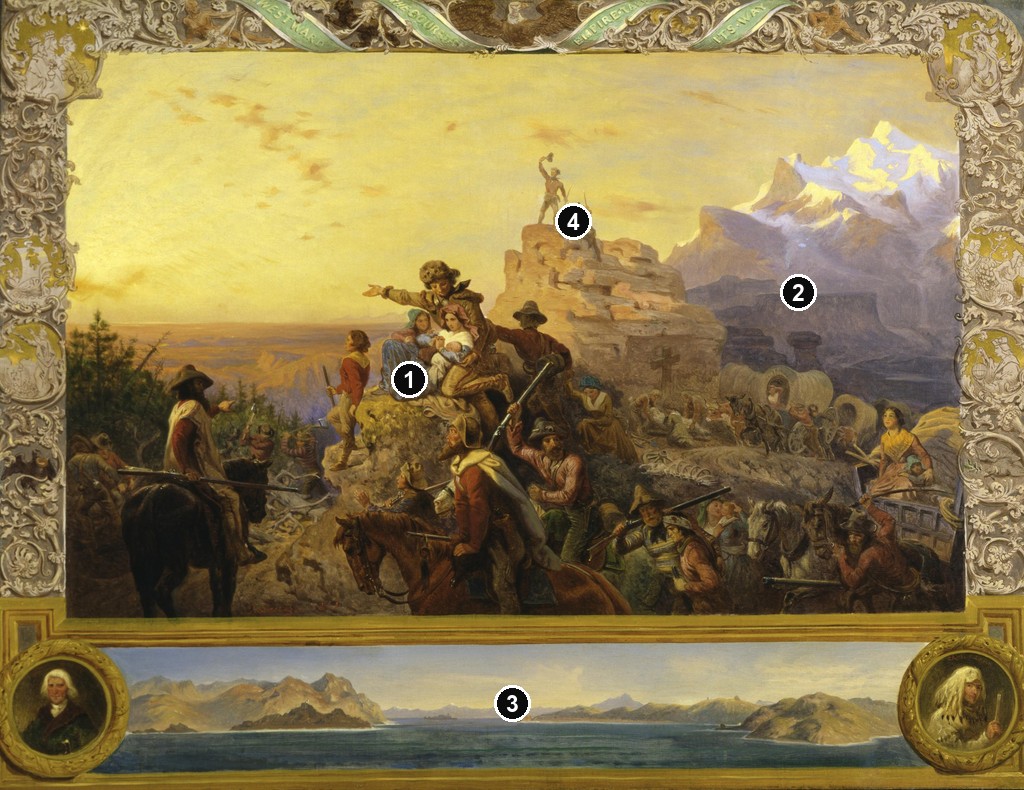
Annotated Details from Westward the Course of Empire Takes Its Way
The numbered points identify visible features discussed in this article. Return from each detail to the whole composition. Emanuel Leutze, Westward the Course of Empire Takes Its Way (mural study, U.S. Capitol), 1861. Oil on canvas, 84.5 × 110.1 cm. Smithsonian American Art Museum, 1931.6.1, Bequest of Sara Carr Upton. Image source. CC0 / Public domain. Separate resized overview with numbered points; details cropped from the original. Original colour and appearance retained.
Details from WESTWARD THE COURSE OF EMPIRE TAKES ITS WAY
Compare the cropped details with the complete images above. Notice how their colours, shapes and positions contribute to the larger compositions.
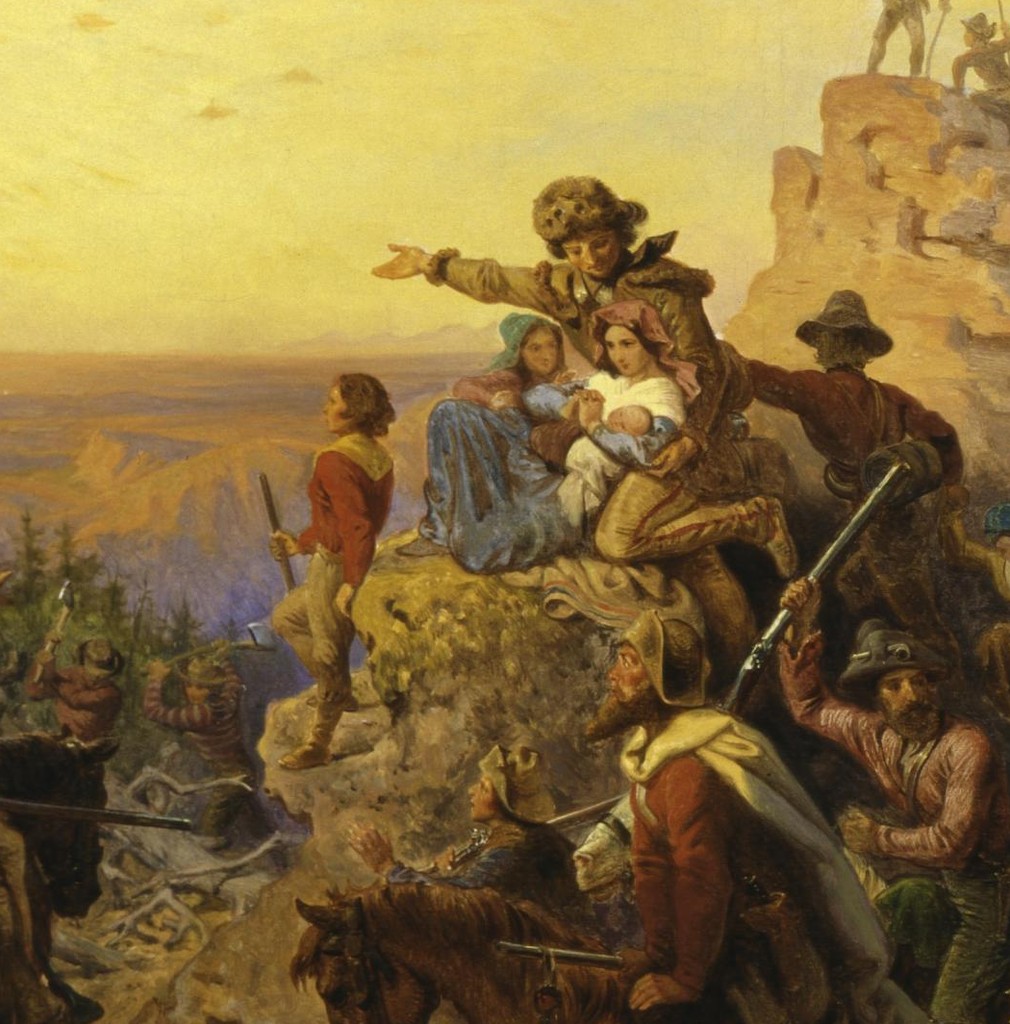
Pointing figure and family group
A pointing arm directs attention towards the bright opening at the left. Seated women and a child gather below it, joining the promise of a destination with the immediate presence of a family.
Cold peaks and the wagon train
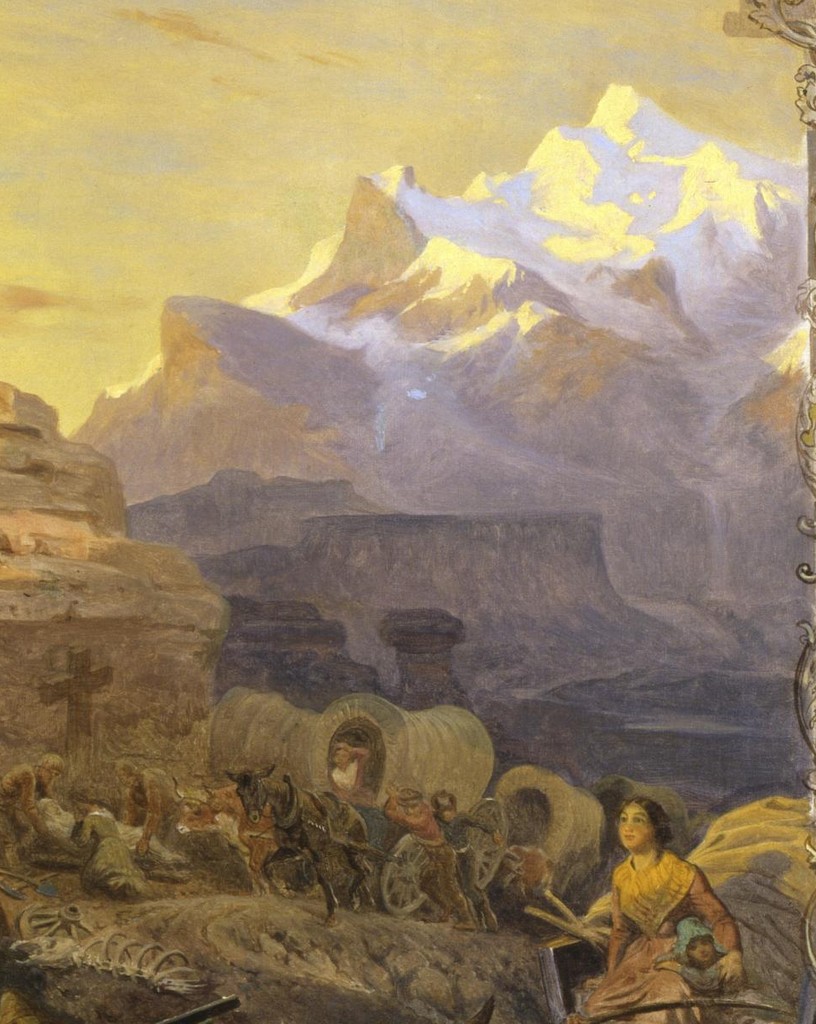
Pale mountain summits rise above the line of wagons and travellers. The contrast between distant cold heights and the closer rocky passage makes the route appear demanding.
Border and lower harbour view
The lower panorama is separated from the central journey by a painted gold band. Portrait medallions at its ends connect the harbour view with the elaborate border; all are parts of the 1861 oil study.

Raised figures on the rocks
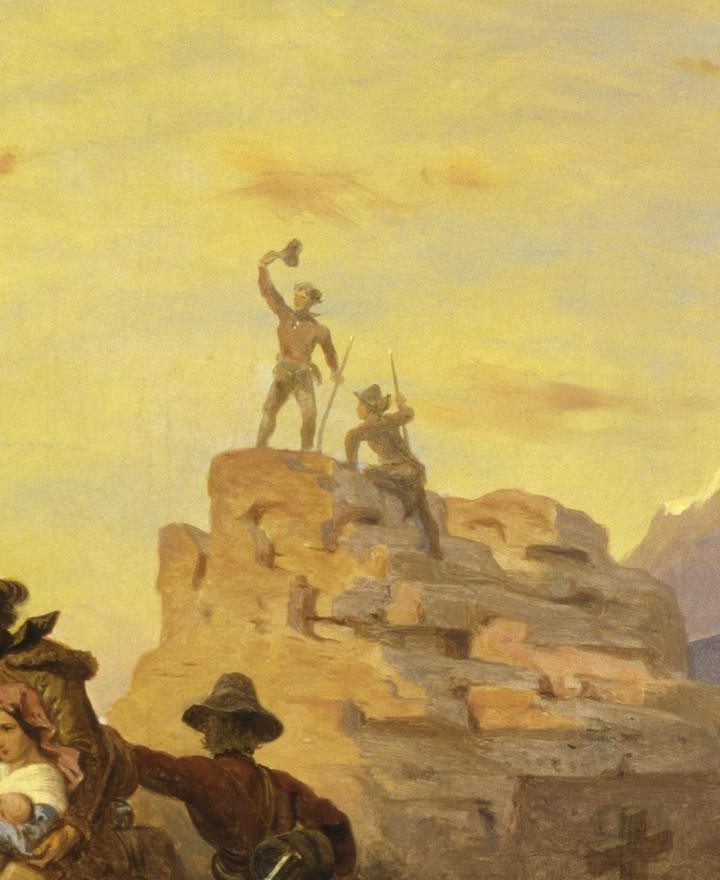
Figures stand above the main group on stepped rocky ground. A raised hat meets the open sky, extending the movement of ascent through the centre of the composition.
Following the movement towards the light
The oil study’s most immediate division is between the luminous distance at the left and the more confined, rocky passage at the right. Snow-covered summits rise behind the travellers, while a broad yellow sky extends over the country ahead. Figures turn, point and look towards the opening. The composition makes a direction feel desirable before a viewer has identified any of its historical or literary references.
Leutze interrupts this sweep with a central rock formation. People gather on and around its ledges, creating different levels of visibility. Some can already survey the distance; others are still struggling along the path below. The crowd does not occupy a single flat procession. Its staggered arrangement allows arrival, expectation and continued exertion to coexist within one scene.
The foreground horse and rider contribute another change of level. Their larger forms bring the journey close to the spectator, while the smaller wagons and figures disappear into the passage behind them. Repeated bodies and equipment give the eye a route back through the picture. The landscape becomes a space occupied through movement, rather than a detached panorama admired from a comfortable viewpoint.
In preparing the mural, Leutze travelled to the Colorado region in 1861 to sketch the Rocky Mountains. That encounter with western terrain contributed to the work, but the resulting scene is an organised national allegory. Its light, converging travellers and expansive prospect ask to be read together. The mountain setting gives physical form to an argument about effort, passage and a hoped-for future. [1]
The brightest areas carry much of that argument. Their warmth contrasts with the darker passage and cooler mountain shadows. A spectator can therefore read the crossing of the divide as a transition in emotional condition as well as location. Hope seems to occupy the open country, while the difficult terrain contains what the party must overcome. This is an effect of Leutze’s arrangement, rather than evidence that migration offered such a clear outcome.
Families, labour and the cost of passage
The travellers include women, children, mounted figures and people on foot. Leutze distributes their actions across the composition: pointing, carrying, looking, helping and pressing forward. The movement requires more than heroic resolve. Animals, equipment and physical support make it possible. These details allow the great national theme to be encountered through smaller acts whose importance is easier to recognise.
Family groups are especially significant. A child changes the implied duration of the journey: the party is carrying a possible future population, alongside its possessions. A mother’s presence draws attention to care and vulnerability within the public story. The painting’s promise consequently depends on intimate relationships as well as on the scale of the continent. Its emotional appeal asks the spectator to care about particular people reaching a destination.
Henry T. Tuckerman’s account, published in 1867, preserves an extended description of the mural’s figures. It discusses tired animals, young travellers, a mother and infant, and help offered to a wounded youth. This contemporary explanation presents an elaborate human drama within the migration. It should be read as an account of the picture’s intended episodes, including the assumptions of its period, rather than as testimony about an actual wagon party. [5]
That distinction matters when looking at suffering. Injury and exhaustion might seem to challenge the optimistic prospect. Within the composition, however, they also make eventual arrival appear more valuable. Difficulty supplies the emotional price of the promised reward. Leutze gives hardship a place in the scene while directing attention towards a conclusion that seems to justify the passage.
The painting provides little room for uncertainty about the direction itself. Travellers can hesitate, fall behind or require assistance, but the light continues to favour the western opening. Their differing experiences are drawn into one overarching movement. This is one of the ways a large group becomes a persuasive public image: individual episodes vary while the composition maintains a shared destination.
The border enlarges the argument
The painted ornament is part of Leutze’s design. At the top, an eagle and curling green ribbons bring the title into the image. Along the sides, small scenes and figures invite closer inspection than the central migration requires. Their reduced scale changes the rhythm of looking: broad narrative movement gives way to a succession of concentrated references.
Both the Architect of the Capitol and the Smithsonian identify the portrait medallions as William Clark on the left and Daniel Boone on the right. They connect the generalised migration to named figures in the national story of western exploration and settlement. Beneath the principal scene, the long view of the Golden Gate supplies an imagined endpoint on the Pacific. The lower strip therefore completes a journey whose main action remains in the mountains. [1] [6]
The Smithsonian’s interpretation relates the border’s biblical and classical travellers to ideas of providence and heroic passage. Moses, the Magi and Jason provide earlier stories against which the American journey can be understood. These associations lend religious and legendary authority to the modern subject. They encourage a viewer to recognise migration as part of a much longer, seemingly purposeful history. [6]
The title itself comes from Bishop George Berkeley’s poem On the Prospect of Planting Arts and Learning in America . Placing its westward prediction above the travellers makes the inscription function like a governing proposition. People and landscape then appear to demonstrate the movement announced in words. The phrase’s reference to empire also makes clear that the work’s ambitions extend beyond an account of ordinary travel. [1]
Keeping the entire border visible changes the interpretation of the study. An isolated reproduction of the central travellers can emphasise endurance, scenery or family feeling. The complete composition surrounds those experiences with an argument about history. Its decorative richness helps unite the separate episodes, but its content gives the attractive surface a political and moral purpose.
Watch: Emanuel Leutze
Choose a film to explore the artist’s work, its interpretation and its wider setting.
It's not only about the American Revolution, Leutze's Washington Crossing the Delaware
Smarthistory considers the ideas and historical distance behind Washington Crossing the Delaware.
Watch on YouTubeExpansion painted during the Civil War
The mural’s optimistic direction was created during a national crisis. Leutze received the commission in 1861 and completed the work in 1862, while the Civil War was being fought. The Capitol was an especially charged setting for a picture that organised many people into a collective advance. Its location placed an image of national continuity within the building of federal government. [1]
The Architect of the Capitol identifies the American flag in the mural as a symbol of the Union. That meaning ties the painting to the circumstances of its execution. A westward journey could offer a longer view of national development while the existence and future of the Union were being contested. The flag thus belongs both to the depicted party and to the political argument made by the public commission. [1]
The smaller study and the finished wall painting also differ in their inclusion of a young African American figure. According to the Capitol’s account, the youth in the mural was absent from two early oil sketches. It suggests that his addition may have been influenced by emancipation in the District of Columbia. That remains a qualified explanation of a particular compositional change. [1]
The National Archives dates the act ending slavery in the District to 16 April 1862. It provides a firm historical context for that possible connection, without proving the circumstances of Leutze’s decision. Separating the documented date from the proposed artistic response preserves the distinction between an event and an interpretation. The mural’s development occurred within a city whose relationship to slavery was changing during the work itself. [7]
These changes make the completed mural more than an enlarged transfer of the Smithsonian canvas. Its public meaning could develop as Leutze worked. The study is valuable partly because it preserves an earlier arrangement against which the finished composition can be considered. A detail documented in the wall painting should consequently be identified there, rather than treated as visible in every version bearing the same title.
Stereochromy and the architectural surface
The difference in medium is equally important. The Smithsonian picture is oil on canvas. For the Capitol, Leutze used stereochromy, a German technique in which pigments applied to plaster are sealed with waterglass, a silica solution. The Architect of the Capitol records this process and the mural’s cleaning and conservation in 1998–99. Its materials belong to the history of the building as well as to Leutze’s studio practice. [1] [2]
Stereochromy should therefore be distinguished from both the portable oil painting and an ordinary assumption that every wall painting is traditional fresco. The fixing material matters to how colour remains attached to the surface. It also makes descriptions of canvas lining, canvas weave or an oil painting’s varnish inappropriate unless they concern one of the separate studies. Each object has its own material questions.
The change of scale introduces another practical demand. A group that can be inspected at close range on a small canvas must remain legible across a large stairway wall. Broad light, large silhouettes and a strongly directed composition help sustain that reading. Fine incidents in the border can reward closer attention without carrying the entire burden of communicating the principal subject.
The commission joins pictorial ambition to institutional authority. A painting of migration becomes part of a route through the House wing; the building lends permanence and public importance to the representation. The border and lower panorama help organise the large surface into a coherent ensemble. Leutze’s work consequently asks how a national story can inhabit architecture, alongside the familiar question of how a story can fill a canvas.
Whose future does the picture imagine?
The work is commonly discussed through Manifest Destiny: the belief that American expansion across the continent was a destined national development. The Smithsonian connects the mural study to that idea. Its imagery turns a movement undertaken by particular people into an account of collective historical purpose. Such an interpretation helps explain the combination of promising light, strenuous ascent and borrowed religious authority. [4]
The border also exposes a limit in that account. Tuckerman’s contemporary description places Native figures in opposition to, or retreat before, the expanding society. His language is openly prejudicial. Read critically, the description shows how the programme assigned different roles to different peoples: the migrants’ progress occupies the centre, while Indigenous presence is accommodated within a story that treats their displacement as part of its forward motion. [5]
Recognising that structure changes the apparent openness of the western prospect. The landscape may look available to the travellers, but availability is an effect of the picture’s viewpoint. The scene cannot establish the absence of earlier inhabitants, their rights or their own understandings of the land. Its persuasiveness depends partly on allowing the spectators to share the travellers’ anticipation without giving equal space to those other perspectives.
Leutze’s liberal politics and the mural’s Union associations make these tensions especially revealing. A picture could accommodate the prospect of freedom for a formerly enslaved person while retaining an expansionist account that marginalised Native people. Its different meanings should be considered together. The work’s political commitments were shaped by its own century and do not resolve into a single, universally inclusive message.
Looking between the study and the mural
The Smithsonian study offers a particularly useful starting point because the full design can be examined as one object. Begin with the movement of the central party, then follow the surrounding references and the harbour below. The apparent destination becomes more than a bright area of landscape once it is connected to the title, the medallions and the Golden Gate.
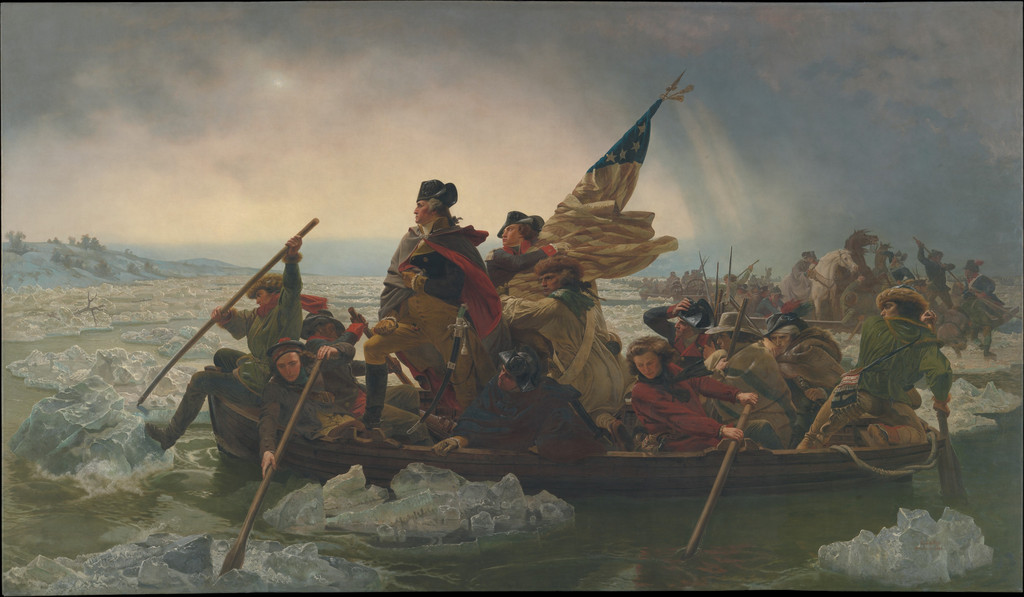
Comparison with Leutze’s other paintings places the work within a broader practice of arranging historical meaning. The Delaware canvas gathers military leadership and shared labour within a boat; the westward composition disperses those concerns across a party moving through mountainous terrain. Both depend on bodies working together, but their historical subjects, destinations and political implications remain distinct.
The study and mural preserve different stages and materials of this ambitious public project. Looking carefully at both makes room for admiration of Leutze’s orchestration, attention to the circumstances of the commission, and criticism of the national future it presents. Its promise becomes more understandable when the visible effort, the ornamental argument and the people excluded from its central story are considered within the same reading.
Artworks directory
A selected directory of paintings and drawings discussed in these articles. Different versions are listed separately.
| Name | Date | Medium |
|---|---|---|
| Washington Crossing the Delaware (Met canvas) | 1851 | Painting |
| Westward the Course of Empire Takes Its Way (oil study) | 1861 | Painting |
| Westward the Course of Empire Takes Its Way (Capitol mural) | 1861–62 | Painting (mural) |
| Washington Rallying the Troops at Monmouth (large original) | 1854 | Painting |
| Washington Rallying the Troops at Monmouth (replica) | 1857 | Painting |
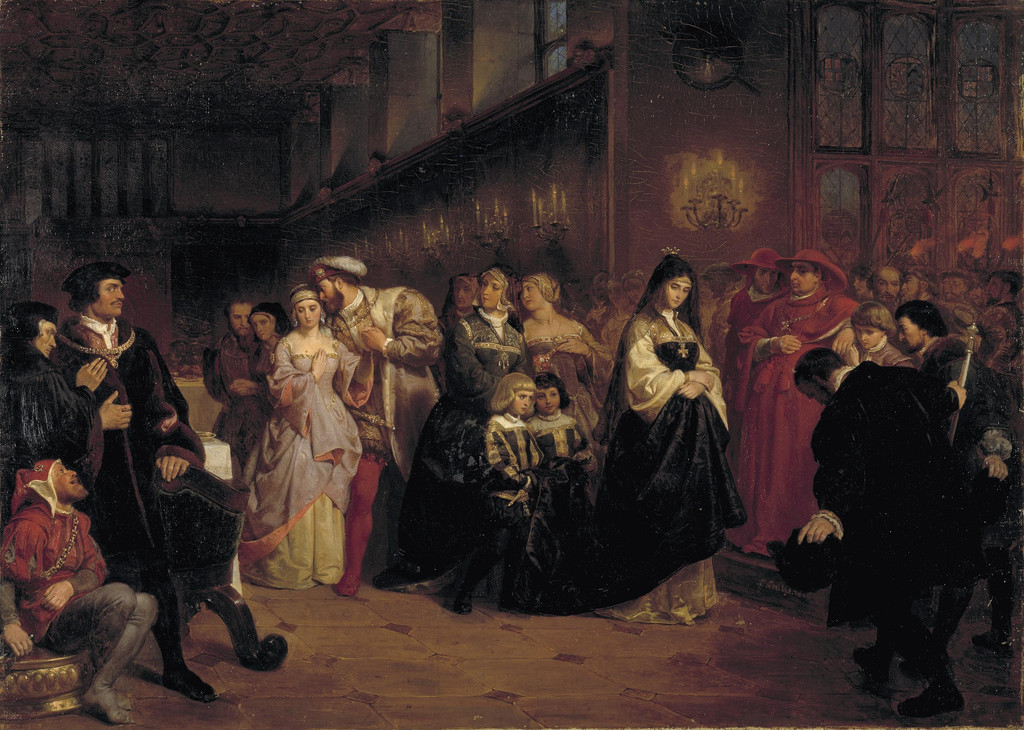
| The Courtship of Anne Boleyn | 1846 | Painting |
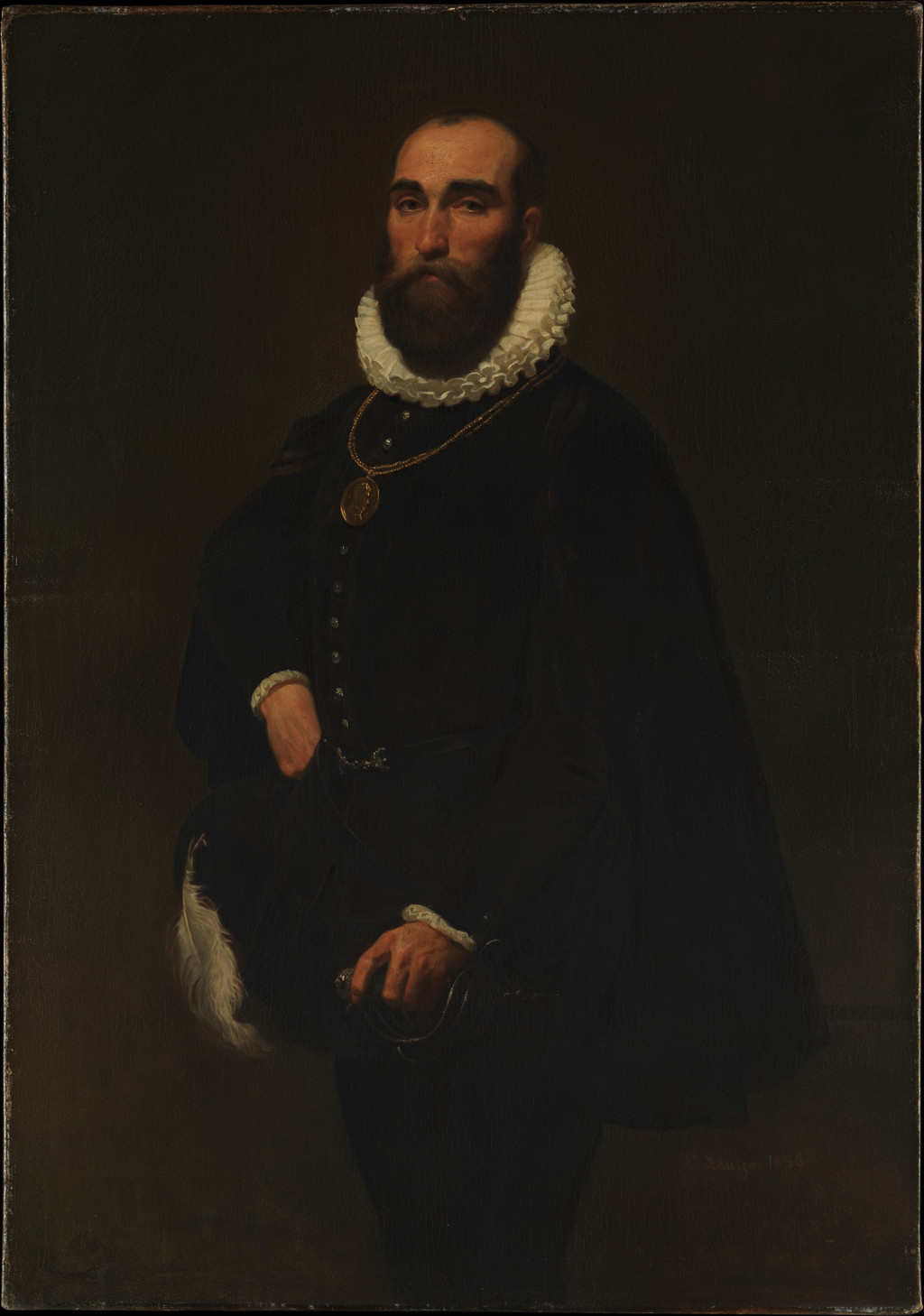
| Worthington Whittredge | 1856 | Painting |
| Signing of the Alaska Treaty | c. 1867 | Painting |
| The Last Drop (McGuire Scrapbook) | Date not specified | Drawing |
| The Amber Necklace | 1847 | Painting |
| Maria Lottner | c. 1842 | Painting |
| Heinrich Lottner | 1858 | Painting |
| Cromwell at Milton’s Home (Schwäbisch Gmünd version) | 1855 | Painting |
| Titian’s Lagoon Voyage | 1857 | Painting |
| Mary Stuart’s First Mass in Holyroodhouse | 1866 | Painting |
| Evening Party at Milton’s (National Gallery of Art canvas) | 1854 | Painting |
| Friedrich Wilhelm Hütz | 1863 | Painting |
| Waving figure from Westward the Course of Empire Takes Its Way | c.1860 | Drawing |
Frequently Asked Questions
The large mural is in the west stairway of the House wing in the U.S. Capitol. The oil study illustrated here belongs to the Smithsonian American Art Museum, accession 1931.6.1.
The Smithsonian dates its oil study to 1861. The Capitol commission was made in July 1861, and the finished mural dates to 1861–62.
They are separate objects. The Smithsonian work is oil on canvas, 84.5 × 110.1 cm. The Capitol mural is a stereochrome wall painting measuring 20 × 30 feet, and includes changes from the early studies.
It comes from a poem by Bishop George Berkeley and presents westward movement as part of a larger course of history. Leutze connects that idea with American migration, exploration and national expansion.
It is a wall-painting technique using pigments applied to plaster and sealed with waterglass, a silica solution. It is the medium of Leutze’s Capitol mural; his Smithsonian study is an oil painting.
Discussion
Look again at the images and ideas explored in Westward the Course of Empire Takes Its Way. These editorial prompts invite your observations.
Does the painting’s bright destination make the travellers’ hardship seem inevitable, justified or more troubling? Consider how the border changes your response to the central scene.
Reader Insights
Where do the travellers’ gestures lead your eye?
How does the border change your reading of the central journey?
Whose future is presented by the picture’s bright destination?
Join the Conversation
Share a detail, comparison or question about Westward the Course of Empire Takes Its Way below.
References
- Architect of the Capitol , Westward the Course of Empire Takes Its Way . Commission, dimensions, location, technique, conservation and differences from the early sketches. View source
- Smithsonian American Art Museum , Westward the Course of Empire Takes Its Way (mural study, U.S. Capitol) , 1861, accession 1931.6.1. Oil-study object record and image. View source
- Natalie Spassky , American Paintings in the Metropolitan Museum of Art , Volume II, 1985, pp. 13–25, especially pp. 15–16. Leutze’s career and pursuit of a national commission. View source
- Smithsonian American Art Museum , research notes on accession 1931.6.1, May 2012. Study provenance and interpretive discussion. View source
- Henry T. Tuckerman , Book of the Artists , 1867, Leutze chapter, pp. 333–345, especially pp. 336–338. Contemporary description of the mural’s figures and border, read as a historical account with prejudicial assumptions. View source
- Smithsonian American Art Museum , Westward the Course of Empire: Observation and Interpretation , educational resource. Border interpretation and medallion identifications; historical artist statements are mediated through this publication. View source
- National Archives , The District of Columbia Emancipation Act , National Archives Identifier 299814, Record Group 11. Act dated 16 April 1862. View source
- Splash image source.
Emanuel Leutze, Westward the Course of Empire Takes Its Way (mural study, U.S. Capitol), 1861. Oil on canvas, 84.5 × 110.1 cm. Smithsonian American Art Museum, 1931.6.1, Bequest of Sara Carr Upton. CC0 / Public domain . Resized only; native appearance, complete image and margins preserved.
View source