 by
Tom Gurney
Tom Gurney BSc (Hons) is an art history expert with over 20 years experience
Email:
tomgurney1@gmail.com
/ Phone:
+44 7429 011000
Emanuel Leutze, Düsseldorf and American History: Introduction
An American historical painting could take shape far from the place it represented. Emanuel Leutze developed Washington Crossing the Delaware in Düsseldorf, among artists who exchanged ideas, posed for one another and kept in touch with patrons across the Atlantic. The city supplied a setting in which the American past could become both a professional opportunity and a subject of European political interest. [1]
Leutze’s role within that setting extended beyond making his own pictures. His studio became a meeting place and a source of advice for Americans abroad, including Worthington Whittredge, Eastman Johnson and Albert Bierstadt. Following those connections explains why his career belongs to the history of artistic exchange as well as to the history of American national imagery. The two were closely entwined. [1]
At a Glance
- Arrival Leutze reached Düsseldorf in 1841
- Institutional connection Enrolled as a history painter at the Royal Art Academy
- Wider school Academy teaching, independent studios and an international artistic community
- American connections Worthington Whittredge, Eastman Johnson, Albert Bierstadt and William Stanley Haseltine
- Associations Mutual aid, the Malkasten founded in 1848 and the German Art Union of 1856
- Political setting German liberal and national aspirations around the revolutions of 1848
- International market Exhibitions, collectors, dealers and reproductive prints
- Central work Washington Crossing the Delaware , painted in Düsseldorf; the Met canvas dates to 1851
Contents
- What the Düsseldorf school included
- Crossing the Atlantic to learn
- Academy, independent studio and political argument
- Associations and mutual support
- Whittredge and the practical life of the studio
- Eastman Johnson and a painting for the engraver
- Exhibitions, prints and American audiences
- Revolution seen across the Atlantic
- The limits of the story of freedom
What the Düsseldorf school included
The Kunstpalast defines the Düsseldorf school broadly, encompassing artists at the academy and in its surrounding community. Its account emphasises the international attraction of both institutional teaching and independent painters. Americans entered an established artistic centre alongside visitors from Scandinavia, Russia and other regions. The school’s reach extended across history painting, landscape and scenes of everyday life. [2]
That breadth matters when considering Leutze’s American circle. A landscape painter could benefit from the company of a historical painter without adopting the same subjects. Professional example, introductions and the experience of working near ambitious pictures could cross the boundaries between genres. Their shared city did not require all these artists to produce one uniform kind of art.
Leutze’s own work illustrates the distinction between membership in an artistic environment and obedience to a single teaching method. He was recognised as an exponent of Düsseldorf painting, yet the Met’s scholarly catalogue describes his early rejection of the academy’s painstaking finish in favour of a broader approach. His position combined participation with independence. [1]
Crossing the Atlantic to learn
Leutze had already worked as a portrait painter in America before seeking further training. Support from the Philadelphia collector Edward L. Carey and the merchant Joseph Sill helped make his European journey possible. He arrived in Amsterdam in January 1841 and continued to Düsseldorf. The academy’s student records, cited by the Met catalogue, list him as a history painter. [1]
His early success there shows how quickly training and recognition could interact. Columbus before the High Council of Salamanca , painted in 1841, won praise from the academy’s director Wilhelm von Schadow and was acquired by the Düsseldorf Art Union. Another Columbus subject, showing the explorer’s return in chains, gained recognition in Brussels and entered the American Art-Union’s orbit in New York. European achievement could support an American reputation. [1]
The appeal of studying abroad therefore involved more than acquiring a set of technical exercises. Artists could encounter ambitious work, establish relationships and place paintings before audiences beyond their home city. Leutze’s experience offered a particularly visible example of those possibilities. His biography follows the journeys in detail; their wider significance lies in the connections they made available.
Academy, independent studio and political argument
Leutze left formal academy study and established his own Düsseldorf studio. His independence did not end his engagement with the city’s painters. In a letter reproduced by Henry T. Tuckerman, he discussed artistic fellowship as well as divisions associated with Schadow and Carl Friedrich Lessing. He characterised the former tendency through Catholic severity and the latter through a freer Protestant spirit. [3]
That is Leutze’s partisan description of an environment he inhabited. It reveals how artistic disagreements could be understood through religious and intellectual affiliations, while leaving room for differences among individuals. It also helps explain why an artist might value Düsseldorf without accepting every prescription of its academy.
The same letter describes the choice of a historical incident as a way to communicate a larger idea. For Leutze, a picture needed a governing thought, with the episode serving its expression. His interest in history painting was consequently intellectual and political as well as practical. The past supplied occasions through which conviction, conflict and resistance might be made visible. [3]
These principles did not determine every painting’s meaning in advance. Costume, gesture, setting and the spectator’s own knowledge still shape an encounter with the finished work. The style and technique article considers how Leutze translated his dramatic ambitions into particular arrangements of figures and paint.
Associations and mutual support
Leutze took an active role in organised artistic life. He became a member and later president of the Union of Düsseldorf Artists for Mutual Aid and Support. He also helped establish the Malkasten in 1848 and participated in founding the German Art Union in 1856. The Met catalogue places these activities beside his political engagement and his position within the independent artistic community. [1]
Such associations gave artistic life a collective dimension. A painter’s prospects depended partly on professional relationships, and the language of mutual assistance indicates needs that extended beyond the individual studio. Leutze’s reputation for helping Americans belongs within this wider pattern of community building.
Tuckerman’s account of Leutze’s return visit in June 1863 describes a warm reception at the Malkasten, with music, supper and greetings from fellow artists. The account, which reproduces a report from the time, preserves the social performance of belonging. Leutze had returned to America in 1859, but Düsseldorf remained a place where his presence carried personal and professional significance. [3]
Whittredge and the practical life of the studio
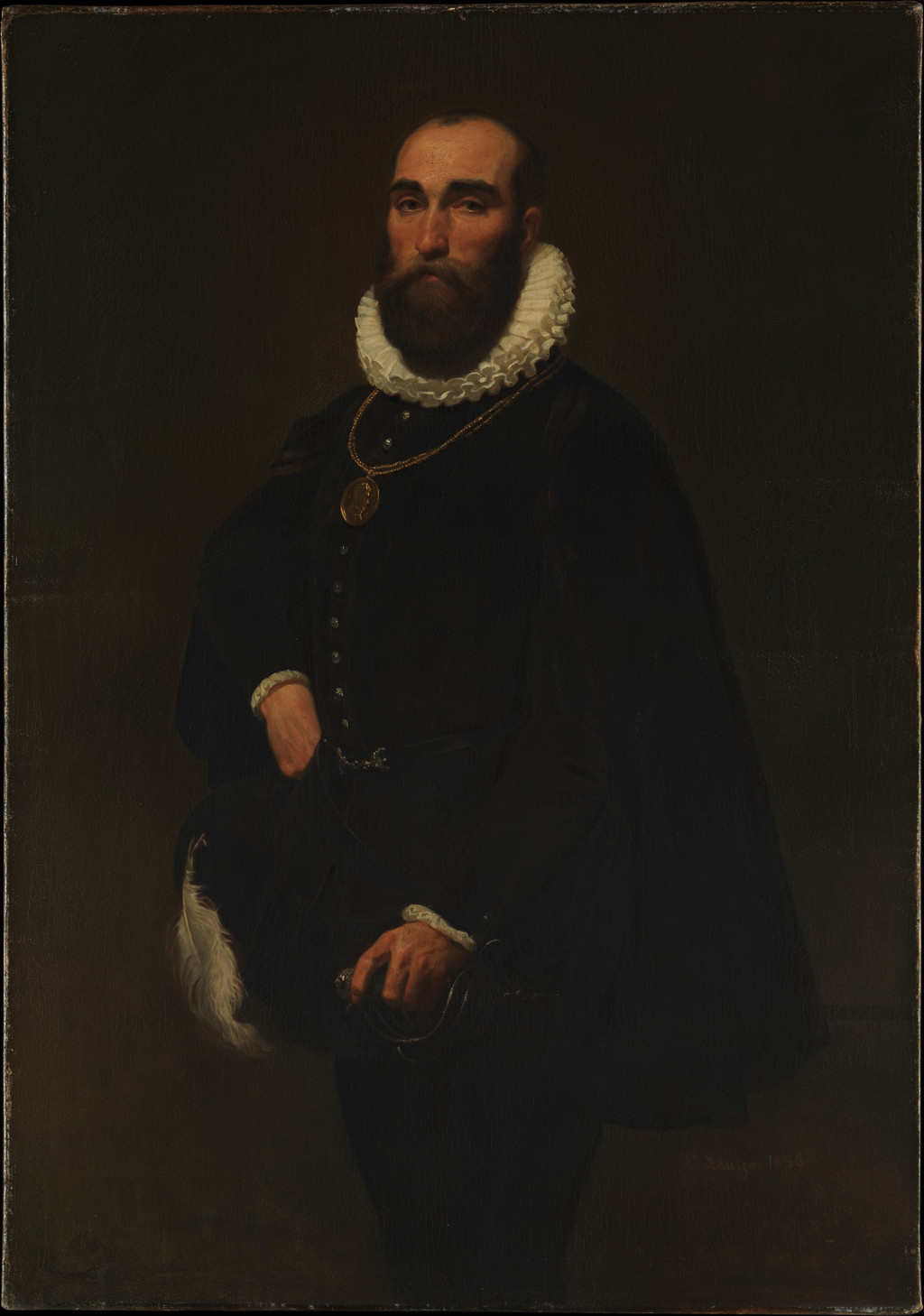
The portrait of Worthington Whittredge gives one of these relationships a visible form. Painted in 1856, it presents a contemporary landscape artist in seventeenth-century dress. The ruff, chain and dark clothing evoke an older portrait tradition while preserving the identity of a living colleague. The Met catalogue suggests that the costume probably came from Leutze’s collection of period clothing. [1] [4]
Whittredge also participated in the making of Washington Crossing the Delaware . He posed for Washington’s body and for the steersman; the general’s head drew on Houdon’s sculptural likeness. A fellow painter’s physical presence could thus help supply a figure within an imagined historical event. The friendship connects portraiture, modelling and history painting without making them interchangeable. [5]
The studio offered an unusually immediate encounter with pictorial construction. An artist nearby could see an ambitious composition developing and take part in its practical demands. A pose had to work within the group; costume had to sit convincingly on a body; a gesture needed to remain legible across a large canvas. Those demands made the workplace a setting for learning through shared activity.
Leutze’s circle also included Albert Bierstadt and William Stanley Haseltine, whom the Met catalogue names among the Americans he befriended and advised. Their inclusion shows the reach of his position without requiring every relationship to be described as formal academy instruction or every picture to be treated as a joint production. [1]
Eastman Johnson and a painting for the engraver
Eastman Johnson’s experience supplies more specific evidence of learning through work. His letters of 1851, reproduced and discussed in the Eastman Johnson Catalogue Raisonné, describe painting under Leutze’s instruction and making a reduced copy of the Delaware composition intended for an engraving. They bring the studio into contact with the future circulation of the image. [6]
The catalogue’s authors, Patricia Hills and Abigael MacGibeny, distinguish that history from the attribution of an individual surviving smaller painting. Their entry identifies the work as Leutze with Johnson’s assistance, and Hills argues that it supplied the engraver’s model. This is a particular scholarly attribution, rather than a reason to assign every reduced version to Johnson. [6]
The episode connects artistic development with a practical commission. A younger painter could learn from translating a complex composition to another scale, while the finished result served a commercial purpose. The drawings and prints article follows the distinction between an artist’s original work, a painted copy and a print made after it.
Watch: Emanuel Leutze
Choose a film to explore the artist’s work, its interpretation and its wider setting.
It's not only about the American Revolution, Leutze's Washington Crossing the Delaware
Smarthistory considers the ideas and historical distance behind Washington Crossing the Delaware.
Watch on YouTubeExhibitions, prints and American audiences
The Kunstpalast’s account also describes the commercial structures supporting Düsseldorf painting: art associations promoted exhibitions, acquisitions and engravings, while dealers widened the market. It identifies John G. Böker’s Düsseldorf Gallery in New York as an important American outlet from 1849. Paintings and their reproductions could introduce the school to viewers who never travelled to Germany. [2]
Leutze’s career depended on several such channels. The American Art-Union promoted his work, and its dissolution in 1852 removed a significant source of support. The success of the Delaware painting nevertheless continued to attract commissions. Its exhibition history and Paul Girardet’s engraving, published by Goupil in New York in 1853, extended the subject’s reach. [1] [7]
The engraving carried a composition through a different material and at a more manageable scale. It preserved the recognisable grouping of Washington, the flag and the boatmen while translating colour into tonal marks. Its existence helps explain how an image made within a particular European studio could enter a much wider American visual culture.
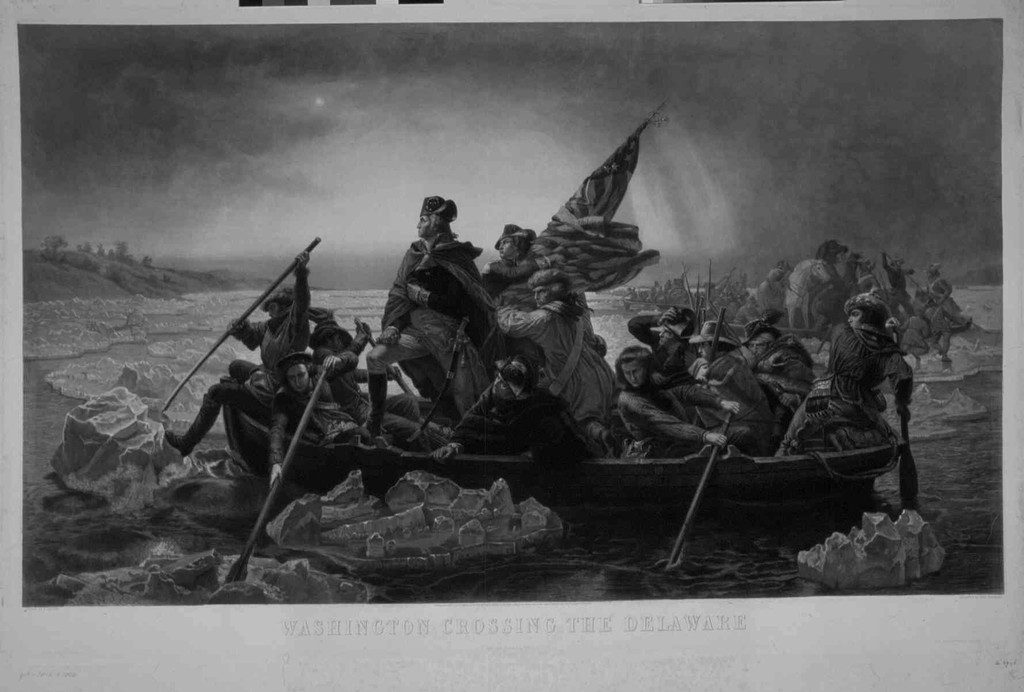
Paul Girardet after Emanuel Leutze, Washington Crossing the Delaware, engraving published in 1853. Leiden University Libraries, PK-P-126.302. Digitised reproduction via Wikimedia Commons, CC BY 4.0. Resized only. Paul Girardet after Emanuel Leutze; digitised by Leiden University Libraries, PK-P-126.302; reproduction via Wikimedia Commons, CC BY 4.0.
Image source
.
Creative Commons Attribution 4.0 International
. Resized only; complete supplied photograph including margins and calibration fragment retained; no appearance editing.
Revolution seen across the Atlantic
Political aspirations also travelled through this network. During the revolutionary period of 1848, Leutze aligned himself with liberal opponents of Prussian authority who sought a united democratic Germany. His interest in the American Revolution therefore developed amid struggles over the future of the German states. The Met catalogue connects those settings in its account of his career. [1]
Washington could stand for more than a famous American individual. A historical leader associated with independence offered material through which a painter in Germany could consider resistance, national purpose and collective action. The Delaware picture’s setting in the American past did not isolate it from questions that mattered to Leutze’s contemporaries in Europe. [5]
Leutze’s own account of his ambitions, reproduced in the Met catalogue, imagined a long historical sequence connecting resistance in medieval communities with religious change, migration and American independence. This was a selective story of freedom. It helps connect the varied periods represented in his paintings, while also revealing how strongly he arranged history around a preferred political direction. [1]
European subjects remained part of that practice. Schwäbisch Gmünd’s museum has documented paintings concerning Cromwell, Titian and Mary Stuart alongside Leutze’s family portraits. His paintings place American history within a larger body of work drawn from European politics, religion, literature and artistic life. [8]
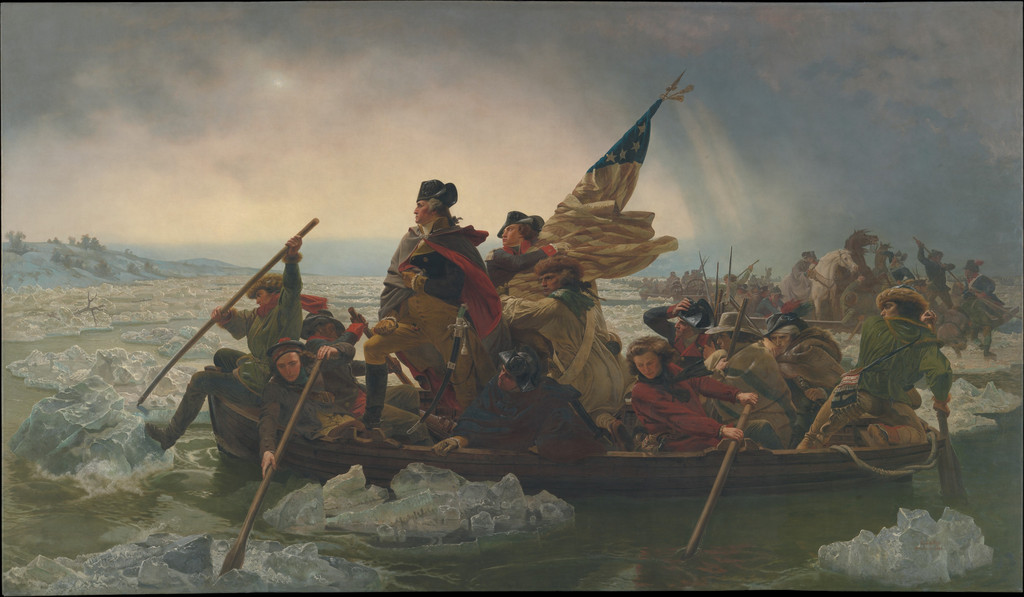
Emanuel Leutze, Washington Crossing the Delaware, 1851. Oil on canvas, 378.5 × 647.7 cm. Metropolitan Museum of Art, 97.34, Gift of John Stewart Kennedy, 1897. The Metropolitan Museum of Art.
Image source
.
CC0 / Public domain
. Resized only; native appearance, complete image and margins preserved.
The limits of the story of freedom
Liberal conviction did not make nineteenth-century representations inclusive in every respect. Tuckerman’s account of the 1863 Düsseldorf reception includes artists dressed as Black and Indigenous people during the meal. Its celebratory tone accepts the racial impersonation as part of the entertainment. Read critically, the passage reveals assumptions within a community that could also praise liberty and artistic fellowship. [3]
The paintings invite comparable questions. In his contribution to the Met’s Native Perspectives , Mohawk artist Alan Michelson identifies the figure at the Delaware boat’s stern as likely representing an Indigenous soldier. He sets that presence beside the promises of the 1778 treaty with the Lenape and the subsequent violations and violence, including the Gnadenhütten massacre. His reading places pressure on an image of shared national purpose by recalling the treatment of Indigenous allies. [9]
Leutze later celebrated westward expansion in Westward the Course of Empire Takes Its Way . The Capitol commission turned the movement of settlers towards the Pacific into a monumental public picture. Its relationship with his earlier democratic ideals is part of the interest of his career: a language of progress could support national expansion while leaving other histories outside its central action. [10]
Understanding the Düsseldorf connection makes those questions more precise. Leutze’s American pictures emerged through European training, artistic friendship, international commerce and political hopes. Their public authority was made through those relationships. Looking at the network behind them reveals both the breadth of the exchange and the choices through which a complicated past became a compelling national image.
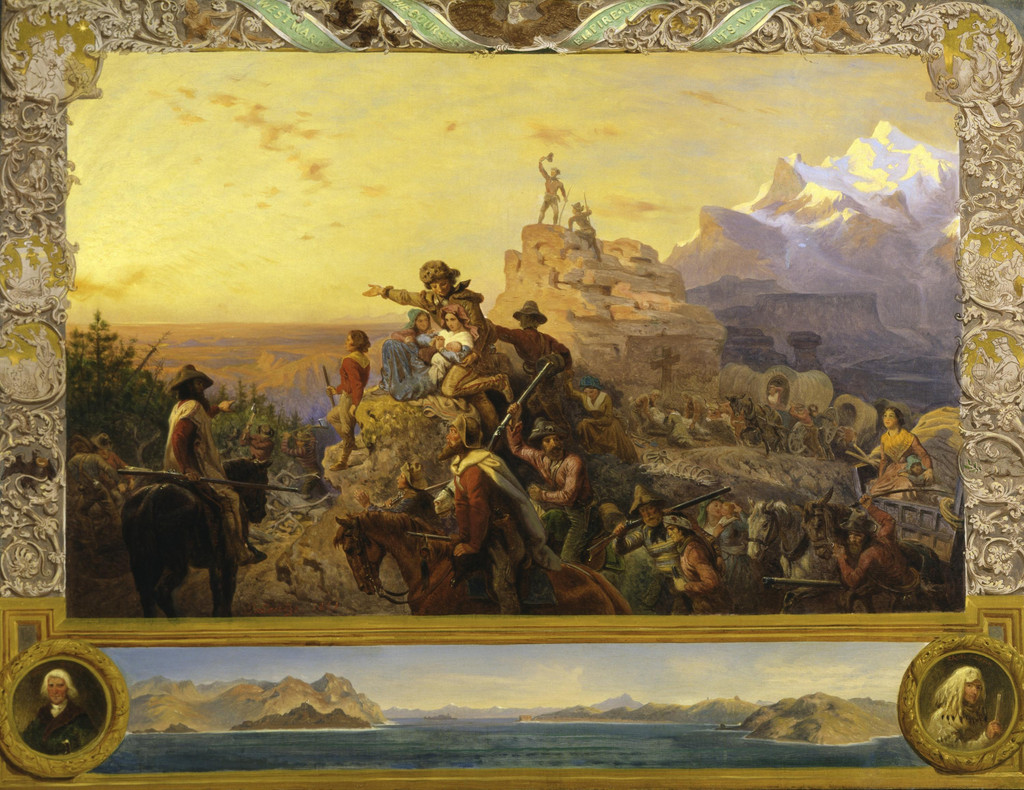
Emanuel Leutze, Westward the Course of Empire Takes Its Way (mural study, U.S. Capitol), 1861. Oil on canvas, 84.5 × 110.1 cm. Smithsonian American Art Museum, 1931.6.1, Bequest of Sara Carr Upton.
Image source
.
CC0 / Public domain
. Resized only; native appearance, complete image and margins preserved.
Artworks directory
A selected directory of paintings and drawings discussed in these articles. Different versions are listed separately.
| Name | Date | Medium |
|---|---|---|
| Washington Crossing the Delaware (Met canvas) | 1851 | Painting |
| Westward the Course of Empire Takes Its Way (oil study) | 1861 | Painting |
| Westward the Course of Empire Takes Its Way (Capitol mural) | 1861–62 | Painting (mural) |
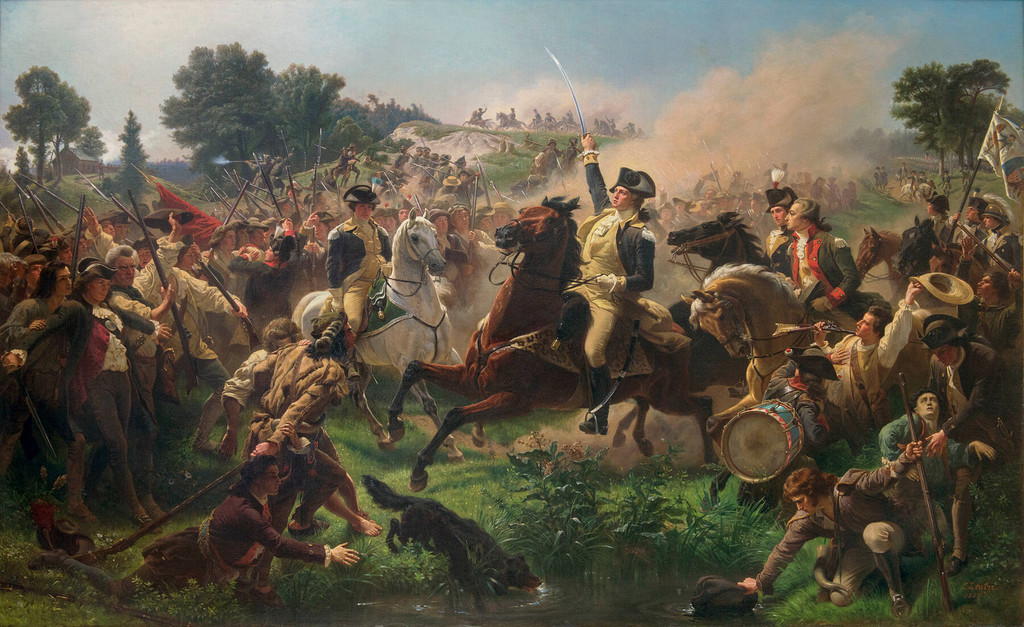
| Washington Rallying the Troops at Monmouth (large original) | 1854 | Painting |
| Washington Rallying the Troops at Monmouth (replica) | 1857 | Painting |
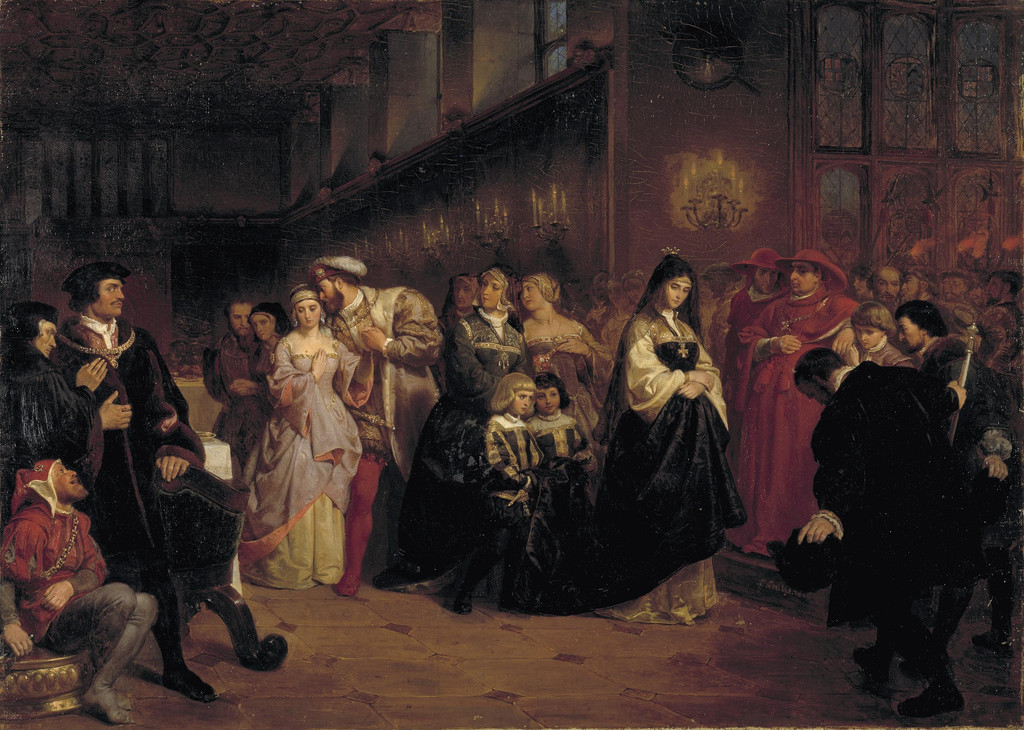
| The Courtship of Anne Boleyn | 1846 | Painting |
| Worthington Whittredge | 1856 | Painting |
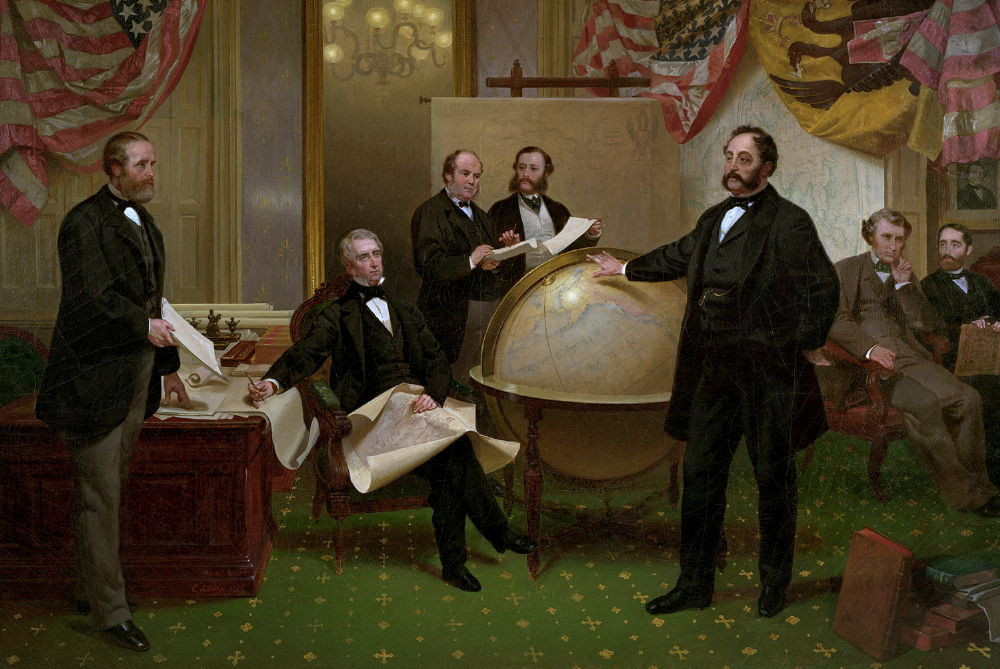
| Signing of the Alaska Treaty | c. 1867 | Painting |
| The Last Drop (McGuire Scrapbook) | Date not specified | Drawing |
| The Amber Necklace | 1847 | Painting |
| Maria Lottner | c. 1842 | Painting |
| Heinrich Lottner | 1858 | Painting |
| Cromwell at Milton’s Home (Schwäbisch Gmünd version) | 1855 | Painting |
| Titian’s Lagoon Voyage | 1857 | Painting |
| Mary Stuart’s First Mass in Holyroodhouse | 1866 | Painting |
| Evening Party at Milton’s (National Gallery of Art canvas) | 1854 | Painting |
| Friedrich Wilhelm Hütz | 1863 | Painting |
| Waving figure from Westward the Course of Empire Takes Its Way | c.1860 | Drawing |
Frequently Asked Questions
He developed it in Düsseldorf. The Metropolitan Museum’s large canvas dates to 1851, following an earlier version damaged by a studio fire.
The term encompasses the academy and its surrounding artistic community, including independent studios and international artists working in several genres.
His circle included Worthington Whittredge, Eastman Johnson, Albert Bierstadt and William Stanley Haseltine. Their relationships included friendship, advice, modelling and particular studio work.
His 1851 letters describe making a reduced copy intended for engraving while working under Leutze’s instruction. The catalogue raisonné discusses the attribution of a particular surviving smaller version separately.
Discussion
Look again at the images and ideas explored in Emanuel Leutze, Düsseldorf and American History. These editorial prompts invite your observations.
Does knowing that the Delaware composition developed in Düsseldorf change how you understand it as an American image? Consider its studio models, intended audiences and political setting.
Reader Insights
How does Whittredge’s portrait present a living colleague through historical dress?
How does Girardet’s print change your encounter with the Delaware image?
What does the Düsseldorf setting add to your reading of American historical subjects?
Join the Conversation
Share a detail, comparison or question about Emanuel Leutze, Düsseldorf and American History below.
References
- Natalie Spassky , American Paintings in the Metropolitan Museum of Art , Volume II, 1985, Leutze section, pp. 13–25, especially pp. 14–16 and 25. Academy records, independence, artistic associations, American circle, politics and Whittredge portrait. View source
- Kunstpalast Düsseldorf , The Düsseldorf School of Painting . Institutional overview, international artists, genres and commercial networks. View source
- Henry T. Tuckerman , Book of the Artists , 1867, Leutze chapter, pp. 333–345, especially pp. 335–336 and 339. Published artist’s letter and mediated account of the 1863 reception; original letter and newspaper report not independently consulted. View source
- Metropolitan Museum of Art , Worthington Whittredge , 1856, accession 03.16. Object record and image. View source
- Carrie Rebora Barratt and contributors , Washington Crossing the Delaware: Restoring an American Masterpiece , Metropolitan Museum of Art Bulletin , Fall 2011, especially pp. 5–7. German revolutionary setting, studio models and construction of Washington’s likeness. View source
- Patricia Hills and Abigael MacGibeny , Washington Crossing the Delaware , Hills no. 5.0.2, Eastman Johnson Catalogue Raisonné, updated 8 September 2022. Johnson’s letters, reduced version and scholarly attribution. View source
- Library of Congress , Washington Crossing the Delaware , Paul Girardet after Emanuel Leutze, Goupil, New York, 1853. Print publication record. View source
- Museum im Prediger / City of Schwäbisch Gmünd , Emanuel Leutze: zum 200. Geburtstag , 2016 exhibition account. European subjects and family portraits. View source
- Alan Michelson , contribution on Washington Crossing the Delaware in the Metropolitan Museum of Art’s Native Perspectives , 11 September 2019. Indigenous figure and critical historical interpretation. View source
- Architect of the Capitol , Westward the Course of Empire Takes Its Way . Mural subject, public setting and imagery of westward expansion. View source
- Splash image source.
Emanuel Leutze, Worthington Whittredge, 1856. Oil on canvas, 129.2 × 102.9 cm. Metropolitan Museum of Art, 03.16. Gift of Several Gentlemen, 1903. The Metropolitan Museum of Art. CC0 / Public domain . Resized only; native appearance, complete image and margins preserved.
View source