by Tom Gurney
Tom Gurney BSc (Hons) is an art history expert with over 20 years experience
Page created on September 3, 2026 / Page updated on September 13, 2026
Email: tomgurney1@gmail.com / Phone: +44 7429 011000
How Painters Turn Consequential Stories into Visual Action
History painting is an ambitious form of narrative art. Its subjects may come from classical history, the Bible, mythology, literature, allegory or a major public event. Despite the name, it is not simply a painted record of something that really happened. The older idea derives from istoria: a significant story shaped through actions, expressions and moral choices.[1]
European academies placed history painting at the top of their hierarchy from the sixteenth century onward. Artists were expected to invent a convincing multi-figure scene, understand anatomy and perspective, know authoritative texts and make a complex event intelligible at a glance.[2] The category's prestige helps explain many grand canvases, state commissions and prizes. It also exposes the assumptions and exclusions built into academic art.
At a Glance
- Core ideahistory painting presents an ambitious narrative drawn from history, scripture, mythology or literature.
- Look fora consequential action, legible protagonists, gestures, setting and a constructed moral or civic frame.
- History meant storythe traditional category included sacred, mythological and literary narratives, not only recorded events.
- Invention mattersartists interpret sources and organise action rather than simply illustrate facts.
- Explore nextcompare mythological , religious and everyday-life subjects.
Contents
What makes a painting a history painting?
A history painting turns a consequential story into a visual argument. The decisive feature is not age or factual accuracy, but serious narrative purpose. A painter selects the charged moment—before a sacrifice, during a reversal, after a defeat—and arranges bodies, gestures, architecture, light and symbols so that viewers can reconstruct causes and consequences.
Traditional subjects included ancient Greek and Roman history, Christian scripture, Greco-Roman myth, epic poetry and allegories of virtue or government. Later artists applied the same elevated language to recent wars, revolutions and public disasters. Scale was often large, but size alone never creates the genre. A compact biblical panel may carry a more concentrated narrative than a vast ceremonial portrait.
Famous history paintings and what they do
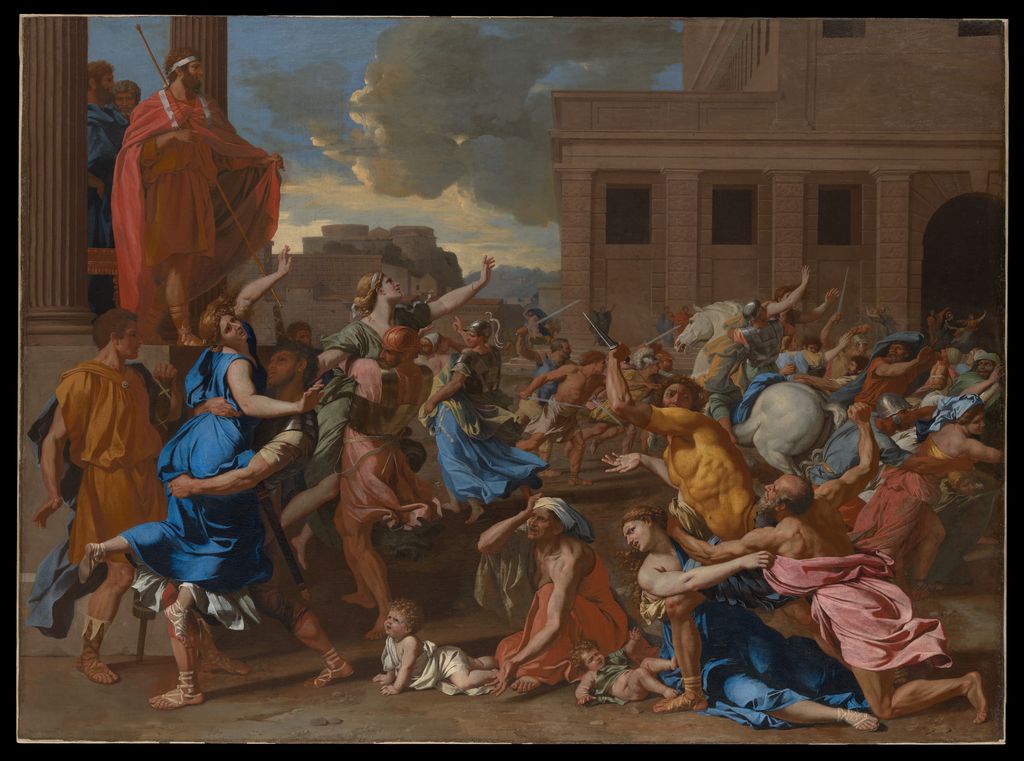
Classical legend — The Abduction of the Sabine Women
Nicolas Poussin's The Abduction of the Sabine Women, probably painted in 1633–34, reconstructs the Roman foundation legend as a carefully organised crisis.[3] The signal-giving figure at left initiates a surge of opposed bodies across the square. Architecture fixes the setting while repeated diagonals make violence spread through the crowd. Poussin does not offer neutral archaeology; he converts a troubling story into a study of command, panic and civic origins.
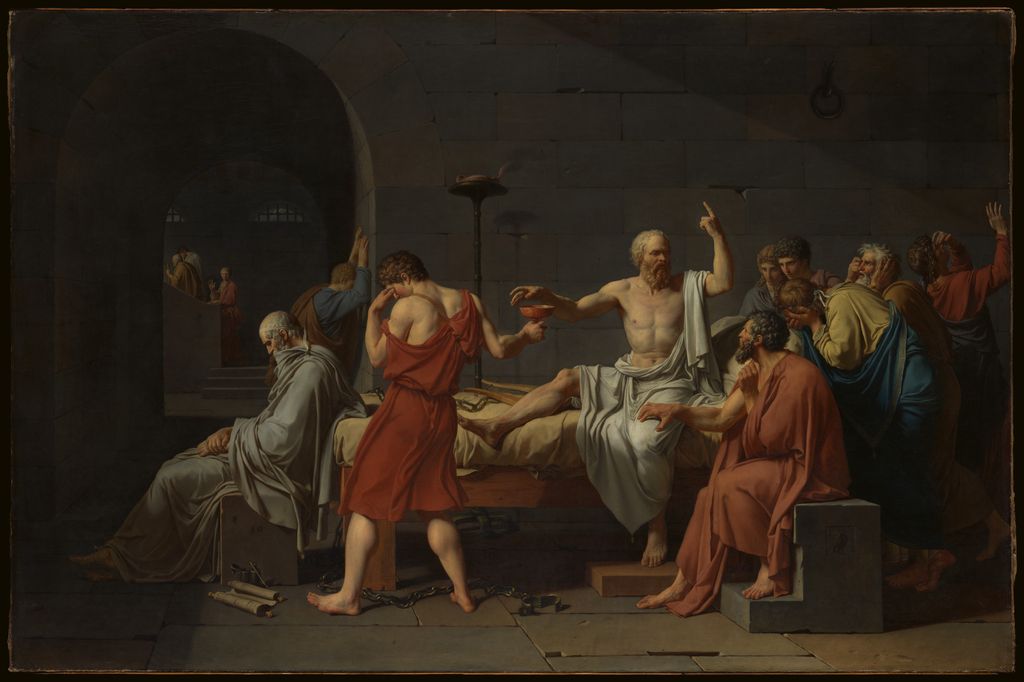
Moral example — The Death of Socrates
Jacques Louis David's The Death of Socrates (1787) shows the philosopher reaching for the cup of poison while continuing to teach.[4] The clean architecture, controlled gestures and contrast between Socrates's alert body and his grieving companions frame death as a chosen test of principle. The painting became a model of Neoclassical history painting because every formal decision supports a moral reading.
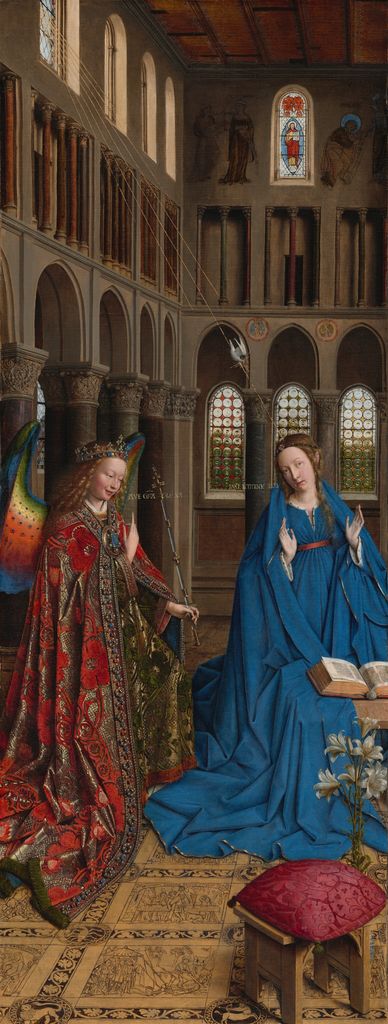
Biblical narrative — The Annunciation
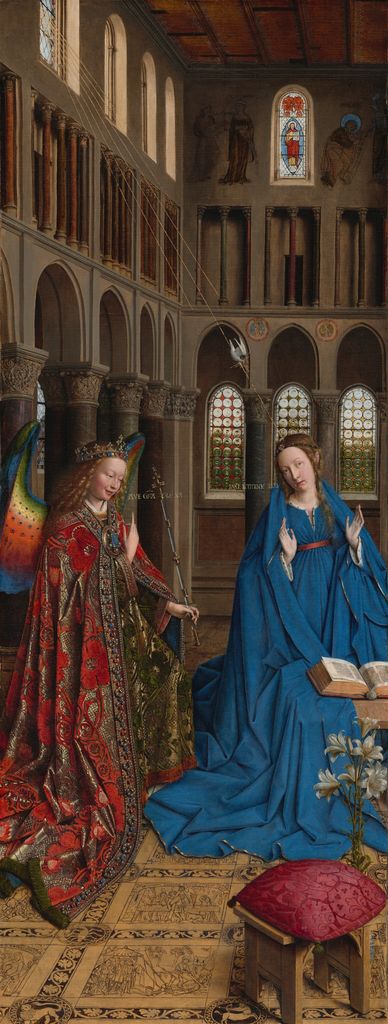
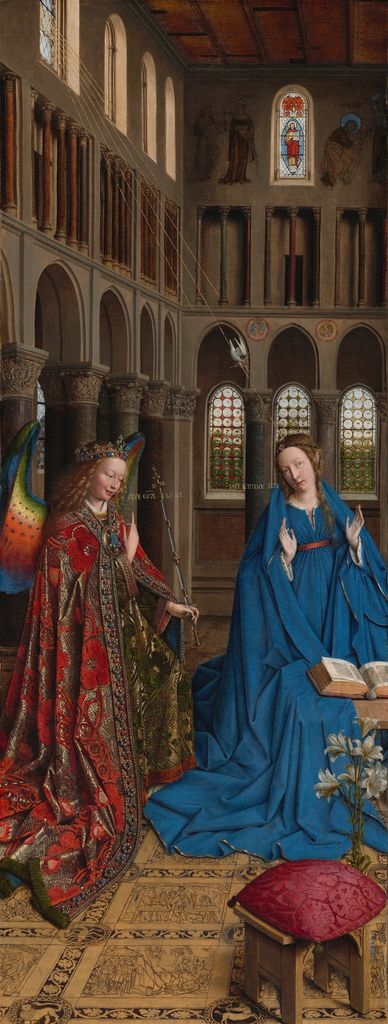
Jan van Eyck's The Annunciation, made around 1434–36, presents Gabriel's message to Mary inside an elaborate church.[5] The figures, inscriptions, architecture and details draw different moments of Christian history into one devotional encounter. Although the work is unquestionably religious art, its serious narrative, textual source and symbolic construction also demonstrate why biblical subjects stood within the history-painting tradition.
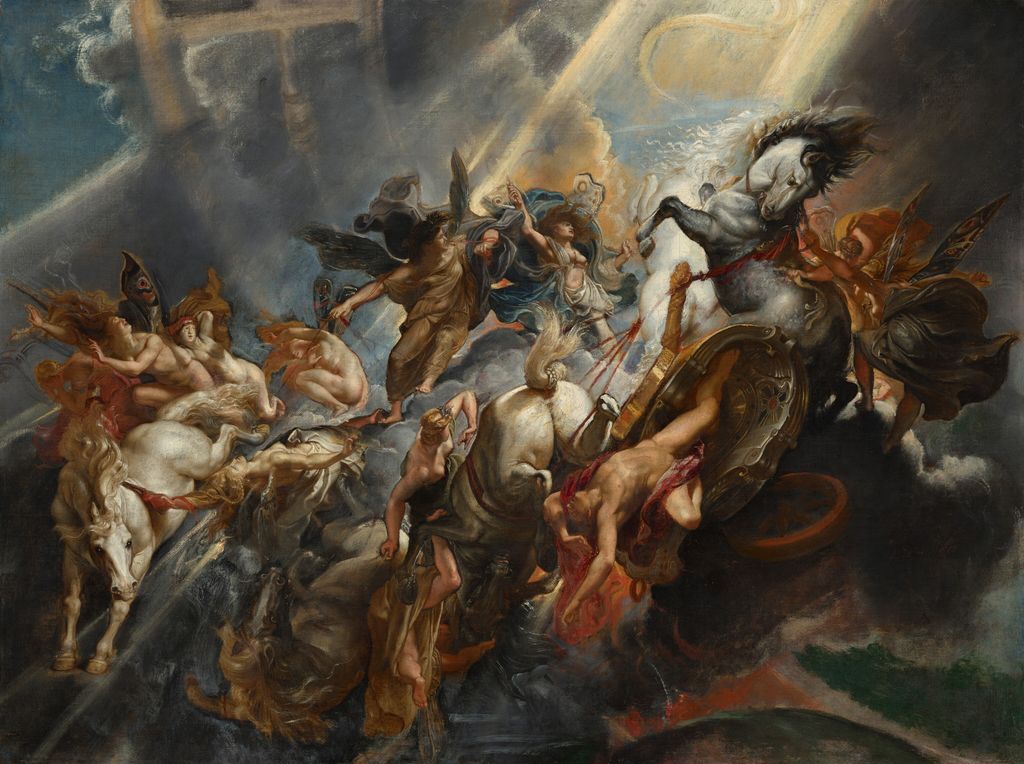
Myth transformed into action — The Fall of Phaeton
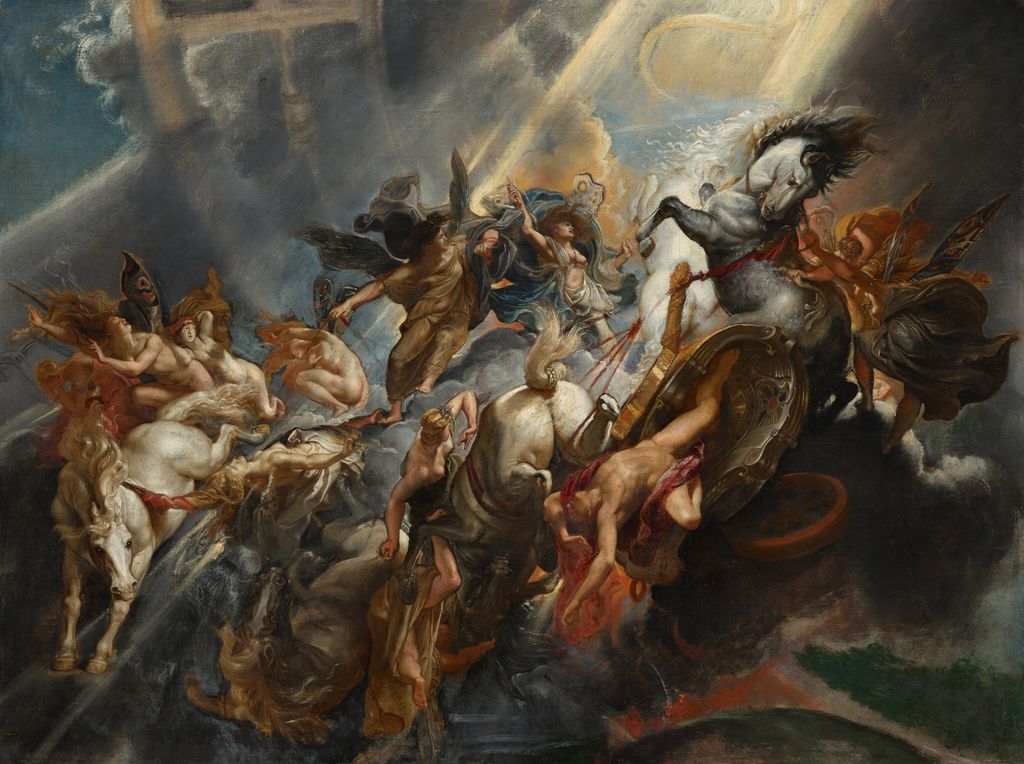
In The Fall of Phaeton, Peter Paul Rubens translates an ancient myth into a chain reaction of twisting horses, falling bodies and broken order.[6] Lightning tears through the scene as the sun god's son loses control of the chariot. The work shows why mythology appealed to history painters: it joined learned literature, expressive anatomy, supernatural spectacle and consequences that could be read as warnings about ambition.
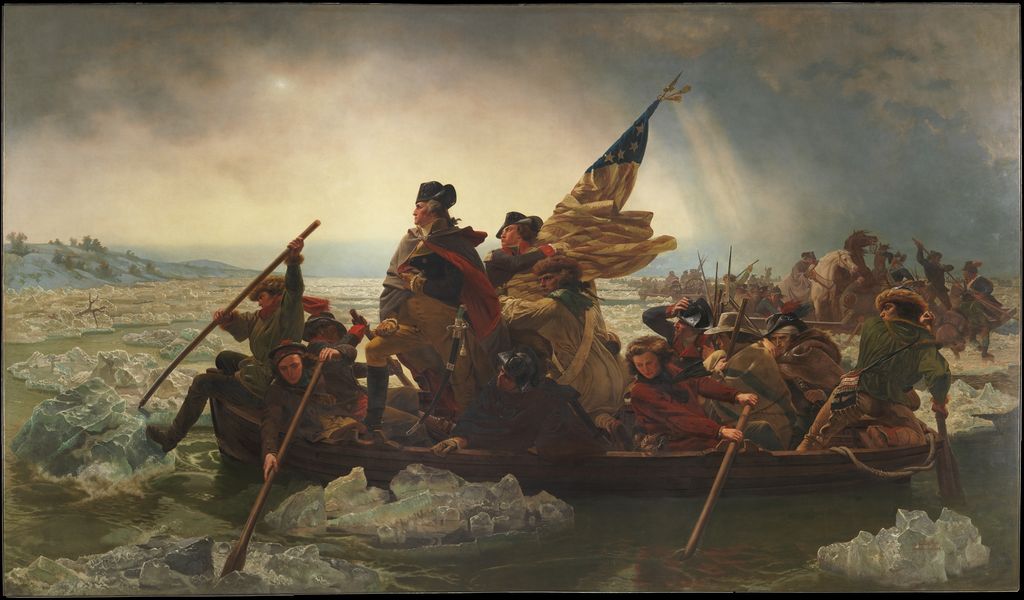
Recent history made heroic — Washington Crossing the Delaware
Emanuel Leutze painted Washington Crossing the Delaware in 1851, decades after the event it commemorates.[7] A crowded boat advances diagonally through ice while Washington rises above the group against a brightening sky. The scene is theatrical rather than documentary in every detail, but that is central to its function. It turns a precarious military crossing into a public image of resolve and collective destiny.
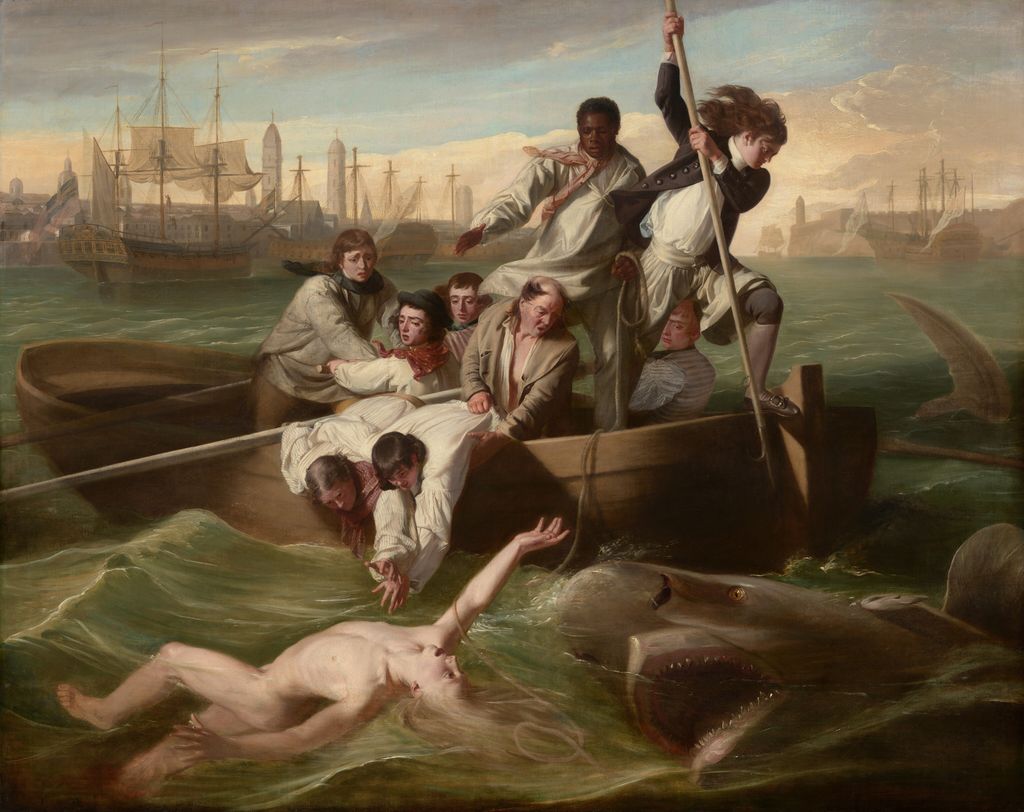
Modern-life danger — Watson and the Shark
John Singleton Copley's Watson and the Shark (1778) represents a shark attack that had occurred in Havana in 1749.[8] Sailors reach from a boat toward the exposed swimmer as the shark returns. The painting borrows the scale and concentrated climax of history painting for a recent event involving a private individual. It helped expand the category beyond kings, saints and ancient heroes.
Historical events, allegory and invention
History painters rarely behaved like cameras. They compressed time, combined witnesses, adjusted costumes and landscapes, or borrowed poses from earlier art. Such invention aimed to make an event memorable and meaningful. Benjamin West's The Death of General Wolfe (1770) famously dressed its recent military protagonists in contemporary clothing while arranging the dying commander through echoes of sacred lamentation.[9]
Eugène Delacroix's Liberty Leading the People (1830) goes further by joining observed revolution with allegory. A personification of Liberty strides across the barricade among recognisable social types. The painting refers to the July Revolution, but its central figure turns immediate politics into a larger claim about sacrifice, citizenship and collective action.[10]
These inventions are not excuses to ignore accuracy. Viewers should ask what has been altered, whose account is presented and what political work the image performs. The genre often turns contested events into apparently inevitable stories.
The viewer's position matters as much as the hero's. Painters may place us among witnesses, keep us at a ceremonial distance or make us arrive just after violence. Crowd reactions often offer a range of possible responses: grief, fear, resolve, disbelief or obedience. Reading those secondary figures prevents the central protagonist from monopolising the story and can reveal people whom official histories reduce to background roles.
Why history painting ranked highest
Academic theory treated history painting as the closest visual equivalent to epic poetry or tragedy. A successful composition supposedly required mastery of every subordinate skill: the human figure, expression, costume, architecture, landscape, still-life detail and dramatic unity. Training therefore progressed from copying prints and casts to life drawing and, finally, multi-figure composition.[2]
Access to that training was unequal. Because the most prestigious category depended heavily on study from the nude, restrictions on women's participation in life classes limited their academic opportunities.[11] Artists such as Artemisia Gentileschi nevertheless produced forceful biblical and classical narratives, demonstrating that institutional barriers—not capacity or ambition—helped shape the historical record.
The hierarchy also privileged particular European textual traditions and patrons. Treating classical or Christian narratives as inherently “higher” than landscapes, still lifes or scenes of work made social power look like natural artistic value.
How history painting changed
Renaissance theorists valued coherent narrative and expressive action. Seventeenth-century academies formalised the hierarchy, while Baroque painters intensified movement, emotion and theatrical light. Neoclassical artists returned to ancient examples for civic virtue; Romantic painters embraced catastrophe, revolution and psychological extremity.
During the nineteenth century, modern public life complicated the category. Reported events, colonial expansion, national revolutions and mass audiences demanded new forms of credibility. Some artists retained the grand manner; others exposed its artificiality. By the twentieth century, the academic hierarchy had lost much of its authority, yet artists continued to stage political memory, historical trauma and collective myth on ambitious scales.
History painting therefore did not simply disappear. Its central problem—how to make a consequential event visible—survives in murals, political painting, installation, photography and film, even when the old label is not used.
History painting versus nearby genres
Painting Genres provides the wider taxonomy. History painting is distinguished from genre painting by the kind of event and its treatment: a tavern conversation or domestic task belongs to everyday-life genre painting, while a moralised public narrative traditionally belongs to history painting. Portraiture may appear within a historical composition, but the sitter's likeness is not the sole purpose.
Religious and mythological art overlap with history painting without being identical to it. A devotional icon, ritual image or isolated saint may be religious art without staging a complex istoria. Mythological art can include decorative, symbolic or modern reinterpretations that reject academic narrative. Marine painting becomes history painting when a naval event is presented as a consequential public story; a study of waves and ships need not do so.
How to read a history painting
First identify the source: chronicle, scripture, myth, poem, political event or allegory. Then locate the chosen moment. Is the action beginning, reaching its climax or leaving consequences for viewers to imagine? Follow gestures and sightlines to see how information moves across the composition.
Notice also what remains outside the frame. A decisive instant often depends on an earlier cause and an anticipated result that the painter never shows directly.
Next compare the image with the story and with the period that commissioned it. Costume, heroes, omissions and symbols reveal what the painter's audience was encouraged to admire or condemn. Finally, separate scale from seriousness. The strongest history paintings do not merely look grand; they make the stakes of a story legible while leaving room to question how history has been constructed.
Watch: History Painting through Formal Analysis
Choose a museum-led whole-work analysis, a close reading, or a foundations overview for considering history painting.
Introducing Formal Analysis: Landscape
Follow how subject, space, colour and composition work together across a complete artwork.
Watch on YouTubeFrequently Asked Questions
History painting is narrative art based on consequential subjects from history, scripture, mythology or literature.
No. The historical category used “history” broadly for significant stories, including biblical, mythological and literary subjects.
European academies associated it with invention, learned sources, complex figure composition and moral or civic meaning.
Not always. The work’s narrative structure, function, visual emphasis and historical classification also matter.
Identify the source and decisive moment, trace gesture and viewpoint, then compare the painted construction with historical evidence and intended audience.
Discussion
Which work on this page most visibly transforms its source into a staged argument rather than a neutral report?
Reader Insights
Ask what happened immediately before and what the image implies will follow.
Gesture, grouping, light and architecture direct the narrative.
Compare the visual argument with the text, event or tradition it reworks.
Join the Conversation
Share one precise observation or a useful museum example below.
References
- History Paintings — National Gallery, London
- Academic — National Gallery, London
- The Abduction of the Sabine Women — The Metropolitan Museum of Art
- The Death of Socrates — The Metropolitan Museum of Art
- The Annunciation — National Gallery of Art
- The Fall of Phaeton — National Gallery of Art
- Washington Crossing the Delaware — The Metropolitan Museum of Art
- Watson and the Shark — National Gallery of Art
- The Death of General Wolfe — National Gallery of Canada
- Liberty Leading the People — Musée du Louvre
- Women Artists — National Gallery, London