by Tom Gurney
Tom Gurney BSc (Hons) is an art history expert with over 20 years experience
Page created on September 3, 2026 / Page updated on September 13, 2026
Email: tomgurney1@gmail.com / Phone: +44 7429 011000
How Artists Construct Place from Observation, Memory and Power
Landscape art makes a place—or an imagined environment—its organising subject. Mountains, fields, forests, rivers, weather and built features establish the work's scale and meaning. People may appear, sometimes prominently, but they inhabit a world shaped by terrain, atmosphere and distance.
Landscape is not one universal tradition moving toward ever greater realism. Chinese painters developed cultivated landscapes of brush, ink, poetry and memory centuries before European academies treated the category as independent. Japanese prints, Dutch views, British Romantic painting and art of the Americas each joined place to different materials, audiences and ideas.[1][2]
At a Glance
- Core idealandscape art makes land, weather or a shaped environment the organising subject.
- Place can be madeobservation, memory, convention and invention often operate together.
- Human presence variesfigures may be absent, small or central without displacing the environmental structure.
- Context mattersownership, labour, travel, extraction and environmental change can shape how a view was made.
- Explore nextcompare marine art and the wider painting genre guide .
Contents
What counts as landscape art?
Landscape art can describe a recognisable site, combine observed features, reconstruct memory or invent an ideal place. The category includes painting, print, drawing, photography and other media. “Landscape format” merely means a work is wider than it is tall; orientation alone does not determine subject.
The key question is whether the environment carries the work. A biblical figure in a vast valley may belong to both religious and landscape art. A field full of harvesters can overlap with Genre Painting. Water and coast can bring a scene into Marine Art. Painting Genres provides the wider family.
Landscape can appear empty while recording intense human intervention. Roads, fields, property boundaries, cleared forests and distant buildings make land political. Even a wilderness view is composed from a position, and that position has a history.
Eight landscapes and eight ways of constructing place
Cultivated withdrawal — Cloudy Mountains
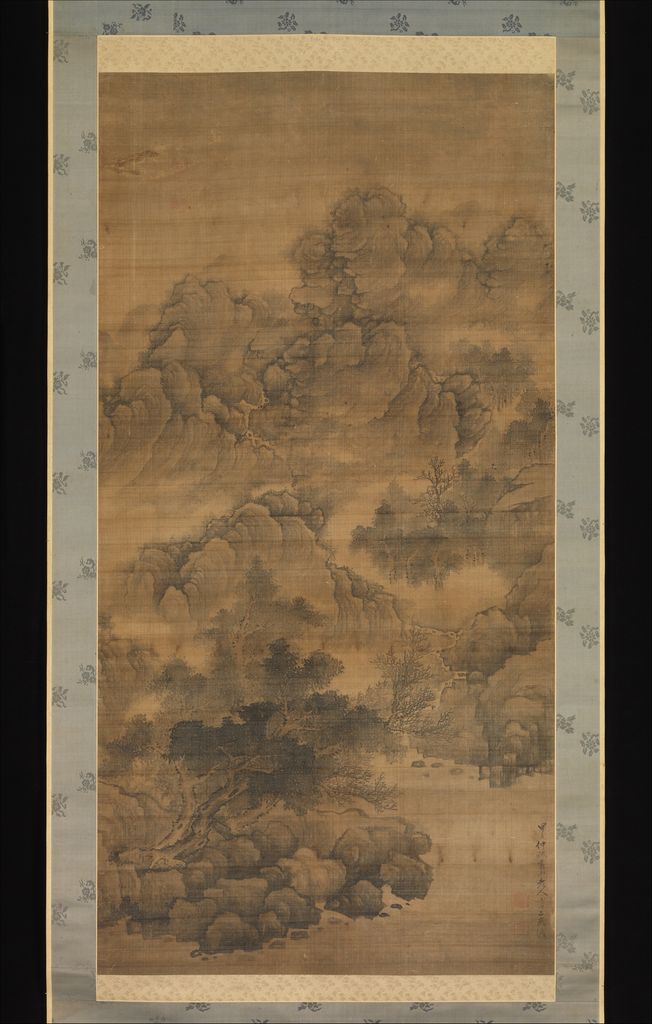
Fa Ruozhen's hanging scroll Cloudy mountains (1684) builds depth through layers of dark rock, trees, pale mist and receding peaks.[3] Ink density and open paper create atmospheric intervals; the eye moves upward rather than entering through a single fixed viewpoint.
Chinese landscape painting had become an independent genre by the late Tang dynasty. Later scholar-artists used inherited styles, calligraphic brushwork and images of retreat to express cultivation, personal feeling and political position.[2] Fa's mountains are therefore not simply a record of geology. They belong to a conversation among nature, artistic precedent and the mind.
Time across a screen — Landscapes of the Four Seasons
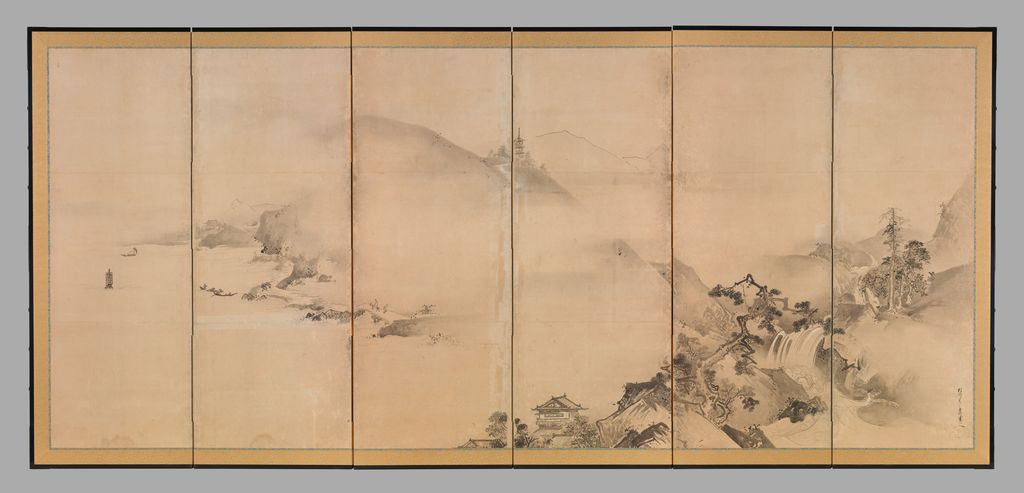
Kanō Tan'yū's Landscapes of the Four Seasons, made in the 1630s, extends across paired six-panel Japanese screens.[4] Shorelines, buildings, boats, mist and mountains unfold laterally across folds and broad pale spaces. Viewers cannot absorb the work as one window; they move beside it.
Seasonal change is distributed across a domestic architectural surface. The screen divides rooms while opening an imaginative world. Its format makes landscape environmental in two senses: it represents place and reshapes the place in which it is seen.
Land as labour — The Harvesters
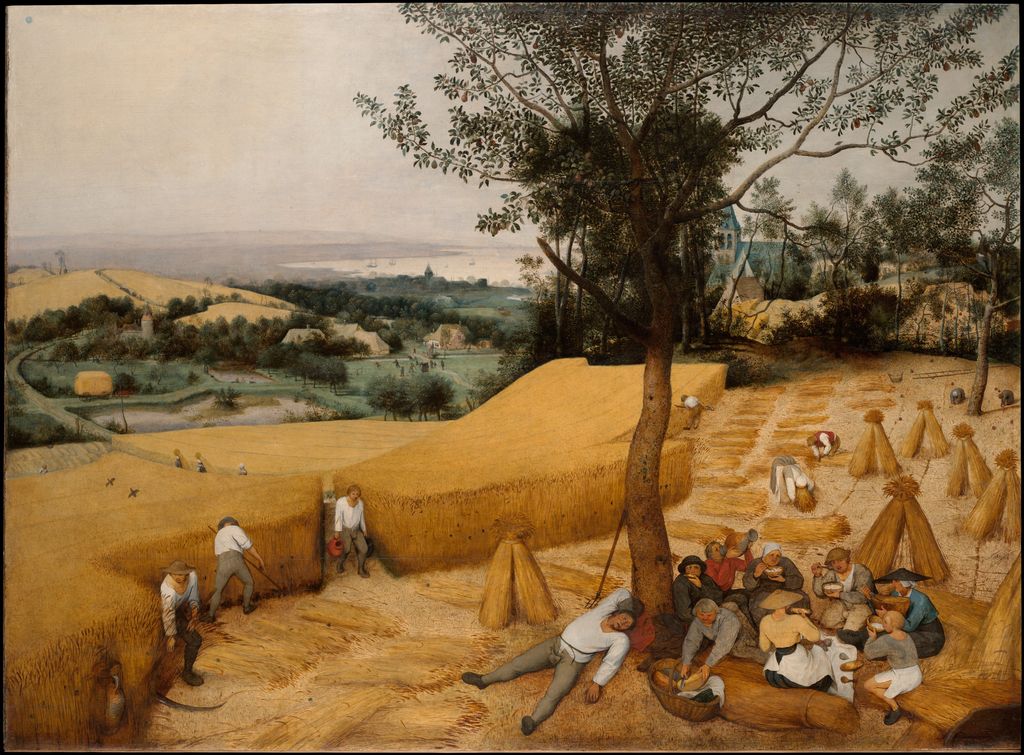
Pieter Bruegel the Elder's The Harvesters (1565) surveys ripe fields, workers eating and cutting grain, orchards, village buildings and distant water.[5] The high viewpoint connects many activities without making a single figure the hero.
This is both landscape and scene of everyday work. Seasonal abundance depends on collective labour and managed land. The panorama may appear harmonious, yet it is densely organised by paths, crops and ownership. Bruegel turns the agricultural year into a social geography.
Expressive cityscape — View of Toledo
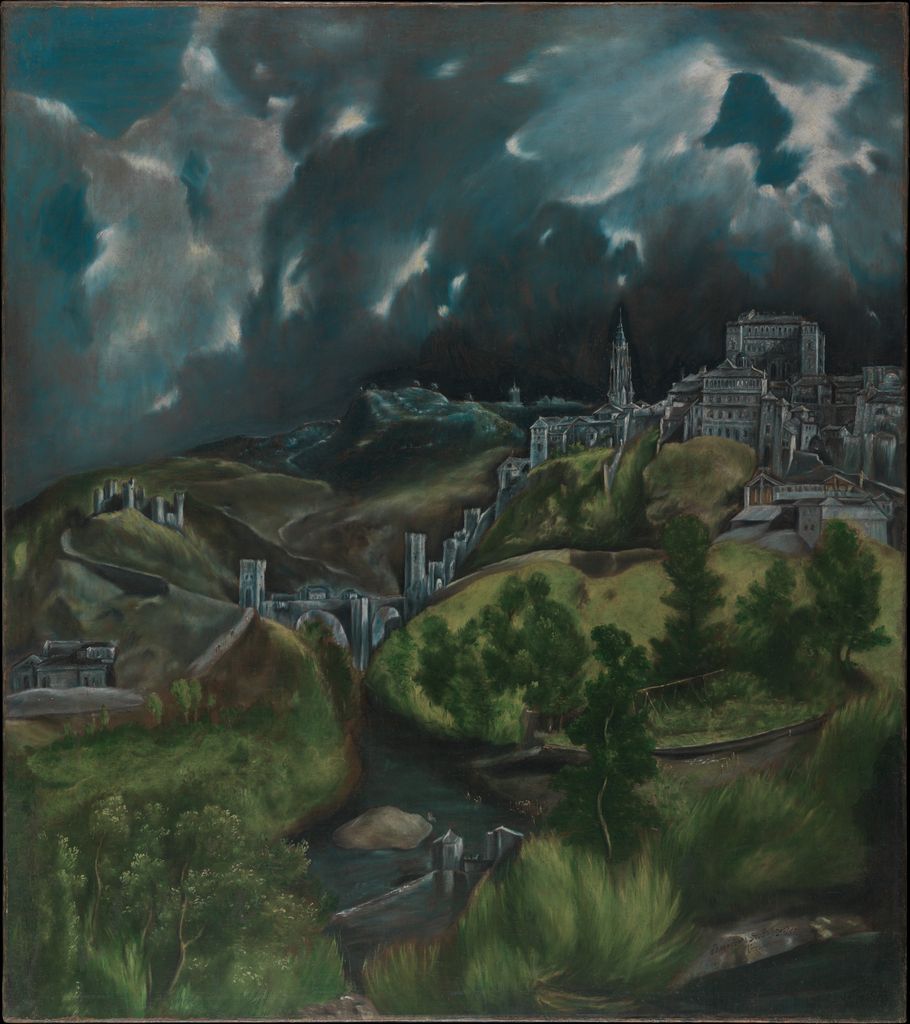
El Greco's View of Toledo, around 1599–1600, raises pale buildings above intense green hills beneath a dark, opening sky.[6] The city is recognisable but rearranged. Storm light and compressed slopes make the place emotionally charged.
Topographical accuracy is only one landscape aim. El Greco selects and shifts features to construct an image of spiritual and civic presence. The work demonstrates how a real site can become expressive without ceasing to be a landscape.
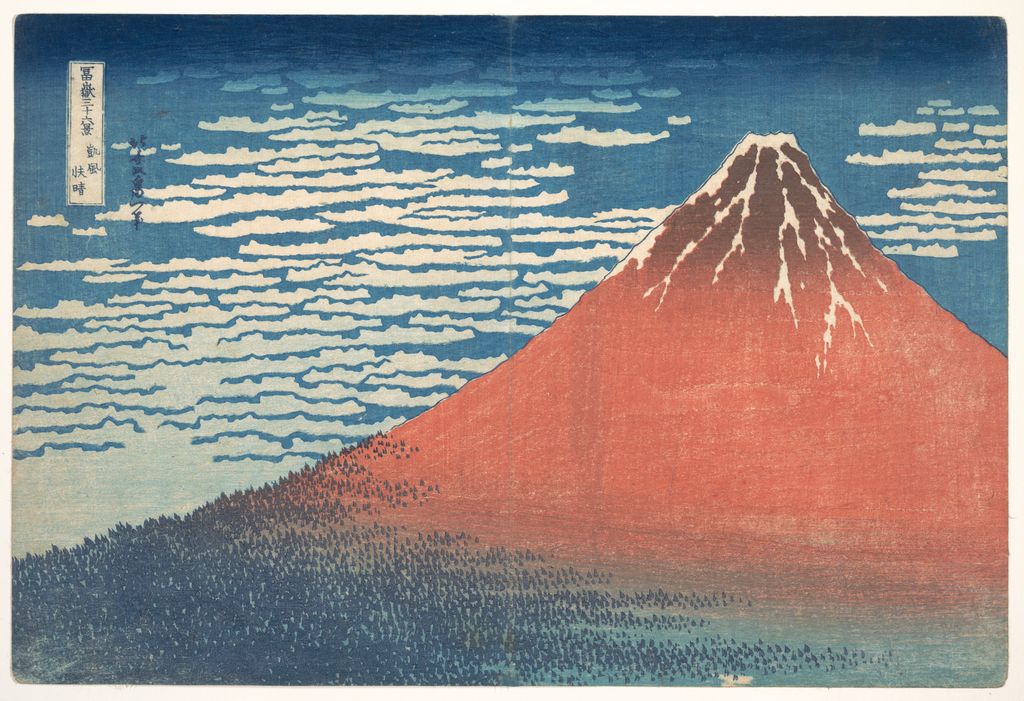
Iconic mountain — Red Fuji
Hokusai's South Wind, Clear Sky, known as Red Fuji, dates from around 1830–32 and belongs to Thirty-six Views of Mount Fuji.[7] The mountain fills the sheet as dark forest, reddish slope and snow traces meet a blue sky crossed by patterned clouds.
Few details indicate human scale, yet the print concerns observation, season and reproducible image culture. Fuji is both a specific landmark and a recurring subject transformed by viewpoint and weather across the series. The bold division of colour makes atmosphere monumental.
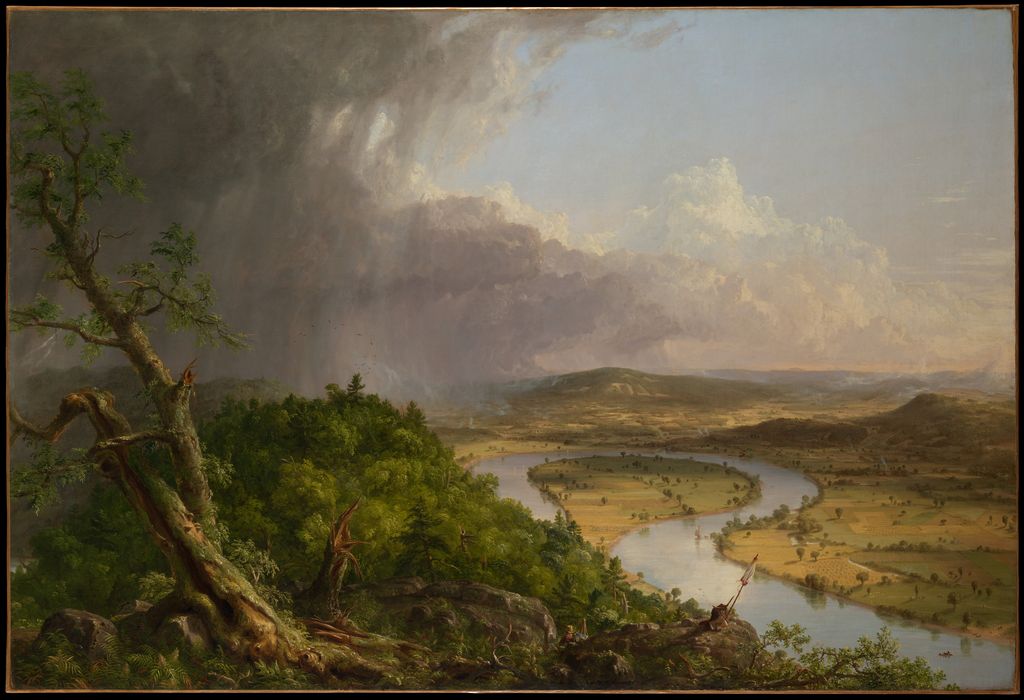
A contested panorama — The Oxbow
Thomas Cole's 1836 View from Mount Holyoke, Northampton, Massachusetts, after a Thunderstorm—The Oxbow divides storm-darkened forest from a sunlit, cultivated river valley.[8] A tiny self-portrait of the artist looks out from the foreground.
The contrast has often invited readings of wilderness and settlement, but neither side is neutral. The land was Indigenous homeland before and during settler expansion. Fields and clearings represent political occupation as well as visual order. The painting asks who imagines the landscape's future and whose presence a national view makes visible or absent.
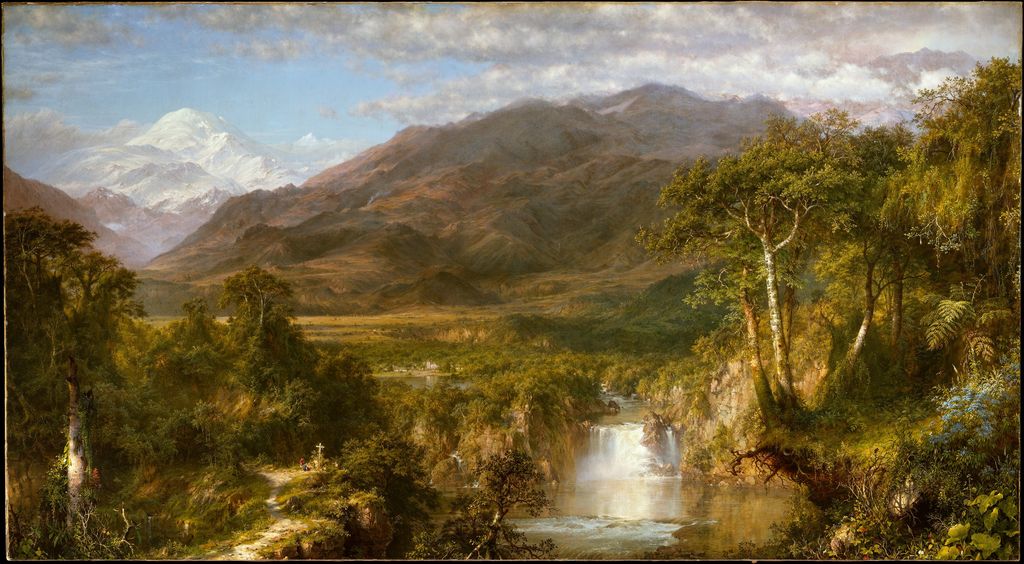
Transnational spectacle — Heart of the Andes
Frederic Edwin Church's Heart of the Andes (1859) combines dense vegetation, waterfalls, plains and snowy peaks into a vast Ecuadorian prospect.[9] Minute detail encourages close inspection while the distant mountain pulls the eye across an impossible abundance of zones.
Church travelled in South America, but the canvas synthesises observations rather than reproducing one viewpoint. Exhibited as a spectacle in the United States, it joined scientific curiosity and immersive display to a period of expanding commercial and imperial interest. Visual wonder should be read alongside that unequal geography.
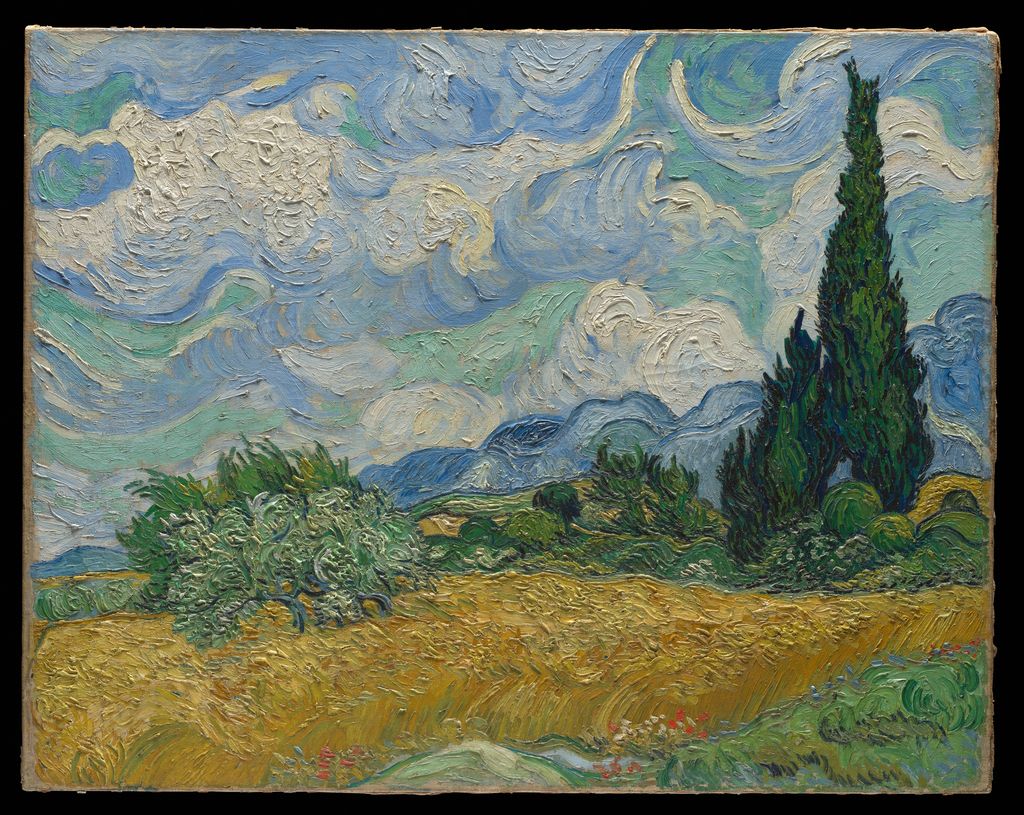
Weather made tactile — Wheat Field with Cypresses
Vincent van Gogh's Wheat Field with Cypresses (1889) connects yellow-green field, dark trees, blue hills and curling clouds through repeated directional marks.[10] Depth remains clear, but almost every zone feels active.
The landscape is neither a photographic instant nor pure invention. Observation becomes a rhythmic painted structure. Trees rise like dark flames while cloud and vegetation echo one another, making weather and growth feel materially continuous.
Landscape as setting and independent subject
In European traditions, landscape long served religious, mythological and historical narratives. Terrain established pilgrimage, pastoral abundance or divine order. Claude's Landscape with Hagar and the Angel uses framing trees, water and distant light to guide the eye toward a small sacred encounter.
Seventeenth-century Dutch painters were among the first Europeans to treat landscape as a subject in its own right.[1] Local dunes, waterways, winter scenes and cultivated fields acquired pictorial importance. During the eighteenth and nineteenth centuries the category expanded through travel, topography, the picturesque, the sublime and changing ideas of national land.
That European account cannot stand for landscape everywhere. In China, independent landscape carried philosophical, social and political meanings much earlier; retreat and historical style could matter more than direct transcription.[2] Traditions meet through collecting, prints, colonial movement and artistic exchange, but they do not lose their differences.
Observation, memory and invention
Many landscapes begin in front of a motif, yet finished works may combine sketches, remembered effects and studio construction. From the seventeenth century artists made oil studies outdoors; the practice widened in the eighteenth century and became common training in the nineteenth. Only later did painting a finished picture outside become more widespread.[11]
Plein air therefore describes a practice, not a guarantee of untouched immediacy. Light changes, weather moves and composition requires selection. A topographical view may pursue recognisable features; an ideal landscape arranges nature according to inherited conventions; an expressive landscape alters a site to intensify mood.
Gustave Courbet's La Grotte de la Loue gives rock and water the physical weight once reserved for grand narratives. Its rough surface and near-absence of figures challenged academic expectations. Landscape's rise was not merely a change of subject but a redistribution of artistic seriousness.
Land, ownership and environmental history
Landscape images can naturalise political claims. Survey views, estate portraits and national panoramas make bounded or occupied land appear orderly and inevitable. Colonial landscapes may celebrate access while omitting displacement, extraction or coerced labour.
Environmental history changes the questions. A forest may be managed, a river redirected, a species introduced or a horizon altered by smoke. Agriculture records skill and sustenance as well as ownership. Even apparently empty land can contain paths, seasonal use and histories invisible to the painter's intended audience.
This does not reduce every landscape to an accusation. It makes beauty more specific. Understanding who shaped, travelled through and represented a place adds depth to visual pleasure.
Scale can hide those histories. A panoramic viewpoint compresses farms, roads and settlements into pattern; a distant worker may become a coloured mark. Close foreground detail can instead make plants or rocks seem available for inspection and possession. Exhibition context matters as well: viewers who encountered a vast foreign prospect in a city gallery occupied a very different position from the people who lived within the represented region. Looking slowly means moving between the image's compelling whole and the local evidence it gathers, simplifies or excludes.
How to read landscape art
Begin with the horizon, viewpoint and route for the eye. Are you above the land, enclosed by it or blocked from entering? Follow scale cues such as people, trees, paths and buildings. Then notice how weather controls visibility and mood.
Distinguish observed site from constructed image. Which features seem selected, repeated or rearranged? Consider the work's format: scroll, screen, print and framed canvas ask the body to look differently.
Finally, ask whose place is represented. What labour, ownership, travel or belief made this environment meaningful? What remains outside the frame? Landscape art turns terrain into culture. Its most powerful works make us feel distance and atmosphere while teaching us that no view is simply given.
Watch: Landscape Art through Formal Analysis
Choose a museum-led whole-work analysis, a close reading, or a foundations overview for considering landscape art.
Introducing Formal Analysis: Landscape
Follow how subject, space, colour and composition work together across a complete artwork.
Watch on YouTubeFrequently Asked Questions
Landscape art makes land, weather, water or a shaped environment its principal organising subject.
No. Landscapes can combine observation, memory, convention, idealisation and invention.
Yes. Cityscapes and built environments can belong to the broader landscape tradition when place organises the work.
Views can naturalise estates, boundaries, cultivation or territorial claims, so patronage and land history may change interpretation.
Identify viewpoint, horizon, scale, weather and human traces, then ask how material, context and visual convention construct the place.
Discussion
Which landscape on this page most clearly changes a place through memory, convention or political framing?
Reader Insights
Height, distance and cropping determine what the viewer can possess or overlook.
Roads, fields, buildings and absences can reveal labour and ownership.
A depicted location is always reorganised through medium and composition.
Join the Conversation
Share one precise observation or a useful museum example below.
References
- Landscape Paintings from the National Gallery of Art — National Gallery of Art
- Landscape Painting in Chinese Art — The Metropolitan Museum of Art
- Cloudy Mountains — The Metropolitan Museum of Art
- Landscapes of the Four Seasons — The Metropolitan Museum of Art
- The Harvesters — The Metropolitan Museum of Art
- View of Toledo — The Metropolitan Museum of Art
- South Wind, Clear Sky (Red Fuji) — The Metropolitan Museum of Art
- The Oxbow — The Metropolitan Museum of Art
- Heart of the Andes — The Metropolitan Museum of Art
- Wheat Field with Cypresses — The Metropolitan Museum of Art
- Plein Air Paintings — National Gallery, London