by Tom Gurney
Tom Gurney BSc (Hons) is an art history expert with over 20 years experience
Email: tomgurney1@gmail.com / Phone: +44 7429 011000
The Shapes We Notice—and the Spaces That Shape Them
Positive space is an area read as occupied by a figure, form or principal visual presence. Negative space is an area read around, between or within it. The two belong to one relationship: a figure makes its surrounding field easier to notice, while that field helps establish the figure's edges, intervals and position.[1][2]
These terms describe how an image is apprehended, not two kinds of material. An apparently unoccupied area may still contain paper tone, paint, texture or marks. Nor do positive and negative mean good and bad, active and passive, complete and missing, or successful and unsuccessful.
The related phrase figure/ground relationship names the relation between a depicted form and the pictorial field against which it is read.[3] It overlaps positive-and-negative-space vocabulary, but the terms are not an exact universal synonym set. A figure need not be a person, and a ground is not automatically a distant background. Occupied and unoccupied are useful approximations rather than literal facts about what covers the canvas, paper or object.
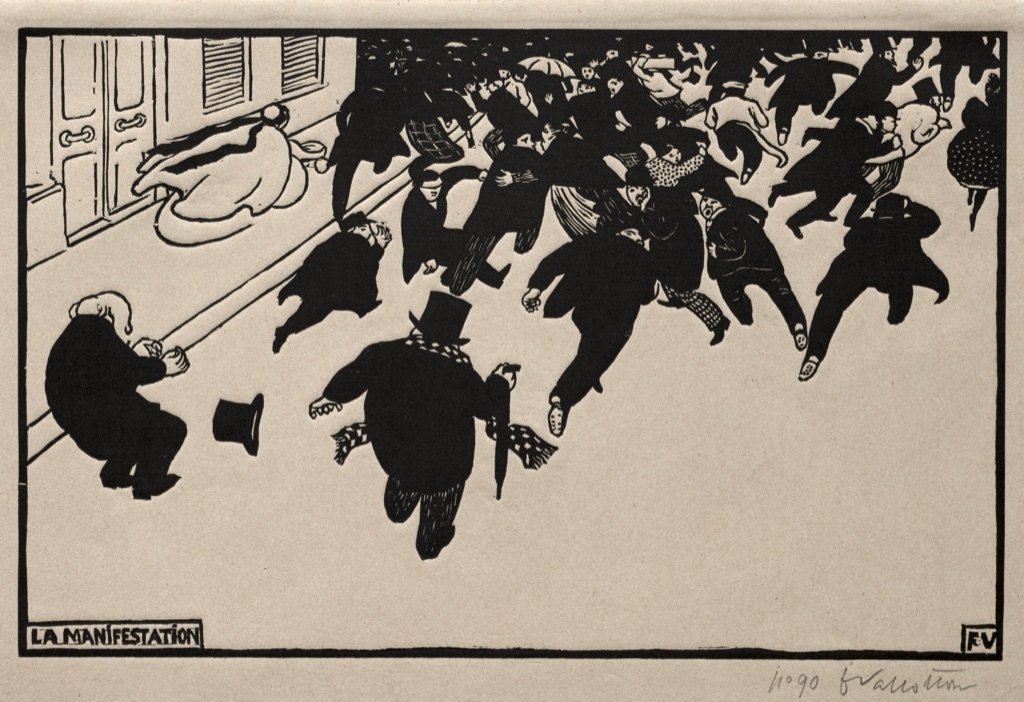
Félix Vallotton · The Protest · 1893 · Cleveland Museum of Art · CC0. The light opening at lower right is shaped by the crowd around it; a detailed close reading appears below. Source details.
At a Glance
- Positive spacean area read as occupied by a figure or form.
- Negative spacean area around, between or within that presence.
- Shared boundarythe edge that makes both areas legible.
- Reversalfigure and ground exchange roles as attention shifts.
- Key testinspect both sides of the same edge.
Contents
How the relationship becomes visible
A positive area may separate clearly from its surroundings, or it may share edges with them so closely that both sides of the boundary become noticeable. A pale interval between two dark figures, for example, can form a distinct negative area even though no line has been drawn around it. A colour or value change can make the division legible, but colour and value keep their own jobs as elements of art.
The relation is not always fixed. In one work the figure may remain stable against a broad field. In another, adjacent areas may compete, so that first one and then another seems to come forward. Reversal can describe such a shift, while ambiguity can describe a relation that remains unsettled. These are descriptions of particular visible evidence, not compulsory types.
Four questions for recognising positive and negative space
Use these as practical close-looking prompts, not as a method prescribed by any institution:
- 1
What area first reads as the figure or occupied visual presence?
- 2
What area surrounds, separates, enters or lies between it?
- 3
Which shared edges, intervals, enclosures, adjacencies or value and colour differences make the relation legible?
- 4
Do the roles remain stable, compete or shift, and what exact visible evidence supports that reading?
Begin with one relation rather than trying to label every patch in the work. Follow an edge, then look at both sides of it. Notice whether an interval stays open, narrows, returns elsewhere or joins a larger field. If your reading shifts, name the edge or adjacency that prompted the change instead of assuming that everyone must see the same figure first.
When occupied and surrounding areas remain distinct
Vallotton: a crowd and an opening in The Protest
Félix Vallotton's The Protest, 1893, is a woodcut in the Cleveland Museum of Art, accession 1999.323.[5] The complete sheet packs dark-coated figures across the upper and left portions while a broad light area opens at the lower right.
That light field is not simply unused paper. Its angled boundaries are formed by the crowd, and its size becomes evident only beside the dense cluster. The positive and negative areas therefore define one another: the crowd gives the opening its irregular shape, while the opening makes the crowd's compression easier to describe. This is a spatial distribution visible in the print, not a claim about the demonstration's emotional effect.
Attributed to Kanō Naonobu: a small presence in a broad field
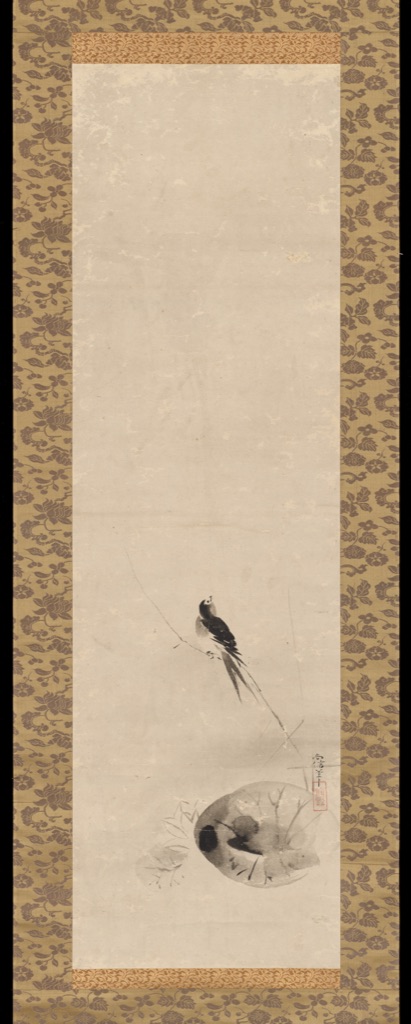
Small Bird on Reed, a seventeenth-century Japanese hanging scroll attributed to Kanō Naonobu, belongs to The Metropolitan Museum of Art, accession 53.118.2.[6] A small dark bird and a slender reed occupy a narrow passage in the complete painted scroll, surrounded by a much broader pale paper field.
The field remains materially present as paper and washes rather than becoming literal nothingness. Its breadth helps the small marked passage read as a figure without turning the scroll into a lesson about emptiness or a presumed national aesthetic. Here the relation stays comparatively stable: the bird and reed gather as the principal presence, while the surrounding field remains continuous around them.
The Acheloös Painter: figure and ground around a vessel
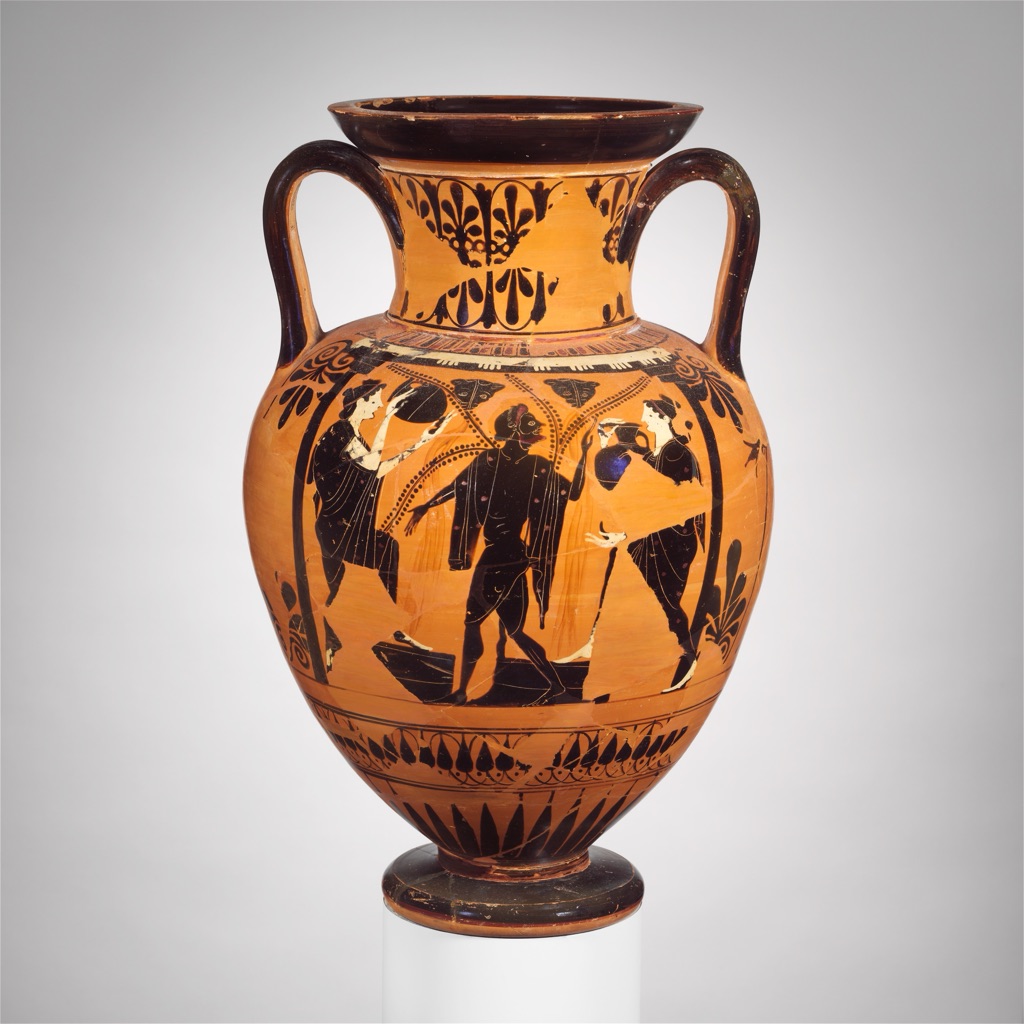
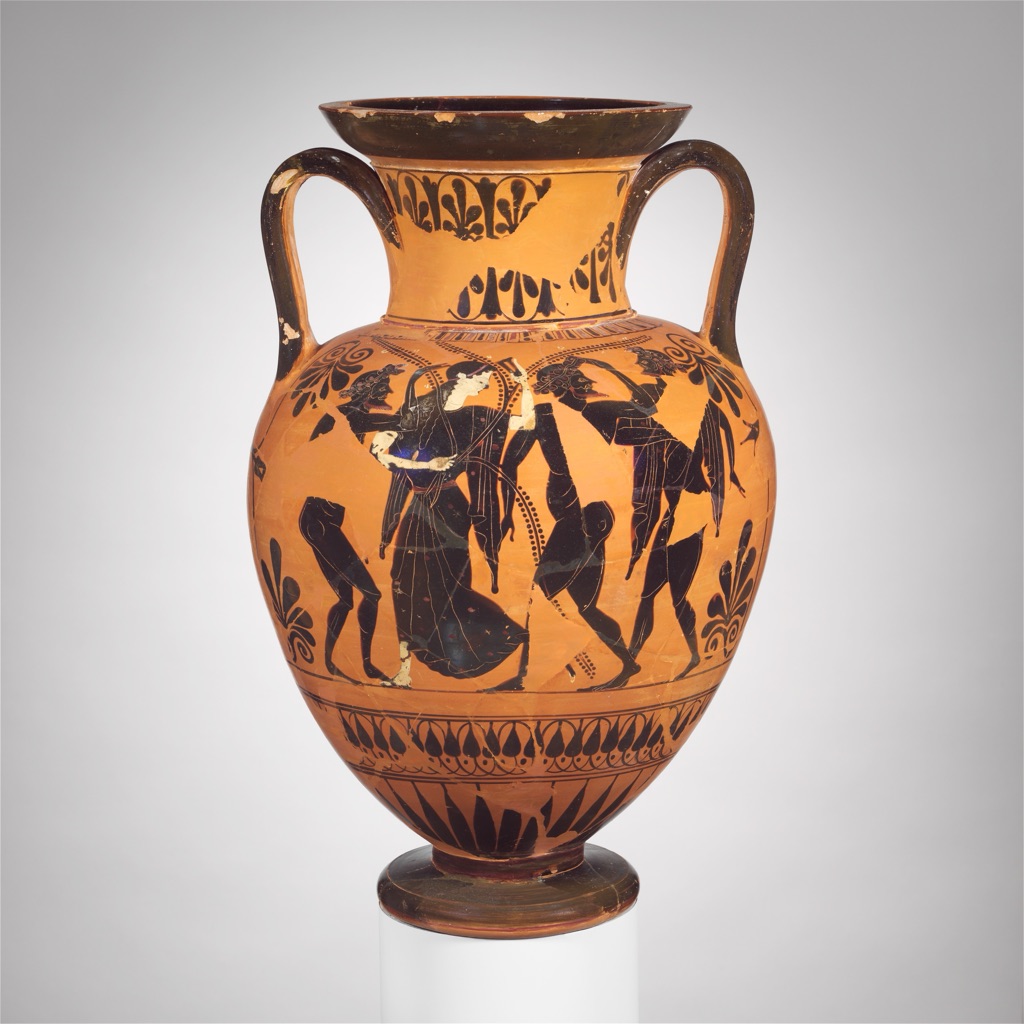
The Greek Attic Terracotta neck-amphora (jar), attributed to the Acheloös Painter and dated about 510–500 BCE, is in The Metropolitan Museum of Art, accession 56.171.22.[7] Both complete views are needed because painted figures and architectural forms extend around the curved vessel.
Black figures read against the reserved orange terracotta, but the ground is not merely a backdrop laid behind a flat scene. It continues around the object's body and enters the intervals between painted forms. Looking from one side to the other shows that figure-ground analysis can remain useful on a decorated object without becoming a history of vase painting, pattern or technique.
Shared edges and competing readings
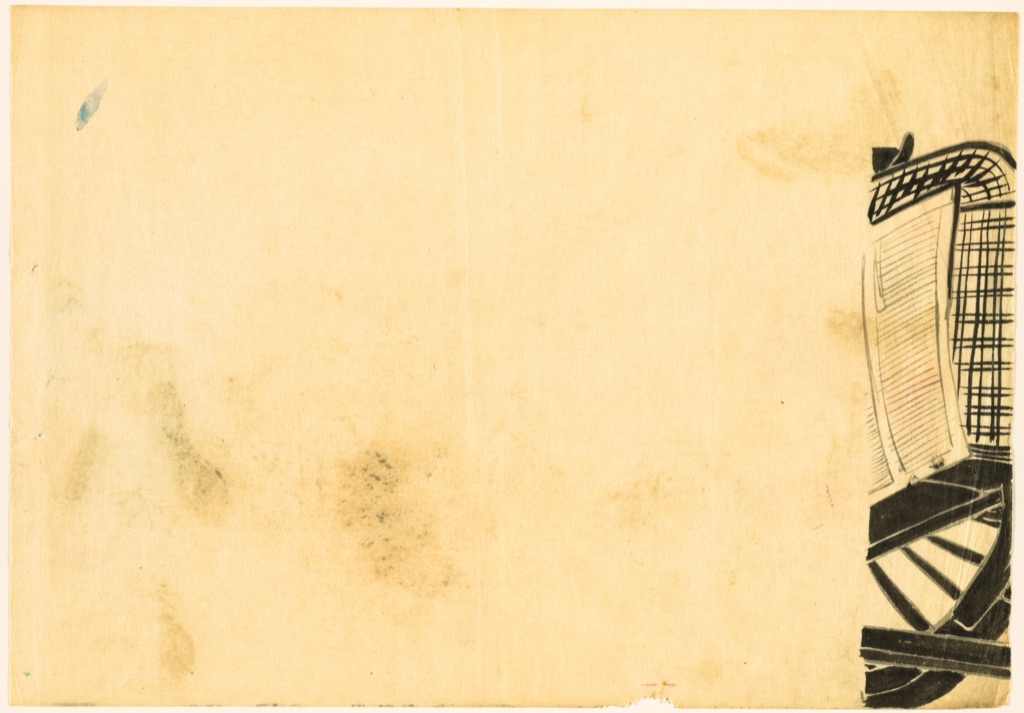
Kamisaka Sekka: a marked edge meeting a wide field
Kamisaka Sekka's 1909 Flowers of a Hundred Worlds: Section of Flower-draped Carts is a complete catalogued preparatory-drawing component in the Cleveland Museum of Art, accession 1989.85.3.[8] Part of a flower-draped cart enters at the far right of a broad pale sheet.
The cart's cropped edge establishes a concentrated marked area, while the surrounding paper stretches beyond it. Because the object reaches the sheet edge, positive space is not confined to a closed island in the middle. Cropping can leave the relation open: we recognise the visible cart passage without pretending that the remainder of the larger subject is present on this component.
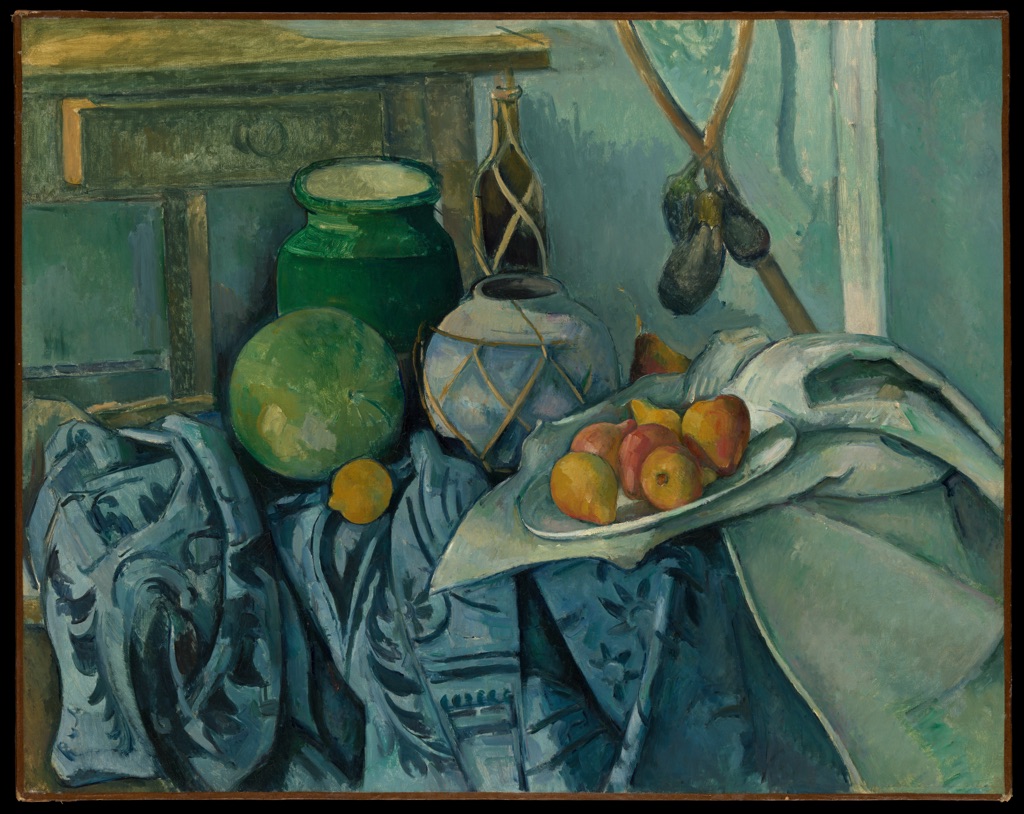
Cézanne: boundaries that soften
Paul Cézanne's Still Life with a Ginger Jar and Eggplants, 1893–94, is an oil painting in The Metropolitan Museum of Art, accession 61.101.4.[9] A jar, fruit, cloth and eggplants occupy the complete canvas amid patterned and muted surrounding passages. A Museum of Modern Art study notes the unusually close relation between objects and their surroundings in this work.[10]
Some contours are clear, yet elsewhere an object's edge meets a passage of similar colour or value and becomes less decisive. The cloth, tabletop, wall and patterned areas do not settle into one simple foreground figure against an empty ground. This is a useful instance of competing relationships: the objects remain identifiable, while neighbouring passages sometimes press forward or merge at their edges. The description concerns what is visible, not one required perception.
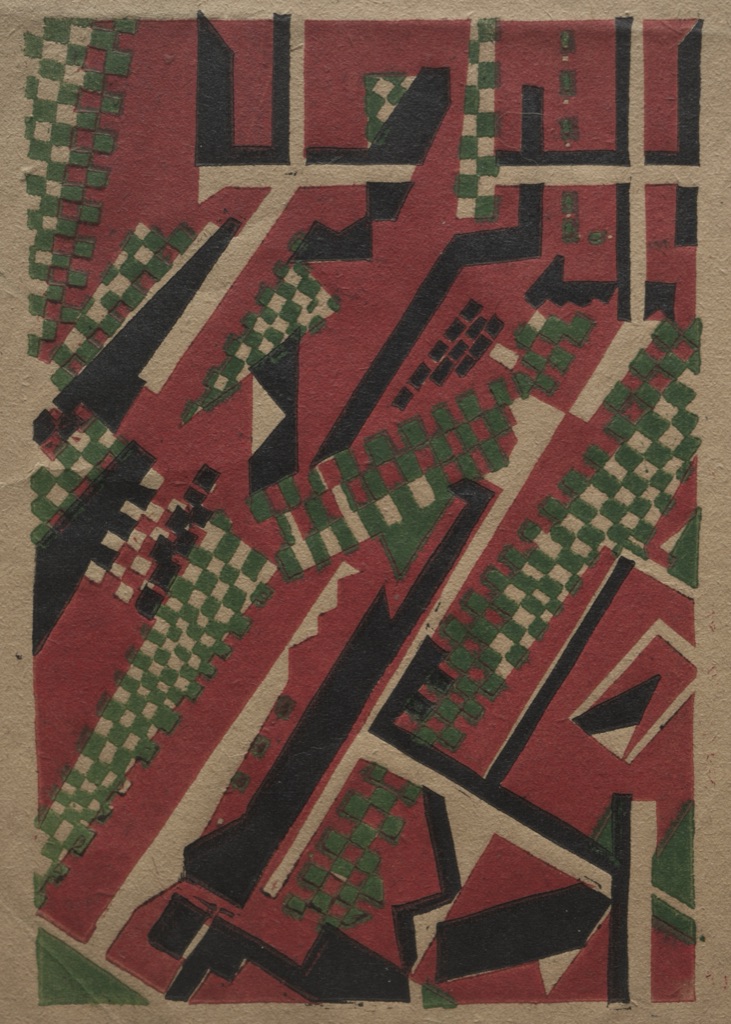
Wadsworth: interlocking areas across a sheet
Edward Alexander Wadsworth's The Open Window, made about 1914, is a colour woodcut in the Cleveland Museum of Art, accession 1987.49.[11] Across the complete vertical sheet, red, black and green passages meet exposed paper in an arrangement of angular and curving areas.
No single area needs to remain the figure throughout. A dark passage can seem prominent beside pale paper, then become a ground for a neighbouring red or green area. Shared edges allow the reading to shift locally without requiring a diagram or an illusion. Colour difference helps articulate the areas, but the central question is which side of a boundary currently reads as occupied and which reads around or between it.
From pictorial fields to one actual opening
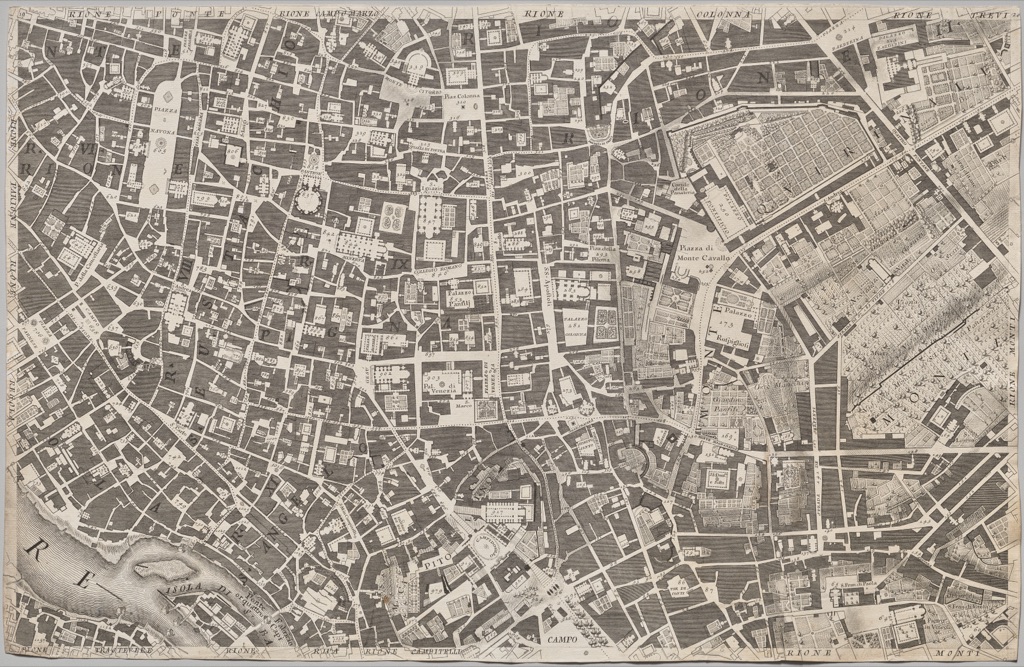
Nolli and collaborators: buildings, streets and interiors
The 1748 sheet from Nuova pianta di Roma, known as La Pianta Grande di Roma, is by Giovanni Battista Nolli, with Carlo Nolli, Rocco Pozzi and Pietro Campana de Soriano as engravers and Stefano Pozzi as designer. The Cleveland Museum of Art holds the complete catalogued sheet as accession 2020.276.8.[12]
Dense dark building footprints are divided by pale streets, courtyards and accessible interiors. The dark and light areas form a particularly legible figure-ground relation, yet neither colour alone fixes the terms: the pale network can itself become the principal visual presence when we follow it across the sheet. This is close looking at a historical print, not instruction in architecture, urbanism or map design.
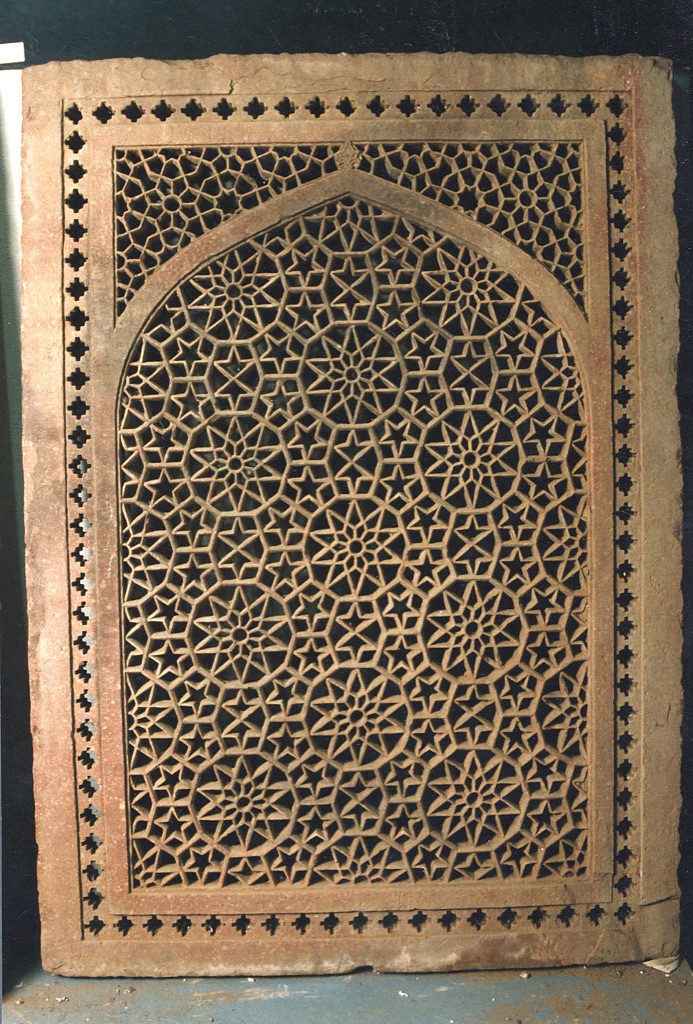
A Mughal-period jali: solid and open areas
The Pierced Window Screen (Jali), probably made in Agra in the second half of the sixteenth century by an unrecorded maker, is a red-sandstone object in The Metropolitan Museum of Art, accession 1993.67.1.[13] Across the complete rectangular screen, remaining stone and geometric openings interlock within a solid frame.
The jali is the page's one extension from pictorial areas to actual openwork. Its openings are physical, not painted negative shapes, and its surviving stone has volume. Even so, the same relational question remains useful: each opening is made legible by the stone around it, while the remaining lattice is articulated by the openings within and between its parts.[4][13] The analogy stops there; the object's architectural setting, material and three-dimensional presence are not interchangeable with a field of paper or paint.
Positive and negative space and their neighbours
Positive and negative space focuses on the interaction between areas read as occupied and areas read around, between or within them. Space in Art has the broader job of explaining areas, distances, intervals and actual or represented depth. Shape in Art concerns a bounded or visually distinguishable two-dimensional area; both the positive and negative areas in a relation can have visible shape.
Line in Art explains paths and extended marks, although a line may establish one shared edge. Form in Art concerns actual or represented volume, which matters when the jali is considered as an object. Value in Art concerns relative lightness and darkness, while Contrast in Art concerns perceptible difference; either may help adjacent areas separate without becoming the controlling subject.
Composition in Art considers the complete realised organisation of a work. Pattern in Art begins when recurrence is organised across the work rather than when a single solid and opening are compared. Balance, Emphasis, Rhythm, Unity, Variety and Proportion describe other relationships and are not alternative names for figure and ground.
The Elements of Art places this focused relationship beside the wider family of elements. Colour may help separate occupied and surrounding areas, but positive and negative space keeps attention on how those areas depend on one another.
Look for Positive and Negative Space Yourself
Choose a complete artwork and identify the area that first reads as its principal visual presence. Then look around and through it. Find one interval, opening or surrounding field, and trace the boundary it shares with the occupied area.
Describe the evidence without treating pale as automatically negative or dark as automatically positive. The boundary might be a line, a value or colour change, an overlap, a cropped edge or the meeting of two passages. Ask whether the relation remains stable across the work or whether another area begins to compete as you keep looking.
Finally, test the reading from the other side of the edge. What shape does the surrounding area have? Does it connect to a larger field, enter the figure or break into several intervals? Positive and negative space becomes most useful when both sides of a boundary are treated as parts of one visible relationship.
Watch: Space, Shape and Figure–Ground
Choose an elements overview, a focused discussion of shape, or a museum-led formal analysis.
Elements of Art: Introduction
Place figure and ground beside shape, form, line, colour, value and texture.
Watch on YouTubeFrequently Asked Questions
Positive space is an area read as occupied by a figure, form or principal visual presence.
Negative space is an area read around, between or within an occupied figure or form.
Yes. Shared edges and competing areas can make figure and ground swap roles as attention changes.
No. It may contain colour, texture or detail; negative describes its relational role rather than literal emptiness.
Trace an edge, inspect the areas on both sides and notice intervals, enclosures and openings around or within a form.
Discussion
Where does a surrounding interval become as visually important as the figure it helps define?
Reader Insights
Follow a single boundary and describe the areas on both sides.
Notice openings between, around or inside forms rather than treating them as unused space.
Shift attention and ask whether another area can briefly become the figure.
Join the Conversation
Share one close observation or a useful museum example below.
References
- J. Paul Getty Museum, “Understanding Formal Analysis — Elements of Art”
- J. Paul Getty Museum, Elements of Art
- The Museum of Modern Art, “Figure/ground relationship”
- The Metropolitan Museum of Art, Make Your Mark
- Cleveland Museum of Art, Félix Vallotton, The Protest, 1893
- The Metropolitan Museum of Art, attributed to Kanō Naonobu, Small Bird on Reed, 17th century
- The Metropolitan Museum of Art, attributed to the Acheloös Painter, Terracotta neck-amphora (jar), ca. 510–500 BCE
- Cleveland Museum of Art, Kamisaka Sekka, Flowers of a Hundred Worlds: Section of Flower-draped Carts, 1909
- The Metropolitan Museum of Art, Paul Cézanne, Still Life with a Ginger Jar and Eggplants, 1893–94
- The Museum of Modern Art, “Objects of Desire: Cézanne, Still Life with a Ginger Jar and Eggplants”
- Cleveland Museum of Art, Edward Alexander Wadsworth, The Open Window, c. 1914
- Cleveland Museum of Art, Giovanni Battista Nolli and collaborators, La Pianta Grande di Roma, 1748
- The Metropolitan Museum of Art, Pierced Window Screen (Jali), second half 16th century
- Quarto, Susie Hodge, Elements of Art. Publisher record.
- Phaidon, E. H. Gombrich, The Story of Art. Publisher record.