by Tom Gurney
Tom Gurney BSc (Hons) is an art history expert with over 20 years experience
Page created on September 2, 2026 / Page updated on September 13, 2026
Email: tomgurney1@gmail.com / Phone: +44 7429 011000
How a Still Image Can Set the Eye in Motion
Movement in art is the impression of action and the path through which a still artwork invites your attention to travel. A figure may appear to run, fall or turn; a storm may seem to sweep across a landscape; a line of forms may lead your eye from foreground to distance. Nothing on the page or canvas has to move physically for movement to feel present.[1][4]
These are two overlapping ways of looking, not two official types. Depicted or implied action concerns what appears to be happening within the image. Viewer path concerns how visible relationships may lead attention between its parts. One often supports the other: the direction of a runner's body can imply action while also carrying your eye across the picture.
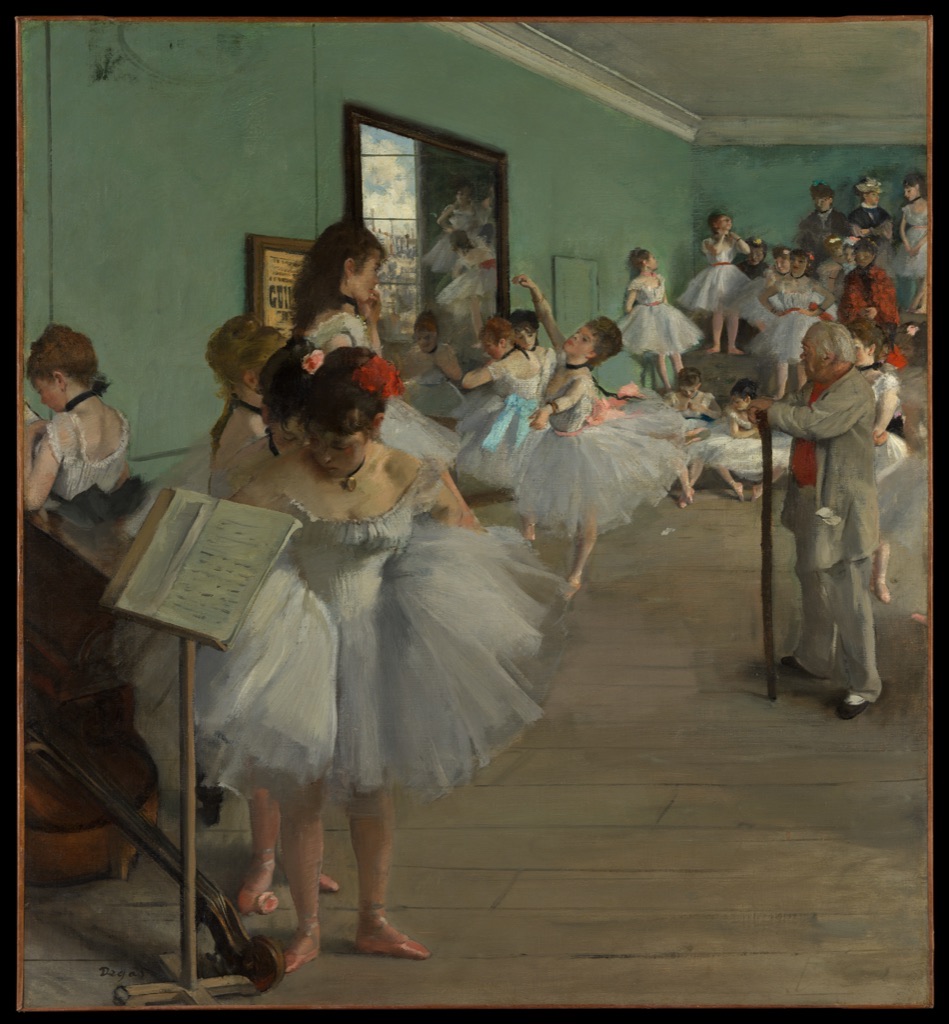
The Dance Class by Edgar Degas, 1874, The Metropolitan Museum of Art. Varied poses, diagonal floorboards and the instructor's central position invite the eye to move among moments of rehearsal rather than read one frozen action. Image: The Met Open Access, CC0.
At a Glance
- Core ideaimplied action and directional travel in a still work.
- Action cuespose, sequence, crop, overlap and visible effects.
- Viewer pathedges, diagonals, trails and intervals can guide attention.
- Important limitmovement is not simply another word for “busy”.
- Close neighbourrhythm concerns pace and interval.
Contents
Artists and institutions do not use one universal taxonomy of movement. It is more useful to identify the evidence in a particular work. Diagonals, curves, gestures, gazes, repeated positions, receding paths and directional marks can all contribute, but none is required in every case.[2][3][4]
Here, directional force means a visible relationship that feels strongly aimed—a sloping bridge, an outstretched arm or a sequence of bodies—not a literal force inside the object. Continuation is an inference: a line, action or trail appears likely to carry on beyond a figure, zone or edge. Some works can also create an optical suggestion of vibration or instability, but that narrower effect is not a separate category that every account of movement must include.[2]
The path of attention is an invitation, not a measured law. Different viewers may enter a work at different points, pause in different places or reverse direction. The useful question is not “Where must the eye go?” but “Which visible relationships encourage it to move?” This visual principle is also different from a named art movement such as Impressionism or Cubism.
Action and viewer path
A still image can select a moment whose pose already implies a before and an after. A bent knee, streaming garment or tilting body may appear caught between stable positions. Repeated positions can make that change more explicit, while a crop at the edge may suggest that an action continues outside the frame.
Viewer path can be quieter. A wake may carry attention backwards along a river; a row of animals may connect foreground and distance; a bridge may establish a strong diagonal even when the people crossing it are small. Composition describes the whole arrangement of these parts. Movement is one effect that arrangement may produce, not another word for composition.[1][3]
The two readings can separate. A portrait may depict a turning body while holding attention in a compact area. A landscape may contain little bodily action yet guide the eye through a sequence of paths, trees and clouds. Recognising that difference prevents movement from becoming a synonym for “busy.”
Six questions for recognising movement
When a work feels active—or when you are unsure why it does—ask:
- What appears caught in action? Look for bodies, objects, water, weather or fabric that seem to be changing.
- Which direction feels strongest? Notice diagonals, curves, edges and marks that seem to aim or sweep.
- Where do gesture and gaze point? A hand, face or leaning body can direct attention beyond itself.
- Do positions repeat or change in sequence? Repetition may let you infer what happens from one instant to the next.
- What seems to continue? Follow a cropped form, overlapping action, wake, path or line towards an edge or another area.
- Where are you redirected or paused? Notice where a direction meets a contrast, a figure, an interruption or a quieter interval.[1][2][4]
Use the questions flexibly; a work may make only two of them especially useful. Begin with what is visible, then describe the movement as forceful, gentle, circular, interrupted or distributed only if the evidence supports that language.
Depicted action: bodies and sequence
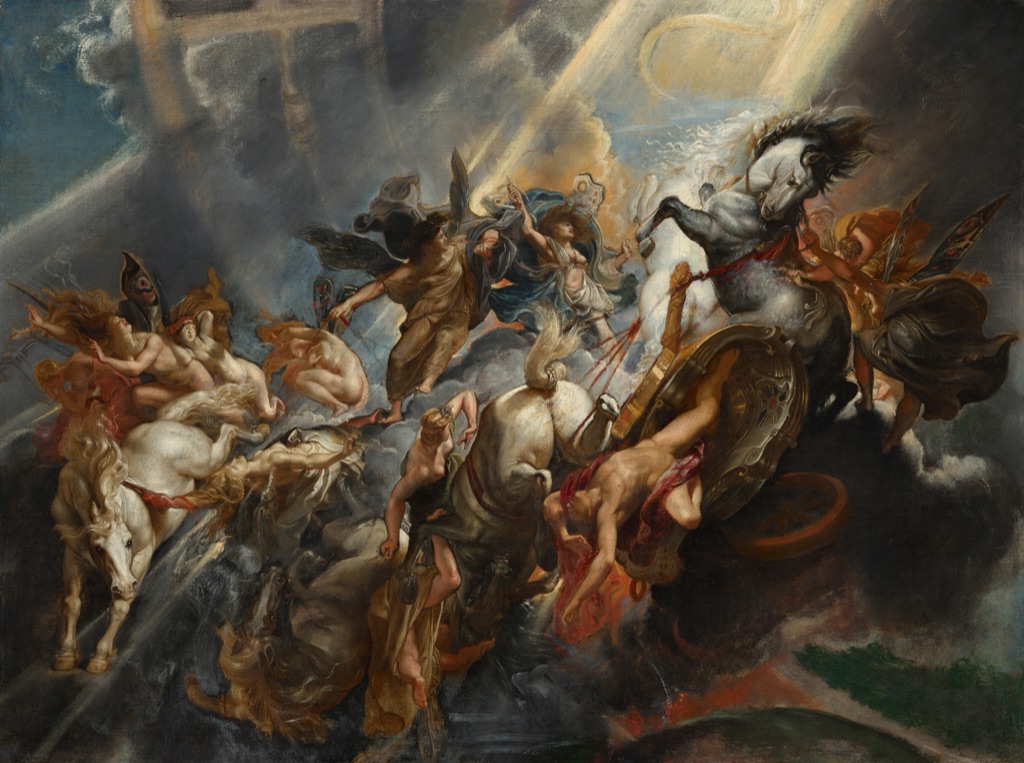
Rubens: a field of falling directions
Sir Peter Paul Rubens, The Fall of Phaeton, c. 1604/1605, probably reworked c. 1606/1608, is in the National Gallery of Art, Washington (accession 1990.1.1).[5] Horses, figures, reins and fragments of the chariot pitch in different directions. Long diagonals cross rather than settle into one stable route.
The painting does not simply contain many bodies. Their tilted torsos, thrown limbs and tumbling overlaps make each part feel temporarily suspended between positions. Attention jumps from one fall to another, so depicted catastrophe and viewer path reinforce each other without becoming a single prescribed circuit.
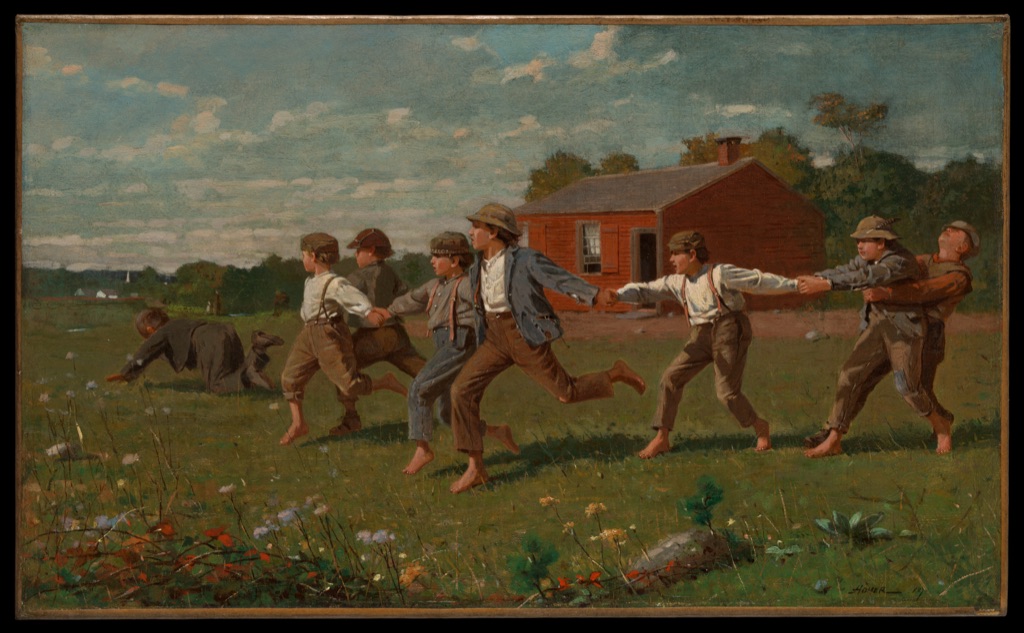
Homer: a chain under strain
Winslow Homer, Snap the Whip, 1872, is in the Metropolitan Museum of Art (accession 50.41).[6] The boys' joined hands create a line across the field, while running legs and leaning torsos pull that line in opposing directions. At the left, the chain breaks. The gap makes continuation especially vivid because the action appears to have exceeded the group's grip.
This is movement without a painted blur. Each body is legible, but their connected poses turn separate figures into a shared action. The eye follows the chain, then pauses at the break where the direction changes.
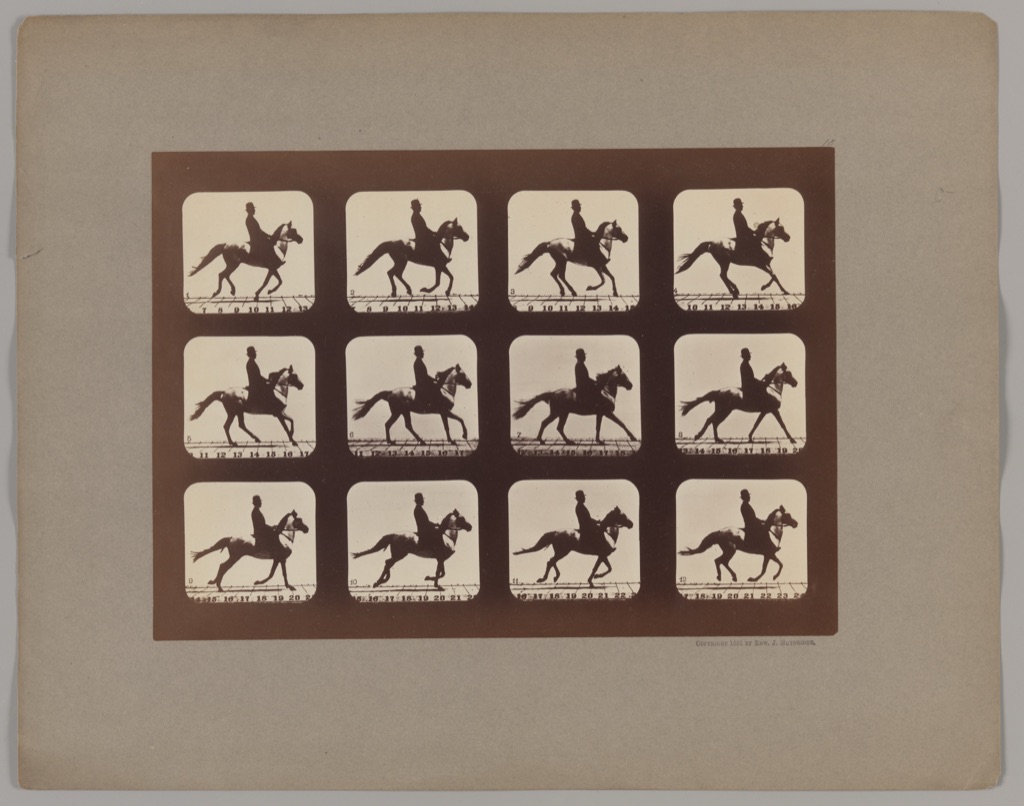
Muybridge: change between still frames
Eadweard Muybridge's Attitudes of Animals in Motion, made in 1879 and printed in 1881, is in the Metropolitan Museum of Art (accession 2015.778.33).[7] Twelve photographs show a rider and horse at successive moments. No single frame physically moves, yet the changing position of legs, head and body lets us infer action between them.
The regular grid helps comparison, but the movement lesson is not simply pattern or rhythm. What matters here is the visible difference from one position to the next and the sequence our attention constructs across the mounted sheet. The example makes clear that implied action can arise from several stills as well as from one dramatic pose.
Cezanne: action in a few marks
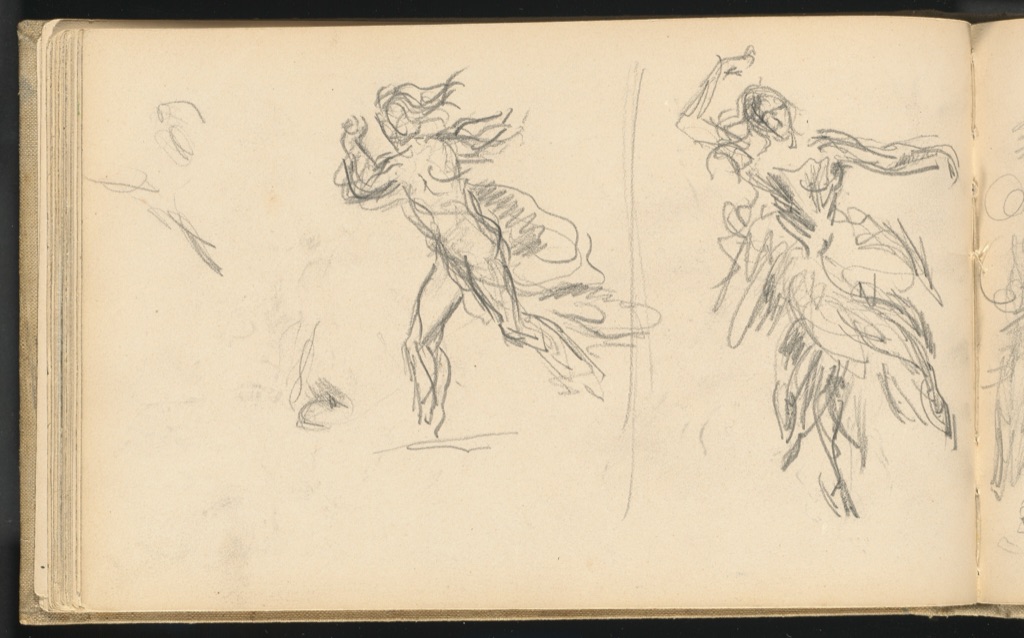
Paul Cezanne's Spanish Dancers, 1883/1886, is in the National Gallery of Art, Washington (accession 1992.51.9.ss).[8] Two lightly drawn figures lean and extend their arms in different directions. The graphite lines gather around bent bodies and trailing clothes, then loosen into the surrounding sketchbook page.
Because the drawing is sparse, every change of angle matters. A raised arm, tilted torso or repeated contour is enough to imply a turn. Line contributes to the effect, but the lesson remains movement: how a few directional relationships make an unfinished instant feel active.
Direction and the path of attention
Hokusai: wind shown through its effects
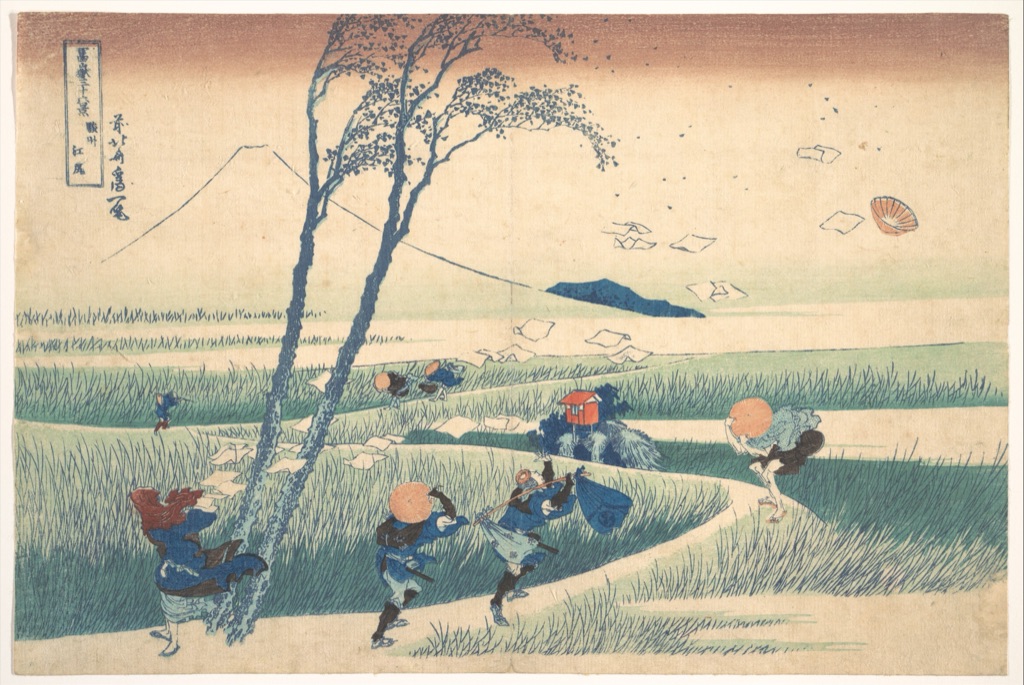
Katsushika Hokusai, Ejiri in Suruga Province, ca. 1830–32, is in the Metropolitan Museum of Art (accession JP2953).[9] The wind is invisible, but its effects are spread across the print. Travellers brace themselves, clothes pull sideways, trees bend, and loose papers rise into the sky. Mount Fuji remains quiet in the distance.
Attention moves among those responses, linking figures, trees and flying sheets into one event. This is a different movement lesson from Hokusai's Great Wave: here, a force becomes legible through many small reactions set against a still landmark.
Hiroshige: rain crossing a bridge
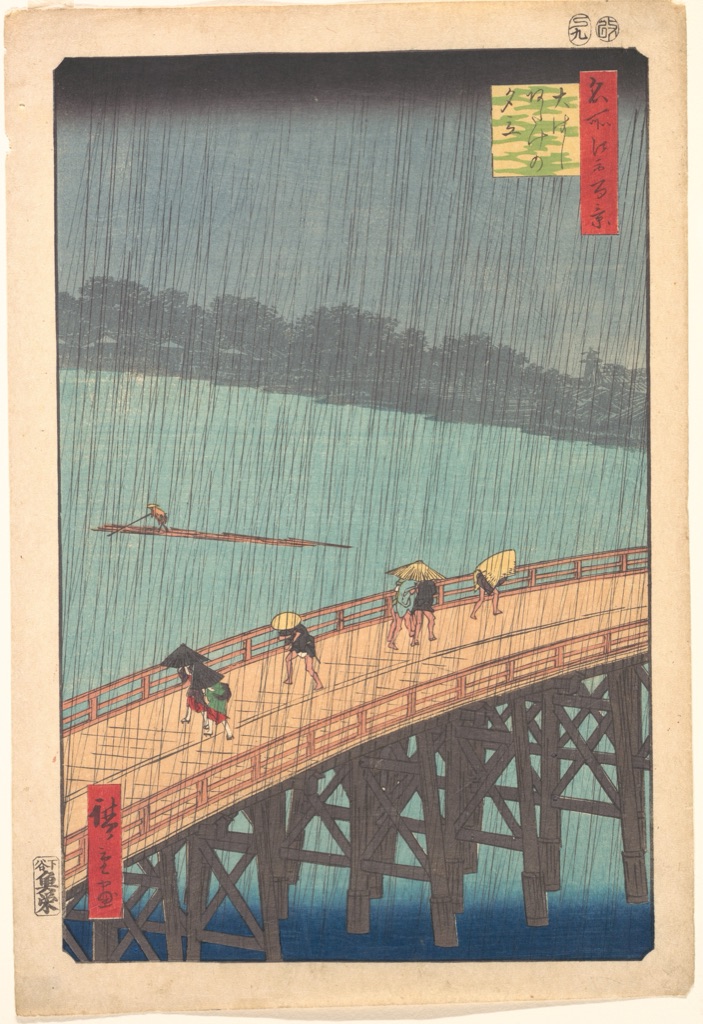
Utagawa Hiroshige, Sudden Shower over Shin-Ōhashi Bridge and Atake, 1857, is in the Metropolitan Museum of Art (accession JP2522).[10] Dense rain lines slant across the image while the bridge climbs diagonally from lower left to upper right. The figures hurry along its length, their bodies bent beneath hats and coverings.
Several directions coexist: the rain falls across the bridge, the bridge carries attention upward, and a small boat crosses the open water beyond. The viewer may follow any of them first. Their intersection makes the scene active without requiring one fixed route.
Eakins: a quiet course into depth
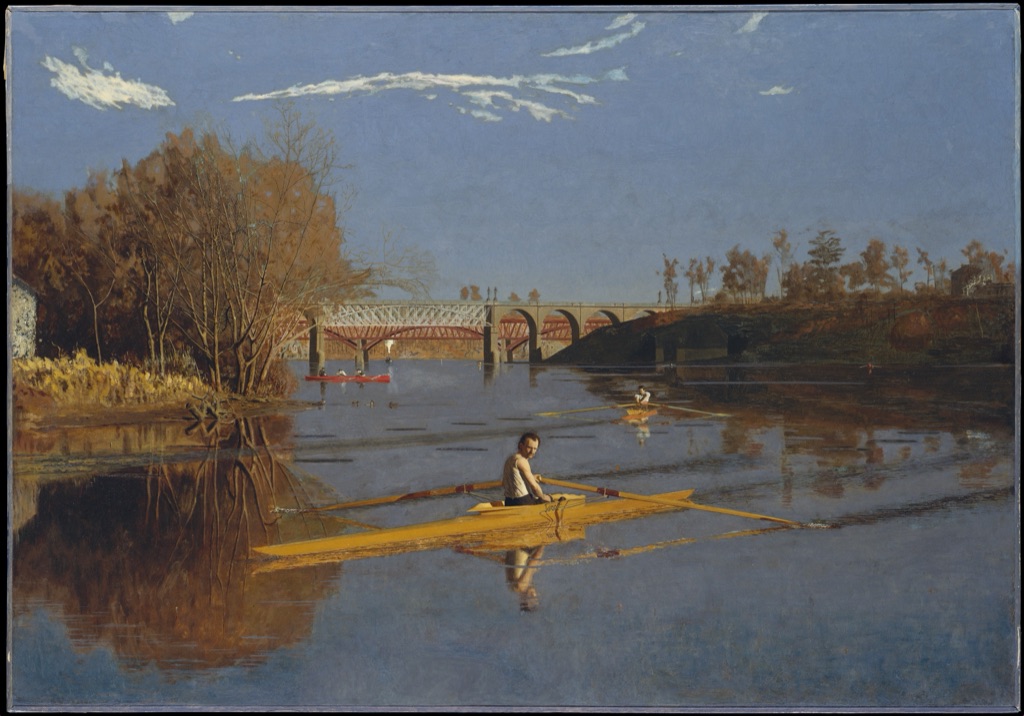
Thomas Eakins, The Champion Single Sculls (Max Schmitt in a Single Scull), 1871, is in the Metropolitan Museum of Art (accession 34.92).[11] The nearest rower's long oars extend across the boat, while a narrow wake records passage through the water. A second sculler and distant bridges continue the river's recession.
The action is controlled rather than explosive. Oars, wake and repeated crossings invite attention from the foreground boat towards the farther reaches of the river. Depth belongs to space as an element; here it is observed only because it helps movement unfold through the scene.
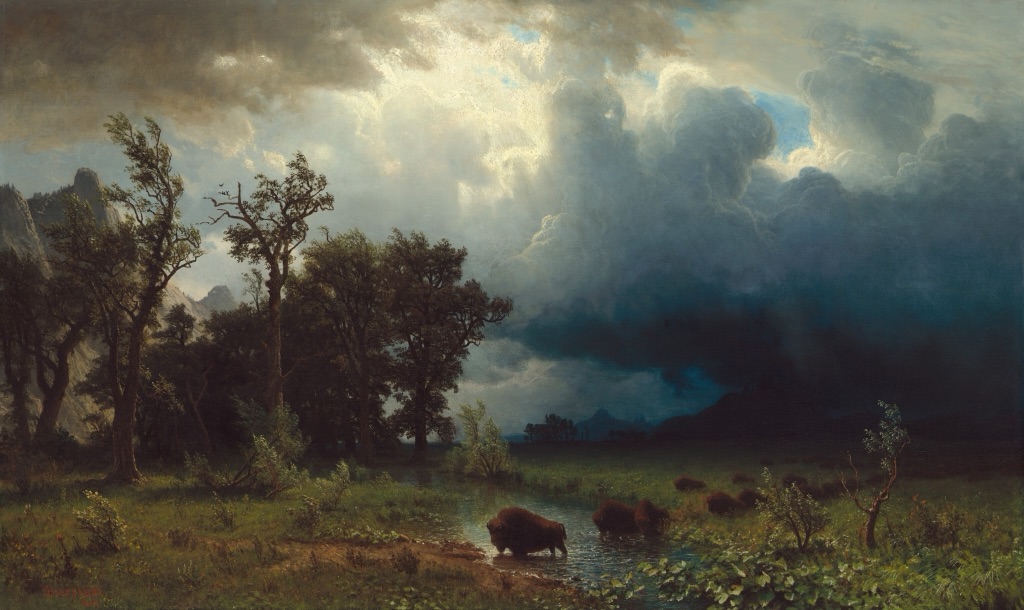
Bierstadt: movement distributed across a landscape
Albert Bierstadt, Buffalo Trail: The Impending Storm, 1869, is in the National Gallery of Art, Washington (accession 2014.79.3).[12] A line of buffalo crosses the stream and recedes towards the right. Wind-bent trees pull upwards at the left, while the dark storm field spreads across much of the sky.
No single figure controls the whole effect. Attention can travel with the herd, follow the bright water into depth or rise into the clouds. Movement is distributed across several connected zones, showing that a landscape can guide looking without becoming a crowded action scene.
Movement and its neighbours
Movement becomes clearer when related ideas retain their own jobs. Rhythm concerns pace and interval through recurrence and variation; repetition may contribute to movement, but one diagonal or gesture can create direction without a repeating beat. Pattern is organised recurrence, not every sequence that happens to lead the eye.
Line is a visual element and may establish direction, while space concerns depth and occupied or unoccupied relationships. Balance concerns visual weight, and proportion concerns size relationships between parts and wholes. Each can influence how attention travels without becoming a synonym for movement.
Emphasis organises relative priority; movement may lead towards or between those priorities. Contrast is perceptible difference and may turn attention towards a new area. Unity is coherence among distinguishable parts, while variety concerns sustained diversity. A path can feel smooth or interrupted without deciding whether the whole work is unified.
The Principles of Art places movement among other organising relationships. Rhythm, emphasis, composition and related ideas can refine the analysis, while movement keeps attention on implied action and directional travel.
Look for movement yourself
Choose one still artwork and find the strongest direction you can see. Trace it with your eyes, then notice what starts it, what extends it and where it pauses or changes. Ask whether the effect comes mainly from depicted action, from a path between parts, or from both.
Then look for a quieter alternative. A wake, leaning tree, repeated figure or receding trail may do more than a dramatic pose. Describe what invites your attention rather than insisting on one correct route. Movement becomes easier to recognise when “the picture feels active” turns into a concrete account of bodies, marks, intervals and connections.
Watch: Movement through Formal Analysis
Choose a museum-led whole-work analysis, a close reading of directional light and gesture, or a foundations overview.
Introducing Formal Analysis: Landscape
Trace how paths, diagonals and intervals guide attention through a still landscape.
Watch on YouTubeFrequently Asked Questions
Movement is the implied action or directional path that a still artwork presents to the viewer.
Pose, sequence, diagonal direction, crop, repetition and visible effects such as wakes or wind can imply change over time.
No. Movement concerns implied action and directional travel; rhythm concerns pace and interval through recurrence and variation.
Yes. Paths, water, clouds, trees, diagonals and changes through depth can guide attention through a landscape.
No. A work can invite several plausible paths, each of which should be supported with visible evidence.
Discussion
Which still work on this page makes movement most convincing, and what visible evidence creates it?
Reader Insights
Depicted action and a viewer's path can reinforce one another, but they are not identical.
Wakes, bent trees and flying paper can make an invisible force legible.
A work can invite several defensible routes rather than one prescribed circuit.
Join the Conversation
Share one precise movement observation or a useful museum example below.
References
- J. Paul Getty Museum, “Understanding Formal Analysis — Principles of Design.” https://www.getty.edu/education/teachers/building_lessons/formal_analysis2.html
- J. Paul Getty Museum, “Vocabulary for Describing an Artwork.” https://www.getty.edu/education/k-12-learning/describe-listen-draw/vocabulary-for-describing-an-artwork/
- Massachusetts College of Art and Design, “Principles and Elements.” https://massart.edu/app/uploads/legacy-files/Principles%20and%20Elements.pdf
- Neuberger Museum of Art, Purchase College, SUNY, “Principles of Art: Movement.” https://www.purchase.edu/live/files/3415-activity-principles-of-art-movement
- National Gallery of Art, “The Fall of Phaeton.” https://www.nga.gov/artworks/71349-fall-phaeton
- The Metropolitan Museum of Art, “Snap the Whip.” https://www.metmuseum.org/art/collection/search/11140
- The Metropolitan Museum of Art, “Attitudes of Animals in Motion.” https://www.metmuseum.org/art/collection/search/700109
- National Gallery of Art, “Spanish Dancers.” https://www.nga.gov/artworks/76264-spanish-dancers
- The Metropolitan Museum of Art, “Ejiri in Suruga Province.” https://www.metmuseum.org/art/collection/search/55735
- The Metropolitan Museum of Art, “Sudden Shower over Shin-Ōhashi Bridge and Atake.” https://www.metmuseum.org/art/collection/search/55433
- The Metropolitan Museum of Art, “The Champion Single Sculls (Max Schmitt in a Single Scull).” https://www.metmuseum.org/art/collection/search/10819
- National Gallery of Art, “Buffalo Trail: The Impending Storm.” https://www.nga.gov/artworks/166427-buffalo-trail-impending-storm