by Tom Gurney
Tom Gurney BSc (Hons) is an art history expert with over 20 years experience
Email: tomgurney1@gmail.com / Phone: +44 7429 011000
How a Single Path Can Shape the Way We See
Line in art is an identifiable path or extended mark with direction and length. It might be drawn in ink, cut into stone, printed from a metal plate or painted with a brush. It can be slender or broad, straight or curved, continuous or broken. What makes it useful to recognise is not the tool that produced it, but the path we can see and the relationships that path establishes.[1][2][3]
Some linear relationships have no continuous mark. A glance, a pointing hand or a row of aligned edges can make separate parts feel connected. This is usually called implied line: a perceived direction supported by visible evidence rather than an invisible stroke that we pretend is physically there.[2][4][5]
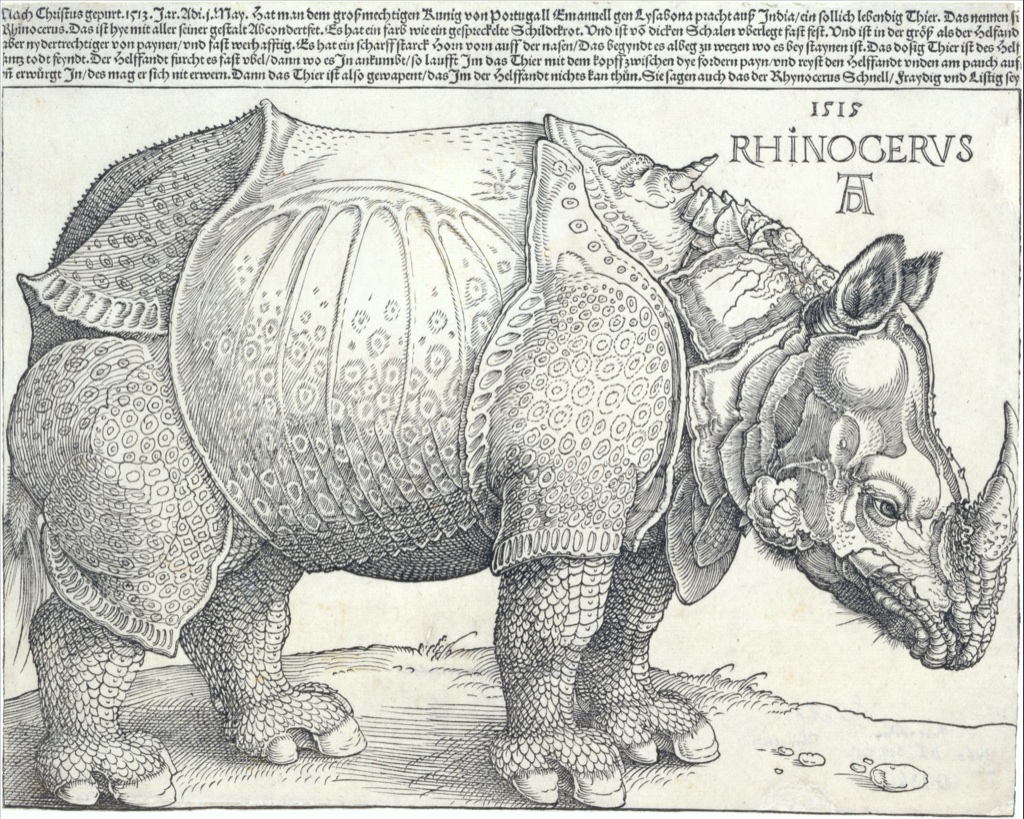
Albrecht Dürer · The Rhinoceros · 1515 · The Metropolitan Museum of Art · Public Domain. Contour, hatching and changes in density make a remarkable imagined surface from printed line. Source details.
At a Glance
- Core ideaa visible or implied path with direction and length.
- Visible linea materially present mark, cut or printed path.
- Implied linea connection created by alignment, gaze or gesture.
- Look forwidth, direction, curvature, breaks and density.
- Related effectscontour, value, texture, movement and rhythm.
Contents
Visible, actual and implied line
Visible line is the clearest term for a path or mark that can be seen in the work. Some institutional resources use actual or physical line for a visibly made mark; others may use those words for a materially three-dimensional linear element. That variation is worth knowing, but it does not establish a set of official types.[1][4]
Suggested line is useful ordinary wording that overlaps with implied line. In either case, the evidence matters. Separate shapes might align, two figures might look towards one another, or repeated edges might establish a direction without joining into one connector. Such a relationship may be strong, faint or open to another reading. It does not prove that every viewer follows the same path.
A contour follows or defines the boundary of a shape or form. Outline is a familiar overlapping word, though the terms are not exact synonyms in every context. An edge can also appear where two areas change in colour, value or surface even when no literal line has been drawn.[1][5] Width, length, direction, curvature, continuity and density are qualities we can describe; none carries one fixed mood or meaning.
Lines can also contribute to neighbouring effects. Closely spaced lines may build value or help a form appear to turn. Hatching names such parallel groupings, while cross-hatching adds intersecting sets; these are brief descriptive terms here, not instructions.[5][7] A line may be directional or gestural, but its appearance alone cannot prove speed, emotion or the artist's intention.
Four questions for recognising line
When you look at an unfamiliar work, ask:
- 1
Where is the visible path, and where does it begin, change or end? Follow what is materially present before naming an effect.
- 2
What can you describe directly? Notice width, length, direction, curvature, continuity and density.
- 3
What is the line doing? It may define a contour or edge, build value or surface, or connect parts. Keep those neighbouring effects secondary to the line you can identify.
- 4
Is the relationship marked or implied? If there is no continuous connector, name the exact alignment, gaze, gesture or interval that supports your reading.
The questions replace a memorised chart of “line meanings” with evidence from the work itself.
Paths printed, drawn and painted
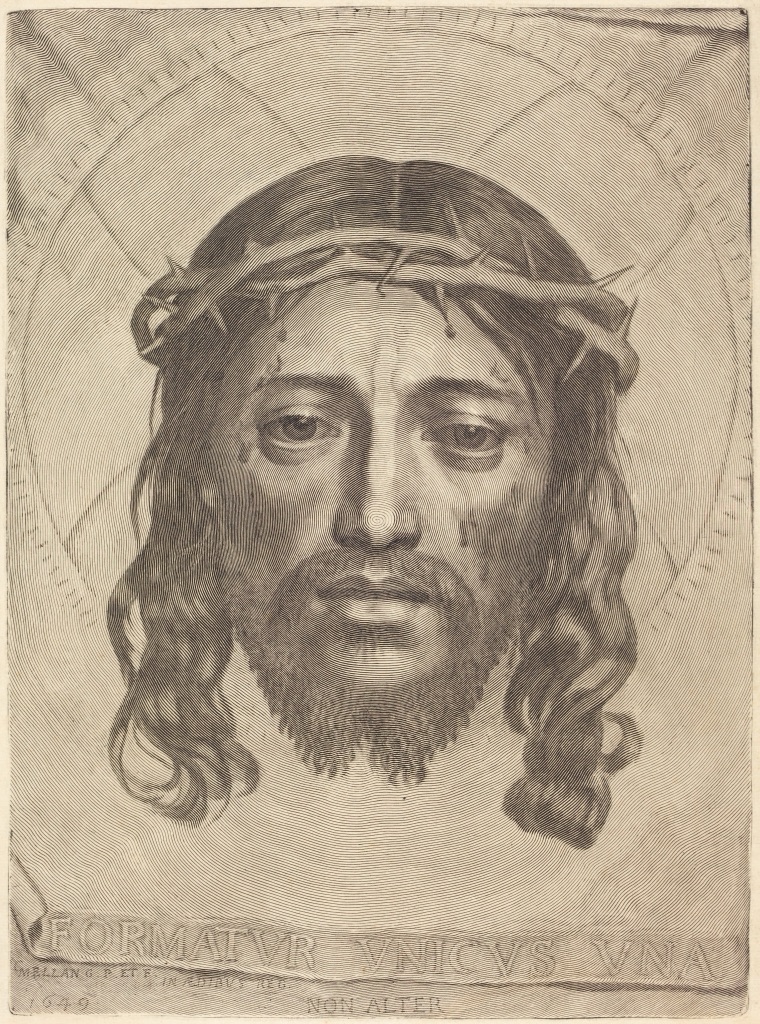
Mellan: one line changing density
Claude Mellan's The Sudarium of Saint Veronica, 1649, is an engraving in the National Gallery of Art, Washington (accession 1943.3.6144).[8] The complete sheet presents its Christian subject through an extraordinary continuous spiral.
Follow that path from its broad outer turns towards the face. The line narrows, widens and draws closer to itself. Where the turns crowd together, the image becomes darker; where they open, the paper remains brighter. Line, value and represented form work together, but the primary evidence is wonderfully economical: one uninterrupted route altered through width and interval.
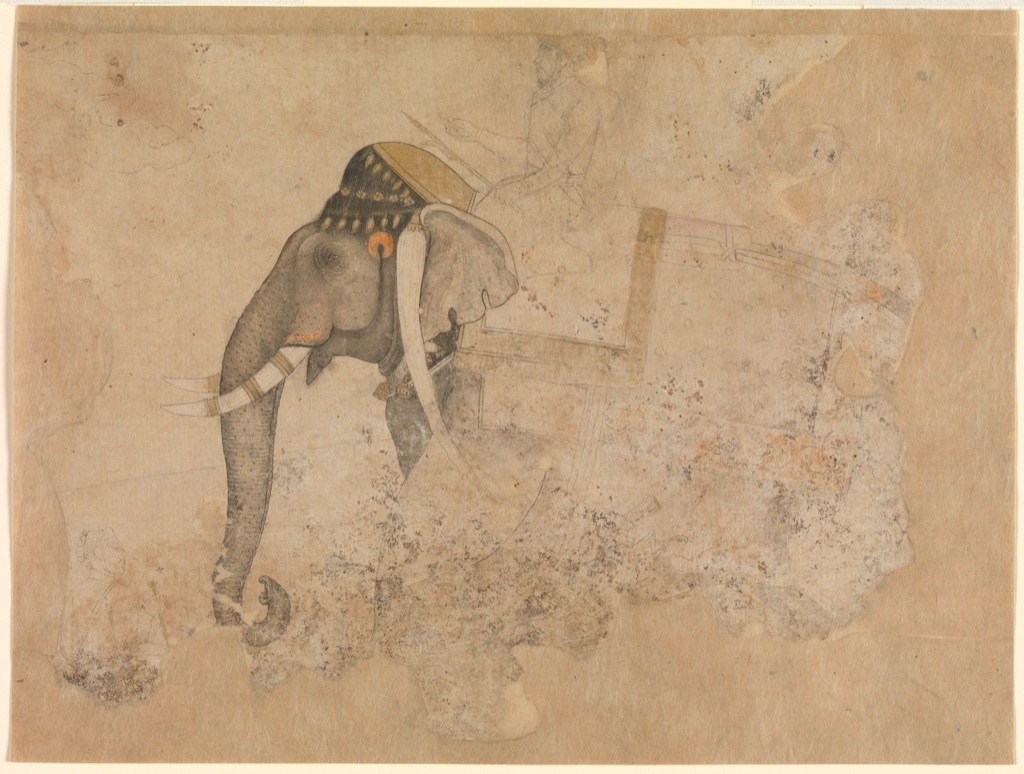
Hashim: contours that do not close everything
Elephant and Rider, ca. 1640, is attributed to the Indian artist Hashim and belongs to The Metropolitan Museum of Art (accession 2010.255). The museum records ink and watercolour on paper and notes water damage to the sheet.[9] That damage is part of the object's condition, not evidence of expressive intention.
Fine contours make the elephant's forehead, trunk, back and legs legible, while shorter internal marks articulate its ear, eye and decorated harness. The rider and ground emerge from similarly selective paths. Many boundaries remain incomplete, yet the figure does not dissolve. The work shows that a contour can identify a body without enclosing every part like a diagram.
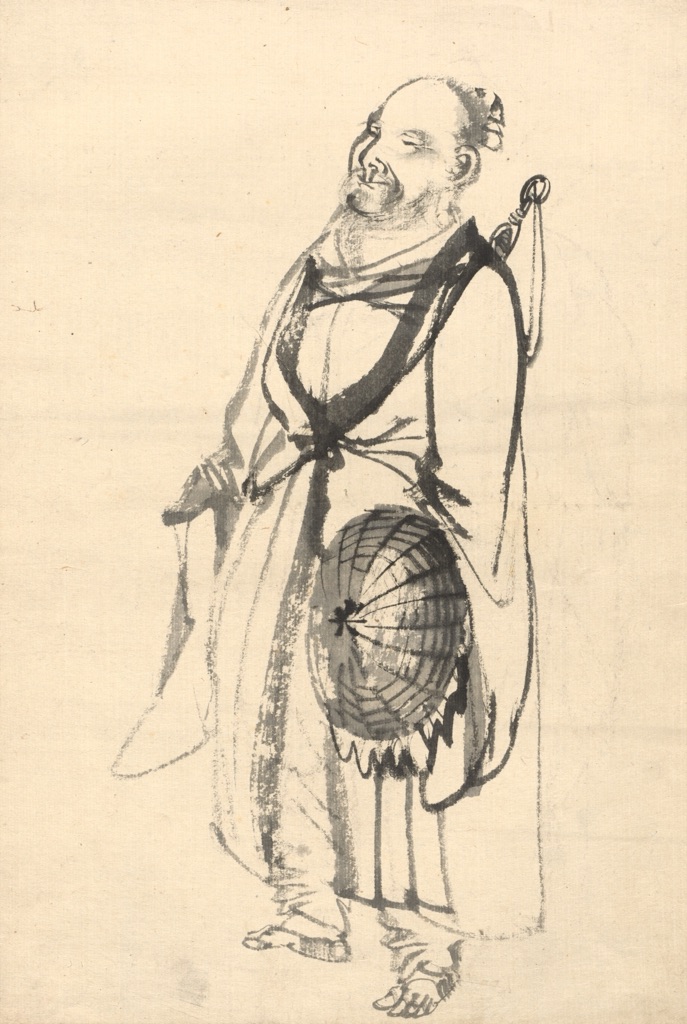
Bairei: weight changing along a path
The hanging scroll The Wandering Hermit, ca. 1880–95, is attributed to the Japanese artist Kōno Bairei and is held by the Cleveland Museum of Art (accession 1985.288).[10] Across the open paper, darker and lighter ink paths distinguish a figure, his robe and his staff.
Some marks broaden under the folds of clothing; others taper around the face or run thinly along the staff. These changes give each path a different visual weight without assigning it a fixed emotion. The scroll is best read in full: the unmarked paper lets us see where a line begins, disappears and resumes.
An Egyptian palette: line cut into an object
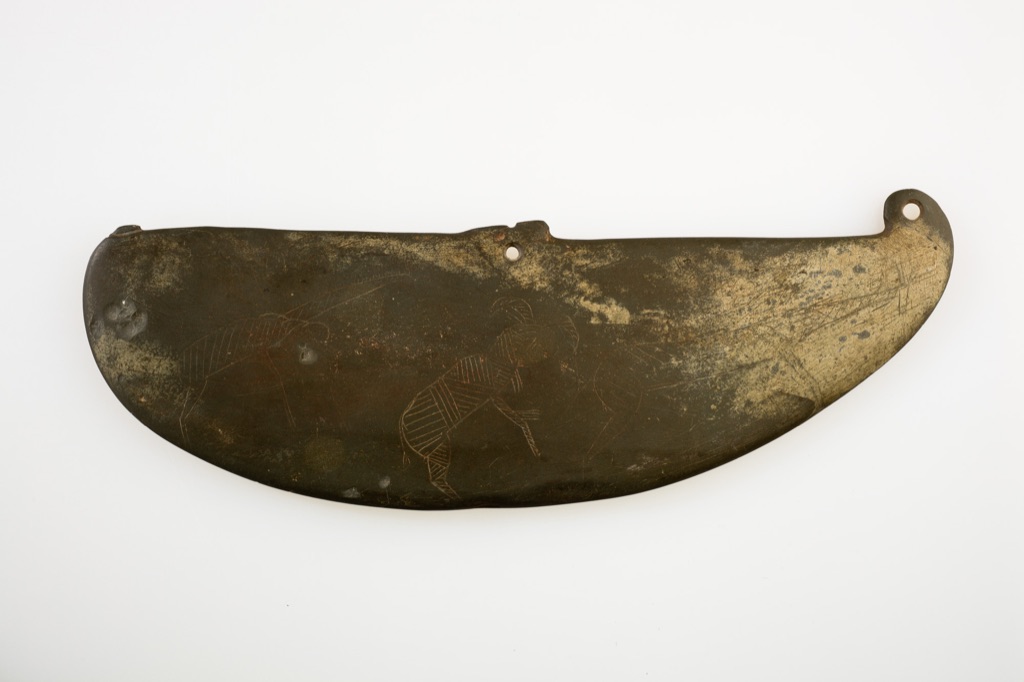
The maker-unrecorded Egyptian Palette with Incised Figures of Giraffes, Ibex, and Antelope, ca. 3850–2960 BCE, is a schist object in The Metropolitan Museum of Art (accession 68.59).[11] Its animal figures are incised into the complete dark palette.
Here line is not only deposited on a flat sheet. Shallow cuts create visible paths within a three-dimensional object. Their curves pick out long necks, backs, horns and legs, while small interruptions keep one animal distinct from another. The incision has a physical surface, but the line lesson lies in how those cut paths make figures legible across the stone.
Written, etched and painted relationships
A Qur'an folio: written line in sacred context
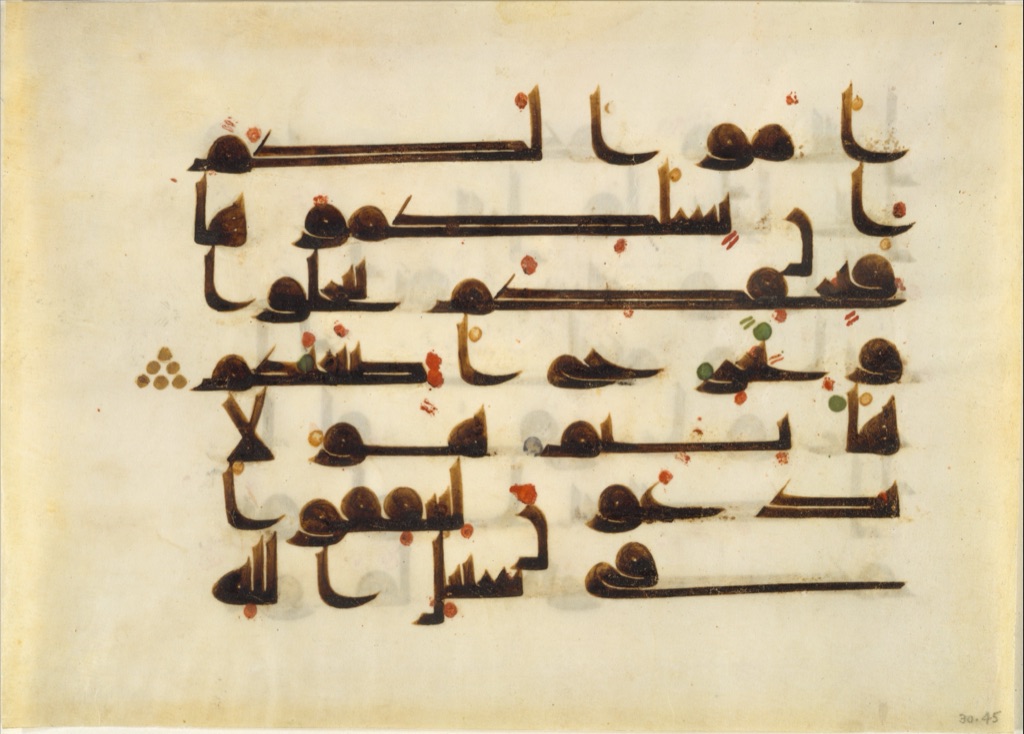
Folio from a Qur'an Manuscript, probably made in Syria in the late 9th–early 10th century, is held by The Metropolitan Museum of Art (accession 30.45). It is ink and gold on parchment.[12] The complete folio is a page of sacred text, not a decorative sample or a generic calligraphy exercise.
Its broad Arabic script makes changes in width, direction and interval immediately visible. Horizontal passages extend across the parchment, upright and curving strokes interrupt them, and open spaces separate one group from the next. Calling these marks line does not replace their written and religious identity; it gives us a precise way to describe their visible paths.
Doughty: economical lines across a landscape
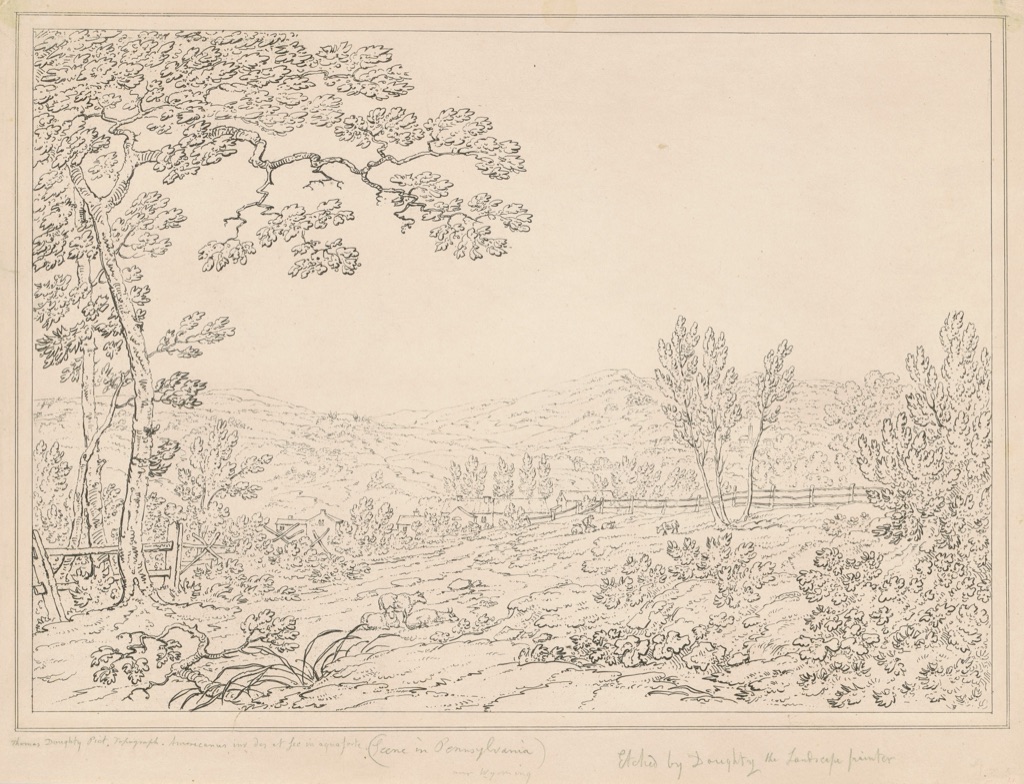
Thomas Doughty's Pennsylvania Landscape, c. 1810–30, is an etching in the National Gallery of Art, Washington (accession 2015.19.872).[13] Etching transfers ink from lines worked into a plate to paper, leaving a printed path that can be read across the complete sheet.[6]
Doughty uses relatively sparse marks to distinguish trees, sloping ground, water and distant land. Some edges are firm; others thin out or stop, allowing the paper to participate in the image. Those intervals help suggest distance, but this is not a perspective lesson. The central observation is how economical lines can separate several forms and areas without dense modelling.
Korean Bamboo: tapered marks and open silk
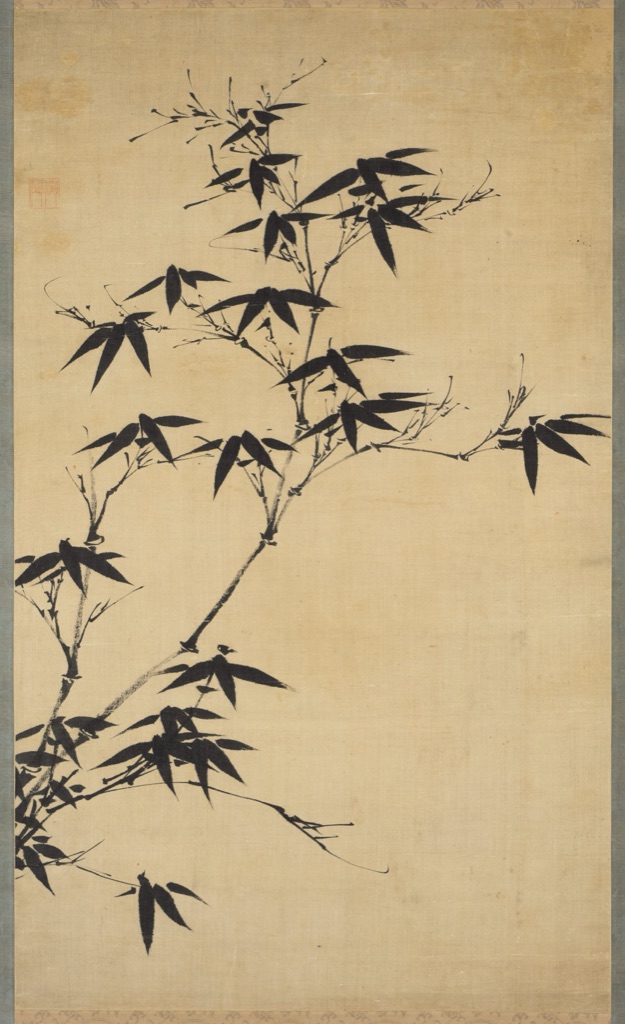
The hanging scroll Bamboo, made by an unrecorded Korean artist in the 1900s, is ink on silk and belongs to the Cleveland Museum of Art (accession 1999.169).[14] Long stems, short joints and pointed leaves occupy only part of the tall field.
The marks change as they travel. Stems remain comparatively continuous, while leaves widen and taper within a much shorter span. Their directions recur, but not as a rigid pattern, and large areas of silk stay open. Looking at the full scroll makes the contrast between sustained and brief paths as important as any single stroke.
When the connector is implied
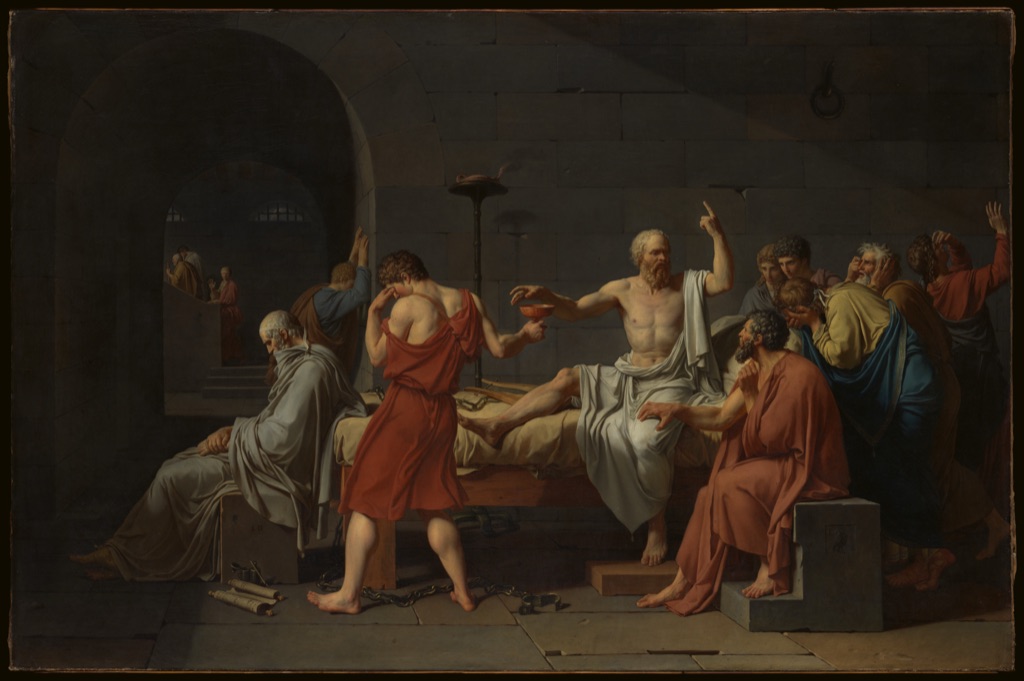
David: gestures and gazes across a painting
Jacques Louis David's The Death of Socrates, 1787, is an oil painting in The Metropolitan Museum of Art (accession 31.45).[15] Socrates reaches towards a cup while extending one finger upward; around him, hands point, reach and withdraw as faces turn in different directions.
No single painted stroke joins all these actions. Instead, the relations among fingers, forearms, gazes and repeated angles can suggest connections across the figures. This is an implied-line reading grounded in exact visible evidence, not a claim that the eye must travel along one prescribed route. It is also distinct from asking which figure or area receives priority: here the useful question is how separate gestures become directionally related.
Line and its neighbours
Line can help another element or principle operate without becoming interchangeable with it. A contour may bound a shape or help a form appear volumetric. Dense lines may create darker value; broken edges may contribute to represented space; and repeated marks may support texture. Directional relations can contribute to movement, recurring lines can establish intervals in rhythm, and recurring motifs can form a pattern. Composition concerns how all the parts become a realised whole.
The difference is one of focus: begin with the identifiable path or implied relation and name what it visibly does. The Elements of Art places line alongside the other elements, while the related subjects below help test where a linear reading ends and another question begins.
Related topics
For browsing centred on practitioners, Line Artists remains the artist-led guide. Line Drawings is the drawing-led collection. Both offer useful next steps, while the formal element and the close-looking questions remain the subject here.
Look for Line Yourself
Choose one complete artwork or object and locate a path you can describe without guessing how it was made. Follow where it thickens, bends, breaks or ends. Does it close a contour, stop short of one, or meet an edge created by a change between areas?
Then look for a possible implied relation. Are separate forms aligned? Does one figure point or look towards another? Name the precise evidence and allow for more than one reading. If the lines also build darkness, surface, depth, recurrence or action, say which effect you see while keeping its neighbouring concept distinct.
Line becomes clearer when we ask what is visibly connected and how. From one engraved spiral to a cut animal outline, a sacred written page or a chain of gestures, the path may be continuous, interrupted or only implied. Careful looking begins with the evidence and lets meaning remain as open as the work permits.
Watch: Line from First Mark to Close Analysis
Choose a focused lesson on line quality, a short overview of the elements, or a museum demonstration of formal analysis.
Elements of Art: Line Quality
See how pressure, direction and tools give visible paths different weights and characters.
Watch on YouTubeFrequently Asked Questions
Line is a visible or implied path with direction and length. It may be drawn, painted, printed, cut or perceived between separate forms.
Implied line is a directional relationship suggested by aligned edges, gestures, gazes or intervals rather than one continuous mark.
Useful observable qualities include width, length, direction, curvature, continuity, density and changes of weight.
A line is a path or mark; an edge is a boundary between areas and may exist through a change of colour, value or surface without a drawn line.
Closely spaced, crossing or varied marks can make passages appear darker and can suggest a surface, while remaining identifiable as lines.
Discussion
Which visible or implied line changes the way you read an artwork, and what exact evidence supports that response?
Reader Insights
Describe where a line begins, changes direction, thickens, breaks or ends.
Ask whether a boundary is drawn or created by a change between adjacent areas.
Name the gaze, gesture, alignment or interval that creates a connection without a continuous line.
Join the Conversation
Share one close observation or a useful museum example below.
References
- J. Paul Getty Museum, “Understanding Formal Analysis”
- National Gallery of Art, “The Elements of Art: Line”
- Museum of Modern Art, A Vocabulary for Discussing Art
- Honolulu Museum of Art, Elements of Art | Line
- Smarthistory, “Line”
- Victoria and Albert Museum, “What is print?”
- National Gallery of Art, “Explore the Basics of Drawing”
- National Gallery of Art, Claude Mellan, The Sudarium of Saint Veronica, 1649
- The Metropolitan Museum of Art, attributed to Hashim, Elephant and Rider, ca. 1640
- Cleveland Museum of Art, attributed to Kōno Bairei, The Wandering Hermit, c. 1880–95
- The Metropolitan Museum of Art, Palette with Incised Figures of Giraffes, Ibex, and Antelope, ca. 3850–2960 BCE
- The Metropolitan Museum of Art, Folio from a Qur'an Manuscript, late 9th–early 10th century
- National Gallery of Art, Thomas Doughty, Pennsylvania Landscape, c. 1810–30
- Cleveland Museum of Art, Bamboo, 1900s
- The Metropolitan Museum of Art, Jacques Louis David, The Death of Socrates, 1787
- The Metropolitan Museum of Art, Albrecht Dürer, The Rhinoceros, 1515. Collection record.
- Quarto, Susie Hodge, Elements of Art. Publisher record.
- Phaidon, E. H. Gombrich, The Story of Art. Publisher record.
- Children's Museum of the Arts, “Elements of Art: Line Quality.” Watch on YouTube.
- Children's Museum of the Arts, “Elements of Art: Introduction!” Watch on YouTube.
- Getty Museum, “Introducing Formal Analysis: Landscape.” Watch on YouTube.