by Tom Gurney
Tom Gurney BSc (Hons) is an art history expert with over 20 years experience
Page created on September 2, 2026 / Page updated on September 13, 2026
Email: tomgurney1@gmail.com / Phone: +44 7429 011000
Let the Eye Find the Edge Before the Hand Fixes It
Contour drawing uses line to follow the boundaries that make a form readable. The outer silhouette is one kind of contour, but it is not the whole method. An overlapping arm, the turn of a sleeve, the edge between cheek and hair, and a line travelling across a curved surface can all describe structure.
The National Gallery of Art introduces contour through continuous long lines that convey shape and distinguishes it from gesture, hatching and crosshatching.[1] That is a useful exercise rule, not a law governing every contour drawing. Historical artists pause, restart, reinforce, lose and recover edges. What matters is that the line reports a boundary or transition rather than merely decorating the page.
This guide separates five kinds of contour, shows how artists used them in working drawings and gives exercises that reveal whether you are looking at the subject or drawing a remembered symbol.
At a Glance
- Follow boundaries, not symbolsObserve silhouettes, overlaps and internal transitions instead of drawing a remembered shorthand.
- Separate line systemsContour describes an edge; gesture carries action; hatching models tone and texture.
- Vary pace and pressureSlow down at directional changes and strengthen only the edges that organise the form.
- Use negative spaceTreat the gap beside an object as a measurable shape sharing the same contour.
- Allow edges to disappearLost-and-found contour can let value, light or another form carry part of the boundary.
Contents
Choose the Contour Exercise That Matches the Problem
Each exercise isolates a different visual decision. Use the constraint long enough to expose a habit, then return to a fully observed drawing rather than treating the exercise as a finished style.
| Method | What it trains | Working rule | Typical mistake |
|---|---|---|---|
| Slow observed contour | Sustained looking and directional change. | Move the pencil only as the eye travels; pause at landmarks. | Moving at one speed and smoothing every irregularity. |
| Blind contour | Eye-hand coordination and resistance to symbols. | Look only at the subject and keep the tool moving for a short timed study. | Treating distortion as the aim rather than evidence of the constraint. |
| Modified contour | Observation balanced with proportion. | Look mainly at the subject but check the page at structural intervals. | Peeking continuously and reverting to an ordinary outline. |
| Cross-contour | Turn, volume and surface direction. | Send selected lines across the form as though wrapping its surface. | Adding decorative stripes that ignore the object's volume. |
| Selective contour | Hierarchy, overlap and lost-and-found edge. | Reserve the darkest line for decisive junctions and omit redundant edges. | Outlining every object with equal weight. |
| Negative-space contour | Proportion and shared boundaries. | Draw the gaps between objects before their internal detail. | Naming the object mentally and losing the measured shape beside it. |
Five kinds of contour
An *outer contour follows the visible silhouette. An internal contour marks a boundary within it, such as the meeting of two fingers or the edge of a fold. An overlap shows which form passes in front. A cross-contour travels across a form and helps explain its turn in space. A lost-and-found contour strengthens an edge where clarity is needed and lets it disappear where adjacent values or open space can carry the form. Getty’s Sculptural Line* project likewise uses contour to investigate form, shape and movement rather than reducing it to a flat perimeter.[12]
Hatching is different. Parallel or crossed strokes can model tone and texture, but they do not become contour simply because they are lines.[2] Gesture is also different: it prioritises action, balance and direction. A drawing can combine all three systems, as many historical sheets do, but naming their jobs helps you practise them deliberately.
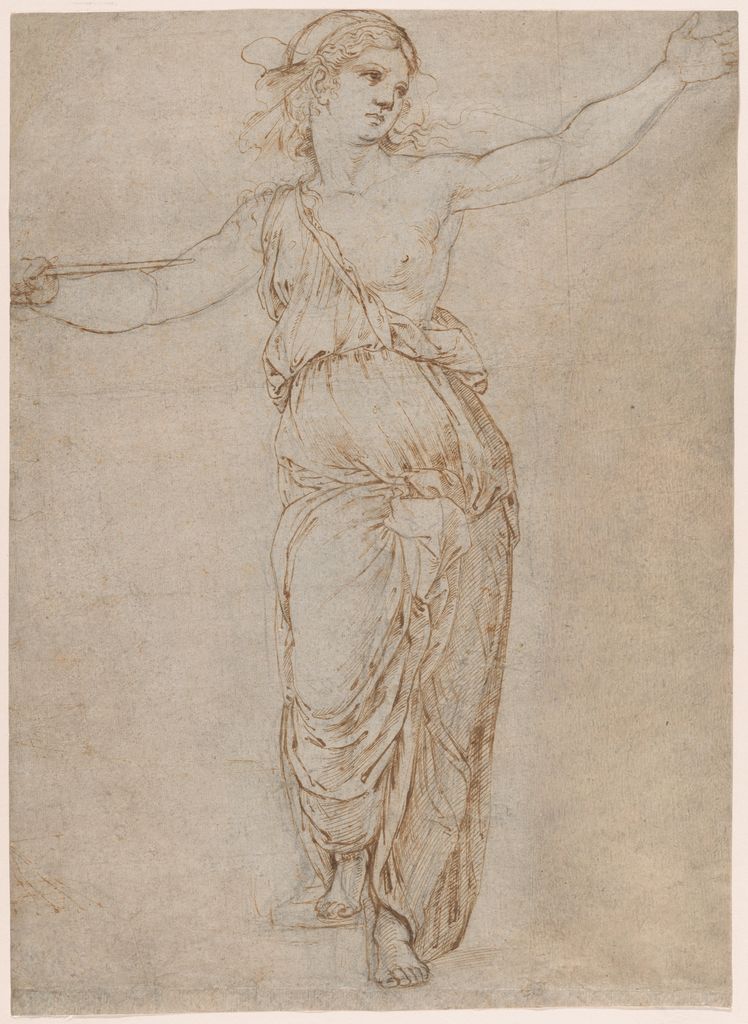
Raphael’s Lucretia of 1508–10 makes the combination visible. Pen and brown ink sit over a vigorous black-chalk underdrawing; the sheet also contains stylus incisions and black chalk on the verso for transfer.[3] The Met notes emphatic single contours, descriptive hatching and numerous pentimenti—changes visible especially in the underdrawing. Raphael did not simply trace a perfect perimeter. He searched in chalk, selected and reinforced important boundaries in ink, then prepared the design to move elsewhere.
Look particularly at the difference between the figure’s governing edge and the short marks that model it. If every hatch were removed, the pose and rhetorical gesture would remain. If the contours were removed, the hatching would not independently hold the design together. That hierarchy is a useful test in your own work.
Slow contour: make the eye lead
Choose an ordinary object with several overlaps—a shoe, folded coat or plant is better than a ball. Place one point on the page, then let your eye travel along the subject’s edge. Move the pencil only when the eye moves. At every change of direction, stop and compare the point you have reached with two landmarks already drawn.
Do not demand one unbroken line. The NGA’s continuous-line prompt helps discourage scratchy repetition, but a controlled restart can clarify a genuine break.[1] The purpose is sustained looking. Use a light line while uncertain, then strengthen only the portions that establish an overlap or the main turn.
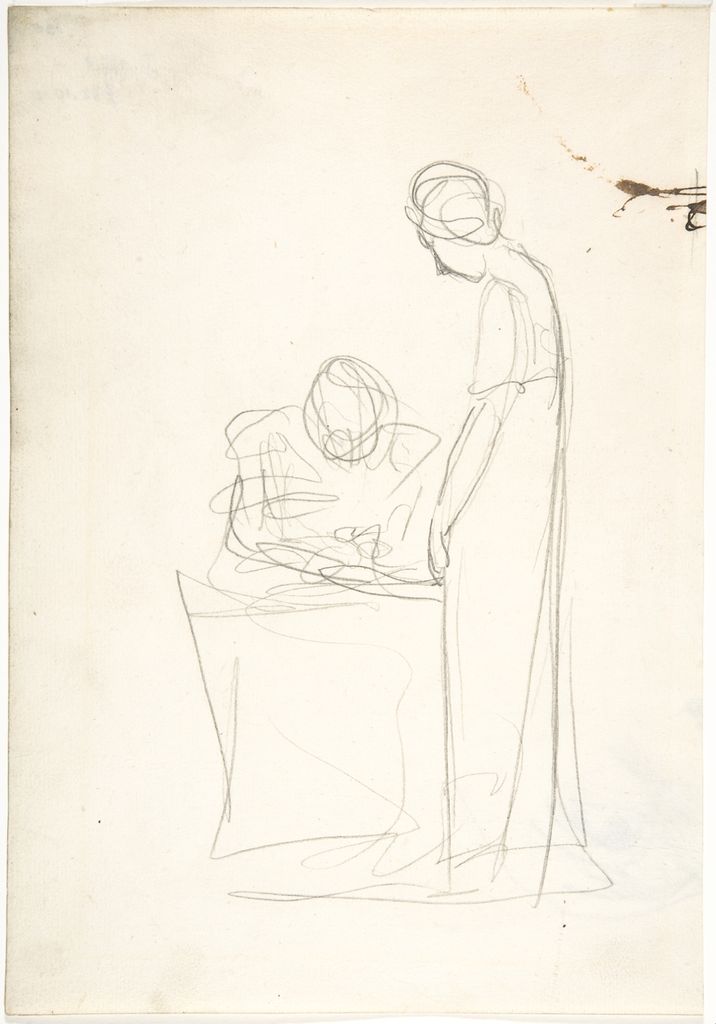
George Romney’s Study of two figures, probably around 1777, shows why pace should remain responsive rather than uniform. The Met describes long, deft graphite strokes for a standing woman and a more frenetic calligraphy for her seated companion.[4] Different line characters coexist because the figures present different visual and expressive problems. “Confident line” does not mean making every edge at the same speed.
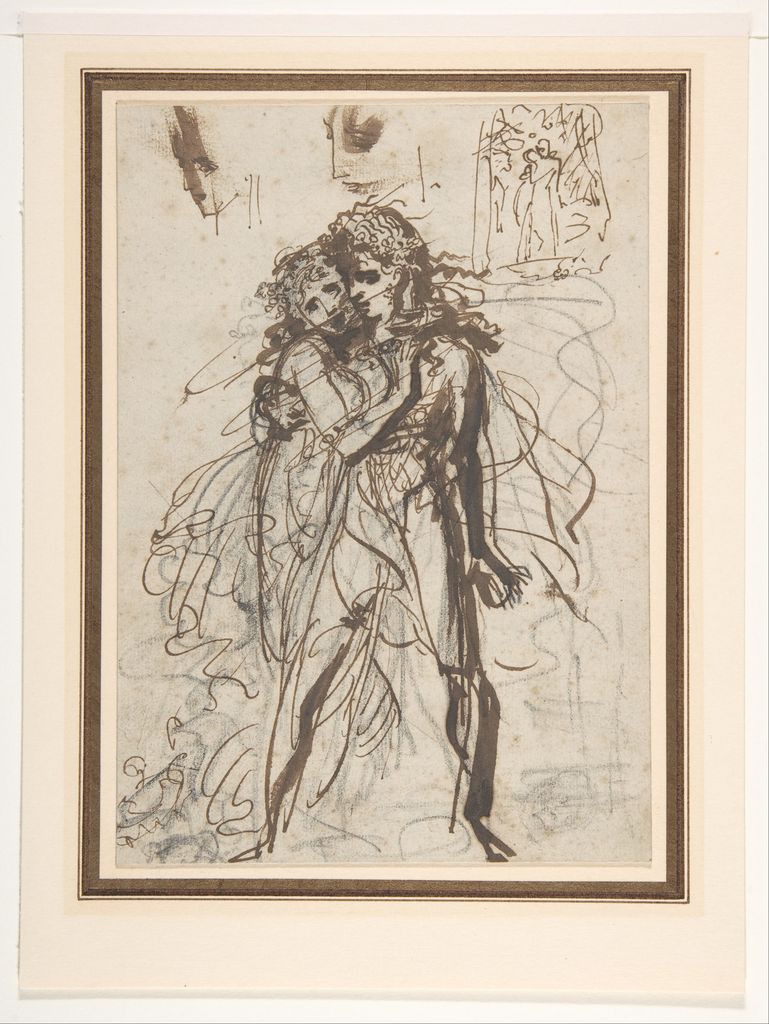
Baron Antoine-Jean Gros’s undated A Man and a Woman Embracing pushes searching line further. Pen and brown wash lie over black chalk in a flurry of rapid sketches. The Met suggests—but does not prove—that it may relate to Gros’s lost Shepherds of Arcadia.[5] The useful visual fact is the accumulation around two interlocking bodies. Some repeated lines test their relation; others become dominant. Keep that difference when assessing your own revisions: a search can remain visible without every attempt receiving equal weight.
Blind contour: coordination, not a style label
In blind contour drawing, keep your eyes on the subject rather than the paper and allow the pencil to follow the route of looking. The NGA frames this as a short exercise connecting eye and hand.[6] Its distortions are evidence of the constraint, not proof that proportion is irrelevant.
Use three minutes on a face, hand or crumpled object. Do not peek, erase or lift the tool. Afterwards, do not “correct” the drawing. Instead, circle three places where the line records an unexpected indentation or overlap you would usually simplify. Then make a second, sighted contour drawing and preserve those observations while checking proportion.
The exercise works because it interrupts symbol drawing. Many people know a shorthand eye, leaf or hand and substitute it before looking. Blind contour makes that substitution harder. It is a training method, however, not the definition of contour drawing and not an authenticity test for expressive line.
Use contour to describe designed volume
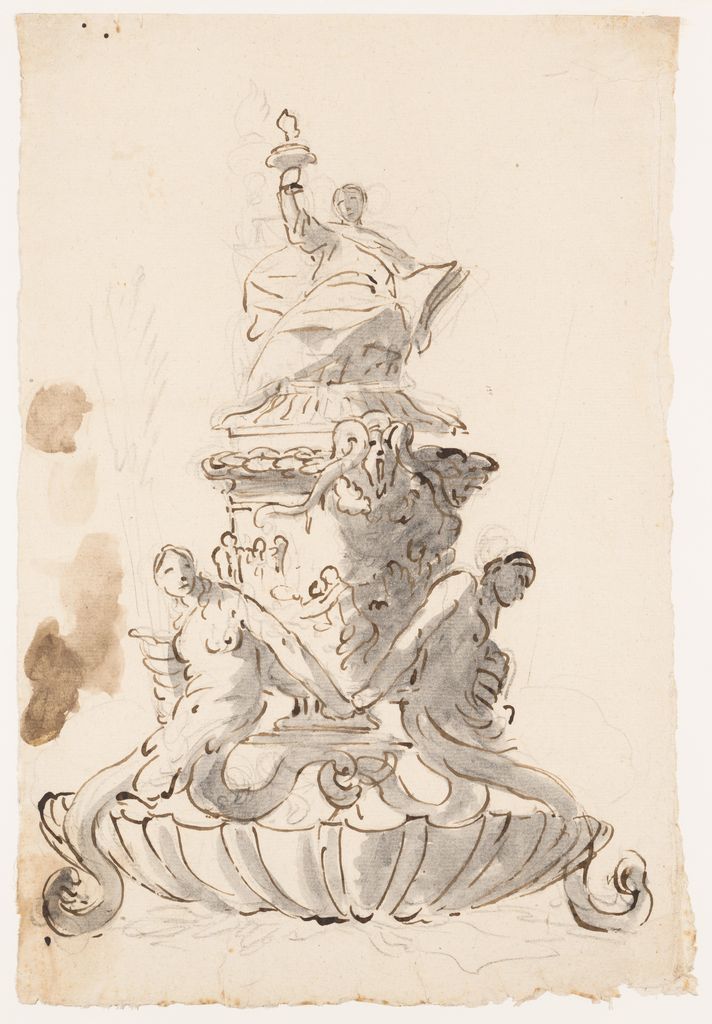
Contour is equally useful when the subject has not yet been made. Giovanni Battista Tiepolo’s Study for an Inkstand, about 1740–45, combines pen, grey wash and black-chalk underdrawing.[7] Formerly identified as a fountain, it is now understood as a probable silver inkstand viewed slightly from below, with mermaid supports, shell-shaped pen holders and a central figure of Wisdom.
The revised identification is a reminder that line does not explain an object without context. Yet the drawing’s contours do practical design work: symmetry, overlaps and changes of plane allow an imagined metal object to occupy space. Wash supports the volume, but the outline of projections and recesses makes the structure legible.
Try the same problem with an invented vessel. Draw its centre line first. Build only one half of the silhouette, then mirror the principal widths. Add internal contours where one component overlaps another, and two cross-contours around a rounded part. If the object reads only after shading, the contour structure needs revision.
Contour, modelling and transfer
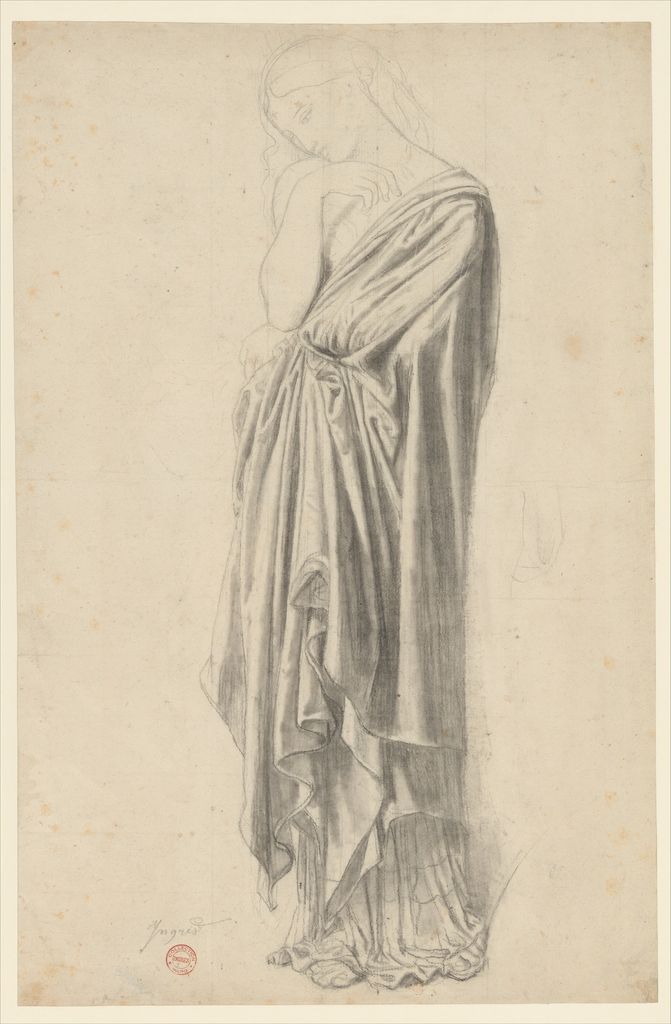
Jean-Auguste-Dominique Ingres’s Study for the Figure of Stratonice, made between 1834 and 1840, combines graphite, black chalk and rubbed charcoal; some contours were incised for transfer.[8] The sheet therefore carries at least two visual roles. Soft tonal material models the figure, while selected boundaries become transferable design information. A contour may be physically impressed rather than simply visible as pigment.
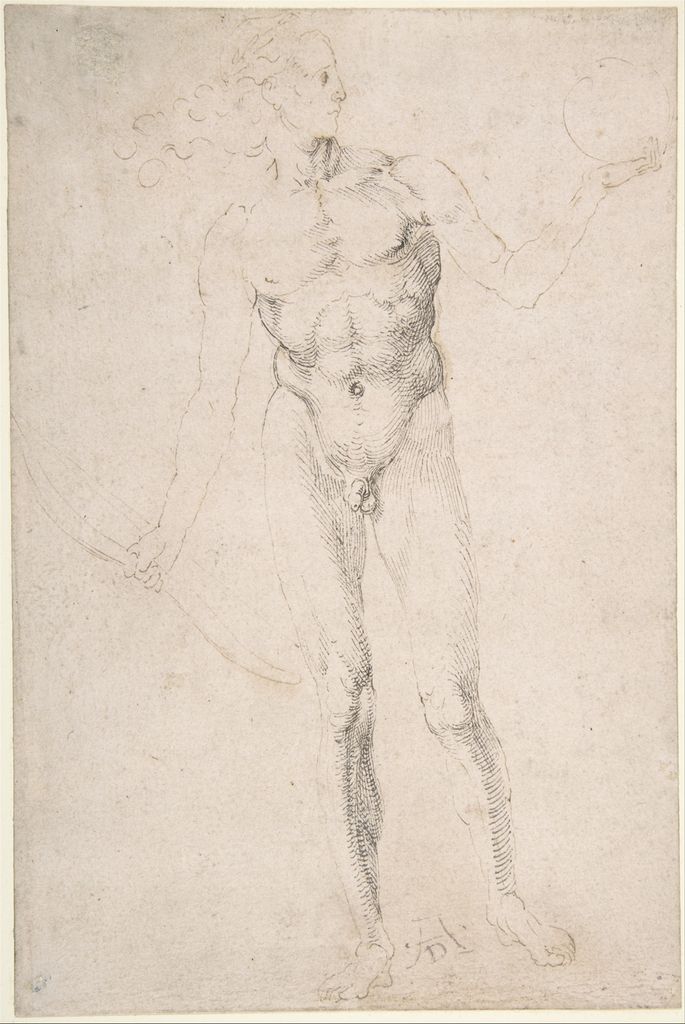
Albrecht Dürer’s Standing Male Nude Holding a Bow, 1501–3, reveals another staged process. The Met identifies lighter brown contours that may have been traced from an Apollo in a painting, followed by darker ink for hair and modelling added freehand.[9] The two ink colours and two line characters separate the inherited or transferred scaffold from further observation and invention.
For practice, trace only the outer and major internal contours of one of your own drawings onto a fresh sheet. Put the source away. Develop the copy freehand with cross-contours and hatching. Compare the two stages: which information survived transfer, and which had to be rediscovered? The exercise demonstrates why a contour can function as a portable structure without being a complete drawing.
Selective contour: do not outline everything equally
An equal dark outline around every visible thing flattens space. Use line weight and omission to create hierarchy. Strengthen a contour at an overlap, under a form or near the centre of attention. Lighten or lose it where illumination is strong, where two shapes merge gently, or where another cue already explains the boundary.
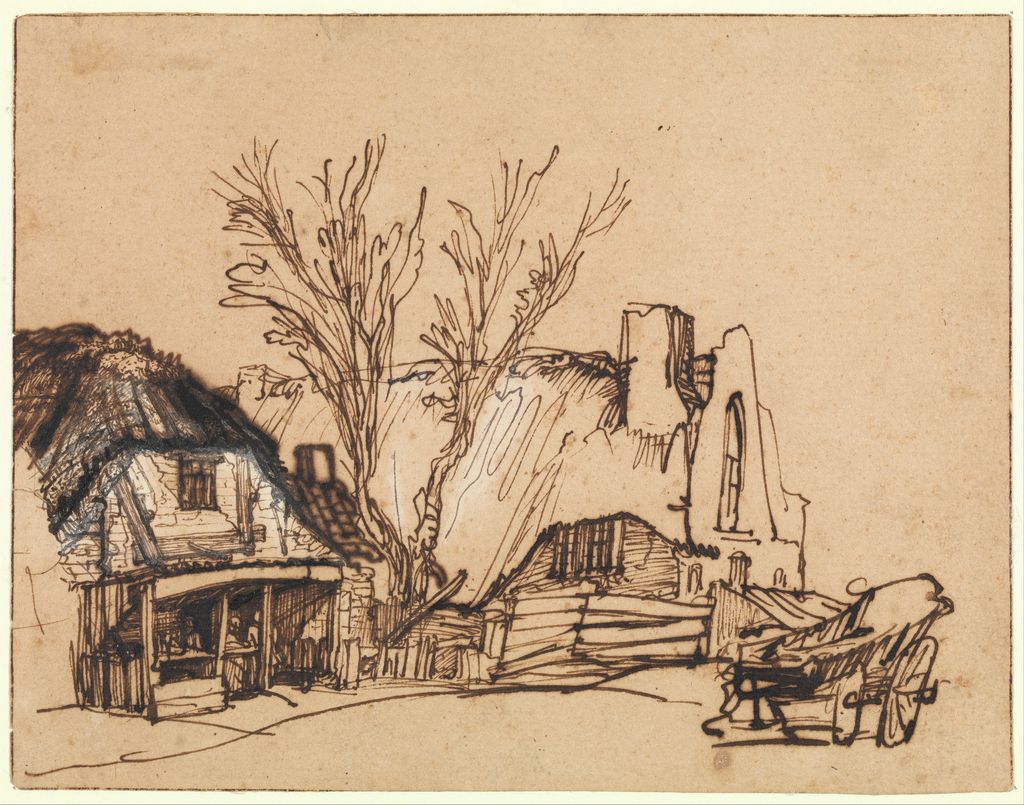
Rembrandt’s Two Cottages, about 1636, deliberately combines the summary and the specific.[10] The nearer cottage, figures and a damaged carriage receive selective detail, while the second cottage and trees remain apparently sketchier. The Met also finds probable white chalk or body-colour correction where pen definition was unsatisfactory.[10] Economy here is not an unfinished patch left by accident. It controls attention and distance.
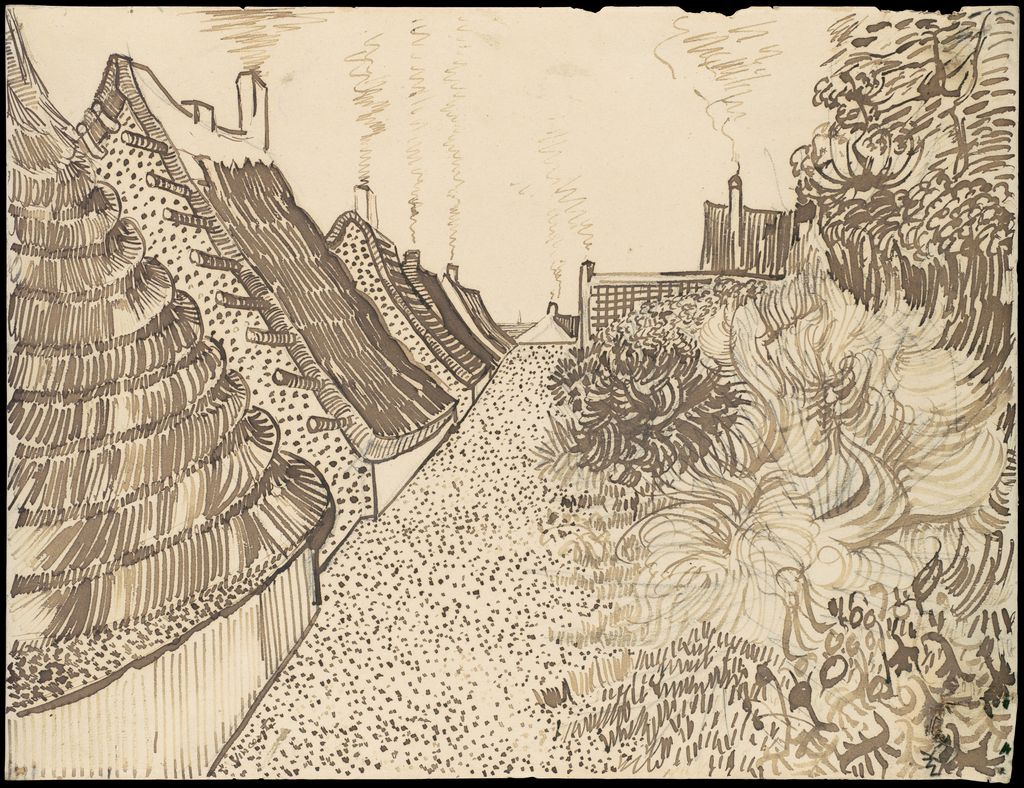
Vincent van Gogh’s Street in Saintes-Maries-de-la-Mer, drawn around 15 July 1888, creates another hierarchy with reed pen, quill and brown ink over graphite.[11] Roofs, road, vegetation and sky receive different rhythms rather than one generic outline. Van Gogh sent the drawing to Émile Bernard as one of a group communicating his recent work; it re-creates a painted composition in a different medium rather than mechanically copying it. The museum notes that black-chalk additions at the right may be by a later restorer, so those marks should not be casually used as evidence of Van Gogh’s line.[11]
Make a drawing with three line weights. Reserve the darkest for no more than five short overlaps. Use the middle weight for the main silhouette and the lightest for internal turns. At the end, erase or omit a quarter of the outer edge. If the form collapses, restore only the minimum needed. This trains selection rather than automatic outlining.
Negative space and the contour between things
A contour belongs visually to both shapes that meet along it. When you draw the left edge of a bottle, you also define the right edge of the empty space beside it. Checking that neighbouring shape is one of the best ways to escape a memorised symbol. Instead of asking whether the bottle “looks right”, compare the width of the gap at its shoulder, middle and base.
Arrange three objects so that they overlap. Before drawing any detail, trace the two enclosed negative spaces between them. Add the objects by treating those first lines as shared boundaries. Then compare the size of the central opening with the combined silhouette. This reverses the usual order of attention and makes proportion errors easier to see.
The same principle operates in figure drawing. In Raphael’s Lucretia, the space between the raised arm and head is as decisive as either anatomical outline. In Gros’s embracing pair, small wedges of paper separate limbs that might otherwise merge. These spaces are not leftover background. They are measurable shapes that confirm where one contour turns into an overlap.
When tone can replace an edge
Objects do not carry dark outlines in nature. We perceive many boundaries because neighbouring areas differ in value, colour, texture or focus. A contour drawing translates some of those differences into line, but it need not translate all of them. Where a lit cheek meets a light background, an artist may let the contour disappear; a nearby shadow or internal feature can keep the form legible.
Test this with a simple profile against a lamp. Draw the shadow side with a firmer contour and the illuminated side with short, separated indications. Add one internal edge—the eyebrow, ear or collar—but no shading. If the profile remains readable, the omitted line is doing useful work. If it vanishes entirely, restore a small segment at the most informative turn rather than tracing the whole edge.
Rembrandt’s Two Cottages provides a historical model for this economy. Specific pen marks concentrate around the nearer structure while more distant forms loosen. The white correction is equally instructive: once an ink edge was too forceful, opaque light could reduce it. Lost-and-found contour is therefore not always spontaneous virtuosity; it can be the product of revision.
Contour across different tools
A graphite contour can begin pale and be adjusted gradually. Pen asks for a more committed decision, though underdrawing and opaque correction can support it. Chalk readily changes width as the stick turns. Reed pen can jump from a broad, blunt accent to a narrow broken stroke. Incised contour may carry no colour at all but can transfer or register a design.
Do not force every tool to imitate a mechanical fineliner. Repeat a curved edge with three tools and keep the size constant. With graphite, vary pressure at the turn; with chalk, rotate from point to side; with a dip or reed pen, let speed change the flow. Label what each variation communicates—weight, light, texture or emphasis. The exercise joins the physical account in drawing mediums to the structural purpose of this route.
Van Gogh’s street is particularly valuable here. Reed pen and quill generate separate vocabularies: broken verticals, compact roof hatches, curling vegetation and open directional strokes. The street is held together not by a single smooth perimeter but by local line systems calibrated to different surfaces. Contour can remain coherent while its texture changes.
Common contour problems
If the drawing looks like a familiar symbol, slow down at direction changes and compare negative spaces. If the line is hairy, stop making several equal attempts: search lightly, then choose one. If the form looks flat, add overlaps and cross-contours before shading. If everything shouts equally, restrict the darkest line to structural junctions. If proportions drift during a continuous-line exercise, remember that the constraint trains attention; follow it with a sighted drawing that permits checking.
Do not confuse smoothness with observation. Raphael’s selected ink line grew from pentimenti. Romney varied pace. Gros allowed search to accumulate. Dürer combined tracing and freehand development. Rembrandt used correction. These works are valuable because contour records decisions, not because the artists avoided revision.
For movement and weight, continue to gesture drawing. For measured comparison from a present subject, use observational drawing. The drawing styles guide places contour beside tonal and wash-led approaches, while drawing mediums explains what makes each line physically different.
Watch Artists Build Form with Line and Charcoal
Choose a Getty reconstruction of historical charcoal practice, a curator-led account of Sargent's charcoal portraits or a National Gallery Singapore studio demonstration.
Drawing with Charcoal: Historical Techniques
Getty conservators and artists reconstruct how prepared charcoal, fixative and erasure can build, revise and clarify a drawing.
Watch on YouTubeFrequently Asked Questions
Contour drawing uses line to describe the boundaries and transitions that make a form readable, including silhouette, overlap, internal edge and lines that turn across a surface.
No. An outline usually means the outer perimeter, while contour can also describe internal boundaries, overlaps, cross-contours and edges that appear or disappear.
Blind contour is a short eye-hand coordination exercise. Looking only at the subject makes it harder to substitute a familiar symbol for an observed edge; distortion is a consequence, not the goal.
A continuous line can be a useful exercise constraint, but historical contour drawings often pause, restart, reinforce, lose and recover edges. The line's descriptive job matters more than never lifting the tool.
Use overlaps, changes of line weight and a few cross-contours that follow the surface turn. Let some edges disappear where value or another form already explains the boundary.
Discussion
Which drawing becomes more convincing when you compare its strongest contour with the edge the artist chose to leave open?
Reader Insights
The same contour defines both the object and the negative space beside it.
Silhouette, overlap, cross-contour and hatching should not all be treated as one generic mark.
A lost edge can describe light or distance as effectively as a reinforced one.
Join the Conversation
Share one contour study in which slowing down, checking negative space or reducing line weight changed what you could see.
References
- National Gallery of Art, “Drawing Everyday Objects”: source.
- National Gallery of Art, “Explore the Basics of Drawing”: source.
- The Metropolitan Museum of Art, Raphael, Lucretia, 1997.153: source.
- The Metropolitan Museum of Art, George Romney, Study of two figures, 2001.61a,b: source.
- The Metropolitan Museum of Art, Antoine-Jean Gros, A Man and a Woman Embracing, 1998.52: source.
- National Gallery of Art, “Mindful Drawing: Activities that Embrace Experimentation”: source.
- The Metropolitan Museum of Art, Giovanni Battista Tiepolo, Study for an Inkstand, 1975.1.425: source.
- The Metropolitan Museum of Art, Jean-Auguste-Dominique Ingres, Study for the Figure of Stratonice, 63.66: source.
- The Metropolitan Museum of Art, Albrecht Dürer, Standing Male Nude Holding a Bow, 63.212: source.
- The Metropolitan Museum of Art, Rembrandt, Two Cottages, 1975.1.801: source.
- The Metropolitan Museum of Art, Vincent van Gogh, Street in Saintes-Maries-de-la-Mer, 48.190.1: source.
- J. Paul Getty Museum, “The Sculptural Line”: source.