by Tom Gurney
Tom Gurney BSc (Hons) is an art history expert with over 20 years experience
Page created on September 5, 2026 / Page updated on September 13, 2026
Email: tomgurney1@gmail.com / Phone: +44 7429 011000
One Word, Many Jobs: How Illustration Changes with Its Audience
Illustration has never had one recognizable look. It may inhabit a prayer book, explain the stages of a plant, sharpen a political argument, accompany a story or announce a night’s entertainment. What connects those images is not a particular kind of line or color. It is a relationship: an illustration interprets, explains, narrates, documents or persuades for an audience.
That makes “illustration styles” useful search language but an imperfect historical category. Editorial illustration names a function. Children’s-book illustration names a publishing and audience context. A poster is a format. Woodcut and lithography are processes of reproduction. Digital describes a production environment. None of these terms guarantees a single appearance, and one image can belong to several categories at once. The Victoria and Albert Museum’s illustration holdings range across manuscripts, botanical art, printed books, proofs, fashion plates, printing blocks and digital work, while the Library of Congress presents the book itself as a collaboration among image, typography, binding and craft.[1][2]
This guide therefore follows illustration through its uses and settings rather than sorting pictures into rigid visual boxes. Readers interested in contour, gesture, tonal construction or wash will find those approaches in Drawing Styles. Materials and their handling belong to Drawing Mediums. Illustrated people do not turn this page into a body-construction lesson; practical study of poses belongs to Figure Drawing. Here the questions are different: What was the image asked to communicate? Where did it appear? Who was meant to see it? How did the means of reproduction affect its reach?
At a Glance
- Core ideaIllustration is a relationship between image, message, audience and setting, not one recognisable look.
- Categories overlapEditorial, scientific, children's, fashion, poster and digital labels can describe function, market or format.
- Reproduction mattersManuscript painting, woodcut, lithography, commercial printing and digital distribution change what an image can do.
- Read the objectIdentify the original page, drawing, proof, plate or file rather than assuming the reproduced image is the whole work.
- Compare responsiblyAsk who commissioned, made, translated and encountered the image before treating style as an isolated personal signature.
Contents
Compare Illustration Types by the Job They Perform
The same technique can serve different kinds of illustration. Begin with the image's communicative task and route to an audience, then consider its visual language.
| Type or setting | Primary task | Typical context | What to verify |
|---|---|---|---|
| Manuscript illumination | Structure devotion, narrative and page use. | Handwritten codex, prayer book or choirbook. | Page sequence, script, patronage, materials and later disbinding. |
| Printed-book illustration | Interpret or extend a text for repeated circulation. | Woodcut, engraving, lithograph or other printed page. | Designer, printmaker, publisher, edition and relation to the text. |
| Scientific and botanical | Select and arrange evidence for comparison or explanation. | Study, plate, atlas, field record or institutional publication. | Observed sources, time-compression, labels and historical accuracy. |
| Editorial and caricature | Comment, argue, satirise or frame current events. | Newspaper, magazine, periodical or digital editorial. | Publication date, audience, stereotypes and political context. |
| Children's and narrative | Sequence a story and shape character or imagined space. | Picture book, chapter book, serial or digital story. | Age assumptions, text-image pacing, edition and collaborative roles. |
| Fashion | Describe, promote or idealise dress. | Fashion plate, magazine, catalogue, design or campaign. | Whether the image is preparatory, documentary or promotional. |
| Advertising and poster | Attract attention and persuade at a distance. | Street poster, handbill, packaging or campaign image. | Scale, lettering, sponsor, placement and reproductive process. |
| Technical | Make structure, sequence or operation legible. | Patent, manual, diagram, cutaway or exploded view. | Projection, conventions, labels, intended expertise and revision. |
| Digital and vector | Create adaptable images for networked publication. | Interface, animation, editorial platform or scalable graphic. | Software is not a style; examine distribution, version and output. |
Manuscript illumination and the designed page
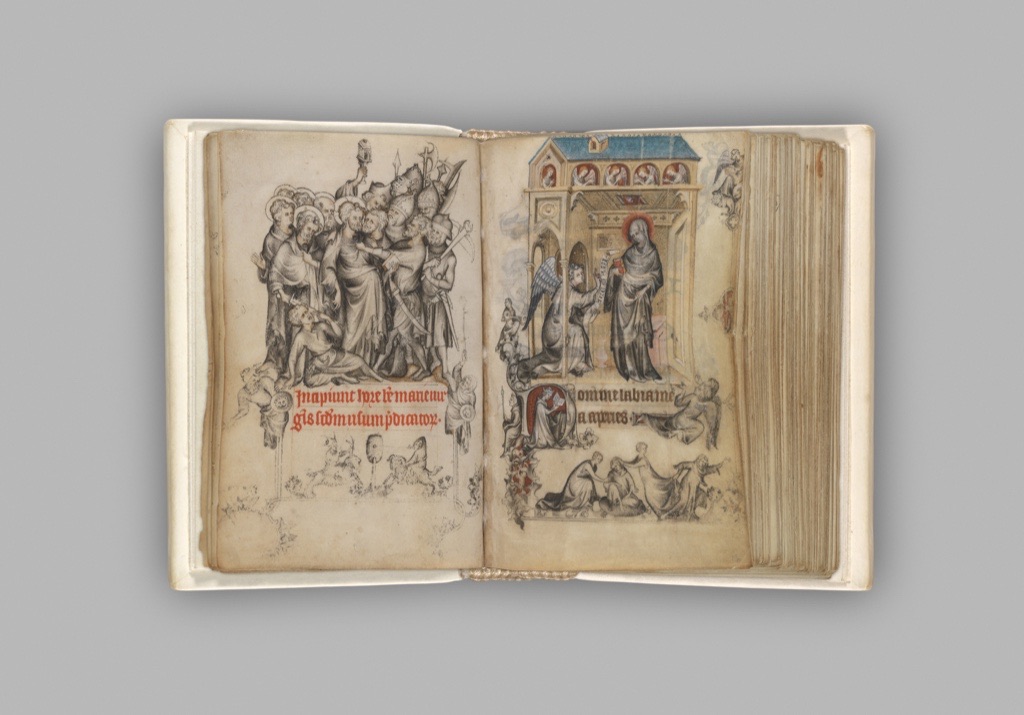
Before mechanically reproduced books, illumination joined image, script, ornament and the physical turning of pages. Jean Pucelle’s Hours of Jeanne d’Evreux, made in Paris around 1324–28, shows why manuscript illustration cannot be reduced to a freestanding picture. The Metropolitan Museum of Art attributes the tiny devotional book to Pucelle and records grisaille tempera and ink on vellum. Made for the queen’s private daily prayer, it combines scenes from the lives of Christ and Saint Louis with an unusually extensive world of marginal figures.[3]
The book’s images work at several scales. Major scenes organize devotion, red lettering structures the text, and figures in the margins animate the edges of the page. Meaning emerges from sequence, placement and use. The reader does not encounter illustration as an isolated composition but as part of a designed object held in the hands.
The arrival of print did not abruptly end manuscript practice. Getty’s account of manuscripts in the age of print describes a period of overlap in which hand production and new reproductive technologies coexisted, producing hybrid books and visual habits.[4] Historical categories should therefore be treated as intersecting practices, not consecutive boxes in which one medium makes another disappear.
Printed books, reproduction and collaboration
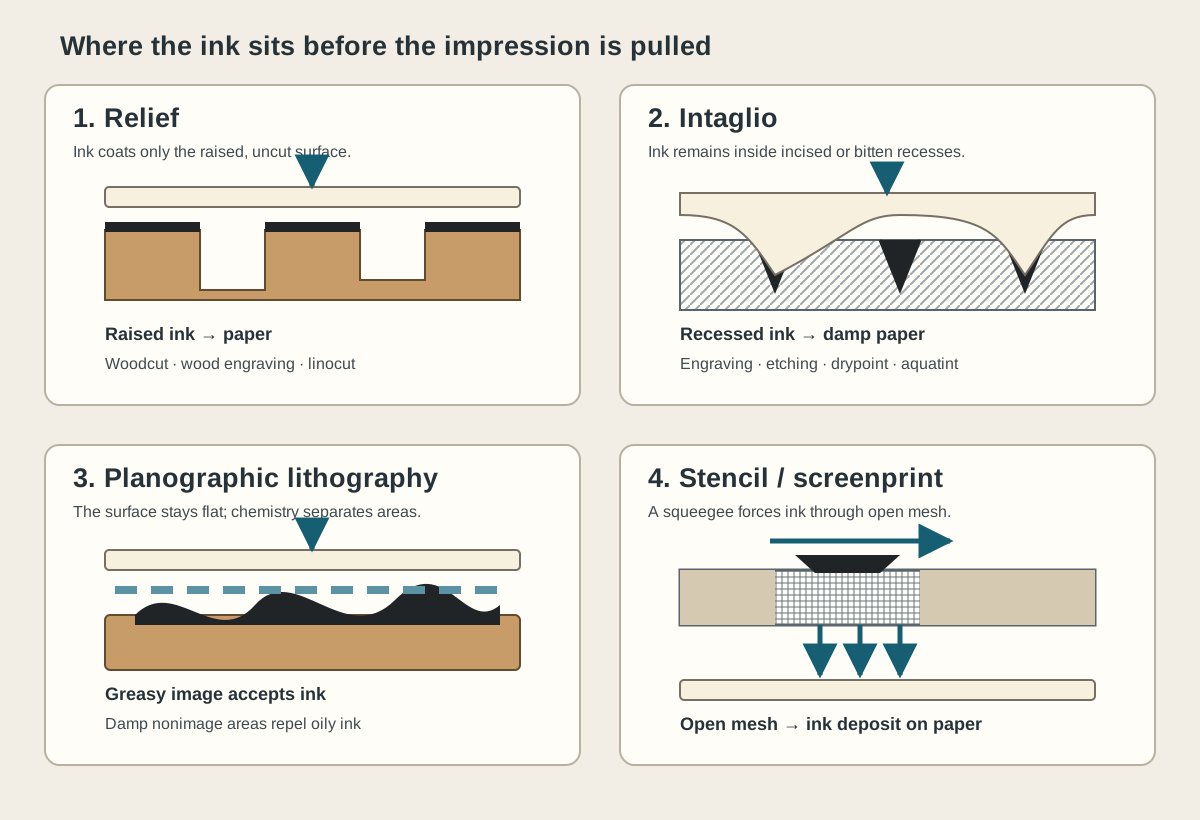
Reproducible images changed how illustration could circulate. In fifteenth-century European books, printers could lock a woodblock together with movable type, allowing words and pictures to pass through a common press operation. The Metropolitan Museum of Art links the expansion of Italian woodcut book illustration in the late fifteenth century to devotional, scientific, mathematical and literary publications.[5] This is a history of production and distribution, not an instruction in relief printing.
Nor did the printed illustration necessarily pass directly from one artist’s hand to the reader. Getty’s study of drawings made for books notes that many eighteenth-century French designs were commissioned by publishers and then supplied to printmakers as guides for engraving. In the nineteenth century, lithography and more efficient wood engraving lowered the cost of reproducing images and extended their circulation.[6] The illustrator, publisher, engraver, printer, writer and designer might all shape the eventual page.
These relationships complicate the familiar idea of an illustrator as a solitary author. A drawing may be an intermediate object rather than the final published image. A block or plate may translate it. Lettering and page design may alter how it is read. Book illustration is best understood as a network of decisions about content, format, labor and audience.
Scientific and botanical illustration
Scientific illustration is often described as if it simply copies observed facts. Historical examples reveal a more active process. An image can select specimens, separate stages, compare structures or combine observations that could not appear together at one moment. Its explanatory value comes partly from arrangement.
Johanna Helena Herolt’s A Poppy in Three Stages of Flowering with a Caterpillar, Pupa, and Butterfly, dated by the Met to the late seventeenth or early eighteenth century, makes that selection visible. The watercolor gathers several phases of the plant’s bloom and several stages of insect transformation on one sheet. It is not a snapshot of a single scene.[7]
The museum connects the work to the workshop of Maria Sibylla Merian and to a related composition published in 1717. It also explains that Herolt adapted the design for collectors of drawings.[7] The sheet therefore belongs simultaneously to histories of observation, workshop collaboration, publication and the autonomous collectible image. It should not be called scientifically current merely because its subject is natural history.
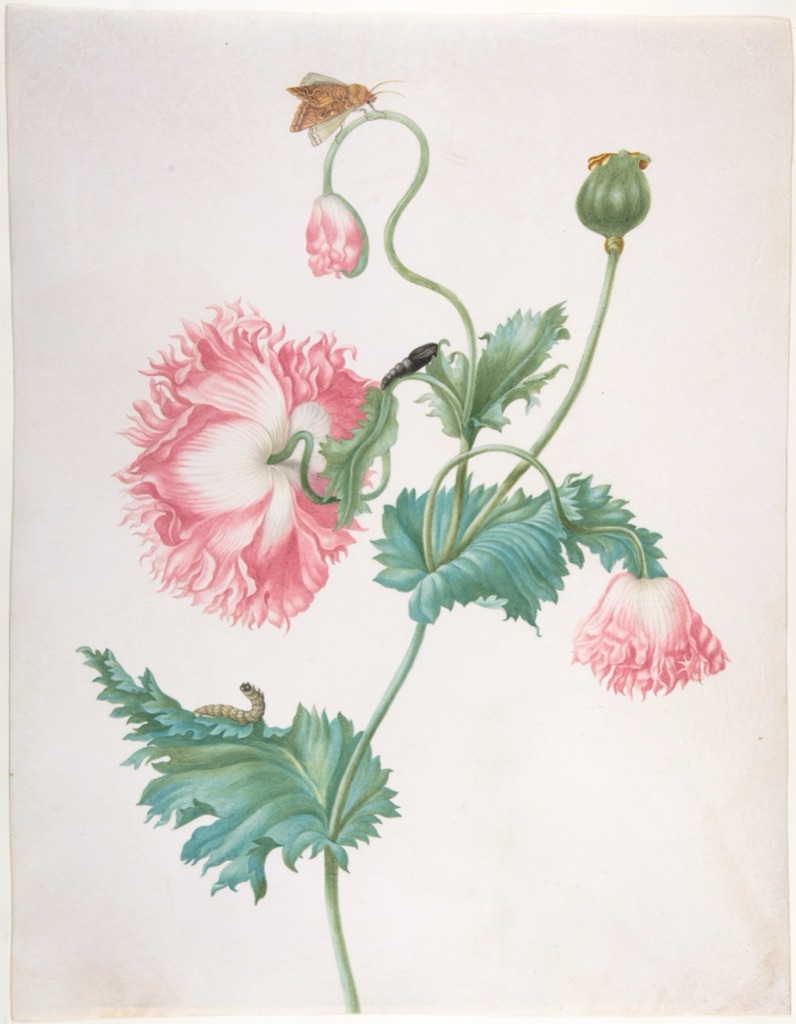
Botanical illustration belongs here as a history of communication and publication. Practical study of plants—how to observe, organize a page or choose materials—remains the subject of Botanical Drawing. The boundary matters because a historical reference page should not quietly become an exercise or imply that an old image supplies modern scientific authority.
Editorial illustration, caricature and the periodical
Editorial illustration gains meaning from topical publication. The Library of Congress’s Cabinet of American Illustration brings together drawings for magazines, newspapers and books alongside cartoons, cover designs and poster sketches.[8] These labels overlap, but they direct attention to an image’s destination: an issue, article, cover or public controversy.
Caricature intensifies that connection to context. It may exaggerate selected physical features so that a public figure is recognizable and an argument becomes immediate.[9] Exaggeration is not neutral. It can focus political criticism, but historical caricature can also transmit hostile stereotypes. Identifying the target, publication and purpose is therefore essential.
Honoré Daumier’s The Past, the Present, and the Future was published in La Caricature on January 9, 1834. The lithograph joins three faces of King Louis-Philippe. The Met’s catalogue and publication on caricature interpret them as a sequence moving from hope through hostility toward a gloomy forecast for the reign.[10][11] The work is not merely a display of distorted features; its form carries a specific political judgment within a periodical setting.
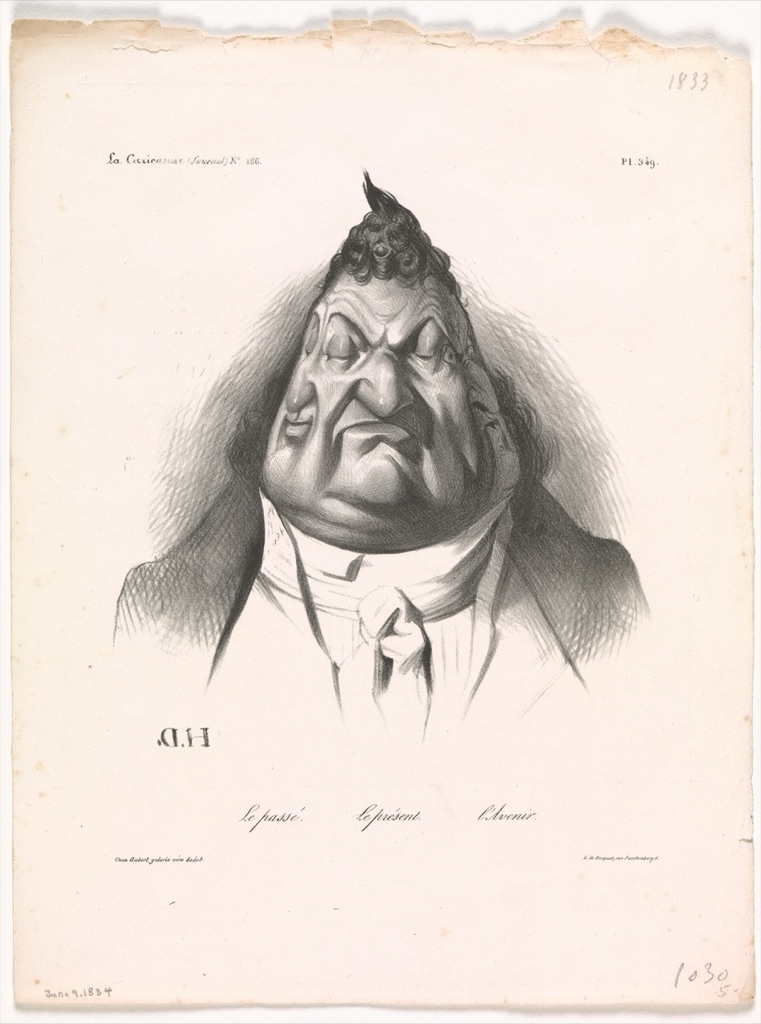
Cartoon and caricature can intersect, but they are not interchangeable names for every editorial image. A cartoon may build a scene or visual argument without exaggerating a particular person’s likeness. Caricature may appear outside a newspaper or magazine. Function and publishing setting remain more reliable guides than a single formal feature.
Children’s-book and narrative illustration
Children’s-book illustration is also a relationship rather than one visual style. Images may introduce characters, extend a written episode, establish rhythm across page turns, supply information or address readers at different levels. The Library of Congress’s selection of classic children’s books illustrated and published around 1900 demonstrates substantial variety within a single audience and publishing context.[12]
A surviving preparatory drawing can reveal the category before the final book is known. The Metropolitan Museum of Art catalogues Charles Kirkpatrick Sharpe’s 1828 Repository for Rubbish, vol. I, L.F.C. 1828—Illustration for children’s book as a work in pen and ink with brush and wash. It shows a seated woman amid monkeys, a goat, books, drawing materials and other animals arranged around a blank center.[13] The record does not provide a complete publication history or narrative, so the visible design should not be turned into an invented story.
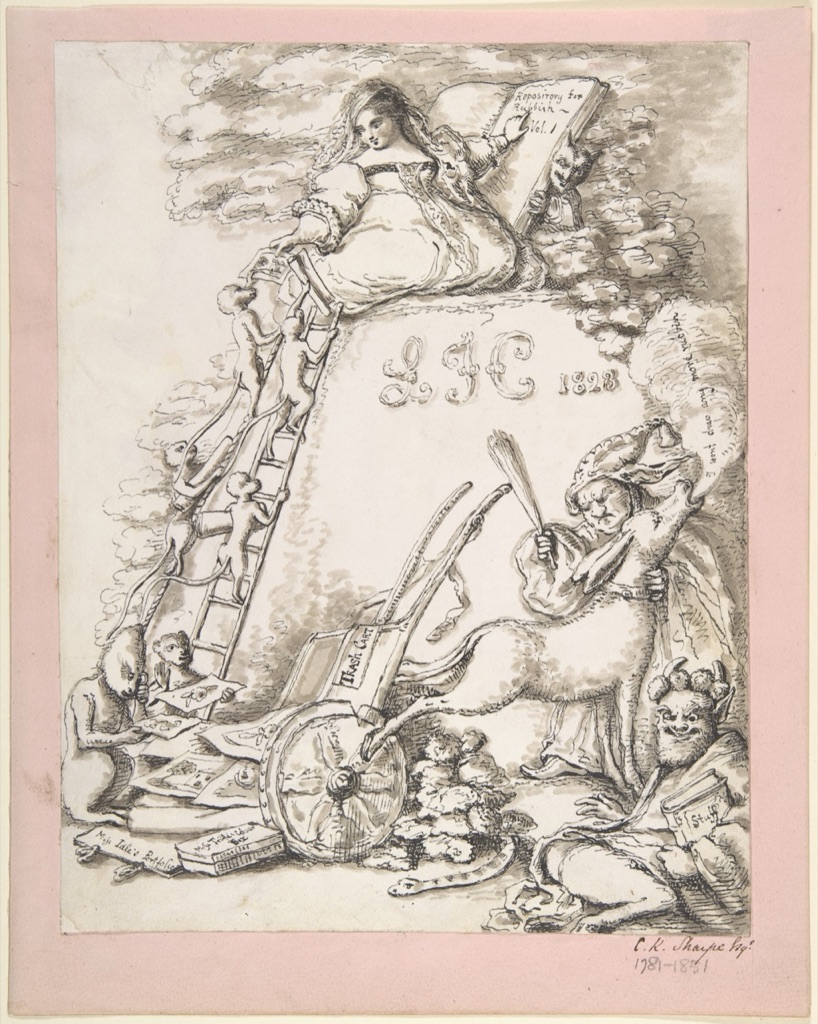
The flourishing of illustrated publishing from the mid-nineteenth to early twentieth century has its own artists, technologies and landmark books. That period history and its broader directory belong to the Golden Age of Illustration. Linking the specialist account is more useful than compressing its canon into a general taxonomy.
Fashion illustration and the fashion plate
Fashion illustration communicates clothing through selective figures, settings and publication systems. The V&A describes fashion plates as images circulated in magazines and journals to publicize dress, yet its research also stresses that scholars disagree about when the form began and what should count as a fashion plate.[14][15] Claims about the first example are therefore less useful than questions about audience, printing and purpose.
Jules David’s Two Women in Day Dresses preserves a stage in that process. According to the Met, the watercolor was prepared for the fashion plate dated October 19, 1886, in Le Moniteur de la Mode. Two women model elaborate day dresses on a Paris street.[16] It is the design for a reproduced plate, not the final printed page.
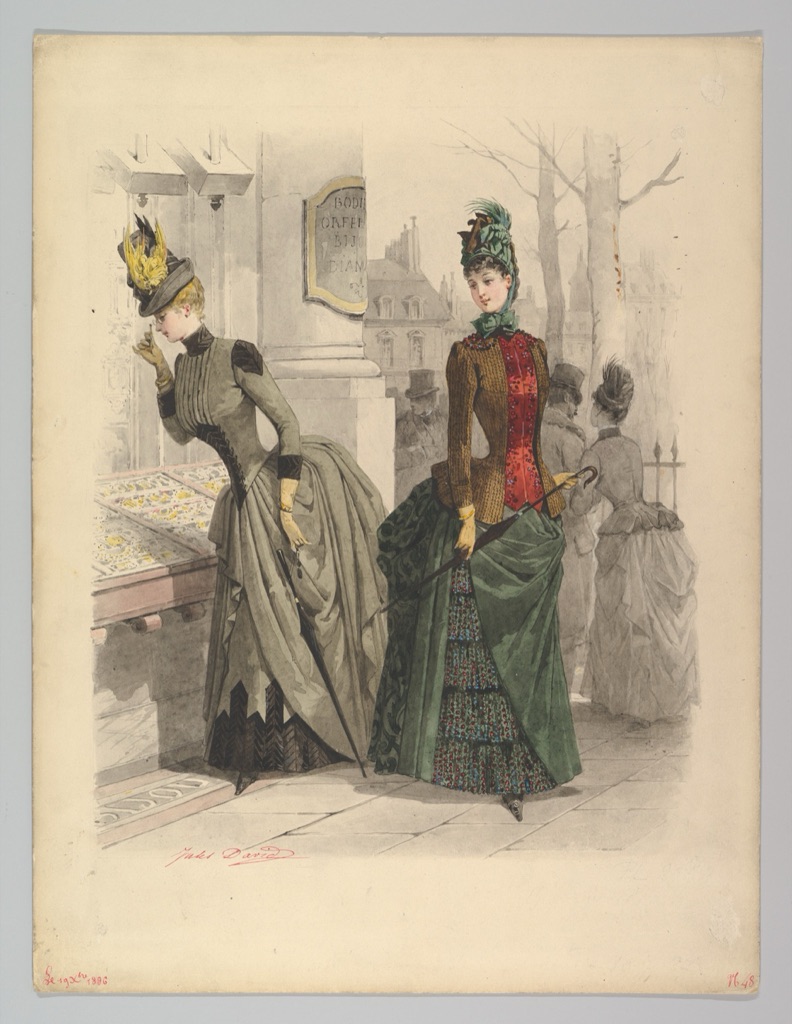
Fashion images can document aspiration and commerce as much as garments. They often assume particular ideas about gender, class and social access. Reading them historically means asking whose appearance was promoted, who could obtain the publication and how the illustrated figure related to clothing actually made or worn.
Advertising and poster illustration
Advertising illustration addresses viewers with a persuasive purpose. Posters make that purpose public through scale, lettering and placement. Library of Congress collections group posters across advertising, entertainment, travel, events and propaganda, showing that the format cannot be assigned one subject or appearance.[17][18] The institution also warns that collection visibility does not settle the rights of every item, a useful reminder that access and permission are separate questions.[17][25]
Henri de Toulouse-Lautrec’s Moulin Rouge: La Goulue demonstrates the poster as a coordinated commercial image. Commissioned to advertise the Paris nightclub in 1891, the four-color lithograph was printed on three sheets. La Goulue dances in the center, the performer Valentin le Désossé cuts across the foreground, an audience becomes a dark band of silhouettes, and large lettering names the venue and attraction.[19]
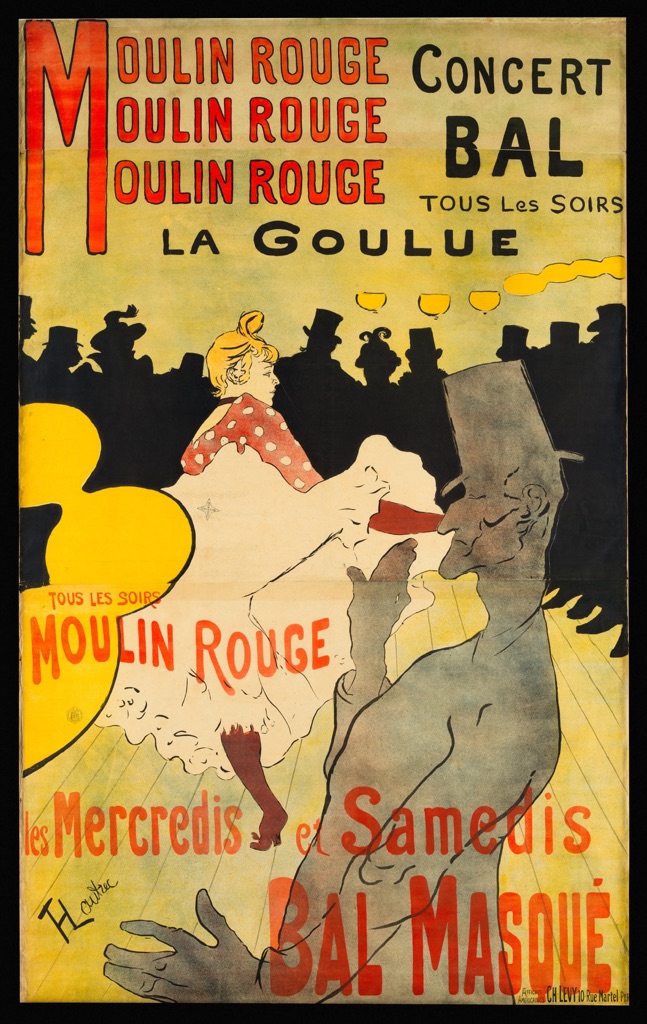
The image’s economy is inseparable from its intended setting. It had to command attention, identify a place and convert performance into publicity. At the same time, its treatment of a female performer, a largely male audience and Parisian nightlife belongs to histories of work, spectatorship, gender and class. Context is more revealing than treating it as a timeless recipe for strong design.
Technical illustration and explanatory views
Technical illustration is defined most clearly by explanatory function. A useful image may isolate a component, compare views, label parts or clarify spatial relations that prose alone cannot convey. The Library of Congress’s architecture, design and engineering collections preserve examples across drawings, measured plans and other forms of visual documentation.[20]
Current United States Patent and Trademark Office guidance provides a narrow contemporary example of that function. It requires drawings when they are necessary to understand claimed subject matter and specifies conventions for views, numbering, legends, shading and reproducibility.[21] Those rules demonstrate how an institutional purpose can shape an image. They are not offered here as legal advice, engineering instruction or a guide to preparing a patent application.
Technical illustration can use line, tone, sectional views, diagrams or digital models, so it does not belong to a single medium. Its identity rests on what the image must make intelligible, for whom and under which conventions.
Digital and vector illustration
Digital illustration is likewise not one appearance. “Digital” can describe how an image is made, revised, stored or distributed; “vector” identifies a way of constructing scalable graphics. Neither term tells us whether the result will resemble a diagram, poster, fashion image, cartoon or painted scene.
The V&A includes digital work within its illustration holdings and has documented “computer art” as a historical label used for computer-made work from roughly the 1960s into the early 1980s.[1][22] Its account of Barbara Nessim records experimental computer works made in 1982 and 1983 alongside a wider career in illustration and design.[22][23] This is evidence for a changing production environment, not for a single inventor or a universal digital style.
No modern work is reproduced in this guide. Museum display and online visibility do not by themselves establish permission to reuse a file. Keeping the discussion text-only also prevents a historical overview from becoming a software lesson, trend roundup or imitation guide. Questions about brushes, paper, tablets and other working materials belong with their specialist owners rather than defining the categories here.
A framework for comparing illustration types
Instead of asking which fixed list an illustration belongs to, five connected questions provide a more durable comparison:
- Function: Does the image narrate, explain, document, comment or persuade?
- Publishing setting: Is it part of a manuscript, book, periodical, poster, institutional document or digital publication?
- Audience: Was it made for private devotion, specialist study, readers, consumers, citizens or spectators?
- Reproduction: Was it painted on a page, transferred to a block or plate, printed at scale or distributed digitally?
- Historical context: Which commissions, technologies, institutions and social assumptions shaped what could be shown?
These questions allow overlap. Pucelle’s prayer book is manuscript illumination, narrative imagery and page design. Herolt’s watercolor is botanical observation, workshop production and a collectible adaptation related to print. David’s drawing is fashion illustration at a preparatory stage. Daumier’s lithograph is both caricature and editorial publication. Toulouse-Lautrec’s work is a poster, an advertisement and a color lithograph.
That overlap is the point. Illustration styles are better understood as changing systems of communication than as a menu of visual effects. Line, color and technique still matter, but they acquire meaning through a task, an audience and a route into public or private view. A historical reference can then show how images worked without turning their forms into lessons, worksheets or timeless rules.
Watch Illustration Move from Manuscript to Printed Book
Use these museum films to connect finished pages with material production: making a manuscript, handling a complete choirbook and printing and binding a book.
Making Manuscripts
The Getty reconstructs parchment, ruling, writing, pigments and gilding so manuscript illumination can be understood as a material and collaborative process.
Watch on YouTubeFrequently Asked Questions
Illustration styles are recurring ways images communicate within particular settings, audiences and technologies. Historical labels often name a function or market rather than one fixed appearance, so editorial, scientific, fashion and children's illustration can each contain many visual languages.
A technique describes how an image is made, such as pen and wash, woodcut, lithography or vector drawing. A style describes broader visual relationships, while an illustration category may instead describe purpose, audience or publishing context.
Useful broad groups include manuscript and book, scientific and botanical, editorial and caricature, children's and narrative, fashion, advertising and poster, technical, and digital illustration. They overlap and should not be treated as a universal ranking.
No. Digital names a production and distribution environment. A digital image can imitate ink, collage, paint, engraving or geometric vector forms, and may be editorial, narrative, technical or commercial in function.
Check the complete object record: page or sheet, publication, date, commissioner, designer, printmaker, publisher, process, edition, intended audience and later alterations. A detached reproduction may hide the relationships that gave the image meaning.
Discussion
Which illustration changes most when you restore its original page, audience or means of reproduction?
Reader Insights
Ask whether the image narrates, explains, documents, comments or persuades.
Look beyond a detached reproduction to the page, publication, scale and sequence.
Separate illustrator, printmaker, publisher, writer, designer and later digital distributor where evidence allows.
Join the Conversation
Share an illustration whose original context changed how you understood its visual style below.
References
- Victoria and Albert Museum, Illustration — Explore the Collections.
- Library of Congress, Art of the Book.
- The Metropolitan Museum of Art, The Hours of Jeanne d’Evreux, Queen of France.
- J. Paul Getty Museum, Blurring the Line: Manuscripts in the Age of Print.
- The Metropolitan Museum of Art, Woodcut Book Illustration in Renaissance Italy: The First Illustrated Books.
- J. Paul Getty Museum, Reading Between the Lines: Drawing Illustrations.
- The Metropolitan Museum of Art, A Poppy in Three Stages of Flowering with a Caterpillar, Pupa, and Butterfly.
- Library of Congress, Cabinet of American Illustration.
- The Metropolitan Museum of Art, How to Read Portraits.
- The Metropolitan Museum of Art, The Past, the Present, and the Future.
- The Metropolitan Museum of Art, Infinite Jest: Caricature from Leonardo to Levine.
- Library of Congress, Classic Children’s Books.
- The Metropolitan Museum of Art, Repository for Rubbish, vol. I, L.F.C. 1828—Illustration for children’s book.
- Victoria and Albert Museum, The art of fashion plates: a hidden history of three pioneering women.
- Victoria and Albert Museum, An adorned print: Print culture, female leisure and the dissemination of fashion.
- The Metropolitan Museum of Art, Two Women in Day Dresses: Preparatory drawing for a fashion plate from Le Moniteur de la Mode.
- Library of Congress, Advertising Poster Collection.
- Library of Congress, Posters: Artist Posters.
- The Metropolitan Museum of Art, Moulin Rouge: La Goulue.
- Library of Congress, Architecture, Design and Engineering Drawings.
- United States Patent and Trademark Office, Applying for Patents.
- Victoria and Albert Museum, Cataloguing Change: Women, Art and Technology.
- Victoria and Albert Museum, Barbara Nessim: an artful life.
- The Metropolitan Museum of Art, Open Access.
- Library of Congress, Prints and Photographs: Rights and Restrictions Information.