by Tom Gurney
Tom Gurney BSc (Hons) is an art history expert with over 20 years experience
Page created on September 2, 2026 / Page updated on September 13, 2026
Email: tomgurney1@gmail.com / Phone: +44 7429 011000
Capture the Force of a Pose Before Its Surface Detail
Gesture drawing reduces a subject to its main action, weight and directional relationships. It is often quick and loose, but speed alone does not make a gesture. A hurried collection of outlines can remain stiff; a carefully developed drawing can preserve a strong underlying action.
The National Gallery of Art separates gesture from contour, hatching and pressure exercises and uses it to capture overall form quickly.[1] Getty describes gesture drawing as a way to investigate pose, movement and placement.[2] Together, those definitions shift attention from finish to organisation. The goal is to decide what the subject is doing before describing everything it contains. All eight museum images used below are public-domain works supplied under the Met’s Open Access policy.[12]
Gesture is not limited to athletes or dancers. A reader leaning towards a page, a seated body resisting gravity, a cat preparing to turn and a group converging on one point all contain directional relationships. This guide builds them from action line to mass, support and memory.
At a Glance
- Map action firstFind the dominant direction, counter-direction and support before enclosing the figure.
- Connect the massesRelate ribcage, pelvis, head and bearing limb instead of assembling separate body parts.
- Use time as a filterShort poses reveal priorities; speed should simplify decisions, not excuse random marks.
- Draw weight, not just motionA seated, resting or bending figure can carry strong gesture through compression and balance.
- Review the structureCheck whether the action survives after details, tone and corrected contours are added.
Contents
Build a Timed Gesture Session with a Clear Purpose
Time limits are filters, not quality scores. Give each interval one structural job, then compare whether the same action survives as the drawing becomes more developed.
| Interval | Primary task | Keep | Leave out |
|---|---|---|---|
| 30 seconds | State the dominant action and support. | One main direction, one counter-direction and ground contact. | Features, fingers, clothing detail and complete outlines. |
| 2 minutes | Connect the large masses. | Head, ribcage, pelvis, bearing limb and key overlap. | Small anatomy and decorative contour. |
| 5 minutes | Test weight and turning. | Compression, stretch, balance, foreshortening and selective contour. | Equal finish across every part. |
| 10 minutes | Develop volume without losing action. | Structural landmarks, limited tone and revised proportions. | Shading that hides a weak directional map. |
| Moving subject | Store and reconstruct recurring actions. | Repeated direction, interval and weight pattern. | Chasing one frozen silhouette after it has changed. |
| Review | Compare the whole sequence. | The study whose action remains clearest at thumbnail size. | Assuming the longest pose is automatically the best. |
Find the action before the outline
An action line is a simplified directional sweep through the pose. It is not always the anatomical spine and it need not be one continuous curve. In a symmetrical standing pose, two opposing directions may be more truthful than an invented S-shape. Begin by asking where the energy travels and which direction dominates.
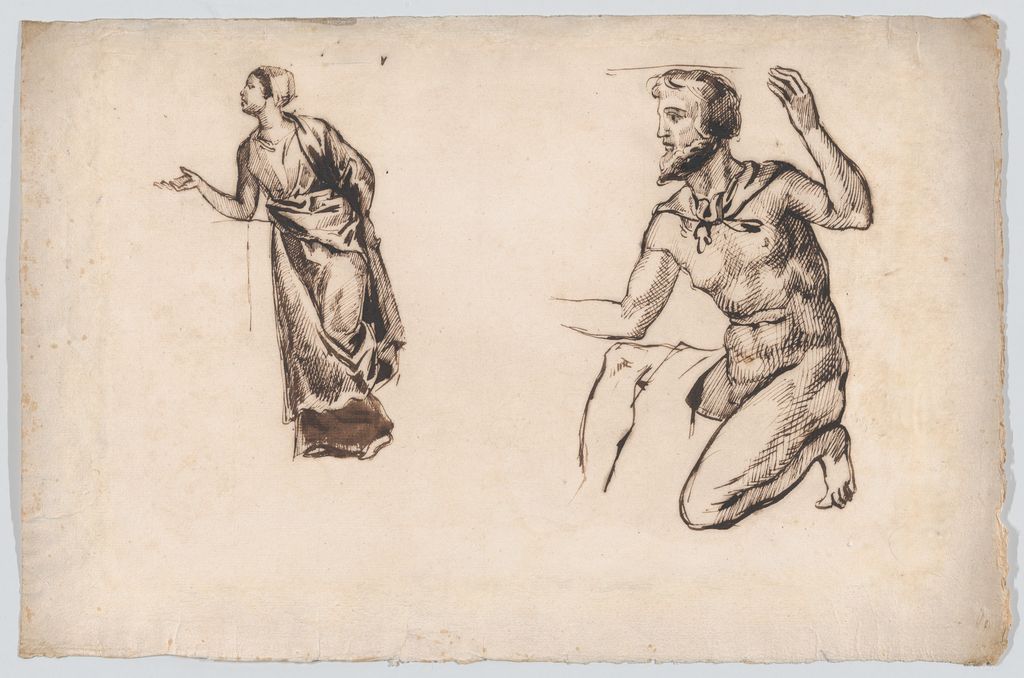
Eugène Delacroix’s Standing Woman and Kneeling Man sets two bodies against each other in pen and brown wash.[3] The Met record supplies title, broad date range and medium but no extended interpretation. Visually, the contrast is enough for a gesture lesson: one body rises while the other compresses downward. The space between them participates in that counter-movement.
Set a timer for thirty seconds. Draw only head direction, shoulder axis, pelvis axis and the longest directional sweep. Repeat the pose three times, changing the starting point. If each result becomes a perimeter, remove limbs and work with axes alone. The purpose is not a presentable sketch but a map that another stage can use.
Connect ribcage, pelvis and support
The torso is not one rigid bean. Treat ribcage and pelvis as separate masses whose tilts and turns can oppose each other. Connect them through the direction of the spine, then locate what supports the weight: feet, seat, knee, hand or an external object.
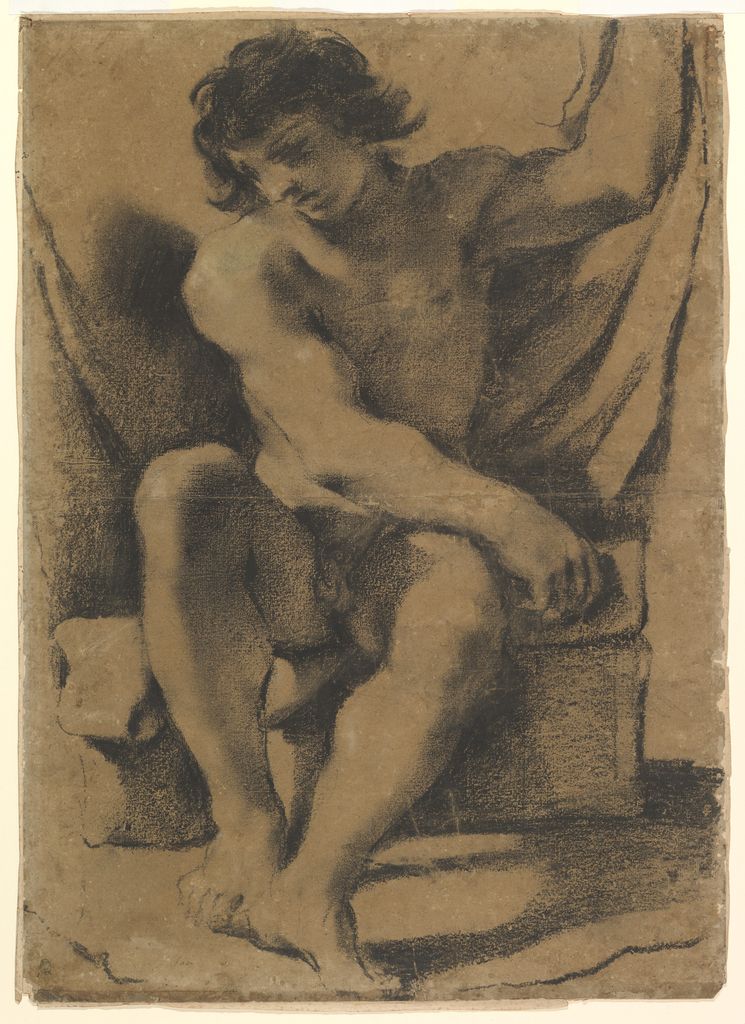
Guercino’s Seated Nude Young Man in Nearly Frontal View, about 1618, is an academy life study rather than known preparation for a final work.[4] The Met draws attention to the sharp opposing turns of torso and pelvis in relation to the limbs, producing complex movement even though the model is seated. Modified black chalk, rubbed into broad smoky tones, reinforces the compressed mass.[4]
This is “movement in repose”. Nothing in the pose needs to travel across the room. Tension comes from opposed orientations and the effort of support. Draw a seated model in two minutes using two ovals for ribcage and pelvis, one connector and the bearing points. Add limbs only after an arrow placed inside each mass makes its turn clear.
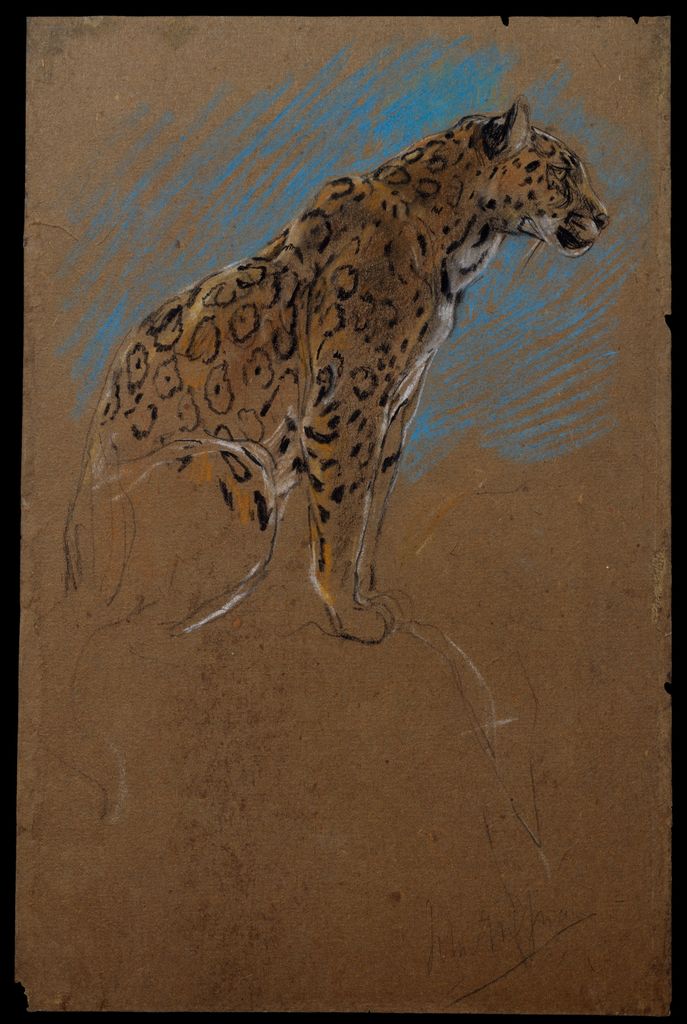
John Macallan Swan’s pastel Study of a Jaguar offers the same question in a different anatomy.[5] The museum record is sparse, so a specific behavioural story would be speculation. Instead, look for the relation between shoulder mass, pelvis, spine and paws. On a quadruped, the back becomes an obvious directional bridge; weight may shift between four supports rather than two.
Gesture through repeated studies
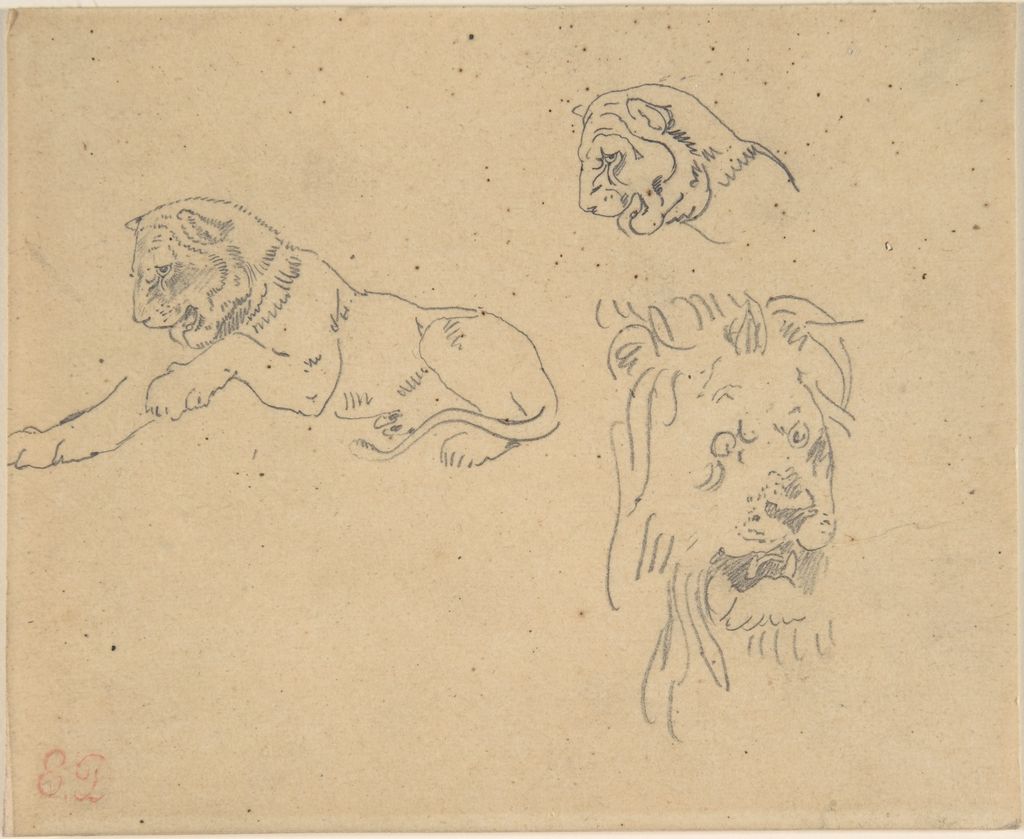
One pose rarely reveals the whole action. Repeating it allows you to change emphasis, correct a mistaken direction and remember what disappears when the subject moves.
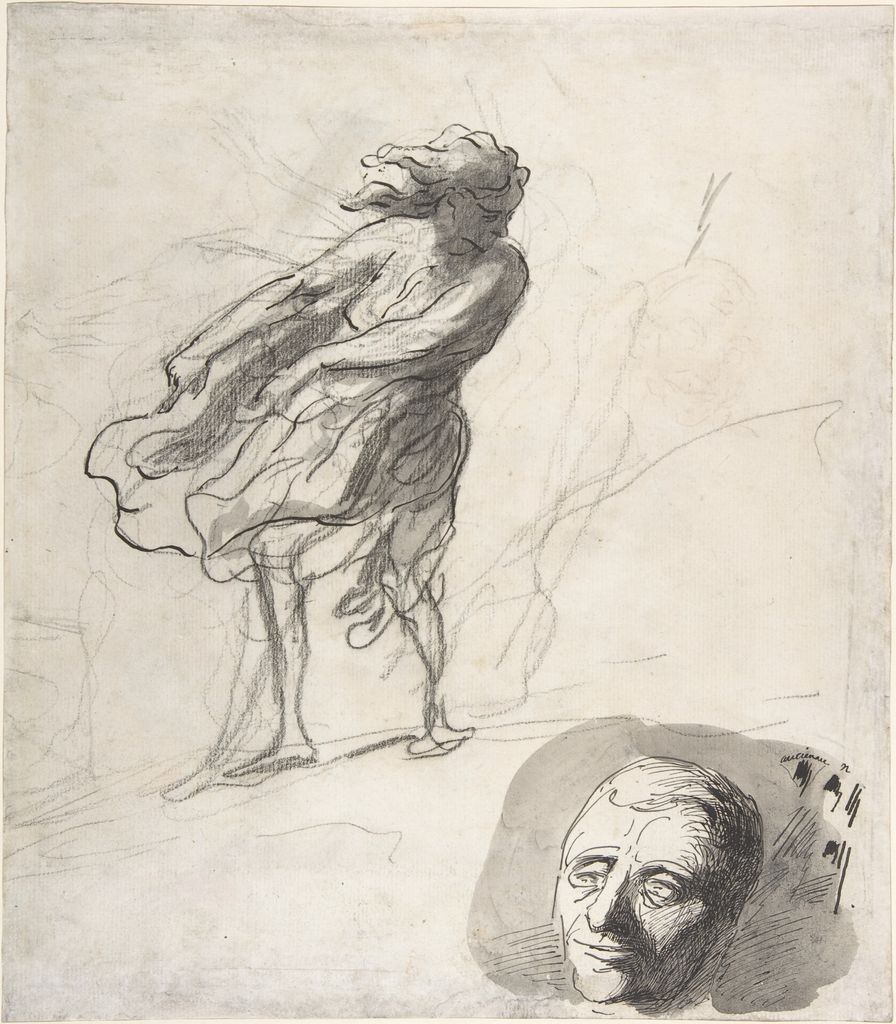
Honoré Daumier’s nineteenth-century Sheet of Studies with a Dancer combines black chalk, pen, ink and grey wash.[6] The record does not identify a performance or final project. Its value here is the coexistence of repeated figures and abbreviated marks. A study sheet can test several placements without pretending that each is an independent composition.
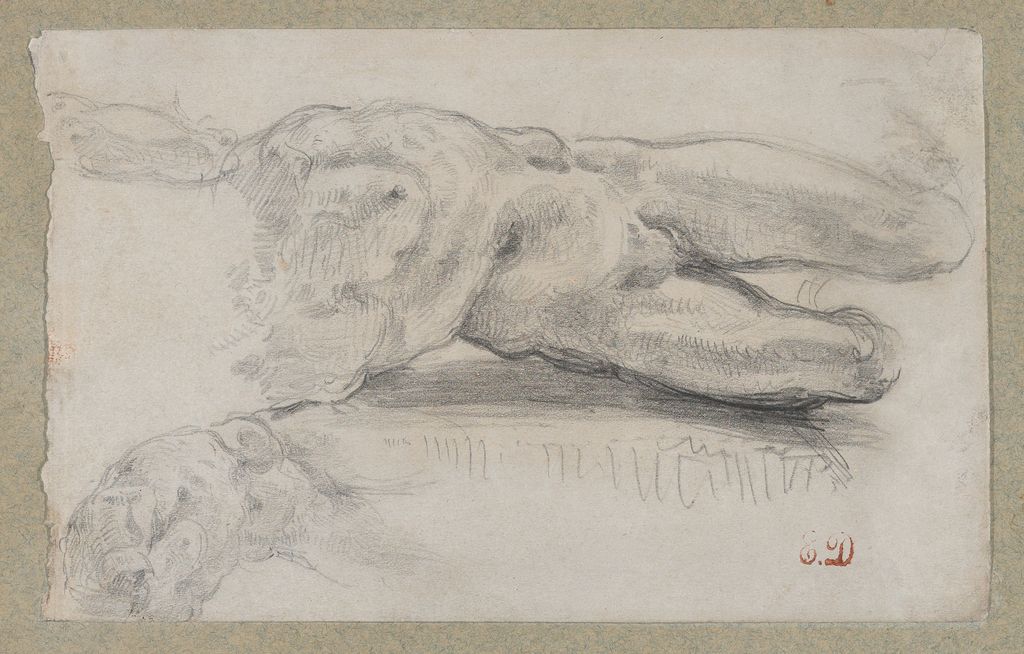
Delacroix’s Three Studies of a Lion similarly gives the animal more than one moment.[7] Do not combine the poses into an imaginary sequence the record does not document. Compare them instead: where does the long axis change, which mass leads, and how does the space under the body open or close?
At a park or from a safe distance to a moving animal, watch for five seconds, look down and draw from memory for ten. Do not chase the subject with the pencil. Record only direction, mass and support. Repeat six times. Memory removes minor detail automatically, turning movement into a sequence of priorities.
From a quick map to a developed drawing
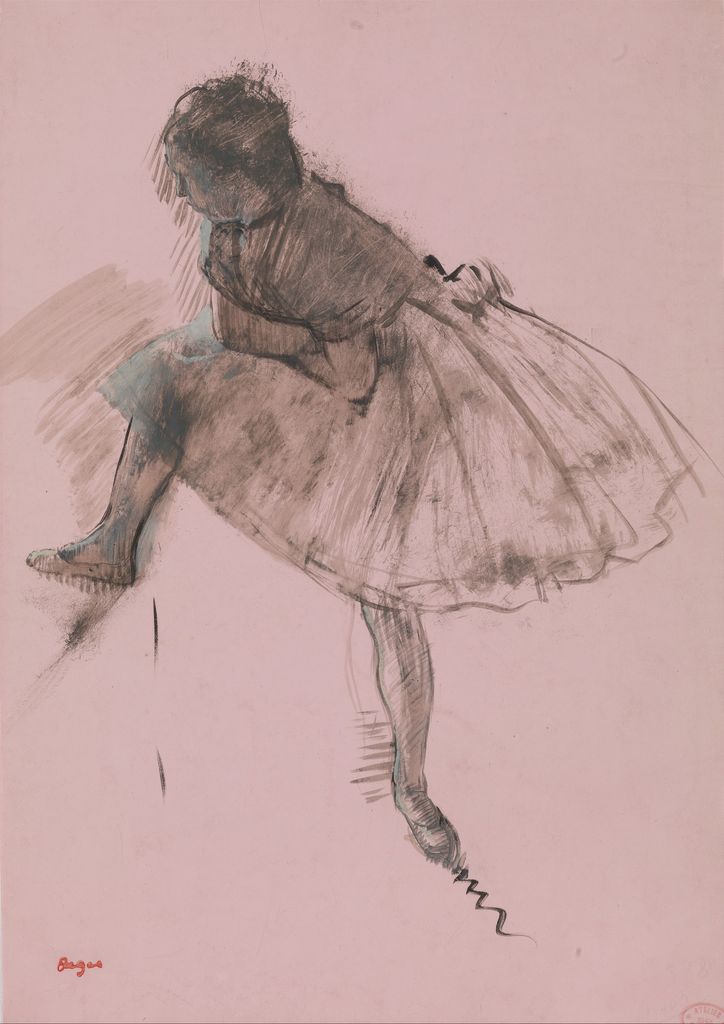
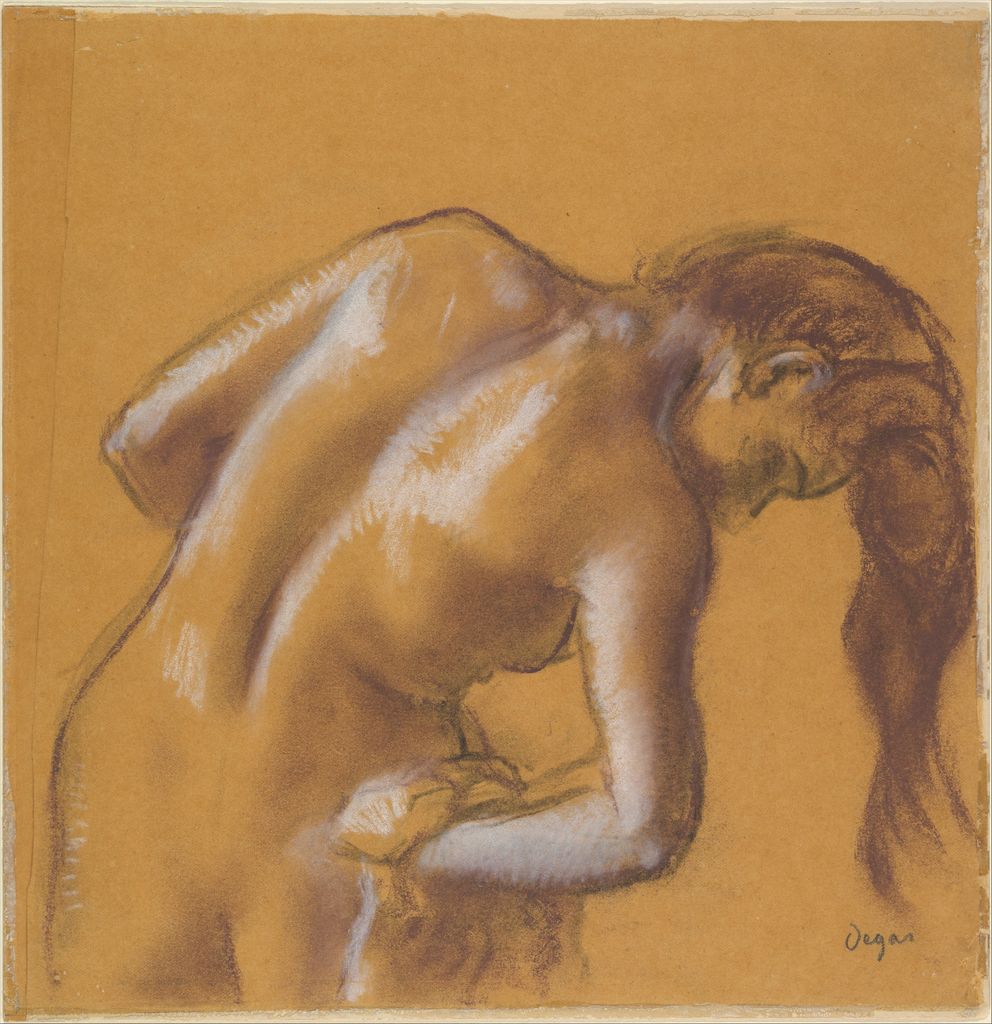
A gesture can remain a finished study, or it can guide a longer work. Getty’s dance lesson explicitly uses a gesture sketch as the basis for a developed figure.[8] Development should preserve the initial action rather than bury it under corrected parts.
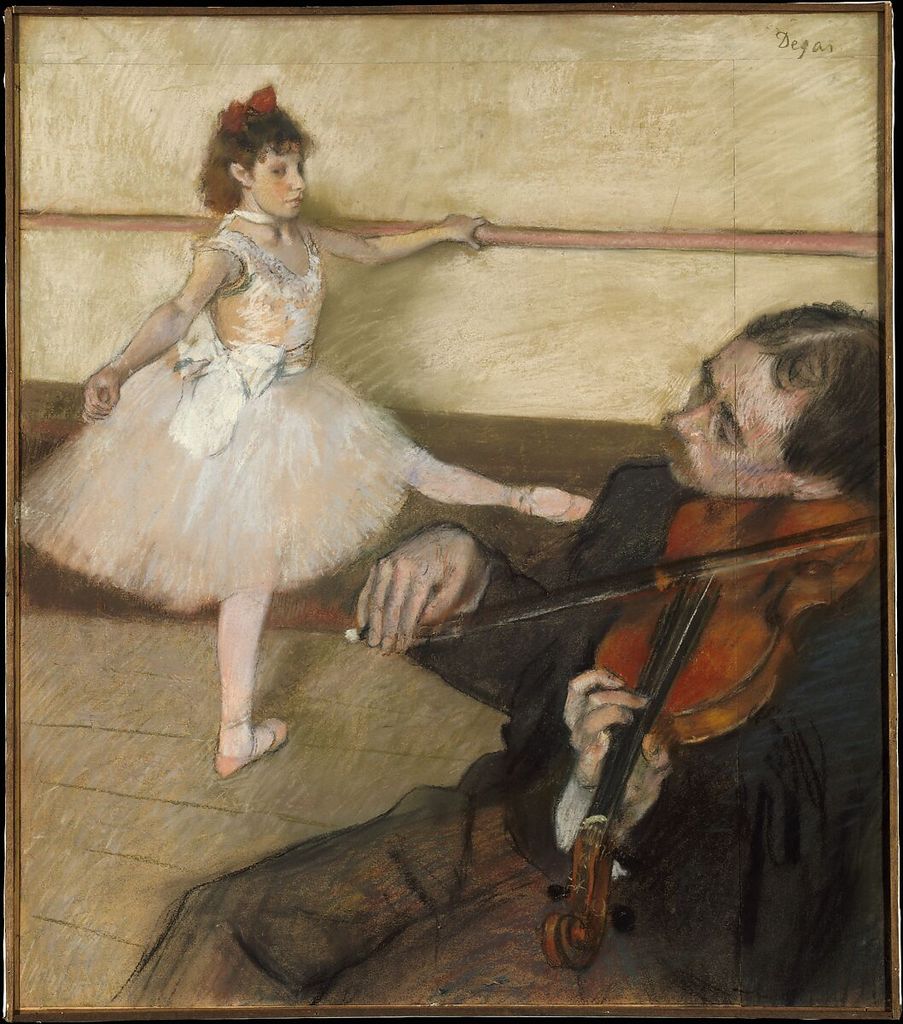
Edgar Degas’s Study of a Ballet Dancer, about 1873, belongs to a larger group of studies for ballet pictures.[9] Oil and opaque watercolour move across prepared pink paper in confident brushstrokes. A cast shadow in front of the dancer’s foot and bluish-green highlights help place and illuminate the body. Gesture is carried by brush, value and interval, not only by a linear skeleton.
Take a two-minute gesture and lay tracing paper over it. Add simple body masses while preserving the original axes. On another overlay, draw contour. If the developed figure loses the action, compare where the new outline contradicts the first map. Move masses before adding anatomy.
Degas’s Bather Drying Herself provides a slower, inward action.[10] The figure bends and reaches within a compact silhouette. The museum record secures the object but does not justify an elaborate narrative. Treat the towel, arm, back and supporting body as connected directions. A gesture drawing can be concentrated and private rather than expansive or theatrical.
Weight, pressure and the ground
Use pressure to reinforce weight-bearing decisions. A darker or broader mark under a foot, seat or compressed side can make support legible; uniform pressure removes that hierarchy. The ground line should meet the bearing point, not float beneath it as decoration.
Draw a standing pose for five minutes. Mark the likely centre of gravity with a vertical and compare it with the base between the feet. Make the supporting leg slightly firmer and keep the free leg lighter. Then cover the outer contours: the remaining axes and pressure changes should still communicate which side carries weight.
In Delacroix’s standing-and-kneeling pair, opposing levels make support easy to compare. In Guercino’s seated study, broad tone anchors the compressed body. Swan’s jaguar distributes weight across a long horizontal structure. Different anatomies and materials still answer the same question: what prevents the mass from falling?
Draw a moving subject without chasing it
Continuous movement makes detailed observation impossible, so divide looking from recording. Watch one repeated action—a person walking, a bird landing, a pet turning—for several seconds. Choose the instant that best explains the action. Look away and draw three masses and two directions from memory. When the action repeats, correct only one relationship.
This differs from copying a frozen photograph. You must decide what persists across several sightings and what belongs to one accidental instant. The result may be less anatomically complete but more specific about rhythm. Delacroix’s repeated lions are useful here because comparison across poses exposes which direction changes and which anatomical masses remain stable.
Use a small page divided into six frames. Limit each observation to ten seconds and each drawing to twenty. Under every frame, write one verb—push, fold, reach, settle, turn or spring. If the drawing does not support its verb, change the axes rather than adding surface detail. Never place yourself, another person or an animal at risk to obtain a view.
Gesture beyond the human figure
The NGA’s teaching sequence uses ordinary objects as well as figures, which helps separate gesture from a theatrical idea of bodily motion.[1] A plant leans towards light; stacked boxes press down and tilt; a twisted cloth carries opposing pulls. Gesture describes organised forces and placement, even when nothing is moving.
Arrange a tall bottle, low bowl and folded cloth. Draw their combined direction in thirty seconds. On a second sheet, exaggerate the dominant diagonal while keeping each object recognisable. On a third, reverse the arrangement’s emphasis. The exercise trains compositional gesture: the eye should travel through the group rather than stop at three isolated outlines.
Swan’s jaguar and Guercino’s sitter demonstrate two kinds of contained energy. One has a horizontal animal structure; the other turns within a seated human pose. Neither needs speed lines. Direction is embedded in the relation of masses, the compression of gaps and the placement of support.
Let the material carry the action
Choose a tool whose resistance and width suit the exercise. Soft charcoal can place a torso mass in one pass and lift it again. A brush can widen through pressure and taper as it changes direction. A hard pencil encourages smaller corrections but may tempt you into detail. Ink makes commitment visible.
Repeat one two-minute pose in charcoal, brush and pencil. Keep the same paper size and subject. Afterwards, identify which tool made you think in mass, which in direction and which in boundary. Do not rank them by neatness. The useful medium is the one whose physical behaviour reinforces the session’s question.
Degas’s ballet study shows gesture carried by opaque watercolour and oil rather than a bare action line. Vincent’s composition distributes energy through pen rhythms and wash. Daumier shifts among chalk, ink and wash on one study sheet. Historical gesture is therefore not a single wiry look; material can embody weight and tempo directly.
Group gesture and directional rhythm
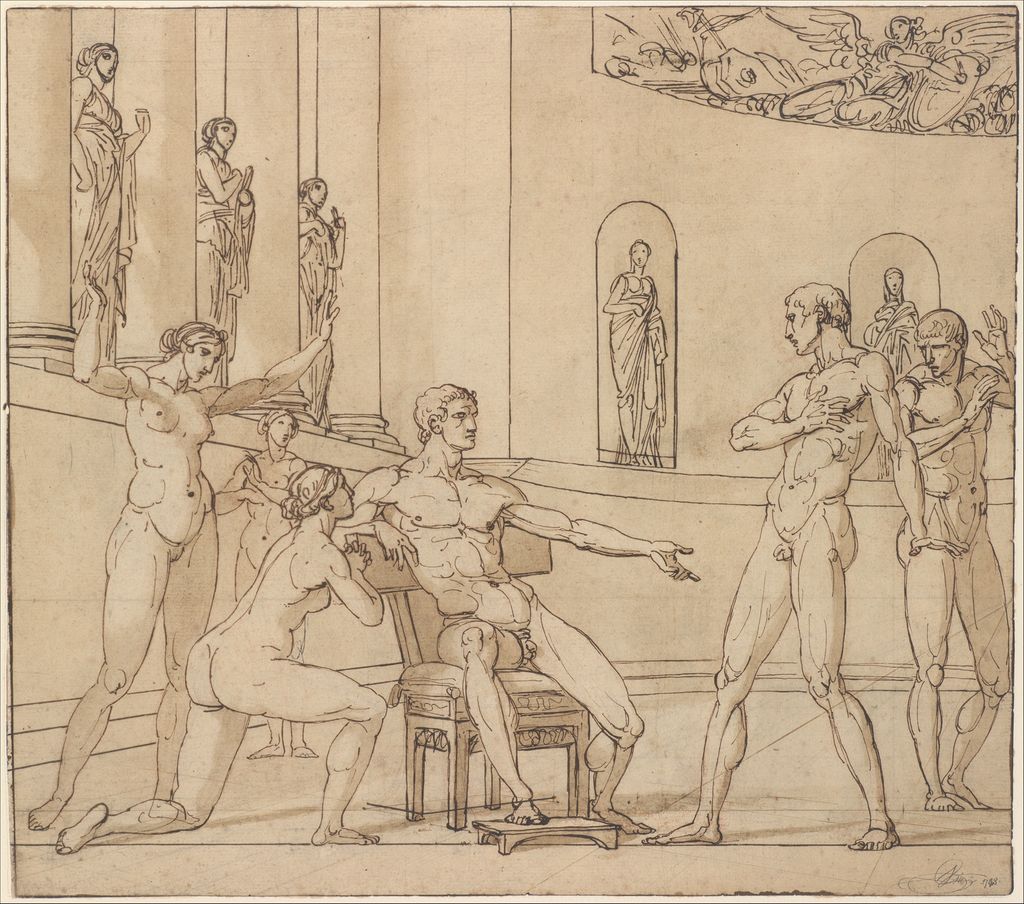
A group has a gesture larger than any one figure. Start with the combined silhouette, major gaps and the direction linking centres of mass. Repeated parallel limbs can create rhythm; opposing diagonals can produce conflict; a curve of heads can organise attention.
François-André Vincent’s Clemency of Augustus, about 1787–88, is a compositional study for a history painting.[11] The Met describes pen lines that “vibrate” with muscularity and notes that Vincent first worked out the figures nude before clothing them for the painted scene. Red-chalk traces, perspective lines, ink and wash carry different stages of the design.[11]
Reduce a three-figure scene to one enclosing shape and three arrows. Add a single shared curve or diagonal that connects the figures. Only then separate their torsos. If the composition becomes three isolated mannequins, return to the gaps and shared direction rather than adding gestures to individual hands.
Timing without rushing
Use time limits to force selection. Thirty seconds is enough for axes; two minutes for main masses and support; five minutes for weight, overlap and a small amount of tone. A longer drawing can begin with the same sequence. Speed is useful when it prevents premature detail, but random marks do not become perceptive because the timer is short.
Create a ladder of the same pose: 30 seconds, two minutes, five minutes and fifteen minutes. After each drawing, write what was added. If the two-minute version loses the action found at thirty seconds, the added masses were misplaced. If the fifteen-minute version gains detail but loses weight, contour or anatomy has contradicted the support.
The line of action is also a hypothesis, not a rule to protect at all costs. Recheck it when the body masses disagree. Guercino’s torso and pelvis need opposing turns; forcing them onto a single graceful curve would weaken the pose. Gesture simplifies relations, but it must remain answerable to observation.
Common gesture problems
If a quick drawing looks like a wire figure, add ribcage and pelvis as masses. If it looks like an outline, remove the perimeter and draw internal direction. If every pose leans dramatically, check vertical support rather than inventing motion. If dark strokes appear everywhere, reserve pressure for bearing points and dominant direction. If a longer drawing stiffens, compare it with the first map before correcting details.
Remember that gesture does not reveal how long a historical artist spent on a sheet. Daumier’s abbreviation, Vincent’s vibrating lines and Degas’s confident brushwork support visual analysis; they do not provide a stopwatch. Use “rapid-looking” only when the physical evidence warrants it, and do not turn looseness into a romantic claim about spontaneity.
Review a session by covering details with tracing paper and redrawing only the action, masses and supports you can still detect. Compare that map with the first gesture. If they disagree, decide whether the long drawing discovered a better structure or merely drifted. Keeping both answers makes progress visible and turns quick studies into evidence rather than disposable warm-ups.
For boundary-led practice, continue to contour drawing. For proportion, landmarks and a full session structure, see figure and life drawing. Drawing mediums explains how charcoal, ink, pastel and wash change gesture physically.
Watch Drawing Materials Turn Observation into Action
Choose a Getty reconstruction of historical charcoal practice, a curator-led account of Sargent's economical charcoal portraits or a National Gallery Singapore studio demonstration.
Drawing with Charcoal: Historical Techniques
Getty conservators and artists show how prepared charcoal, fixative and erasure can build, revise and clarify an active drawing.
Watch on YouTubeFrequently Asked Questions
Gesture drawing maps the action, weight, balance and directional relationships of a subject before surface detail. It is often quick, but speed is a training constraint rather than its definition.
Use several intervals for different purposes: about 30 seconds for direction, two minutes for connected masses and five or ten minutes for weight, overlap and selected volume.
No. Gesture prioritises action, balance and directional force; contour describes boundaries and transitions. A developed drawing can combine both systems.
Yes. Compression, reach, counter-rotation and the relationship to a chair or ground can make a seated or resting figure strongly directional without implying literal movement.
Look for recurring action rather than chasing one outline. Make brief memory maps of direction, interval and weight, then compare several repetitions of the subject.
Discussion
Which study carries the clearest sense of weight when you compare its first directional map with the later contours and tone?
Reader Insights
The large directional relationship should remain readable before individual parts are named.
Support, compression and counter-rotation make a stationary pose gestural.
A short interval is valuable only when it strips the drawing to a chosen priority.
Join the Conversation
Share one pose in which a shorter study revealed the action more clearly than a longer, more detailed drawing.
References
- National Gallery of Art, “Drawing Everyday Objects”: source.
- J. Paul Getty Museum, “Drawing from the Masters: Bodies in Motion”: source.
- The Metropolitan Museum of Art, Eugène Delacroix, Standing Woman and Kneeling Man, 2024.591.33: source.
- The Metropolitan Museum of Art, Guercino, Seated Nude Young Man in Nearly Frontal View: source.
- The Metropolitan Museum of Art, John Macallan Swan, Study of a Jaguar, 59.23.80: source.
- The Metropolitan Museum of Art, Honoré Daumier, Sheet of Studies with a Dancer, 1978.342: source.
- The Metropolitan Museum of Art, Eugène Delacroix, Three Studies of a Lion: source.
- J. Paul Getty Museum, “All I Want to Do Is Dance, Dance, Dance!”: source.
- The Metropolitan Museum of Art, Edgar Degas, Study of a Ballet Dancer, 1975.1.611: source.
- The Metropolitan Museum of Art, Edgar Degas, Bather Drying Herself: source.
- The Metropolitan Museum of Art, François-André Vincent, The Clemency of Augustus, 1985.245.2: source.
- The Metropolitan Museum of Art, Open Access: source.