by Tom Gurney
Tom Gurney BSc (Hons) is an art history expert with over 20 years experience
Page created on September 3, 2026 / Page updated on September 13, 2026
Email: tomgurney1@gmail.com / Phone: +44 7429 011000
Why a Famous Drawing Is More Than a Familiar Image
Drawing can be an experiment, a record, a design or a finished work in its own right. A sheet may preserve the first movement of an idea more directly than a painting or sculpture, yet that apparent immediacy can be deceptive. Silverpoint resists correction, wash requires control, and a large cartoon can demand as much planning as the work it prepares. The marks may look spontaneous while embodying years of trained observation.
This directory introduces 18 historically significant drawings made from 1473 to 1873. It is a guided selection, not a ranking. The works were chosen because together they demonstrate distinct purposes and materials: studies for paintings and prints, self-portraits, natural observations, an architectural design, a literary diagram and independent imaginative sheets. For a wider introduction, visit Drawings; the related Drawing Mediums and Drawing Styles directories explain techniques and visual approaches without duplicating the objects gathered here.
The dates provide an initial route through the selection, while medium and function create other useful comparisons. Each linked title opens the site's fuller account of that work. An artist link leads to broader coverage, but repeated artists are linked only once so that the directory remains centred on drawings rather than turning into a set of short biographies.
At a Glance
- Scope18 significant drawings made from 1473 to 1873; a guided selection rather than a ranking.
- Compare by dateFive chronological groups reveal changing purposes without implying a simple march of progress.
- Compare by mediumMetalpoint, ink and wash, watercolour, chalk and graphite each impose different decisions.
- Compare by functionPreparatory studies, finished sheets, designs, diagrams and cartoons solve different problems.
- Check the objectTitles, dates, materials and present locations follow collection records and are cited below.
Contents
Drawings across time
Use the chronology, medium and working-function controls to compare the 18 drawings. Mixed-media sheets can appear under more than one medium.
Showing all 18 drawings.
Before 1500: observation, identity and systems
The earliest sheets in this selection show drawing expanding beyond workshop notation. A landscape records a dated encounter with place, self-portraiture becomes a test of scrutiny, and diagrams translate difficult ideas into visible structures. Metalpoint and silverpoint reward patient, deliberate lines because erasure is difficult.
Landscape dated 5 August 1473
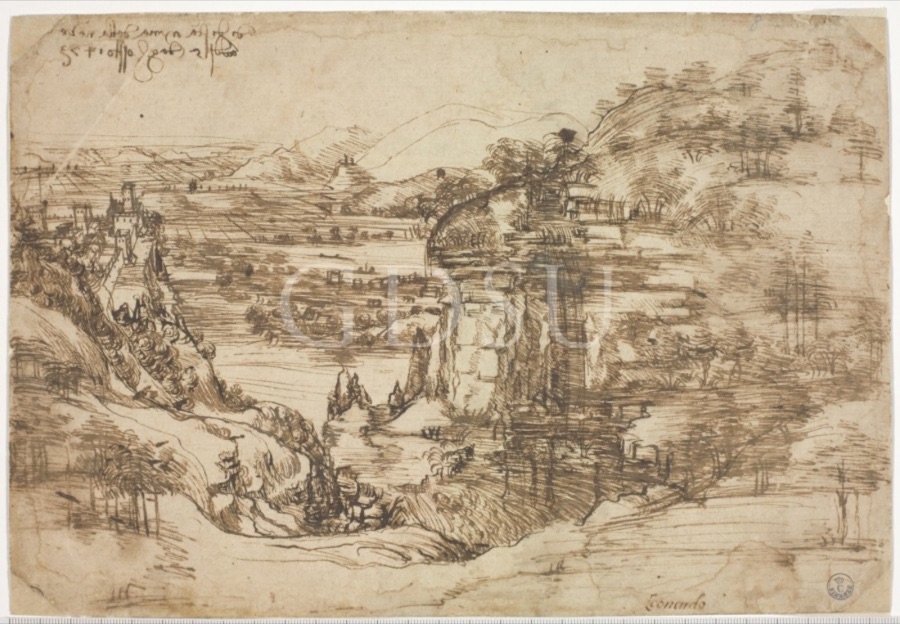
Landscape dated 5 August 1473 places a river valley between steep, broken slopes. Lines thicken around rocks and vegetation, then loosen as the terrain recedes, allowing density of mark to suggest both distance and atmosphere. The inscription fixes an unusually precise date, but it does not securely identify the view; the local route's traditional place-name should therefore be treated cautiously. Technical examination by the Uffizi and Opificio delle Pietre Dure distinguishes leadpoint underdrawing from carbon-black and ink interventions and also considers the reverse of the sheet. That evidence makes the work valuable as a material record of Leonardo revisiting an observation, not simply as a single inspired outline.[1]
Studies of Hands
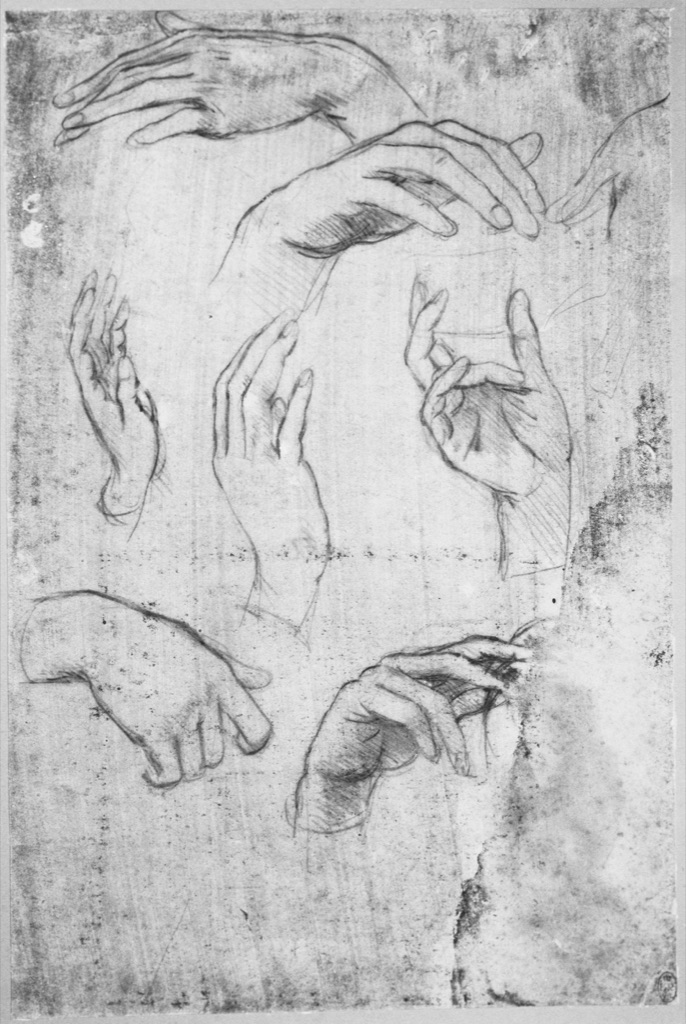
In Studies of Hands, overlapping wrists and fingers emerge through fine metalpoint lines and delicate changes in tone. One hand gathers fabric; another seems to support or present an unseen object. Their separation from a complete body makes gesture itself the subject. The Royal Collection identifies the sheet as RCIN 912615 and relates it to Leonardo's preparations for the unfinished Adoration of the Magi now in the Uffizi. That connection changes how the fragments are read: these are not a general catalogue of anatomy but trials for expressive actions within a larger composition. The pink ground lets small highlights and shadows give the fingers convincing volume.[2]
Self-Portrait at Thirteen
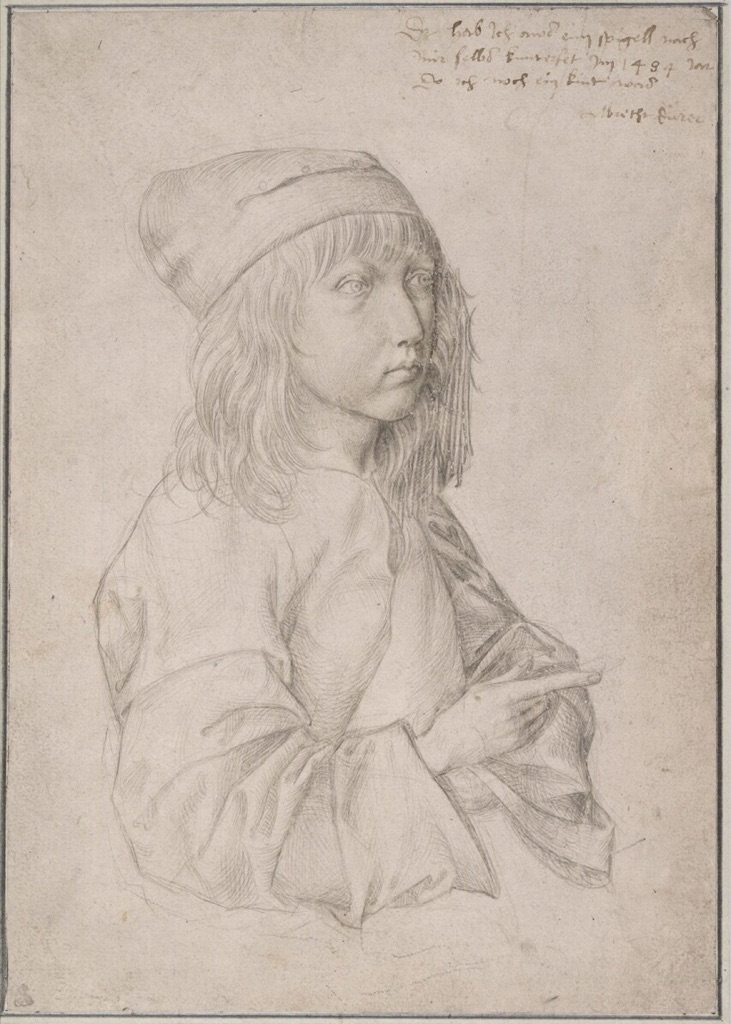
Dürer's Self-Portrait at Thirteen presents the young artist turning towards the viewer while pointing emphatically to the right. The face is carefully modelled, but the long finger and alert gaze give the study an almost demonstrative energy. Silverpoint demands commitment: a metal stylus leaves controlled lines on a prepared surface and offers little room for revision. The Albertina records the work as inventory 4839 and places it among the defining sheets of its drawings collection. Its importance lies not only in the artist's age. By making himself both observer and observed subject, Dürer announced the sustained self-examination that would recur throughout his career.[3]
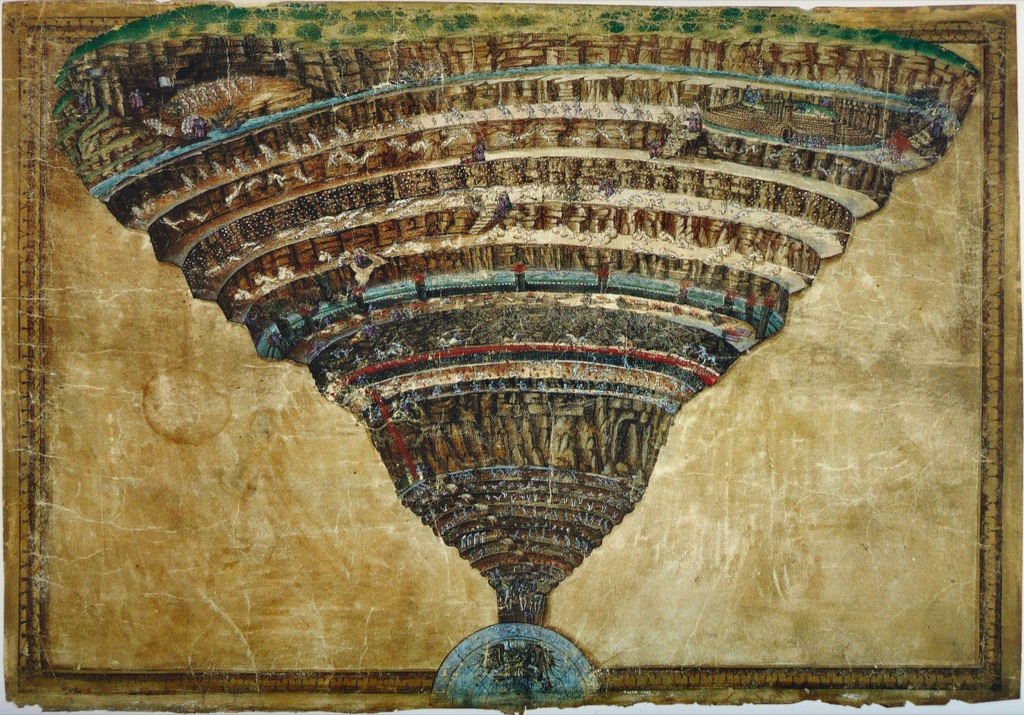
Chart of Hell
Chart of Hell turns the descending circles of Dante's Inferno into a single legible cross-section. The funnel narrows towards the earth's centre as ledges, structures and minute figures distribute episodes through the imagined geography. It is at once an illustration and an information design: spatial order helps a reader grasp relationships that unfold sequentially in the poem. The Vatican Apostolic Library identifies the sheet as folio 101r in manuscript Reg.lat.1896.pt.A, part of Botticelli's late-fifteenth-century Dante project. Its mixed technique supports both precision and emphasis, from the underlying silverpoint plan to ink contours and touches of tempera.[4]
Vitruvian Man
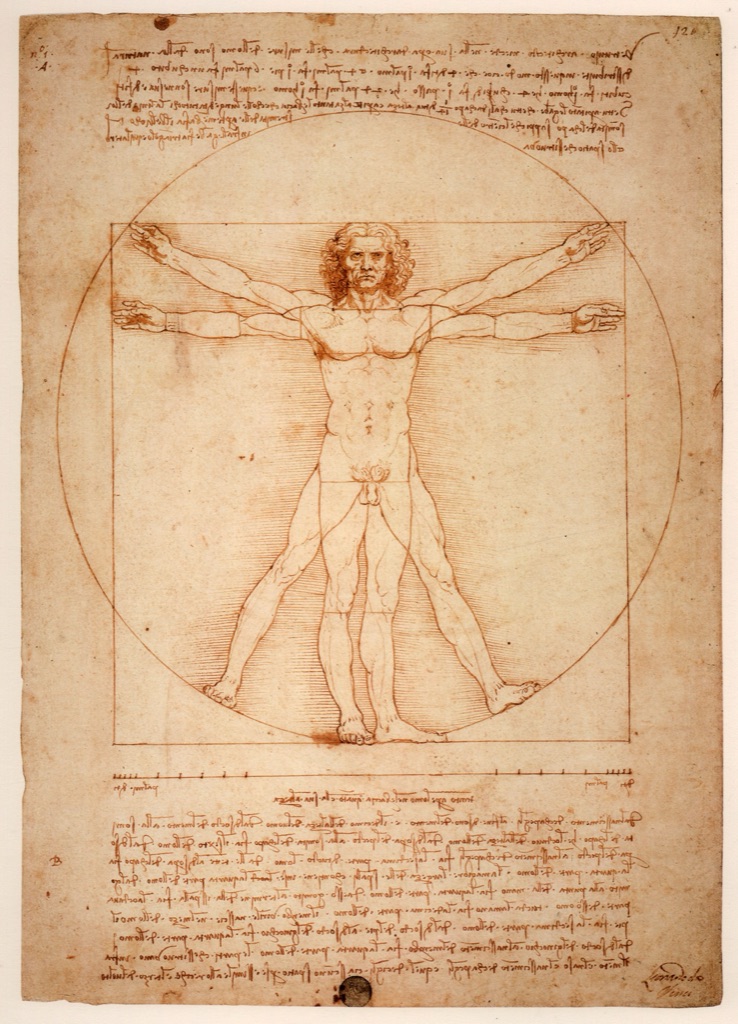
Vitruvian Man superimposes two positions of a male figure within a circle and square. The doubled arms and legs allow one body to test more than one geometric relationship, while surrounding notes bind visual experiment to written inquiry. Rather than treating the figure as a timeless emblem of perfection, it is more useful to see the sheet as an active investigation of claims about human proportion associated with the ancient writer Vitruvius. The Gallerie dell'Accademia records it as catalogue 228 and explains how Leonardo examined the different centres required by the circle and square. Drawing becomes a way to question, compare and reason through a problem.[5]
1500–1549: nature, invention and preparation
During the first half of the sixteenth century, drawings could move between close natural observation and ambitious projects for altarpieces, frescoes, tombs or prints. Some of these sheets gained independent fame even though they began as preparatory work. Others assert the autonomy of drawing through finish, scale or imaginative completeness.
Wing of a Blue Roller
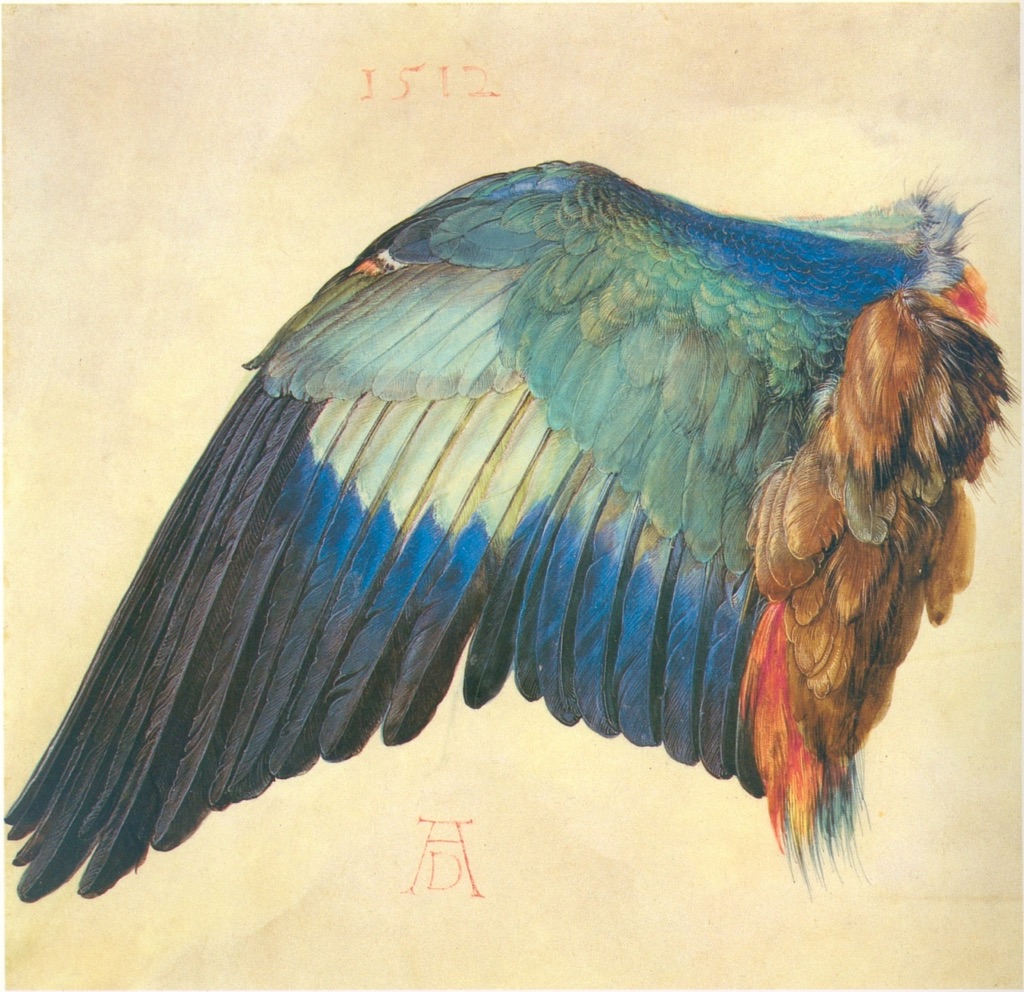
In Wing of a Blue Roller, overlapping feathers form bands of turquoise, cobalt, brown and black. Fine barbs remain individually legible while white heightening makes the surface flash as though it changes under light. The isolated wing is both specimen and composition: its fan-like spread gives a fragment the presence of a complete object. The Albertina identifies the sheet as inventory 4840 but retains an unresolved date of about 1500 or 1512. Preserving that alternative matters. A famous image can tempt later viewers into false precision, whereas the museum's dating reminds us that even intensely observed works may have an uncertain place within an artist's chronology.[6]
Young Hare
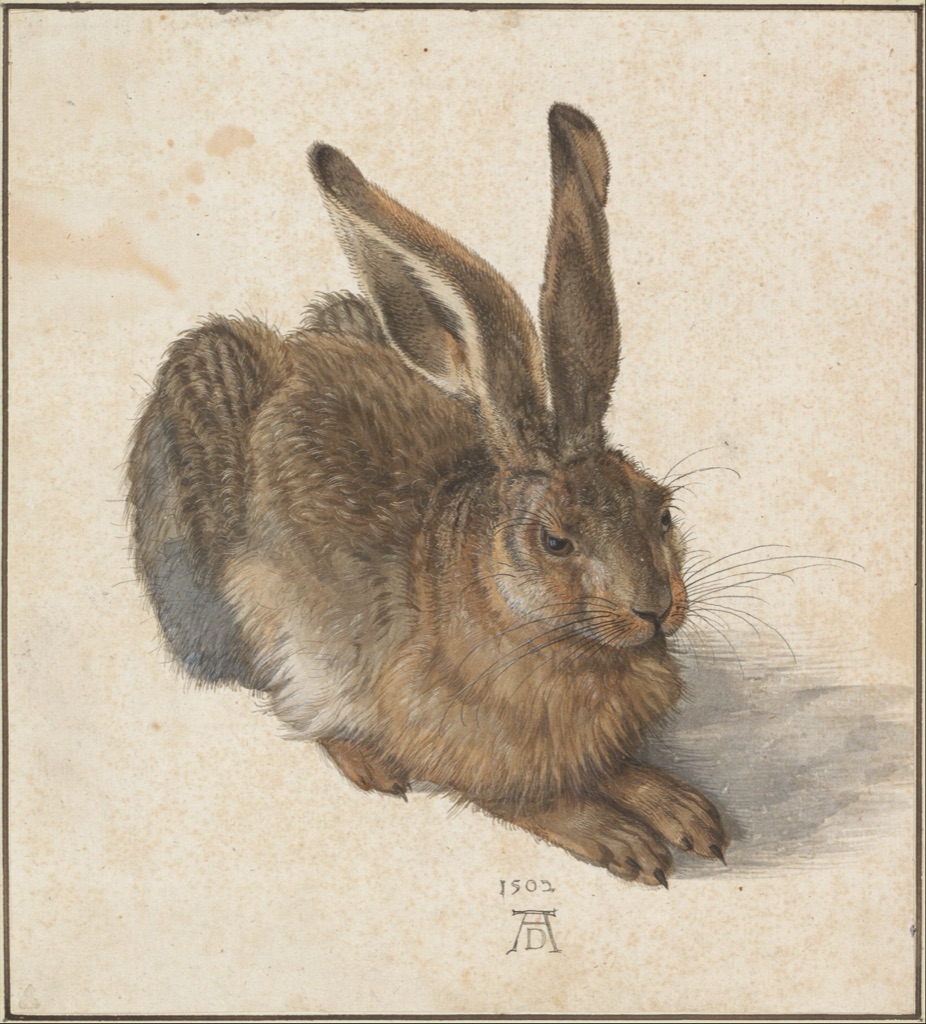
Young Hare sits compactly in profile, its ears raised and eye catching a small point of light. Dürer varies short strokes across the fur, describing changes in direction, softness and colour without dissolving the animal's weight. The paws press against an almost empty ground, concentrating attention on posture rather than habitat. The Albertina records the sheet as inventory 3073 and treats it as a central example of Dürer's celebrated animal studies. Its fame does not rest on scientific detachment alone. Minute observation is organised into a convincing encounter with a living creature that seems poised to move.[7]
Great Piece of Turf
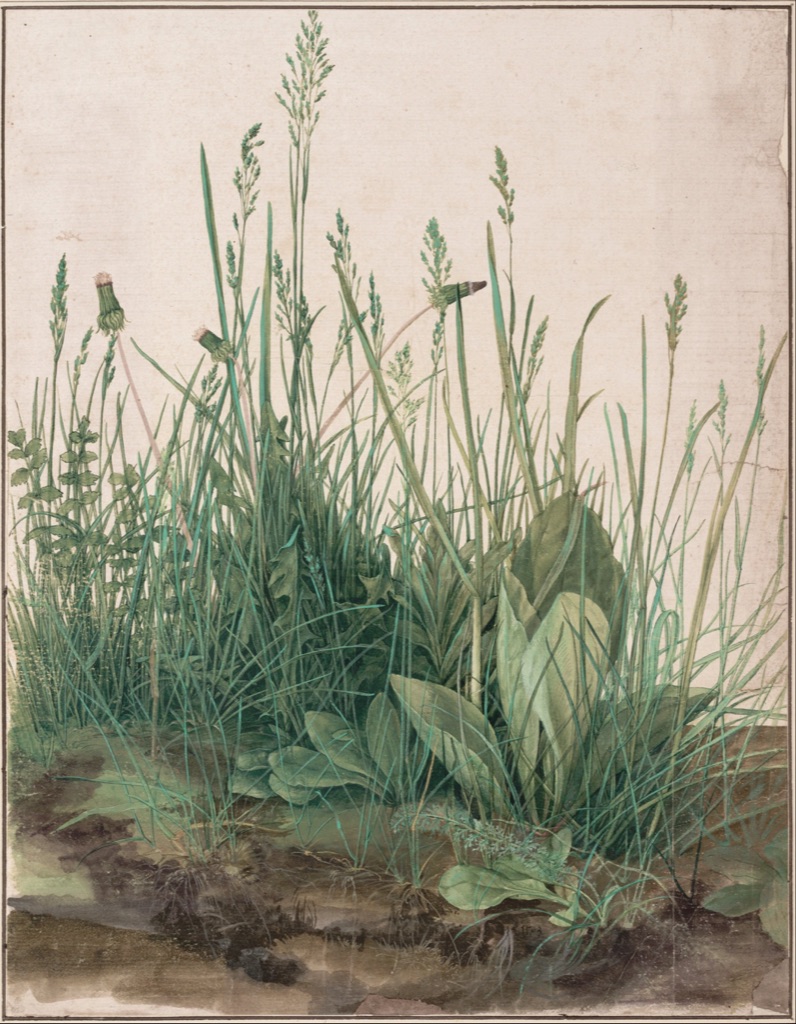
Great Piece of Turf raises a common clump of grasses and broad leaves to the scale of sustained attention. Stems cross, bend and disappear into a dark base; different species compete for space without being regularised into a decorative pattern. Dürer keeps the tangled growth readable through variations in green, brown and pale highlight. The Albertina also uses the English title Large Piece of Turf and records the sheet as inventory 3075 among the artist's plant studies. The work's achievement is compositional as well as observational: an apparently accidental patch of ground becomes a dense vertical structure, complete without a surrounding landscape.[8]
The Tree Man
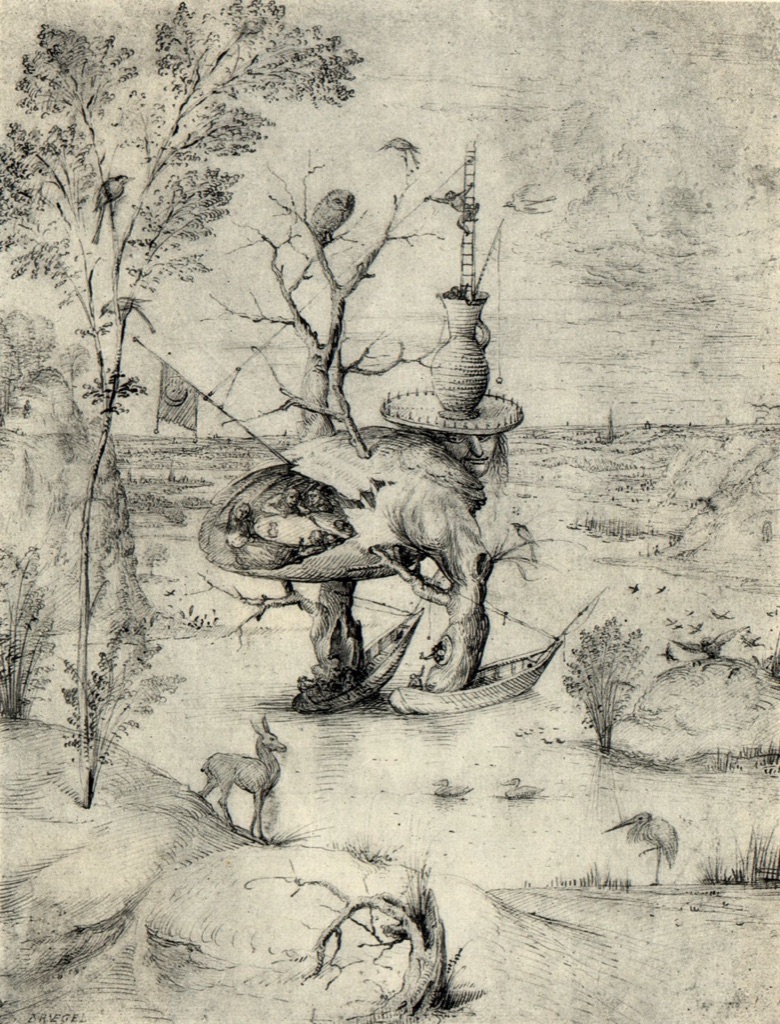
The Tree Man combines a hollow trunk, human face, cracked eggshell body and branch-like legs into one unsettling creature. Tiny figures occupy and circle the hybrid structure, making scale as unstable as anatomy. Bosch's pen lines move from crisp contour to restless hatching, allowing the fantasy to remain structurally persuasive. Albertina scholarship identifies inventory 7876 as one of the early Netherlandish sheets that demonstrates drawing's emergence as an autonomous work rather than merely a stage towards another object. A later inscription naming Bruegel does not overturn the attribution. The sheet instead helps explain how Bosch's inventions could circulate as finished visual ideas.[9]
Design for the Tomb of Pope Julius II
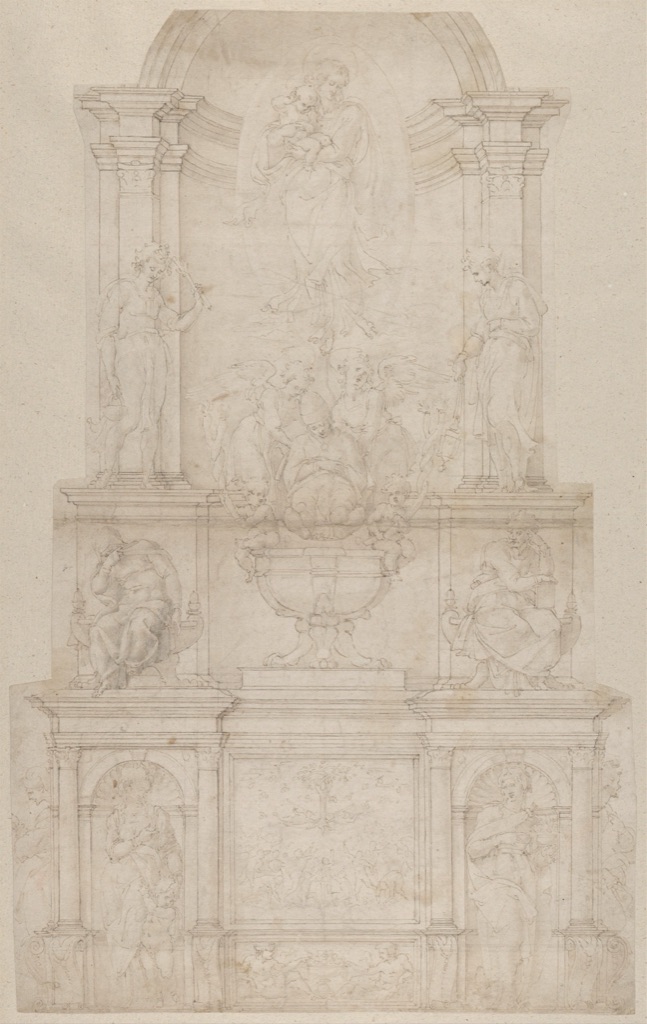
Design for the Tomb of Pope Julius II compresses an enormous sculptural programme onto a small sheet. Figures inhabit stacked niches and architectural zones, while repeated verticals organise the monument's density. Pen and wash clarify masses; incised and leadpoint lines preserve earlier planning beneath the more assertive design. The Met dates the drawing to 1505–1506 and connects it to Michelangelo's first conception for the pope's tomb, a commission repeatedly revised over decades. The sheet matters because it makes revision visible. It records an expansive proposal before compromise, relocation and altered scale transformed the realised monument.[10]
Praying Hands
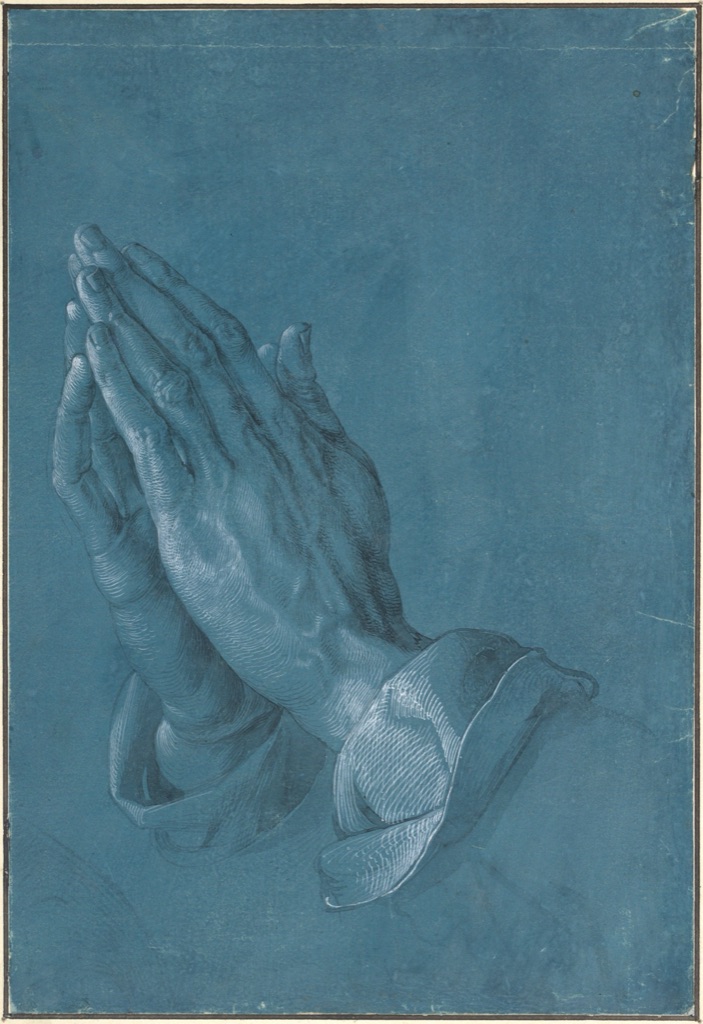
Praying Hands isolates two raised hands, their fingers aligned while sleeves open below. White strokes catch knuckles and tendons against the blue ground; grey wash gives the wrists weight. The concentrated fragment has acquired an independent devotional life, yet its original working purpose should not be lost. Albertina documentation identifies inventory 3113 as a study connected with the Heller Altarpiece and simultaneously recognises its status as a masterpiece of drawing. That double identity is crucial: preparation and completion are not opposites here. The care invested in a subsidiary detail produced a sheet capable of standing apart from the painting it helped Dürer plan.[11]
Preparatory Study for Adam in the Disputation of the Holy Sacrament
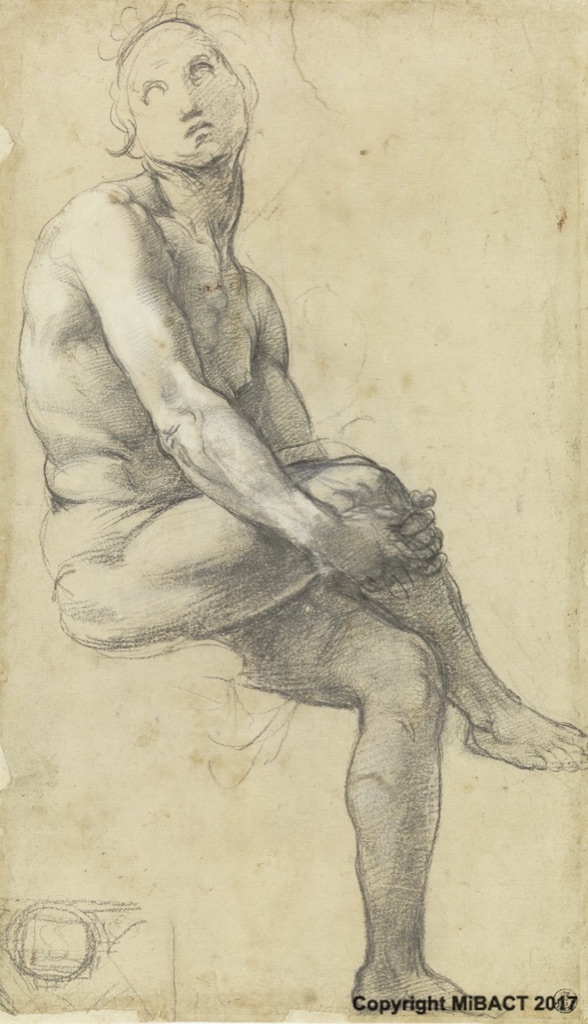
Raphael's Preparatory Study for Adam builds a seated nude from broad dark modelling and sharp white accents. The body's twist, planted foot and raised arm test how a substantial figure can occupy a complex group. A small architectural sketch shares the recto, preserving another strand of planning on the same sheet. The Uffizi identifies it as 541 E recto, dates it to early 1509 and relates the figure to Adam in the Vatican fresco known as the Disputation of the Holy Sacrament. The study reveals that the fresco's apparent clarity depended on separate trials of anatomy, light and pose.[12]
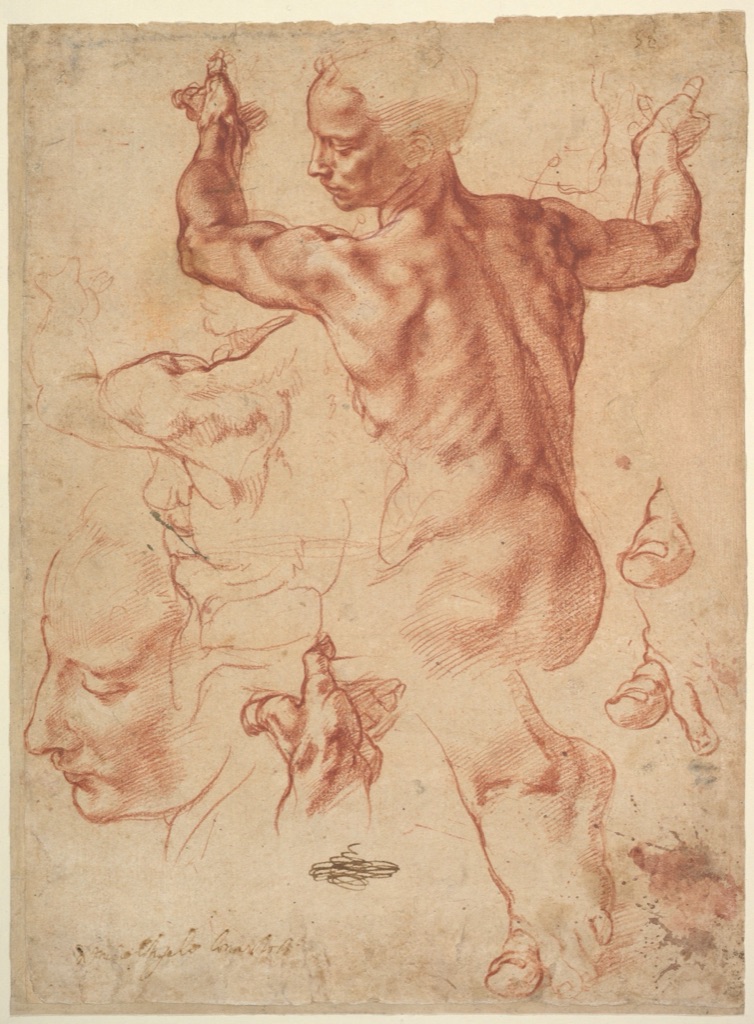
Studies for the Libyan Sibyl
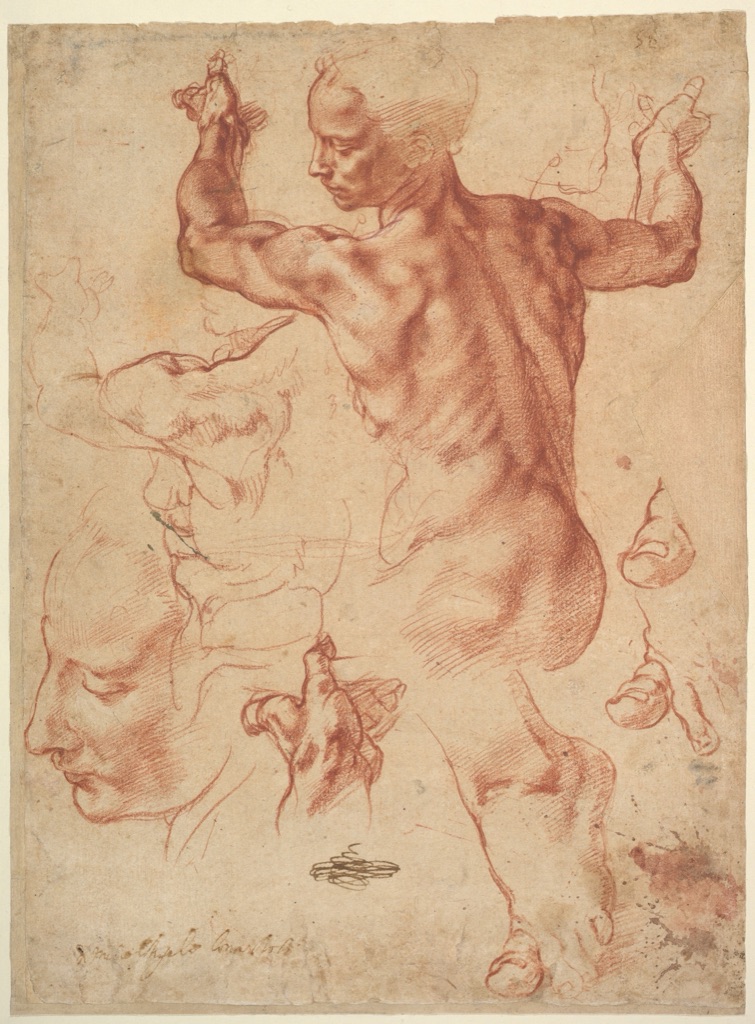
Studies for the Libyan Sibyl gathers a powerfully turned seated figure with concentrated studies of a hand and foot. Red chalk describes the body's muscular load while white accents lift forms from the sheet. The separate extremities show Michelangelo solving precise problems rather than merely sketching a general pose. The Met identifies accession 24.197.2 and connects the recto directly with the Libyan Sibyl on the Sistine Chapel ceiling; it also records different material on the reverse. The sheet allows viewers to follow attention moving between the whole figure and the anatomical details that make its rotation believable.[13]
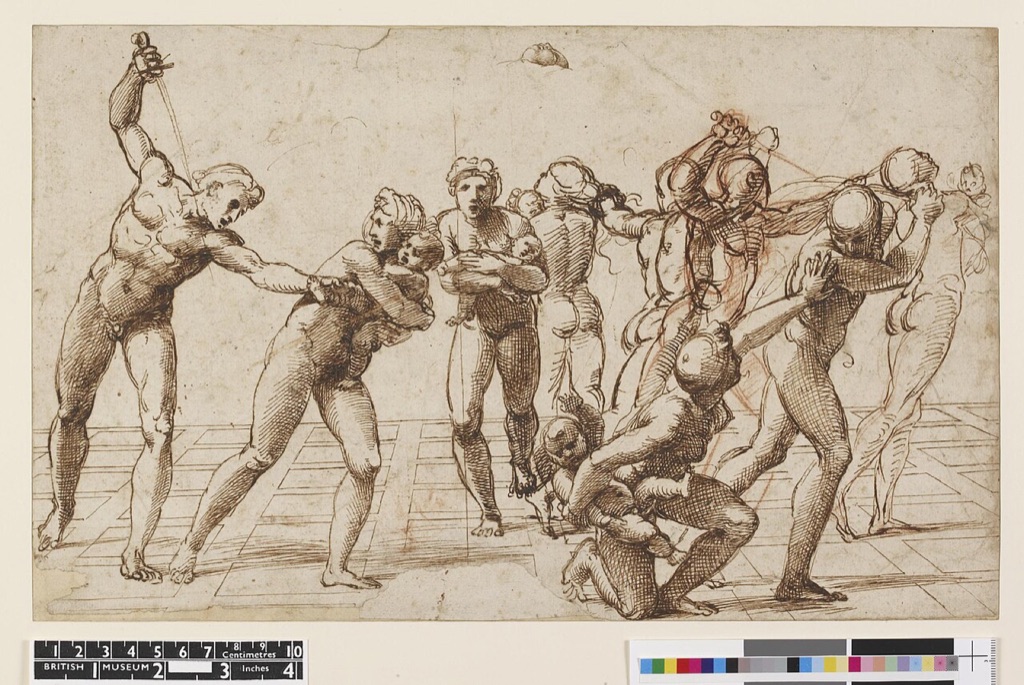
Study for the Engraving The Massacre of the Innocents
Study for the Engraving The Massacre of the Innocents arranges struggling mothers, infants and attackers in a compressed field of intersecting limbs. Red chalk lies beneath decisive ink, while pricked contours show that the composition was prepared for transfer. The British Museum identifies the sheet as 1860,0414.446 and relates it to the engraving made by Marcantonio Raimondi. That object history is essential: similarly titled museum works are impressions of the print, whereas this is the drawing used to develop and transmit the design. Its force comes from the balance between violent action and a carefully controlled structure intended to survive translation into another medium.[14]
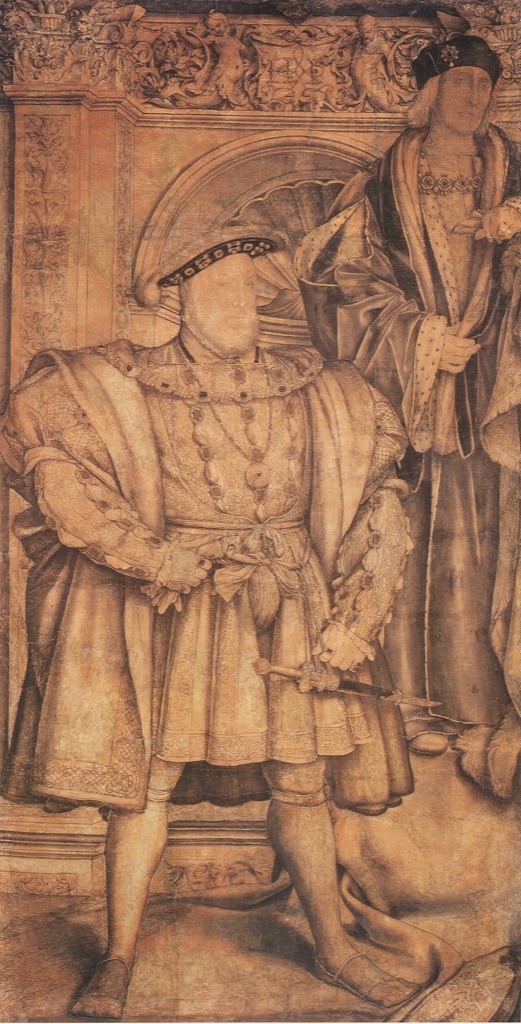
Henry VIII and Henry VII
Henry VIII and Henry VII preserves two monumental figures from Holbein's design for the Whitehall Palace mural. The kings stand within emphatic architecture, with Henry VIII's broad frontal pose projecting authority. At full scale, a cartoon is not a casual preliminary sketch but a working template capable of transferring a complex design to another surface. The National Portrait Gallery records NPG 4027 as the surviving left half of the cartoon for a mural later destroyed by fire. Because the original painting is lost, the drawing carries unusual documentary weight: it preserves the planning, scale and physical presence behind one of Tudor portraiture's most influential royal images.[15]
1550–1749: drawing for reproduction
Printmaking allowed compositions to travel far beyond a single collection. A design drawing could determine the image while a specialist engraver reversed and translated its marks for the plate. The distinction between drawing and print is therefore central to object identity.
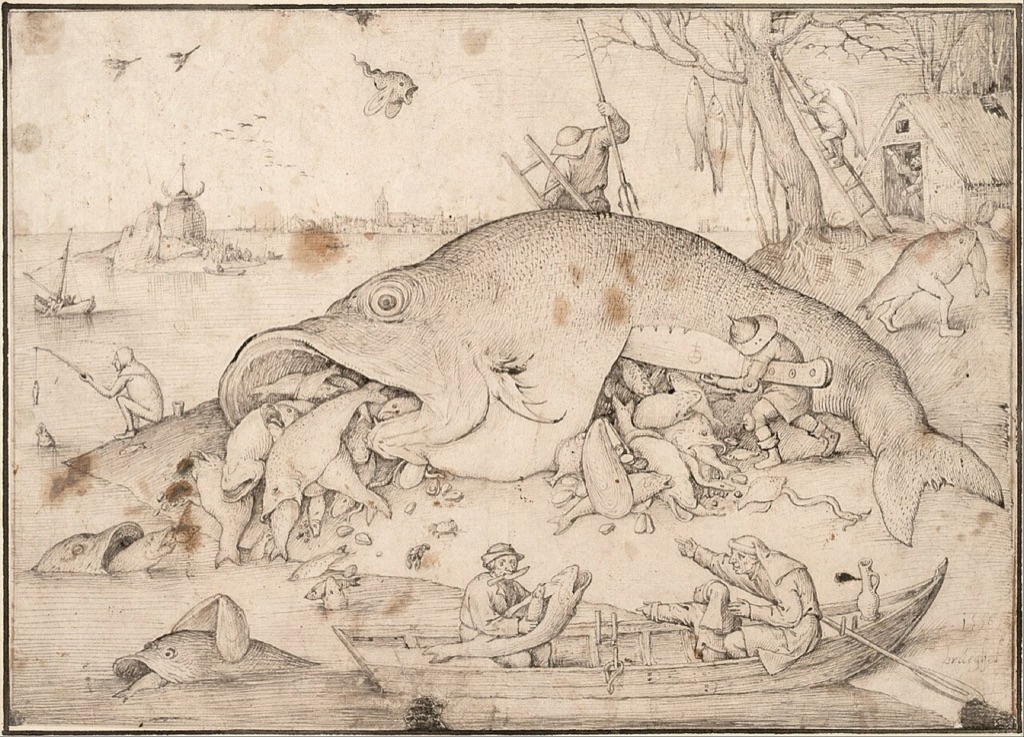
Big Fish Eat Little Fish
In Big Fish Eat Little Fish, an enormous fish is cut open and disgorges smaller fish, while people, boats and fantastic creatures repeat the same predatory pattern. The proverb becomes an entire visual ecosystem of appetite and power. The Albertina identifies inventory 7875 as Bruegel's 1556 drawing and records transfer lines connected with its later reproduction as an engraving by Pieter van der Heyden. The printed version reverses the design and introduced a misleading credit to Bosch. Keeping those objects separate restores Bruegel's authorship and shows how a drawing could serve as the authoritative design even when another maker produced the widely circulated image.[16]
1750–1849: the artist observing himself
The portability of paper made it well suited to private experiments and sequences. Drawings could be kept in albums, where a self-portrait might sit among studies that tested expression, invention and social observation.
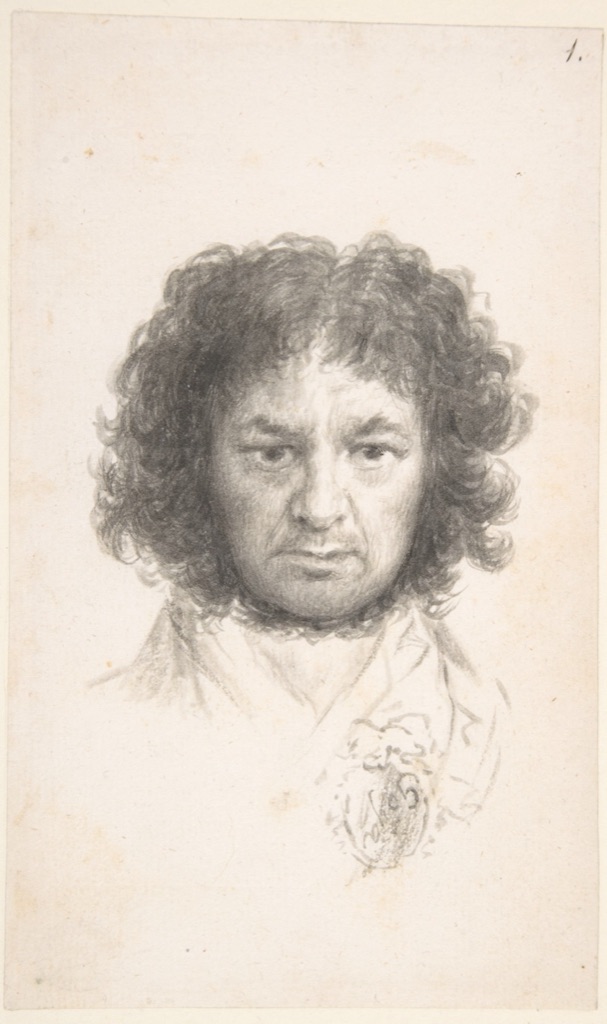
Self-Portrait
Goya's Self-Portrait faces the viewer from beneath a dark hat, the coat and surrounding shadow massed in carbon-black ink. Economical strokes define the eyes, nose and mouth without smoothing away the act of drawing. The direct gaze makes the small sheet feel confrontational rather than ceremonial. The Met records it as accession 35.103.1, dates it to about 1796 and places it within an album context. That setting matters: the portrait was part of an intimate paper-based practice, not a formal painted likeness designed for public display. Its concentrated handling makes self-scrutiny inseparable from experiment with the brush.[17]
1850–1900: drawing as a tool for movement
In the nineteenth century, artists continued to use drawing to prepare larger works, but new subjects and working methods changed what preparation looked like. A grid could help carry a quickly observed pose into another composition without removing the energy of the first study.
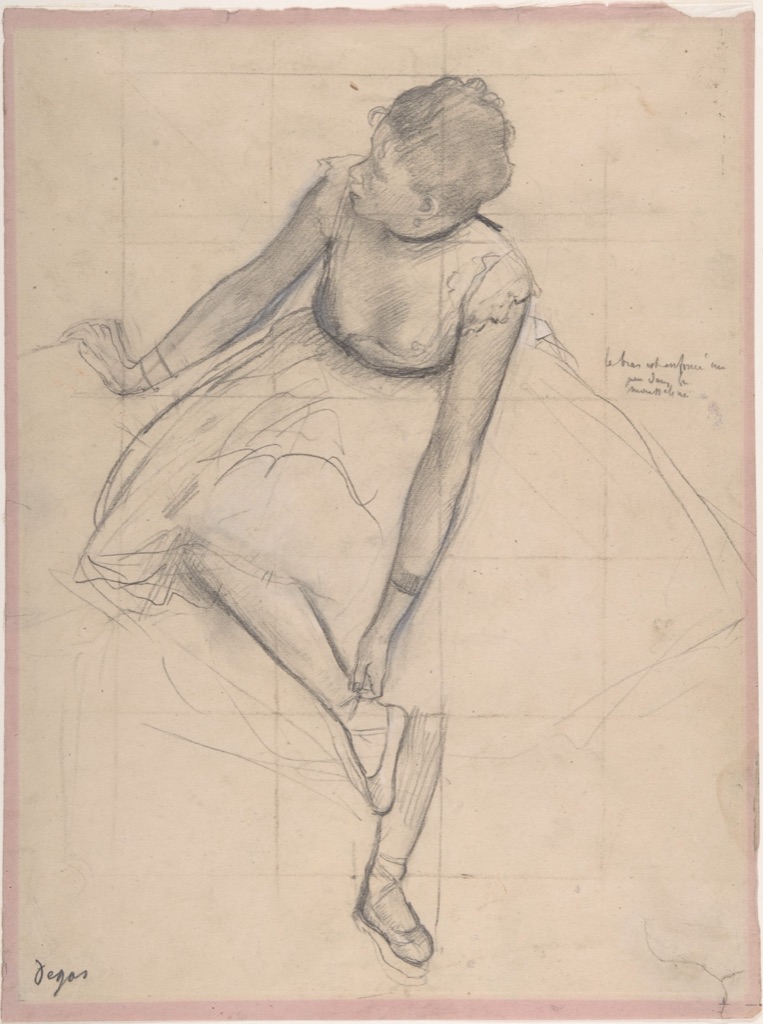
Dancer Adjusting Her Slipper
Dancer Adjusting Her Slipper shows a seated performer bending sharply over one foot. The compressed pose avoids the polished spectacle of the stage and concentrates instead on balance, strain and a routine act of preparation. Graphite establishes the figure, while black and white chalk articulate form against pink paper. A visible grid indicates that the study was squared for transfer, joining immediate observation to a measured process of enlargement or reuse. The Met identifies the sheet as accession 29.100.941 and dates it to 1873. Its combination of rapid bodily insight and deliberate transfer structure makes it an especially clear example of drawing as both observation and working instrument.[18]
Ways to compare the drawings
Chronology is only one way through these works. Materials reveal another history. Metalpoint and silverpoint encourage exact, accumulating lines; chalk can model a figure with broad tonal force; pen and wash can move between analysis and invention; watercolour gives feathers, fur and plants a vivid surface. Mixed techniques often appear where a single material could not answer every problem.
Function is equally revealing. Leonardo and Botticelli use drawing to test systems of proportion or imagined geography. Michelangelo, Raphael, Dürer and Degas prepare figures for works in other forms, but their studies remain compelling when separated from those outcomes. Holbein's cartoon preserves a lost mural, while Bruegel's design clarifies authorship behind a famous print. Dürer's nature studies, Bosch's fantasy and Goya's self-portrait demonstrate that paper could also carry complete, independent statements.
These categories overlap rather than forming a ladder of importance. A preparatory sheet may become better known than the finished object; a meticulously observed animal can be as constructed as an architectural plan. Looking across the selection shows why drawing is not merely painting's preliminary stage. It is a flexible mode of thought in which observation, revision, transfer and invention remain visible together.
Watch How Drawing Materials Shape What We See
These museum-led choices move from historical reconstruction to close looking and hands-on practice, helping the directory's object records become visible decisions.
Leonardo da Vinci: Anatomist
A Royal Collection curator uses Leonardo's anatomical sheets to show how observation, material and repeated drawing can function as sustained visual investigation.
Watch on YouTubeFrequently Asked Questions
Leonardo da Vinci's Vitruvian Man is among the most widely reproduced, but fame is not an objective ranking. Its recognisability comes from the union of figure study, geometry, writing and later reproduction; other drawings are equally important for different historical questions.
No. Some were conceived as independent or presentation sheets, while others are studies, cartoons, designs or diagrams. The intended function should be established before finish is judged.
Begin with the museum's object record and technical research. Colour alone is unreliable: chalk, metalpoint, graphite, ink, wash and altered paper can produce overlapping appearances on a screen.
The surviving and well-documented Renaissance corpus makes changes in workshop practice, observation, design and collecting unusually visible. The chronological concentration reflects the scope of this particular directory, not the full global history of drawing.
Confirm the object, date, medium, scale, function and present collection. Then follow changes in line weight, pressure, edge, tone, correction and blank paper before moving to symbolic interpretation.
Discussion
Which sheet in this directory most changes when you compare its function with its finished appearance?
Reader Insights
Start with date, material, scale, function and collection before interpreting expression.
Look for pressure, direction, repetition, correction and untouched paper.
A preparatory study and an autonomous drawing should not be judged by the same kind of finish.
Join the Conversation
Share the drawing and one visible piece of evidence that changed how you understood it below.
References
- Gallerie degli Uffizi, “Diagnostic campaign on Leonardo's Landscape drawing 8P”.
- Royal Collection Trust, “Studies of Hands,” RCIN 912615.
- The Albertina Museum, “Drawings & Prints”.
- Vatican Apostolic Library, “Reg.lat.1896.pt.A”.
- Gallerie dell'Accademia, “Study of the Proportions of the Body, known as the Vitruvian Man”.
- The Albertina Museum, “Drawings & Prints”.
- The Albertina Museum, “Albrecht Dürer”.
- The Albertina Museum, “Albrecht Dürer”.
- The Albertina Museum, “Bruegel and His Time”.
- The Metropolitan Museum of Art, “Design for the Tomb of Pope Julius II”.
- The Albertina Museum, “Leonardo–Dürer: Master Drawings on Coloured Ground”.
- Gallerie degli Uffizi, “Preparatory Study for Adam in the Disputation of the Holy Sacrament”.
- The Metropolitan Museum of Art, “Studies for the Libyan Sibyl”.
- The British Museum, “Study for the Engraving The Massacre of the Innocents”.
- National Portrait Gallery, “King Henry VIII; King Henry VII,” NPG 4027.
- The Albertina Museum, “Big Fish Eat Little Fish”.
- The Metropolitan Museum of Art, “Self-Portrait”.
- The Metropolitan Museum of Art, “Dancer Adjusting Her Slipper”.