 by
Tom Gurney
Tom Gurney BSc (Hons) is an art history expert with over 20 years experience
Email:
tomgurney1@gmail.com
/ Phone:
+44 7429 011000
Henry VIII and Henry VII: the Whitehall Cartoon: Introduction
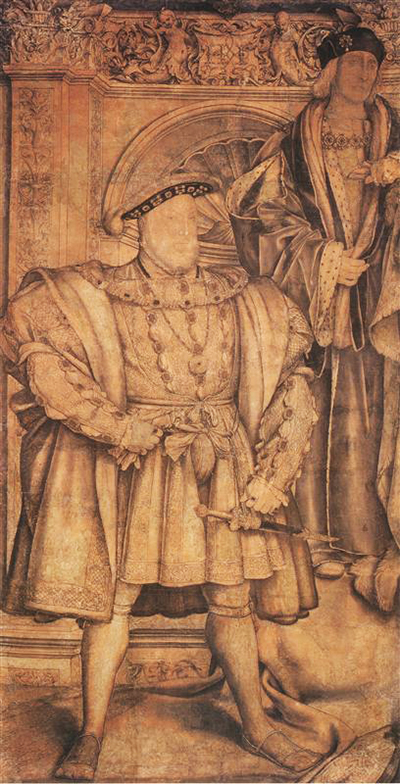
Henry VIII fills the lower part of this enormous drawing, while his father stands above and behind him. Sleeves, fur and jewellery give the younger king a spreading outline. Henry VII’s robe falls in long folds beside him. The son holds the foreground of their ornamented interior; the father belongs to the space beyond.
This is the surviving left-hand cartoon for Hans Holbein the Younger’s lost Whitehall mural. Made around 1536–37, it stands more than two and a half metres high. Its ink, watercolour and assembled paper preserve the design at the scale of the intended painting. Looking at it means meeting a familiar royal image while it was still being worked out. [1]
At a Glance
- Collection title King Henry VIII; King Henry VII . [1]
- Artist Hans Holbein the Younger. [1]
- Date and medium c.1536–37; ink and watercolour. [1]
- Dimensions 257.8 × 137.2 cm. [1]
- Collection National Portrait Gallery, London, NPG 4027; allocated to the Gallery in 1957. [1]
- What survives The left section of the preparatory design, showing the two kings. [1]
- Lost painting The Whitehall mural, completed in 1537 and destroyed on 4 January 1698. [1] [2]
- Complete painted record Remigius van Leemput’s reduced copy of 1667, Royal Collection, RCIN 405750. [2]
This work across Hans Holbein the Younger’s career
Dead Christ in the Tomb
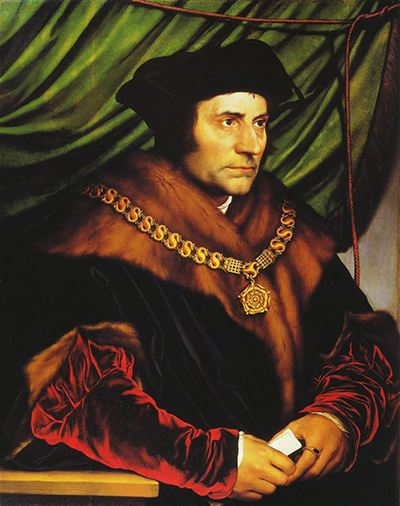
1521–22 [4]Sir Thomas More
1527 [5]Georg Giese
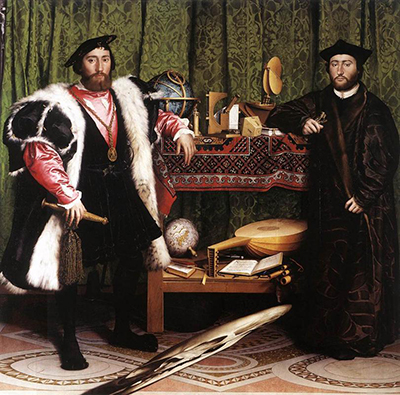
1532 [6]The Ambassadors
1533 [7]Contents
- A Drawing That Meets the Body
- Father and Son in the Same Interior
- Paper, Cut-Outs and the Work of Transfer
- The Turn of Henry’s Head
- Restoring the Missing Half
- A Royal Room and a Longer Afterlife
- Survival and the Care of the Drawing
A Drawing That Meets the Body
The first thing a small reproduction conceals is the relationship between this drawing and a standing person. At its actual size, the king’s shoes are substantial forms, his sleeves take up real space and the ornament above him extends beyond an ordinary viewer’s head. The drawing has an architectural scale. It invites the eye to travel upwards through a setting that seems large enough to enter.
Start at Henry VIII’s feet. One shoe angles towards the lower left; the other reaches across the lower right. Between them, the legs form a wide opening beneath the short tunic. The stance makes a firm base, but its effect comes from more than width. The feet point in different directions, and the lines of the calves change as they descend. The figure remains articulated within its broad silhouette.
Above the knees, vertical folds divide the tunic into long strips. Those narrow rhythms draw the eye towards the waist, where the arrangement becomes busier: belt, hands, gloves and the fastening of the garment gather together. The elbows project beyond this concentrated centre. Holbein gives the body a succession of expansions and contractions, so that the enormous sleeves never become a shapeless mass.
The drawing’s subdued colour makes those relationships especially clear. Pale areas of the tunic and stockings sit within stronger dark boundaries. The face is comparatively small, and its features are quieter than the costume. A viewer who begins by searching for Henry’s expression may miss how thoroughly the rest of the figure has already shaped the encounter.
There is also room for the eye to wander. A narrow decorated upright rises on the left. Curves from the shell-shaped niche spread behind the king’s cap. Across the top, small figures, foliage and ornamental scrolls crowd a horizontal band. Holbein sets the large, readable body against a setting whose detail takes longer to disentangle. The king can register immediately; the room rewards a slower inspection.
Father and Son in the Same Interior
Henry VII is easy to overlook when the drawing is reproduced primarily as an image of his son. He stands towards the right edge, his head near the ornament at the top. His cap is compact, his shoulders narrower, and the long robe draws attention downwards through the length of the figure. His hands stay close to his body, making an arrangement quite different from Henry VIII’s wide elbows.
Look at the two men’s sleeves. In the foreground, large rounded forms push towards the sides. Behind, the father’s fabric gathers into deeper, more angular folds. Along the opening of his robe, pale fur makes a broken vertical border. The contrast distinguishes the figures even where their clothes overlap. The folds help distinguish their positions in space.
The head heights can initially be misleading. Henry VII appears much higher in the image, but this does not make him a giant beside his son. The floor and steps place the figures at different depths and levels. His robe descends behind the younger king; his shoes belong to the raised space at the back. The architecture holds the two bodies within a legible arrangement.
The family relationship crosses time. Henry VII died in 1509, many years before this drawing, and the representation is necessarily posthumous. The father’s presence establishes a lineage that a portrait of Henry VIII alone could only imply. [1] Visually, the sequence is tangible: the earlier king stands behind the reigning one, whose body advances towards the spectator.
That arrangement also gives the father a distinct compositional task. He occupies the upper right, balancing the son’s large mass on the lower left. His long outline guides the eye through an area that would otherwise be mostly architecture. Try covering him in a reproduction: the younger Henry remains recognisable, but the drawing loses much of its upward movement and its sense of a second inhabited space.
Paper, Cut-Outs and the Work of Transfer
A cartoon in this context is a preparatory drawing on the scale of a painting. The National Portrait Gallery describes this one as a construction of joined paper sheets, with the kings’ figures and faces cut out and pasted onto the background. [1] That description changes how we look at the apparent unity of the scene. Bodies and architecture belong to one image, but the object was assembled from separate pieces.
Imagine following a figure’s perimeter around the robe, sleeve and cap. An outline does several jobs at once. It defines a person, separates overlapping forms and establishes where that person belongs within the architecture. At this size, adjusting a contour means altering a shape measured against an actual human body. The crispness of a small preparatory sketch would be insufficient on its own: the complete arrangement had to work across a much larger surface.
Transfer could preserve those decisions without requiring every contour to be invented afresh on the wall. In pouncing, fine holes along an outline allow powdered material to pass through and leave a corresponding line of dots. A painter can then connect and develop that guide. The Gallery’s current display label proposes that this surviving cartoon was kept as a studio record, while another sheet carried the design to the wall. Its relatively good condition informs that interpretation. [1]
The drawing belongs to the preparation of the mural; the claim that this very surface was fixed against the palace wall is less secure. It could preserve a composition while another sheet absorbed the handling involved in transfer.
The practical intelligence of the object becomes visible in its combination of precision and adaptability. A face can be worked separately from a sleeve; a figure can be positioned against a setting; an outline can be repeated. Alongside Holbein’s smaller portrait drawings , this great sheet reveals how much depended on paper before a painted figure reached its final home.
Watch: Holbein’s portraits and working methods
Explore museum films on Holbein’s drawings, painted portraits and close-looking details.
Hans Holbein at the court of Henry VIII
A Royal Collection Trust film exploring Holbein’s work at Henry VIII’s court.
Watch on YouTubeThe Turn of Henry’s Head
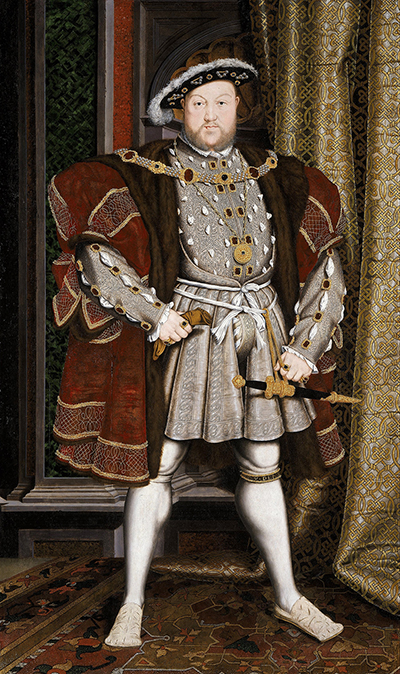
The familiar royal pose was still capable of change. In the cartoon, Henry VIII’s head turns to one side, while the torso is more directly presented. Leemput’s record of the completed mural shows the face turned towards the spectator. The difference is documented by the National Portrait Gallery and remains visible when the works are compared. [1] [2]
In the drawing, the nose points away from the centre of the chest. One side of the face opens more fully, and the cap seems to follow a slightly sloping direction across it. The body’s breadth and the head’s angle pull the eye along different paths. We can take in the shoulders first, then follow the face sideways through the surrounding space.
In Leemput’s painting, the two eyes sit more evenly across the face. The beard forms a central shape above the decorated chest, and the face agrees more closely with the front of the torso. It is a small alteration within an enormous composition. Nevertheless, it changes where a viewer feels placed: the painted king addresses the space in front of him more directly.
The change need not be explained through an invented exchange between artist and ruler. Neither image records a conversation or tells us who requested an adjustment. Their comparison gives a firmer kind of knowledge: a major royal likeness could be revised after the full-size design had reached the stage preserved here.
This is one reason to spend time with the cartoon before turning to a finished version. Familiarity can make the wide stance seem inevitable. The angled face disrupts that expectation, allowing us to see separate decisions within the image: how the feet spread, where the elbows fall, which way the head turns. The royal presence emerges through their coordination.
Restoring the Missing Half
Leemput’s Henry VII, Elizabeth of York, Henry VIII and Jane Seymour was painted in 1667 for Charles II. It is oil on canvas, measuring 88.9 × 99.2 cm, and records the entire composition at a reduced scale. The Royal Collection identifies it as the only complete record of Holbein’s mural. [2] Its breadth immediately explains why the surviving cartoon looks so tall and narrow.
The two kings occupy the left. On the right stand Elizabeth of York behind and Jane Seymour in front. Between them rises a large inscribed central structure. The older generation stands higher, while Henry VIII and Jane occupy the lower foreground. Across the group, relationships are expressed through placement before the viewer begins to read the inscription.
The central block occupies a remarkable amount of space. Its flat inscribed face holds the middle of the picture, dividing the family while providing a shared point around which the four figures gather. Above it, an arch and roundel pull the composition upwards. At the sides, the two shell niches answer one another. The architecture makes a single setting out of several distinct positions.
Colour creates other connections. Red fabric appears on both sides, while the pale areas of Henry’s stockings and Jane’s sleeves catch the eye lower down. Their costumes differ sharply in shape. Henry’s legs remain separately visible; Jane’s skirt spreads into a continuous triangular mass. The pair balance across the central structure without becoming mirror images.
The Royal Collection’s translation of the Latin verses presents a competition between father and son over which ruler deserves greater praise. Its exhibition account also connects the inscription with Henry VIII’s supremacy over the English Church and identifies a lion and dragon among the heraldic ornaments above. [2] [9] The writing gives a verbal argument to the display of bodies, costly clothing and elaborate architecture.
The copy cannot restore the experience of standing before the palace wall. Its figures are smaller, and its painted surface belongs to Leemput, more than a century after Holbein. It can, however, restore relationships lost when Henry VIII is seen alone. The surviving cartoon’s right edge becomes a point of interruption: beyond it once stood a structure, two women and another half of the room.
A Royal Room and a Longer Afterlife
The Royal Collection places the mural in Whitehall’s Privy Chamber, where Henry received important guests. [2] [9] In that setting, the figure painted on the wall could form part of an encounter with the living king. The relationship between image and room matters. A visitor would meet a life-size royal body within architecture that extended the magnificence of the surroundings.
This was an image of dynastic continuity made in 1537. A connection with the birth, or expected birth, of Edward has been proposed; the occasion remains uncertain. [1] The painting’s selection of family members nevertheless gives the idea of succession a clear visual form. Henry VII and Elizabeth of York stand behind the present royal couple. Generation follows generation within one stable interior.
The later history of the composition took it far beyond that particular room. A full-length version at Petworth, catalogued as studio of Holbein, dates to about 1543–47 and is painted in oil on oak. The National Trust draws attention to a fold of carpet as evidence of its close relationship to the lost mural. [10] It offers a different kind of survival from Leemput’s copy: the king’s figure carried into a separate portrait.
These objects preserve different amounts of the original invention. A single-figure repetition can retain the stance, hands and costume while leaving out the family argument. Leemput preserves the family and architecture within a much smaller painted field. The cartoon keeps the monumental scale and the paper construction, while stopping before the final turn of Henry’s head.
The paper drawing cannot supply the finished mural’s precise colours. A reduced painted copy cannot show Holbein’s handling on the lost wall. A studio portrait cannot automatically be treated as a surviving painting by his own hand. Each gives a particular view of an image whose original setting has disappeared. The broader group of Henry VIII portraits and copies makes those variations especially rewarding to compare.
Survival and the Care of the Drawing
The wall painting was destroyed in the Whitehall Palace fire of 4 January 1698. Leemput’s copy had already been made thirty-one years earlier. [2] The large paper drawing survived separately, eventually entering the National Portrait Gallery in 1957. [1] An object connected with preparation thus outlasted the permanent-looking painted interior.
Survival does not mean that the paper has reached us untouched. The Gallery’s annual review for 2003–04 records a detailed survey by Alan Donnithorne, then paper conservator to the Royal Collection. The drawing was mapped and photographed, infrared reflectography was carried out, and limited treatment secured flakes before it was rehung. [11] These are specific acts of examination and care, rather than evidence for a wholesale repainting or reconstruction.
That account also changes the way we think about the drawing’s apparent strength. The commanding bodies belong to a physical surface that needs close attention. Looking from a distance, we read a planted foot or projecting sleeve. Nearer investigation addresses the small areas from which those large forms are built. Monumentality and delicacy coexist in the same object.
The cartoon still offers something that no small copy can replace: the chance to measure a drawn king against our own body. Yet the evidence of making remains present within that encounter. Joined paper, attached figures and a head that would later turn all keep the design open to scrutiny. The image’s authority is forceful; the surviving drawing lets us see the practical decisions that gave it shape.
Artworks directory
Explore paintings, drawings, prints and designs, including works without a separate article. Related studies and versions have their own entries; workshop works and copies are labelled. Print designs and series are grouped rather than repeated for every impression.
Frequently Asked Questions
It means a full-size preparatory design for a painting. Holbein’s surviving drawing belongs to the preparation of the dynastic mural completed at Whitehall in 1537. [1]
The National Portrait Gallery’s current display label suggests that it was retained as a studio record and that another cartoon was used for pouncing the design onto the wall. Direct use of this surviving sheet should therefore remain qualified. [1]
Discussion
Look again at the images and ideas explored in Henry VIII and Henry VII: the Whitehall Cartoon. These editorial prompts invite your observations.
Reader Insights
Compare the wide sleeves of Henry VIII with the long fall of his father’s robe. How does each shape establish a different place within the room?
Compare the cartoon with Leemput’s copy. Does Henry’s direct gaze change your response more than his stance or costume?
Imagine the surviving paper extended to include the central inscription and the queens. Which relationship becomes most noticeable in the complete group?
Join the Conversation
Which detail most changes your understanding of the Whitehall image: the assembled paper, Henry VII’s presence or the alteration to Henry VIII’s face? Share what you notice when you look again.
References
- National Portrait Gallery , King Henry VIII; King Henry VII , Hans Holbein the Younger, c.1536–37, NPG 4027; collection record and display labels, including the label dated 22 June 2023. View source .
- Royal Collection Trust , Remigius van Leemput, Henry VII, Elizabeth of York, Henry VIII and Jane Seymour , 1667, RCIN 405750; collection description, measurements and provenance. View source .
- Kunstmuseum Basel, Bildnis des Bonifacius Amerbach, 1519, inventory 314 (in German) . View source .
- Kunstmuseum Basel, Der tote Christus im Grab, 1521–22, inventory 318 (in German) . View source .
- The Frick Collection, Sir Thomas More, 1527, accession 1912.1.77, collection record . View source .
- Gemäldegalerie Berlin, Georg Gisze . View source .
- Susan Foister, The Ambassadors, The German Paintings before 1800 (2024) . View source .
- Susan Foister, Christina of Denmark, Duchess of Milan (2024) . View source .
- Royal Collection Trust , Holbein at the Tudor Court , Nash Gallery large-print exhibition labels, “Painting the King” and “The Whitehall Mural”, PDF pp.24–27. View source .
- National Trust , Henry VIII (1491–1547) , studio of Hans Holbein the Younger, c.1543–47, oil on oak panel, Petworth House, NT 486186; collection record, caption and summary. View source .
- National Portrait Gallery , Annual Review 2003–2004 , “Conservation”, printed p.12, concerning the survey, imaging and treatment of the Holbein cartoon. View source .
- Würth Collection, Holbeins Schutzmantelmadonna, inventory 14910, current owner account (in German) . View source .
- Metropolitan Museum, Dance of Death series . View source .
- Kunstmuseum Basel, Bildnis der Frau des Künstlers mit den beiden ältesten Kindern, about 1528–29, inventory 325 (in German) . View source .
- Kunsthistorisches Museum Wien, Next Generation, Jane Seymour, about 1536–37, inventory 881 (in German) . View source .