by
Tom Gurney
Tom Gurney BSc (Hons) is an art history expert with over 20 years experience
Email:
tomgurney1@gmail.com
/ Phone:
+44 7429 011000
Sir John More by Hans Holbein the Younger: Introduction
Pale eyes, fine white hair and a narrow, closed mouth emerge between a black cap and a spreading fur collar. Holbein gives the face a lightness: its edges almost disappear into the paper, while the clothing makes a broad, enclosing frame. This is Sir John More, the judge and father of Sir Thomas More, drawn around 1526–27 for Holbein’s portrait of the More family. [1] The sheet rewards looking both as a likeness of an elderly man and as one part of a larger gathering.
At a Glance
- Artist Hans Holbein the Younger.
- Title Sir John More (c.1451–1530) .
- Date c.1526–27.
- Medium Black and coloured chalks.
- Size 35.1 × 27.3 cm, sheet of paper.
- Collection Royal Collection, RCIN 912224. [1]
This work across Hans Holbein the Younger’s career
Dead Christ in the Tomb
1521–22 [3]Sir Thomas More
1527 [4]Georg Giese
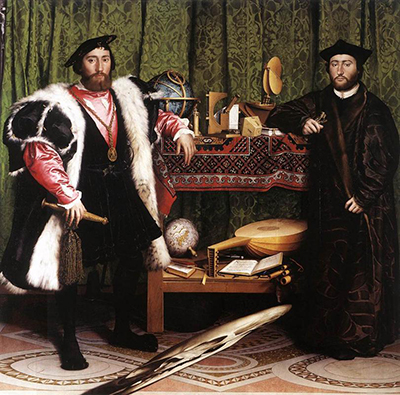
1532 [5]The Ambassadors
1533 [6]Contents
- The judge in the More family
- A face built with very little weight
- Cap, collar and the open paper
- A study for a lost gathering
The judge in the More family
Sir John was serving as a justice of the King’s Bench when Holbein drew him; he had held that position since 1520. His approximate birth date places him in his mid-seventies. The inscription at the upper left identifies him through both his profession and his relationship to Thomas. It is an eighteenth-century copy of an earlier identification, rather than writing added at the sitting. [1]
That small line of lettering helps restore the social world around an otherwise isolated head and shoulders. An elderly parent has his own place within the household’s portrait. Knowing who he is changes the balance of the encounter: we can look at the features in their own right while also recognising the older generation of the family.
A face built with very little weight
Start with the eyes. Their pale centres are held by fine outlines, with small dark accents at the lids. The two brows sit lightly above them. Below, the long nose is described through a mixture of contour and faint shadow; the mouth needs only a few strokes to register its uneven line. The hair at either side is sparse and wispy, giving the stronger edge of the cap something delicate to rest against.
Age appears through these particular relationships. The cheek is hollow beside the nose, the skin folds beneath the eyes, and the chin narrows towards the collar. The drawing offers a face to examine without telling us what its owner was thinking. The slight movement at the corners of the mouth might suggest a reserved smile, yet it remains too subtle to settle into a single expression.
Colour contributes as much as outline. In its exhibition account, the Royal Collection explains that Holbein laid dry chalk over a dampened area to suggest the small broken veins in Sir John’s cheeks. [8] The rosy patches are therefore worth attending to alongside the stronger marks. Flesh emerges through changes in tone and texture, without enclosing every form.
Watch: Holbein’s portraits and working methods
Explore museum films on Holbein’s drawings, painted portraits and close-looking details.
Hans Holbein at the court of Henry VIII
A Royal Collection Trust film exploring Holbein’s work at Henry VIII’s court.
Watch on YouTubeCap, collar and the open paper
The cap has a quite different density. Its broad dark shape tilts across the top of the head, with creases and overlapping edges giving it volume. Below, the fur spreads beyond the face on both sides. Short strokes break its outer contour into bristles, while warmer, softer passages fill the collar’s interior. The narrowing ends lead the eye down towards the bottom of the sheet.
Much of the garment beneath remains lightly indicated. At the left shoulder, long lines establish the fall of the fabric without covering the paper. This uneven distribution of detail gives the drawing its rhythm: dark cap, pale face, warm collar, then an increasingly open lower area. The viewer can move between a convincing presence and the economical marks that construct it.
A study for a lost gathering
The sheet belongs to the preparations for Sir Thomas More and his Family . Holbein’s group painting is lost, while a composition drawing survives in Basel. [1] The Royal Collection’s exhibition account connects the individual sitters’ poses with the arrangement being developed for that larger work. [8]
Seen alone, Sir John’s slight turn gives the bust an easy asymmetry. Within the family project, that direction also has a compositional purpose: a head must work in relation to other heads, bodies and surrounding space. The study preserves the close attention needed for one person before we consider the demands of assembling a household. Close looking moves us from tiny accents around an eye to a likeness that could take its place among others.
Artworks directory
Explore paintings, drawings, prints and designs, including works without a separate article. Related studies and versions have their own entries; workshop works and copies are labelled. Print designs and series are grouped rather than repeated for every impression.
Frequently Asked Questions
It is a drawing in black and coloured chalks, made as a study for the family portrait. [1]
The face carries subtle modelling and touches of colour, while much of the lower garment is indicated with lines. The distinction is visible on the sheet; its purpose as a preparatory study helps explain why every area did not require the same treatment. [1]
Discussion
Look again at the images and ideas explored in Sir John More by Hans Holbein the Younger. These editorial prompts invite your observations.
Reader Insights
Compare the cap’s firm outline with the soft edges of the cheek and the broken contour of the fur. Where does each texture become convincing?
Does the expression change as you move your attention from the pale eyes to the corners of the lips?
Consider how this gently turned head might function beside other people. What changes when you think of the sheet as part of a family portrait?
Join the Conversation
Which detail first makes Sir John feel present to you: the eyes, the mouth, the fine hair or the weight of the collar?
References
- Royal Collection Trust , Sir John More (c.1451–1530) , c.1526–27, RCIN 912224, collection record. View source .
- Kunstmuseum Basel, Bildnis des Bonifacius Amerbach, 1519, inventory 314 (in German) . View source .
- Kunstmuseum Basel, Der tote Christus im Grab, 1521–22, inventory 318 (in German) . View source .
- The Frick Collection, Sir Thomas More, 1527, accession 1912.1.77, collection record . View source .
- Gemäldegalerie Berlin, Georg Gisze . View source .
- Susan Foister, The Ambassadors, The German Paintings before 1800 (2024) . View source .
- Susan Foister, Christina of Denmark, Duchess of Milan (2024) . View source .
- Royal Collection Trust , Holbein at the Tudor Court , exhibition text, “Die Familie von Thomas More, 1526–27”, PDF page 11 (in German). View source .
- Royal Collection Trust , John More , c.1526–27, RCIN 912226, collection record. View source .
- Würth Collection, Holbeins Schutzmantelmadonna, inventory 14910, current owner account (in German) . View source .
- Metropolitan Museum, Dance of Death series . View source .
- Kunstmuseum Basel, Bildnis der Frau des Künstlers mit den beiden ältesten Kindern, about 1528–29, inventory 325 (in German) . View source .
- Kunsthistorisches Museum Wien, Next Generation, Jane Seymour, about 1536–37, inventory 881 (in German) . View source .