by
Tom Gurney
Tom Gurney BSc (Hons) is an art history expert with over 20 years experience
Email:
tomgurney1@gmail.com
/ Phone:
+44 7429 011000
The Body of the Dead Christ in the Tomb: Introduction
A long white cloth runs beneath a body that almost fills its stone enclosure. The head lies at the left, the feet reach towards the right wall, and there is scarcely room above the chest. Christ's mouth and eyes remain open. His near hand, darkened around its wound, rests against the cloth at the front edge. No mourner stands between that body and the person looking at it.
Hans Holbein the Younger's The Body of the Dead Christ in the Tomb , painted in 1521–22, is in the Kunstmuseum Basel. [1] Its severity begins with these simple arrangements. The painting gives us a place from which to look, but no accompanying figure who shows us how to feel. Compassion, religious recognition, resistance and unease may arrive together. The narrow compartment holds the body still while the eye moves from one end to the other, trying to take in a death that refuses to become an abstract idea.
Centuries later, Fyodor Dostoevsky made a copy of this painting part of the troubled world of The Idiot . That literary afterlife is powerful, but the picture has more to offer than an illustration of a novelist's doubts. Its painted space, altered inscription and possible connection with a family memorial open different approaches to the same unsettling encounter.
At a Glance
- Artist Hans Holbein the Younger.
- Title The Body of the Dead Christ in the Tomb ; also called The Dead Christ in the Tomb .
- Date 1521–22.
- Medium Oil on limewood.
- Dimensions 32.4 × 202.1 cm.
- Collection Kunstmuseum Basel, Amerbach-Kabinett, inventory 318. [1]
- Subject Christ's body after the Crucifixion, laid inside a narrow tomb.
- Original purpose Uncertain; Christian Müller proposed a connection with the Amerbach family memorial. [2]
- Literary reception A copy appears in Dostoevsky's The Idiot , in passages involving Myshkin, Rogozhin and Ippolit. [3]
This work across Hans Holbein the Younger’s career
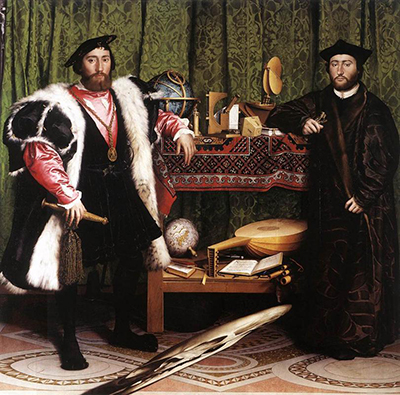
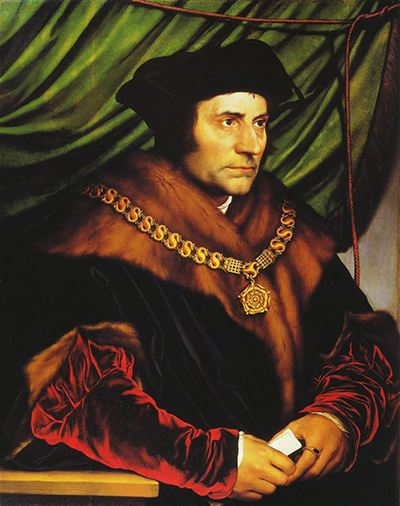
Sir Thomas More
1527 [5]Georg Giese
1532 [6]The Ambassadors
1533 [7]Contents
- A body seen at close quarters
- The face, the hand and the white cloth
- Between burial and Resurrection
- Why the painting carries two dates
- A memorial for the Amerbach family?
- Dostoevsky's encounter in Basel
- The painting in The Idiot
- Looking again after the novel
A body seen at close quarters
The first surprise is the amount of space a human body occupies. Holbein presents it almost completely sideways. There is no long recession towards the feet and no crowd around the head to break the outline into smaller episodes. The principal movement is across the painting. Shoulder, waist, thigh, knee and ankle form an uneven horizontal sequence, held between the dark upper boundary and the pale cloth below.
Those boundaries are firm, but the body is full of variations. The rib cage rises, the abdomen falls away, the hip lifts again. The legs extend without becoming two neat parallel lines. Near the right edge, the feet turn upwards and overlap, their toes bringing a more intricate silhouette into the simple rectangular space. At the other end, loose hair spills across the cloth. These small departures keep the horizontal figure uneven and particular.
The recess is shallow enough to seem within reach. Its right end can be read as a separate plane; the back wall lies close behind the flesh. The ceiling presses down visually, leaving a low strip of darkness above the higher parts of the body. The painting offers little of the breathing room that a landscape, distant architecture or open sky might provide. Everything needed for the encounter lies within a small vertical interval.
At the front, the cloth catches on the ledge and falls in irregular folds. Its edge is especially significant because it marks a boundary shared by two kinds of space. Behind it lies the painted tomb. In front of it stands the viewer. The hand comes close to that division. We can follow its contour without having to imagine entering a distant scene, yet the ledge keeps it inaccessible. Proximity does not lead to contact.
A reproduction can obscure how strongly these relationships depend on scale. On a small screen, the work may become a thin strip surrounded by empty space. The body then appears miniature, and the viewer can survey it all at once. Try following it slowly from the head to the feet instead. The face, chest and injured hand each demand a pause. The complete body becomes something assembled through successive acts of attention.
There is also no figure inside the tomb who looks back at us. The open eyes belong to the dead man; they establish no exchange of recognition. No attendant guides the eye towards a particular wound. This gives looking an awkward independence. We choose where to pause, and that freedom can feel less comfortable than a composition in which mourners have already supplied the appropriate gestures.
The pressure begins with this spare organisation of space. A narrow box, a stretched body, a pale strip of cloth and a handful of darker marks make it difficult to pass over the figure as a familiar religious sign.
The face, the hand and the white cloth
The face is turned sufficiently towards us to be visible, but it does not offer the composure of a sleeping face. The mouth opens beneath the moustache. The eye is exposed under a heavy brow. Hair spreads towards the left edge, and the neck carries the head back towards the raised chest. Across these few inches, flesh, hair, mouth and eye change sharply in colour and texture.
There is a particular discomfort in the survival of features associated with life. An open mouth usually suggests breathing or speech. An open eye usually promises sight. Here neither expectation is fulfilled. The painted features remain available to scrutiny while the person they belong to is beyond response. The viewer supplies the ordinary associations and then encounters their failure.
Holbein does not dissolve the rest of the body into shadow. Light articulates the shoulder, the long upper arm and the prominent structures of the chest. The abdomen is hollowed, and the transition from rib cage to waist is abrupt. A small, dark wound interrupts the side. It does not need to spread across a large area to matter: the surrounding flesh gives the interruption its force.
The near arm extends along the body towards the centre of the panel. It makes a second long line inside the larger outline, connecting shoulder and hand. The wrist narrows before the hand expands into a cluster of bent fingers. A darker patch marks the wound on its back. The fingers are neither laid out for inspection nor closed into a simple fist. Their uneven arrangement makes this a particular hand, difficult to reduce to an emblem.
The hand also sits where several visual systems meet. Its darkened colour differs from the warmer length of the arm. Its fingers overlap the pale cloth. Behind it, the fabric around the hips gathers into tighter folds. Farther right, the legs take up the horizontal movement again. This crowded central area becomes a hinge between the exposed torso and the long stretch towards the feet.
White fabric appears in two roles. The cloth around the hips covers the body, while the larger sheet beneath it receives the body's weight. The first is bunched and drawn close; the second stretches along the ledge, gathering into a rhythm of small vertical falls. They belong to the same pale family of colour, but their folds make their functions legible. Covering and supporting are different acts, even when no living hand remains to perform either.
The sheet's pale surface also makes the darker flesh easier to see. Beneath the head, hair separates into strands against it. Beneath the hand, the folds register the fingers' contours. Near the feet, the cloth gathers again as the available space runs out. Its continuity links parts of the body that the eye otherwise encounters separately.
This cloth can carry an emotional association with care, although the painting does not show who arranged it. Someone has laid out the body; the surviving scene contains the result of that action. The absence of attendants therefore does not erase every suggestion of human involvement. It leaves care visible through an object, while withholding the people who might explain or soften what we see.
Colour helps bind the enclosure together. The walls have subdued brown and greenish tones; the flesh moves between pale illumination and darker, cooler areas. Against these, the cloth is conspicuous without becoming a brilliant theatrical spotlight. The painting's muted range encourages attention to slight differences. The wound on the hand, the opening of the mouth and the darkness beneath an edge can carry considerable weight because so little competes with them.
None of these observations requires a diagnosis of the body or a story about a particular model. What matters pictorially is the distribution of colour, the exposure of the face and the tension between the figure's overall stillness and its many uneven contours. Holbein makes death visible through the stubborn particularity of a body.
Between burial and Resurrection
The subject occupies an interval within the Christian story. Christ has died, but the Resurrection has not been represented. A viewer may know the story's outcome while contemplating this moment. Showing death does not, by itself, tell us whether the painter or the intended viewer believed death had the final word.
The Gospel of John gives a useful point of reference. After Jesus' death, a soldier pierces his side. Joseph of Arimathaea obtains permission to take the body, and Nicodemus brings spices. Together they prepare it with linen and place it in a new tomb in a garden. These passages describe people acting around the body, with practical urgency and care. [9]
Holbein's image isolates the body from that activity. Joseph and Nicodemus are absent, and the cloth leaves the greater part of the figure exposed. There is no garden to establish a location beyond the recess. The viewer meets the result of burial without being taken through its narrative stages. This is one reason the picture can feel suspended: action has stopped, but the body remains before us.
John's next chapter begins with Mary Magdalene finding the tomb open. Peter and another disciple encounter the linen cloths without the body; Mary then sees angels and, eventually, recognises the risen Jesus. Later in the chapter, wounds become signs through which the risen Christ is identified, including in the encounter with Thomas. [10] In that sequence, an occupied tomb, an empty tomb and a living body bearing wounds have different meanings.
Here the tomb is occupied. Holbein has given the body enough visibility to prevent the viewer from hurrying towards the empty space of Easter morning. For someone contemplating the Passion, that delay can make the reality of death more insistent. For someone approaching without religious belief, the same arrangement can make the image feel closed around mortality. The physical details remain the same; the larger story brought to them differs.
The absence of a painted Resurrection should therefore remain an absence, open to interpretation. It need not be converted into a hidden declaration of disbelief. Equally, it would be too easy to explain away every disturbing detail as a reassurance that the viewer has merely failed to recognise. The picture allows the body to be difficult. Knowledge of what comes next in the Gospel does not make the exposed eye or wounded hand pleasant to contemplate.
This is a useful distinction when setting the work beside Holbein's Passion Altarpiece . A sequence of episodes carries a reader onwards through successive events. A single body held in a long enclosure asks for another kind of duration. Looking becomes an act of remaining with one moment, and that moment contains no visible answer to the question of what will happen next.
Watch: Holbein’s portraits and working methods
Explore museum films on Holbein’s drawings, painted portraits and close-looking details.
Hans Holbein at the court of Henry VIII
A Royal Collection Trust film exploring Holbein’s work at Henry VIII’s court.
Watch on YouTubeWhy the painting carries two dates
The present niche emerged through revision. X-rays and an apparently contemporary silverpoint copy, now unlocated, indicate an earlier curved covering, with signature and date near the feet. In the squared enclosure Holbein inscribed 1522, then painted over the final numeral to leave 1521. The current museum record therefore dates the work 1521–22. Why the earlier year was retained is uncertain. [1]
The change is worth imagining while looking at the finished painting. A curved covering would have supplied an arching movement above the body. The straight ceiling now repeats the horizontal direction of the ledge, closing the figure between two long boundaries. The right wall ends that movement decisively. The enclosure we see is a considered arrangement, not an inevitable container supplied by the subject.
The inscription belongs to the space as well. Its position at the right makes the eye travel beyond the body towards a surface that can hold writing. The painted wall momentarily behaves like a material object that someone could mark. Perspective, flesh and lettering thus share the same small fictive world.
The surrounding architectural frame is probably early nineteenth century. A separate paper strip bearing the Crucifixion title and small angels may already be reflected in an inventory addition of 1585/87. [1] The body and niche form one painted field; the surrounding material has its own history. A decorated surround can restore religious signs to an encounter that, within the panel itself, is remarkably bare.
A memorial for the Amerbach family?
Christian Müller proposed that Bonifacius Amerbach commissioned the panel for a family epitaph in the small cloister of Basel's Charterhouse. The surviving inscription slab's width supports a reconstruction with the painting above it. Müller's evidence includes Amerbach's 1520 correspondence about an epitaph for his parents and brother Bruno. He also related the painting's perspective to a raised position and the confined viewing space of the cloister. This remains a reasoned reconstruction, not a surviving installation plan. [2]
Such a setting would bring the dead Christ into proximity with named human dead. A viewer could read about members of a family and then look towards a body central to Christian belief. The painting's long horizontal form would acquire a practical architectural role above an inscription. Its relationship with mortality would be both particular and shared: one family's commemoration beneath the figure of Christ.
An epitaph also changes the pace of looking. Reading names, relationships and dates takes time. Looking upwards afterwards would interrupt that verbal attention with a body that offers no speech. The panel's own lettering would connect the two acts without making them identical. This is one reason Müller's proposal is so suggestive, even though the missing commission prevents certainty about the intended whole.
Amerbach's commemorative planning extended over years. The memorial installed in 1544 carried text and heraldry, without this painting; the panel probably never occupied the proposed position. [2] The idea of a family commission must therefore be kept distinct from a claim that the painting was actually displayed in the cloister.
A further piece of context survives in a recorded loan: on 16 December 1521 Amerbach borrowed Bernhard von Breydenbach's illustrated account of the Holy Land, published in 1486. Basel's exhibition proposed that discussion of Christ's tomb may have helped shape the picture. The loan is documented; a particular conversation with Erasmus, and any instructions resulting from it, remain conjectural. [11]
The appeal of these possibilities lies in the questions they bring into focus. Who would have stood before the panel? How high would it have been? What words or objects would have accompanied it? A painting encountered alone on a museum wall cannot automatically reproduce those relationships. Yet uncertainty about its first setting does not empty the object of history. It makes its present isolation something to consider, alongside the isolation Holbein painted around the body.
The portrait of Bonifacius Amerbach offers another point of entry into this circle. The possible patron of a memorial and the man represented in a portrait can be approached together, while the commission of the Dead Christ remains an open historical question.
Dostoevsky's encounter in Basel
Fyodor and Anna Dostoevsky visited Basel in 1867. Anna's diary and later memoirs preserve different emphases: her diary describes her own horror alongside her husband's admiration and his attempt to see more closely from a chair; the memoir recalls his prolonged absorption and her fear that his agitation might precede a seizure. These are separate accounts, not a single verbatim record of the visit. [11]
Even in this brief evidence, looking is not one uniform experience. Two people stand before the same painting, and its truthfulness need not produce the same pleasure, pain or judgement. The desire to move closer can coexist with another person's wish to leave. The image's severity creates a shared occasion without guaranteeing a shared response.
Anna's accounts also return attention to the practical encounter with a museum object. The height of a painting, the availability of a chair and the distance from which a face can be examined affect what looking feels like. A famous response does not happen in an abstract space. It belongs to a room, a body and a particular moment of attention.
Dostoevsky's novel The Idiot was published in 1868–69. [11] Within it, the painting becomes a copy in Rogozhin's house. This is already a transformation. A work encountered while travelling is relocated to the private rooms of a fictional character, where it becomes part of conversations about belief, suffering and the possibility of trusting another person.
The distinction between the Basel visit and the novel is essential. Anna tells us something about an encounter she witnessed. The novel stages other encounters through invented voices. Neither supplies a statement from Holbein about why he painted the body as he did.
The painting in The Idiot
Myshkin and Rogozhin
In Part II, chapter IV, Prince Myshkin passes through Rogozhin's rooms. A long, low painting hangs above a door, distinguished from the less interesting pictures around it by its shape. Rogozhin mentions its monetary value; Myshkin recognises it as a copy after Holbein and recalls seeing the original abroad. The conversation moves abruptly from recognition to a question about belief in God. [3]
In Eva Martin's translation, Myshkin exclaims: “Why, a man's faith might be ruined by looking at that picture!” [3] It is one of the most memorable sentences associated with Holbein, and one of the easiest to detach from its setting. The speaker is a fictional prince in a tense conversation. His startled thought does not amount to a neutral explanation of the painting, still less to a recorded opinion from the sixteenth century.
The conversation continues after that exclamation. Myshkin tells stories that bring belief into contact with violence, deception, maternal affection and trust. He and Rogozhin exchange crosses. [3] The picture has opened a question that their actions and stories keep complicating. A single disturbing image does not make the chapter's thinking stop.
The placement over a door is also effective within the fiction. It makes the picture part of a passage from one room to another. The characters pause beneath it, speak, move on and return to what has been said. The body remains fixed while their relationship shifts around it. A painted scene of stillness becomes a catalyst for speech.
In the next chapter, Myshkin thinks again about Rogozhin's attachment to the image. He interprets the desire to look as a struggle to recover belief. [3] That is Myshkin's compassionate reading of another person, and it gives the picture a second role. The image that might endanger faith can also be the object towards which someone repeatedly turns because faith is needed.
Ippolit's explanation
The longer passage comes in Part III, chapter VI, within Ippolit's written explanation. Gravely ill and preoccupied with his own approaching death, he recalls the copy at Rogozhin's. His account dwells on a body subjected to suffering and asks how the people who loved Christ could have seen such a corpse and still believed in Resurrection. [3]
Ippolit's argument expands far beyond description. Nature becomes a crushing, impersonal power, imagined in Martin's translation as an “enormous mechanical engine of modern days”. [3] This machinery belongs to the nineteenth-century character's language. There is no machine in Holbein's niche. Ippolit has turned the body into evidence for a frightening conception of existence, in which nothing precious is protected from destruction.
His position as a speaker matters. The painting reaches us through a recollection embedded within a document that he reads to others. The reader must attend both to the image he describes and to the distressed person making an argument from it. The force of his words does not oblige us to treat every inference as a judgement endorsed by the novel as a whole.
Myshkin, Rogozhin and Ippolit therefore do different things with the same picture. Recognition, compulsive looking, compassion and philosophical protest gather around it. The literary structure preserves those differences. It gives the painting several lives within a single novel, rather than one final meaning.
Tatyana Kasatkina's 2006 essay challenges the habit of treating the work's place in Russian culture as exclusively a sign of death without Resurrection. She proposes an alternative reading of incipient movement and light, connected with renewal, and stresses the importance of encountering the original. [12] Her interpretation is a modern critical intervention. It offers a counterweight to Ippolit's despair without becoming evidence of Holbein's private intention.
The novel sharpens our awareness of what a viewer brings. Ippolit supplies a theory of nature. Myshkin supplies a concern for the suffering of another person. Rogozhin supplies an attachment he cannot easily explain. Their encounters make the act of looking visible as an activity shaped by need, memory and fear.
Looking again after the novel
After reading The Idiot , the most useful thing to do is look at the panel again without expecting it to repeat the novel's language. The figure is stretched across a narrow space. The cloth is folded, the wall is close, the mouth remains open. These details can support a disturbing experience without collectively spelling out a philosophical proposition.
Notice how much of the image remains carefully ordered. The enclosure is severe, but its planes are legible. The pale sheet runs steadily beneath the uneven body. The central hand draws attention without breaking the long movement towards the feet. Pain and physical vulnerability coexist with a disciplined arrangement of shapes. The painting's capacity to unsettle depends partly on that clarity: it gives the viewer little confusion behind which to retreat.
Look, too, at the distance between a visible feature and the language used to explain it. A lifted contour may be read as tension, the consequence of a body's position or, within an explicitly religious interpretation, the beginning of movement. A pale area can be described before it is assigned a spiritual meaning. Looking closely keeps those possibilities available without pretending they are equivalent kinds of evidence.
At the end of the panel, the feet rise against the wall and the available space closes. Returning to the left, the hair falls onto the sheet beside the exposed face. Between those ends lies the whole body, offered to sustained attention. The strongest encounter may begin with that simple act of returning: seeing another detail, waiting with it, and allowing the difficulty of the image to remain.
Artworks directory
Explore paintings, drawings, prints and designs, including works without a separate article. Related studies and versions have their own entries; workshop works and copies are labelled. Print designs and series are grouped rather than repeated for every impression.
Frequently Asked Questions
It is in the Kunstmuseum Basel, inventory 318. [1]
The museum dates it 1521–22, reflecting changes to the niche and inscription during its making. [1]
Müller proposed an Amerbach memorial connection; no surviving commission establishes it conclusively. [2]
In The Idiot , a copy appears in Rogozhin's house. Myshkin fears its effect on belief, then reflects on Rogozhin's need to look at it. Ippolit later develops a much longer argument about death and nature. These are different fictional responses. [3]
That interpretation cannot be established as Holbein's intention. The picture shows the dead body; viewers have understood its relationship with Christian belief differently. The opposing responses within The Idiot , and Kasatkina's later reading, demonstrate that its reception is not uniform. [3] [12]
Discussion
Look again at the images and ideas explored in The Body of the Dead Christ in the Tomb. These editorial prompts invite your observations.
Reader Insights
The injured hand lies close to the ledge between the painted tomb and the viewer. Consider whether the face or this hand first makes the body feel personally close.
There is no mourner inside the panel. Does that absence leave you more exposed to the body, or give you greater freedom to look without an expected response?
A passage from The Idiot can change the next encounter with Holbein's painting. Notice which details the novel helps you see and which become easier to overlook once its language is in mind.
Join the Conversation
Which part of the painting holds your attention longest: the open face, the wounded hand, the white cloth or the enclosing walls? Describe what you see there, and how it shapes your response to the whole body.
References
- Kunstmuseum Basel , Der tote Christus im Grab , current collection record, inventory 318 (in German). View source .
- Christian Müller , “Holbeins Gemälde ‘Der Leichnam Christi im Grabe’ und die Grabkapelle der Familie Amerbach in der Basler Kartause”, Zeitschrift für Schweizerische Archäologie und Kunstgeschichte 58 (2001), pp. 279–289; especially the reconstruction on pp. 282–286 (in German). View source .
- Fyodor Dostoevsky , The Idiot , translated by Eva Martin, Project Gutenberg eBook 2638; Part II, chapters IV–V, and Part III, chapter VI. View source .
- Kunstmuseum Basel, Bildnis des Bonifacius Amerbach, 1519, inventory 314 (in German) . View source .
- The Frick Collection, Sir Thomas More, 1527, accession 1912.1.77, collection record . View source .
- Gemäldegalerie Berlin, Georg Gisze . View source .
- Susan Foister, The Ambassadors, The German Paintings before 1800 (2024) . View source .
- Susan Foister, Christina of Denmark, Duchess of Milan (2024) . View source .
- The Gospel of John , chapter 19, especially verses 31–42, World English Bible Classic , public-domain translation. View source .
- The Gospel of John , chapter 20, World English Bible Classic , public-domain translation. View source .
- Kunstmuseum Basel , Holbein and Dostoevsky , exhibition wall texts, 2021; including the discussion of Amerbach's book loan and extracts from Anna Dostoevskaya's diary and memoirs. View source .
- Tatyana Kasatkina , “После знакомства с подлинником” (“After Encountering the Original”), Novy Mir , no. 2 (2006) (in Russian). View source .
- Würth Collection, Holbeins Schutzmantelmadonna, inventory 14910, current owner account (in German) . View source .
- Metropolitan Museum, Dance of Death series . View source .
- Kunstmuseum Basel, Bildnis der Frau des Künstlers mit den beiden ältesten Kindern, about 1528–29, inventory 325 (in German) . View source .
- Kunsthistorisches Museum Wien, Next Generation, Jane Seymour, about 1536–37, inventory 881 (in German) . View source .
- Splash image , Hans Holbein the Younger, The Body of the Dead Christ in the Tomb, 1521–22. Oil on limewood, 32.4 × 202.1 cm. Kunstmuseum Basel, Amerbach-Kabinett, inv.318. Image source . Public domain .