by
Tom Gurney
Tom Gurney BSc (Hons) is an art history expert with over 20 years experience
Email:
tomgurney1@gmail.com
/ Phone:
+44 7429 011000
Darmstadt Madonna: Introduction
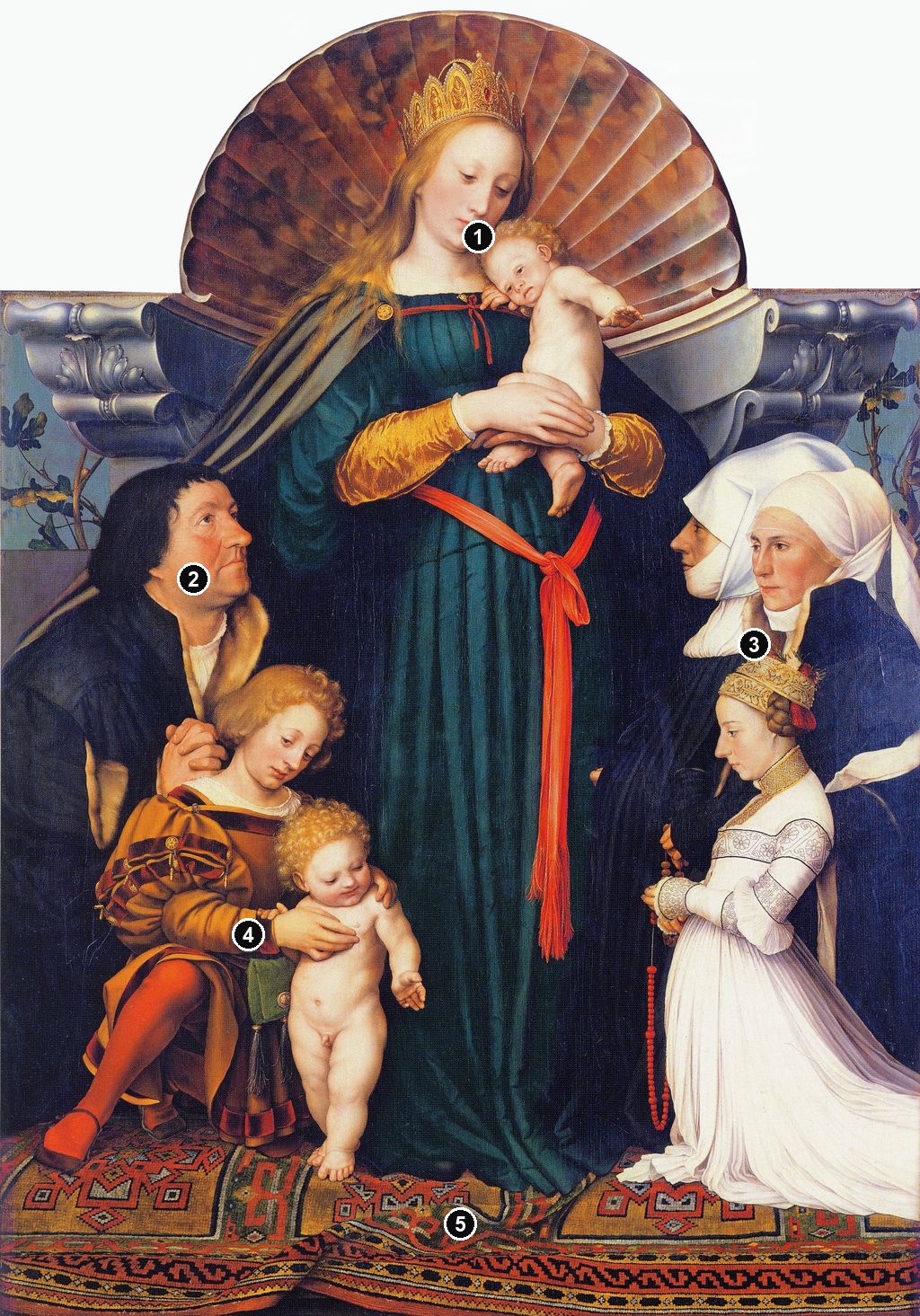
The Virgin’s dark cloak spreads around a family kneeling at her feet. Beneath a great scallop shell, she holds the Christ Child against her shoulder, while a man looks upwards from one side and three female figures gather on the other. Close to the lower edge, a small naked child stands on a richly patterned carpet. His bare foot, the girl’s white dress and the Virgin’s long red girdle bring the scene within touching distance.
Hans Holbein the Younger’s Darmstadt Madonna combines the presence of individual people with an image of heavenly protection. Its fuller title, Madonna of Mayor Jacob Meyer zum Hasen , identifies the Basel patron whose family surrounds Mary. Würth dates the painting to 1525/26 and 1528: it belongs to two phases of work, separated by Holbein’s first stay in England. The original is now in the Würth Collection, displayed in the Johanniterkirche in Schwäbisch Hall. [1] [2]
The familiar geographical name preserves a later chapter in its history. For many nineteenth-century viewers, another painting in Dresden seemed to be the true Holbein. The eventual recognition of the Darmstadt picture as the original became a landmark in the study of art. Before that celebrated test of attribution, this was a family’s devotional painting, built from likenesses, gestures and relationships. [3]
At a Glance
- Artist Hans Holbein the Younger. [1]
- Collection title Madonna des Bürgermeisters Jacob Meyer zum Hasen ; also called the Darmstadt Madonna or Meyer Madonna . [1]
- Date 1525/26 and 1528, according to the Würth Collection. [1]
- Form A painted panel with a semicircular upper section. [1]
- Patron Jacob Meyer zum Hasen, former mayor of Basel. [4]
- Collection Würth Collection, inventory 14910. [1]
- Usual display Johanniterkirche, Schwäbisch Hall, Germany. [1]
- Important distinction The Dresden version is a seventeenth-century copy by Bartholomäus Sarburgh. [5]
This work across Hans Holbein the Younger’s career
Dead Christ in the Tomb
1521–22 [7]Darmstadt Madonna (current article)
1525/26 and 1528, according to the Würth CollectionSir Thomas More
1527 [8]Georg Giese
1532 [9]The Ambassadors
1533 [10]Contents
- A patron Holbein already knew
- The family on either side of Mary
- Mary’s cloak, crown and shell
- Hands, textiles and the folded carpet
- Drawings and a painting revised
- Devotion in a changing Basel
- Dresden, Darmstadt and the Holbein dispute
- From a family possession to Schwäbisch Hall
- Annotated details
A patron Holbein already knew
Jacob Meyer zum Hasen had commissioned Holbein long before this Madonna. In 1516 the artist painted the paired portraits of Meyer and his second wife, Dorothea Kannengiesser, now in the Kunstmuseum Basel. The museum connects that commission with Meyer’s election as mayor on 24 June 1516. His marriage to Dorothea had taken place by 1513, so the portraits should not be described as wedding pictures made in the year of the election. [12]
That earlier commission matters because the Madonna was made within an established relationship. Meyer did not appear before Holbein for the first time as an anonymous kneeling donor. The artist had already studied his face and placed him beside Dorothea in a carefully constructed architectural setting. About a decade later, the same patron entered a much more ambitious arrangement, sharing one painted space with the Virgin and Child. [1] [12]
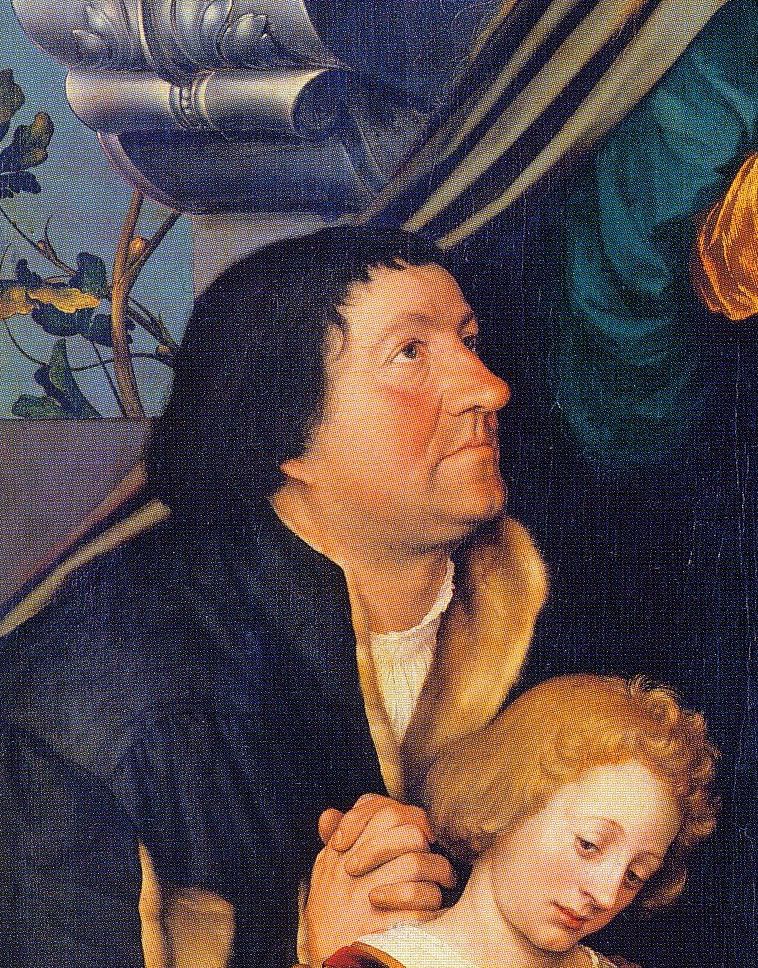
The change of format also changes what a likeness does. A paired portrait invites comparison between husband and wife: their dress, their poses and the way the two panels belong together. In the Madonna, Meyer’s face participates in prayer. His hands join below his chin; his head tilts upwards; the pale fur at his collar brings the warm colour of his skin out of the dark coat. His body occupies the side of the painting, while his attention carries the eye towards its centre.
The difference between social position and bodily posture is striking. The man whose name identifies the work kneels lower than Mary. Nevertheless, Holbein gives him a substantial head and recognisable features. His nose, jaw and compressed mouth remain specific. The portrait does not dissolve into a conventional figure of devotion.
The effect is intimate without becoming casual. Meyer is close enough to Mary’s cloak to seem included within its shelter, yet no familiar domestic exchange takes place. He does not address the other figures, turn towards the spectator or display an object explaining his status. His folded hands establish his role immediately. The picture gathers the patron’s family around a sacred presence, while retaining the outward restraint of people absorbed in prayer.
The family on either side of Mary
Meyer kneels on the viewer’s left. On the right, the traditional identification places his deceased first wife, Magdalena Baer, furthest back; Dorothea, his second wife, in front of her; and their daughter Anna at the front. Magdalena had died in 1511. The inclusion of both wives therefore brings together people who could not have posed as this living group. [4] [12]
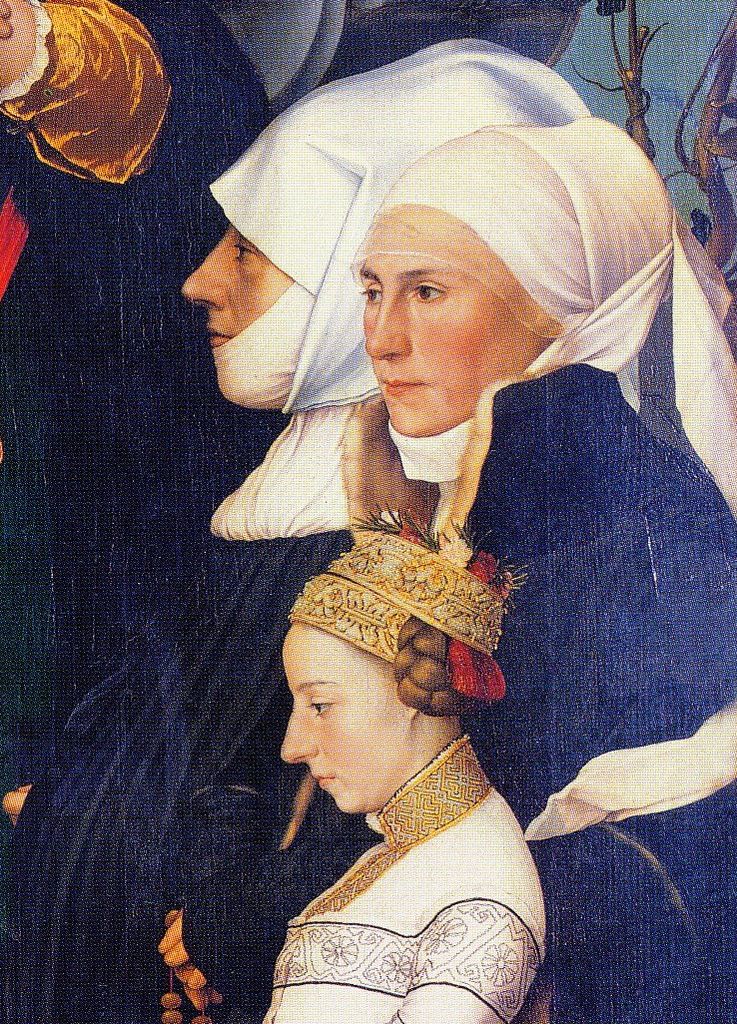
Look first at the women’s head coverings. The rear figure appears in sharp profile, her face partly enclosed by white cloth. Dorothea’s face is turned more towards the viewer, under another broad white headdress. Anna’s smaller head is framed by braided hair and an elaborate gold-coloured ornament. These successive shapes make the three figures readable even though they are compressed into a narrow area.
The difference in their clothing carries across the whole right side. Against the women’s dark garments, Anna’s white dress forms a broad, luminous foreground. Its folds fan towards the edge, and bands of ornament cross her sleeves and bodice. Her hands meet around a string of beads, whose red lower section hangs down beside the dress. The face is quiet and concentrated; the costume supplies much of the movement.
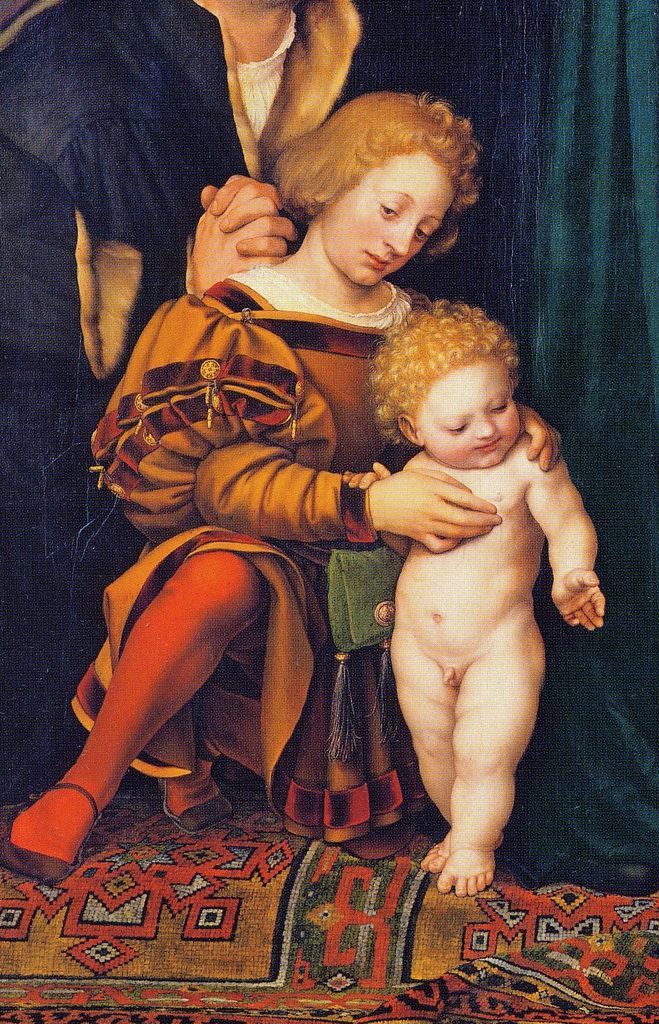
The left foreground poses a different problem. A richly dressed young figure holds a naked child upright. Their identities remain debated. Fritz Endemann’s discussion warns against simply calling them Meyer’s sons and considers sacred identifications, including the infant John the Baptist and an angel. Those proposals should retain their uncertainty. [4]
Visually, the pair helps the painting hold its balance. The older figure’s ochre clothing and red stockings answer Anna’s brilliant white, while the standing child provides a small vertical form beside Mary’s much larger one. Their bodies extend towards the viewer more strongly than the kneeling adults behind them. They also introduce physical support: an arm circles the little child’s torso, and a hand steadies him beneath the shoulder.
The two infants are especially easy to confuse in a small reproduction. Christ is the child held by Mary, high in the composition. The second naked child stands near the carpet below. Their positions generate an exchange across the picture, but their bodies behave differently. Christ reclines against his mother; the lower child bears his own weight, with help. Above, the head rests near Mary’s neck; below, the curls bend forward over the chest.
Recognising the family does not require a name for every figure. Holbein makes the group legible through differences of age, position, dress and attention. The remaining uncertainty changes how we describe the lower pair, while leaving their visible contribution to the composition intact.
Annotated Details from Darmstadt Madonna
The numbered points identify visible features discussed in this article. Return from each detail to the whole composition. Hans Holbein the Younger, Madonna of Mayor Jacob Meyer zum Hasen, also called the Darmstadt Madonna, 1525/26 and 1528. Würth Collection, inventory 14910; Johanniterkirche, Schwäbisch Hall. Würth Collection; reproduction from Müller/Kemperdick et al.2006 via Wikimedia Commons. Image source . Public domain .
Details from DARMSTADT MADONNA
Compare the cropped details with the complete images above. Notice how their colours, shapes and positions contribute to the larger compositions.
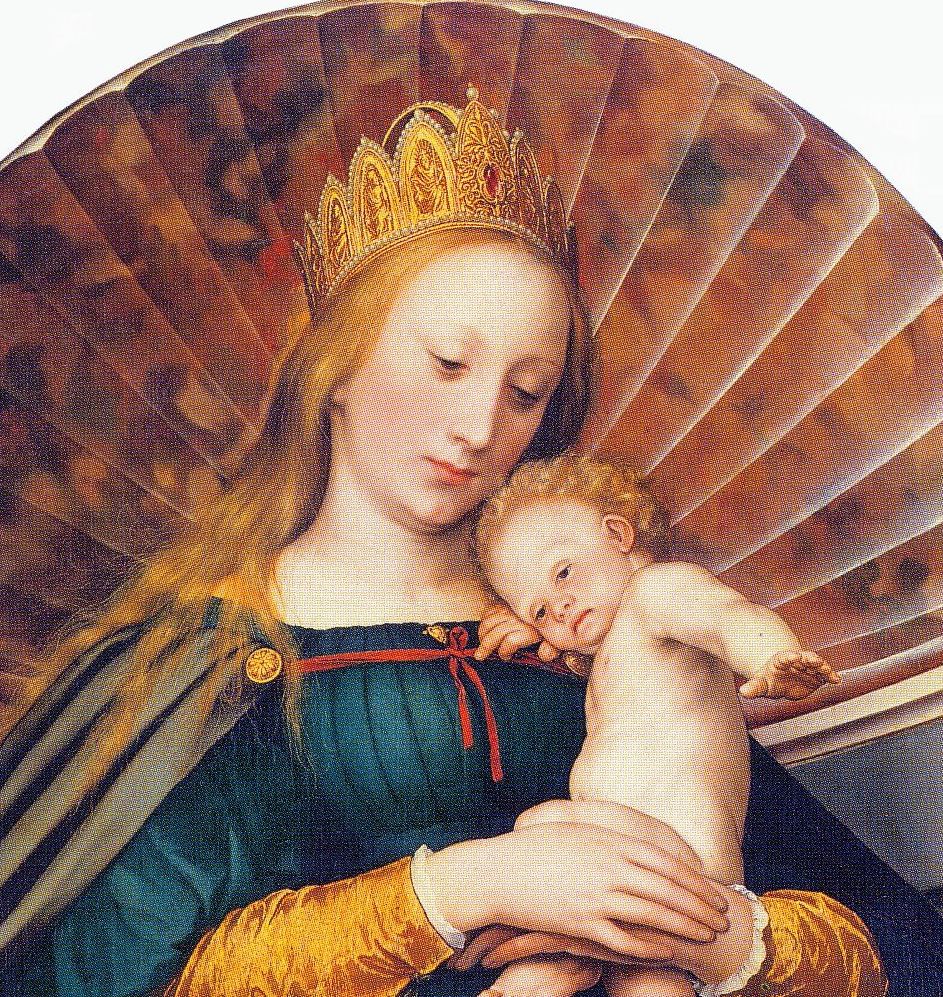
Mary and the Christ Child
The crown, lowered face and reclining child gather beneath the scallop shell. Follow the different directions of the mother’s head and the child’s extended arm.
Meyer at prayer
Meyer looks upwards, his hands joined below his chin. The fur collar brings warm skin and pale hair into view against the dark cloak.
The women of the donor family
Overlapping white head coverings and Anna’s ornamented hair distinguish three heads within a narrow space. Compare their directions and the intervals between them.
The two younger figures
One young figure supports the naked child below. Their identities remain debated; the contact of hands and bodies can be followed without settling those names.
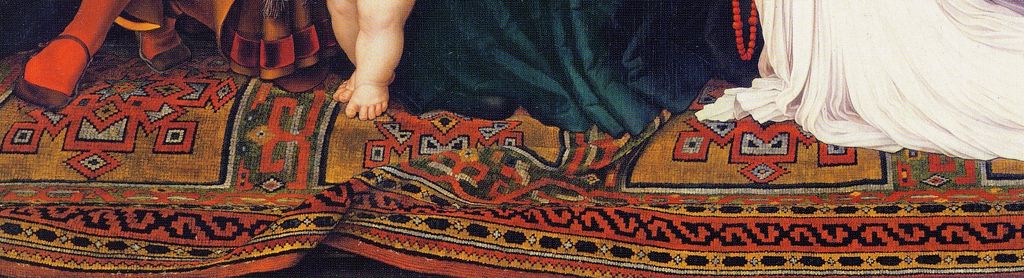
The folded carpet
The carpet’s repeated shapes change direction as the fabric rises into a fold. Feet, drapery and textile meet along the foreground.
Mary’s cloak, crown and shell
Mary dominates the centre from crown to hem. Her blue-green dress descends in long folds that make an almost continuous column. The dark cloak spreads outwards over the kneeling figures, gathering their varied silhouettes into a single enclosure. The owner presents the picture as a Schutzmantelmadonna , or Virgin of Mercy: an image in which Mary’s mantle gives protection. [1] [13]
Here that protection has a physical delicacy. The cloth does not form a symmetrical tent, held wide by assistants. Its boundaries are interrupted by heads, shoulders and the niche behind. On Meyer’s side, the sweep of dark fabric seems to continue across his back. On the women’s side, broad white headdresses stand out against it. Shelter is expressed through overlapping bodies and clothing.
Mary’s crown introduces another kind of presence. Its pointed, gold-coloured forms rise against the shell, above a face whose eyelids are lowered. The head inclines towards the child. Crown and gesture hold together her exalted status and the familiar action of a mother supporting an infant. No abrupt change of style separates royal ornament from skin or hair: each is given a tangible surface.
The shell makes a vast frame around that small exchange. Its ribs spread from behind the Virgin’s head and shoulder towards the curved top of the panel. Pale edges catch the light, while the recesses between them deepen into brown. The niche gives Mary a monumental setting, but its closeness prevents it from becoming a distant architectural backdrop.
At either side, stone brackets and curling mouldings introduce harder, cooler shapes. Leaves rise against the flat areas beside them. The painter moves from flesh to hair, metal, stone, cloth and vegetation within a remarkably confined field. Each substance has a different way of receiving light.
The upper curve and the long central dress also give the whole painting a memorable outline. The arch gathers the head and child; below it the composition expands into the kneeling group. Small irregularities keep that structure alive: Mary inclines one way, the infant stretches another, and the donors occupy unequal amounts of space. Symmetry supplies the framework, while bodily differences keep the people distinct.
The red girdle brings a bright, winding line through the centre. It crosses Mary’s waist, knots at the front and hangs almost to the carpet, breaking the long dark folds. Following it downwards leads the eye from the mother and child towards the place occupied by the family. Colour makes that journey before a viewer has worked out the identities.
Hands, textiles and the folded carpet
The hands give this still gathering much of its activity. Meyer presses his palms together. Mary supports Christ with broad, overlapping hands. Anna holds her beads close to her body. The young figure on the left steadies the standing infant. Prayer and care take different forms, but both involve the meeting of one surface with another.
Mary’s hands are particularly conspicuous because her sleeves shine around them. The warm gold-coloured cloth is creased and broken by highlights; against it, the skin looks smooth. One hand crosses beneath the child’s body, its long fingers extending towards the other sleeve. The clasp is secure, and the child’s legs hang at different angles below it.
Christ’s outstretched arm opens a small space above the women’s heads. His other arm bends closer to Mary. The inclination of his head, the exposed neck and the relaxed legs prevent the body from becoming a rigid emblem. At the same time, his raised position allows the gesture of his extended hand to be read across the entire group.
The handling of textiles distinguishes the figures as clearly as their faces. Meyer’s coat is dark, broad and weighty, with fur that breaks its edge. The younger figure’s sleeves are elaborately slashed and tied. Anna’s sleeves are patterned and fitted, while the skirt widens around her knees. Mary’s gown has the longest uninterrupted folds. These differences create an ordering of surfaces without making everyone wear the same ceremonial costume.
The carpet is the most insistent patterned surface. Bands of red, black, ochre and green run along the bottom of the composition. Geometric forms repeat, then change direction as the fabric turns over a raised edge. Near the centre, the carpet lifts into a conspicuous fold. That small disturbance keeps the floor from becoming a flat decorative strip.
The standing child’s toes rest close to the pattern, giving the eye a point at which painted flesh meets the complicated textile. Beside him, the red stocking and dark shoe of the older figure lead towards the lower corner. Across the painting, Anna’s white skirt spreads over the same ground. Three very different forms establish the foreground: exposed skin, fitted clothing and abundant drapery.
These details reward attention as material observations before receiving a theological meaning. The fold gives the carpet thickness; the bead string records a devotional action; the hands demonstrate support and prayer. Their persuasiveness comes partly from how readily they can be understood through ordinary experience. The sacred gathering acquires immediacy through bodies that touch, cloth that creases and a surface on which a foot can stand.
Watch: Holbein’s portraits and working methods
Explore museum films on Holbein’s drawings, painted portraits and close-looking details.
Hans Holbein at the court of Henry VIII
A Royal Collection Trust film exploring Holbein’s work at Henry VIII’s court.
Watch on YouTubeDrawings and a painting revised
The Würth dating, 1525/26 and 1528, preserves the painting’s development across two periods of Holbein’s work. The Städel’s account likewise places its making before and after his first English stay of 1526–28. A single date such as 1526 is therefore useful shorthand, but it conceals the return to an existing composition. [1] [2]
A surviving drawing of Meyer in Basel belongs to about 1525/26. The museum records black and coloured chalk, leadpoint at the contours and incised lines on a light-green prepared ground. The sheet measures 38.3 × 27.5 centimetres and bears inventory number 1823.140. It is a separate object from the earlier study associated with the 1516 portraits. [14]
Those material details tell us why a portrait drawing deserves attention in its own right. Coloured chalk can distinguish the warmth of a face from its contours; a prepared ground supplies a middle tone from which lighter and darker passages emerge. The record of incised lines also directs attention to the sheet as a worked surface. It should not be treated as a transparent window onto one uninterrupted sitting or an exact transcript of every stage in the painting. [14]
Endemann describes specific changes to the female group: Magdalena’s profile was added behind the others, Dorothea’s chin covering was removed, and Anna’s loose hair gave way to her elaborate headdress. He leaves the precise purpose of the alterations unresolved. [4]
The changes matter because they affect relationships, not merely accessories. Bringing the deceased first wife into the group broadens the family’s presence across time. Altering the younger woman’s appearance changes the balance between her small face and the rich shapes around it. What now appears to be a settled, continuous gathering contains decisions made at different moments.
Basel’s museum reports that X-ray and infrared examinations during the 1950s confirmed alterations and correspondences with the surviving chalk studies. That is evidence about making and revision; it does not supply a complete account of every intervention the panel has undergone. [3]
The finished picture’s clarity was achieved through change. The carefully fitted female heads, the enclosing cloak and the crowded foreground are the result we encounter, while drawings and technical examination preserve evidence of an earlier state beneath that apparent unity.
Devotion in a changing Basel
The painting’s date places it near a decisive transformation in Basel’s religious life. The Städel connects Holbein’s later Basel years with the iconoclastic upheavals of 1528/29 and the Reformation’s challenge to the use of religious images. Endemann reads Meyer’s commission in relation to the patron’s continued adherence to the old Catholic faith. [2] [4]
That context sharpens what the painting presents. Mary stands crowned and physically close to the donor family. Their prayer is directed within a scene in which the Virgin and Child share their space. The image gives substantial painted form to an encounter that depends upon faith. For a patron attached to Marian devotion, its beauty and its religious function could work together.
The painting supplies no straightforward narrative event. There is no road to Bethlehem, stable or identifiable episode of Christ’s childhood. The donors kneel in the presence of mother and child. Their clothes belong to a recognisable human world, while the enormous shell and concentrated arrangement create a setting apart from everyday life.
The faces also resist a simple account of what everyone sees. Meyer looks upwards, but the women keep their attention lower. Mary’s own gaze is lowered towards Christ. The figures do not exchange the sequence of looks that might bind a conversational scene together. Their closeness is bodily and compositional; inward attention remains individual.
The original destination is uncertain. Endemann discusses the possibility of a private chapel at Meyer’s Gundeldingen property, while Basel’s museum also treats the painting’s function and original architectural setting as questions. A precise reconstruction should remain a proposal. [4] [3]
The devotional force is visible without resolving that question. Holbein supplies a compact space where a family can gather around a sacred figure, and where the viewer can approach the same foreground. The carpet reaches the lower edge; the child stands just above it; the dark dress rises towards Mary’s hands. The painting makes approach possible through its arrangement of forms, even as the reserved faces hold something back.
Dresden, Darmstadt and the Holbein dispute
The two versions acquired very different reputations. Dresden bought its painting in Venice in 1743 through Francesco Algarotti. The appearance of the other version in 1822 raised an increasingly public question: which painting was Holbein’s original? The dispute reached its decisive encounter at the Dresden exhibition of 1871, where the two panels were shown together and specialists met at a three-day congress. The Darmstadt picture was recognised as the original. [5]
Dresden’s museum now identifies its painting as a copy made by Bartholomäus Sarburgh in 1635–37. It dates the establishment of that more specific attribution to 1910. These are distinct developments: recognising the original and identifying the copyist did not happen at the same moment. [5]
The history is a useful reminder that looking and attribution are related but different activities. A viewer may admire a painting for its calm, finish or proportions. Establishing who made it requires comparison and historical evidence. A version that has become familiar through display and reproduction can accumulate an authority of its own.
The Dresden picture was particularly consequential because its reputation had grown under Holbein’s name. Basel’s account explains how the comparison with Raphael’s Sistine Madonna helped turn it into a statement about the standing of northern European painting. Taste and cultural pride became entangled with the question of authorship. [3]
For the modern viewer, the point is not to replace one unquestioning preference with another. The distinction allows each object to be understood more accurately. The Würth panel records Holbein’s invention and revisions; the Dresden painting records a later painter’s response to that invention and a long history of mistaken identification.
It also changes how reproductions should be read. A caption saying only “Holbein’s Madonna” can conceal which object is being shown. The curved top, the donor arrangement and the shell make the subject easy to recognise, but recognising the subject is not the same as identifying the physical painting. Its collection and attribution belong beside its title.
The Johanniterkirche original can then be approached on its own terms: its compressed gathering, heavy central folds, vivid girdle and uneven distribution of heads. These are the forms through which Holbein assembled the encounter. Their interest survives the attribution dispute and is easier to see once that dispute no longer obscures the painting itself.
From a family possession to Schwäbisch Hall
The name Darmstadt Madonna records a journey far from Basel. The Hessen Landesarchiv traces the original through the Amsterdam art market to Paris, where Prince Wilhelm of Prussia bought it in 1822. He gave it to his wife Marianne of Hessen-Homburg; inheritance brought it into the Hessen-Darmstadt family. It was in Darmstadt from 1852 and later displayed in the Schlossmuseum. [15]
The painting’s movement continued in the twentieth century. After the Second World War it was lent to Basel from 1947 to 1958. The loan became linked to an unusual arrangement for Darmstadt children to take recuperative holidays in Switzerland. The children became known as the Madonnenkinder . [15]
Basel’s account records annual groups of twenty children travelling to Davos in 1953–58. An album they gave the museum in 1954 preserved drawings and accounts of their holidays. [3]
This episode gives the painting’s history a human scale different from the arguments over ownership and attribution. A work that shows a family seeking protection became associated with practical care for children centuries later. That connection belongs to its reception; it need not be projected backwards as something Holbein anticipated. The painting acquired new relationships through the people who looked after it and lived alongside its temporary display.
The original was subsequently lent to Frankfurt’s Städel Museum in 2004–11 before entering the Würth Collection. Its established home is now the Johanniterkirche in Schwäbisch Hall. [15]
The building supplies another layer of context. Würth opened the restored former church as a museum in 2008, bringing together paintings and sculpture from the late Middle Ages and early modern period. The Madonna occupies a setting in which religious objects can again be encountered within ecclesiastical architecture, although the building operates as a museum. [1] [13]
The current collection title brings the patron back into view: Madonna of Mayor Jacob Meyer zum Hasen . “Darmstadt” remains useful because it distinguishes the original’s history from Dresden’s. “Meyer” returns attention to the commission and its kneeling family. The names illuminate different parts of the same object’s life.
Artworks directory
Explore paintings, drawings, prints and designs, including works without a separate article. Related studies and versions have their own entries; workshop works and copies are labelled. Print designs and series are grouped rather than repeated for every impression.
Frequently Asked Questions
The original belongs to the Würth Collection and is normally displayed in the Johanniterkirche in Schwäbisch Hall, Germany. The collection identifies it as inventory 14910. [1]
No. The Dresden version is now identified as a copy made by Bartholomäus Sarburgh in 1635–37. Comparison in 1871 established the Darmstadt panel as Holbein’s original; the identification of Sarburgh followed in 1910. [5]
Discussion
Look again at the images and ideas explored in Darmstadt Madonna. These editorial prompts invite your observations.
Reader Insights
Compare Meyer’s prayer, Mary’s support of Christ and the older child’s hold on the infant below. How does each gesture establish a different relationship?
Follow the carpet across the foreground. Where do pattern, folds, feet and clothing make the figures feel close to the viewer?
Consider the inclusion of Meyer’s deceased first wife. How does that knowledge change your understanding of the apparently unified gathering?
Join the Conversation
Which detail first draws your attention away from Mary’s face: the red girdle, Anna’s white dress, the standing child or the carpet? Describe how it leads you towards another part of the painting.
References
- Würth Collection , Hans Holbeins Schutzmantelmadonna , current collection feature; title, date, inventory and location (in German). View source .
- Städel Museum , Holbein and the Renaissance in the North , exhibition Digitorial, 2023–24. View source .
- Kunstmuseum Basel , Saalblatt Madonnenkinder , exhibition text, 2020 (in German). View source .
- Fritz Endemann , Madonnenland: Die Darmstädter Madonna von Hans Holbein dem Jüngeren in Schwäbisch Hall , Schwäbische Heimat , 2012/2, pp. 224–229 (in German). View source .
- Staatliche Kunstsammlungen Dresden , Gemäldegalerie Alte Meister feiert 150. Jahrestag des „Dresdner Holbein-Streits“ und die Dresdner Madonna von Bartholomäus Sarburgh , 30 August 2021 (in German). View source .
- Kunstmuseum Basel, Bildnis des Bonifacius Amerbach, 1519, inventory 314 (in German) . View source .
- Kunstmuseum Basel, Der tote Christus im Grab, 1521–22, inventory 318 (in German) . View source .
- The Frick Collection, Sir Thomas More, 1527, accession 1912.1.77, collection record . View source .
- Gemäldegalerie Berlin, Georg Gisze . View source .
- Susan Foister, The Ambassadors, The German Paintings before 1800 (2024) . View source .
- Susan Foister, Christina of Denmark, Duchess of Milan (2024) . View source .
- Kunstmuseum Basel , Doppelbildnis des Jacob Meyer zum Hasen und seiner Frau Dorothea Kannengiesser , 1516, inventory 312, collection record (in German). View source .
- Würth Collection , Alte Meister in der Sammlung Würth / Old Masters in the Würth Collection , Johanniterkirche leaflet, 2026 (in German and English). View source .
- Kunstmuseum Basel , Bildnis des Jacob Meyer zum Hasen , about 1525/26, inventory 1823.140, collection record (in German). View source .
- Hessen Landesarchiv , Johannes Reutzel and Sebastian Wigand, Tausche 20 Millionen gegen 100.000 Mark! , 2023 (in German). View source .
- Metropolitan Museum, Dance of Death series . View source .
- Kunstmuseum Basel, Bildnis der Frau des Künstlers mit den beiden ältesten Kindern, about 1528–29, inventory 325 (in German) . View source .
- Kunsthistorisches Museum Wien, Next Generation, Jane Seymour, about 1536–37, inventory 881 (in German) . View source .
- Splash image , Hans Holbein the Younger, Madonna of Mayor Jacob Meyer zum Hasen, also called the Darmstadt Madonna, 1525/26 and 1528. Würth Collection, inventory 14910; Johanniterkirche, Schwäbisch Hall. Würth Collection; reproduction from Müller/Kemperdick et al.2006 via Wikimedia Commons. Image source . Public domain .